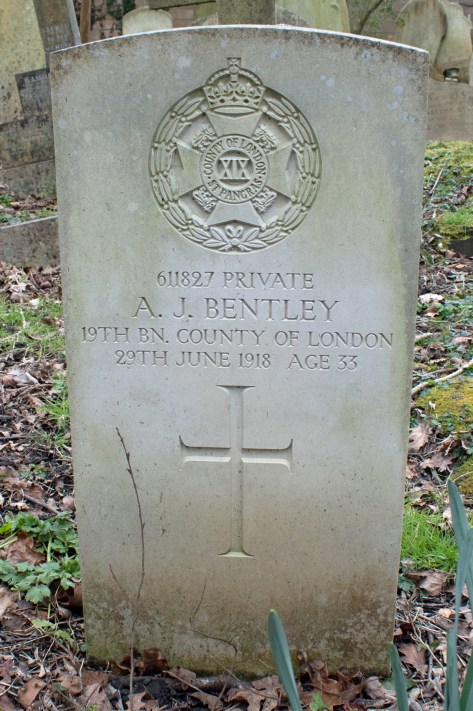
Albert John Bentley was born in St Pancras, Middlesex, in the spring of 1885. The second of six children, his parents were John and Eleanor (also known as Elizabeth) Bentley. John was a piano maker, and the family lived at 27 Hampshire Street in St Pancras.
When his father died in 1910, Albert had already started to follow in his footsteps. The following year’s census recorded him living with his mother and three younger siblings. Employed as an organ builder, his was one of three wages being brought into the household.
Albert stepped up to play his part when war broke out. Full details of his military service have been lost to time, but it is clear that he enlisted in the London Regiment, and was assigned to the 1st/19th (County of London) Battalion (St Pancras).
It is unclear whether or not Private Bentley spent any time overseas. By the summer of 1918, however, he had fallen ill, and was admitted to a military hospital in Shoreham-by-Sea, Sussex. He succumbed to a combination of influenza and pneumonia on 28th June 1918: he was 33 years of age.
The body of Albert John Bentley was taken back to Middlesex for burial. He was laid to rest in the sweeping grounds of Highgate Cemetery.
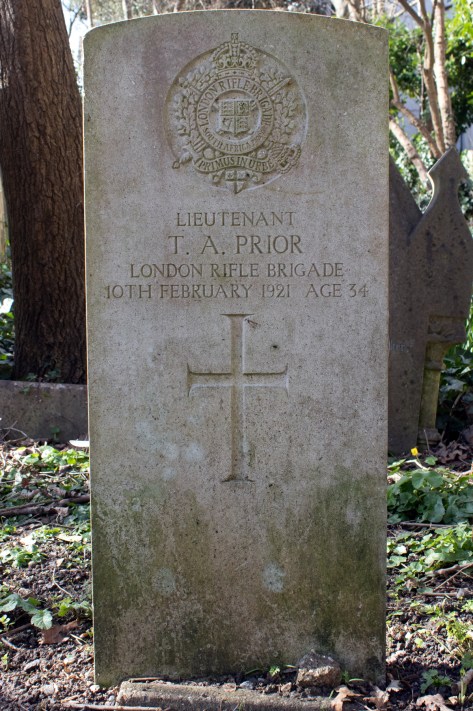
Thomas Ashley Prior was born in Islington, Middlesex, at the start of 1886. The third of seven children, he was the only son to Thomas and Ellen Prior. Thomas Sr was a colonial produce broker agent and, at the time of the 1891 census, the family were living in rooms at 115 Sussex Road.
Over the following years, the family lived together, but moved homes. By 1901 they were living at 1 Blythwood Road, Islington; ten years later they had set up home at 10 Oakfield Road, Stroud Green. By this point Thomas Sr was listed as being a rubber broker. Four of the children were employed in respectable trades: Thomas Jr as a bullion refiner’s clerk, his older sisters as a paper merchant’s clerk and a saleswoman for the court dressmaker. The youngest employed sibling, 22 year old Margaret, was also a clerk, for an estate agent. The family had a live in servant, Alice Charles, supporting them.
War rose its ugly head in 1914, and Thomas Jr stepped up to play his part. He was already a volunteer in army and, as a later military history confirms, he threw himself into a more permanent role:
PRIOR, THOMAS ASHLEY. Enlisted 1909. Served continuously and went to France with 1st Batt. Nov. 1914-May 1915 (wounded). 2nd Lieut. 28/9/15. Served in France again with 1st Batt. March-June 1916 and Nov. 1916-June 1918. Lieut. 1917. Sports. Member of Brighton March and Marathon Teams. Died 1921.
[The History of The London Rifle Brigade 1859-1919]
Thomas’ regiment – the London Rifle Brigade – was actually the 5th Battalion of the London Regiment. Based on his unit’s time abroad, it is likely what Thomas was wounded at Ypres – possibly during the Battle of St Julien. On his return to the front, he would have fought at Arras and Ypres in 1917, and at the Somme (Arras) the following year.
Lieutenant Prior’s return to Britain is not documented. HIs mother, Ellen, had died in 1912, and his father followed in 1918. The London City Directory for 1920 recorded him as living at 8 Oakfield Road, a double-fronted Victorian terrace within sight of Finsbury Park.
Thomas Ashley Prior died on 10th February 1921. Just 34 years of age, the cause of his passing is not clear. He was laid to rest in Highgate Cemetery, not far from his last recorded address.
George William John Whiteway was born in Paignton, Devon, on 4th February 1893. The youngest of three children, and the only son, his parents were William and Sarah Whiteway.
William was a journeyman painter, and from at least when his son was born, the family lived in a small terraced house, 9 Tower Road, on the outskirts of the town centre.
By the time of the 1911 census, George had completed his schooling, and was working as an apprentice painter. It is unclear whether this was under his father’s tutelage, as he gave his employment as verger and caretaker of the local parish church.
When war broke out, George stepped up to play his part. He enlisted in Torquay on 1st December 1915, and his service records note that he was of good physical development, stood 5ft 6.25ins (1.68m), and weighed 126lbs (57.2kg). He was also recorded as having light brown hair, brown eyes and a fair complexion.
Initially assigned to the Duke of Cornwall’s Light Infantry, Private Whiteway was transferred to the London Regiment and attached to the 3rd/21st Battalion. By the summer of 1916 George had transferred to the 1st/21st (County of London) Battalion, also known as the First Surrey Rifles. On 15th June his unit was sent to France, and he soon found himself in fighting on the Somme.
Private Whiteway’s time in France was to be a brief one. Caught up in the Battle of Flers-Courcelette, he was wounded in the back and neck, and, after initial treatment on site, he was medically evacuated to Britain.
It is unclear where George was first admitted, but by February 1917, he was being tended to in the Voluntary Aid Detachment Hospital in his home town, Paignton. He remained there for a couple of month, before being released back to duty.
Private Whiteway’s time fighting was over. He was transferred to the 619th Home Service Employment Company of the Labour Corps, and would spend the next year in and around Winchester, Hampshire. It is evident, however, that George’s health had been impacted. By March 1918 he was in hospital again, this time close to his army base. Suffering from a combination of peritonitis and tuberculosis, the contagious nature of the latter condition would lead to his dismissal from military service, and he was formally stood down on 29th April 1918.
At this point, George’s trail goes cold. It seems likely that he returned home, as his death was recorded in Totnes, Devon. He breathed his last on 25th August 1918: he was 25 years of age.
George William John Whiteway was laid to rest in Paignton Cemetery, a short walk from his family home.
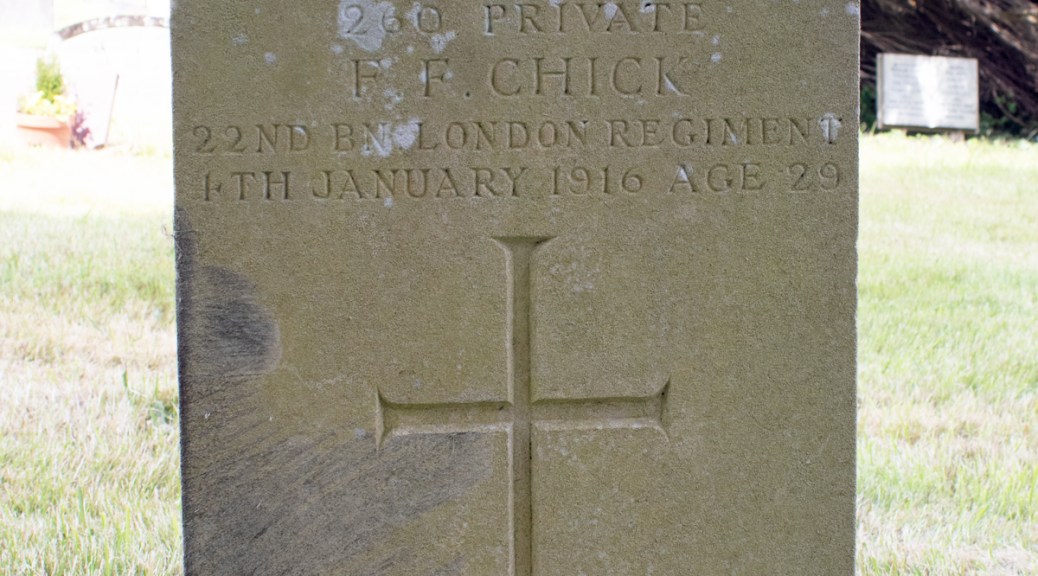
Francis Frederick Chick was born in the spring of 1886 in Axminster, Devon. One of eight children, his parents were brickmaker Edwin (or Edward) Chick and his wife, Elizabeth.
When he completed his schooling, Francis found work as a sawyer’s apprentice. However, he wanted bigger and better things and, on 19th November 1900, he enlisted in the army. At 14 years of age, he was just short of 5ft (1.52m) in height, and had fair hair, blue eyes and a fresh complexion.
Initially enlisting in the Royal Marine Light Infantry, Boy Chick was to serve three years in the naval division. The 1901 census found him based at the East Stonehouse Barracks in Devonport, Devon, where he was a Bugler.
In September 1903, Francis transferred across to the Devonshire Regiment, remaining within the band structure. He came of age in March 1904, and, as a Private, he took on the role of Drummer. By the start of 1909, his unit had moved overseas, and the next census, taken in 1911, found Private Chick billeted in St George’s Barracks in Malta.
Francis remained in Malta for three years, and moved to Egypt with his unit in January 1912. By this point, having completed nearly twelve years’ service, he elected to stay on and renewed his contract. While serving in North Africa, he completed his induction into the Camel Corps, although by the end of the year, he was back on home soil after nearly four years abroad.
At this point, Francis seems to fall off the radar. It is unclear whether his move back to Britain was because he had been placed on reserve status, or due to medical reasons. To add to the mystery, when war broke out, he did not re-join the Devonshire Regiment, but enlisted in the London Regiment instead. He was assigned to the 22nd (County of London) Battalion, but later records note a connection to the 22nd (Wessex and Welsh) Battalion of the Rifle Brigade.
Private Chick was in Buckinghamshire by the winter of 1915/16, and it was here that he became unwell. Admitted to hospital in Aylesbury, he died of pneumonia on 4th January 1916: he was 29 years of age.
The body of Francis Frederick Chick was taken back to Devon for burial. He was laid to rest in the cemetery of his home town, Axminster.
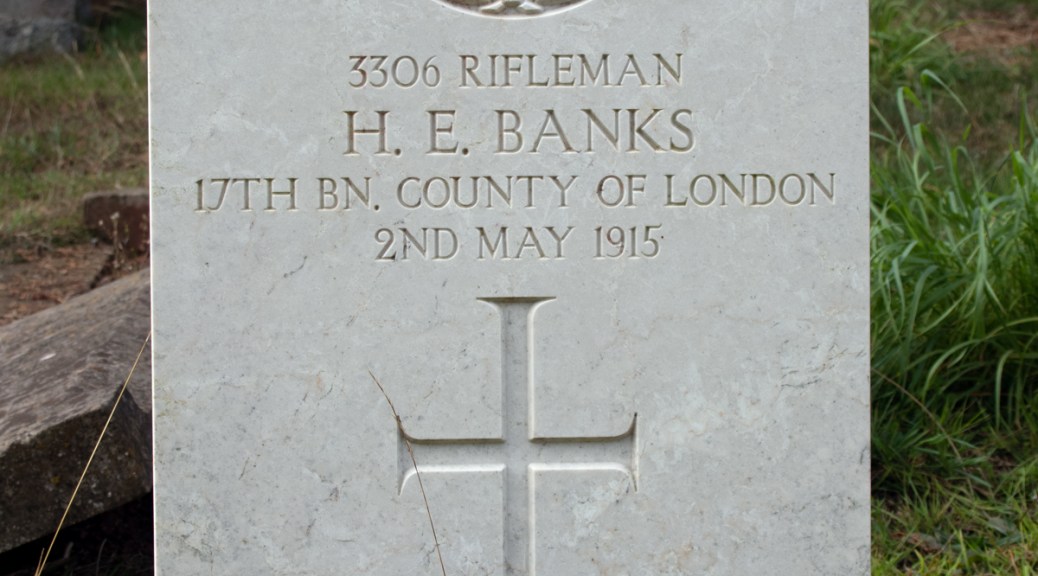
The early life of Henry Ernest Banks is destined to remain lost to time as there is little documentation available to corroborate details. The first concrete documentation for him is his marriage certificate, and this sheds lights onto the man he had become.
The wedding took place on 7th August 1905, and confirms that Henry was 19 years of age. His father was recorded as being James Banks who, by this point was deceased. He had been a chairmaker, and his son had followed in a similar type of work, being employed as a French polisher.
Henry’s bride was 19-year-old Blanche Hearnden, who was noted as being the daughter of deceased traveller William Hearnden. At the time of their marriage, the newlyweds were living at 13 Busby Street, Bethnal Green, London. Now long since gone, the road led directly to St Matthew’s Church, which is where their nuptials took place.
By the time of the 1911 census, Henry and Blanche were living with her mother in Whitechapel. They had had a child, son Ernest, the previous year, and the mixed household included Blanche’s three sisters and their children. Money must have been tight, but four members of the household were bringing in some money, Henry working as a French polisher, with two of his sisters-in-law working as a cigarette packer and a printer’s assistant. Blanche and her other sister were listed as housewives, while her mother, who was also called Blanche, was noted as being a charwoman.
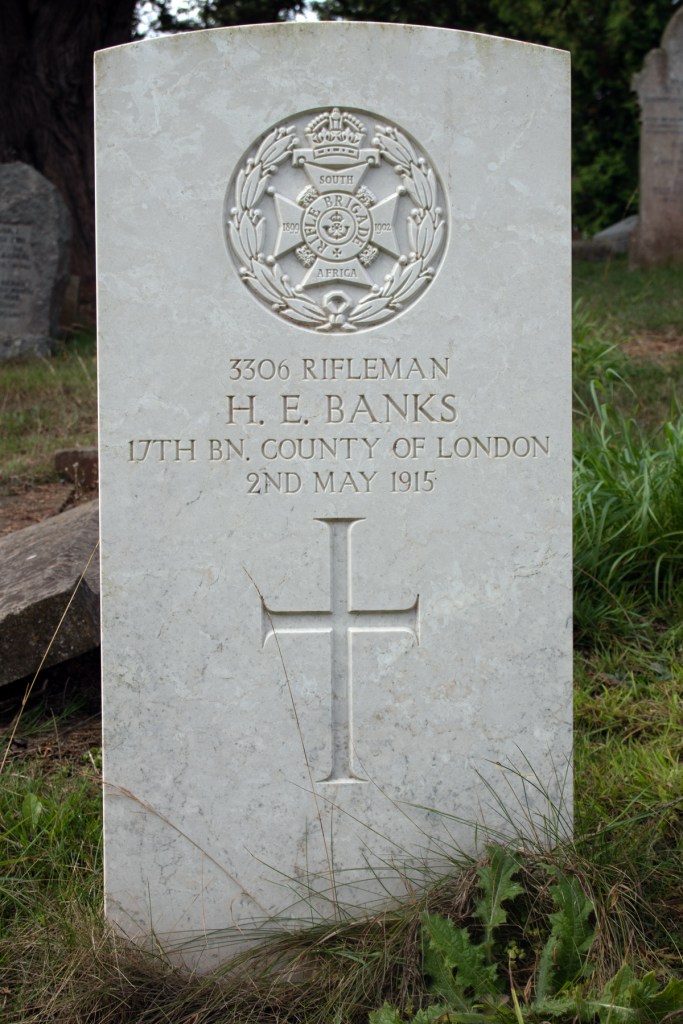
When war broke out, Henry was called upon to play his part. Details of his military service are sketchy, but it is clear that he enlisted in the London Regiment, and was attached to the 17th (County of London) Battalion, which was also known as the Poplar and Stepney Rifles.
Rifleman Banks’ unit was sent to France on 9th March 1915. Within a matter of weeks, however, he was back in the UK, and appears to have been admitted to a hospital in Paignton, Devon.
Henry died on 2nd May 1915, and one record – his entry on the Grave Registration Form – that sheds a little light on Henry’s passing. It is noted being as a result of a strangulated hernia, although this is the only document that gives any details about his death. Henry was 28 or 29 years of age.
Henry Ernest Banks was laid to rest in Paignton Cemetery, Devon.
William White was born in the autumn of 1892 in Gravesend, Kent. He was the second of eleven children to Joseph and Eleanor – or Ellen – White. Joseph was a general labourer who, by the time of the 1911 census, was employed in the local docks.
The same census recorded the family of eleven people living in four rooms at 2 Robert Street, Gravesend. In addition to Joseph, both William and his older brother, Joseph Jr, were employed as assistants for a local butcher, while the next youngest of the siblings, Edward, was working as a bootmaker’s errand boy.
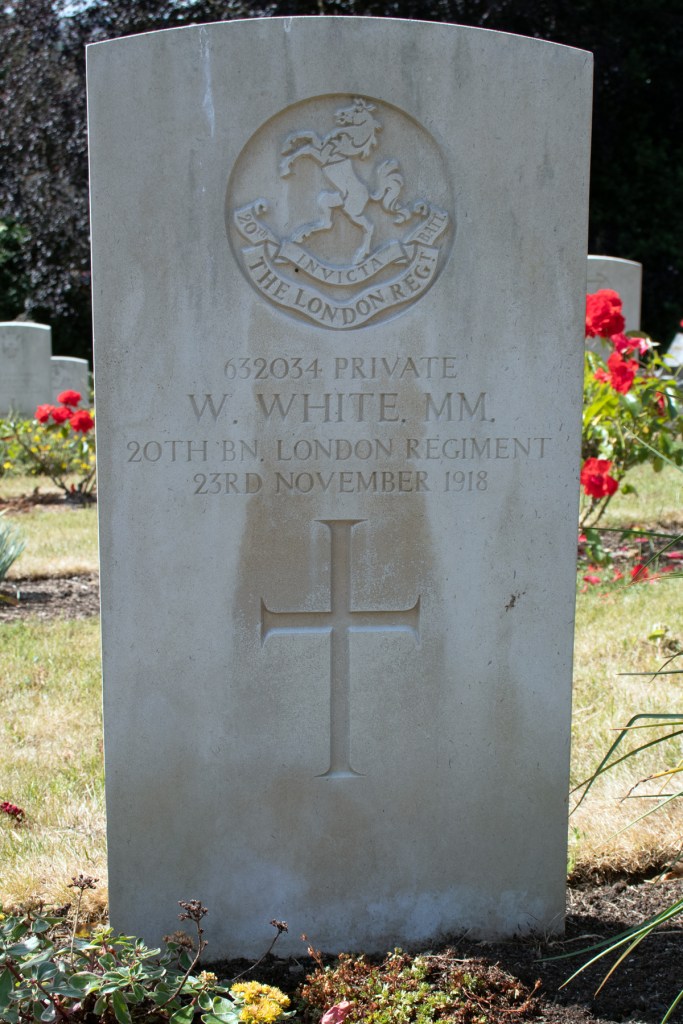
When war was declared, William stepped up to play his part. Full service details have been lost to time, but it seems that he had enlisted by the spring of 1918 at the latest. He joined the London Regiment, and was assigned to the 20th (City of London) Battalion. Private White’s unit spent the duration of the conflict on the Western Front, fighting at Loos, the Somme and Messines amongst other areas.
By the end of the war, William had been awarded the Military Medal for his bravery, although it is unclear when and for what he receive it.
The next confirmed record for Private White was his admission to hospital in Somerset, as he was suffering from pneumonia. He was sent to the Bath War Hospital, but it is unclear whether he had been on home soil when he fell ill, or if he had been medically transferred there from across the English Channel.
William White’s condition was to prove fatal. He passed away in hospital on 23rd November 1918, at the age of 26 years old. His body was laid to rest in the military section of Locksbrook Cemetery in Bath, not far from the hospital where he had breathed his last.
Conrad Thomas Bedford was born on 8th August 1891 in Bowes Park, Middlesex. The younger of two children, his parents were Thomas and Clara Bedford. Thomas was a bank clerk, who had a strong focus on education and, after his untimely death in 1899, aged just 40, Clara was keen to ensure that her only son received the best.
Conrad was educated at Seaford College in Sussex, and was boarding there at the time of the 1901 census. Whilst there, he served in the College Cadet Corps, which was attached to the Royal Sussex Engineers, and by the time he left, in 1909, he had taken the rank of Corporal.
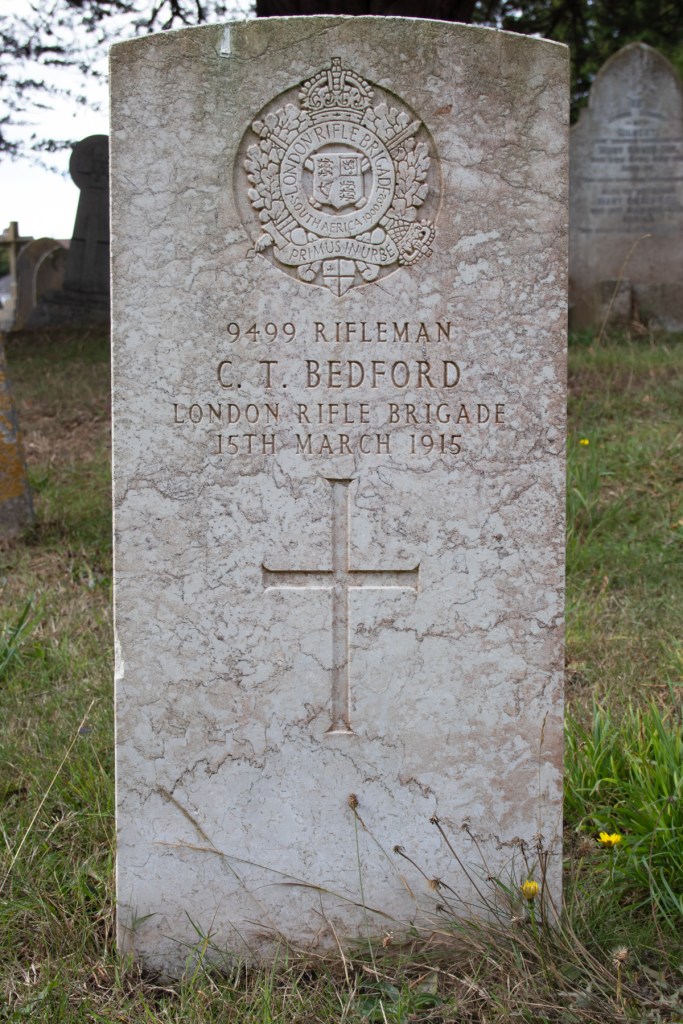
When he completed his schooling, Conrad found work as a clerk in the London Joint Stock Bank, and soon volunteered for the London Rifle Brigade. When war broke out, he willingly stepped up to serve his country, and became attached to the regiment’s 5th Battalion.
The 1/5th (City of London) Battalion (London Rifle Brigade), to give the London Regiment’s unit it’s full title, fought on the Western Front, and Rifleman Bedford arrived in the Wallonia region of Belgium on 4th November 1914.
Early in 1915, Conrad was based near Ploegsteert, when, at around 2am on 27th February, he was shot in the right shoulder. He was medically evacuated to Britain, and admitted to the American Women’s War Hospital, in Paignton, Devon. While his injury was treated, sepsis set in, and Rifleman Bedford succumbed to it: he passed away on 15th March 1915, at the age of 23 years old.
Surprisingly, Clara did not bring her son back to London, where she was living. Instead, Conrad Thomas Bedford was laid to rest in Paignton Cemetery, not far from where he had breathed his last.
Wilfrid Hinton Butler was born on 11th June 1895 in Cowley, Oxfordshire, one of four children to Alexander and Mary Butler. Alexander was a foreign stamp importer who, by 1899, had moved the family to the outskirts of Clevedon, Somerset.
The 1911 census found Alexander and Mary living in Clevedon, with Wilfrid’s two younger siblings. Wilfrid himself is missing from the document and, intriguingly, his parents are noted as having only two children: this is likely an misunderstanding over the number of children, and the number residing at home.
At this point, Wilfrid drops off the radar completely, and it is only through later documentation that we can identify what became of him. When war broke out, he joined up, enlisting in the London Regiment. Initially assigned to the 15th (County of London) Battalion (Prince of Wales’s Own Civil Service Rifles), he moved across to the 13th (County of London) Battalion (Kensington) at some point during the conflict.
Private Butler was firmly ensconced in northern France by 1916 and his unit fought in some of the bloodiest battled of the Somme. He was not to come out unscathed, however, and it is likely that he was wounded during the Battle of Morval.
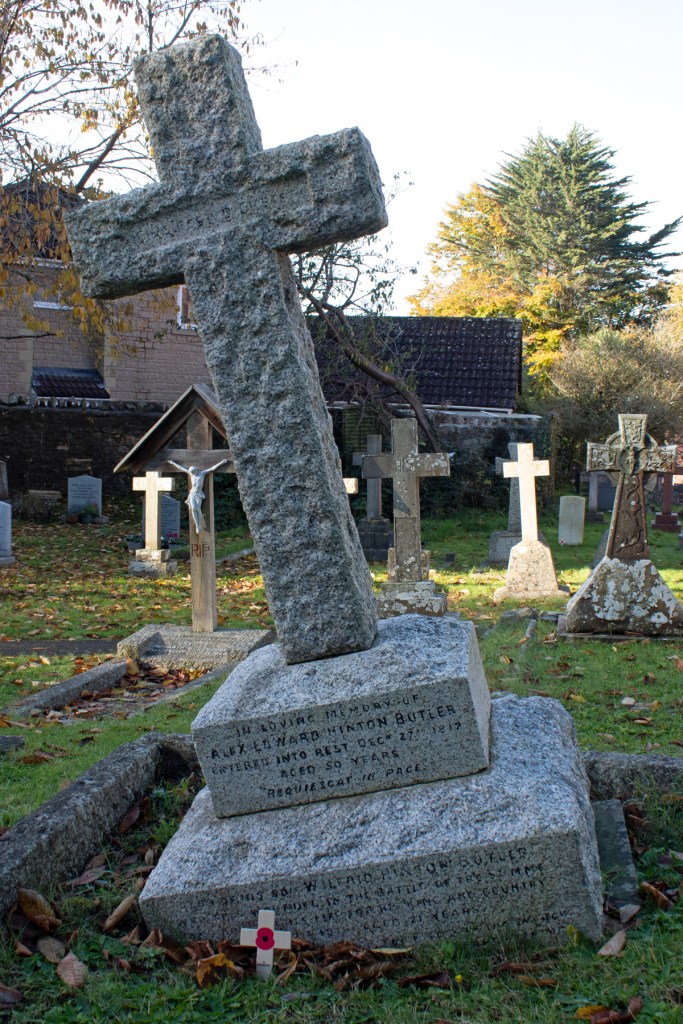
The injuries Private Butler had received were severe enough for him to be medically evacuated back to Britain for treatment. He was admitted to hospital in Kings Norton, Birmingham, but his wounds were to prove fatal. He passed away on 2nd October 1916: he was 21 years of age.
Wilfrid Hinton Butler was taken back to Somerset for burial. He was laid to rest in the graveyard of St Mary’s Church, Walton Clevedon.
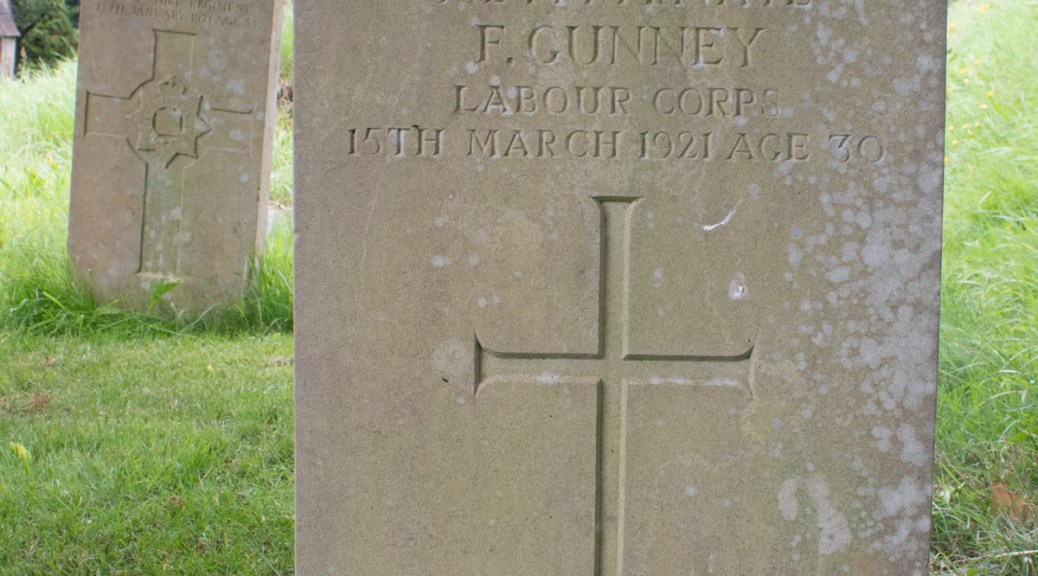
Frank Gunney was born in Brushford, Somerset, in the spring of 1890. The youngest of four children, with two sisters and a brother, his parents were William and Mary. William was a groom-turned-gardener, but when Frank left school, he found other employment: by the time of the 1911 census, he was recorded as being a tailor.
Frank’s older brother, James, followed his father’s trade, becoming a groom when he finished his schooling. His work took him to South Wales, where he met and married Emma Lewis. The couple went on to have two children: Hilda and Kenneth. When war came to Europe, James enlisted, joining the Royal Army Service Corps as a Private.
Frank followed his brother into the army, enlisting in the Somerset Light Infantry on 11th December 1915. This must have proved a tragic time for his mother, Mary, as, just ten days later, William died “after a long and painful illness.” [Western Times: Friday 24th December 1915]
Frank’s service records give little away about the man he had become, but do note that he was 5ft 5ins (1.65m) tall. He was re-assigned to the 1st/21st Battalion of the London Regiment, and was sent to France in June 1916.
Private Gunney’s service papers suggest that he was injured on 9th September 1916, having received a gun shot wound to the head. He appears to have been treated on site, and there seems to be no notable break in his time on the front line.
James was killed in action on 7th April 1917: he was 33 years of age, and was laid to rest in the Warlincourt Halte British Cemetery in Saulty. Mary had lost a husband and a son within eighteen months, and James had left a widow and two children.
In March 1917, Private Frank Gunney had transferred to the Labour Corps, and aside from a six-month period on home soil, would remain in France until September 1919. He then returned to Britain, and was demobbed a month later.
Frank returned to Somerset, but his trail then goes cold. Two documents give an idea as to what happened next, however. The first is a newspaper report about his burial:
The funeral took place in All Saints’ Churchyard, Dulverton… of Mr F Gunney, only don of Mrs Gunney… who died on Tuesday last. Deceased served three years in France, and has been in failing health practically ever since demobilisation, although the end came rather suddenly.
Western Times: Tuesday 22nd March 1921
His army Pension Ledger Card, confirms that he had been discharged from the army because of a ‘septic wound to his left thumb’, which was due to his military service. It appears that this had festered over the ensuing years: Frank Gunney passed away on 15th March 1921, aged 30 years of age.
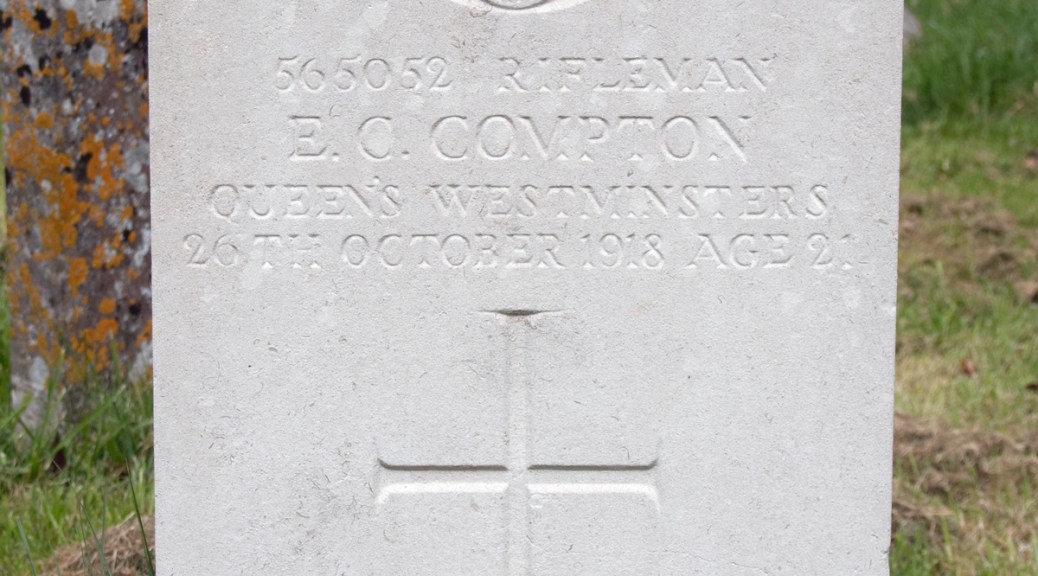
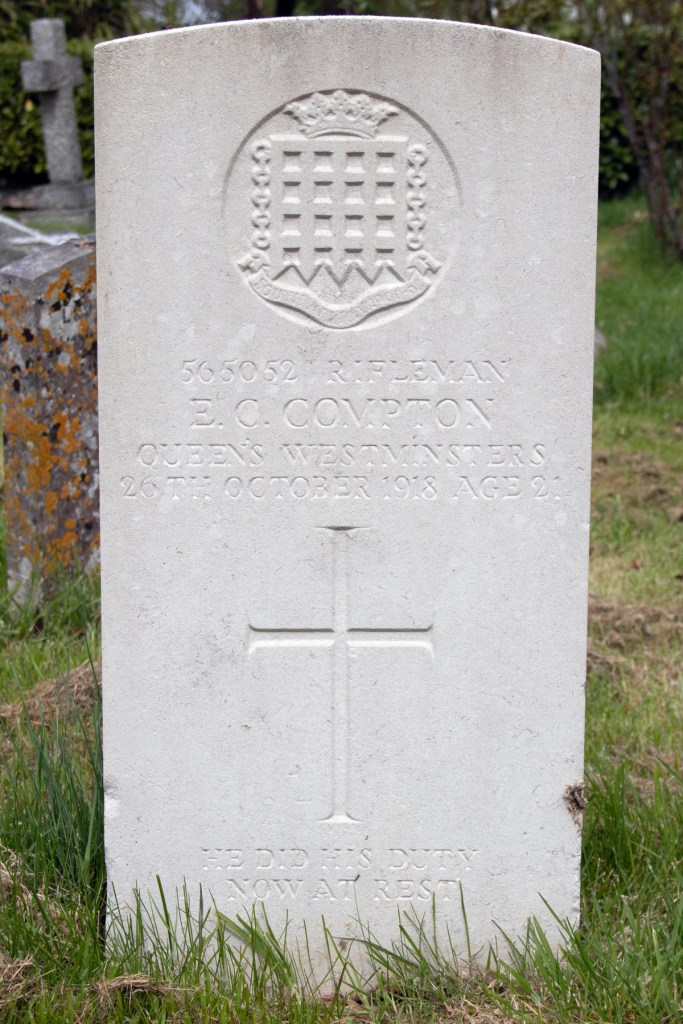
Edward Charles Compton was born in Islington, Middlesex on 4th July 1897, the only child to Charles and Ada Compton. Charles was an agent for the Prudential Insurance company, and the family lived on Devonshire Road, with Charles’ aunt, Mary.
When he finished his schooling, on 7th July 1911, Edward found work as a clerk for the North African Mission. When war came to European shores, he was eager to serve his King and Country. He enlisted on 10th September 1914, and was assigned to the 11th (Reserve) Battalion of the London Regiment.
Rifleman Compton’s service records confirm that he was 5ft 8ins (1.73m) tall, with good vision and physical development. He wasn’t formally mobilised until the summer of 1916 and, after training, he was transferred to the 16th (County of London) Battalion, also known as the Queen’s Westminster Rifles. He was sent to France on 19th December 1916.
Edward would have been involved in the German retreat to the Hindenburg Line in the spring of 1917, and the First and Third Battles of the Scarpe in April and May. At the end of July he returned to Britain and, while the reason for this is unclear, it seems that his health was suffering.
On 24th September 1917, Rifleman Compton was medically discharged from the army, after three years and fifteen days’ service. The cause for this isn’t documented, but there is no evidence that he was wounded, so it is likely to have been an illness of some description.
Edward returned to Islington and on 20th October 1918, he married Emily Backholer. She was a farmer’s daughter from Paignton, Devon, and was registered as living there when the couple’s banns were read during October.
Tragically, Edward and Emily’s marriage was not to be a long one: he died in Kelston, near Bath, Somerset, on 26th October 1918, less than a week after his wedding. He was just 21 years of age.
Edward Charles Compton was laid to rest in the graveyard of St Nicholas’ Church in Kelston, Somerset.











 Death and Service