Stanley Curtis was born on 31st October 1899, and was one of 21 children to Rowland and Sarah Curtis. Rowland was a gardener and labourer from Warminster, Wiltshire, and it was here, at 9 Marsh Street, that the family were raised.
There is little information available about Stanley’s early life: he was only two years old at the time of the 1901 census, and still at school for the next return in 1911. Later document, however, confirms that he worked as a farm labourer when he completed his schooling and that he was an active member of the Warminster Cadets.
Stanley was keen to play his part when war broke out. He enlisted in the Royal Navy as soon as he was able to, joining as a Stoker 2nd Class on 7th December 1917. His service records show that he was 5ft 4ins (1.62m) tall, with brown hair, brown eyes and a fresh complexion.
Stoker 2nd Class Curtis was sent to HMS Victory, the Royal Naval Dockyard in Portsmouth, Hampshire, for his training. After four months there he was given his first assignment, on board the protected cruiser HMS Amphitrite. Working as a minelayer, she served in the North Sea, and was positioned off Scotland when Stanley fell ill.
Stoker Curtis was disembarked in Edinburgh, and was admitted to the city’s Royal Naval Hospital with peritonitis. Sadly the condition was to prove fatal, and he passed away on 13th September 1918, a few weeks short of his 19th birthday.
The body of Stanley Curtis was brought back to Wiltshire for burial. He was laid to rest in the graveyard of Christ Church, Warminster, just a few minutes’ walk from where his grieving family lived.
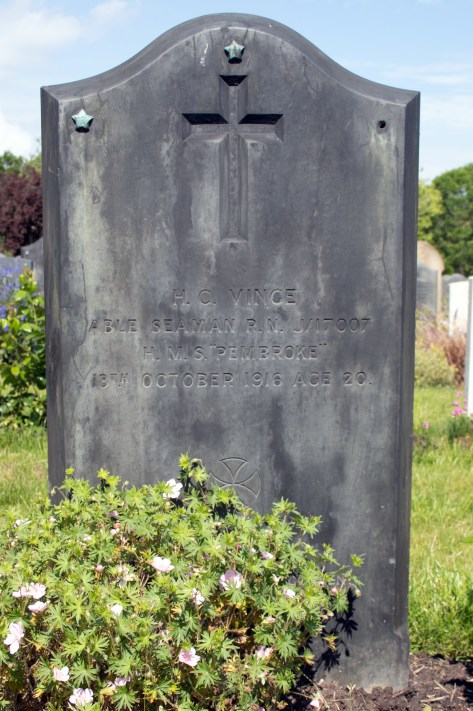
Harry Cooper Vince was born in Battersea, Surrey, on 14th January 1896. The 1901 census noted he was the son of Elizabeth Vince, a cook for barrister and solicitor Robert Purvis. The next census found Harry, Elizabeth and Elizabeth’s husband Harry, as one of four families to have taken rooms at 47 Bessborough Place, Pimlico.
Harry sought a life of adventure and, on 21st March 1912, he gave up his work as a kitchen boy to enlist in the Royal Navy as a Boy 2nd Class. He was dispatched to the training ship HMS Impregnable.
On 6th September 1912, having been promoted to Boy 1st Class, Harry was assigned to the battleship HMS Vanguard. Over the next couple of years he learnt his trade, and would come to be based out of HMS Pembroke – the Royal Naval Dockyard in Chatham, Kent – in between voyages.
Harry came of age on 14th January 1914, and was formally inducted into the Royal Navy as an Ordinary Seaman. His service records note that he was 5ft 5ins (1.65m) tall, with brown hair, blue eyes and a fresh complexion. He was also recorded as having small moles on his right buttock,
By the late spring of 1916, Harry had been assigned to the submarine depot ship HMS Bonaventure. He would remain on board for two years, during which time he was promoted to Able Seaman.
The next four months would go by in a bit of a blur for Able Seaman Vince. During this time he moved between three ships – the submarine depot ships HMS Dolphin and HMS Maidstone. The last of the three was HMS Lucia, originally the British-built steamship Spreewald, captured from the German Navy in 1914.
In September 1916, Harry was admitted to the Royal Naval Hospital in Chatham, suffering intestinal obstructions. These would prove too severe, and he succumbed to peritonitis on 13th October 1916. He was 20 years of age.
The body of Harry Cooper Vince was laid to rest in the military section of Woodlands Cemetery, Gillingham, not far from the naval base he had called home.
Interestingly, Harry’s service records not an irregularity in his name: “Registered at Somerset House in the name of Ball. Boy kept in ignorance of the fact for obvious reasons.” It would seem that Elizabeth may not have been married at the time her son was born. It also throws some potential doubt as to who his father was.
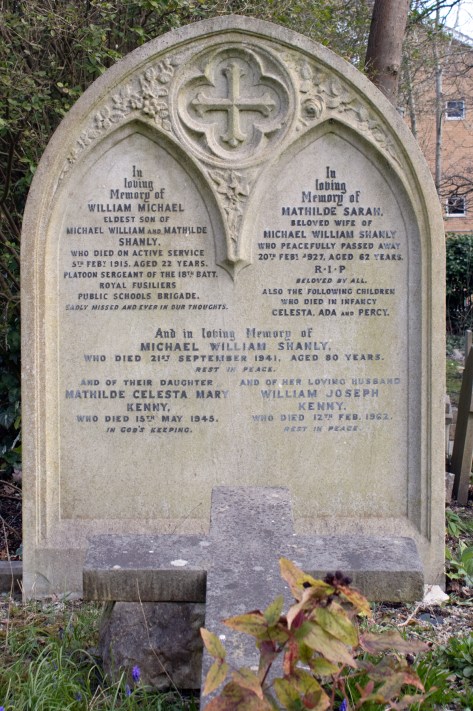
William Michael Shanly was born in Hampstead, Middlesex, in the summer of 1892. The fourth of eight children, of whom three died in infancy, he was the eldest son to Michael and Mathilde Shanly. Michael was the owner of a coffee and refreshment company.
The Shanly family lived at 78 Sumatra Road, Hampstead, but by the time he was nine years old, William had been sent to Sussex, and was boarding at the Xavarians Brothers School in Uckfield.
There is little further information available about William’s life. His epitaph on the family headstone suggests that he died on active service and was a Platoon Sergeant of the 18th Battalion of the Royal Fusiliers. His unit was also known as the 1st Public Schools, although exactly what role he held is unclear. His entry on the Commonwealth War Graves Commission Grave Index suggests that he was attached to the 15th (Reserve) Battalion, but his military records no longer exists, so it isn’t possible to confirm either way.
Serjeant Shanly died on 5th February 1915, aged 22 years of age. He had had an operation for appendicitis five days earlier, but had succumbed to peritonitis.
William Michael Shanly was laid to rest in the family plot in Highgate Cemetery, not far from where his grieving family were living.
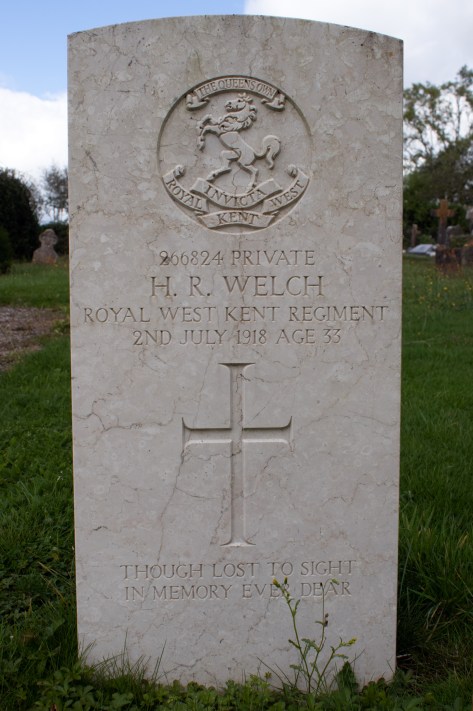
Horace Ralph Welch was born in Mere, Wiltshire, in the autumn of 1884. The middle of seven children, his parents were John and Ellen Welch. John was a silk drier, and the family lived in Water Street, close to the town centre.
John died in 1895, and Ellen was left to bring up the family on her own. Her older children found work, and Horace was employed by John Runtz, stock broker and Justice of the Peace. The family lived at 131 Lordship Road, Stoke Newington and employed two live-in servants other than Horace, who worked as a page.
On 11th November 1916, Horace married Beatrice Batchelor. Born in Watford, Hertfordshire, she was the daughter of an engine driver and, at the point she exchanged vows, she was working as an assistant in a boot shop. Horace was now employed as a butler, and the couple set up home in Watford. They went on to have a daughter, Eileen, in the summer of 1917.
By this point, Horace has stepped up to play his part in the conflict that was raging across Europe. He enlisted on 12th December 1916 – just four weeks after marrying Beatrice – and was initially assigned to the Kent Cycle Corps.
Private Welch would spend the best part of two years on home soil, before being shipped off to France in April 1918. By now he had been transferred to the Queen’s Own (Royal West Kent Regiment).
Horace was only overseas for a matter of a fortnight, before he became unwell. Medically evacuated to Britain for treatment, he was admitted to the Voluntary Aid Detachment Hospital in his home town, Mere. Suffering from appendicitis, he was operated on, but died from peritonitis soon afterwards. Private Welch passed away on 2nd July 1918: he was 33 years of age.
Horace Ralph Welch was laid to rest in Mere Cemetery, on the outskirts of the town.
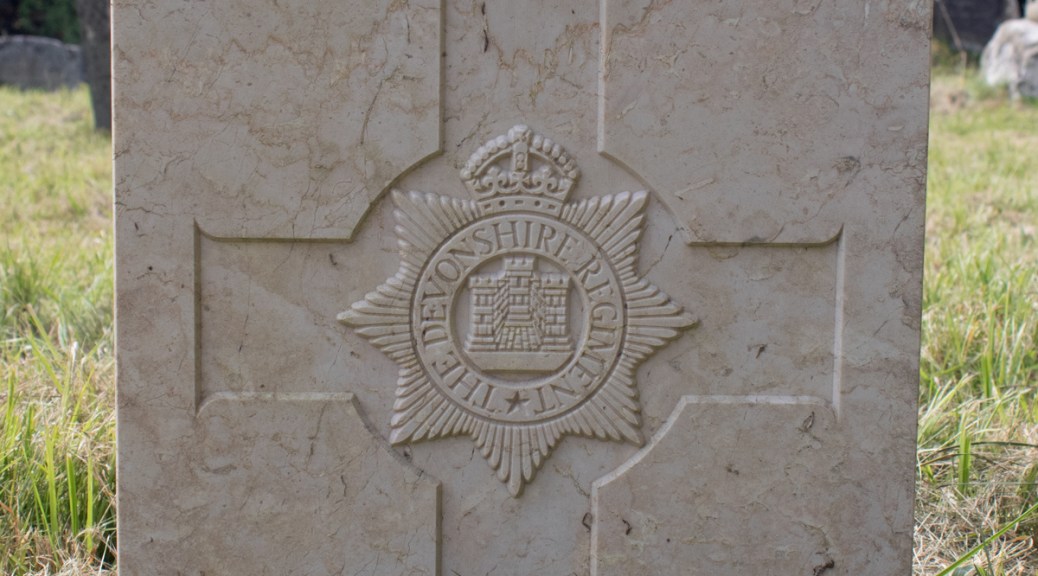
It was with painful regret that the inhabitants of Bratton Fleming heard of the death of Private Havelock Webber… who passed away at Hursley, near Winchester, on Tuesday in last week. On being called to the Colours a few weeks ago, he was attached to the 3/6th Devons. Previous to joining up he followed the occupation of a tailor, and was also a part-time postman. Deceased was well-known and highly respected. He was closely connected with every movement at the Village Hall, and was a member of the Committee of Management.
[North Devon Journal: Thursday 11th May 1916]
Havelock Webber was born in Bratton Fleming early in 1878. There is no information available for his parents, but the 1891 census recorded him as living with his paternal grandparents, George and Grace Webber. At 13 years old, Havelock was already learning the tailoring trade.
Havelock doesn’t appear in the 1901 census, and the 1911 return gives little information away either. At this point he is boarding in a house with either the Bale or Musworthy family (his is a separate record, with those two families adjoining his).
Beyond this, there is little information available about Private Webber’s life or military service. He died from peritonitis on 2nd May 1916 in the Hampshire Camp. He was 38 years of age.
Havelock Webber’s body was brought back to Devon for burial. He was laid to rest in the graveyard of St Peter’s Church in his home village of Bratton Fleming, Devon.
George William John Whiteway was born in Paignton, Devon, on 4th February 1893. The youngest of three children, and the only son, his parents were William and Sarah Whiteway.
William was a journeyman painter, and from at least when his son was born, the family lived in a small terraced house, 9 Tower Road, on the outskirts of the town centre.
By the time of the 1911 census, George had completed his schooling, and was working as an apprentice painter. It is unclear whether this was under his father’s tutelage, as he gave his employment as verger and caretaker of the local parish church.
When war broke out, George stepped up to play his part. He enlisted in Torquay on 1st December 1915, and his service records note that he was of good physical development, stood 5ft 6.25ins (1.68m), and weighed 126lbs (57.2kg). He was also recorded as having light brown hair, brown eyes and a fair complexion.
Initially assigned to the Duke of Cornwall’s Light Infantry, Private Whiteway was transferred to the London Regiment and attached to the 3rd/21st Battalion. By the summer of 1916 George had transferred to the 1st/21st (County of London) Battalion, also known as the First Surrey Rifles. On 15th June his unit was sent to France, and he soon found himself in fighting on the Somme.
Private Whiteway’s time in France was to be a brief one. Caught up in the Battle of Flers-Courcelette, he was wounded in the back and neck, and, after initial treatment on site, he was medically evacuated to Britain.
It is unclear where George was first admitted, but by February 1917, he was being tended to in the Voluntary Aid Detachment Hospital in his home town, Paignton. He remained there for a couple of month, before being released back to duty.
Private Whiteway’s time fighting was over. He was transferred to the 619th Home Service Employment Company of the Labour Corps, and would spend the next year in and around Winchester, Hampshire. It is evident, however, that George’s health had been impacted. By March 1918 he was in hospital again, this time close to his army base. Suffering from a combination of peritonitis and tuberculosis, the contagious nature of the latter condition would lead to his dismissal from military service, and he was formally stood down on 29th April 1918.
At this point, George’s trail goes cold. It seems likely that he returned home, as his death was recorded in Totnes, Devon. He breathed his last on 25th August 1918: he was 25 years of age.
George William John Whiteway was laid to rest in Paignton Cemetery, a short walk from his family home.
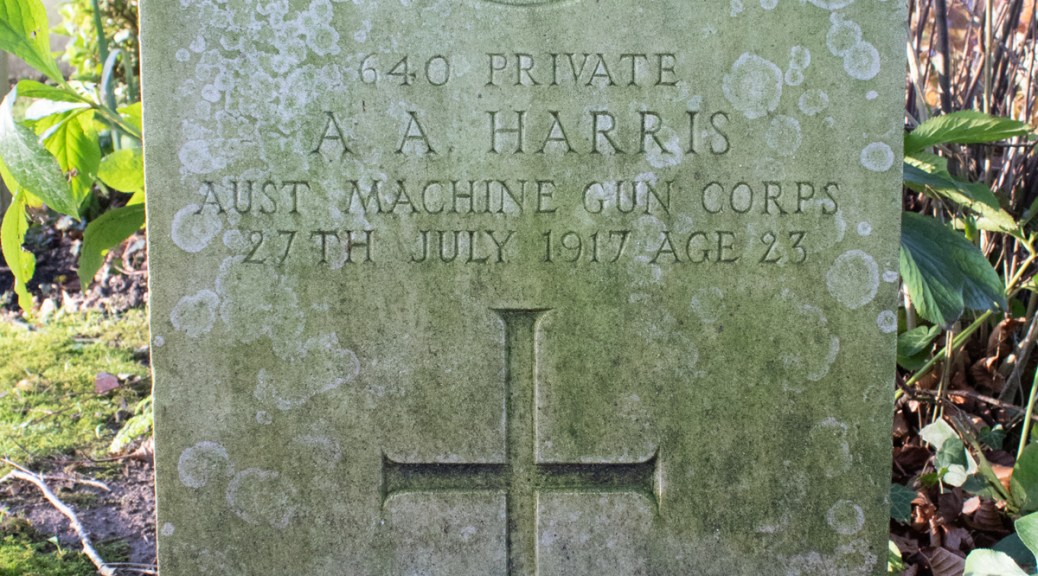
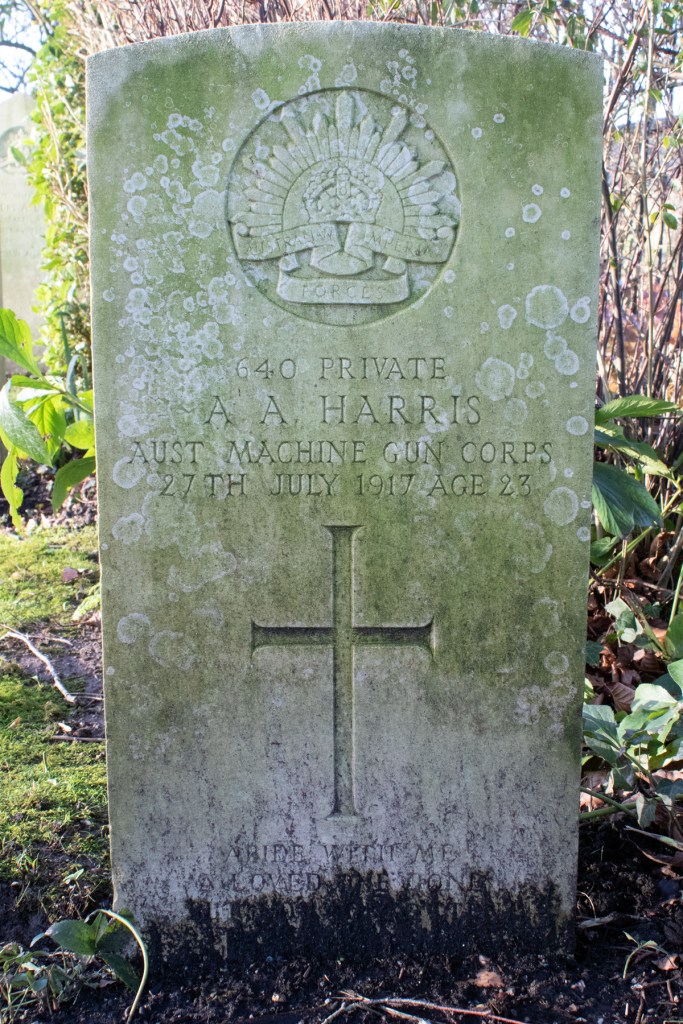
Albert Arthur Harris was born on 14th December 1893 in Huon, Tasmania, Australia. The second of seven children – and the oldest son – his parents were Arthur and Eliza.
There is little information available about Albert’s early life. When he finished his schooling, he found work as an orchardist, and this was his line of work when, on 12th April 1916, he stepped up to serve his King and Empire.
Albert joined the Australian Imperial Force, and his records suggest that he had tried to enlist before, but had been turned down because of varicose veins. His medical report confirms that he was 6ft (1.83m) tall and weighed 155lbs (70.3kg). He had fair hair, blue eyes and a fair complexion.
Private Harris set sail from Australia on 11th May 1917, arriving in Plymouth, Devon, two months later. He was billeted near Codford in Wiltshire, and assigned to the Australian Machine Gun Corps.
Albert’s time in Britain was to be brief. While in camp, he came down with peritonitis, and hospitalised. He developed septicaemia, and died on 27th July 1917: he was just 23 years of age.
Albert Arthur Harris was laid to rest in the newly extended graveyard of St Mary’s Church in Codford.
William Stringer was born in Warlingham, Surrey, on 4th December 1885, and was one of nine children to Stephen and Jane Stringer. Stephen was a carter, but is seems that William wanted an escape.
On 18th April 1901, he enlisted in the Royal Navy and, because of his age, he was granted the rank of Boy 2nd Class. He was initially sent to HMS Impregnable, the school ship, and remained there for just over a year, during which his hard work paid off and he was promoted to Boy 1st Class.
His basic training complete, and after a short stint at HMS Vivid, the Royal Naval Dockyard at Devonport, he was assigned to HMS Collingwood. Over the next couple of years, William served on a couple more vessels and, in 1903, when he came of age, he was formally inducted into the navy, and given the rank of Ordinary Seaman.
William’s service records show that he was 5ft 4ins (1.63m) tall, had auburn hair, brown eyes and a fresh complexion. For distinguishing marks, he was noted as having two dots on his left forearm and scars on his legs.
Now that he was tied to a twelve year contract, Ordinary Seaman Stringer’s seems to have viewed his life in a different light. His ‘very good’ conduct quickly changed to ‘fair’ and, at the end of 1904, he spent two separate stints in the cells, presumably because of his attitude or behaviour.
This shock to the system seems to have been what William needed, however, as in 1905, he took to the new role, and his ratings improved once more. Over the next couple of years, he served on HMS Montagu and HMS Diamond, returning to Devonport in between voyages. In January 1907 he was promoted again, this time to Able Seaman, but, as with the previous promotion, things began to go downhill again.
In March, he spent two weeks in Diamond’s brig, a punishment that was repeated in September. The following month Able Seaman Stringer’s service records not his character as ‘indifferent’ and, the following month he was discharged from the Royal Navy, having refused to work for 42 days.
It was while he was serving on board HMS Diamond that William met Lena Cropp, who was presumably working in one of the ports on the South Coast. She was the daughter of labourer Jesse Cropp and his wife, Philadelphia. When Jesse died in 1897, Philadelphia married bricklayer James Smith, who had boarded with the family for a number of years.
William and Lena had a son, Joseph, on Christmas Day 1907. Now removed from the Navy, William moved his young family back to Surrey, where he found work as a cowman, and Lena took in laundry to bring in an extra income. The couple went on to marry in 1911, and went on to have two further children – Elsie, who was born in 1912, but who died when just a toddler; and Gladys, who was born in the summer of 1918.
When war closed in on Europe, something of a sense of duty must have pulled on William. He enlisted in the summer of 1915, joining the East Surrey Regiment. He seems to have quickly transferred across to the Labour Corps, and arrived in France on 15th July.
It is unclear for how long Private Stringer served in France, but at some point he returned to Britain. In October 1918, he was admitted to the War Hospital in Bath, suffering from stomach problems. His health was to prove his undoing, and he passed away from a biliary calculi peritonitis on 8th October 1918, at the age of 34 years of age.
Finances may have been tight for Lena, as William was buried in the city where he died, rather than being brought back to Surrey, where she was living. Because of this, it is unlikely that he ever met his daughter, who had been born just two months before.
William Stringer was laid to rest in the Roman Catholic Cemetery in Bath.
William’s Pension Ledger notes Lena as his widow, but only mentions one child – Joseph – as a dependent. The document also records him as an illegitimate stepchild, as he had been born a couple of years before the couple married.
The record notes that it, while Joseph’s legitimacy meant he was not eligible for a share of his William’s pension, it had been decided that the basic rate should be provided while he remained in Lena’s care.









 Death and Service