Tag Archives: Petty Officer

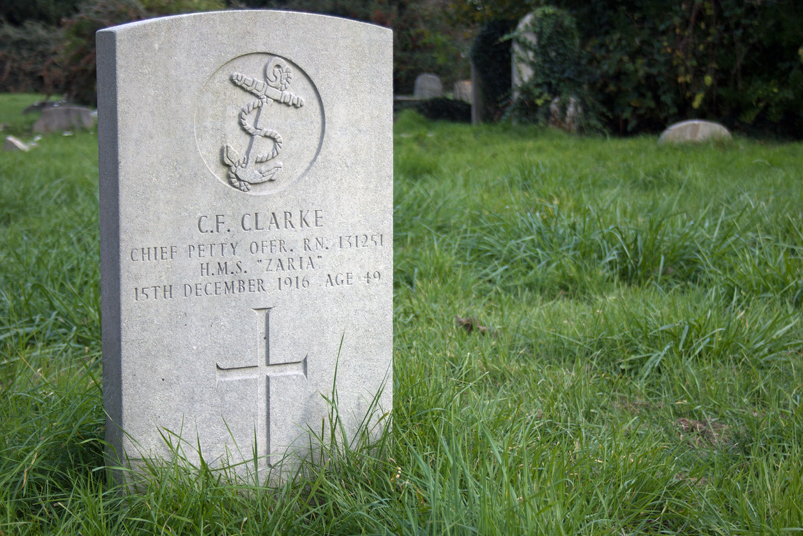
Chief Petty Officer Charles Clarke

Chief Petty Officer Charles Clarke

Charles Frederick Clarke was born on the 14th April 1869 to James and Jane Clarke. James was born in Suffolk, but moved to London, where he found work as a watchman (guarding the city streets at night). Jane was from Essex, and the couple went on to have five children, of whom Charles was the middle child.

Charles was set on a life of adventure, joining the Royal Navy in 1887, for a period of twelve years. During this time, he served on eleven vessels, working his way up through the ranks from Boy to Ordinary Seaman to Able Seaman, Leading Seaman and eventually Petty Officer.

In October 1895, he married Lydia Rogers, a sailor’s daughter from Portsmouth. The couple would go on to have nine children, eventually settling in Sussex.

When his naval service ended in 1899, Charles enlisted again. Within six years, he had achieved the rank of Chief Petty Officer, and in March 1909, after 22 years’ service, retired from active duty. He was obviously well respected, however, and was selected to serve on the staff of the Royal Naval Recruiting Office in Portsmouth. His service records suggest that he resigned from this role on 14th April 1914.

It seems that Chief Petty Office Clarke took on a role on the vessel HMS Zaria. This was a ship that was requisitioned by the Royal Navy, which acted as a patrol ship, guarding the coastal waters around the UK. While details are scant, Charles certainly served on board for a couple of years, and he died on board, from causes undisclosed, on 16th December 1916, at the age of 47 years old.

Brought back to West Sussex, Charles Frederick Clarke was laid to rest in the Broadwater Cemetery in Worthing. This was where Lydia was now living; she was buried in the same grave, when she passed away eight years after her husband.

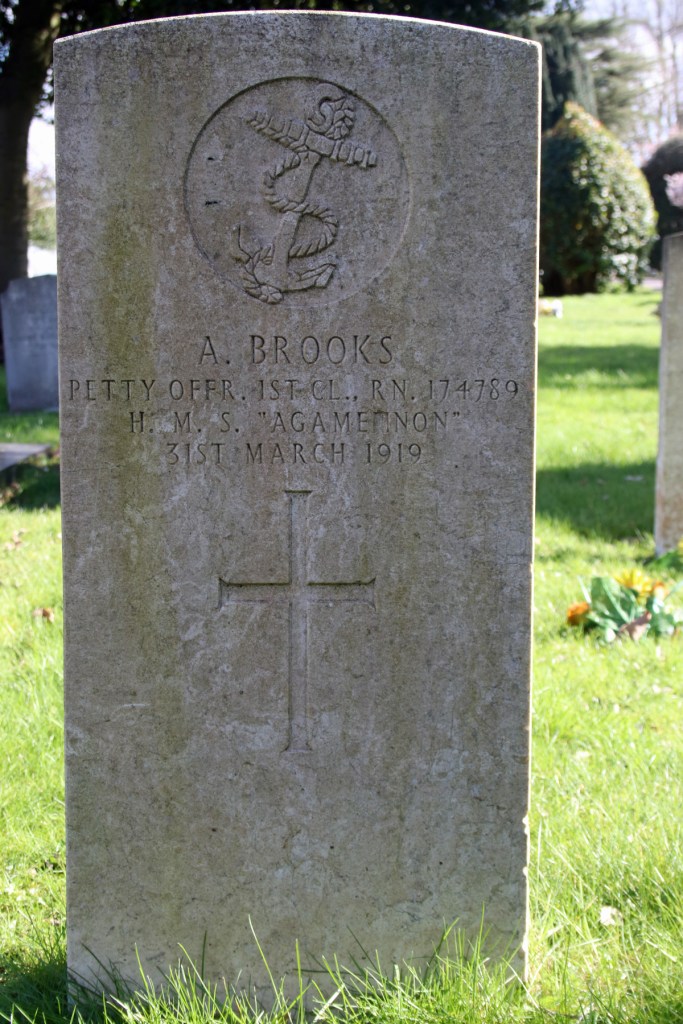
Petty Officer 1st Class Albert Brooks

Petty Officer Albert Brooks

Albert Brooks was born in February 1877 in Cambridge. Sadly, a lot of the documentation for his early life is lost to time, but he enlisted in the Royal Navy in July 1893, at the rank of Boy 2nd Class.

He formally enrolled in naval service in February 1895, initially for a period of twelve years. Beginning as an Ordinary Seaman aboard HMS Thunderer, during his initial time in the navy, he was promoted to Able Seaman and then Petty Officer 2nd Class, while serving on vessels including Hawke, Wildfire, Eclipse and Vernon.

In 1904, Albert married Rosina Wise. A couple of years younger than her new husband, she had been born in Camberwell, South London. The couple had a daughter, Gwendoline, and they set up home in Gillingham, Kent, where Albert was based when not at sea.

War was on the horizon, however, and Petty Officer Brooks’ naval service was extended until the end of the conflict.

Albert was promoted to Petty Officer 1st Class, and continued his service on vessels that included Andromache, London and Hibernia. He transferred to what would be his final ship, HMS Agamemnon, in November 1917.

Petty Officer Brooks served aboard Agamemnon for eighteen months, but it was while stationed at the Naval Dockyard in Chatham that he fell ill. He passed away from aortic disease of the heart – more than likely a heart attack or cardiac arrest – on 31st March 1919. He had just turned 42 years of age.

Albert Brooks lies at rest in the Woodlands Cemetery in Gillingham, Kent.


Sergeant Christopher Faulkner

Sergeant Christopher Faulkner

Christopher William Thomas Faulkner was born in 1881, one of five children to William and Harriet Faulkner. There is little information about Christopher’s early life, but the 1891 census shows him living with his mother and siblings in the St George’s Barracks in St Martin in the Fields in central London. William is not listed, so it can only be assumed that he was away on duty when the census was completed.

Christopher attended the military school; his record confirms that he was born on 17th June 1881, and spent four months at the school when he was ten years old. William is listed as a Sergeant and the family were living at the St George’s Barracks, which were located in the site now occupied by the National Portrait Gallery.

The military life was indelibly in Christopher’s life by this point. Whilst the records are sparse, he had certainly enlisted by the time he was 25. On Boxing Day 1904 he married a woman called Essie Brant, the daughter of a tailor from Croydon.

On the marriage certificate, Christopher was listed as a Lance Corporal in the Royal Marine Light Infantry and was based at the barracks in Chatham, Kent.

The young couple went on to have four children together and, by 1911, Essie was living in Gillingham, not far from the naval base in Chatham. The majority of Christopher’s career was served here, although when war broke out, he also saw conflict overseas.

By 1916, he was promoted to Sergeant and was assigned to HMS Dominion, which patrolled the North Sea. Ill health must have taken hold, however, and by the end of 1917, Sergeant Faulkner was reassigned to Chatham, before being medically discharged at the beginning of the following year.

Sadly, there is no record of the cause of his release from duty, but it appears to have been something to which he would eventually succumb. The next record is of Sergeant Faulkner’s death, on 5th January 1920, at the age of 39 years old.

Christopher William Thomas Faulkner lies at rest in the Woodlands Cemetery in Gillingham, Kent.


Christopher’s grave also acts as a memorial to his son.

Leslie Albert Gerald Faulkner was born on 9th June 1910. On leaving school, he sought military service like his father, and enlisted in the Royal Navy for a period of twelve years’ service.

Unusually, details of his service appear to end after just three years, in January 1929. However, later records confirm that he continued to serve at HMS Pembroke, the on-shore vessel in Chatham, through to the Second World War, achieving the rank of Chief Petty Officer.

Chief Perry Officer Faulkner’s military records did thrown up some further information, though. Surprisingly, his death records give specific details of the cause of his passing, stating that it was a “rupture of the liver due to secondary neoplasm of the liver, due to primary seminoma of testis”. In effect, Leslie had suffered testicular cancer, which then spread to his liver.

Leslie Albert Gerald Faulkner died on 28th November 1945, at the age of just 35 years old. He was buried in the same grave as his father, in Woodlands Cemetery, Gillingham.


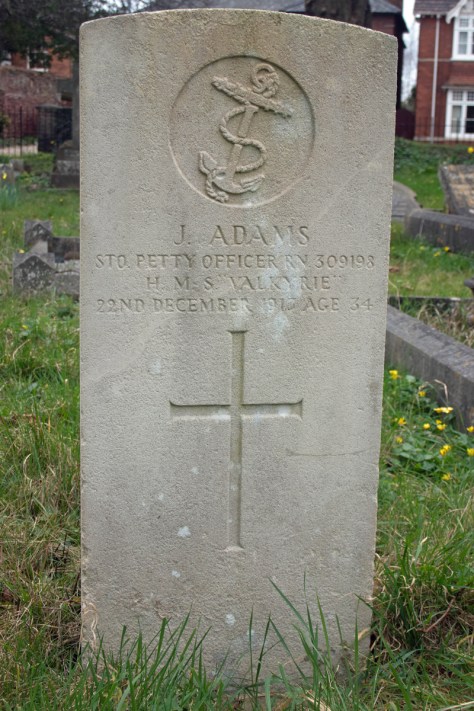
Petty Officer Stoker James Adams

Petty Office Stoker James Adams

James Adams was born in June 1883, son of Robert and Eliza Adams from Bridgwater in Somerset. Robert was an agricultural labourer; James was one of seven children.

James was keen to get out and see the world. In November 1905 – aged just 12 years old – he enlisted in the Royal Navy as a stoker. After training in Devonport, Plymouth, Stoker Adams served on a number of different vessels, including HMS Victorious, Ramillies, Amphitrite, Monmouth, Andromeda and Halcyon.

By the time war broke out, James has been promoted to Leading Stoker, and was assigned to HMS Cornwall. This was an armoured cruiser that was involved in the Battle of the Falklands in December 1914.

Promoted to Stoker Petty Officer in October 1915, James continued to serve on HMS Cornwall until he was transferred to the brand new ship, HMS Valkyrie. The vessel was involved in offensive sweeps and convoy escorts based out of Harwich.

On 22nd December 1917, the Valkyrie was part of the escort for a convoy travelling to the Netherlands, when she struck a mine. In total, nineteen men were killed, twelve instantly; this included Stoker Petty Officer Adams. He was 34 years old.

James Adams lies at rest in the Wembdon Road Cemetery in his home town of Bridgwater.


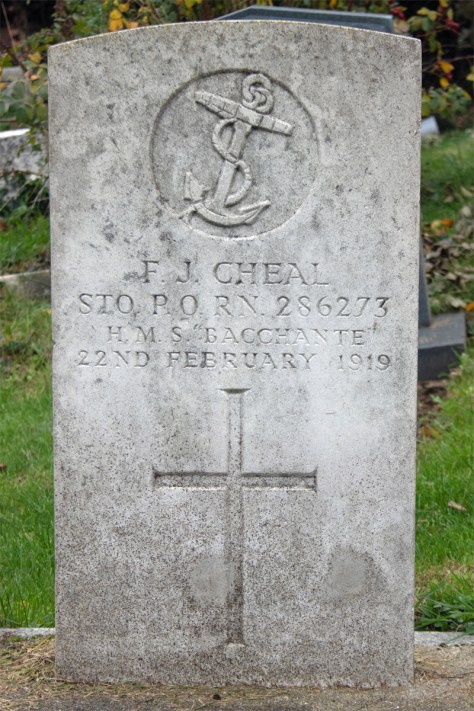
Petty Officer Stoker Frederick Cheal

Petty Officer Stoker Frederick Cheal

Frederick James Cheal was born in Reigate, Surrey in July 1880. One of six children, his father Francis was an agricultural labourer and cowman, while his mother Ann looked after their children.

While born in the landlocked Home Counties, Frederick appeared to be drawn to a life on the open seas. He enlisted in the Royal Navy on 26th October 1897, for a period of 12 years.

Stoker Cheal served his time on a number of vessels over that time, ships with names like Hannibal, Warrior and Furious. Having completed his service, Frederick was discharged on 28th October 1910.

Frederick’s wanderlust remained, though, and it appears that his discharge was more of transfer. He immediately enrolled in the fledgling Canadian Navy for a period of five years, dividing his time between land-based instruction and service on the HMS Niobe.

War broke out, and Stoker Cheal’s service was extended beyond the initial five-year term. Again, rather than his service coming to an end, he transferred back to the Royal Navy in August 1916.

Promoted, Petty Officer Stoker Cheal was assigned to the HMS Bacchante, an armoured cruiser that served as an escort to the British convoys off the African coast.

Frederick was admitted to the Royal Naval Hospital in Chatham, Kent, in early 1919 with influenza and pneumonia. He passed away on 22nd February, aged 38.

He lies at rest in the graveyard of St Margaret’s Church in Rainham, Kent.


Here is where a mystery lies. There is no discernible link between Frederick Cheal and Rainham, other than that is where his widow lives.

A lot of Rose Anne Cheal’s life is sadly lost to time. There are no marriage records to link her to Frederick, and I have been unable to identify her maiden name or whether she was even English (the couple could easily have met during Frederick’s time in Canada).

From her later records, it is evident that she lived in Rainham, just around the corner from the church where her husband is buried. The 1939 register confirms that she was a couple of years older than Frederick; she was born on Christmas Eve 1878. The register also confirms that the couple had two children, Francis, who was born in 1914, and Kathleen, born two years later.

Some mysteries are not meant to be solved; Frederick lived a full life on the open seas, spending 22 years serving two navies. He died in the same way as many other returning soldiers and sailors, a victim of the Spanish Flu pandemic. He left a wife and two young children, a sad tale repeated countless times across the continent.