William Reginald Hunt was born in the Somerset village of Butcombe on 14th September 1900. The youngest of six children, his parents were farmers Walter and Bertha Hunt.
Little information about William – who was known in the family as Reggie – is available. He was still at school at the time of the 1911 census and enlisted in the army in the summer of 1918. His service papers no longer exist, and his life in between these points is lost to time.
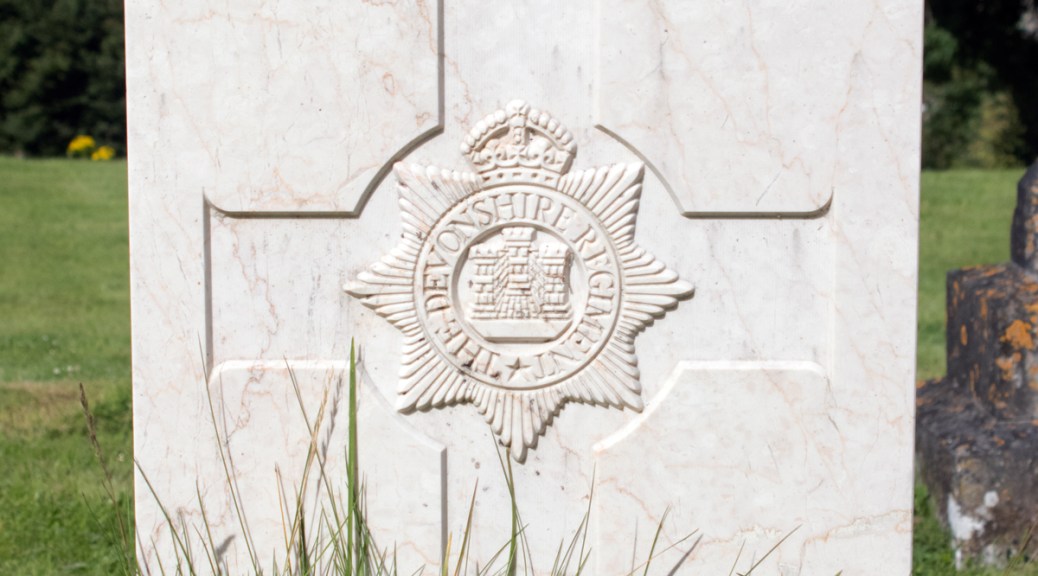
Private Hunt joined the Devonshire Regiment, and was attached to the 53rd (Young Soldier) Battalion. He was based at Rolleston Camp in Wiltshire and, while billeted there, in the cramped and overcrowded conditions of the army barracks, he contracted pneumonia.
William was admitted to the camp’s hospital, but the condition was to prove too much. He passed away on 23rd November 1918, aged just eighteen years old.
The body of William Reginald Hunt was brought back to Somerset for burial. He was laid to rest in the graveyard of St Michael’s Church, in his home village of Butcombe.
Albert Sharp was born in Rugeley, Staffordshire, in the summer of 1894. One of six children, his parents were George, who was a house painter, and Janet Sharp. When he left school, Albert found work as a bricklayer’s labourer, but, when war was declared, he sought a new adventure.
Albert enlisted in the army on 21st February 1916. Assigned to the North Staffordshire Regiment, he was initially attached to the 5th Battalion. His medical records show that Private Sharp was 5ft 6ins (1.6m) tall, and weighed 122lbs (553kg).
By November 1916, Albert found himself in France. Unusually, his life over the next couple of years is pretty well documented. His battalion saw action at the Hindenburg Line, the Third Battles of Ypres, Cambrai and the Third Battles of the Somme, but Private Sharp’s service records shed more light onto his life than simply where he fought.
Albert seems to have been a bit of a character, and this got him into trouble on more than one occasion. On 9th November 1916, he was confined to barracks for two days, for having untidy bedding and no towel on his bed. The following day, he was punished with another two days’ confinement for not attending his battalion’s role call.
On 18th December 1916, Private Sharp found himself in trouble again. This time, he was confined to barracks for five days for appearing dirty on parade, and committing a nuisance. Four days later, Albert was admitted to the camp hospital for reasons that are unclear. He returned to his unit just under a week later.
At the end of February 1917, Private Sharp transferred to the 31st Light Railway Operating Company of the Royal Engineers. He remained with the battalion for just under a year, although again his time there was not without incident. On 31st August 1917, Albert was confined to barracks for seven days for being absent from parade. The same punishment was meted out for the same offence on 8th January 1918.
Later that month, Private Sharp re-joined the North Staffordshire Regiment, and was this time attached to the 9th Battalion. He remained on the Western Front and was caught up in some of the fiercest fighting of the closing months of the conflict.
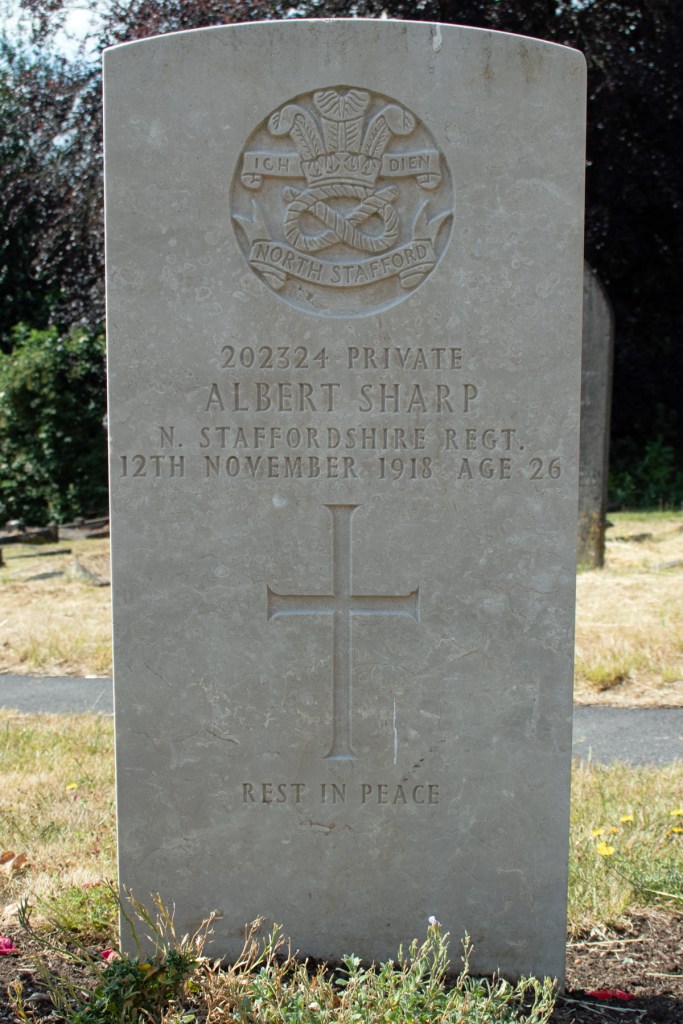
On 12th May 1918, Albert was caught up in a gas attack. Seriously injured, he was medically evacuated to Britain for treatment and admitted to the Bath War Hospital on 29th May. The next six months saw a slow and steady decline in his health. He passed away at 5:45am on 12th November 1918, the day after the Armistice was signed, from a combination of pneumonia and emphysema that was directly attributable to his injuries in France. Albert was 24 years of age.
It seems likely that Albert’s family were unable to pay for his body to be taken back to Staffordshire for burial. His service records give only his mother, Janet, as a next of kin, so it would seem that George had passed away by the time Albert enlisted. For some reason, however, while the British Register of Army Effects note that Private Sharp has effects to the value of £39 10s (£2250 in today’s money), this amount does not appear to have been paid. Janet passed away in the early 1920s, and Albert’s brother continued to try and obtain this gratuity on her behalf, but seems to have been unsuccessful.
Albert’s family did get his belongings when he died, however, which came to a postal order for 2s (around £3 today), 50 French centimes, a leather purse, two combs, two jack knives, a razor, a shaving brush, a toothbrush, two briar pipes and a pouch of tobacco, a nickel cigarette case, a text book, a wallet containing his pay book, his cap badge and six letters.
Unable to afford to bring Albert Sharp’s body back to his home town, he was, instead, laid to rest in the sweeping vista of Bath’s Locksbrook Cemetery, not far from the hospital in which he had breathed his last.
Charles Herbert Dyer was born in the Somerset village of West Monkton in the spring of 1890. One of eight children, his parents were farm labourer Charles Dyer and his wife Mary.
By the time of the 1911 census, Charles Jr had set out on his own, settling in Briton Ferry, near Port Talbot, Glamorganshire. He found work as a gardener and, from this point on, he went by his middle name, Herbert.
Over the next few years, Herbert continued his employment in Wales, although he did make a move to Newport, Monmouthshire. When war came to Britain, Herbert stepped up to serve King and Country, enlisting in the South Wales Borderers on 10th January 1916. Less than two weeks later, he married Ethel May Andrews, in All Saints’ Church, Newport.
Private Dyer was formally mobilised on 2nd March 1916. His service records show that he was 5ft 10ins (1.78m) tall and weighed 141lbs (64kg). Details of his service are a little scrambled, but it appears that Herbert was initially assigned to the 3rd (Reserve) Battalion, and remained on home soil throughout the conflict.
Herbert was based in Bottesford, Leicestershire, in December 1916, where he was put on report and docked 14 days’ pay for being absent from his post, and refusing to obey a superior’s order. Six months later, he had moved camp, and was confined to barracks for two weeks, and docked two days’ pay for being absent without leave for a day and ten hours.
By the summer of 1918, Herbert had transferred across to the Royal Engineers where, with the rank of Pioneer, he was assigned to the 15th Anti-Aircraft Company. Full details of his time in his new regiment have been lost, but he was certainly based in Essex as the war came to a close.
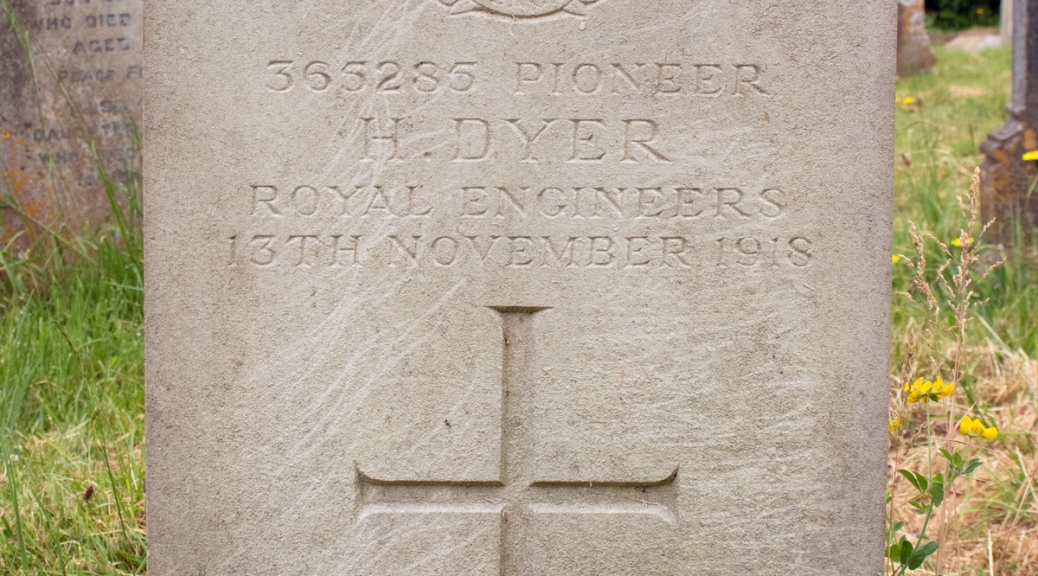
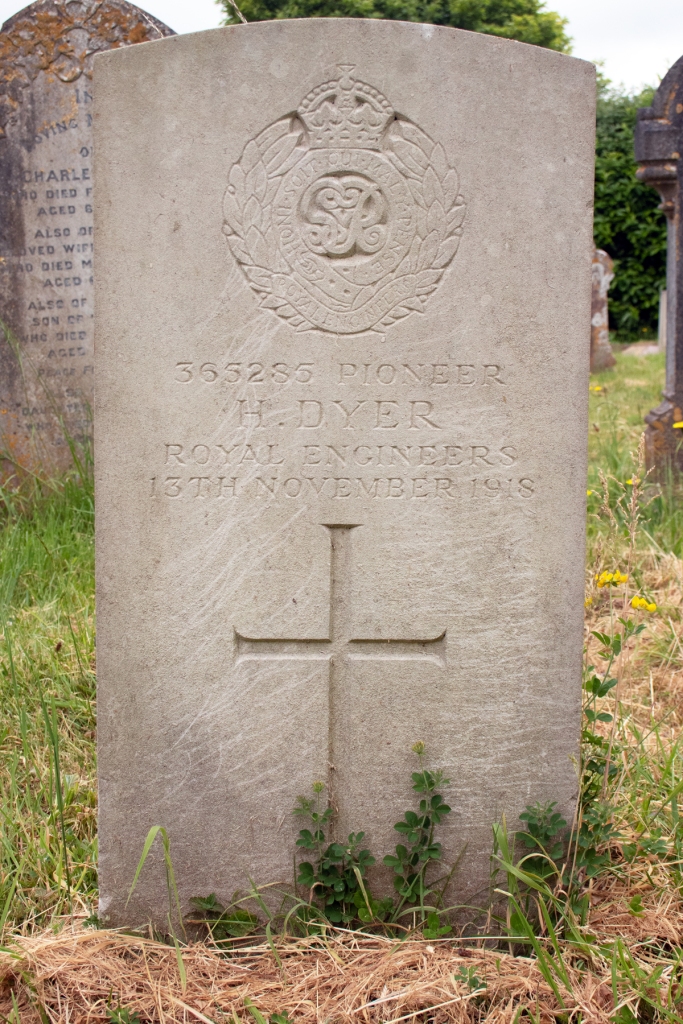
Pioneer Dyer’s health was, however, beginning to suffer by this point. He had a bout of influenza, which developed into pneumonia. He was admitted to the Warley Military Hospital in Brentwood, on 10th November 1918, but, by this point, his body had seemingly had enough. He passed away at 11:20am on 13th November 1918, at the age of 28 years old.
The body of Herbert Dyer was brought back to Somerset for burial. Ethel had moved in with her in-laws in West Monkton by this point, and was a couple of months’ pregnant. Herbert was laid to rest in the peaceful graveyard of St Augustine’s Church. His son – who Ethel named Herbert – was born on 6th June 1919, never to know his father.
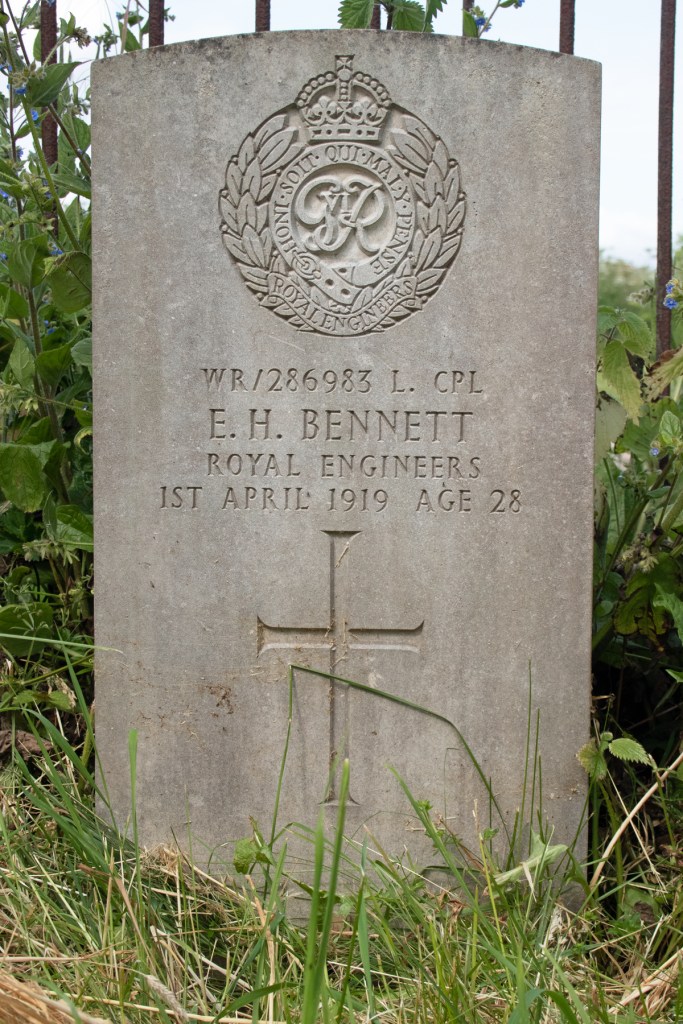
Ernest Harry Bennett was born in the summer of 1890, he third of ten children to Harry and Caroline – or Carrie – Bennett. Harry was a journeyman mason from the Devon village of Chagford, and this is where the Bennett family were raised.
When he finished his education, Ernest found work as a general labourer, and it this work that likely took him across the border to Somerset. He found work as a platelayer for the Great Western Railway in Taunton, and settled in Rowbarton, to the north west of the town.
On 28th September 1912, Ernest married Gertrude Alice Bennett in her local parish church, St George’s in Ruishton. A few months later, the couple had a son, Frederick, and almost exactly two years later, a daughter, Gladys, was born.
By this point, war was raging across Europe, and in July 1915, Ernest received the notice to enlist. Assigned to the Royal Engineers, he was attached to the 53rd Railway Company, probably to make use of his civilian trade. By the end of 1915, Ernest found himself in Egypt, and remained there for the rest of the war.
In July 1918, the now Lance Corporal Bennett was posted to the Railway Operating Division, but continued his service in North Africa. On 8th March 1919, he sailed from Port Said, heading back to Britain to be demobbed.
Returning to Somerset, Ernest fell ill, contracting pneumonia, probably on the journey home. He was admitted to the Taunton Military Hospital, but passed away from the condition just ten days after reaching England’s shores, on 1st April 1919. He was just 28 years of age.
The body of Ernest Harry Bennett was laid to rest in the graveyard extension to St George’s Church in Ruishton, not far from where his widow and children lived.
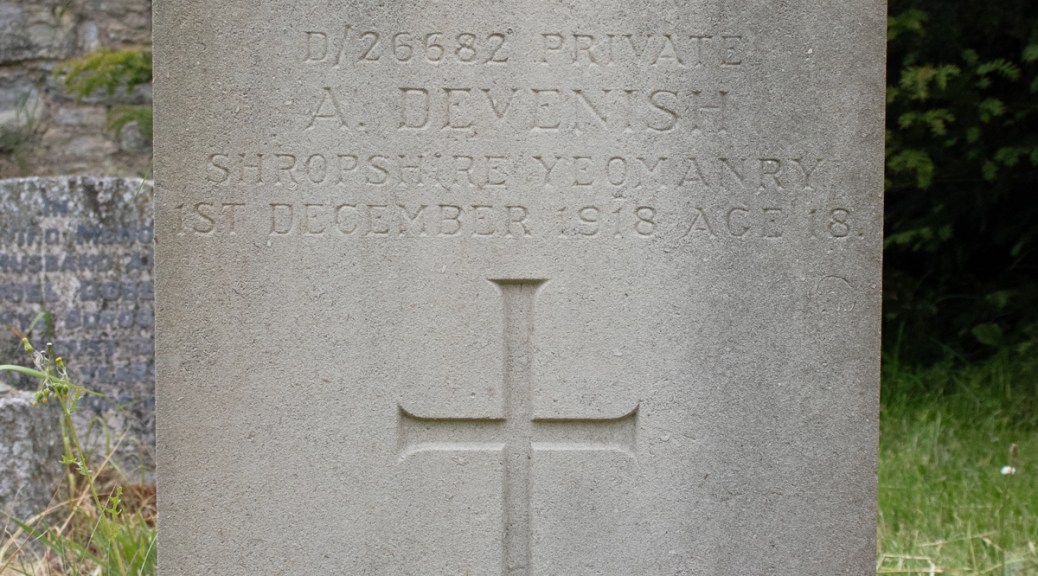
Arthur John Walderow Devenish was born in the spring of 1900, and was the oldest of ten children. His parents, John and Ada Devenish, were both born in Maiden Newton, Dorset, and this is where Arthur and his younger sibling Albert were born. By 1905, however, plumber and glazier John had moved the family thirty miles north-west, across the Somerset border to the village of Thurlbear.
There is little concrete information about young Arthur’s life. When war broke out, he was too young to enlist, but had definitely joined up by the spring of 1918, presumably as soon as he came of age. Private Devenish was assigned to the 2nd/1st Battalion of the Shropshire Yeomanry. The troop remained on home soil, and, by the time Arthur enlisted, was a cyclist unit, based in Northumberland.
Early in 1918, Private Devenish’s battalion moved to County Kildare, Southern Ireland. He was billeted in barracks in Curragh Camp, and remained there for the rest of the conflict. Tightly packed accommodation was a breeding ground for a range of illnesses and, by November 1918, Arthur had contracted pneumonia. He was admitted to the camp hospital for treatment, but the condition was to get the better of him, and he passed away there on 1st December 1918, aged just 18 years of age.
The body of Arthur John Walderow Devenish was brought back to Somerset for burial. He was laid to rest in the quiet graveyard of St Michael’s Church, in Orchard Portman, not far from where the family lived in neighbouring Thurlbear.
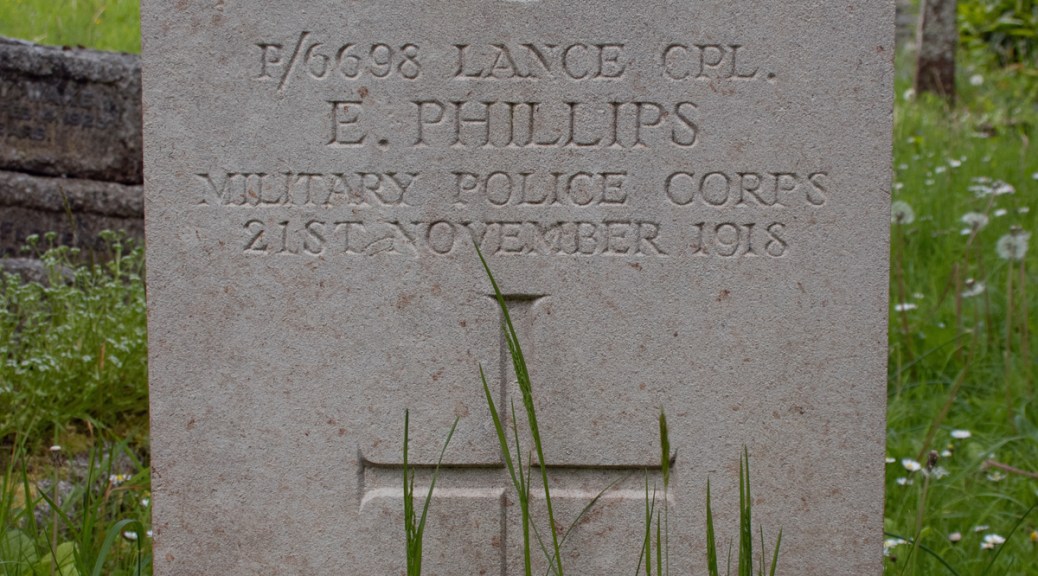
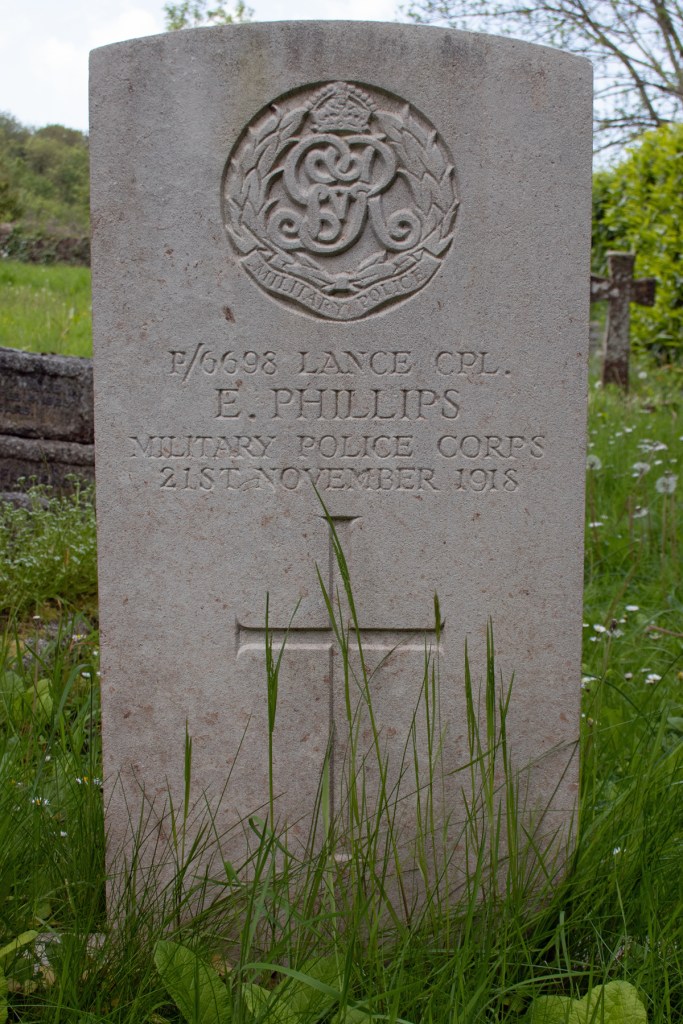
Ernest Algernon Phillips was born at the start of 1879 in the Somerset village of Winscombe. One of nine children, his parents were Arthur and Elizabeth Phillips. Arthur was a gardener, and Ernest followed suit when he finished his schooling.
By the time of the 1911 census, he was boarding with his younger sister Rose and her family – brother-in-law Leonard and nephew Leslie. Just a couple of weeks later, on 11th May 1911, Ernest married Winifred Carey. She was a coachman’s daughter from Winscombe, and the couple set up home in a cottage on the outskirts of the village.
When war broke out, Ernest felt a need to play his part. He enlisted in Bristol on 8th December 1915, but was not formally mobilised until the following June. Initially assigned to the Devonshire Regiment, he was transferred to the Worcestershire Regiment and attached to the 6th Battalion.
Private Phillips’ troop was based on home soil, and he was barracked in the garrison in Harwich, Essex, for the next six months. On 31st January 1917, he was transferred to the Military Police Corps, and given the rank of Acting Lance Corporal. Full details of his service from this point on are lost to time, but it is clear that he remained on home soil until the end of the war.
By November 1918, Ernest had fallen ill. He was admitted to the Queen Alexandra Military Hospital in London on 20th November, suffering from pneumonia. Within a matter of hours, while this seemed to have cleared, his pulse was ‘rapid, irregular and compressible.’ He was medicated, but did not respond to treatment, and passed away the following day. His death was noted as apparently being caused by clots of blood in the heart, but, at the request of his family, no postmortem examination was carried out. He was 39 years of age.
Ernest Algernon Phillips was brought back to Somerset for burial. He was laid to rest in the quiet graveyard of St James the Great Church in Winscombe.
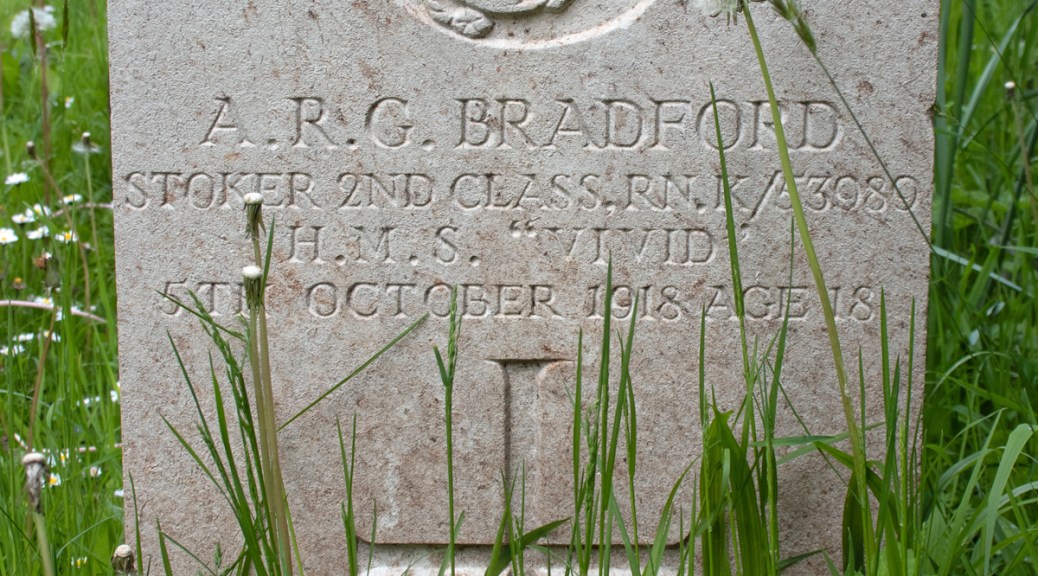
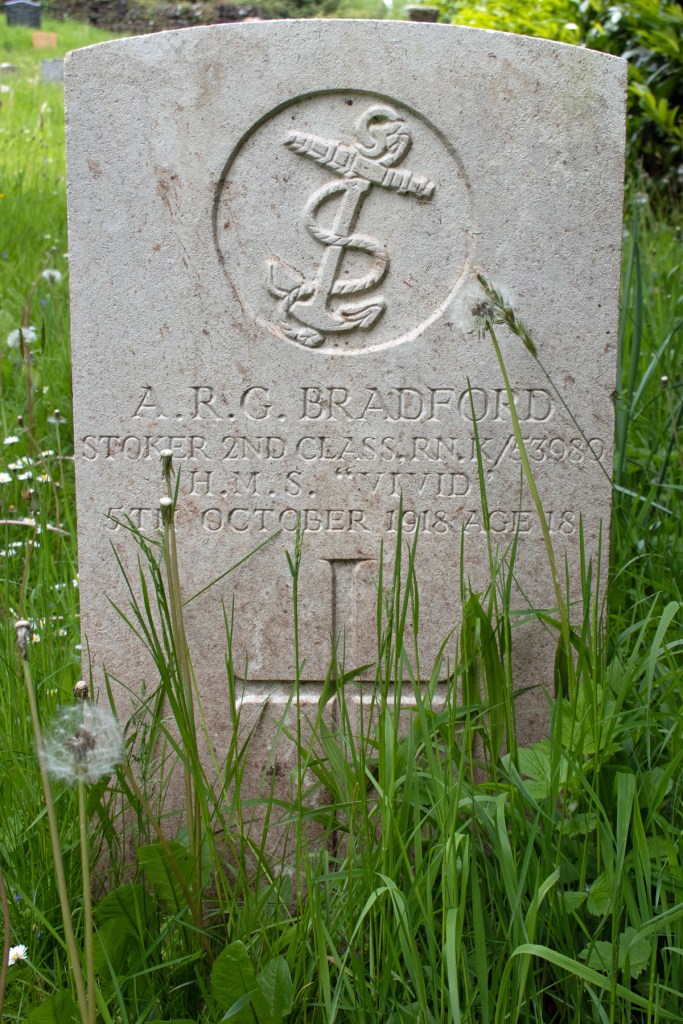
Arthur Redvers George Bradford was born in the Somerset village of Winscombe on 16th September 1900. He was second of six children to George Bradford, who was a postman, and his wife, Louisa.
When he finished his schooling, Arthur found work as a carter. War was raging across Europe by this point, however, and he was evidently keen not to miss out on the excitement. On 18th September 1918, just two days after his 18th birthday, he enlisted in the Royal Navy.
Stoker 2nd Class Bradford was noted as being 5ft 3.5ins (1.61m) tall, with brown hair, grey eyes and a fresh complexion. He was sent to HMS Vivid, the Royal Naval Dockyard in Devonport, for training, but his time there was to be tragically short.
Cramped barracks prove to be the perfect breeding ground for illness, and in early October 1918, influenza and pneumonia were rife. Around a dozen of Stoker Bradford’s colleagues died from the diseases in the time he was at the base, and, on 5th October 1918, he too was to succumb to them. He was just eighteen years old, and had been in the Royal Navy for just 17 days.
The body of Arthur Redvers George Bradford was brought back to Somerset for burial. He was laid to rest in the quiet graveyard of St James the Great Church in his home village of Winscombe.
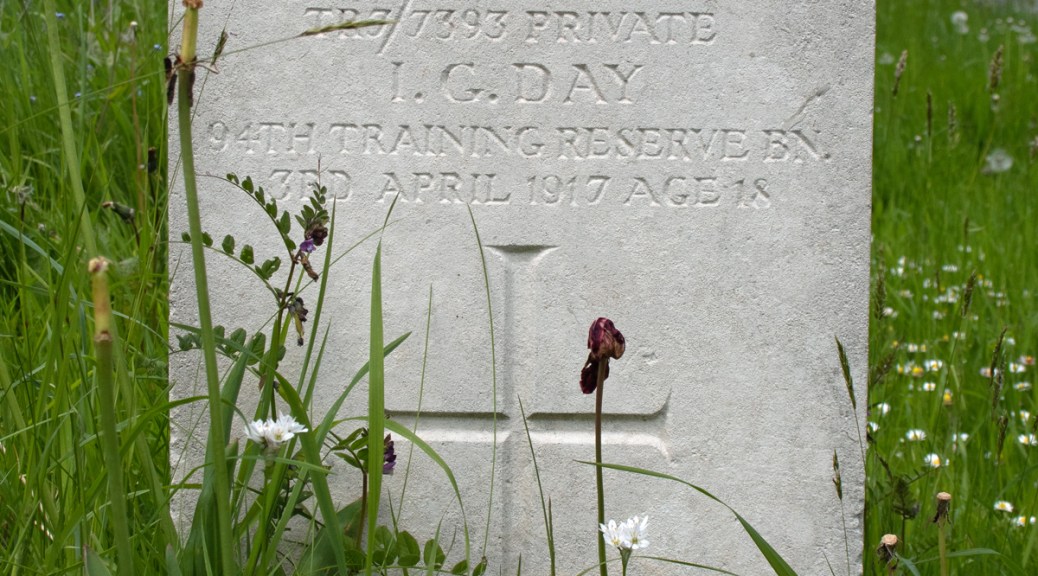
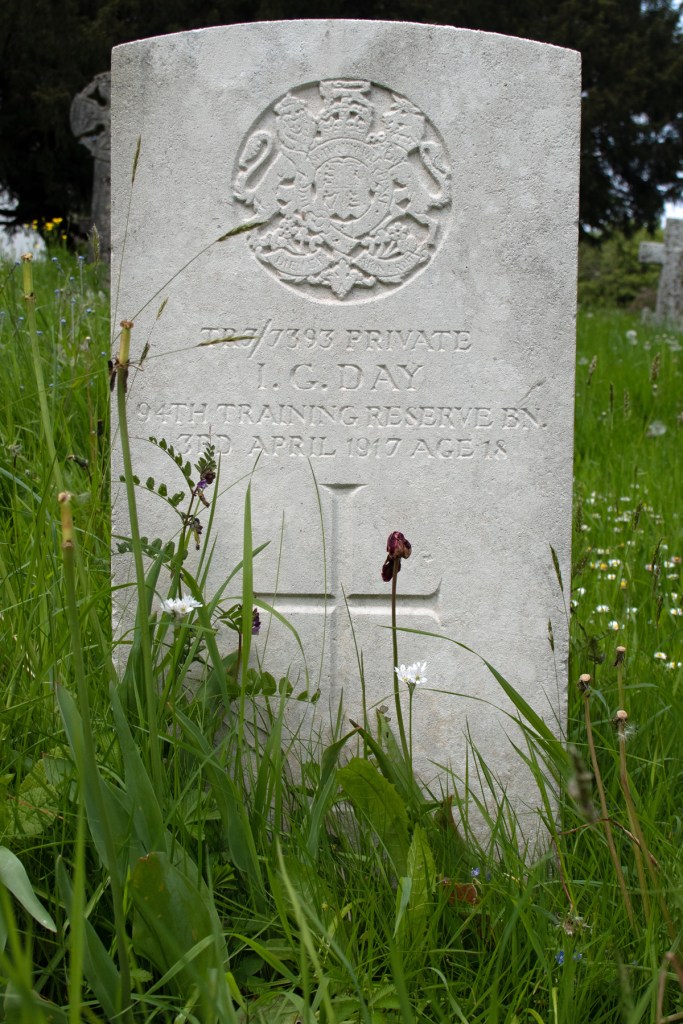
Ivan George Day was born in the summer of 1898, the oldest of three children to George and Emma Day. George was a brick and tile maker from Weare in Somerset and it was here that he and Emma raised their young family.
When Ivan finished his schooling, he found work as a postman, but, with war raging across Europe, he seemed keen to play his part. In February 1917, he enlisted in the army and was assigned to the 93rd Training Reserve Battalion. His service records show that he was just 5ft 3ins (1.6m) tall and weighed 121lbs (54.9kg).
Private Day was sent to Chiseldon Camp, to the south of Swindon in Wiltshire and, tragically, this move to cramped army barracks was to prove his undoing. Within four weeks of arriving, Ivan was admitted to the camp’s hospital, having contracted measles and pneumonia. Less than a week later, the conditions had gotten the better of him. He passed away on 3rd April 1917, at just eighteen years of age.
Ivan George Day’s body was brought back to Somerset for burial. He was laid to rest in the peaceful graveyard of St Gregory’s Church in his home village of Weare.
Tragedy was to strike the Day family again when, George died eighteen months later, aged 51 years old. Emma lived until 89 years old, passing away in Weston-super-Mare in the summer of 1955.
Ivan was not the only Somerset soldier to succumb to pneumonia at Chiseldon Camp that spring. Private Charles Oborne, died from the same condition a few days before Ivan was admitted to the hospital. Private Everett Ferriday, of the 94th Training Battalion, passed away in the same hospital on the same day as Ivan, also from pneumonia.
You can read their stories by following the links above.
Bertie Baden Clark was born on 5th August 1900 in the hamlet of Dunball, near Puriton in Somerset. The third of seven children, his parents were quarry and cement works labourer George Clark and his wife, Bessie.
When war came to Europe, George stepped up to play his part. Despite being 44 years old, he enlisted in the Royal Army Service Corps on 4th November 1915 and, within a year, was in France. He remained posted at the No. 4 Remount Depot until October 1918.
“On the morning of the 1st October 1918, I left the 26th Squadron 4 Base Remount Depot riding a horse and leading one to exercise about a mile & half from the Squadron while proceeding by the side of the railway line my horse was frightened by the whistle of a railway engine & ran away with me throwing me to the road and stepping on my right ankle.”
Private Clark was initially treated at the No. 2 Canadian General Hospital, but was soon invalided back to Britain and placed on furlough until being formally demobbed from the army early in 1919.
Bertie, meanwhile, could see the excitement of the war passing him by. Determine to play is part before it was too late, he gave up his job as a labourer on 13th July 1918 and enlisted in the Royal Naval Volunteer Reserve.
Given the rank of Ordinary Seaman, his service records confirm that he was 5ft 6in (1.68m) tall (1in, or 2.5cm, taller than his father), with dark brown hair, grey eyes and a fresh complexion. He was noted as having a scar on his right knee.
Bertie was sent to HMS Victory, the Royal Naval Dockyard in Portsmouth, Hampshire, for training. Tragically, this was to be his only posting. He was admitted to the dockyard hospital early in October, suffering from double pneumonia and influenza. The condition was to take his life, and he passed away on 10th October 1918, at the age of just 18 years old.
Bertie Baden Clark’s body was brought back to Somerset for burial. He was laid to rest in the quiet graveyard of St Michael’s Church in Puriton, the funeral attended by his family, including his recently returned father, George.
Cyril Spencer Wilson was born on 12th July 1883 in Charlcombe, Somerset. The youngest of three children, his parents were John and Edith Wilson. John was a solicitor who went on to become President of the Bath Law Society and, because of his standing, Cyril and his siblings had a comfortable upbringing: all three censuses covering his life – in 1891, 1901 and 1911 – all show the family living in a large villa in Charlcombe, with a cook and a housemaid to support them.
[Cyril] was educated at Bath College and Lancing College, and then studied engineering at Bristol University. He then became an articled pupil at the Great Western Railway Works at Swindon. Very interested in, and a keen supporter of, the Territorial movement, he was a Captain of the [Royal Engineers] Wilts Fortress Engineers when war broke out.
Bath Chronicle and Weekly Gazette: Saturday 2nd November 1918
Cyril had begun work for the Great Western Railway in July 1902, and became attached to the Institute of Civil Engineers the following January.
Captain Wilson formally enlisted when war was declared, and was soon sent to France. “He was awarded the Military Cross early in the summer of 1917, after being twice mentioned in despatches for excellent work.” [Bath Chronicle and Weekly Gazette: Saturday 2nd November 1918]
Cyril was promoted to Major soon after this, and would go on to serve in France for more than a year more. In February 1918 he married Amy Pounds, the daughter of a bank clerk from East London and the couple exchanged vows in the city.
Major Wilson returned to France, but contracted dysentery that summer. He returned to Britain to recuperate, but came down with pneumonia, and this was to take his life. He died on 27th October 1918, aged 35 years old.
Cyril Spencer Wilson’s body was brought back to Somerset for burial. He was laid to rest in the family plot in St Mary’s Churchyard, Charlcombe.







 Death and Service