Tag Archives: pneumonia

Private Donald Mees

Private Donald Mees

Donald Mather Mees was born on 14th July 1900, the only child of Arthur and Mary from Mells, Somerset. Arthur was a grocer and wine merchant, who, by the time of the 1911 census, had set the family up in Warminster.

Given his young age, there is little documented about Donald’s early life; most of the information available comes from the newspaper reports of his passing:

The military funeral which passed through Frome on Wednesday afternoon was a very sad one. It was that of Private Donald Mather Mees, only son of Mr AH Mees, grocer… formerly of Mells…

The deceased was a somewhat delicate lad, and had only joined up a few weeks – less, we believe, that a month – when he was taken ill and succumbed to pneumonia at King George V Hospital at Dublin on 15th inst.

His parents had been notified of his illness and were preparing to visit him when their journey was interrupted by the news of his death.

Somerset Standard: Friday 23rd August 1918

Private Donald Mather Mees, of the Wiltshire Regiment, had died on 15th August 1918, at the age of 18. He was laid to rest in the graveyard of St Andrew’s Church in the village of his birth, Mells.


Petty Officer William Coughlan

Petty Officer William Coughlan

William Henry Coughlan was born on 16th November 1891, one of thirteen children to William and Catherine Coughlan. William Sr was a labourer, born and bred in the East End of London, who raised his family in Hackney.

William Jr seemed keen for a way to improve himself and in May 1909, enlisted in the Royal Navy. Initially given the rank of Boy, this was due to his age; on his eighteenth birthday a few months later, he was formally enrolled in the navy as an Ordinary Seaman.

To begin with, he was billeted at HMS Ganges II, the shore-based training ship in Harwich, Suffolk, but within a matter of weeks he was on board a sea-going destroyer, HMS Antrim.

Ordinary Seaman Coughlan was obviously a keen young man; by the time the Great War broke out, he had served on four further ships, as well as another shore base, HMS Pembroke I. He rose through the ranks to Able Seaman and, by 1915, had reached the role of Leading Seaman.

Most of his service was spent upon HMS Agamemnon, initially in the Channel, but was then moved to the Mediterranean. On the night of the 5th May 1916, the ship was moored in the harbour at Thessaloniki (Salonika). A Zeppelin, the LZ55, made a bombing raid, but when the searchlights caught it, the Agamemnon fired on it and hit the aircraft, breaking it in two. It crashed in the swamps around the Vardar river and its crew were captured.

Leading Seaman Coughlan remained on the Agamemnon, before returning to England in November 1917, where he received further training at the Naval Dockyard in Chatham. He was promoted to Petty Officer a couple of months later, and began three years of shore- and ship-based service.

In the summer of 1921, while again based in Chatham, he contracted pneumonia, succumbing to the lung condition in a matter of weeks. Petty Officer Coughlan died on 26th July 1921, aged just 29 years old.

William Henry Coughlan was laid to rest in the Woodlands Cemetery in Gillingham; within walking distance of the naval base that had become his home.


Gunner Percy Gast

Rustington

Percy Cyril Edward Gast was born in the West Sussex village of Nutbourne in 1889. His parents were William and Eliza Gast and he was one of sixteen children, seven of whom survived.

William was an agricultural labourer, and farming was the line of work the whole family went into; by the time of the 1911 census, they had moved to Rustington, near Worthing, where Percy was working as a cowman.

When war broke out, Percy enlisted, joining the Royal Garrison Artillery. His skillset soon identified, he was transferred over to the 696th Agricultural Company of the Labour Corps.

While full details of his time in the army are not readily available, Private Gast served his time on home soil. Towards the end of the war he contracted influenza and pneumonia and was admitted to the Mile End Military Hospital in Newham, East London.

Sadly, the lung conditions were to prove his undoing; Private Gast passed away on 20th November 1918, at the age of just 29 years old.

Percy Cyril Edward Gast’s body was brought back to Rustington for burial. He lies at rest in the graveyard of St Peter and St Paul’s Church in the Sussex village.


Private Leonard Patch

Private Leonard Patch

Leonard David Patch was born on 22nd October 1892, the oldest of four children to David and Fanny Patch from Norton-sub-Hamdon in Somerset. David was a stone mason, but when his eldest son left school, he found work as a carpenter.

When war came to Europe, Leonard was one of the first from the village to volunteer. Given the small size of Norton-sub-Hamdon, it seems likely that he would have done so with friends; many of the Pals Battalions were formed like this.

Leonard joined the Somerset Light Infantry as a Private, and was assigned to the 7th Battalion. He was sent to Woking, Surrey, for training and it was while he was billeted there that he contracted measles. Moved to the Military Isolation Hospital in Aldershot, he developed pneumonia, and passed away from the lung condition on 25th February 1915. He was just 22 years of age, and had seen no military action.

Private Patch’s body was brought back to his home village, where he was laid to rest in the graveyard of St Mary’s Church, where he had been baptised two decades before.


Of Leonard’s brothers, two saw active service.

John Henry Patch, the second oldest of the siblings, served in the Royal Engineers, enlisting just ten months after his brother had died. He survived the war, married Linda Turner in Yeovil and went on to have a son, Norman. John passed away in February 1969, a few days after his 75th birthday.

Edward Lionel Patch – the third brother – served with the Devonshire Regiment. He too survived the war, marrying Honor Brown in 1923; they also had a son, called David. Edward passed away in Yeovil in 1966, aged 70 years old.

The youngest of the four brothers, Clarence William Patch, was born in 1899 and was lucky enough not to have seen military service. He married Emily Brown in 1924 and the couple had a daughter, Emmie. Sadly, she passed away as a babe-in-arms, and Emily was to follow soon after. In 1931, Clarence married again, this time to Emily Dyer; they went on to have a son, Douglas Leonard. Clarence passed away in 1945 at the age of just 46 years old.


Pioneer Charles Churchill

Pioneer Charles Churchill

Charles Churchill was born towards the end of 1883, in the Somerset village of West Chinnock. One of six children, his parents were Isaac Churchill and his wife Elizabeth. Isaac was an agricultural labourer, and the family lived in a cottage on Eastfield Farm, where he worked.

When he left school, Charles also found work on the farm. He knew the owners well and, in 1909, married their servant, Ellen Mary Young, in the parish church. The couple moved in with Ellen’s widowed mother, Harriet, and went on to have two children, Florence, born in 1909, and George, who was born three years later.

By this time war was on the horizon. Full details of his military service are not available, but it appears that Charles initially enlisted in the Royal Berkshire Regiment. He subsequently transferred to the Labour Corps, before being reassigned again to the Royal Engineers.

There are no dates available for the transfers, so it’s impossible to know how quickly they took place. Charles’ record shows that he was awarded the Victory and British Medals while in the Royal Engineers, however, so it is likely that he spent most of his time in this regiment.

The medal record also confirms that Pioneer Churchill did not serve in a theatre of war, so would have spent his time on home soil.

Sadly, this is where information on Charles seems to dry up. He survived the war, but contracted pneumonia late in 1919 and passed away on Christmas Day that year. He was just 36 years of age.

Charles Churchill was laid to rest in the graveyard of St Mary’s Church in his home village of West Chinnock, the place where he and Ellen had been married ten years earlier.


Stoker 1st Class Patrick Tynan

Stoker 1st Class Patrick Tynan

Patrick Tynan was born in Roscrea, Southern Ireland, on 9th June 1893. He was the eldest of four children to John and Anne Tynan, but sadly, there is no further information available for his early years.

Patrick’s story really picks up on 14th December 1915, when he joined the Royal Engineers as a Private. His service record states that he was living in Bangor, Gwynedd, and that he was a stall keeper at a fairground – a subsequent document noted his trade as a showman. He was noted to be 5ft 8ins (1.72m) tall, weighed 151lbs (68.5kg), and had numerous scars on his back.

Private Tynan did not stay in the UK for long. Assigned the new role of Driver, he was attached to the GHQ Signal Company and sailed from Devonport on 30th June 1916, bound for Mesopotamia. Arriving in Margil – the port connected to Basra – he was based here for more than a year, before moving north to Baghdad.

By this time, Patrick had risen to the rank of Lance Corporal, and was obviously a trustworthy member of the company. Towards the end of 1917, he had again been promoted, this time to Corporal.

During his time in modern day Iraq, Patrick was admitted to hospital a handful of times; there is little information on the conditions he suffered, but none appear to have been life threatening, as they were only for short periods. It’s also interesting to find that his service records confirm a month’s leave in May 1918, spent in India.

When the war came to a close, Corporal Tynan was still in the Middle East. Ready to be demobbed, his company moved to India and boarded the SS Chupra in Calcutta on 26th February 1919, bound for home.

Back in the UK, however, Patrick was not ready to give up the formal military life. Having returned to Gillingham in Kent, where the Royal Engineers were based, he initially found work as a tram conductor, but soon signed up for a five year term with the Royal Navy as a stoker.

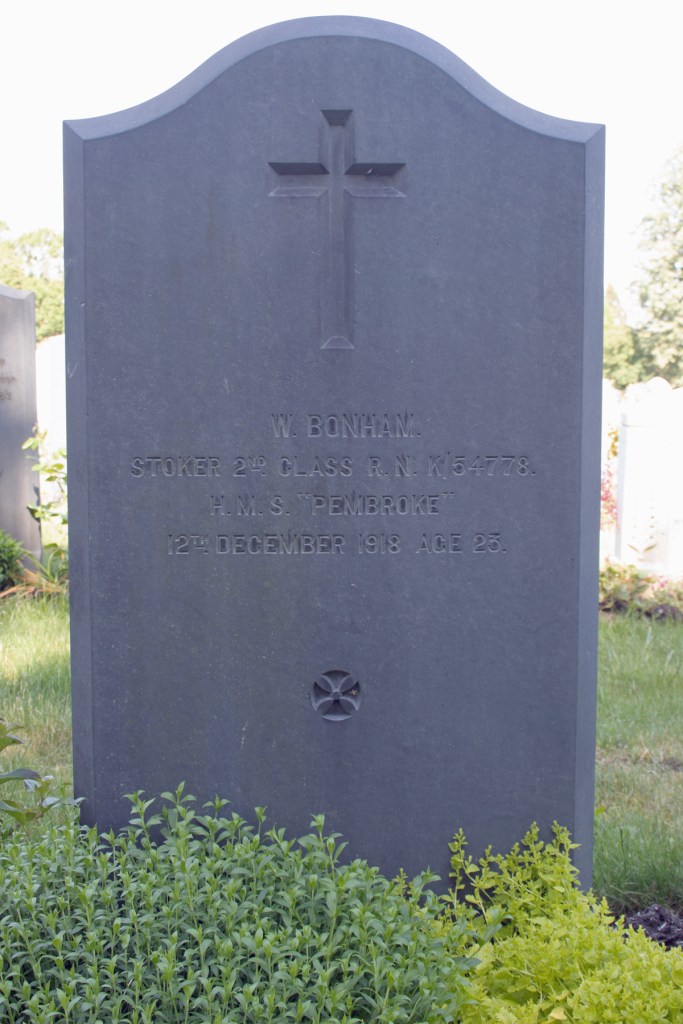
He was based on HMS Pembroke II, the shore-based establishment at Chatham Dockyard, but sadly, his time in the navy was to be a short one. Admitted to the Royal Naval Hospital in the town with pneumonia, he passed away form the condition on 1st October 1919. He was just 26 years old.

Patrick Tynan was laid to rest in the Woodlands Cemetery in Gillingham. He had a short but full life, something his modest gravestone doesn’t begin to hint at.


Able Seaman Michael Goulding

Able Seaman Michael Goulding

Michael Joseph O’Neill Goulding was born on 5th May 1884, the oldest of six children to Michael and Ellen Goulding (née O’Neill). Michael Sr worked for the inland revenue and his job took him around most parts of the British Isles.

Michael Jr had been born in Limerick – both of his parents came from Ireland – but his subsequent three siblings (Patrick, Margaret and William) had all been born in Scotland. His second youngest sibling, Lily, was born in County Durham, the youngest back in Scotland, while, by the time of the 1901 census, the whole family were living in Forest Gate, East London.

The census also shows that Michael Jr, having left school, was working at Customs House (presumably where his father was employed), as a boy copyist on tea accounts. The inland revenue at that time was a career for life; by the next census in 1911, the family had moved to Hertford, where Michael Sr was a customs and excise supervisor, and Michael Jr was an assistant clerk at the same place of employment.

War was on its way, but Michael seems not to have enlisted immediately. While specific dates for his joining up are not available, it appears that he was still working for the Inland Revenue when he got married in Shoreditch, in April 1917. His wife was called Bridget Mary Gough (known as Bryde), and she had also been born in Ireland. The couple went on to have a daughter, Ellen (or Eileen), the following year.

By this time, Michael had definitely enlisted. He joined the Royal Naval Volunteer Reserve, and was based at HMS Pembroke, the shore-based establishment in Chatham, Kent. This was the location for the Navy’s main accounting base, so it is likely that he was employed for financial, rather than his military, skills.

Able Seaman Goulding served through to the end of the war and beyond, and it was while he was based in Kent that he became unwell. Admitted to the Royal Naval Hospital in Chatham, he succumbed to a combination of bronchitis and pneumonia on 22nd February 1919. He was 34 years of age.

Michael Joseph O’Neill Goulding was laid to rest in the Woodlands Cemetery in nearby Gillingham. His family were still in Hertford, while his widow and daughter moved back to Ireland.


Michael Joseph O’Neill Goulding
(courtesy of ancestry.co.uk)

Stoker 1st Class Cornelius O’Brien

Stoker Cornelius O’Brien

Documentation on the early life of Cornelius Edward O’Brien is pretty scarce, so it is impossible to build a picture of him before the First World War. He was born in the late 1890s in Whitechapel, East London and was working as a carman when he received his enlistment papers.

Cornelius joined the Royal Navy as a stoker on 27th November 1915 and was sent to HMS Vivid II, the shore-based establishment in Devonport that served as the Stokers and Engine Room Artificers School. He trained there for a couple of months before being assigned to HMS Drake, where he spent most of 1916.

Returning to Devonport, Stoker O’Brien spent a further year on board HMS Vivid II, gaining the rank of Stoker 1st Class. By the end of 1917, however, he was back at sea, having been sent to HMS Vixen, a naval destroyer that served in the Thames Estuary, performing anti-submarine patrols and counter mining operations there.

In mid-November 1918, with the war officially over, Cornelius was admitted to the Royal Naval Hospital in Chatham, suffering from influenza, pneumonia and pleurisy. Sadly these were to prove too much of a challenge for him and he passed away on 21st November 1918.

Cornelius Edward O’Brien was laid to rest in the Woodlands Cemetery in Gillingham, not far from the Naval Dockyard in Chatham.


Private Edgar Rattle

Private Edgar Rattle

Edgar Albert Rattle was born in Yeovil, Somerset, in 1895, the youngest of three children to Alfred and Charlotte Rattle. Alfred was a railway porter from Yatton, who raised his family in a cottage near the centre of the town.

When he left school, Edgar found employment as an accounts clerk; by the time of the 1911 census, Alfred has moved from being a porter to collecting passengers’ tickets; the family lived in a terraced house next to the station where he worked.

War was on the horizon by now and, although Edgar’s full service records are no longer available, the documents that do remain give an indication as to his time in the army.

Private Rattle enlisted in the early stages of the war; he joined the Somerset Light Infantry in October 1914, although it is not clear which battalion he was assigned to. Later in the conflict, he had been attached to the Labour Corps, and spent some time working on a farm in Ilchester.

It was while in Ilchester in October 1918, that Edgar had some leave, and travelled to Dorset. He was taken down with pneumonia and admitted to the Bournemouth Military Hospital, but subsequently died, breathing his last on 24th October 1918. He was just 23 years of age.

Edgar Albert Rattle’s body was brought back to Yeovil for burial. He lies at rest in the town’s cemetery.


Sergeant Herbert Rendell

Sergeant Herbert Rendell

Herbert George Rendell was born in the summer of 1886, the oldest of six children to George and Catherine Rendell. George was a twine maker from West Coker, near Yeovil in Somerset, and it was in this village that he and Catherine raised their young family.

While he initially found work as a labourer when he left school, the lure of a better life and career proved too much for Herbert and, in June 1905, he enlisted in the Royal Engineers as a Sapper. He spent three years spent on home soil, working hard and earning a Good Conduct medal for his service. During his tour of duty, he contracted pneumonia, spending five weeks in hospital in Chatham, Kent, over Christmas 1905, but fully recovering.

In September 1908, Herbert was sent to Singapore for a three-year tour of duty with the 21st Company. His body was not accustomed to the different environment, and he was hospitalised three times for malaria and myalgia, as well as two bouts of gonorrhoea in 1908 and 1910.

In December 1911, Sapper Rendell returned home, where he served for a further three years before war broke out in the summer of 1914. Having been promoted to Lance Corporal, and after a short bout in hospital following a reaction to his cowpox vaccination, he was sent to Egypt.

Assigned to the 359th Water Company, he would have been charged with constructing and maintaining the supply pipes to and from the Front Line and for his work was soon promoted to Corporal.

In the spring of 1918, the now Sergeant Rendell was transferred to the 357th Water Company, and found himself in Palestine, where he stayed until the end of the war. He came home on leave in April 1919, and it was here that, once again, he contracted pneumonia.

Sadly, Sergeant Rendell was not to recover from the lung condition for a second time; he passed away at his parents’ home on 9th April 1919, at the age of 32 years old.

Herbert George Rendell was laid to rest in Yeovil Cemetery, not far from the village where he was born.