Tag Archives: Private

Private Henry Morgan

Private Henry Morgan

Henry Morgan was born in 1892 in Bridgwater, Somerset. He was the oldest of two children, both boys, to Charles Morgan and his wife Ellen. Charles managed the local collar works, making collars for shirts.

While Henry’s younger brother, Herbert, followed his dad’s business, according to the 1911 census, Henry was learning the farming trade. This was to stand him in good stead, and in 1912, he emigrated to Australia, to become a farmer.

Henry settled in Gunnedah, New South Wales, but was called up when war broke out. He enlisted in May 1916 and joined the Australian Machine Gun Corps. His troop left Australia on the ship Borda in November 1916, arriving in Plymouth two months later, and he finally reached France in March 1917.

Initially part of the 9th Machine Gun Battalion, Private Morgan transferred to the 3rd Machine Gun Corps in April 1918. Involved in the Allied defence of the German Spring Offensive, he was caught up in a gas attack and injured.

Wounded on 17th April 1918, Henry was evacuated back to England and admitted to the Voluntary Aid Detachment Hospital in Cheltenham. Sadly, Private Morgan was not to recover, and he died from his injuries on 8th May 1918. He was just 25 years old.

Henry Morgan lies at rest in the Wembdon Road Cemetery in his former home town of Bridgwater, Somerset.
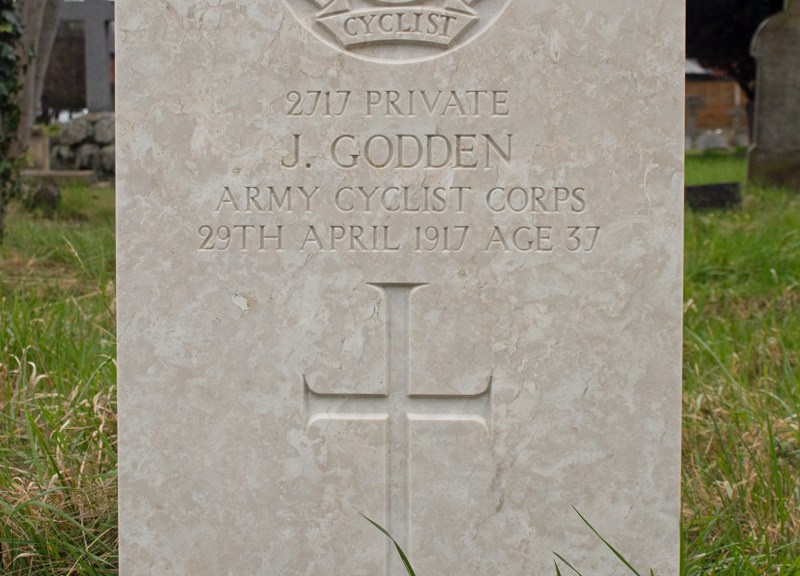
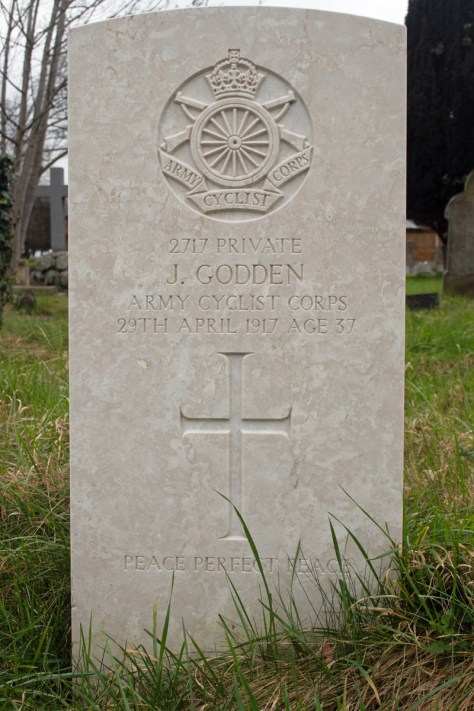
Private James Godden

Private James Godden

James Godden was born in the autumn of 1879. The youngest of six children to Charles and Mary Ann Godden, the family lived in Bridgwater, Somerset. Charles was a labourer and, while his older brothers followed in a similar vein, by the time of the 1901 census, aged 21, was listed as a hairdresser.

James married Hester Addicott in 1906, and the couple had three children – Ruby, Leslie and Freda. Hairdressing may not have been that well paid; according the to 1911 census, the young family had four boarders, ranging from 17 to 60 in age.

War was on its way, and James enlisted at the end of 1914. Initially joining the Somerset Light Infantry, he was soon transferred to the Army Cyclist Corps. Sadly, full details of his military service are not readily available, but it seems likely that he was part of the company’s First Line, who saw service overseas.

Private Godden served three years before being medically discharged from the army. His discharge records give a startling insight into his health.

Originated at Chiseldon Camp: April 12th 1917.

He is in a condition of violent excitement, talks without ceasing and suffers from insomnia. Refuses solid food, but will take a little milk. Not result of, but aggravated by, strain of ordinary military service.

Permanent total incapacity. Treatment in an asylum required.

Cause of discharge: Medically Unfit – Acute Mania

James Godden: WW1 Pension Records

James was admitted to the Somerset & Bath Asylum in the village of Codford, near Taunton. For good or bad, his time there was brief. Within a couple of weeks, he contracted bronchitis. Sadly, James was to succumb to this, and passed away on 29th April 1917. He was 27 years of age.

An additional twist in the tail came from the local newspaper report on his passing:

Somerset Athlete Killed

The death is reported of a former well-known athlete in the person of Mr James Godden, who before joining the Army carried on business as a hairdresser at Bridgwater. The deceased, who was 37 years of age, enlisted in December 1914, and was subsequently transferred to a cycle corps. He death occurred at a Somerset institution after a short illness. The deceased was well known throughout the West of England as a crack cyclist, and competed at big athletic meetings at Exeter, Plymouth, Bath and Bristol, in addition to local sports. He had won altogether over 400 prizes. He leaves a widow and three children.

Wells Journal: Friday 4th May 1917

James Godden lies at rest in the Wembden Road Cemetery in his home town of Bridgwater, Somerset.

James Godden, celebrated on an Ogden’s Cigarettes card
(with thanks to John Boyland)

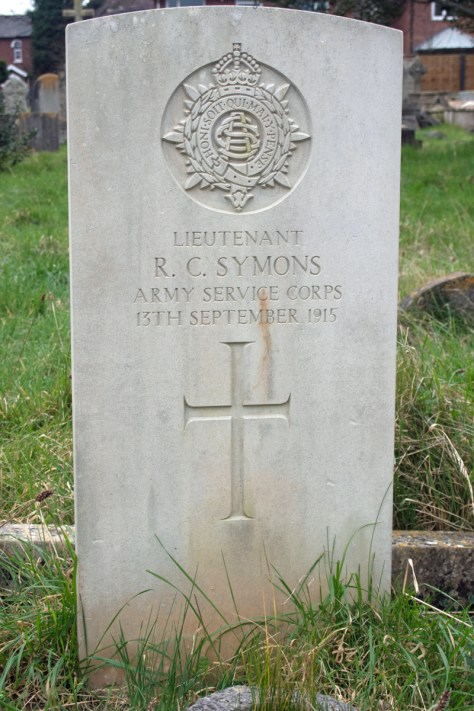
Lieutenant Rudolph Symons

Lieutenant Rudolph Symons

Rudolph Clifford Symons was born in the autumn of 1887, one of ten children to Clifford and Clara Symons. Clifford ran a brick and tile manufacturer’s and later became a town councillor in the family’s home of Bridgwater in Somerset.

By the time of the 1911 census, Rudolph had become the works manager for his father, but war soon beckoned.

Sadly, Rudolph’s full military record has been lost to time, but he enlisted in the Royal Army Service Corps early on in the conflict and was promoted to Lieutenant at the end of September 1914. He was involved in recruiting new soldiers, and it was following one of these meetings that he was involved in an accident.

The local media picked up the story:

On Friday night, while riding through St Jon Street on his motorcycle, to which a side-car was attached, he collided with a horse and light waggon… Lieutenant Symons appears to have been struck by one of the shafts in the region of the heart, and was rendered unconscious. He was at once conveyed to his home, where he was medically attended and was subsequently removed to the nursing home on Friarn Street. On the following day a specialist was called in, and an operation performed, but the injuries were of so severe a character that death ensured on Monday.

Taunton Courier and Western Advertiser: Wednesday 22nd September 1915

The coroner reported that Rudolph had died from an internal haemorrhage and the inquest recorded a verdict of accidental death, and exonerated the waggon driver – a dealer caller Wyatt – from all blame.

Lieutenant Symons was a popular man, a vocalist in the Bridgwater Amateur Operatic Society, and was also heavily involved in the local annual Guy Fawkes celebrations.

He died on 13th September 1915, aged 27 years old, and lies at rest in the Wembdon Road Cemetery in his home town.


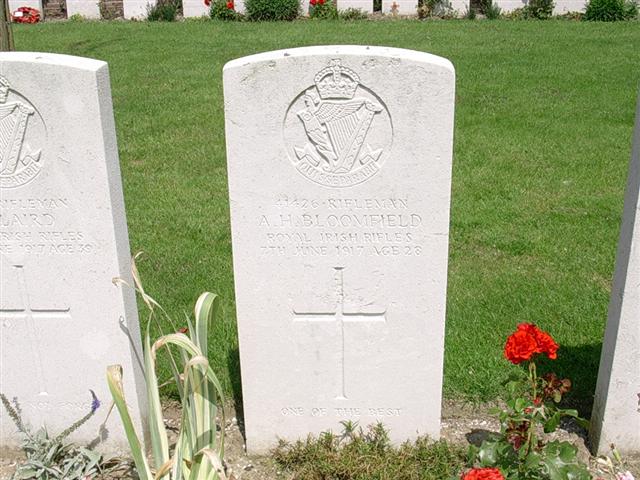
Private Arthur Bloomfield

Private Arthur Bloomfield

Arthur Henry Bloomfield was born on 19th December 1888, the youngest of six children. His parents, agricultural labourer and carter William and his wife Mary, raised the family in the small Norfolk village of East Harling, which was about halfway between the larger towns of Thetford and Diss.

Arthur married Rose Howlett in November 1911; the couple had two children – Margaret and Frederick – who became siblings for Rose’s daughter, Violet.

While Arthur’s military records are scarce, it is evident that he enlisted in the 9th Battalion of the Royal Irish Rifles. Private Bloomfield’s troop fought at a number of the key skirmishes on the Western Front, including the devastating (for the battalion) Battle of Albert in 1916.

A year later, the 8th and 9th Battalions were caught up in the Battle of Messines and it was here that Private Bloomfield met his fate. His pension records show that he was killed in action on 7th June 1917. He was 28 years old.

Arthur Henry Bloomfield lies at rest in the Lone Tree Military Cemetery in Mesen, West Flanders, Belgium.


Interestingly, Arthur’s pension records only cite his beneficiaries as Rose, Margaret and Frederick. This may go further in confirming that Violet was not his daughter.


Arthur Henry Bloomfield was my great great uncle.


Photo courtesy of Commonwealth War Graves Commission.

Private Bernard Dyke

Private Bernard Dyke

Bernard Dyke was born in 1897, the oldest of three children to Albert and Edith Dyke from Bridgwater, Somerset. Albert worked for a brewery, and the young family lived in a house on the main road west out of the town.

Bernard received a scholarship to attend Dr Morgan’s School, a grammar school in the town, and he was a pupil there from autumn 1910 to spring 1913. He left at the age of 16, and became a merchant’s clerk.

War was on the horizon, however, and Bernard joined up. Full details of his military service are not available, but he enlisted in the Devonshire Regiment. Private Dyke spent some time at the Tregantle Fort, near Plymouth, and it was here that he was caught up in an accident.

It has transpired than a rather remarkable shooting fatality occurred at Tregantle rifle ranges, near Plymouth, on Friday, when Private Bernard Dyke, aged about 24, of the Devon Regiment, received a gunshot would in the left side, and almost immediately expired.

The soldier was acting as an observer for a Lewis gun section when he received the fatal injury, the section being at the time out of action awaiting the appearance of a moving target. On the deceased’s left hand side was a musketry party of nine carrying out an exercise, and when he received his injury only one or two rounds had been discharged by this party.

When the first shot or so had been fired deceased suddenly shouted “Oh! Oh!” and dropped. An officer and NCOs ran to assist him, but found that life was extinct. A military doctor was soon on the spot, and found the bullet had entered the deceased’s left side below the ribs and made its exit at the top of his right arm.

As the musketry party was 80 degrees to the right of the firing party it is strange that a shot could have been fired so wide, but the explanation may be found to be in a ricochet or a soldier’s erratic action.

Western Morning News: Monday 21st January 1918.

Private Bernard Dyke died on 18th January 1918, aged just 20 years old. He lies at rest in the Wembdon Road Cemetery in his home town of Bridgwater, minutes’ walk from his family home.


Bernard Dyke (from ancestry.co.uk)

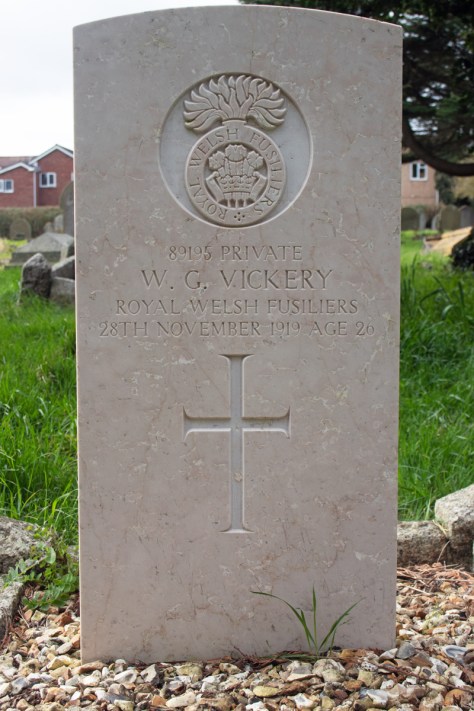
Private William Vickery

Private William Vickery

William George Vickery was born in the summer of 1894, the youngest of three children to George and Mary Vickery. George was a labourer in a brickyard, and this is work that his son followed him into once he left school.

William seems to have progressed with work as, by the time he enlisted for military service, he was recorded as a miner, working in the collieries of South Wales. Initially joining up in February 1916, is seems like his job gave him a level of protection for a couple of years at least; he was not formally mobilised by the Royal Welch Fusiliers until May 1918.

Initially serving on the home front, Private Vickery was shipped to France in September 1918, serving two months there, before returning home. William was eventually discharged from the army on medical grounds; having contracted tuberculosis while on active duty.

There is little information about William after his discharge. It seems likely that his health deteriorated, however, as he died just a year later, on 28th November 1919. He was just 26 years of age.

William George Vickery lies at rest in the Wembdon Road Cemetery in his home town of Bridgwater, Somerset.

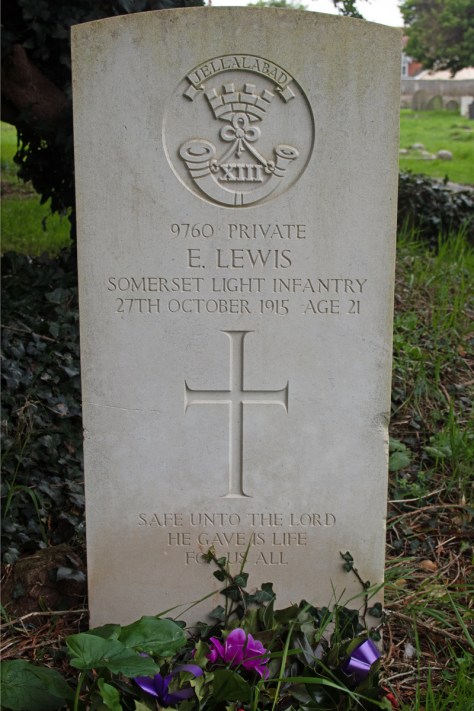
Private Ernest Lewis

Private Ernest Lewis

Ernest George Lewis was born in Bridgwater, Somerset, in the spring of 1895, one of fourteen children to labourer Frederick and his wife Harriett Rose. Two of his older brothers went to work for the local brickworks, but Ernest hauled coal to earn a living once he left school.

When war broke out, he was eager to do his part; he enlisted in the Somerset Light Infantry early on, serving as a Private in the 1st Battalion. His troop was to see some of the fiercest fighting in the conflict, including the Battles of Le Cateau, the Marne, the Aisne, Messines within the first six months.

Private Lewis’ troop was also involved in the Second Battle of Ypres in the spring of 1915, but it was later that year that his fate became sealed. At some point he was caught up in a German gas attack; he was evacuated home, but there is no confirmation whether he was hospitalised as a result (although it seems likely).

The gas was to damage his lungs to the extent that he would not recover. There are conflicting reports as to the cause of Private Lewis’ passing, with one source identifying the gas in France, while another put it down to pneumonia and typhoid. (It seems probable that the attack ultimately resulted in Ernest catching pneumonia, although this is not clear.)

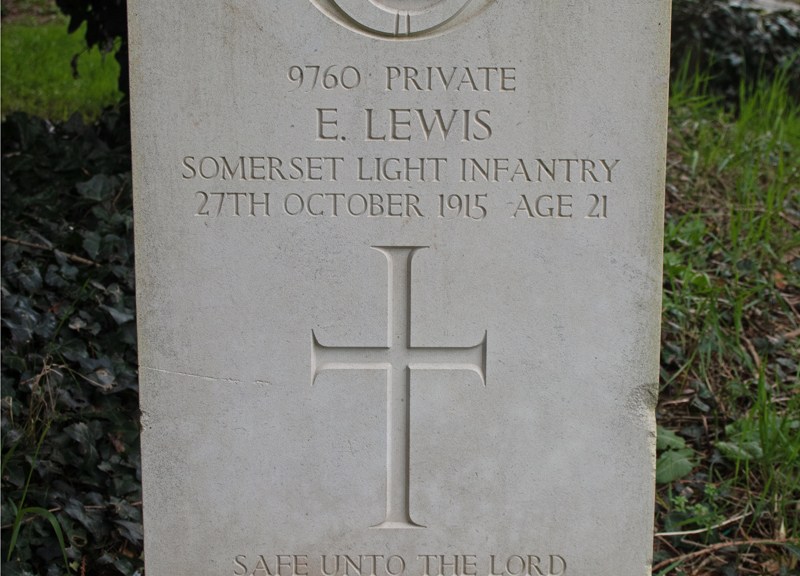
Either way, Private Lewis passed away at home on 27th October 1915. He was just 20 years old.

Ernest had eleven brothers, four of whom would have been old enough to be enlisted to fight. Ernest was the only one of the family to perish.

Ernest George Lewis lies at peace in the Wembdon Road Cemetery in his home town of Bridgwater.


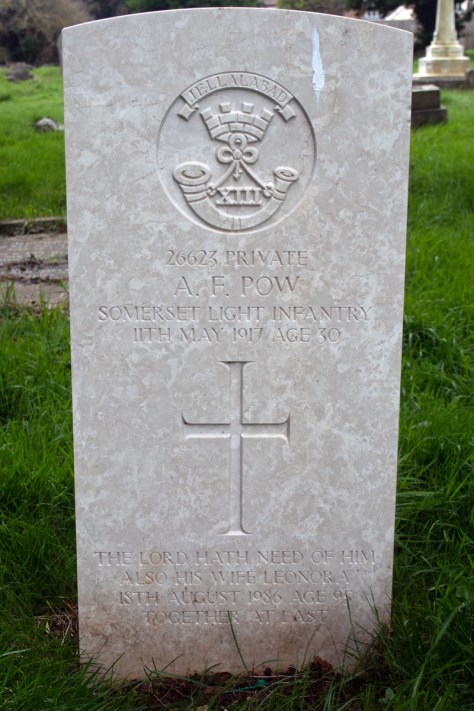
Private Albert Pow

Private Albert Pow

Albert Francis Pow was born in the autumn of 1886, one of five children to Albert and Annie Pow from Somerset. Albert Sr. was a farm labourer, but by the time he left school, Albert Jr. started work as a porter in the Singer sewing machine factory in Bridgwater.

Albert’s father passed away in 1905, at the age of 51, and his son – who was by this time repairing the sewing machines – became head of the household.

He was obviously good at what he did, because, by the time he married in 1913, he was able to support his wife Leonora as branch manager for the Singer store in the town. The young couple soon moved on, as, when war broke out, he was manager of the shop in Barnstaple.

War came calling, and while the date of his enlistment is absent from his records, Private Pow joined the 1st Battalion of the Somerset Light Infantry. Sent to the front, he quickly became ill, suffering from dysentery and trench foot, which led to him being hospitalised for nearly two months.

Returning to his troops, Private Pow’s health remained unsteady, and he soon contracted trench fever. He was evacuated back to England for treatment, and was admitted to the Canadian Red Cross Memorial Hospital in Taplow, Buckinghamshire.

Sadly, Albert was not to recover this time; he died at the hospital on 11th May 1917 as a result of empyema (pleuritis) and an abscess of the axilla (armpit). He was just 30 years old when he died.

Albert Francis Pow lies at rest in the Wembdon Road Cemetery in Bridgwater.


Albert left behind his widow, Leonora and their child Vanessa. Leonora was to be reunited with her late husband; she died in August 1986, and is buried with her beloved.


Private Tom Cox

Private Tom Cox

Thomas Cox was born in September 1900, the oldest of four children to William and Ellen Cox from Bridgwater, Somerset. On Thomas’ baptism records, William listed himself as a manufacturer, but there is nothing to confirm what he made.

Sadly, William died in 1905, leaving Ellen to raise four children under five years old – including a babe-in-arms. Determined to look after her young family, however, by the time of the 1911 census, she gave her occupation as a grocer.

War was on the horizon and, while his full records are not evident, it is clear that Thomas must have looked to enlist as soon as his age would allow. He was assigned to the 53rd (Young Soldier) Battalion of the Hampshire Regiment, a training unit based not far from Warminster.

Sadly, Private Cox’s service was not to be a long one. While training, he contracted pneumonia, and passed away on 31st October 1918. He had just turned 18 years old.

Thomas Cox lies at rest in the Wembdon Road Cemetery in his home town of Bridgwater, Somerset.

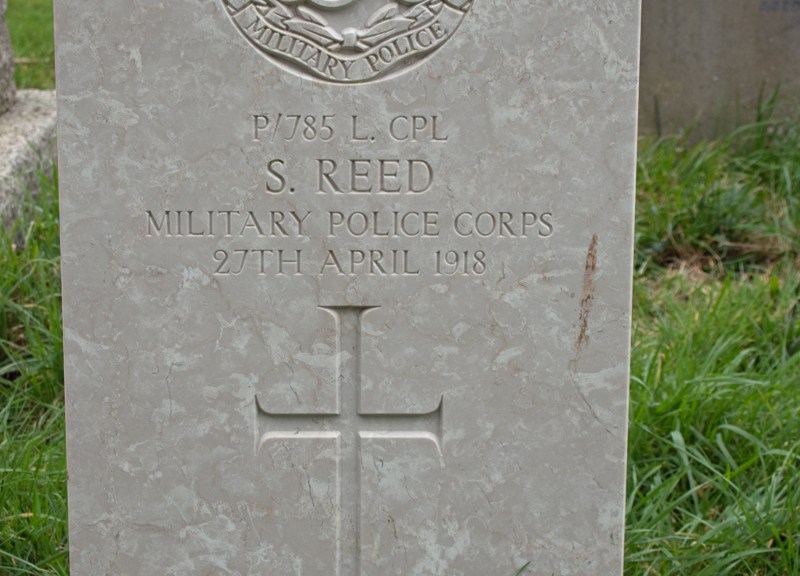
Lance Corporal Stephen Reed

Lance Corporal Stephen Reed

Stephen Reed was born in August 1887, one of seven children to Stephen and Eliza Reed from Bridgwater, Somerset. Stephen Sr was a labourer, eventually working as a carter for the local council.

Stephen Jr sought bigger and better things, however. After initially working as a butcher, he enlisted in the army in January 1907. He served a term of three years in the Coldstream Guards, before being stood down to reserve status in 1910.

Stephen had by then, found his calling in life and joined the police force. Standing at 6ft 1in (1.84m) tall, he would have cut an imposing figure. By the time of the 1911 census, he was boarding at the barracks in Dorchester, where he was listed as a police constable.

In May 1913, Stephen, by now aged 25, married Emily Maud Bower, in their home town. By March of the following year, the young couple had settled back in Swanage, Dorset, and had had a child, Stephen George.

War was on the horizon, however, and Private Reed was re-mobilised in August 1914, finding himself overseas within weeks. He was quickly promoted to Lance Corporal, and, after a couple of years – including fighting at Mons and receiving a subsequent gunshot wound to his hand – was transferred to the Military Police Force.

In April 1918, Lance Corporal Reed contracted tuberculosis, and was ill enough to be evacuated back to England for treatment. He was admitted to the Royal Victoria Hospital in Netley, Hampshire, but passed away within a day of arriving. Sadly, his records show that a telegram was sent to Emily summoning her to the hospital, but, as this was dated the same day he passed away, it seems unlikely that she would have arrived in time.

Lance Corporal Reed died on 27th April 1918. He was 31 years old.

Stephen Reed lies at rest in the Wembdon Road Cemetery in his home town of Bridgwater.


A sad addition to Stephen’s military records is a latter to his widow in September 1918, asking for acknowledgement of receipt of his belongings. The items in question boiled down to: pair of braces; button stick; shaving brush; 2 boot brushes; comb; pipe lighter; handkerchief; pocket knife; safety razor; towel; flannel vest; waistcoat; identity disc; wrist strap; pair of scissors; tie clip; mirror; pipe; cigarette holder; 4 cap badges; card case; wallet and photos; wallet and correspondence; cigarette care; cigarettes; tobacco.

We can assume that these items – especially the photographs and correspondence – gave some level of comfort to Emily, but seeing her late husband’s life summed up in a bagful of belongings must also have been heart-breaking.