Tag Archives: Royal Army Medical Corps

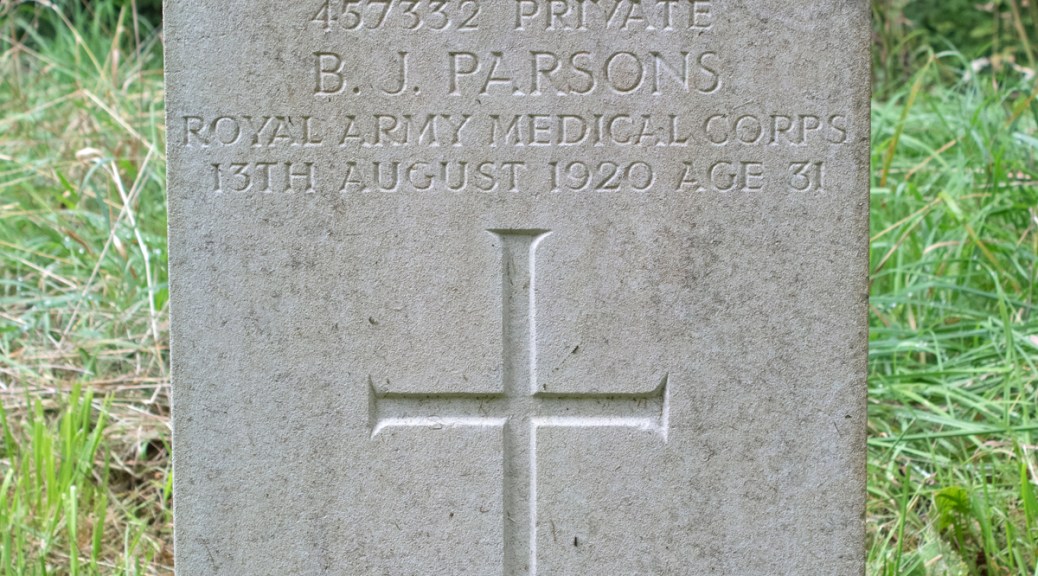
Private Bertie Parsons

Private Bertie Parsons

Bertie James Parsons was born in the summer of 1889, and was the fourth of six children to James and Elizabeth Parsons. James was a quarryman and slate-maker from Somerset, and he and Elizabeth raised their family in the parish of Ashbrittle.

While his older siblings found farm work in this peaceful part of the county, Bertie found employment as a baker’s assistant. This meant a move away from Somerset, and, by the time of the 1911 census, he was apprenticed to a bakery in the Crediton area of Devon.

The following year proved a tragic one for the Parsons family. Bertie’s younger brother, Richard, had found work as a hall boy for an estate in Wheathampstead, Hertfordshire. This was to prove a springboard for him, and he landed work for one of the new class of liners ploughing the waters of the Atlantic. Employed as a 2nd Class Steward, he was employed on the RMS Titanic and, like most of the ship’s 900 crew, he perished on that fateful night of 15th April 1912.

Among the large number of souls who perished with the Titanic recently we regret to report that among that number was a young man named Richard Parsons, aged 18, a native of Ashbrittle, and whose relatives still live in the neighbourhood, his father, James Parsons, being an invalid.

The deceased, who a couple of years ago embarked on a seafaring life, was on board the Olympic when it collided with the Hawke, and he left his home about a month ago, and journeyed to Belfast to assist in getting the Titanic ready for her maiden voyage.

He was particularly pleased at being appointed to a post on the largest ship in the world.

Deceased, who was a bright lad and much respected in the village, occupied the position of lift steward on his previous boat, and on the Titanic was a steward in a second-class dining saloon.

He was unable to swim.

Somerset County Gazette: Saturday 27th April 1912

Steward 2nd Class Richard Parsons

Back in Devon, Bertie was still working as a baker. When war came to Europe, however, he stepped up to play his part. While full service details are not available, it is clear that he enlisted in the Royal Army Service Corps as a Private. He was attached to the 2nd/1st Wessex Field Ambulance, who were sent to France in January 1916.

Private Parsons saw action – or helped treat the results of it – at some of the key battles on the Western Front: the Somme, Ypres, Cambrai, Givenchy and Festubert. In the autumn of 1917, Bertie returned home to marry Florence Riddaway, a milliner from Bow, Devon, who he had courted while working in nearby Crediton. The couple went on to have a son, Douglas, who was born on 26th May 1918.

It is unclear how long Bertie remained in the army after the Armistice was signed. By the summer of 1920, he was back on British shores, and had fallen ill. He was admitted to hospital in Bath with acute staphlococcic infection and a cerebral embolism. He died in hospital on 13th August 1920, at the age of 31 years old.

The body of Bertie James Parsons was taken back to Ashbrittle for burial. He was laid to rest in the village’s St John the Baptist Churchyard.


Tragedy was to remain close by for the Parson family. Florence was a couple of months pregnant when Bertie died. Bertie Jr was born on 26th March 1921, but both mother and son died during childbirth. They were laid to rest near her family in Devon.


Douglas, just two years old, was now an orphan. There is little information about his life in the aftermath of his parents’ passing, but by the time of the 1939 Register, he was working as a motor mechanic in Wellington, Somerset. He lived on until 1993, passing away in Taunton Deane, at the age of 74.

Captain John Cooper

Captain John Cooper

John Bruce Cooper was born on 21st July 1869 in Croydon, Surrey. He was the oldest of eight children, all but one boys, to John and Maria Cooper. John Sr was a boot and shoe manufacturer whose business, by the time of the 1881 census, was employing around 600 people.

By 1901, the business was doing well. The family had moved to Northamptonshire, and were living at Delapré Abbey, on the outskirts of Northampton. They were now supported by fourteen servants living on site, while grooms, coachmen and gardeners were housed on the estate.

John Sr died in August 1906, while Maria passed away less than six months later. Their children, now aged between 25 and 37, went on to live their separate lives. Five of John Jr’s brothers remained in bootmaking, in Leicestershire, Northamptonshire and Surrey, while one of them, Philip, took holy orders. John, however, sought a different route.

In April 1907, John married Violet Mary Gordon in Kensington, London. She was the daughter of a general in the Indian Army, and had been born in Simla. The couple settled in a house in Basingstoke, Hampshire, and went on to have two children: Thomas and Richard. The 1911 census records the family residing in Daneshill Cottage, with two live-in domestics. By this point John was noted as being a dealer in motor cars.

When war broke out, John felt duty bound to serve his country. Little information about his military career remains documented, but a contemporary newspaper report of his funeral provides some indication of his service.

Captain Bruce Cooper… was formerly an officer of Territorial [Royal Army Medical Corps], being transport officer of the 2nd South-Western Mounted Brigade, and was stationed at Frome [Somerset]. Obtaining a commission in the [Army Service Corps], he was promoted captain, and was so proficient and zealous that he became Officer Commanding Vehicles at Bulford Camp, where he was held in the greatest esteem.

Bath Chronicle and Weekly Gazette: Saturday 27th November 1915

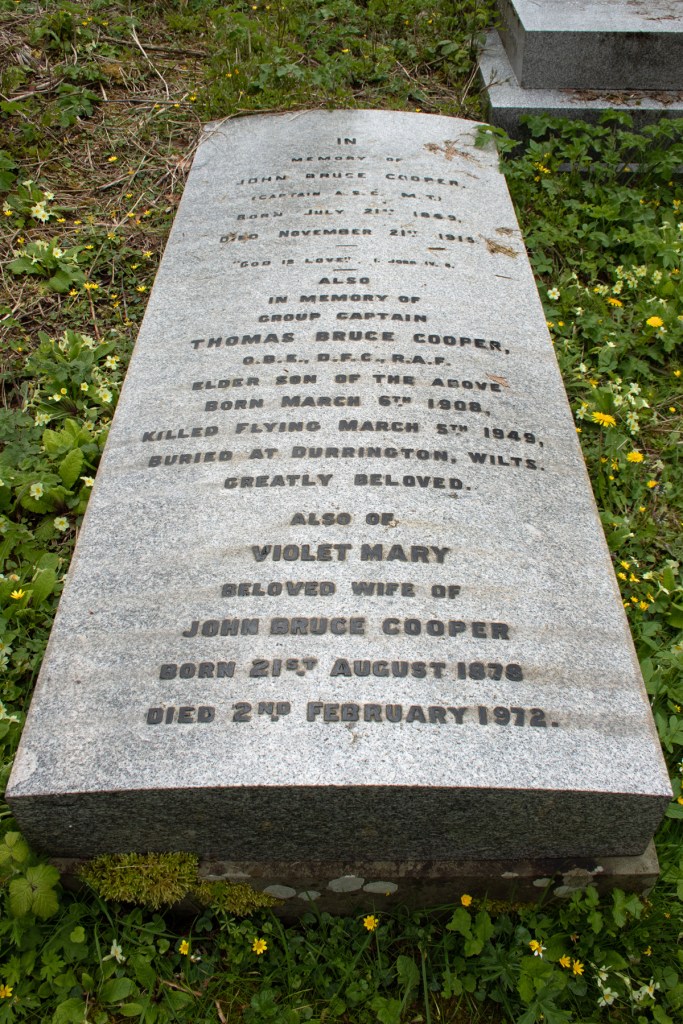
Captain Cooper fell ill in October 1915, and was suffering from phlebitis, or inflammation the veins. This was to prove fatal, and he passed away at the family home in Bath, Somerset, on 21st November 1915. He was 46 years of age.

John Bruce Cooper was laid to rest in a family plot in the cemetery of Bath Abbey. His older son, Thomas was laid to rest with him, when he passed away in 1949. Violet was reunited with her husband and son when she was buried with them in 1972.


Captain John Cooper (from ancestry.co.uk)

Private John Maguire

Private John Maguire

John Maguire was born in Dublin, Ireland, in 1874. There is scant information about his life, and his name is too common to be able to narrow down details of his family.

The only documentation that links to his life is that of his army service. He was working as a labourer when he enlisted in the Royal Army Medical Corps on 27th April 1918. His service records confirm he was 5ft 7ins (1.7m) tall, with blue eyes, grey hair and a sallow complexion. Interestingly, he reported that he did not have any next-of-kin.

Private Maguire seemed to serve on home soil, and was primarily based in Lancashire. It was while here in the January of 1919 that he fell ill with nephritis – kidney disease – and was admitted to the hospital on Adelaide Street, Blackpool.

His condition was such that it led to John’s discharge from military service on medical grounds. On 23rd February he was moved to the 2nd Southern General Hospital in Bristol, and two days later he left army life. John was transferred to the War Hospital in Bath a couple of weeks later, and it was here that he passed away on 16th April 1919. He was 45 years of age.

An addition to John’s initial service records noted that a next-of-kin had been confirmed, and so Mary Prestige, who was living in Bedminster, to the south of Bristol, was informer of her friend’s death.

Respecting the Irishman’s religion, John Maguire was laid to rest in the Roman Catholic Cemetery in Bath, the city in which he died.


John’s friend, Mary Prestige, is also destined to remain a mystery. There are no records of her at the address John’s service records provide – Pipe Cottage, North Street, Bedminster.

There are two census records for Somerset for a Mary Prestige: 1901 records a Durham-born 18 year old Mary working as one of a number of laundry maids at the Marlborough Hill House of Refuge in Bristol.

The 1911 census records the same Mary Prestige visiting a William and Amelia Hockerday in Yatton, Somerset. It is impossible to confirm, however, whether this is the woman John notified the army as his next of kin.


Private Alec Willmott

Private Alec Willmott

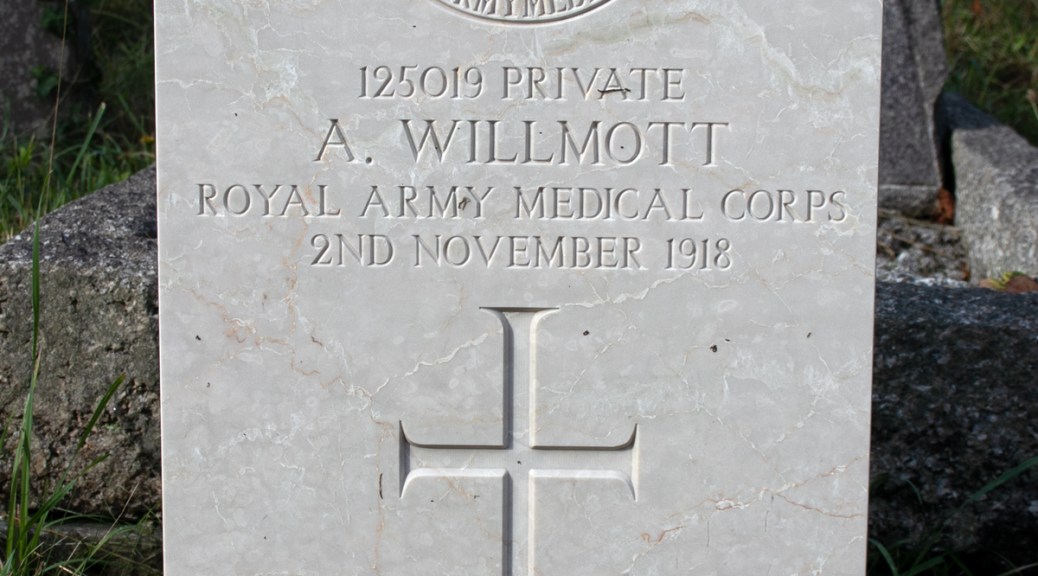
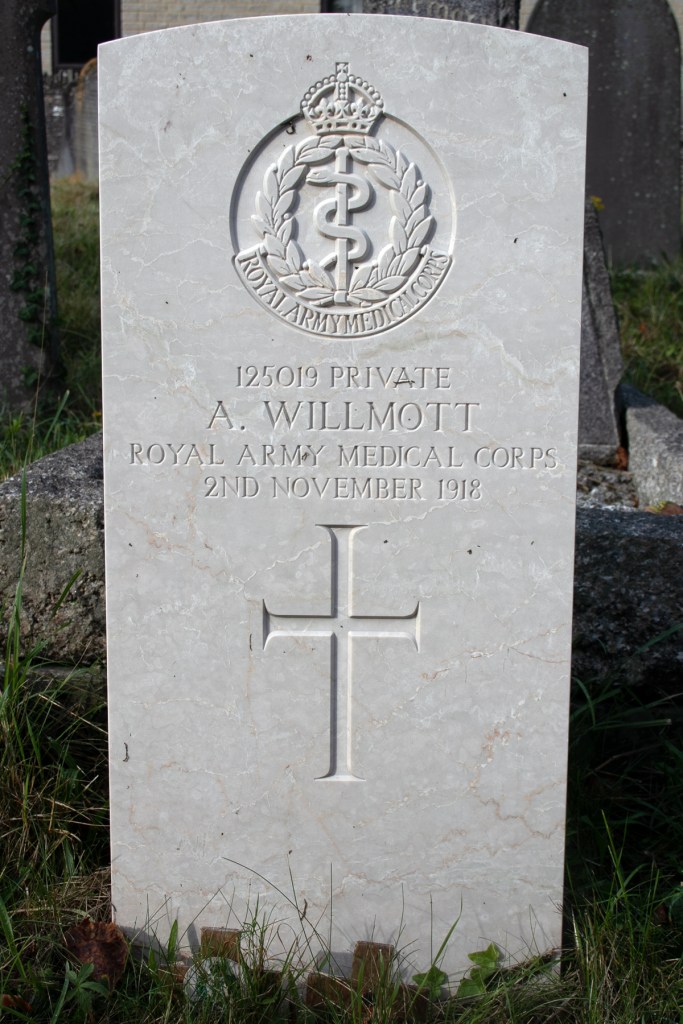
Alec William Willmott was born in 1886 and was one of six children to Henry and Ellen Willmott. Henry was a farm labourer from Oldland in Gloucestershire, and this is where the family were raised.

When he left school, Alec found work making shoes and boots at a local factory – this was work most of the Willmott children went into. On 24th April 1916, he married Elsie Frost in the local church. The couple set up home in Keynsham, and went on to have a son, Cecil, who was born in August 1917.

Alec played his part during the war. Full service details are not available, but it is clear that he had enlisted in the Royal Army Medical Corps by the spring of 1918. There is no confirmation of whether Private Willmott served at home or overseas, but, by October 1918, he had been admitted to the 2nd London General Hospital in Chelsea, suffering from a combination of influenza and pneumonia.

Sadly, these conditions put a strong pressure on his heart: Private Willmott passed away from cardiac failure on 2nd November 1918, at the age of just 32 years old.

Alec William Willmott was brought back to Gloucestershire for burial. He was laid to rest in the graveyard of St Anne’s Church in his home village, Oldland.


Private Harry Ashford

Private Harry Ashford

Harry Ashford was born in Sidford, Devon, on 2nd June 1880, the oldest of seven children to Samuel and Fanny Ashford. Samuel was a mason and Fanny worked as a lace worker managing this at the same time as raising her children. The family left Devon in the late 1880s, settling instead in Chard, Somerset.

After initially working as an errand boy, when Harry finished school he found employment as a house painter. He had met lace worker Ada Hancock by this point, and the couple married in Chard’s Methodist Church on 4th May 1901. The couple set up home in the same road as Harry’s parents, and went on to have a daughter, Nora, the following year.

By this point, storm clouds were brewing over Europe, however, and Harry felt the need to play his part. On 22nd September 1915, at the age of 35, he enlisted in the Royal Army Medical Corps. His service record shows that he stood 5ft 6ins (1.68m) tall and was of good physical development.

Private Ashford served on the Home Front, and was based at the Tweseldown Camp near Farnham, Surrey. He served there for a little over a year before he contracted nephritis – inflamed kidneys – and was admitted to hospital. Sadly, the condition proved too severe, and he died on 31st October 1916 from a cerebral haemorrhage. He was 37 years of age.

Harry Ashford’s body was brought back to Somerset for burial. He was laid to rest in the cemetery of his adopted home town, Chard.


Both of Harry’s parents passed away not long after he died – Samuel in 1919 and Fanny in 1920. Ada never remarried, and lived a reasonable life, passing away in Nottinghamshire in the autumn of 1932, at the age of 53 years old.


Private Charlie Badman

Private Charlie Badman

Charles Badman – better known as Charlie – was born in 1895 in the Somerset seaside town of Weston-super-Mare. His parents were stonemason Henry Badman and his wife Caroline.

Unfortunately, there is little documented information about Charlie’s early life. By the time of the 1911 census, the family were living in a terraced house in Clevedon Road, Weston-super-Mare, a short distance from the sea. Charlie’s four oldest brothers had left home by this point, but his other two siblings – his dressmaker sister Martha and his plasterer brother Arthur – were still living with their parents. Charlie, at this point, was still at school.

When war was declared, Charlie was keen to do his bit. He enlisted in the Royal Army Medical Corps, and was assigned to the 65th Field Ambulance as a Private. This section was connected to the 21st Division, which saw action on the Western Front at Loos, the Somme, Arras, Passchendaele and Cambrai, although it is not possible to determine how Private Badman was involved in these battles. He was awarded, however, the Victory and British Medals for his service.

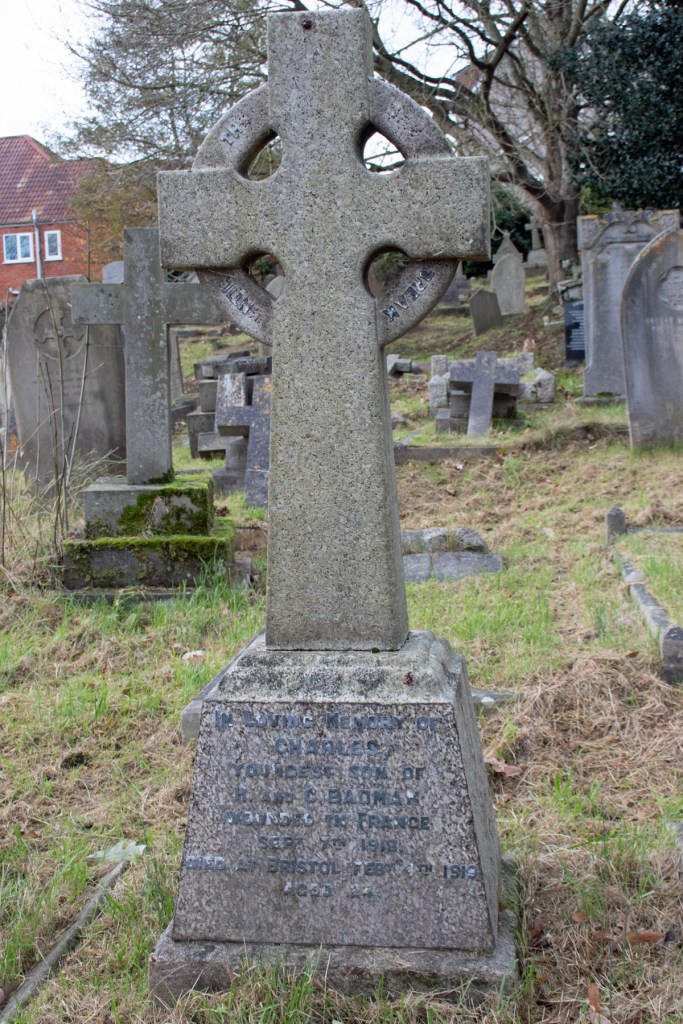
The only other concrete information available for Charlie is the inscription on his gravestone. This confirms that he was wounded in France on 7th September 1918. It seems that he was medically evacuated to England, and was admitted to a military hospital in Bristol, not far from his family in Somerset.

Sadly, it seems that his wounds proved too severe; he died at the hospital five months later, on 4th February 1919, aged just 25 years old.

Charlie Badman was brought back to Weston-super-Mare for burial. He lies at rest in the Milton Road Cemetery in the town.


Private Arthur Lavender

Private Arthur Lavender

Arthur Reginald Lavender was born in Bath on 17th January 1889, the second of two children to George Charles (or Charles George) Lavender and his wife, Elizabeth. George raised the family in Bath and seems to have been a jack of all trades, finding work where he could, as a porter in a warehouse according to the 1891 census and a stationary engine driver ten years later.

On 1st December 1907, at the age of just 18, Arthur married Kate Pearce, a painter’s daughter from Weston-super-Mare. The young couple went on to have a son, Sidney, who was born the following year.

By 1911, Arthur was working in Weston-super-Mare as a warehouseman at a local laundry and, on the day of that year’s census, was staying with his father-in-law. Kate, meanwhile, had taken Sidney to see her brother, Frank, who lived in Bristol.

War was coming to Europe, and, in November 1915, Arthur signed up, joining the Royal Army Medical Corps as a Private. After initial training – including a course on First Aid, he was sent overseas on 11th April 1916, where he was assigned to the 27th Casualty Clearing Station.

Private Lavender’s time in the RAMC seems to have been a complicated one. He was admitted to a field hospital within a month of arriving in France with a double inguinal hernia, a condition that continued to dog him over the coming months.

Arthur was eventually shipped to England in March 1917 for an operation at the Metropolitan Hospital in London. The operation itself seemed to have been a success, but, while admitted, he contracted pneumonia, and it was this lung condition that was to end his life. Private Lavender passed away on 7th May 1917, aged just 28 years old.

Arthur Reginald Lavender was laid to rest in the Milton Cemetery in Weston-super-Mare.


Private Sidney Watts

Private Sidney Watts

Sidney Gilbert Watts was born in 1892, one of five children to railway inspector Arthur Watts and his wife Laura. Initially brought up in the village of Congresbury, near Bristol, Arthur soon moved the family to nearby Taunton.

A likeable man, Arthur continued working for Great Western Railways. He also became involved in the Taunton Co-operative and Industrial Society and, for a number of years was the Chairman. Suddenly, and unexpectedly, however, on 20th January 1907, he collapsed and died from a heart attack.

Now widowed, Laura’s children rallied around her. Most of them had left school; her eldest, Reginald, was a school master, her older daughters Florrie and Mabel worked for a milliner and draper, and two lodgers moved in to help financially support her and her youngest daughter Evelyn.

By this time Sidney had followed in his father’s footsteps, and found work as a porter for GWR. He had moved to Hayle in Cornwall, where, according to the 1911 census, he was boarding with 33-year-old widow, Lizzie Richards, and sharing the house with another railway worker, Richard Crago.

Sidney seemed to be looking for something more. In February 1912, he enlisted as a Private in the Royal Army Medical Corps. He trained as a cook and, when war broke out, was sent out to France as part of the British Expeditionary Force.

In July 1915, Private Watts contracted pleurisy and was treated in a hospital in Boulogne. He was discharged for duty and assigned to a hospital ship, where he stayed for six months. While there, he contracted pneumonia and was bedridden for six weeks, his lung having collapsed.

Sidney was evacuated to England to recuperate. His health did not improve, however, and he was medically discharged from the army on 31st July 1916. A few months later, he was admitted to Cranham Lodge Sanatorium near Gloucester, but passed away on 24th September 1916. He was just 24 years old.

The body of Sidney Gilbert Watts was brought back to Taunton, and he was laid to rest in the St James Cemetery in the town.


Private Percy Payne

Private Percy Payne

Percy Payne was born in the village of Kingston Seymour, between Weston-super-Mare and Yatton, Somerset. His parents were agricultural labourer Harry Payne and his wife, Elizabeth, and he had three brothers.

It seems that Percy’s parents may well have separated by 1911; Elizabeth is listed as a widow in the 1911 census, but Harry appears to be alive and well and living in South Wales.

According to the census records, Elizabeth was working as a charwoman, while three of her children were working to help support the family. Percy’s two older brothers were employed as a carter and a domestic servant, while Percy himself was working as an errand boy.

By the time war broke out, Percy has stepped up the ladder. His service records listed his trade as a groom, working in Congresbury, near Bristol. He enlisted in March 1916, at the age of 19 years and 8 months, and was assigned as a Private in the Northumberland Fusiliers. He spent most of that year training on home soil, before being shipped out to France at the end of December.

Illness seems to have dogged Private Payne; he returned to England after a couple of months, and was transferred to the Labour Corps fairly soon afterwards. By September 1917 a further transfer was made, this time to the Royal Army Medical Corps, before he was finally discharged from military service on 21st January 1918, suffering from tuberculosis.

Sadly, the lung condition was to prove fatal, and Percy passed away on 26th June 1918. He was just 21 years old.

Percy Payne lies at rest in the graveyard of St Mary’s Church in the village of Yatton, Somerset.

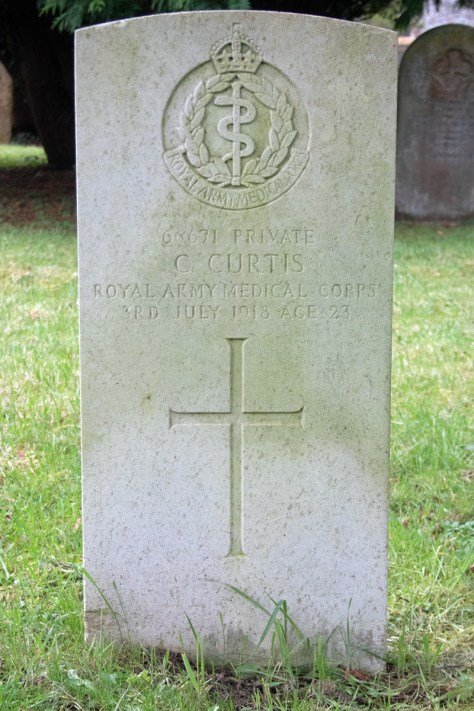
Private Charles Curtis

Private Charles Curtis

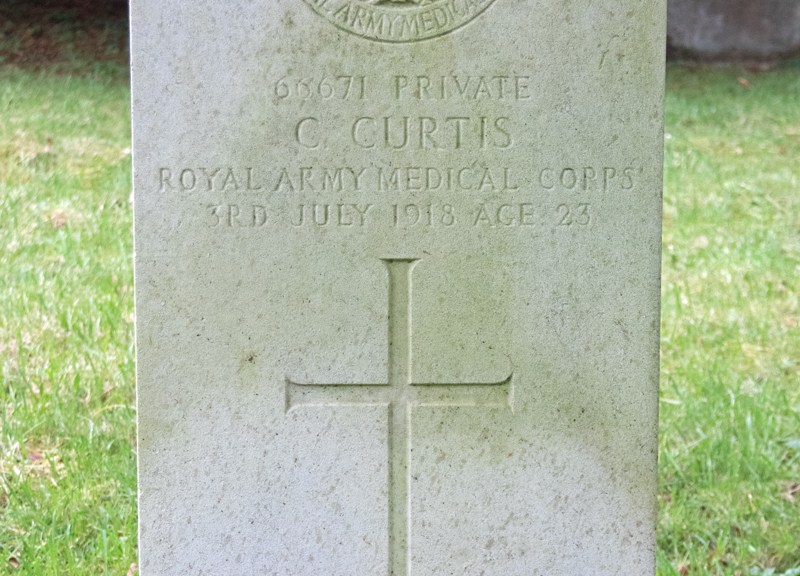
Charles Curtis was born in Wells, Somerset, in January 1894, one of fifteen children to Charles and Mary Jane Curtis. Charles Sr worked as a gardener in the Wells area, and, after leaving school, Charles Jr started work as a mill hand for the local paper mill (this would have been either St Cuthbert’s Mill in Wells, or the Wookey Hole Mill in the nearby village).

Charles enlisted in October 1915, joining the Royal Army Medical Corps. He was posted to France a month later and, while specifics of his military service are not readily apparent, Private Curtis was awarded the Victory Medal, the British Medal and the 1915 Star.

Charles was admitted to hospital on 1st November 1917 with an inflamed cervical gland (reported as Trench Fever), for which he underwent an operation. He remained hospitalised at Whalley Range for more than two months, and was passed for active service, having apparently recovered.

Private Curtis was suddenly taken ill again on 1st July, and his family telegrammed. His mother and one of his sisters boarded a train for the hospital – again in Whalley – but they had not gone far when word came that he succumbed to rheumatic fever. He was 24 years old.

Charles Curtis Jr lies at rest in the graveyard of St Matthew’s Church in the village of Wookey, Somerset.


A newspaper report of his funeral confirms that Charles was one of five brothers who had entered military service during the Great War. Amazingly, given that seven of the brothers ended up serving, Charles was the only one to die as a result of the war.