Tag Archives: Royal Naval Reserve

Leading Seaman Robert Franklin

Leading Seaman Robert Franklin

Robert William Franklin was born on 9th March 1894, one of four children to Alfred and Annie Franklin. Alfred was Australian, who had settled in England in his teens and settled in Woolwich, London, to marry and raise his family. It was not long, however, before the family upped and moved to Greenock, Scotland.

There is little information available about Robert’s early life, but in 1913 he enlisted in the Royal Navy, and served for three years. His enrolment papers show that he was 5ft 4.5ins (1.64m) tall, had auburn hair and brown eyes. He was also noted has having a scar on his abdomen and had been working as an appliance fitter.

Details of his initial service are not readily available, although a later newspaper report suggests that he “was with the Naval Division at the siege of Antwerp [October 1914] and served through the Gallipoli campaign” [Daily Record: Saturday 8th September 1917].

Able Seaman Franklin was transferred to the Royal Naval Reserve in April 1916, and was based at HMS President – the London shore-based establishment. However, he had moved to The Royal Naval Dockyard in Chatham, Kent – also known as HMS Pembroke – by the end of July 1917.

The Dockyard was particularly busy that summer, and the large number of extra servicemen meant that Robert was billeted in temporary accommodation in Chatham Drill Hall.

On the 3rd September 1917, the first night air raid carried out by the German Air Force bombarded the town, and scored a direct hit on the Drill Hall; Leading Seaman Franklin was among those killed instantly. He was just 23 years of age.

Robert William Franklin was laid to rest, along with the other victims of the Chatham Air Raid, in the Woodlands Cemetery, Gillingham.


Stoker George Bell

Stoker George Bell

George Joseph Bell was born on 9th October 1890 in South Shields, County Durham. He was one of four children – all boys – to George and Eleanor Bell. George Sr was from Chatham in Kent and worked as a boilermaker for a shipbuilder.

Both of George Jr’s parents died when he and his siblings were in their teens. Times were definitely harsh for them: George’s older brother Robert was a coal teemer – unloading the carts at the Tyneside docks. His younger brother, Matthew, was a pit pony driver for the Bolden Colliery. George himself was a pressed glass manufacturer.

The 1911 census recorded Robert, George and Matthew boarding with the Easter family; renting a room in a three-bedroomed house on Commercial Road, South Shields, within spitting distance of the docks and river.

George was, by this point, courting a young lady a few doors down from him. Harriet Shield was the daughter of one of the dock labourers; the couple married at St Hilda’s Parish Church on 30th November 1912.

War was coming to Europe, and on 18th December 1914, George enlisted to play his part. His service records show that he stood 5ft 5ins (1.65m) tall, had blue eyes and a fresh complexion. He was also noted as having tattoos of a heart and his initials on his left forearm.

George joined the Royal Naval Reserve – this suggests that he had previously had some sea-going experience, although there is no specific evidence of this. He was given the role of Stoker, and was sent to HMS Pembroke – the Royal Naval Dockyard in Chatham, Kent – for training.

Stoker Bell’s first posting – and where he spent to most of 1915 – was on board the seaplane tender HMS Engadine. He returned to Chatham that November, before being assigned to the minesweeper HMS Gentian two months later.

After five months patrolling the North Sea, Stoker Bell returned to HMS Pembroke in June 1917. The Dockyard was a busy place that summer, and temporary accommodation was needed quickly. Chatham Drill Hall was brought into service, and George found himself billeted there.

On the 3rd September 1917, the German Air Force carried out its first night air raid: Chatham was heavily bombed and the Drill Hall received a direct hit; Stoker Bell was among those killed instantly. He was just 27 years of age.

George Joseph Bell was laid to rest alongside the other victims of the Chatham Air Raid, in the Woodlands Cemetery, Gillingham.


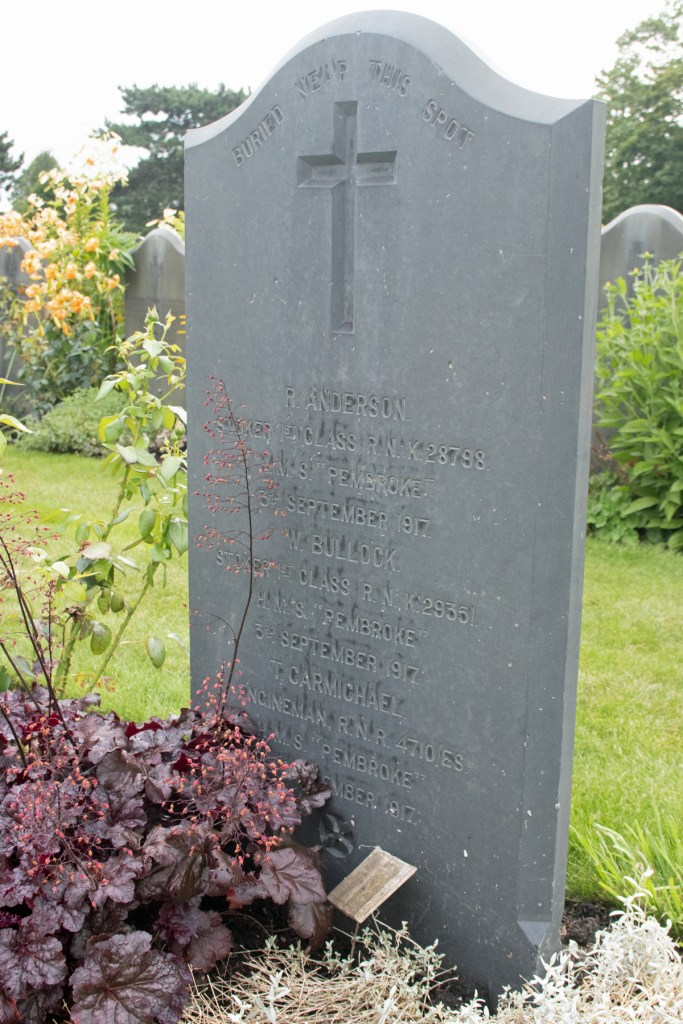
Engineman Thomas Carmichael

Engineman Thomas Carmichael

Thomas Carmichael was born on 19th December 1888, the older of two children to George and Elizabeth – Lizzie – Carmichael. George was an engine fitter from Hull, Yorkshire, and this is where he and Lizzie raised their young family.

Little further information is available for Thomas’ early life. He married a woman called Annie, but no documents remain to confirm when their wedding was. The couple settled in Hull, and went on to have two children, a girl and a boy.

War had his Europe by this point, and Thomas enlisted in the Royal Naval Reserve. He joined the Royal Naval Reserve as an Engineman on 16th May 1916, serving primarily at the shore-based establishments of HMS Pembroke (the Royal Naval Dockyard in Chatham, Kent), HMS Gunner (the Granton Naval Base in Edinburgh) and HMS Vivid (the Naval Dockyard in Devonport).

Engineman Carmichael arrived in Chatham in August 1917. The Dockyard was particularly busy that summer, and the large number of extra servicemen meant that Thomas was billeted in temporary accommodation in Chatham Drill Hall.

On the 3rd September 1917, the first night air raid carried out by the German Air Force bombarded the town, and scored a direct hit on the Drill Hall; Engineman Carmichael was among those killed. He was just 28 years of age.

Thomas Carmichael was laid to rest, along with the other victims of the Chatham Air Raid, in the Woodlands Cemetery, Gillingham. Tragically, the Navy Death Records state that he was Buried as unidentified in one of the following graves: 516, 522, 642, 735, 935, 937 or 948.

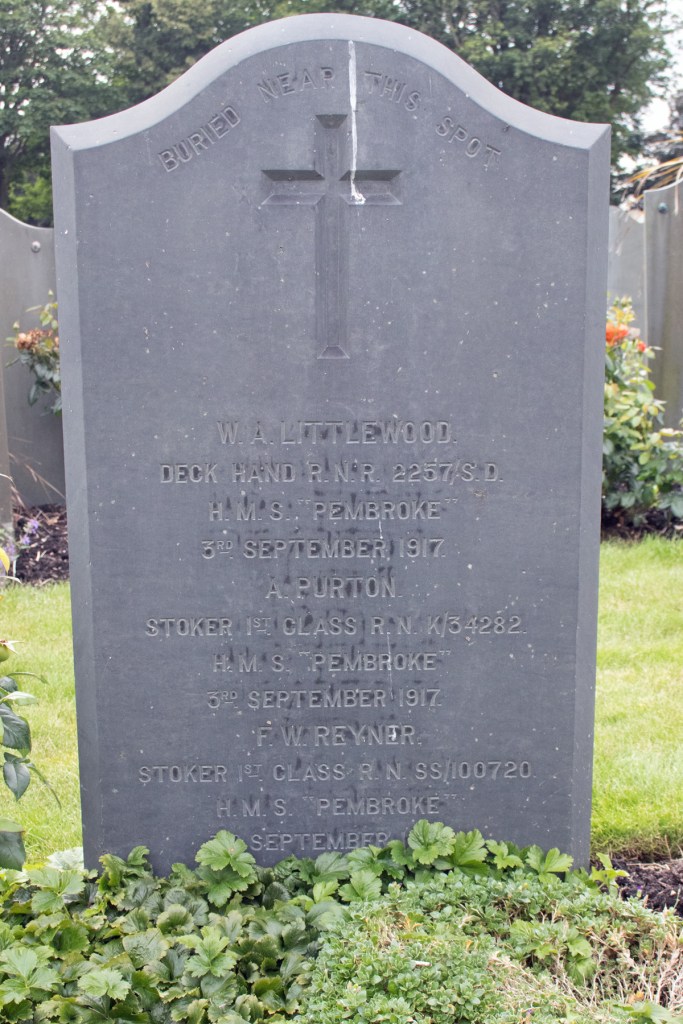
Deck Hand William Littlewood

Deck Hand William Littlewood

William Alfred Littlewood was born on 19th April 1882, the oldest of four children to Henry and Mary. Henry was a labourer for the gasworks in Great Yarmouth, Norfolk, and the couple raised their family in the town.

William also found work with the local gasworks, and this is who he was employed by when, on 19th December 1903, he married Evelyn Harriet Youman. The couple set up home near the centre of the town, and went on to have four children.

When war broke out, William was keen to play his part. On 17th August 1914, he enlisted as a Private in the Army Service Corps and, within a couple of week, was in France. He spent six months on the Western Front, before returning to home soil. The reason for this return to England was an inflammation of the middle ear, and the resulting deafness led to his discharge from the army in June 1915.

William was not to be deterred, however, and within a matter of weeks, he had enlisted again, this time volunteering for the Royal Naval Reserve as a Deck Hand. Over the next two years, he served on a number of different ships, each time returning to HMS Pembroke, the Royal Naval Dockyard in Chatham, Kent.

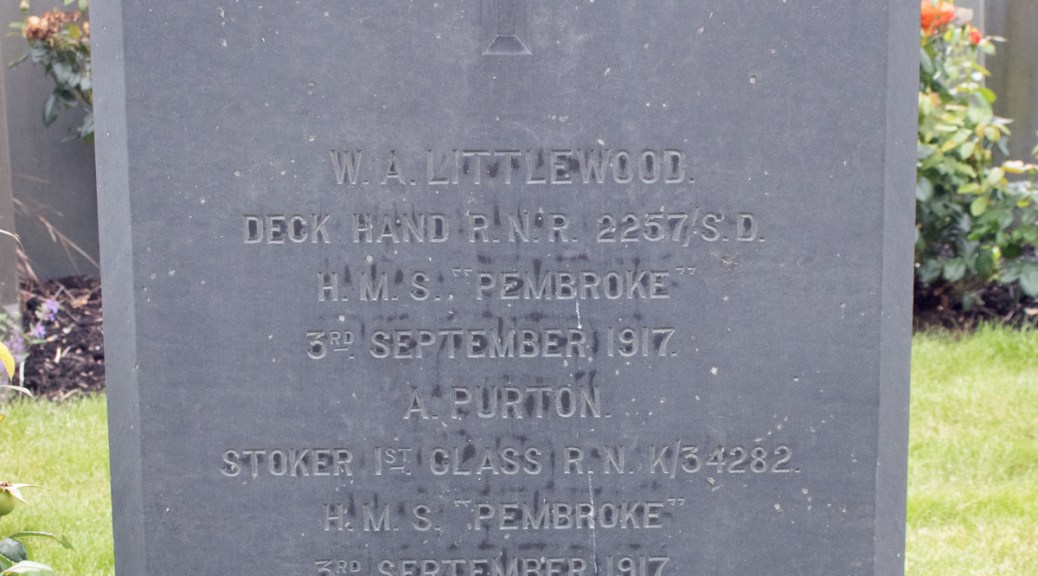
In August 1917, Deck Hand Littlewood disembarked HMS Acteon, and returned to his shore base. The Dockyard was particularly busy that summer, and the large number of extra servicemen meant that William was billeted in temporary accommodation in Chatham Drill Hall.

On the 3rd September 1917, the first night air raid carried out by the German Air Force bombarded the town, and scored a direct hit on the Drill Hall; Deck Hand Littlewood was among those killed instantly. He was 35 years of age.

William Alfred Littlewood was laid to rest, along with the other victims of the Chatham Air Raid, in the Woodlands Cemetery, Gillingham. Tragically, the Navy Death Records state that he was Buried as unidentified in one of the following graves: 516, 522, 642, 735, 935, 937 or 948.

Seaman Francis Crocker

Seaman Francis Crocker

Francis Thomas Crocker was born on 5th February 1895 to Job and Irene Crocker. One of eleven children, the family were born and raised in the small Newfoundland town of Trout River.

Sadly, there is little documentation about Francis’ life. What is clear, however, is that, when war broke out, he volunteered for the Royal Naval Reserve.

By 1917, Seaman Crocker was based at HMS Pembroke, the Royal Naval Dockyard in Chatham, Kent. The base was overly busy that summer, and Frances was billeted in temporary accommodation in the town’s Drill Hall.

On the 3rd September 1917, the first night air raid carried out by the German Air Force scored a direct hit on the barracks and Drill hall; Seaman Crocker was killed instantly. He was just 21 years old.

Francis Thomas Crocker was laid to rest, along with the other victims of the Chatham Air Raid, in the Woodlands Cemetery, Gillingham, some 2500 miles (4000km) from his Canadian home.


Stoker George Simpson

Stoker George Simpson

George Wilfred Simpson was born early in 1882, the second of seven children to Robert and Mary Simpson. Robert was a shipbuilder from Yorkshire, and the family were raised in Thornaby, on the River Tees near Middlesbrough.

Details of George’s early life are a bit patchy, but when he left school he found work as a warehouseman. He met Florence Unwin, who was born in Stockton-upon-Tees, and they married in the spring of 1906. They young couple set up home in the town and went on to have four children, all boys.

When the war came to Europe, George wanted to do his part. His full service records are not available, but he enlisted in the Royal Naval Reserve as a Stoker at some point during the conflict. By the summer of 1917, he was based at HMS Pembroke, the Royal Naval Dockyard in Chatham, Kent.

The base was a particularly busy place at that point in the war and additional accommodation was desperately needed. Stoker Simpson found himself billeted at Chatham Drill Hall, away from the main barracks.

On the night of 3rd September 1917, Chatham suddenly found itself in the firing line, as the German Air Force launched a bombing raid. One of the bombs landed squarely on the Drill Hall, and Stoker Simpson was killed. He was just 35 years old.

Ninety-eight servicemen perished during the Chatham Air Raid that night. They were buried in a mass funeral at the Woodlands Cemetery in nearby Gillingham. This, too, is where George Wilfred Simpson was laid to rest.

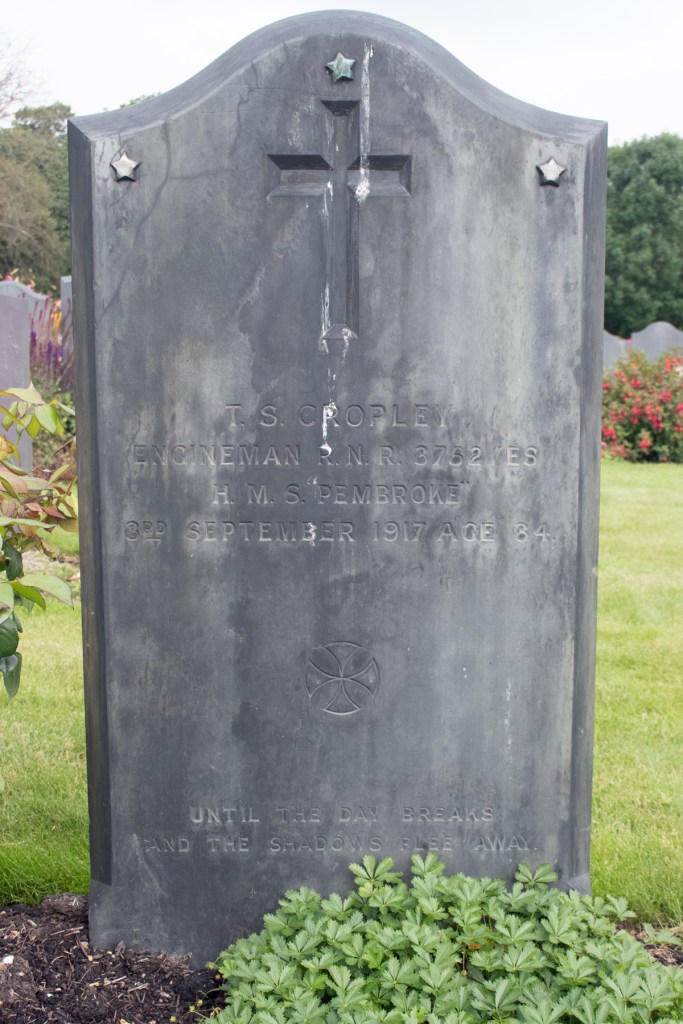
Engineman Thomas Cropley

Engineman Thomas Cropley

Thomas Samuel Cropley was born on 16th November 1882 in the Suffolk village of Mutford. The fifth of eight children, his parents were Robert and Hannah Cropley. Given Mutford’s proximity to the Hundred River Hundred and the coastal town of Lowestoft, it is little surprise that Thomas’ father was a ropemaker. Hannah was also employed, the 1901 census recording her as a monthly nurse – helping women during the month after childbirth.

Thomas’ location to the coast made fishing an ideal choice of work for him, and when he left school he followed his three older brothers into the trade. Indeed, he listed his trade as a deep sea fisherman on his marriage records.

As a young man, he had met bricklayer’s daughter Edith Tuttle, and they tied the knot on 29th May 1906. The couple set up home in Factory Street, Lowestoft, and went on to have seven children.

Sadly, little information on Thomas’ wartime service remains documented. His knowledge of boats and the sea made the navy an obvious option for him, and he enlisted in the Royal Naval Reserve.

Engineman Cropley was assigned to HMS Pembroke – this Royal Naval Dockyard at Chatham in Kent. While it is likely that he served on ships as well, this is certainly the base to which he returned.

Thomas found himself based here in the summer of 1917, which was a particularly busy place at that point in the war. Additional accommodation was desperately needed and he found himself billeted at Chatham Drill Hall, away from the main barracks.

By 1917, the German Air Force had suffered huge losses during the daylight bombing raids it had been undertaking. It was imperative for them to minimise these losses, and so a new tactic – night time raids – was employed.

The first trial of this approach was on the night of 3rd September 1917, and Chatham suddenly found itself in the firing line, startlingly unready and fundamentally unprotected. One of the German bombers landed a direct hit on the Drill Hall, and Engineman Cropley was killed. He was just 34 years old.

Ninety-eight servicemen perished during the Chatham Air Raid that night. They were buried in a mass funeral at the Woodlands Cemetery in nearby Gillingham. This, too, is where Thomas Samuel Cropley was laid to rest.


The lives of Thomas’ family outlines a lot about living conditions in the late nineteenth and early twentieth centuries, with a large number of his relatives dying young.

His father was 68 when he died in 1916; Hannah had passed away fourteen years before, when she was 56 years old. Of his siblings, two did not survive childhood, one died their 20s, one was aged 40, while three reached their late sixties.

Thomas’ widow died in 1921, at the age of 35; their two youngest children died before their first birthdays. Of the other five, one was 31 when he died, while the others lived much longer – one was in their mid-70s, two in their eighties, and the oldest reached her hundredth birthday. A varied legacy indeed.


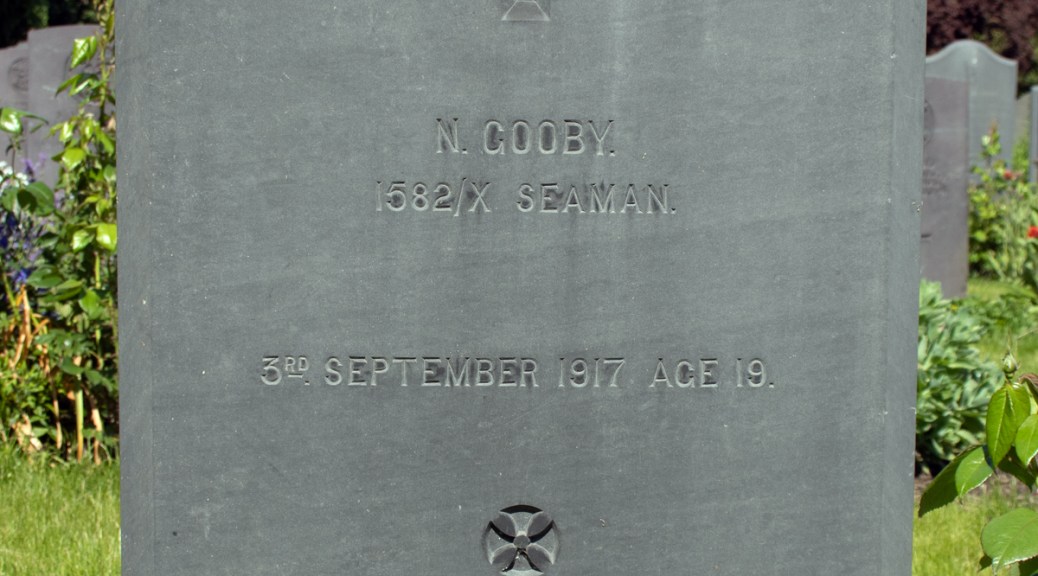
Seaman Nathaniel Gooby

Seaman Nathaniel Gooby

Nathaniel Gooby was born on 28th October 1897, the only son of William Gooby and his third wife, Margaret. Both of William’s previous wives – Tryphena and Amelia – had died before their time, but Nathaniel had six half-siblings, up to forty years older than him.

William was a carpenter, who had been born in England, but had moved to Newfoundland when he was young, and this is where he lived and raised his families.

Sadly, very little documentation remains to evidence Nathaniel’s life. He enlisted as a Seaman in the Royal Naval Reserve, potentially after war was declared (he would have been 16 years old at the outbreak of the conflict). By the summer of 1917 he was based at HMS Pembroke – the Royal Naval Dockyard in Chatham, Kent.

That summer was a busy time for the Dockyard, and temporary accommodation had been set up for the influx of military personnel based there. Seaman Gooby was billeted at Chatham Drill Hall and was sleeping there when the first night air raid was carried out by the German Air Force on 3rd September 1917. The Drill Hall received a direct hit, killing 98 servicemen – Nathaniel included. He was just 19 years of age.

Nathaniel Gooby was laid to rest in the Woodlands Cemetery in nearby Gillingham, along with the other victims of the Chatham Air Raid.

Trimmer Cuthbert Kean

Trimmer Cuthbert Kean

Cuthbert Kean was born on 2nd October 1862, the eldest of four children to John and Jane Kean. John was a tailor from Manchester, who brought his young family up in the town of Crook, County Durham.

Cuthbert followed in his father’s footsteps and, by the time of the 1891 census – when he was 26 years old – was lodging in central Edinburgh, and was working as a tailor.

There is little more information available on Cuthbert’s early years. When war broke out, he enlisted in the Royal Navy, joining up on 26th October 1914. His papers show that he stood 5ft 2ins (1.57m) tall, had a fair complexion and grey eyes.

By 1917, having turned 55, he was transferred to the Royal Naval Reserve, and worked as a Trimmer – an alternative title for a Stoker. He had served on a number of vessels, joining HMS Firefly towards the end of the war.

Early in 1919, Trimmer Kean was admitted to the Royal Naval Hospital in Chatham, Kent, suffering from a sarcoma of the neck. Sadly, he was to succumb to this, and he passed away on 4th March 1919. He was 58 years old. His records give his next of kin as his sister Mary, who was living in Durham.

Cuthbert Kean was laid to rest in the Woodlands Cemetery in Gillingham, Kent.


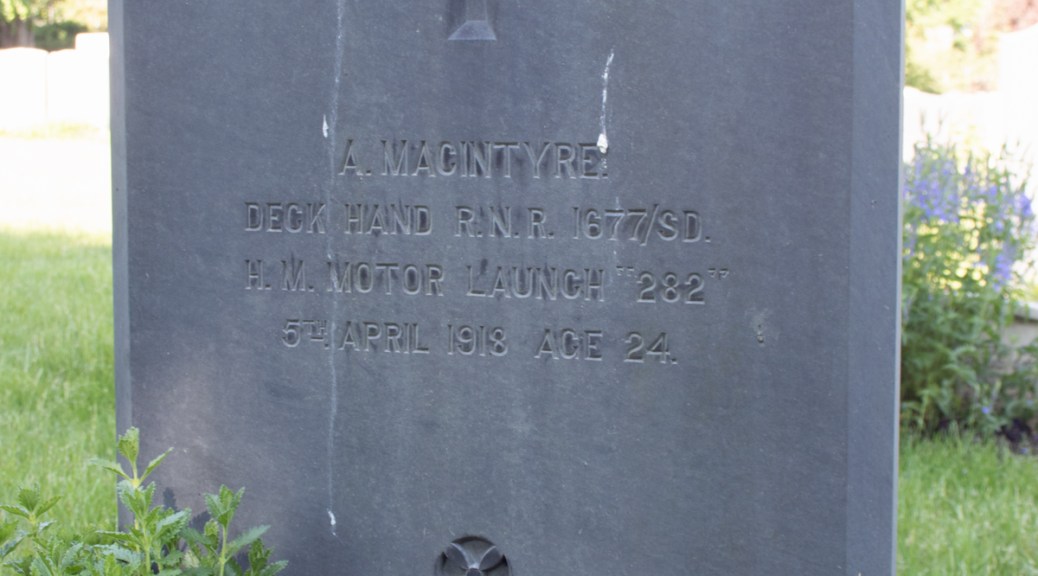
Deck Hand Angus MacIntyre

Deck Hand Angus MacIntyre

Angus MacIntyre was born on the island of Eriskay in the Outer Hebrides on 9th October 1894. One of eleven children, his parents were fisherman Malcolm McIntyre and his wife Flora.

Sadly, there is little information on Angus’ early life and military service. He was still living in the Scottish Islands by the time of the 1911 census, and enlisted in the Royal Naval Reserve when war broke out.

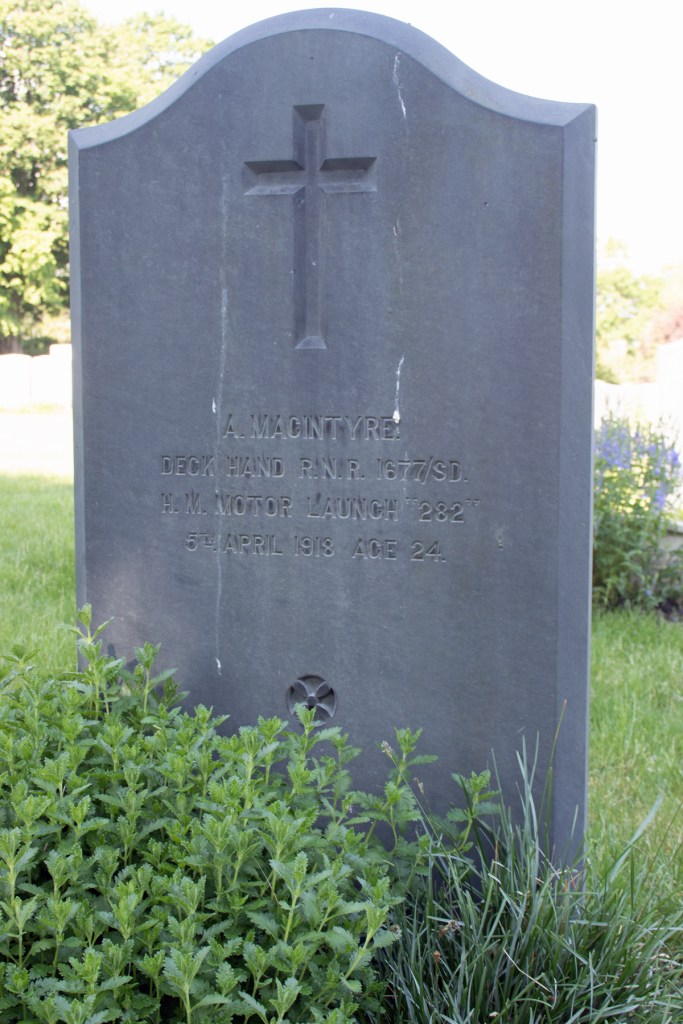
In April 1918, Angus was acting as a Deck Hand on Motor Launch 282 in the North Sea, supporting the “Zeebrugge Raid”, an attempt by the Royal Navy to block the Belgian port by scuppering obsolete vessels in the canal entrance.

Full details are not clear, but it would seem that the vessel Deck Hand MacIntyre was serving on was ferrying men between some of the ships that were being scuppered. When it was trying to manoeuvre it’s way out of the Zeebrugge Canal, it came under heavy machine gun fire, and a number of people on board were shot.

The motor launch managed to get clear of the fighting and returned to England. Unfortunately, Angus was one of the victims of the German gunfire. He was just 23 years of age.

The boat sailed back to the Naval Dockyard in Chatham, Kent. Angus MacIntyre was laid to rest in the nearby Woodlands Cemetery.


Angus Macintyre died at sea 1918
Angus MacIntyre
(from ancestry.co.uk)