Tag Archives: Royal Navy

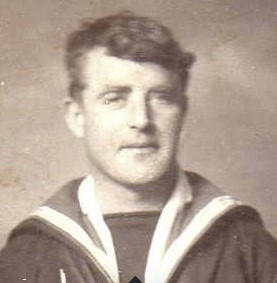
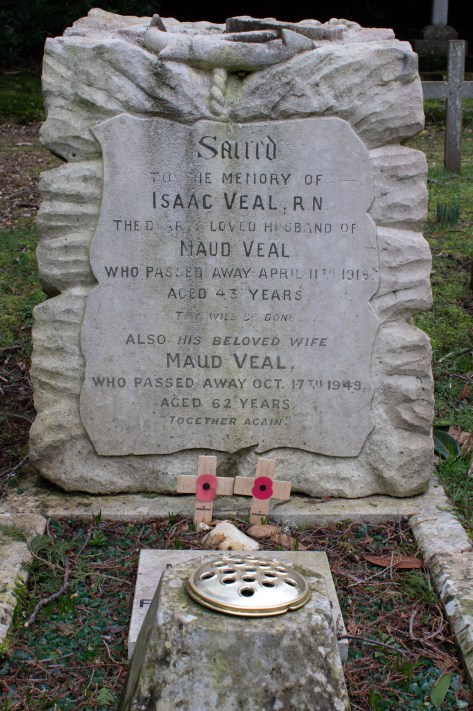
Able Seaman Isaac Veal

Able Seaman Isaac Veal

Isaac Veal was born on 18th November 1874, the seventh of eight children to Joseph and Frances Veal. When he was born, his parents were the publicans at the Waterloo Arms in Lyndhurst, Hampshire, and this is the town in which they would raise their family.

Frances died in 1890, and by the following year’s census, Joseph had stepped back from being a landlord, he was living with three of his children on a farm to the north of the town centre. Now employed as a domestic gardener, Isaac was working with him.

Isaac sought bigger and better things, however, and, on 21st December 1891, he enlisted in the Royal Navy. Intriguingly, though, he gave his date of birth as 10th July 1875. Below the age to formally sign up, he was given the rank of Boy 2nd Class, and was sent to HMS St Vincent in Devonport, Devon, for training. He remained on board for the next two years, rising to Boy 1st Class in March 1893.

On 26th August 1893, Isaac was promoted to Ordinary Seaman: this would normally mark a boy’s coming of age, but the date doesn’t match Isaac’s given date of birth, or his actual one. It is likely, therefore, that his true age had become known.

Ordinary Seaman Veal’s service documents confirm that he was 5ft 6ins (1.68m) tall, with auburn hair, brown eyes and a fair complexion. He signed up for a period of twelve years and, during that time, he would serve on a total of eleven ships. Isaac travelled the world, returning to HMS Victory, the Royal Naval Dockyard in Portsmouth, Hampshire, in between voyages.

On 11th March 1895, Isaac was promoted to the rank of Able Seaman, and his annual reviews generally marked him of very good character. From April 1901 he was assigned to the battleship HMS Revenge, and she would remain his home for more than four years. During his time assigned to her his contract came to an end and he immediately re-enlisted.

On 18th October 1909, Isaac married Ethel Maud Astridge, a caretaker’s daughter from Basingstoke, Hampshire. When they wed, Ethel – who was better known by her middle name – was working as a housemaid for a miller in North Stoneham. The couple would go on to have three children – Beatrice, Mary and Florence – and while her husband was away at sea, Ethel lived in their cottage on Queen’s Road in Lyndhurst.

Back at sea, Able Seaman Veal would continue to travel the world. During the second term of his contract with the navy, he was assigned to a further dozen ships. In August 1912, Isaac was assigned to HMS Dolphin, the shore base in Gosport, Hampshire, which was the home of the Royal Navy Submarine Service. Over the next five years he would split his time between Dolphin and HMS Maidstone. The submarine depot ship, which operated out of Harwich, Essex, would be his home for the majority of the First World War. Able Seaman Veal’s commitment to the navy was being recognised, as was his ability, which was recorded as superior in each of his annual reviews from 1911 onwards.

As the conflict entered its closing months, Isaac’s health was becoming impacted. In the spring of 1918, he was admitted to the sick quarters in Shotley – just across the river from Harwich – suffering from pernicious anaemia and rheumyalgia. The combination of conditions would prove fatal: Isaac passed away on 11th April 1918, at the age of 43 years old.

The body of Isaac Veal was taken back to Hampshire for burial. He was laid to rest in Lyndhurst Cemetery, just a few minutes’ walk from his family home. Conveyed to the cemetery in a motor ambulance van, he funeral was supported by a firing party from the local Bombing School Camp, tributes including “a token of respect from the men of the 8th and 9th Submarine Flotillas.” [Hampshire Advertiser – Saturday 20 April 1918]


After the death of her husband, Maud remained living in Myrtle Cottage, the family’s home for the rest of her life. The 1921 census recorded her as being an apartment House Keeper, while the 1939 Register noted that both she and her daughter Florence, were carrying out unpaid domestic duties.

This latter document identifies three boarders to Myrtle Cottage, including Maud’s younger sister Thirza.

Ethel Maud Veal died on 17th October 1949, at the age of 62. She was buried in the family plot in Lyndhurst Cemetery, reunited with her husband Isaac after more than 30 years.


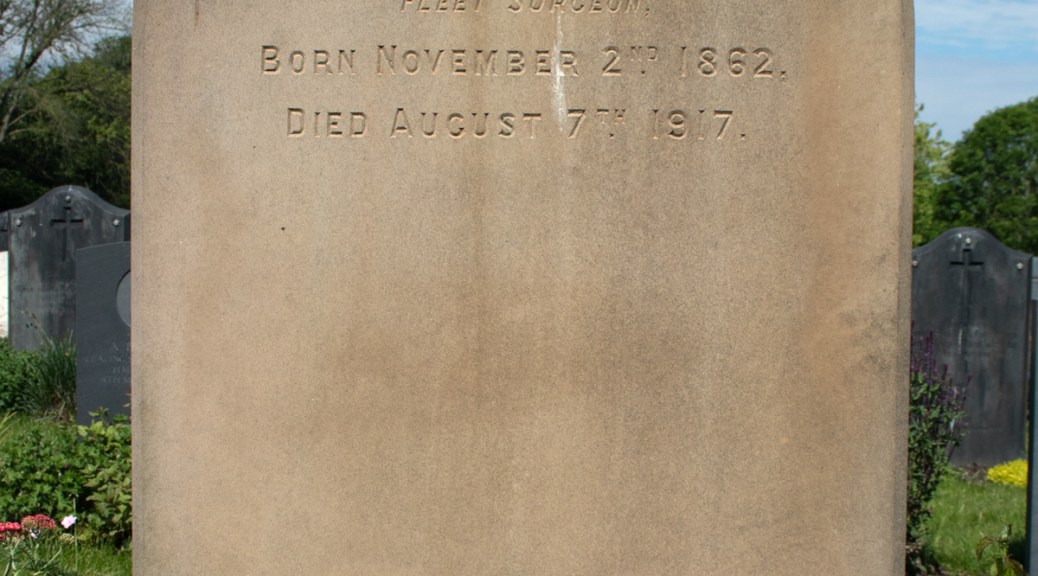
Fleet Surgeon Edward Ward

Fleet Surgeon Edward Ward

Edward Copley Ward was born in Charleville, County Cork, Ireland, on 2nd November 1862. The middle of three children, his parents were Thomas and Elizabeth Ward. Thomas died in 1868, and there is scant information about Edward’s life until he reached his early 20s.

It is clear that he had a focus on education, and a leaning towards the medical side of things. By December 1883, he had qualified as a Master Surgeon at the Royal University of Ireland, and was licenced in midwifery through the King & Queen’s College of Physicians.

Edward was not one to rest on his laurels, however, and he soon tasked himself to a naval career. On 21st August 1900 he was recorded on the Navy Lists as being a Fleet Surgeon, although there is little specific information about this service at this time.

MARRIAGES: WARD-CROWE

October 28, by special licence, at Kill Church… Staff-Surgeon Edward C Ward, RN, to Eleanor, daughter of the late Michael F Crowe, JP, of Melfield, Blackrock, County Dublin.

[Northern Whig: Saturday 1st November 1902]

Edward and Eleanor’s trail goes cold again at this point, and it is not until the 1911 census that we are able to pick them up again. By this point, Eleanor, now 45 years old, is living with four of her sisters, Kate, Charlotte, Isabella and Susanna in a house in Monkstown, Dublin. The family are supported by a domestic servant, Mary Collins.

Edward, meanwhile, was serving on board the battleship HMS Jupiter, which was moored in Weymouth Bay, Dorset. There were 548 crew members on board, and the now Fleet Surgeon Ward was one of seventeen commissioned officers, serving under Rear Admiral Arthur Limpus.

Over the next three years, Edward would serve on six further ships, but, by the time war was declared in the summer of 1914, he found himself shore-based. From December of that year, he served at HMS Pembroke, the Royal Naval Dockyard in Chatham, Kent. His role: to oversee the treatment of incoming wounded troops, and their preparation for onward transport to whichever hospital they would end up.

Fleet Surgeon War would spend the next three years fulfilling this task, but, by the summer of 1917, it would be Edward himself who needed support. Admitted to the Royal Naval Hospital in Chatham, he was suffering from tubercular disease of the kidney, and it would be this condition to which he would succumb. He passed away on 7th August 1917, at the age of 54 years old.

The body of Edward Copley Ward was laid to rest with a simple headstone in Woodlands Cemetery, Gillingham, Kent, not far from the dockyard he had come to know as home.


Interestingly, when Edward’s estate went to probate, he left his estate – worth £1257 7s 11d (approximately £111,500 in today’s money) to Geoffrey Holt Stillwell, with no mention of Eleanor. Geoffrey was a member of a banking family from the south of England, who served as a Lieutenant Colonel in the 4th Hampshire Regiment.


Fleet Surgeon Edward Ward
(from ancestry.co.uk)

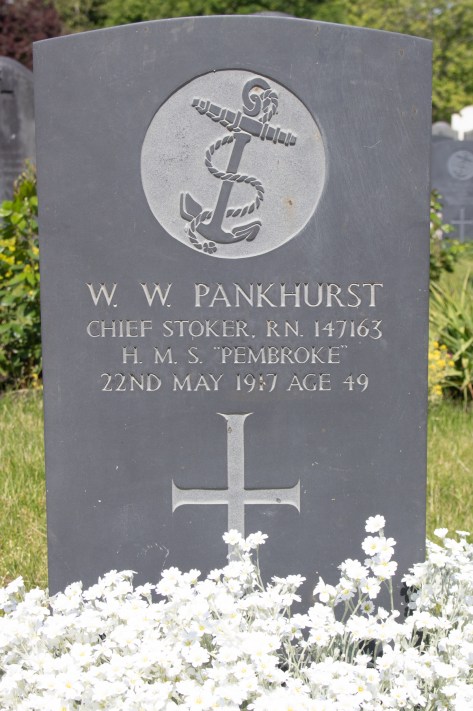
Chief Stoker Walter Pankhurst

Chief Stoker Walter Pankhurst

Walter William Pankhurst was born on 21st March 1867, and was the third of four children – and the only son – to Thomas and Harriet Pankhurst. Thomas was a farm labourer from Staplehurst, Kent, but he and Harriet raised their family in Murston, to the east of Sittingbourne.

Walter initially followed his father into farm work, but he sought a bigger and better life and, on 3rd December 1888, he enlisted in the Royal Navy. His service records show that, at 21 years of age, he was 5ft 7ins (1.7m) tall, with dark hair, hazel eyes and a ruddy complexion.

Given the rank of Stoker 2nd Class, Walter was sent to HMS Pembroke, the Royal Naval Dockyard in Chatham, Kent, for his training. In the summer of 1889 he was given his first posting, on board the gunboat HMS Pigmy, and she would remain his home for the next three-and-a-half years.

When he joined up, Walter had committed to twelve years’ service, and this time was not wasted. By the time his contracted came up for renewal, he had served on three further ships, returning to Chatham in between voyages. He had also progressed through the tanks, to Stoker 1st Class in January 1890, Leading Stoker 2nd Class in March 1897 and, with the renewal of his service, to Leading Stoker 1st Class in February 1901.

On 15th June 1904, Walter married Ellen Goddard. A gardener’s daughter from Eastling, Kent, by the time of their wedding, she was working as a domestic servant for a chemist in Hampstead, Middlesex. The couple exchanged their vows in St Stephen the Martyr’s Church, Hampstead, Ellen’s sister Susan acting as one of the witnesses.

Back in the Navy, Walter’s career continued its progression. Regularly noted as being of very good character, within three months of his wedding he was promoted to Acting Chief Stoker. By October 1905 the role was formalised, and he would end his naval career in December 1910 as Chief Stoker.

Stood down to reserve status, Walter made the move to civilian life. The 1911 census found him and Ellen living at 95 Glencoe Road, Chatham, a small terraced house with just four rooms. The couple had had three children by this point, and Susan was also living with them. A naval pensioner, Walter was still employed by the navy, and was working as a bootmaker’s labourer in the dockyard.

When war was declared in the summer of 1914, Chief Stoker Pankhurst was called into service once more. For the next couple of years he would be based at HMS Pembroke, either working in the dockyard’s boiler rooms or training new recruits.

In the spring of 1917, Walter was taken ill. He was suffering from haematemesis, and the condition was to prove his undoing. He passed away on 22nd May 1917, at the age of 50 years old.

The body of Walter William Pankhurst was laid to rest in the naval section of Woodlands Cemetery, Gillingham, a few miles from where Ellen was now living on Luton Road, Chatham.


By the time Walter passed, he and Ellen had had four children. His widow never remarried, but when she died, on 7th April 1961, she was buried alongside her husband. She was 90 years of age.

The couple’s eldest daughter, Nancy, remained a spinster throughout her life, initially supporting her mother after Walter died. Nancy was buried with her parents, when she died in 1995: she was also 90 years old.


Ship’s Steward Archibald Wright

Ship’s Steward Archibald Wright

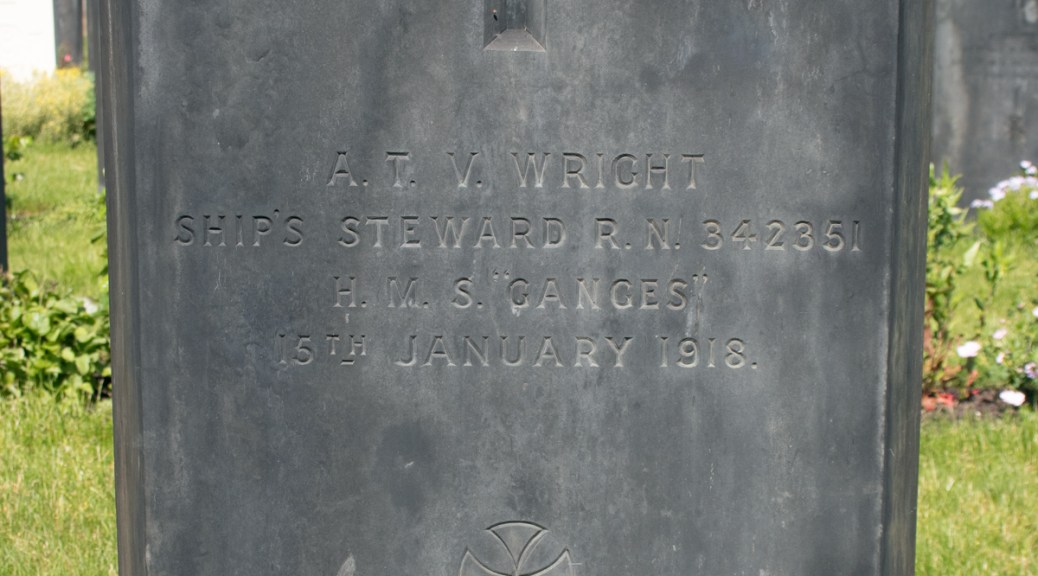
Archibald Thomas Victor Wright was born on 3rd August 1883 in Portsmouth, Hampshire. The second of six children – all boys – his parents were George and Alice Wright. George was a gunner and lieutenant in the Royal Navy, and the seafaring life was an obvious choice for his son to follow as well.

Archibald joined the Royal Navy as a Ship’s Steward Boy on 14th September 1898. Just fifteen years old, he was too young for formally enlist but was sent to HMS Pembroke, the Royal Naval Dockyard in Chatham, Kent, for his training.

Over the next three years, Archibald learnt the tools of his trade. He moved between establishments, from HMS Boscawen in Portland, Dorset, to HMS Excellent back in in Portsmouth. It was while on board the battleship HMS Glory, however, that he came of age, and was formally enlisted in the Royal Navy as a Ship’s Steward Assistant. His service records note that, on turning eighteen, he was 5ft 2in (1.58m) tall, with brown hair, dark brown eyes and a fresh complexion.

Ship’s Steward Assistant Wright’s contract was for twelve years, and during this time he would travel the world. By the summer of 1908 he had served on nine ships, returning to naval bases in Kent and Hampshire between voyages. On 15th June 1908 he was promoted to Acting Ship’s Steward, and just a few weeks later, he got married.

Ellen Osborne was born in Southampton just a month or so after her new husband. The daughter of a house furnisher’s clerk, by the time of the 1901 census she was employed as a boarding school teacher. After the couple married, she moved to Kent to be close to the Royal Naval Dockyard in Chatham (also known as HMS Pembroke), where Archibald would more frequently be based. The 1911 census return found her lodging with Lillie Calcutt at 112 Shakespeare Road in Gillingham, Kent.

Archibald’s career, meanwhile, was continuing apace. On 24th September 1909 he was promoted to Ship’s Steward proper, and in August 1913, when his original term of service came to an end, he quickly renewed it. By now, his service records show that he had had a few tattoos added to his arms: a girl on his right arm, a dragon on his upper left, and two cockerels on his lower left arm. Now 30 years of age, he stood 6ft tall (1.83m) tall, and, intriguingly, his eyes were now recorded as being blue.

Ship’s Steward Wright’s career trajectory does not seem to have been without its hiccups, however. Where his annual review up until 1909 have consistently given his character as very good, from hereon in, it dipped to just good. His ability also began to vary, from very good in 1909, to superior for the following couple of years, to just satisfactory in 1913 and 1915.

Archibald spent the last few years of the war split between HMS Pembroke and HMS Ganges – the training base just outside Ipswich, Suffolk. In January 1918, he was admitted to the Royal Naval Hospital in Chatham, following an epileptic fit. This was to prove fatal, and he passed away on 15th January. He was 34 years of age.

Interestingly, Ship’s Steward Wright’s pension ledger gives a damning insight into his health and mental well-being at the time of his passing. It noted the cause of his death as epilepsy aggravated by alcoholism, adding that the disease was neither contracted on nor aggravated by [active service], but due to his own serious negligence or misconduct.

Archibald Thomas Victor Wright was laid to rest in the military section of Woodlands Cemetery in Gillingham, Kent, not far from the dockyard he had called home.


Naval Instructor George Carter

Naval Instructor George Carter

George Leslie Lewis Carter was born at the start of 1891 in New Cross, Kent. The oldest of three children, his parents were laundry managers William and Isabel Carter.

The Carters’ work seemed to take them across South London and the 1891 census found them living in Hammersmith. George’s two siblings had been born by this point, one in Gravesend, Kent, the other in Richmond, Surrey.

By 1911, William and Isabel had moved the family to Kingston-upon-Thames, Surrey. That year’s census recorded them as living at 142 London Road, which was noted as being a 12-roomed property. The couple were managing a laundry – possibly living in at the laundry itself. George was recorded as being a university student, while his younger brother Lionel was at school. The family also had a housekeeper, Frances Stoke, living with them.

When George finished his studies, he found employment as an Assistant Paymaster with the Royal Naval Reserve. On 15th February 1916, he married Ada Ritchie. She was a merchant’s daughter from Long Ditton, Surrey, and the couple exchanged vows in her local parish church.

At this point, George’s trail goes cold. He became attached to the Royal Naval College in Dartmouth, Devon – also known as HMS Pomone – and took on the role of Naval Instructor. It is unclear what type of instructing he was doing, but it seems likely to have been connected with the administration or financial part of the Royal Navy.

The funeral of Naval Instructor George Leslie Lewis Carter, Royal Naval College, Dartmouth, who died on Monday from pneumonia following an attack of influenza, took place on Wednesday morning…

The mourners were Mrs Carter (widow), Mrs Carter, Surbiton (mother), Mr Carter (brother), and Mr Jamieson Ritchie, London (brother-in-law)…

[Dartmouth & South Hams Chronicle: Friday 2nd August 1918]

Naval Instructor Carter was 27 years of age when he died on 29th July 1918. The newspaper article’s distinction between Ada and Isabel would suggest that Ada may have been living in Dartmouth at the time as well.

George Leslie Lewis Carter was laid to rest in the graveyard of St Clement’s Church in Dartmouth, Devon.


Boy 2nd Class Albert Sampson

Boy 2nd Class Albert Sampson

Albert Frederick Sampson was born on 7th November 1900, and was the older of two children to Albert and Beatrice. Albert Sr was a steward in the Royal Naval College in Dartmouth, Devon, and the family lived in a four-roomed cottage on Victoria Road.

When he finished his schooling, Albert found work as a cabin boy on a merchant vessel. When war broke out, the transition to the Royal Navy was an obvious one, and he enlisted at the start of 1916. His service records show that he was 5ft 4ins (1.62m) tall, with red hair, blue eyes and a fresh complexion. Still under the age to formally enlist, he was given the rank of Boy 2nd Class.

Albert’s time in the navy was to be tragically short. He was admitted to the Royal Naval Hospital in Plymouth, Devon, with acute quinsy, and passed away quickly. He died on 13th February 1916, at the age of just 15 years old.

Albert Frederick Sampson’s body was taken back to Dartmouth for burial. He was laid to rest in St Clement’s Churchyard.


Ordinary Seaman Thomas Fleet

Ordinary Seaman Thomas Fleet

Thomas Fleet was born on 3rd February 1879 in Kingswear, Devon, and was the sixth of nine children to Thomas and Emma. Thomas Sr was a fish dealer, and the family lived on Lower Street over the river in Dartmouth. Most of the family were involved in the fish industry, and by the time of the 1901 census, Thomas Jr was also working as a fisherman.

On Christmas Day 1901, Thomas Jr married Hannah Jury. She was a farm labourer’s daughter from Torquay, Devon. The couple married in Hannah’s home town, but settled back in Dartmouth. They had five children – Reginald, Elspeth, Edith, Florence and Thomas – and set up home in a five-roomed house on Victoria Road.

By the time of the 1911 census, Thomas had changed jobs, and was working as a yachtsman. The following year, Reginald died, at the age of just 9 years old. It is unclear how he died, but he passed in August 1912, and was buried on 2nd September, in St Clement’s Churchyard, Dartmouth.

When war broke out, Thomas would be called upon to serve. Unsurprisingly, given his job, he joined the Royal Navy, enlisting on 30th March 1917 as an Ordinary Seaman. His service records show that, at 5ft 2ins (1.57m) tall, he had brown hair, blue eyes and a fresh complexion.

Ordinary Seaman Fleet was sent to HMS Vivid, the Royal Naval Dockyard in Devonport, Devon, for his formal training. Tragically, however, his time in the service was to be a brief one. He contracted lobar pneumonia and was admitted to the barracks’ sick quarters. He passed away from heart failure on 13th May 1917, at the age of 38 years old.

The body of Thomas Fleet was taken back to Dartmouth for burial. He was laid to rest in the family plot in St Clement’s Churchyard, reunited with his oldest son, Reginald.


Petty Officer 1st Class Frederick Morgan

Petty Officer 1st Class Frederick Morgan

Frederick Morgan was born on 15th July 1871, the oldest of four children to Samuel and Selina. Samuel was a miner from Bristol, Gloucestershire, but it was in the Staffordshire town of Tipton that he and local girl Selina married and raised their family. The 1881 census found the Morgans living at 17 Brewery Street, to the south of the town centre.

Frederick was not destined to follow in his father’s footsteps, however, and had his sights set on a life at sea, rather than in the depths of a coal mine. On 23rd November 1896 he joined the Royal Navy, and was sent to HMS Impregnable, the training base in Devonport, Devon, for his induction.

Being too young to formally enlist, Frederick was given the rank of Boy 2nd Class. Over the next three years, he learnt the tools of his trade, and served at three further bases: HMS Lion, HMS Penelope and HMS Raleigh. During this time, he was promoted to Boy 1st Class and, on 15th July 1889, when he turned 18, he was formally inducted into the Royal Navy.

Ordinary Seaman Morgan’s service records show that he was just 5ft 2.5ins (1.59m) tall. He had light brown hair, blue eyes and a fair complexion. He also had a tattoo by this point, of a dancing sailor on the inside of his right arm.

Frederick remained at HMS Raleigh for the next couple of years, and was promoted to Able Seaman on 1st July 1891. From the autumn, however, his sea-going life really took hold. Over the next ten years, he served on five ships, and was to be based at HMS Vivid, the Royal Naval Dockyard in Devonport, in between voyages. His dedication to the service was recognised – his annual reviews regularly noted his character as very good, and he rose through the ranks to Leading Seaman in May 1898, Petty Officer 2nd Class that October, and Petty Officer 1st Class in January 1901.

Away from work, Frederick’s love life was blossoming. In the autumn of 1893 he married Zipporah Elizabeth Beatrice Griffiths. Better known as Beatrice, she was the daughter of waterman Thomas Griffiths and his wife, Zipporah. The family came from Dartmouth, and this is likely where the young couple got to know each other. They married in St Clement’s Church, Dartmouth, and went on to have two children, George and Kathleen.

On 15th July 1901, Petty Officer Morgan’s initial contract with the Royal Navy came to an end. He renewed it straight away, and would spend the next decade sailing the world. Again Frederick was based at HMS Vivid in between voyages. On 11th July 1911, after 21 years in service, he was formally stood down to reserve status, and he returned to shore.

Frederick’s trail goes cold over the next couple of years, but when war broke out, he was called into service once more. Petty Officer Morgan would serve on the depot ships HMS Leander and Cyclops, which served out of Scapa Flow. He also spent time at HMS Gunner, the naval base to the north of Edinburgh. By March 1919, with the Armistice signed, he found himself based back in Devon.

At the Royal Naval Hospital, Plymouth, on Saturday, an inquest was held relative to the death of Fredk Morgan, 47, a naval pensioner, who died suddenly in the train on Thursday last.

Wm. Griffiths, inspector, GWR, at Millbay, said that PO Morgan was removed from the 6.20 train from Saltash on Thursday, apparently in a fit. He was laid on a seat, and a doctor who was about to travel on another train pronounced life extinct.

Charles Evans Jenkins, surgeon-lieutenant at the Naval Hospital said death was due to fatty degeneration of the heart.

The Coroner, who expressed his sympathy with the widow, declared that death was due to natural causes.

[Western Times: Tuesday 1st April 1919]

Frederick Morgan died of a heart attack on 27th Match 1919. He was laid to rest in the graveyard of St Clement’s Churchyard, Dartmouth, where he and Beatrice had been married.


Stoker 1st Class Frederick Webber

Stoker 1st Class Frederick Webber

Frederick Webber, of Westexe-south, Tiverton, stoker in the Royal Navy, has died at the age of 40. He had been in the Navy 15 years, and was on board HMS Dartmouth when she was torpedoed, and on HMS Sylvia when she sank a submarine. While home on leave in November he was taken ill. He partially recovered, but had a relapse and died on December 28th.

[Tiverton Gazette (Mid-Devon Gazette): Tuesday 1st January 1918]

The early life of Frederick Webber is a challenge to piece together, as his is not an uncommon name for the area and period.

His widow is recorded as Elizabeth Webber, and marriage record from August 1907 suggests his father’s name was also Frederick. Stoker Webber’s entry on the military pension ledger confirms two children – Frederick and Frank.

When he enlisted on 10th February 1903, he gave his date of birth as 26th December 1880 and his place of birth as Exeter, Devon.

This combination of details doesn’t give any definite results from the 1891 or 1901 census, so it’s not possible to confirm the early stages of his life.

Based on Frederick’s naval records, he was working as an engine driver when he joined up. He was 5ft 4ins (1.63m) tall, with dark brown hair, hazel eyes and a fresh complexion. He was also noted as having a tattoo on his right forearm

Stoker 2nd Class Webber was sent to HMS Vivid – the Royal Naval Dockyard in Devonport. Enlisting for an initial period of 12 years, he would spend that time serving on a total of ten ships, returning to his Devon base in between voyages.

Frederick’s career seems to be one of doing just enough to satisfy his superiors. His annual reports noted his character and ability as being good or satisfactory, and he spent three periods of time in the brig – for three days in 1904, 14 days in 1906 and five days in 1910.

Frederick’s was promoted to Stoker 1st Class in July 1906 and, unusually, he remained at that rank for the rest of his career. It may be that promotion didn’t come his way, or simply didn’t appeal to him, and he was happy doing what he was doing.

Stoker Webber came down with bronchitis while he was on leave in November 1917. Based on his service records, he had just turned 47 years of age when he passed.

Frederick Webber was laid to rest in Tiverton Cemetery, not far from his grieving family’s home.


Petty Officer 1st Class George Bailey

Petty Officer 1st Class George Bailey

George Bailey was born in Bedminster, Somerset, on 20th August 1871. One of six children, his parents were George and Anna (or Hannah) Bailey. George Sr was a labourer and, when he died in 1876, Anna moved the family to Clifton, near Bristol.

The 1881 census found the family living in a small cottage at 5 Crosby Row in the then village. Hannah was listed as a late general labourer’s wife, while her three older children were all working for a dairy.

When George finished his schooling, he sought out a career. Joining the Royal Navy, this would prove a long-term role, bringing in a relatively decent wage for him and his family, but also gave him some adventure, not surprising given the number of ships he would have seen going to and fro from Bristol.

George was only 15 years old when he joined up on 25th September 1886, and so was below the age to formally enlist in the navy. Taken on with the rank of Boy 2nd Class, he was sent to HMS Impregnable, the training ship based in Devonport, Devon. Over the next three year he learnt his craft, and served on a few ships, including the battleship HMS Iron Duke.

In October 1887, George was promoted to Boy 1st Class and, on 20th August 1889, while assigned to the Iron Duke, he came of age, and was formally inducted into the Royal Navy. Ordinary Seaman Bailey’s service records show that he was 5ft 5.5ins (1.66m) tall, with auburn hair, blue eyes and a fresh complexion. He was also noted as having a spot tattooed between the finger and thumb of his left hand, a scar on his left leg and another in the centre of his back.

Over the next seven years, George served on a total of ten ships, and saw the world. In between voyages he returned to HMS Vivid, the Royal Naval Dockyard in Devonport. In 1895 he married Elizabeth Bull, from Burrington, Somerset, and the couple went on to have six children.

George’s naval career continued, and he rose through the ranks, to Able Seaman in September 1890, Leading Seaman in June 1895, and to Petty Officer 2nd Class and 1st Class the following year.

In January 1899, George’s life took a different direction. After some time training at HMS Collingwood in Hampshire, he joined the Coastguard service, and would spend the next twelve years serving on the coast of Southern Ireland. This opportunity allowed him to have his family with him, and his and Elizabeth’s four youngest children were born in County Clare and County Cork.

By 1911, the family returned to Britain, setting up home in Brixham, Devon. That year’s census found the Baileys living at 6 Coastguard Station on the waterfront. The family remained there through to October 1913, when George was transferred to the Royal Naval Reserve, having served for 26 years.

George found work as the caretaker of the Electric Theatre in Tiverton, Devon, and this is where he and Elizabeth settled down.

Petty Officer Bailey’s time out of active service was to be limited, however, as, just nine months later, war was declared. Called back into action, he was sent to Western Stack Fort in Milford Haven, Pembrokeshire.

An interesting personality has passed away in First-Class Petty Officer George Bailey, who died suddenly on Tuesday… He came home about a fortnight ago on sick leave, and seemed to be improving in health, and on Tuesday went out for a walk. After retiring to bed his death came suddenly as a result of heart failure.

[Crediton Gazette: Saturday 24th March 1917]

George Bailey died on 13th March 1917: he was 45 years of age. He was laid to rest in Tiverton Cemetery.