Tag Archives: Scotland

Deck Hand John McDonald

Deck Hand John McDonald

Born in Laxay (Lacasaigh) on the Isle of Lewis, Scotland, John Murdo McDonald was the son of Donald and Maggie McDonald. He can be readily identified on the 1901 census, which suggests that he was born in January of that year. The family do not appear on the 1911 census, and John’s trail quickly goes cold.

When war broke out, it would seem that John stepped up to play his part. He joined the Royal Naval Reserve – suggesting that he had some seafaring experience, but his service papers have been lost to time. There are at least four John Murdo McDonalds born around 1901, who all served in the Royal Naval Reserve. None of their service numbers match that of John’s, however.

By the summer of 1917, Deck Hand McDonald was serving on board the motor drifter Ocean’s Gift. The boat, little more than a trawler requisitioned by the Royal Navy, was used as a patrol ship around the Thames Estuary.

That July, John was admitted to the Royal Naval Hospital in Chatham, Kent. He was suffering from tuberculosis, and this would ultimately take his life. He died on 2nd July 1917, aged just 17 years old.

The Isle of Lewis was an unimaginable distance from Kent, and so the body of John Murdo McDonald was not returned to his family. Instead, he was laid to rest in the naval section of Woodlands Cemetery in Gillingham, Kent, not far from the dockyard in Chatham, that had briefly been his home.


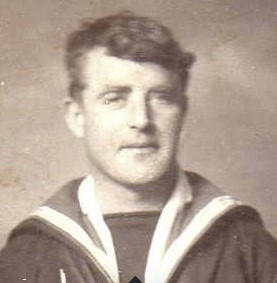
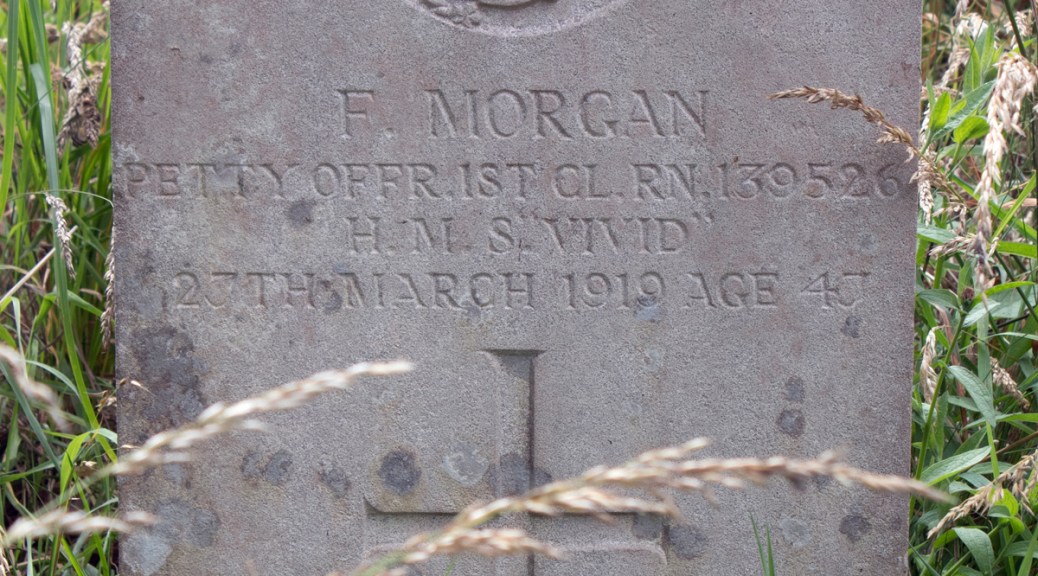
Petty Officer 1st Class Frederick Morgan

Petty Officer 1st Class Frederick Morgan

Frederick Morgan was born on 15th July 1871, the oldest of four children to Samuel and Selina. Samuel was a miner from Bristol, Gloucestershire, but it was in the Staffordshire town of Tipton that he and local girl Selina married and raised their family. The 1881 census found the Morgans living at 17 Brewery Street, to the south of the town centre.

Frederick was not destined to follow in his father’s footsteps, however, and had his sights set on a life at sea, rather than in the depths of a coal mine. On 23rd November 1896 he joined the Royal Navy, and was sent to HMS Impregnable, the training base in Devonport, Devon, for his induction.

Being too young to formally enlist, Frederick was given the rank of Boy 2nd Class. Over the next three years, he learnt the tools of his trade, and served at three further bases: HMS Lion, HMS Penelope and HMS Raleigh. During this time, he was promoted to Boy 1st Class and, on 15th July 1889, when he turned 18, he was formally inducted into the Royal Navy.

Ordinary Seaman Morgan’s service records show that he was just 5ft 2.5ins (1.59m) tall. He had light brown hair, blue eyes and a fair complexion. He also had a tattoo by this point, of a dancing sailor on the inside of his right arm.

Frederick remained at HMS Raleigh for the next couple of years, and was promoted to Able Seaman on 1st July 1891. From the autumn, however, his sea-going life really took hold. Over the next ten years, he served on five ships, and was to be based at HMS Vivid, the Royal Naval Dockyard in Devonport, in between voyages. His dedication to the service was recognised – his annual reviews regularly noted his character as very good, and he rose through the ranks to Leading Seaman in May 1898, Petty Officer 2nd Class that October, and Petty Officer 1st Class in January 1901.

Away from work, Frederick’s love life was blossoming. In the autumn of 1893 he married Zipporah Elizabeth Beatrice Griffiths. Better known as Beatrice, she was the daughter of waterman Thomas Griffiths and his wife, Zipporah. The family came from Dartmouth, and this is likely where the young couple got to know each other. They married in St Clement’s Church, Dartmouth, and went on to have two children, George and Kathleen.

On 15th July 1901, Petty Officer Morgan’s initial contract with the Royal Navy came to an end. He renewed it straight away, and would spend the next decade sailing the world. Again Frederick was based at HMS Vivid in between voyages. On 11th July 1911, after 21 years in service, he was formally stood down to reserve status, and he returned to shore.

Frederick’s trail goes cold over the next couple of years, but when war broke out, he was called into service once more. Petty Officer Morgan would serve on the depot ships HMS Leander and Cyclops, which served out of Scapa Flow. He also spent time at HMS Gunner, the naval base to the north of Edinburgh. By March 1919, with the Armistice signed, he found himself based back in Devon.

At the Royal Naval Hospital, Plymouth, on Saturday, an inquest was held relative to the death of Fredk Morgan, 47, a naval pensioner, who died suddenly in the train on Thursday last.

Wm. Griffiths, inspector, GWR, at Millbay, said that PO Morgan was removed from the 6.20 train from Saltash on Thursday, apparently in a fit. He was laid on a seat, and a doctor who was about to travel on another train pronounced life extinct.

Charles Evans Jenkins, surgeon-lieutenant at the Naval Hospital said death was due to fatty degeneration of the heart.

The Coroner, who expressed his sympathy with the widow, declared that death was due to natural causes.

[Western Times: Tuesday 1st April 1919]

Frederick Morgan died of a heart attack on 27th Match 1919. He was laid to rest in the graveyard of St Clement’s Churchyard, Dartmouth, where he and Beatrice had been married.


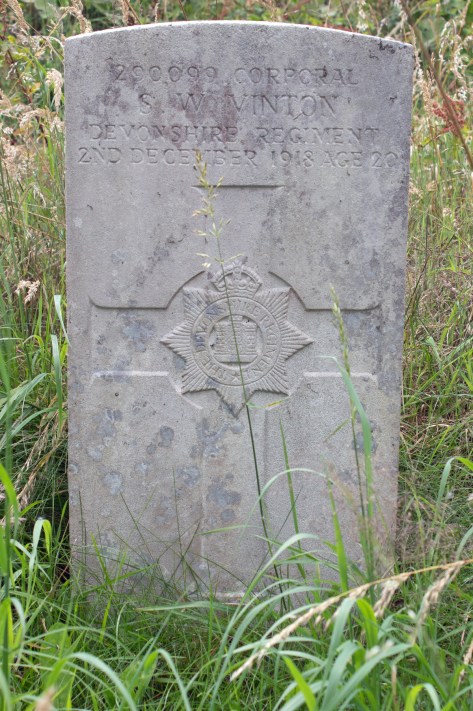
Corporal Stanley Vinton

Corporal Stanley Vinton

Stanley William Vinton was born on 30th April 1898 in Dartmouth, Devon. The second of eight children, his parents were William and Kate. William was an outfitter’s assistant, and by the time of the 1911 census, the family of ten were living in a four-roomed cottage on South Ford Road.

When he finished his schooling, Stanley was apprenticed to a shipwright. Away from work, he volunteered with the Dartmouth Cadet Company, and was drawn towards an army career. On 25th May 1914, he enlisted, joining the 7th (Cyclist) Battalion of the Devonshire Regiment. His service records show that he gave his age as 17 years and four months old. He was 5ft 6.5ins (1.69m) tall, and weighed 154lbs (69.9kg). Private Vinton was of good physical development and had good eyesight.

Stanley was formally mobilised on 5th August 1914. He remained on home soil for the next three years, primarily because soldiers were unable to fight on the Western Front until they turned 19 years of age. During this time, he appears to have impressed his superiors: in July 1916 he was promoted to Lance Corporal, and just four months later he rose to full Corporal.

In July 1917, Stanley’s chance to see some action arrived, when he was posted to the 2nd Battalion, and sent overseas. This move came with a caveat, however, and he reverted to the rank of Private. It was a challenging time for the regiment, and Stanley quickly found himself in the thick of it at Passchendaele.

On 30th November 1917, after four months on the Western Front, Private Vinton’s luck came to end. Caught up in the fighting, he was wounded in his left thigh by shrapnel and the fingers of his left hand by a gun shot wound. He was medically evacuated to Britain for treatment, and admitted to the Edinburgh War Hospital in Bangour.

Thankfully, the injury to Stanley’s hand was minimal, but his leg took longer to heal, and he remained in hospital for more than two months. When he was discharged, Private Vinton was transferred to the regiment’s command depot in Sutton Coldfield. In March 1918, he was promoted to Corporal, but his injured leg was still causing him discomfort. In the end, he was reassigned to a munitions works in Lowestoft, Suffolk, and this is where he would spend the remainder of the year.

Stanley’s constitution was weakened by this point, and that winter, he contracted influenza. The condition was to prove fatal, and he passed away on 2nd December 1918. He was just 20 years of age.

The body of Stanley William Vinton was taken back to Devon for burial. He was laid to rest in the graveyard of St Clement’s Church, Dartmouth, high above the town’s centre, but within walking distance of his grieving family’s home.


Trimmer Cook Douglas Ferguson

Trimmer Cook Douglas Ferguson

At Dartmouth on Saturday, Mr AM Dawson held an inquest on Douglass [sic] Davidson Mitchell Ferguson, cook, aged 30, of a Government trawler, whose body was recovered from the boat float the previous afternoon.

TG Elliott, of the Britannia Inn, said deceased had one drop of whiskey at his house on Thursday.

W Bursey, seaman, said he saw deceased at the King’s Arms Hotel, the same evening. He was very quiet and chatted with others.

Frank Lavers, coal lumper, said he thought he saw Ferguson at 9.50 on his way to the Embankment. Deceased asked the time and spoke quite rationally.

After evidence as to the recovery of the body, and Dr GM Soper’s evidence that the death was due to drowning, an open verdict was returned.

Lieut. PN Taylor [Royal Naval Reserve], commander of the vessel to which deceased had belonged, said Dartmouth was the most dangerous place for the embarkation at night that he had visited, owing to the restricted lighting. He thought rails should eb placed not only around the Boat Float, but along the whole of the Embankment.

Members of the jury agreed that lights in the vicinity of the Boat Float were inadequate, and the jury added a rider to their verdict urging the authorities to provide adequate lighting as advised by the Town Council, for the benefit of persons embarking in the vicinity of the Boat Float, and with a view to preventing further tragedies.

[Western Times: Tuesday 29th February 1916]

Douglas Davidson Ferguson was born in Stirling, Scotland, on 28th August 1896. One of four children, his parents were Andrew and Mary Ferguson. There is little information available about his early life, unfortunately, but it is clear that he enlisted in the Royal Naval Reserve on the 6th September 1915.

Assigned the role of Trimmer Cook, Douglas’s records show that he was 5ft 3ins (1.6m) tall, with brown eyes and a pale complexion. He was also noted as having a tattoo of a dancing girl on his left arm.

Douglas was initially assigned to the cruiser HMS Pactolus, and travelled from Scotland to Devon, where the Royal Naval Dockyard in Devonport would become his base. He remained stationed there for the next few months, working on ships’ galleys as they patrolled out the Channel coastline. It was during one of these voyages that he fell into the River Dart and drowned.

It would seem that Douglas Davidson Ferguson’s family were unable to cover the cost of taking his body back to Scotland for burial. Instead, he was laid to rest in the graveyard of Dartmouth’s St Clement’s Church.


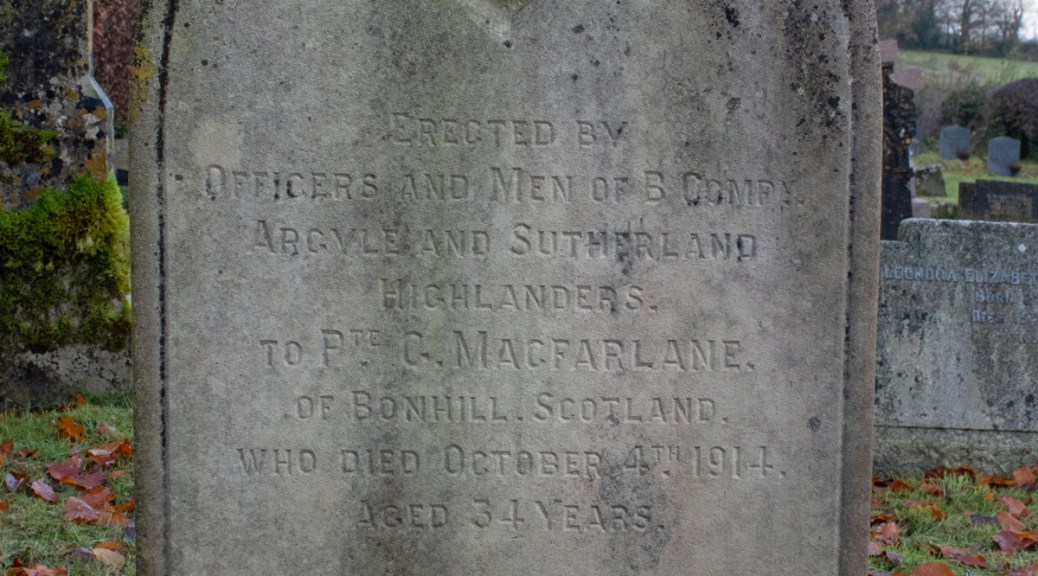
Private George MacFarlane

Private George MacFarlane

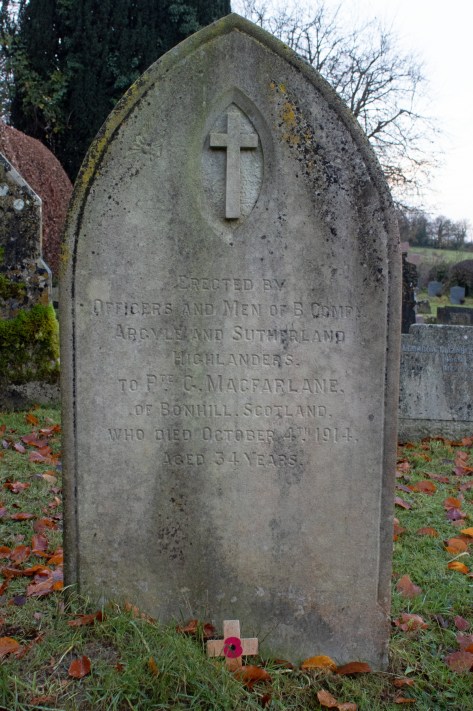
George McFarlane was born in Alexandria, Dumbartonshire, in 1879, and was the third of four children to George and Jane.

There is little concrete information about George Jr’s life, and most of that information comes from his army service records. These confirm that he was working as a printfield worker, employed by the local dye works to produce printed cloth.

The service papers also confirm that George had married Christina Kerr on 19th April 1905, and that they had four children: Irene, William, Christina and George. Christina had also had a son, Richard, from a previous relationship.

George had readily answered the call to serve his country when war broke out. He enlisted on 18th September 1914, and was assigned to the Argyll and Sutherland Highlanders. He is recorded as being 5ft 7ins (1.69m) tall and 135lbs (61.2kg), with auburn hair, grey eyes and a fresh complexion.

Private McFarlane was sent to Wiltshire for his training, and was barracked near the village of Boyton. His time there was to prove tragically short. Within a matter of weeks he contracted pneumonia, and succumbed to the condition on 4th October 1914. He was just 34 years of age, and had been in the army for 16 days.

Christina was unable to cover the cost of bringing her husband back to Scotland. Instead, George McFarlane was laid to rest in Boyton Cemetery, his headstone paid for by the men of his regiment.


Petty Officer 1st Class James Brett

Petty Officer 1st Class James Brett

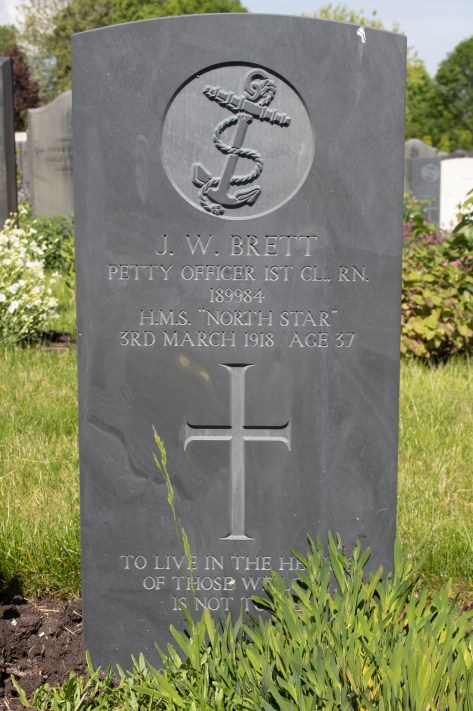
The early life of James Watt Brett is lost in the mists of time. He was born on 25th November 1880 in the Scottish village of Fochabers and when he finished his schooling, he found work as an apprentice draper. He sought bigger and better things, however, and, on 25th August 1896, he joined the Royal Navy.

At just fifteen years old, James was too young to formally enlist. He was given the rank of Boy 2nd Class, however, and dispatched to the training ship HMS Caledonia, for his basic instruction. He remained on board until October 1897, by which point he had been promoted to Boy 1st Class.

Over the next year, James served on two cruisers – HMS Blenheim and HMS Dido. His shore base became HMS Pembroke, the Royal Naval Dockyard in Chatham, Kent, and he would return here time and again in between assignments.

It was while James was serving on Dido that he came of age. Now given the rank of Ordinary Seaman, his records show that he was 5ft 1in (1.54m) tall, with fair hair, blue eyes and a fresh complexion. James would remain on board Dido until January 1902, by which time he had been promoted to the role of Able Seaman.

Over the initial twelve years of his service, James would spend time on eight vessels, and travel the world. His dedication to the navy is clear, although his career was not without its hiccups.

In April 1904, James was promoted again, to the rank of Leading Seaman. The following January he was made Petty Office 2nd Class, although this new role only lasted for a couple of weeks, before he was knocked back down to Able Seaman.

In April 1909, he was again made Leading Seaman and, promoted to Petty Officer 2nd Class once more in January 1910. By October that year, he had risen to Petty Officer 1st Class, by which point his initial contract came to an end.

James immediately re-enlisted, and retained his rank for the remainder of his naval career. At some point after the 1911 census, he married a woman called Annie, and the couple seem to have been based at Burnt Oak Terrace, Gillingham, Kent, although there is no further information about Petty Officer Brett’s new wife.

James seemed to have become more shore-based after his marriage, and he served at HMS Actaeon in Portsmouith, Hampshire, and HMS Pembroke and HMS Wildfire in Kent. By the summer of 1917, he was attached to the Dover Patrol, and assigned to HMS Attentive.

On 3rd March 1918, Petty Officer Brett’s service records note that he was accidentally killed by falling into [a] dry dock at Royal Albert Docks. No further information is available, although it is possible that the accident took place in London. He was 37 years of age.

The body of James Watt Brett was taken back to Kent for burial. He was laid to rest in the military section of the Woodlands Cemetery, Gillingham, not far from where his widow still lived.


Engine Room Artificer 3rd Class Gerald Bowerman

Engine Room Artificer 3rd Class Gerald Bowerman

A distressing fatality, involving the death of a member of the crew of HM destroyer “Rifleman”, and injury to two others, occurred at the harbour where his ship was on Saturday night. A party of four – one civilian and three Navy men – were on a motor cycle and side-car on their way to Provost Matthews’ Quay, from which the sailors were to join their ship. The cyclist, who was controlling the machine in the darkness of the night, failed to observe that the bridge at the dock gates was open to allow a vessel to pass out to sea. The motor cycle collided with the obstruction, with the result that the machine and side-car swerves round, and plunged headlong into the well from which the bridge swings.

The result of the accident was that Gerald Bowerman (25), engine-room artificer, fractured his skull, while his two ship-mates, Charles Morrice, chief engine-room artificer, and James Fulthorpe, engine-room artificer, were somewhat severely injured. Deceased belonged to Buckfastleigh, his residence being the Mechanics’ Arms.

[Western Times: Friday 25th September 1914]

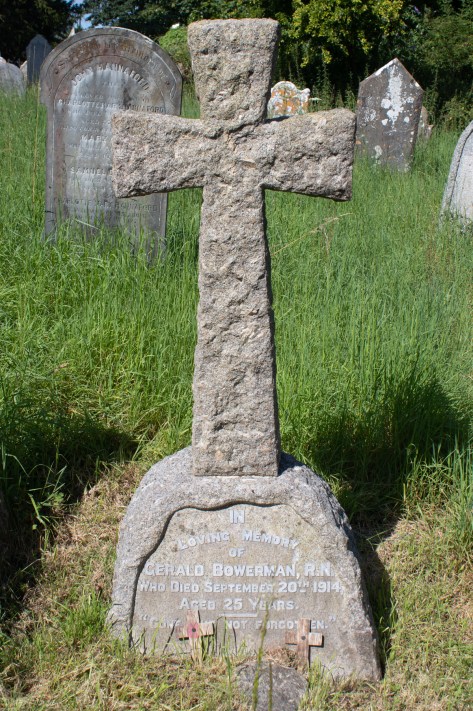
Gerald Bowerman was born in Buckfastleigh, Devon, on 30th October 1888. The youngest of four children, his parents were James and Augusta Bowerman. James was a jack-of-all-trades, with the 1891 census noting that he worked as a grocer, coal dealer and cab proprietor, with his wife assisting in the business.

James seemed to seek out new opportunities, and, by the time of the next census, taken in 1901, the family had moved to Exeter, and were running the Red Cow Inn at the foot of St David’s Hill.

Gerald’s older brother, Harold, joined the navy in 1906, and his sibling was not to be outdone. By 1910, James and Augusta had moved back to Buckfastleigh, and were running the Mechanic’s Arms. Gerald, however, was drawn to the sea and gave up his employment as a fitter and turner to enlisted in the Royal Navy on 14th September 1910. His service records show that he was 5ft 6ins (1.68m) tall, with brown hair, brown eyes and a fresh complexion.

Engine Room Artificer 4th Class Bowerman was first sent to HMS Vivid, the Royal Naval Dockyard in Devonport, for his training. He joined the battleship HMS Bellerophon in February 1911, and she would be his home for the next two years.

After another short spell in Devonport, Gerald transferred to HMS Caesar, then to the depot ship HMS Blake, to which he was assigned on 30th August 1913. The following month he was promoted to Engine Room Artificer 3rd Class, and would remain on board Blake through to the outbreak of war the following year.

Engine Room Artificer Bowerman’s ship was based in Aberdeen when the motorcycle accident occurred. He was just 25 years of age when he died, on 20th September 1914.

Gerald Bowerman’s body was taken back to Devon for burial. He was laid to rest in the graveyard of Holy Trinity Church in his home town of Buckfastleigh.


Private Garfield Peardon

Private Garfield Peardon

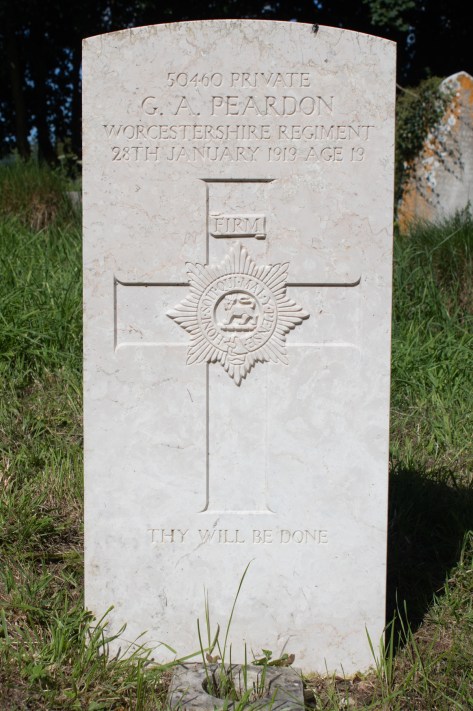
Garfield Ambrose Peardon was born on 24th February 1899, the older of two children to William and Margaret. Both farm labourer William, who had been widowed in 1885, and his second wife, Margaret were from Devon. The 1891 census found the extended family – Garfield and his parents and his older half-brother, William Jr., living in Market Street, Buckfastleigh.

Ten years later, and the family had moved just up the road to Market Street. Both of Garfield’s parents were working for the local woollen mill, William as a horseman and Margaret as a serge weaver. Garfield and his younger brother, Eric, were too young to work, and were both still at school.

Garfield stepped up to play his part for King and Country, although details of his service are a bit of a mystery. He had certainly enlisted by the start of 1918, presumably as soon as he came of age. He joined the Worcestershire Regiment, and was attached to the 3rd Battalion.

Private Peardon served in France, and was likely involved in the Battles of the Somme and Lys in the spring of 1918. His pension ledger records note that, on 27th May, he was recorded as ‘missing’: this was the day of a massive German gas and artillery bombardment and, in the confusion that followed, it appears that Garfield was identified as a potential casualty.

At this point, Private Peardon’s trail goes cold. The next available document is his entry on the Army Register of Soldiers’ Effects: this confirms that he passed away on 28th January 1919 in the 2nd Scottish General Hospital in Edinburgh. This would suggest that Garfield was wounded in the attack, and medically evacuated to Britain for treatment. He was a month short of his 20th birthday when he died.

The body of Garfield Ambrose Peardon was taken back to Devon for burial. He was laid to rest in the the grounds of Holy Trinity Church, Buckfastleigh.


Master Charles Crane

Master Charles Crane

Charles John Crane was born in Canning Town, Essex, on 14th April 1879. One of at least five children, his parents were Charles and Sarah Crane. Charles Sr had been born in Bath, Somerset, but was working in London as a hairdresser when he met his wife, and settled in West Ham. The family lived in rooms at 52 Burnham Street, sharing the house with Sarah’s parents, Daniel and Rebecca King, and siblings.

By the time of the 1891 census, the family set-up had changed. Charles Jr was now living with Daniel and Rebecca at 56 Burnham Street, but his parents and siblings are nowhere to be found. Daniel was a dock labourer, and his job seems to have ignited a passion for the sea that was to direct his grandson’s life.

Charles took to a life at sea, working his way up to the rank of Master, and settling in the Montrose area of Scotland. He married Margaret McIntosh, and they went on to have six children.

When war broke out, Charles was assigned to the SS Innescroone, and served his time on board during the conflict.

FATAL BLOW WHILE WORKING AN ANCHOR.

An inquest was held at the Royal Naval Hospital, Gillingham, into the circumstances attending the death of Charles John Crane, aged thirty-nine, master of the s.s. Innescroone. The deceased met with an accident on the 8th inst. while working the anchor of his vessel, and was removed to the hospital, where he died from the injuries he sustained on 12th inst.

The Coroner (Mr. C. B. Harris) remarked that the deceased’s vessel was at sea, so that it would not be possible to conclude the inquiry that day, as witnesses from the ship would have to be called. Only necessary evidence would be taken, and the inquest would be adjourned. Evidence of identification was given by Mrs Crane, who stated that her husband was conscious when she saw him at the hospital, but he was in too bad a condition to tell her anything about the accident.

Surgeon Percy Gibson, R.N. stated that the deceased was admitted to the hospital from Sheerness, suffering from a blow in the stomach, which he received owing to the winch handle flying back. He was suffering from severe shock. He was operated on the same morning. He had ruptured a small intestine. Peritonitis set in, and he died on Sunday (12th inst.) from rupture of the intestine and general peritonitis. There was a bruise on the abdominal wall just over where the rupture was found, which showed that it was due to the accident.

At the adjourned inquest, the mate (Boynton) gave evidence as to the cause of the mishap. It appeared that the Inniscroone was lying at anchor near the Edinboro’ Channel on the morning of May 8. There was a strong wind blowing either from the north-east or the south-east. It was desired to heave the anchor, but owing to the strong wind the motor failed. In consequence it was intended to use hand power for the purpose. The winch handle was fitted to the winch, but the actual heaving process by hand had not commenced. Owing to a lurch of the ship the grip holding the anchor chain came open, and this sudden strain broke the pivot and part of the frame of the winch’s pawl. As a result the chain started, and many fathoms ran out. In revolving at high speed the winch handle flew off and struck deceased a blow in the stomach, knocking him down. He was attended to by the ship’s doctors, who were called, and admitted to the Sheerness Sickquarters in the afternoon of that day, and removed the next day to the Royal Naval Hospital, Chatham.

The jury found death to be due to peritonitis caused by the accidental blow from the flying winch handle.

The deceased, who belonged to London, had been resident in Montrose for the past sixteen years, and leaves to mourn his loss his widow and a family of six, who reside at 12 Gibson Place. For seven years he sailed on the local ketch Spartan. Full naval honours were given to his burial, which took place on 16th inst. to Gillingham Cemetery, Kent.

[Montrose Standard: Friday 31st May 1918]

Charles John Crane was 39 years of age when he passed away. He was laid to rest in the naval section of Woodlands Cemetery in Gillingham, Kent.


Acting Leading Seaman William Wood

Acting Leading Seaman William Wood

The life of William Wood, who is buried in Woodlands Cemetery in Gillingham, Kent, is a challenge to piece together. His headstone confirms that he held the rank of Acting Leading Seaman in the Royal Naval Reserve, and that he was assigned to SS Portwood at the time of his death.

Full service records for William have long since disappeared, but his pension ledger index card gives his widow as Catherine Rose Wood, of Greenfield Street in Govan, Scotland. It also suggests that the couple did not have any children under full age.

The Royal Navy and Royal Marine War Graves Roll provides William’s date of birth – 28th December 1887 – and goes on to suggest that he was born in London. Sadly, his name is far too common to narrow down census records, and there are no documents relating to his and Catherine’s marriage, so any additional family connections are also lost.

Acting Leading Seaman Wood’s entry on the pension ledger confirms his died of general paralysis of the insane, and his burial in the Gillingham cemetery would suggest that he had passed away in the Royal Naval Hospital in Chatham, Kent. He died on 11th May 1918, at the age of 29 years old.

William Wood was buried in the military section of Woodlands Cemetery, Gillingham, Kent.