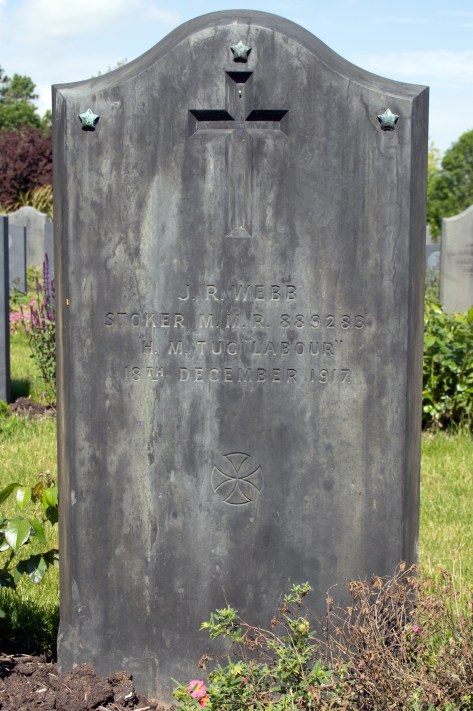
John Robert Webb was born at the start of 1894, and was the youngest of eight children to William and Catherine Webb . William’s work as a wharf labourer found the family in Wapping, East London, and this is where John was born.
According to the 1901 census, the Webbs were living in rooms at 1 Meeting House Alley, close to the docks. William, Catherine and John were still living there in the next census, taken in 1911. By this point, John was 17 years of age, and employed as an office youth.
Over the next few years, John’s trail goes cold. By the time war broke out, he had changed careers, and was working as a Stoker for the Mercantile Marine Service. The boat he was assigned to – a tug named Labour – was based out of Chatham in Kent.
Sadly, there is only one more document connected to Stoker Webb, and that relates to his passing. His pension record confirms that he died on 18th December 1917 from an illness. While the location of his passing is unclear, it is likely to have been either at the Royal Naval Hospital in Chatham, or the town’s dockyard. He was 23 years of age.
The body of John Robert Webb was laid to rest in the military section of Woodlands Cemetery, Gillingham, Kent.
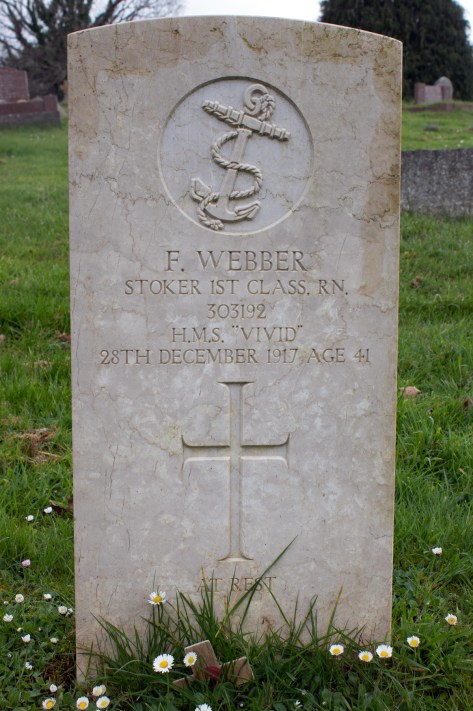
Frederick Webber, of Westexe-south, Tiverton, stoker in the Royal Navy, has died at the age of 40. He had been in the Navy 15 years, and was on board HMS Dartmouth when she was torpedoed, and on HMS Sylvia when she sank a submarine. While home on leave in November he was taken ill. He partially recovered, but had a relapse and died on December 28th.
[Tiverton Gazette (Mid-Devon Gazette): Tuesday 1st January 1918]
The early life of Frederick Webber is a challenge to piece together, as his is not an uncommon name for the area and period.
His widow is recorded as Elizabeth Webber, and marriage record from August 1907 suggests his father’s name was also Frederick. Stoker Webber’s entry on the military pension ledger confirms two children – Frederick and Frank.
When he enlisted on 10th February 1903, he gave his date of birth as 26th December 1880 and his place of birth as Exeter, Devon.
This combination of details doesn’t give any definite results from the 1891 or 1901 census, so it’s not possible to confirm the early stages of his life.
Based on Frederick’s naval records, he was working as an engine driver when he joined up. He was 5ft 4ins (1.63m) tall, with dark brown hair, hazel eyes and a fresh complexion. He was also noted as having a tattoo on his right forearm
Stoker 2nd Class Webber was sent to HMS Vivid – the Royal Naval Dockyard in Devonport. Enlisting for an initial period of 12 years, he would spend that time serving on a total of ten ships, returning to his Devon base in between voyages.
Frederick’s career seems to be one of doing just enough to satisfy his superiors. His annual reports noted his character and ability as being good or satisfactory, and he spent three periods of time in the brig – for three days in 1904, 14 days in 1906 and five days in 1910.
Frederick’s was promoted to Stoker 1st Class in July 1906 and, unusually, he remained at that rank for the rest of his career. It may be that promotion didn’t come his way, or simply didn’t appeal to him, and he was happy doing what he was doing.
Stoker Webber came down with bronchitis while he was on leave in November 1917. Based on his service records, he had just turned 47 years of age when he passed.
Frederick Webber was laid to rest in Tiverton Cemetery, not far from his grieving family’s home.
Charles Ching was born in Torquay, Devon, on 22nd March 1885. The oldest of three children, his parent were Joseph and Sarah Ching. Joseph died by the time Charles was just four years old. The 1891 census found Sarah living with their three sons – plus her other son from a previous marriage – on Pannier Street in Paignton. There is no evidence of work for any of the family, but it is likely that Charles’ half-brother, George, would have been bringing some money in, as he was 14.
Moving forward ten years, and Sarah was employed as a charwoman. Her three boys with Joseph were still at home, and Charles and his younger brother Henry were both working as errand boys.
Charles had his sights on bigger and better things, however, and on 21st March 1903, he enlisted in the Royal Navy. His service records show that he had given up a job as a gardener, and he would continue with manual labour, taking on the rank of Stoker 2nd Class. The document also confirms that he was 5ft 8ins (1.73m) tall, with brown hair, hazel eyes and a fresh complexion.
Throughout his naval career, Stoker Ching would be based out of HMS Vivid, the Royal Naval Dockyard in Devonport. Over the twelve years of his service, he was assigned to six ships, and rose through the ranks. In June 1904, he was given the rank of Stoker, and two years later was promoted to Stoker 1st Class.
On 1st July 1907, Charles was given a posting on board the cruiser HMS Forth. She would remain his home for five-and-a-half years, during which time, a number of things changed. A previously unblemished record was tainted by seven days in cells in November that year, although his misdemeanour is not noted.
In December 1908, Charles married Florence Tucker. The daughter of a carter from Totnes, her mother’s maiden name was Ching, although whether there was any connection to Charles’ late father is unknown.
On 1st September 1911, Charles was promoted again, taking on the rank of Leading Stoker. When his initial term of service came to an end in March 1915, war was raging around the world. He re-enlisted, and his records not that he had grown an inch (2.5cm) over the previous decade, but had also gained a number of tattoos. These included a woman’s head, a rose pierced by a sword and a Japanese woman on his right arm; there was also a peacock, clasped hand, heart and butterfly on his left.
Leading Stoker Ching’s health was beginning to suffer at this point, and by September 1915, he had returned to his short base, HMS Vivid. Suffering from pulmonary tuberculosis, he was invalided out the Royal Navy just a month later.
At this point, Charles’ trail goes cold. He seems to have settled in Totnes with Florence, her father having passed away there in 1915. His health was to get the better of him, however. He passed away on 9th January 1917 at the age of 31 years old.
Charles Ching was taken to Paignton for burial. He was laid to rest in the town’s cemetery.
Florence remained in Totnes after her husband’s passing. Her life there would not be a lengthy one: she passed away in March 1919, aged 29.
Joseph Hawke was born in Paignton, Devon, on 8th January 1887. Details of his early life are lost to time, although the 1891 census suggests that he was one of five children to Maria Hawke, who had been widowed by that point. The family had taken rooms at 104 Pembroke Street in Devonport.
When he finished his schooling, Joseph initially found work as a packer. However, possibly driven by his proximity to the Devon dockyards, he soon stepped up to take a job in the Royal Navy. Joining the training cruiser HMS Northampton, he was given the rank of Boy 2nd Class, as he was under the age to enlist.
Over the next few years, Joseph proved his mettle. In May 1904 he was promoted to Boy 1st Class and, when he came of age on 8th January 1895, he was formally inducted into the Royal Navy, taking the rank of Ordinary Seaman. His service papers show that he was 5ft 3ins (1.6m) tall, with fair hair, hazel eyes and a fresh complexion. It was also noted that he a mole on his right shoulder and abdomen, a scar on his chin, and tattoo marks on the back of his left hand and on his right forearm.
Ordinary Seaman Hawke would serve on three ships in total. On 26th February 1906 he became a Stoker 2nd Class, a role change that might be seen as a semotion, although his records suggest he was of very good character. By November 1906 Joseph had become Stoker 1st Class, but within twelve months, he gave up his life at see, buying himself out of the Royal Navy.
This change of heart may have been driven by love as, on Christmas Day 1908, he married Ellen Saunders, in Tower Hamlets, London. Their wedding certificate gives Joseph’s father’s name as cabinet maker George Hawke, but doesn’t suggest that he is deceased.
The document also gives Joseph’s job as a stoker, later confirmation suggesting that he was employed by the electrical works in Paignton, Devon. Joseph and Ellen would go on to have five children – Marie, Joseph, Albert, Harry and Ellen – between 1909 and 1917.
When war broke out, Joseph was called upon to play his part once more and, as part of the Royal Naval Reserve, he was assigned to HMS Gibraltar in November 1914. Over the next four years, he would serve as a Stoker 1st Class on four more ships, each time returning to HMS Vivid, the Royal Naval Dockyard in Devonport, in between voyages.
By the spring of 1918, Joseph’s health was struggling. He was medically dismissed from active service on 22nd May, and returned home to Paignton. His condition was to worsen, however, and on 17th October 1918 he passed away froma combination of dysentery and influenza. He was 31 year of age.
Joseph Hawke was laid to rest in Paignton’s sweeping cemetery, not far from his family home in Laura Terrace.
William Henry Beadle was born in Heybridge, Essex, on 23rd April 1870. The youngest of three children his parents were William and Sophia Beadle. William Sr was a waterman-turned-labourer, and the young family lived with Sophia’s parents.
When Sophia died in 1875, her widow and their children remained with his in-laws. William Sr died in 1887, and by the time of the 1891 census, his son was living with his now widowed grandmother. The document notes that she was a pauper, but he was a moulder in the local iron works.
William sought bigger and better things and, on 13th August 1891, he enlisted in the Royal Navy as a Stoker 2nd Class. His service records show that, as 21 years of age, he was 5ft 8ins (1.72m) tall, with brown hair, grey eyes and a fresh complexion.
Stoker Beadle was initially sent to HMS Pembroke, the Royal Naval Dockyard in Chatham, Kent, for his training. He would spend the next six months split between there and HMS Wildfire, a shore establishment downriver at Sheerness.
In 1892, William spent six months on board the troop ship HMS Tyne. He returned to Chatham in July of that year, and was promoted to Stoker 1st Class. Over the course of the next eleven years, he would go on to serve on four ships, each time returning to his base port, HMS Pembroke.
William’s service record is pretty much mark free. He was confined to cells for seven days in October 1895, although his offence s unclear. In April 1896 he was promoted to Leading Stoker 2nd Class, and made Leading Stoker 1st Class three years later. In December 1902, while on board the cruiser HMS Diana, William was promoted again, to Acting Chief Stoker, and the following August, his initial contract of service came to an end.
By this point William was a married man. He married Clara Walford in Rochford, Essex, and, while the couple did not go on to have children, there is little additional information about her.
William re-enlisted as soon as his initial twelve-year contract came to an end. In December 1903 he was promoted to Chief Stoker, and he remained at this rank until he war formally retired on 16th August 1913. He had spent more than two decades in the Royal Navy ,and travelled the world: the 1911 census recorded him as one of the crew of HMS Lancaster, moored in Malta.
Chief Stoker Beadle’s time away from the Royal Navy was not to be lengthy and, when war broke out less than a year later, he was called upon once more. He spent nine months back at HMS Pembroke, before being assigned to the new cruiser HMS Calliope. She would be William’s home for the nearly three years, and it was not until March 1918 that he came back to shore.
William’s return to Chatham seemed to coincide with a downturn in his health. He was admitted to the town’s Royal Naval Hospital with nephritis, and this is what would take his life. He died on 8th March 1918: he was 47 years of age.
William Henry Beadle was laid to rest in the military section of Woodlands Cemetery, Gillingham, not far from the naval base he had called home for so long.
Herbert Andrews was born on 9th December 1890 in the Devon village of Buckfastleigh. One of nine children, his parents were William and Elizabeth Andrews. William worked at a local woollen factory, and the family initially lived on Silver Street in the village before moving to Market Street by the turn of the century.
Herbert does not appear on the 1911 census, and at this point William and Elizabeth, both in their 60s, were living on their own. Interestingly, the census inadvertently reveals neither may have been able to write: the return was completed by James Dyer, who lived at 5 Plymouth Road in the village.
The next document available for Herbert relates to his military service. When war broke out, he seems to have quickly stepped up to play his part, giving up his job as a gardener to enlist in the Royal Navy on 7th January 1915. His records confirm that he was 5ft 11ins (1.8m) tall, with black hair, hazel eyes and a fresh complexion. He was also noted as having an operation scar for appendicitis.
Stoker 2nd Class Andrews was initially sent to HMS Vivid, the Royal Naval Dockyard in Devonport, for training. This did not seem to go smoothly, and on 9th May he was detained for 21 days for disobeying orders and being insolent.
On 6th June, Herbert was assigned to the battleship HMS Marlborough. Again, however, this posting did not last for long, and mental health issues may have come to the surface. By 1st July 1915, Stoker Andrews was back ashore in the Royal Naval Hospital in Plymouth, Devon. Within a matter of weeks, he was medically discharged from the navy, and was “discharged to Exminster Asylum on 1.9.15 as a dangerous lunatic.”
At this point, Herbert’s trail goes cold. He passed away on 21st August 1916, at the age of 25 years old. It seems likely that he was still admitted to the mental institution when he died, as his death was registered in Exeter.
Herbert Andrew’s body was taken back to Buckfastleigh for burial. He was laid to rest in the graveyard of the town’s Holy Trinity Churchyard, alongside his brother, Henry, who had died fifteen years before.
Joseph Ward was born in Wednesbury, Staffordshire, on 13th January 1890. The four of five children – all boys – his parents were William and Caroline. William was a coal miner-turned-weighman, but Joseph found work as a riveter when he completed his schooling.
It seems that Joseph sought any employment to avoid going down the mines, and, on 26th August 1910, he enlisted in the Royal Navy. His service records show that he was 5ft 3ins (1,6m) tall, with brown hair, grey eyes and a sallow complexion. He was also noted as having a dot or mole on the back of this left forearm and another on the back of his left hand.
Joseph was given the rank of Stoker 2nd Class, and was sent to HMS Vivid, the Royal Naval Dockyard in Devonport, Devon, for training. This would be his base of operations, and he would return there a number of times in the coming years.
On 4th January 1911, Stoker Ward was given his first posting, on board the armoured cruiser HMS Cumberland. he remained on board for more than two-and-a-half years, and gained a promotion to Stoker 1st Class during this time.
In October 1913, Joseph returned to Devonport, remaining on shore for more than three months. His service record notes he was confined to the Dockyard Sick Quarters for three days, although the cause is not given. In January 1914, he returned to sea again, on board another cruiser, HMS Highflyer. This would prove another lengthy assignment, and Stoker Ward would not return to HMS Vivid for more than three years.
During his short spell ashore, Joseph returned to Staffordshire. He married Lily Wright, a tailoress from Wednesbury. Their honeymoon was brief, however, and he was given a new assignment.
Stoker Ward was attached to HMS Valkyrie, a newly commissioned destroyer attached to the Harwich Force. On 22nd December 1917, she was escorting a convoy to the Netherlands when she struck a mine. Twelve of the crew – including Joseph – were killed, while a further seven subsequently succumbed to their injuries. The Valkyrie was towed to the Royal Naval Dockyard in Chatham, Kent, for repairs.
Joseph Ward was 27 years of age when he was killed. He was laid to rest in the naval section of Woodlands Cemetery in Gillingham, not far from the Kent naval base.
Tragically, Lily was pregnant when her husband was killed. On 25th February 1918, she gave birth to their child, Flora, the daughter Joseph would never know.
Thomas Ellis was born in 1896 in St Leonard’s, Sussex. The third of twelve children, his parents were George and Ellen Ellis. George was a general labourer, but when he finished his schooling, Thomas found work as a golf caddy. The 1911 census recorded the Ellis family living in four rooms at 7 Caves Road to the east of the town centre.
There is little additional information about Thomas, sadly. He joined the Royal Navy when war broke out, and was working as a Stoker 1st Class by the closing months of the conflict. He passed away, through causes unknown, on 7th July 1918, at the age of just 23 years old.
Thomas Ellis was laid to rest in the naval section of the Woodlands Cemetery in Gillingham, Kent, not far from the Royal Naval Dockyard in Chatham – HMS Pembroke – at which he was based.
Albert Willingham was born in Upchurch, Kent, on 4th January 1888. One of eleven children, his parents were George and Annie Willingham. George was a brickmaker and labourer, who moved his family to where the work was. By the time of the 1891 census, they had relocated to the nearby town of Gillingham, and were living on the waterfront at 5 Danes Hill.
As the family grew, so they kept moving. The census of 1901 found the ten Willinghams – George, Annie and eight children including 13-year-old Albert and his youngest sibling, 11-day-old Ada – residing at 5 Court Lodge Road. The small terraced house would still be crowded, however, and this may have been one of the factors pushing Albert to bigger and better things.
Having followed his older brothers into labouring work, Albert decided enough was enough. On 13th July 1908, he enlisted in the Royal Navy, joining up as a Stoker 2nd Class. His service records show that he had brown eyes, dark brown hair and a ruddy complexion. He was 5ft 8.5ins (1.73m) tall.
Stoker Willingham was first sent to HMS Acheron, the training frigate, for his induction. He remained on board for six months, before moving to the cruiser HMS Dido in January 1909. Over the next six years, Albert served on seven further ships, returning to what became his home base, HMS Pembroke in Kent, in between voyages.
Albert quickly became well-travelled, and he served in the Somaliland Expedition, and in the operations in the Persian Gulf between 1909 and 1914. The 1911 census recorded him as being a stoker on board HMS Hyacinth, which was then moored in Bombay (now Mumbai), India.
While on board Hyacinth, Albert was promoted to Stoker 1st Class, and in April 1915, with the war raging around him, he was promoted again, to Acting Leading Stoker. At the end of that month, he was transferred to what would be his final ship, HMS Princess Irene.
She was an ocean liner that had been requisitioned at the outbreak of war, and converted to a minelayer. On 27th May 1915, while moored off Sheerness, Kent, a series of explosions ripped through the ship, killing more than 350 crew. Acting Leading Stoker Willingham was among those who perished: he was 27 years of age.
The body of Albert Willingham was buried in Woodlands Cemetery, Gillingham, Kent, just a short walk from his family’s home.
Albert’s headstone records the permanent rank he held at the time of his passing, rather than acting one he had been temporarily given. He is therefore noted as Stoker 1st Class, instead of Acting Leading Stoker.
Albert George Knieriem was born in Bromley-by-Bow, Middlesex, on 1st January 1892. The eighth of nine children, his parents were German-born Gottliept (anglicised to George) Knieriem, and his London-born wife, Caroline.
George was a labourer at the local gas works, and the family had rooms at 3 Hancock Road. Their home has long since gone, but the Knieriems shared the property with the Richard and Eliza Bone and their four children.
George passed away in March 1906, with Caroline dying less than eighteen months later. Albert found himself an orphan at just 15 years of age. It seems that his oldest brother, also called George, found him employment as a local iron foundry. By the time of the 1911 census, he was boarding with the Fryatt family, at 29 Hancock Road, not far from the old family home.
Albert sought bigger and better things for himself, however, and was drawn to a life at sea. On 14th July 1911 he enlisted in the Royal Navy as a Stoker 2nd Class. His service records confirm that he was 5ft 5.5ins (1.66m) tall, and that he has light brown hair, grey eyes and a fresh complexion.
Stoker Knieriem was initially sent to HMS Pembroke, the Royal Naval Dockyard in Chatham, Kent, for his training. He remained there for four months, before being given his first posting, on board the cruiser HMS Intrepid. She would be his home for the best part of a year, during which time Albert was promoted to Stoker 1st Class.
In September 1912, Albert transferred to HMS Acteon. A former hulk, she was based at Sheerness, Kent, as was used as a torpedo school. Albert would remain there for more than two years, attached to the school’s tender, HMS Kestrel.
On 18th January 1915, Stoker 1st Class Knieriem’s service records note one word: “Run”. Albert had absconded, remaining at large for two months. He was apprehended on 23rd March, and sentenced to 28 days’ detention for going AWOL. Put back on duty on 28th April, he was reassigned, to the former cruise liner, HMS Princess Irene.
The Princess Irene had been requisitioned by the Royal Navy on the outbreak of war and converted into a minelayer. On the morning of 27th May 1915, she was moored in the Medway Estuary and was being loaded with mines. A faulty primer set off a series of explosions, destroying the ship and killing more than 250 crew, Stoker 1st Class Knieriem among them. He was 23 years of age.
Albert’s name comes up in a newspaper article about one of the subsequent enquiries. The Coroner’s inquest on 18th June focused on the bodies in coffins 29 to 34.
No. 32 body was very much shattered. It was dressed as a stoker. The name “A. G Knieriem” was no the band of the trousers.
The body was identified as that of Albert George Knieriem, aged 23, stoker, 1st class, of Bromley-by-Bow.
[Sheerness Guardian and East Kent Advertiser: Saturday 19th June 1915]
Albert’s body was laid to rest in the naval section of Woodlands Cemetery in Gillingham, Kent. He was buried alongside some of the other crew whose bodies had been rescued and identified.