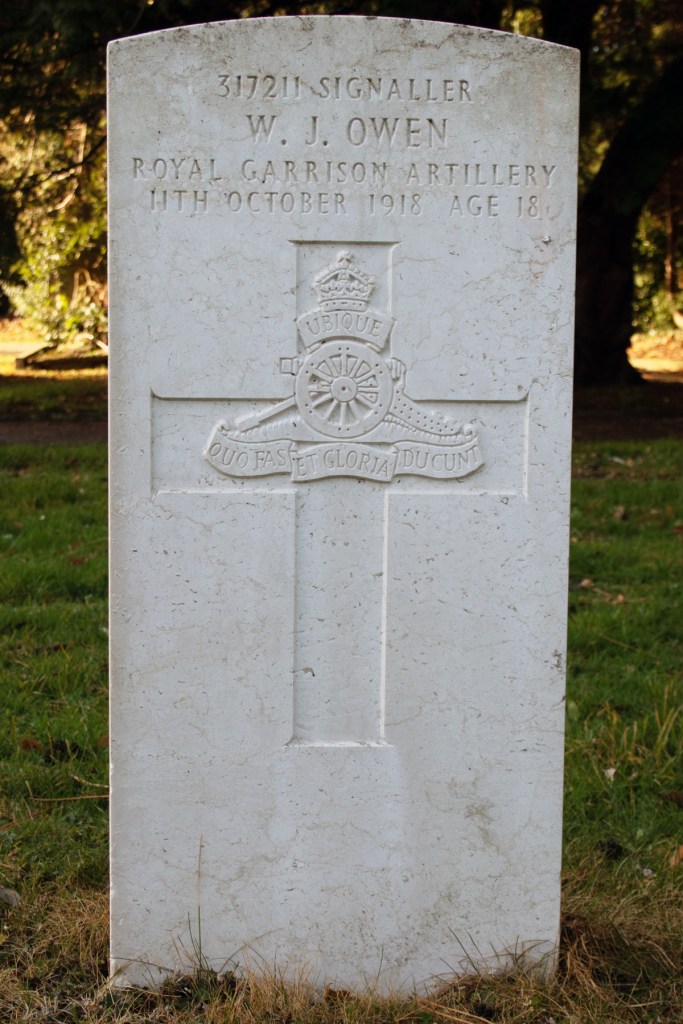
William John Owen was born in the spring of 1900, and was one of thirteen children to Henry and Emma Owen. Henry was an oyster dredger turned coal porter from Faversham in Kent, and this is where the family were born and raised.
There is little concrete information about William’s life, but it is clear that, by April 1918, he had joined the Royal Garrison Artillery, and was assigned to the 2/1st Kent Heavy Battery. Signaller Owen was sent to Larkhill Camp in Wiltshire for training.
The only further information is that William was admitted to the Fargo Military Hospital on Salisbury Plain, suffering from pneumonia. Sadly the lung condition was to get the better of him: he passed away on 11nd October 1918, aged just 18 years old.
William John Owen was brought back to Kent for burial. He was laid to rest in Faversham Borough Cemetery, just a few minutes’ walk from his family home.
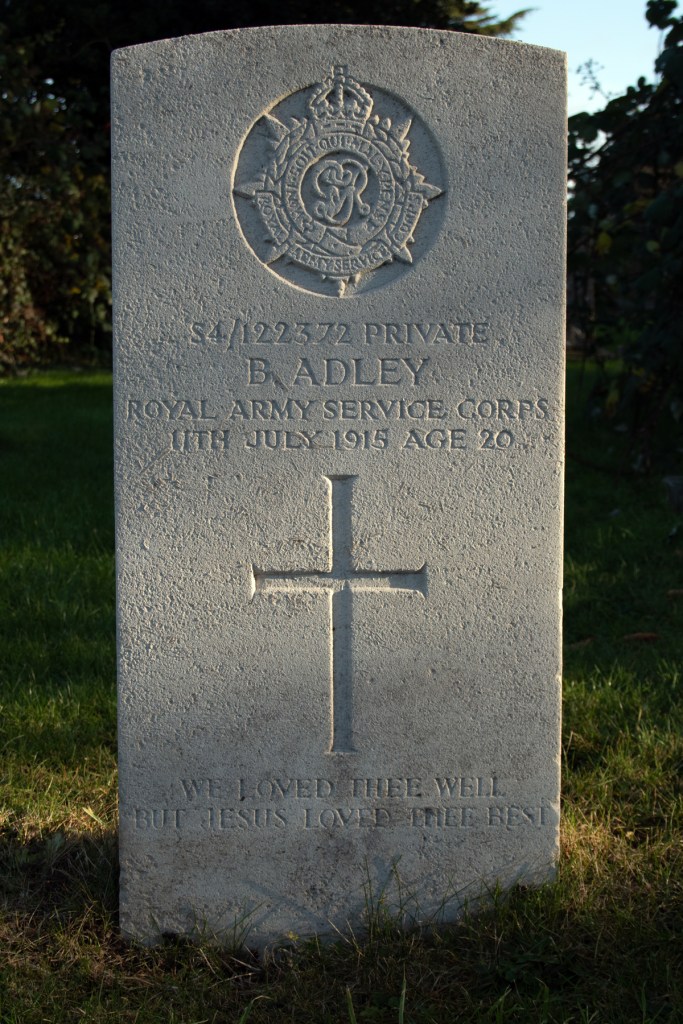
Bert Bennett Adley was born in the spring of 1895, the youngest of eleven children to George and Alma Adley. George was a brickmaker’s labourer from Canterbury, Kent, but it was in nearby Faversham that he and Alma raised their family.
Bert – who was affectionately known as Bertie – found work with a local baker when he left school, and this stood him in good stead when war broke out. He was called up in June 1915, and joined the Army Service Corps as a Private. His service records give little personal information, but they do give his height as 5ft 5ins (1.65m) and his weight as 9st 2lbs (58kg).
Private Adley’s military life was to be tragically short. Based in Aldershot, Hampshire, it is likely that the sudden mixing of recruits from across the country was key in his contracting pneumonia. He was admitted to hospital on 26th June, and died two weeks later, on 11th July 1915. He was just 20 years of age, and had been in the Army Service Corps for just 28 days.
Bert Bennett Adley’s body was brought back to Kent for burial. He was laid to rest in his home town, in the Faversham Borough Cemetery.
Frederick William Twist was born in around 1884, the older of two children to William and Clara Twist. William had been born in Faversham, Kent, and was a labourer in the cement works there.
Frederick did not follow his father’s trade, however, and, on leaving school, he found work in the printing office of the Faversham News, before moving on to Filmer Bros., a local nursery and bulb grower. He was a keen member of the Salvation Army, and played in the local Corps’ band. After more than a decade at Filmer Bros., Frederick took up new employment with Salvation Army Insurance, and worked out of the Whitstable office.
In the spring of 1909, Frederick married Helen Bedster, a bargeman’s daughter from Faversham. At the time of their wedding, she was working as a servant for a brewer manager in the town. The couple settled down in a terraced house in the centre of the town, and went on to have two children.
When war broke out, Frederick was called upon to play his part, but his time in military service was to be a troubled one. A contemporary newspaper expanded on this:
The toll of war continues through nearly a year has elapsed since the war practically ceased… [following] the death of Lance Corporal Frederick William Twist, 16th Lancers, a Faversham man, who passed away at the Military Hospital Woolwich, after a great deal of suffering.
Lance Corporal Twist enlisted under the Derby Scheme and being called up in May 1916, he joined the 16th Lancers and was sent to Ireland. At the end of that year he was drafted to France but in the following May he was invalided home with trench fever.
On his discharge from hospital in Devonshire he returned to Ireland. Then in March of last year there came the great offensive on the Western Front and for the second time deceased was drafted to France. He was not, however, at all fit, and the result was that he was obliged to fall out.
After a further spell in hospital and convalescent camp at the base he was employed on light duty – stores keeping and clerical work – to which he stuck with dogged spirit until in June last he again broke down and was once more in hospital.
Later he was transferred to the Royal Herbert Hospital, Woolwich, where he died on October 7th – a fine example of a British soldier who had struggled, even against weakness and suffering, to do his duty to the very last.
Faversham News: Saturday 18th October 1919
Lance Corporal Frederick William Twist was 35 years of age when he passed. He was laid to rest in the Borough Cemetery of his home town, Faversham.
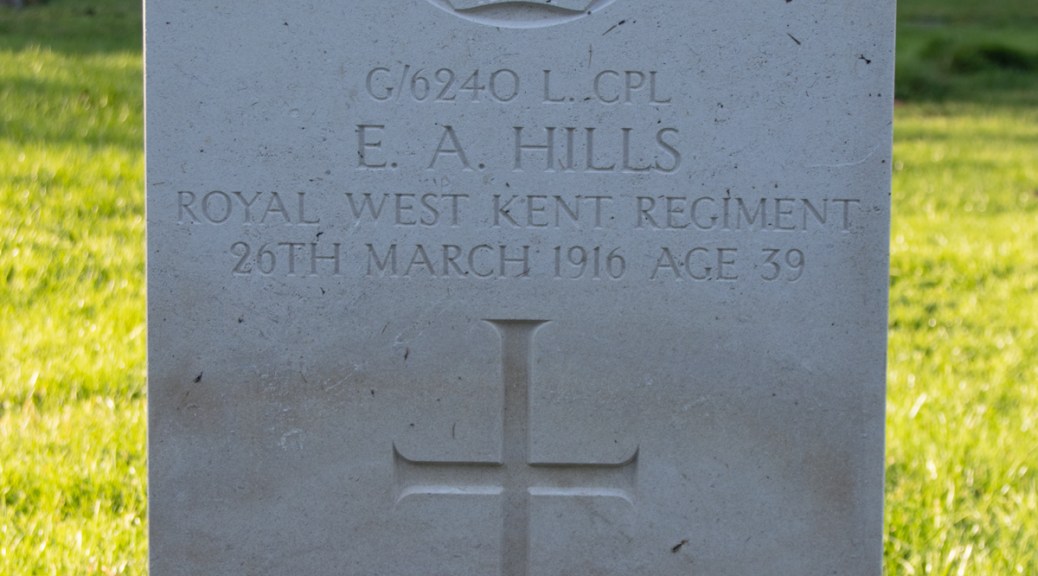
Ernest Albert Hills was born in December 1877, and was the fifth of ten children to Benjamin and Elizabeth Hills. Benjamin was a labourer for a brick maker from the Kent village of Upnor, but it was along the coast in Faversham that he and Elizabeth were to raise their young family.
When he left school, Ernest followed in his father’s footsteps, working in the local brick kiln. By the time of the 1911 census, however, he had moved to South East London and was boarding with his younger brother, William, working with him as a stoker for a Greenwich gas company.
War came to Europe, and Ernest wanted to play his part. On 20th April 1915, he enlisted, joining the Queen’s Own (Royal West Kent Regiment) as a Private. His service records give his height as 5ft 9.75ins (1.77m) and note that he had a scar on the right side of his abdomen.
Private Hills’ service was carried out on home soil: he was assigned to the 3rd (Reserve) Battalion, which was based in Maidstone and Chatham. Ernest was obviously well thought of: within six months of enlisting, he was promoted to Lance Corporal.
His good fortune was not to last for long, however, in the spring of 1916, he fell ill and, while at his family home in March, he passed away, having been suffering from Addison’s disease, a rare disorder of the disorder of the adrenal glands. He was 39 years of age.
Lance Corporal Ernest Albert Hills was laid to rest in the Faversham Borough Cemetery, not far from his family home, and where his father – who had passed away in 1903 – had also been laid to rest.
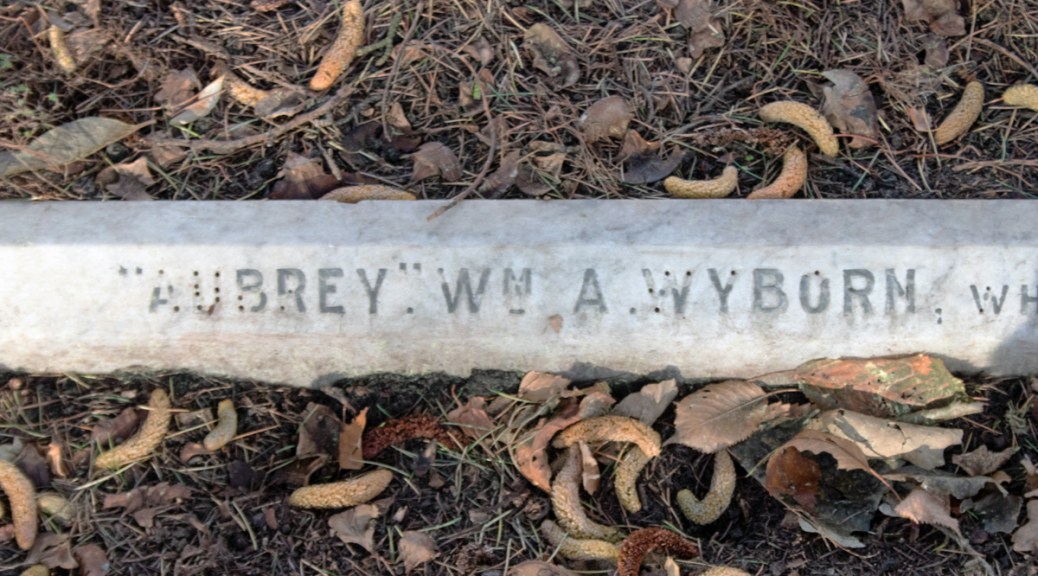
William Aubrey Wyborn was born on 15th November 1897, the middle of three children to farmer-cum-greengrocer-cum-butcher Henry Wyborn and his wife, Esther. The family lived in the Kent village of Tilmanstone, not far from Deal, but soon moved to Faversham in the north of the county.
William proved to be an astute student. After being a pupil at Faversham District Schools, he gained a scholarship to the towns Grammar School. He spent six years there, and proved to be a studious pupil, gaining a prize for maths. He was then granted a scholarship to the Sheffield School of Engineering, and, while studying for his degree there, war broke out.
William joined the West Lancashire Royal Field Artillery in June 1916 and was sent to Aldershot for training. sadly, Gunner Wyborn’s career was to be cut short – while training, he contracted diphtheria and pneumonia, passing away from a combination of the illnesses on 3rd November 1916. He was just short of his 19th birthday.
William Aubrey Wyborn was brought back to Kent for burial. He lies at rest in the family plot in the Faversham Borough Cemetery.
Herbert Macklin was born in Lambeth, Surrey, on 14th August 1897, the youngest of six children to Enos and Sarah Macklin. Enos was a general labourer and, after his mother died in 1909, Herbert worked around his school as a baker’s errand boy, to bring in a little more money for his family.
After Enos passed away in 1912, and with his older sisters all having families of their own, Herbert and his older brother William did what they could to survive, getting some support from the local poor school.
The outbreak of war gave the brothers a sense of purpose, and both enlisted. William joined the Royal Field Artillery, and was sent to France in September 1915.
Herbert, being six years younger than his brother, enlisted later than his sibling. He joined the Middlesex Regiment, on 10th May 1916, and his service records show that he was 5ft 4.5ins (1.64m) tall, 126lbs (57.2kg) in weight and had a fair physical development. While Herbert had a fair physical development, he was also recorded as having flat feet, which somewhat limited his army service.
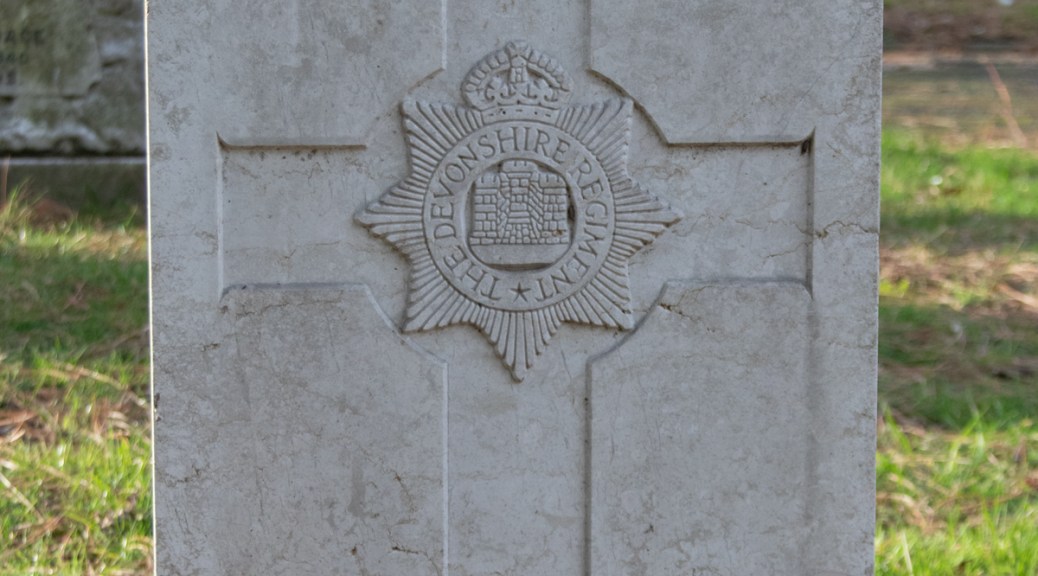
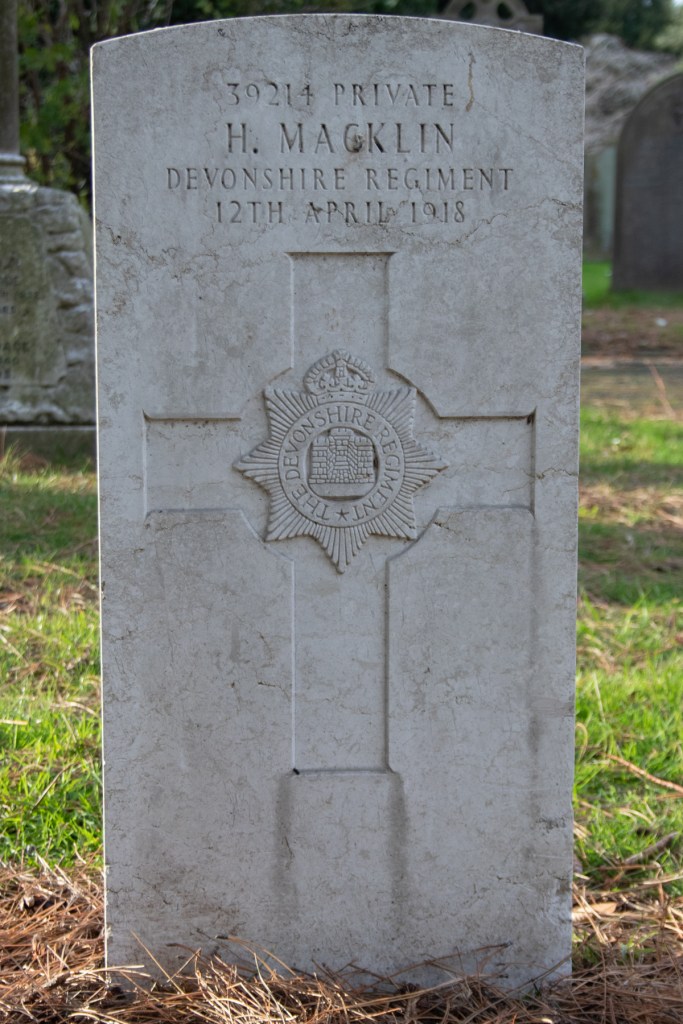
Private Macklin transferred across to the Devonshire Regiment a few months after enlisting. He was then assigned to the regiment’s Labour Corps in the summer of 1917, and remained with them for the rest of his service.
While William was serving abroad, Herbert remained on home soil for the duration. By the spring of 1918, he was working in Kent, but was admitted to hospital in Faversham, suffering from acute tonsillitis. Sadly, this was to prove too much for Private Macklin’s body to take: he suffered cardiac failure, and died on 12th April 1918. He was 21 years of age.
Herbert Macklin was laid to rest in the Borough Cemetery of the town in which he passed, Faversham.
Tragedy was to strike again for the Macklin brothers: as the war moved into its closing months, Driver William Macklin was based in Salonika, Greece. He was not to see England’s shores again, sadly: he passed away on 23rd November 1918, aged just 27 years old.
Roden Latham Chatterton was born on 13th July 1895, in Budin, Bengal, India. He was the only child to George and Ella Chatterton. George was a Lieutenant Colonel in the army, and had married Ella in India, where he was based.
The family had returned to England by the time of the 1911 census, but then moved permanently to Ireland. When war broke out, Roden joined up, enlisting in the 1st Battalion of the Leinster Regiment with the rank of Lieutenant. Full details of Roden’s military service are not available, but he arrived in France in January 1915 and, stayed there for the best part of two years.
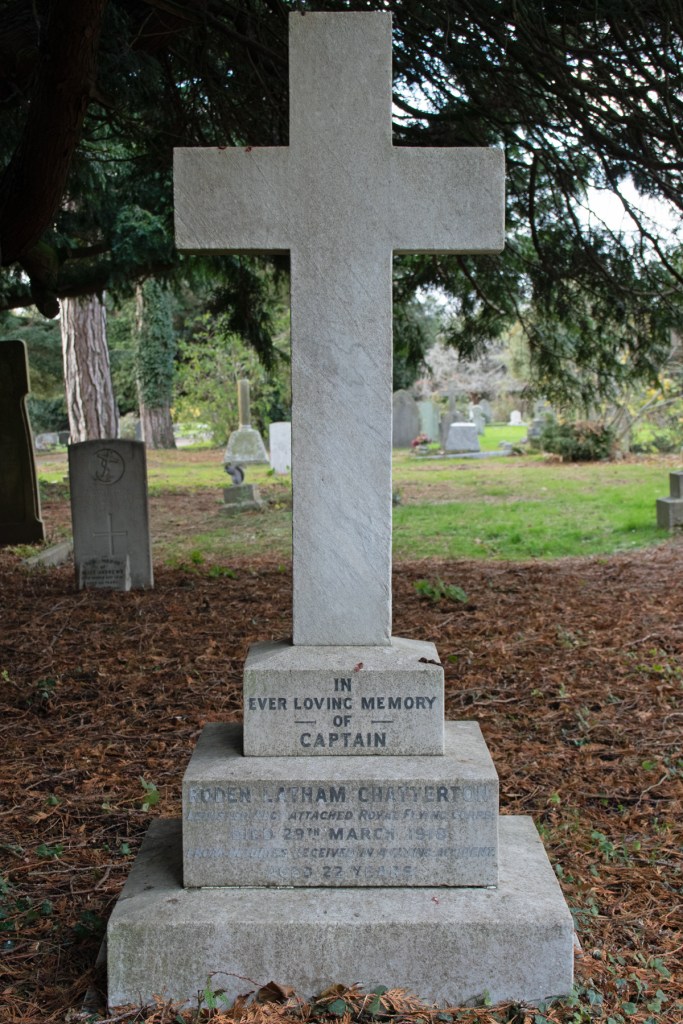
In December 1917, the now Captain Chatterton transferred to the Royal Flying Corps. Based in Kent, he learnt to fly, and was close to gaining his wings, when an accident befell him in March 1918.
About 5:30pm on March 27th, [Captain Chatterton] was about 1.500 feet up, was trying to land near an aerodrome, and the wind was very rough. He shut off the engine and tried a left hand turn when the machine stalled and came down in a spin nose down and crashed to the ground. Several [people] went to his assistance. He was in great pain and made no remarks. He had been strapped in, but the belt had broken. The wind was from the south south-west. He came own into the wind and was trying to turn head into it when the machine got into a spin. It was not an ideal day for flying. Another machine… was flying with the deceased, and that landed all right. There was no collision in the air. When [he] turned he had not got the nose down far enough to keep up the engine speed and, in the witness’ opinion it was through an error of judgment on his part that the machine crashed. Had there been more space he would have got out of the spin. There was nothing wrong with the machine, but it was a type that was very difficult to handle in rough weather.
Whitstable Times and Herne Bay Herald: Saturday 6th April 1918
Captain Chatterton was taken to the Lees Court Military Hospital south of Faversham for treatment, but died of his injuries on 29th March 1918. He was 22 years of age.
Roden Latham Chatterton was laid to rest in a quiet corner of the Borough Cemetery in Faversham.
George William Willis Bunting was born in Faversham, Kent, in the spring of 1889. The middle of eleven children to George and Mary Ann Bunting, he was also the oldest boy. George Sr was a labourer in the town’s munitions works, and his son followed suit, and was recorded as a cordite labourer there in the 1911 census.
When war came to Europe, George Jr was keen to play his part. He enlisted in the Royal Garrison Artillery, and was assigned to the 343rd Siege Battery. While full details of his service are not available, George’s life was laid out in a newspaper report following his death:
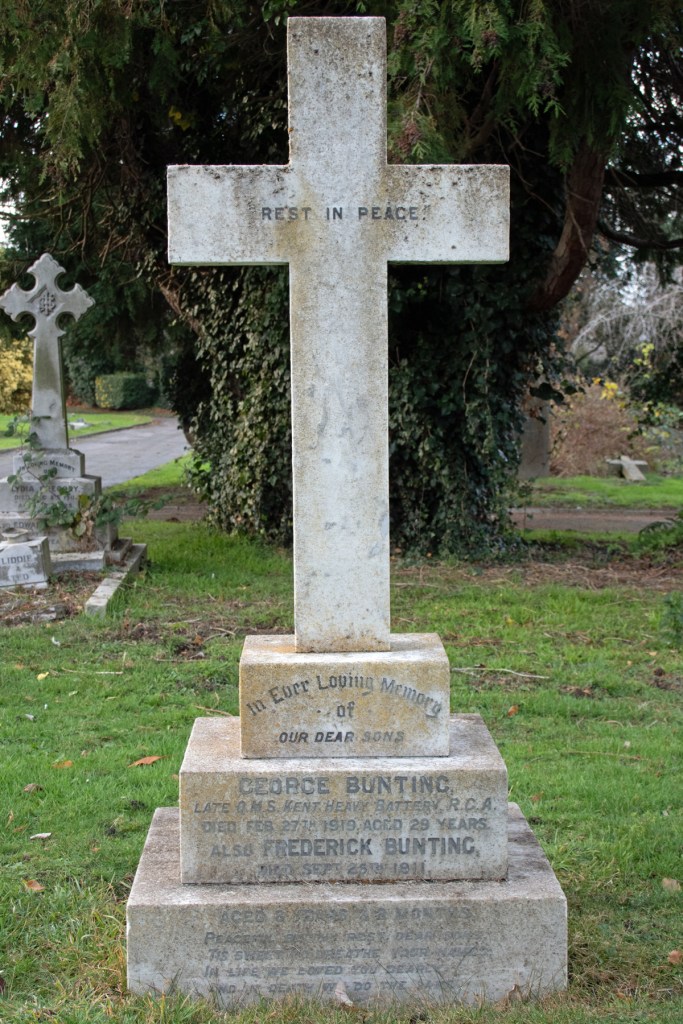
The death has occurred in quite pathetic circumstances of Battery Quartermaster Sergeant George William Bunting, 1st Kent Heavy Battery, Royal Garrison Artillery… who, after serving throughout the war, and coming unscathed through more than three years service in France, though he had several narrow escapes, had died of pneumonia at his home, just as he was anticipating return to civil life.
BQMS Bunting joined the Faversham Volunteer Corps (in which his father also formerly served) some seven years before the war, and when was broke out he was at the annual training with the Battery. War service immediately followed and in 1915 he went to France and, except for leave, had been out there ever since until a few weeks back when he returned for demobilisation. He was not feeling at all well when he arrived home, indeed he seems to have been so unwell that when he got indoors he remarked “I’m done.”
His words, unhappily, were only too prophetic, for he never left the house again, pneumonia developing and culminating in his death on February 27th, only nice days after his arrival.
Prior to the war the deceased, who was in his 30th year and unmarried, had been employed at the Cotton Powder Works ever since he left school. At the commencement of his war service, he was a Corporal, but his keenness at his work steadily gained him promotion and eventually he reached the rank of Battery Quarter Master Sergeant. Keen and conscientious himself, he expected the same in others, and it says much for his example and influence that he was held in the very highest regard by the men of his Battery, while to his officers he was a greatly valued NCO.
Faversham News: Saturday 15th March 1919
Quartermaster Serjeant George William Willis Bunting died at his Faversham home on 27th February 1919. He was just 29 years of age. He was laid to rest in the town’s Borough Cemetery.
Walter James Stevens was born on 29th November 1899, the oldest of three children to James and Elizabeth. James was a labourer in the munitions factory in Faversham, Kent, and this is where Walter and his siblings were born and raised.
Initially attending the council schools, Walter won a scholarship to Wreight’s Grammar School, before gaining work as a clerk at the Shepherd Neame brewery in the town.
From the age of 11, Walter was also an active member of the local United Methodist Church. He was a keen organist, taught at the Sunday School, and played a key role in the Wesley Guild. He was also a sometime member of the St John’s Ambulance, undertaking duties at The Mount Hospital in the town.
When was broke out, Walter was keen to play his part. He enlisted in the Royal Naval Air Service, and was sent for training at their air base in Cranwell, Lincolnshire. While on a flight on 11th March 1918, Flight Officer Stevens’ aircraft crashed, and he was killed instantly. He was just 18 years of age.
Walter James Stevens’ body was brought back to Kent: he was laid to rest in the Faversham Borough Cemetery, not fat from his family home. At the funeral, Walter’s senior officers reported the promise he had shown, and that he was close to passing his probationary exams. Two weeks after his burial, a memorial service to him was given at the church to which he had dedicated so much of his young life.
Frank Harold Ely was born in November 1889, and was the oldest of four children. His parents were coal porter Frank Ely and his wife, Florence. They were both born in Kent, and raised their family in their home town of Faversham.
When Frank Jr left school, he found work as a bottler, but he had his eyes set on bigger adventures. In January 1908, at the age of 18, he enlisted in the 1st Battalion of the Rifle Brigade. His service records show that he was 5ft 5.5ins (1.66m) tall and weighed 109lbs (49.5kg). Rifleman Ely had brown hair, grey eyes and a fair complexion. He was also noted as having a scat on his right knee.
Rifleman Ely’s early service was wholly territorial, but not without incident: in 1909 he was treated for tonsillitis, two years later, he received treatment for syphilis.
He was also not one to toe the line. In August 1911, he was reprimanded for not appearing at the 6:30am parade. On 9th March 1912, he was severely reprimanded for ‘improper conduct in town, at about 11:35pm’. On 25th September 1913, he was reprimanded once again, this time for irregular conduct – using the officers’ latrines.
When war came to Europe, the Rifle Brigade were soon in the thick of it. On 26th August 1914, Frank was wounded in the hand during fighting at Ligny, France, and was then captured and held as a prisoner of war in Hamelin until the spring of 1918.
Moved to the Netherlands, Rifleman Ely was finally released after the Armistice was signed, and returned to England on 19th November 1918. He was demobbed the following March, but re-enlisted within weeks, was given the rank of Serjeant and was due to be shipped to India to continue his service.
However, while at an army camp in Aldershot, Frank contracted pneumonia. The struggles the previous few years had had on his health proved too much for him, and, on 26th August 1919 – five years to the day that he had been shot and captured – Serjeant Ely passed away. He was 40 years of age.
Frank Harold Ely was brought back to his home town for burial. He was laid to rest in Faversham Borough Cemetery.











 Death and Service