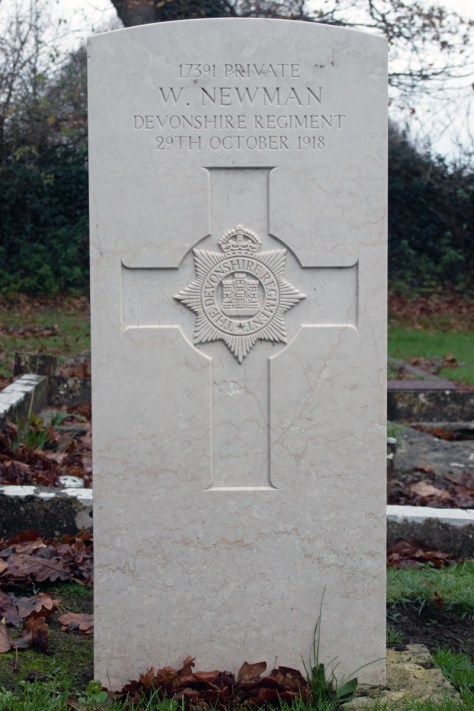
William Newman was born in Dorset in 1880, the oldest of six children to George and Margaret Newman. George worked as an agricultural labourer and a carter, and, after leaving school, William followed suit.
William’s life has been a challenge to piece together; however, I have managed to sketch together some information from a number of sources.
By the 1911 census, he was living with his now widowed father and three of his siblings. Listed as single, he was working as a labourer.
When William joined up, he enlisted in the Devonshire Regiment, before being transferred over to the Labour Corps. He was assigned to 652 Agriculture Company, serving on the home front, presumably somewhere close to home.
There are no details of Private Newman’s death – contemporary newspapers do not highlight anything out of the ordinary or sudden about his passing. I can only assume, therefore, that he passed through natural causes, perhaps influenza or pneumonia.
He died on 29th October 1918, in the village of Martock, Somerset. He was 37 years old.
It appears that William did not marry – his war pension was allocated to his sisters Edith, Alice and Louisa and no spouse is mentioned (nor is his father).
William Newman lies at rest in the quiet churchyard of St Margaret’s in the Somerset village of Tintinhull.
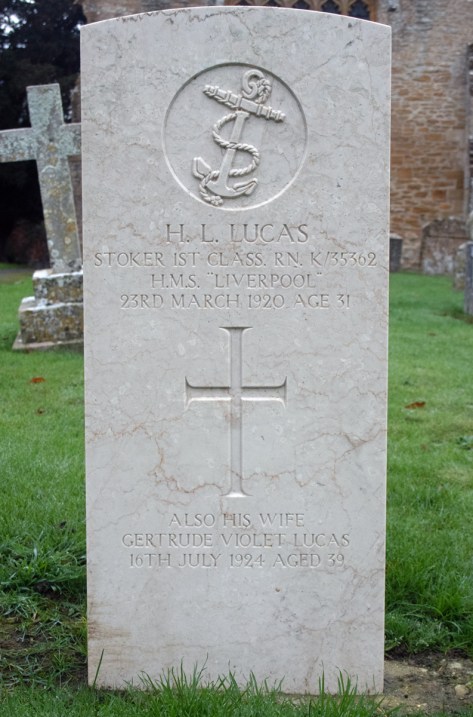
Henry Luke Lucas was born in September 1888, in the quiet Somerset village of Tintinhull. His father Luke worked as an agricultural labourer, while his mother, Ellen was a glovemaker. Henry had three siblings – Kate, Beatrice and Edwin – and two half-siblings – Martha and Eli – from Ellen’s previous marriage (she was widowed in 1880).
Henry married Gertrude Woodman in 1909 having set himself up as a groomsman in the village. Henry Jr, was born the following year and the young couple went on to have three further children, Ellen (born in 1913), Edwin (born in 1915, who sadly died shortly afterwards), and a further son, called Edwin, born in 1916.
The 1910s proved a tragic decade for the Lucas family. Henry’s father Luke had passed away in 1912, and his Ellen had also died four years later.
It may well have been the death of his parents or the promise of continuous paid employment that spurred Henry into enlisting; he joined the Royal Navy on 26th July 1916 as a stoker.
Initial training was carried out on HMS Vivid II in Devonport, Stoker Lucas was assigned to HMS Liverpool for an eight month tour of the Adriatic. While on this tour, Henry was promoted to Stoker 1st Class.
Returning to England, Stoker Lucas was assigned to HMS Egmont II, an accommodation vessel based in Chatham. His move here may have been due to health reasons; within a few weeks Henry was transferred back to HMS Vivid II, from where he was invalided out of service on medical grounds.
The reasons for Henry’s discharge from the Royal Navy was tuberculosis; the local newspaper gave more details when it reported on his funeral:
The death has occurred of Henry Lucas (31) from tuberculosis, which he contracted while serving as a stoker in the Navy. Deceased served abroad during the period of the war and was in Eastern waters when he contracted the disease. He was removed to hospital at Malta, where he remained until his discharge. [This differs from his service records.] In health Lucas was a fearless man, and he maintained this spirit all through his trying illness.
Western Chronicle: Friday 2nd April 1920
Henry Luke Lucas died on 23rd March 1920; he was 31 years old. He lies at rest in the grounds of St Margaret’s Church in his home village of Tintinhull in Somerset.
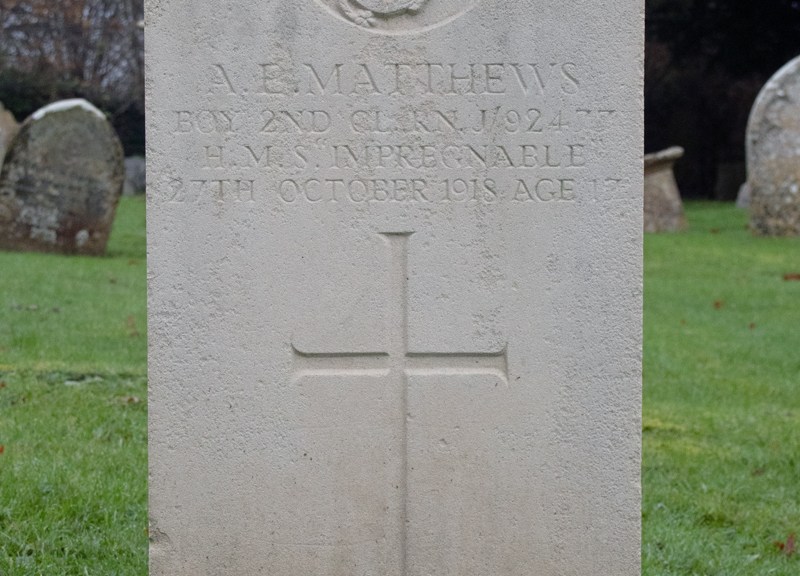
Albert Edward Matthews was born in October 1901 in the Somerset village of Tintinhull. His father James was a glove maker, and he and his wife Mary had three children in all, Percival, born in 1897, Clementina, born in 1898, and Albert, the youngest.
Sadly, Clementina died in 1909, aged just 11 years old. Percival also passed away six years later, aged just 17. James and Mary must have been distraught when Albert announced his decision to do his bit for King and country.
He enlisted almost as soon as he was able to, joining the Royal Navy on 14th September 1918, and you can almost sense his enthusiasm to get involved before missing out on the glory of military service.
Boy Matthews was assigned to HMS Impregnable, the ship based in Devonport, Plymouth, where he was to receive his training. Standing at 5ft 8ins (1.73m) tall, with brown hair, brown eyes and a fair complexion, he was recorded as having a very good character and satisfactory ability.
Sadly, however, Albert was not destined to meet his full potential. Shortly after beginning his training, he contracted influenza and pneumonia, succumbing to the disease on 27th October 1918.
He had just turned 17 years old.
Albert Edward Matthews lies at rest in the graveyard of St Margaret’s Church in his home village of Tintinhull.
The story of this family continued to be tragic. By the time of Albert’s death, the Spanish Flu pandemic was sweeping the world and his tiny part of Somerset was in no way immune.
Just four days after Albert Matthews passed away, his mother, Mary, also fell victim to the illness.
In the space of just nine years, poor James Matthews had buried all three of his children and his wife. A newspaper reported on Mary’s funeral, recognising the “very heavy trials” he had undergone.
The same paper, reports that the influenza pandemic is fizzling out.
A large number of parishioners have been attacked with “flu”, but the epidemic is now on the wane. The school has been closed for the last fortnight.
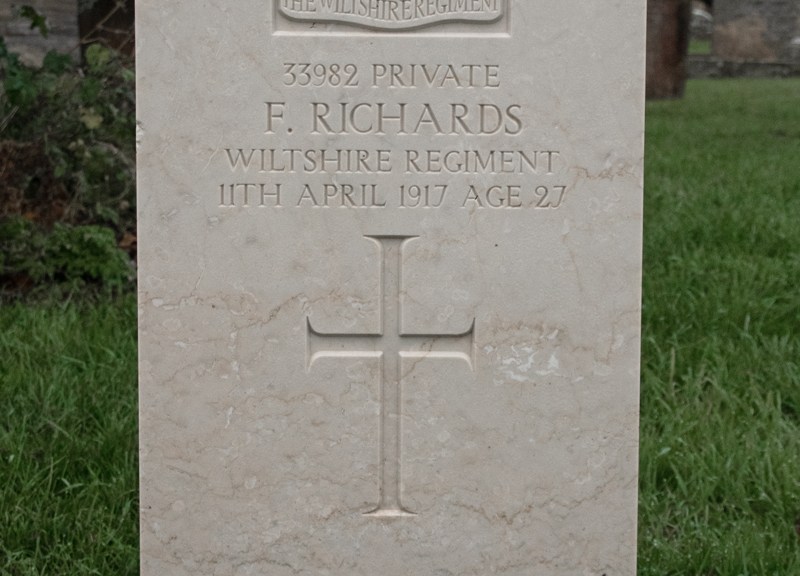
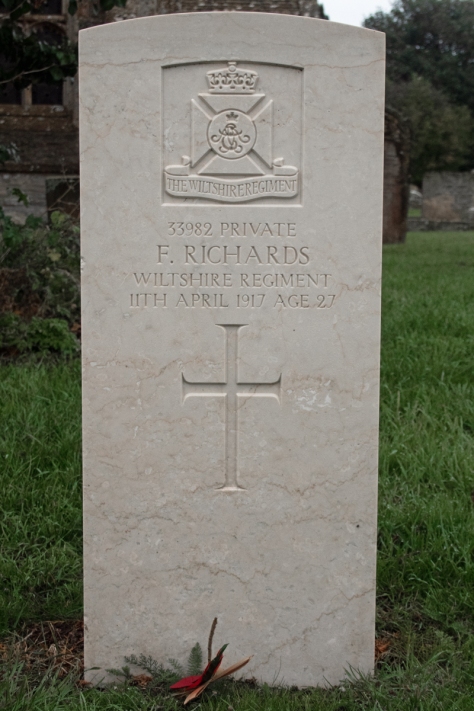
Francis George Richards (or Frank) was born in 1889, the oldest of five children to William and Rhoda Richards. William was an agricultural labourer and the family lived in his home village of Long Sutton in Somerset.
Frank followed his father into agriculture, and, by the 1911 census, was working as a carter.
And that is where the trail of Private Richards goes cold.
What records do exist confirm that he enlisted in the Wiltshire Regiment, serving at its depot in Devizes. This suggests he was part of the 7th (Service) Battalion, raised through the Kitchener Scheme.
The battalion were shipped to France in September 1915, before being moved on to the Balkans, where they fought in the Battle of Horseshoe Hill and the Battles of Dorian. As there are no records of Private Richards’ service, it is not possible to confirm how involved in the fighting in Europe he was, or whether he remained on the Home Front.
Frank’s death also remains a mystery. All that can be said for sure is that he died in hospital on 11th April 1917, in a hospital in England. He was 27 years old. He does not appear to have married, and his pension was assigned to his father.
Frank George Richards lies at rest in the quiet graveyard of Holy Trinity Church in his home village of Long Sutton.
Frank Antell was born in 1880, one of seven children – six sons – to Thomas and Harriett Antell. Thomas was a groom, and Harriett a dressmaker and the family lived in the village of Martock in Somerset.
After Thomas died in 1893, Frank left school and became a carpenter. By the time of the 1901 census, he was living with his mother and youngest brother. Income seems to have been short – there were three other people boarding and lodging with the family.
In August 1904, Frank married Augusta Ring, and together they had five children – Lily, Ada, Leslie, Ronald and Freda.
Frank enlisted in the 13th (Works) Battalion of the Devonshire Regiment; this had been formed in the summer of 1916, so it can only be assumed that he was called up at the start. The battalion was based in Plymouth, so it is likely that Private Antell did not see fighting on the Western Front.
Private Frank Antell’s death is also a bit of a mystery. All that there is to confirm what happened is one stark sentence on his pension ledger:
Wounds self-inflicted during temporary insanity whilst on active service.
This one statement covers a multitude of sins, but does nothing to explain the mystery of what happened. There is no coverage of the incident or funeral in contemporary newspapers, so I have been unable to find any further explanation.
Frank Antell was a man with a young family. His regiment was based in England and was to be so for the duration of the war. One cannot imagine what thoughts were going through his head at the time he took his own life. That the 37 year old felt this was his only option is tragic.
Frank Antell lies at rest in the graveyard of All Saints’ Church in his home village of Martock in Somerset.
Frank’s widow Augusta went on to marry again in 1919, to a Joseph Maunder. She died in 1951 at the age of 73 years old.
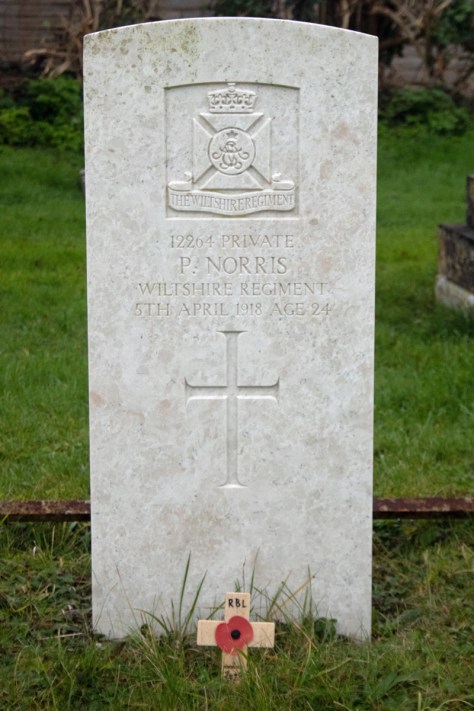
Percy Norris was born in 1894, the youngest of eleven children to William and Julia Norris. William was the caretaker for the water works in Somerton, Somerset, and this is where the family of eleven lived.
By the time of the 1911 census, Percy’s older brother Henry had joined his father at the water works. Julia had passed away five years before, and Percy and three of his siblings continued to live with William. At this point Percy was working as a gardener.
Private Norris’ full military records are not readily available, but it is evident that he enlisted in the 7th Battalion of the Wiltshire Regiment. This was a service troop, formed in 1914, who saw service in France and the Balkans.
It seems that it was during one of the skirmishes that Private Norris was injured. While there is no confirmation of exactly when or where this happened, it is likely to have been at some point in the spring of 1918. Percy was shipped back the England for treatment, and admitted to the Red Cross Hospital in Bridgwater, Somerset.
Sadly, Private Norris did not recover from his injuries. He passed away on 5th April 1918, aged 24 years old.
Percy lies at rest in the cemetery of Somerton, his home town.
Percy’s older brother Henry Norris also died in the Great War. Joining the Royal Naval Volunteer Reserves, Able Seaman Norris was also wounded on active duty, dying of his injuries in January 1918, aged 32. He is buried at the St Sever Cemetery in Rouen, France.
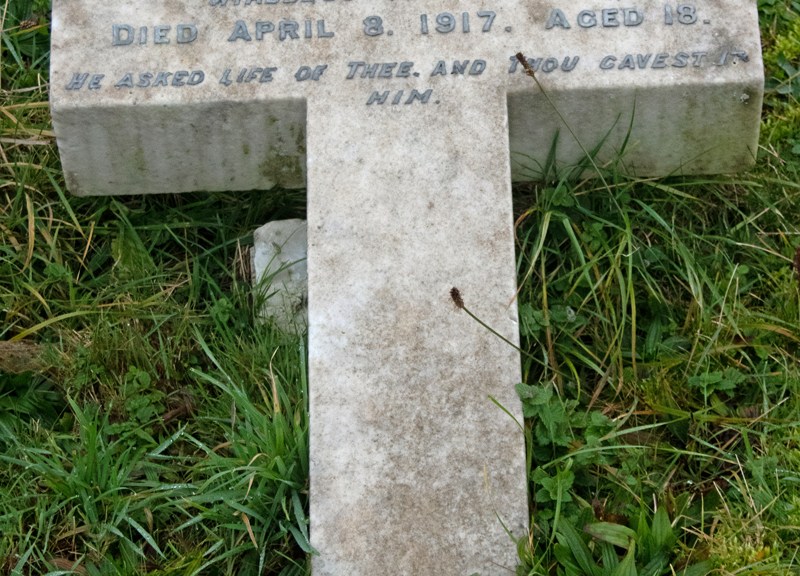
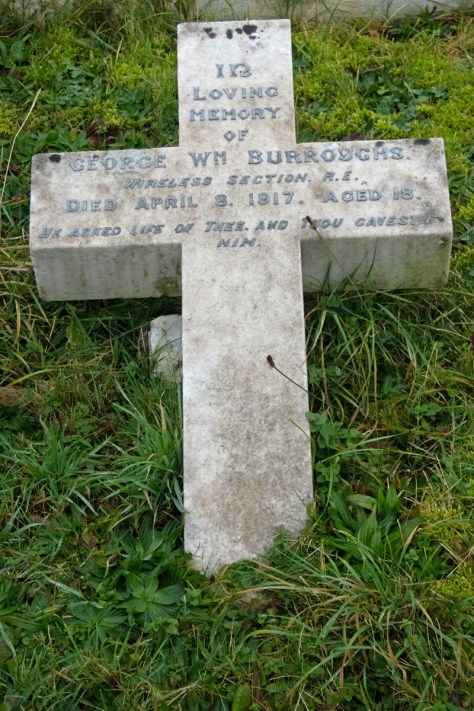
George William Burroughs was born in 1899, the eldest of two sons to harness maker Stratton Burroughs and his wife Alexandra. George was born in Warminster, Wiltshire, but the family soon moved closer to Alexandra’s family in Somerton, Somerset.
The 1911 census found the young family living in Market Place in the centre of Somerton, with a visitor, fancy goods seller Joseph Cazes from Constantinople.
George seems to have enlisted almost as soon as he was old enough to do so, giving up his job as a school teacher (surprising given he was only 17 at the time). He signed up for the Royal Engineers in January 1917, gaining the role of Pioneer.
Sadly, his time in the services was very short. Within weeks of being posted, Pioneer Burroughs was admitted to hospital with meningitis, an illness that was becoming more widespread within the armed forces.
Tragically, after a month in the Norton Barracks Military Hospital in Worcestershire, George passed away from the disease. He was just 18 years old.
George William Burroughs lies at rest in the cemetery of his home town of Somerton.
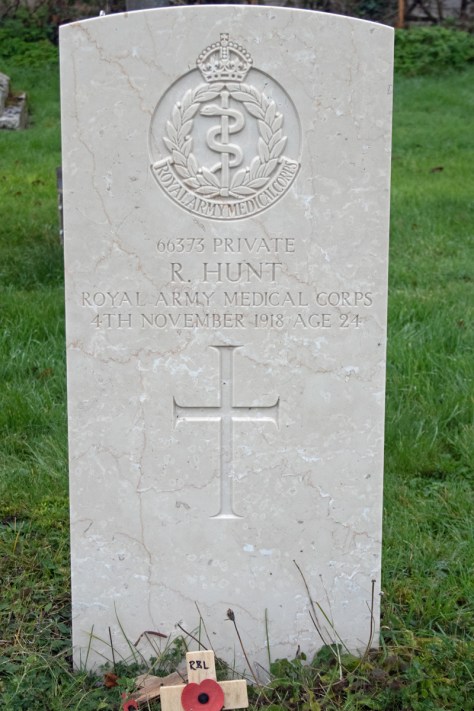
Robert Edward Nichols Hunt was born in Somerton, Somerset in 1894. One of five children to Charles and Rose Hunt, his father was a bootmaker.
By the 1911 census, however, things had taken a different turn; Charles and two of his sons were working for a brewer, Rose was working as a shop assistance in Boots, and the youngest of the family, Kate, was apprenticed to a dressmaker.
It was against this backdrop that war came, and, within a year, Robert had enlisted in the Royal Army Medical Corps. His sign-up documents confirm that he was short sighted, although this was corrected with glasses and he was deemed fit for active service.
Sent to the Western Front in October 1915, Private Hunt definitely found himself in the thick of the action.
In August 1916, he was supporting the fighting at High Wood on the Somme, when a gas shell exploded near him. He fell and, when he woke, he remembered little of what happened. Robert had inhaled a lot of gas, however, and was left coughing with difficulty breathing. He was transferred back to England by train and ship to recover, arriving back on the 2nd September.
There is no record of Robert having gone back to the front. The impact of the gas appears to have been severe and long-lasting. At the end of October 1918, he was admitted to the Becket House Auxiliary Hospital in St Albans with influenza and bronchial pneumonia. Sadly, this was to be a battle he would not recover from, and he passed away on 4th November 1918. He was 24 years old.
Robert Edward Nichols Hunt lies at rest in the cemetery of his home town, Somerton.
There are some times where no amount of research on a person will reveal their information.
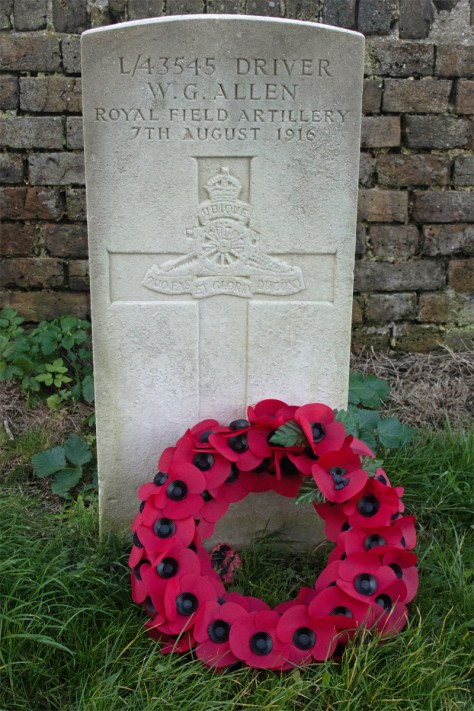
William George Allen is one such person.
The only details I have been able to uncover for this man is his gravestone and the Army Register of Soldier’s Effects.
William Allen was a driver for the Royal Field Artillery. His troop – the 156th Camberwell Brigade – was raised in South London in early 1915, although I have no record of when Driver Allen enlisted.
At some point, the 156th Brigade were stationed at Port Victoria – the fort on the Isle of Grain in Kent.
It was during their time at the fort that William died. He passed on 7th August 1916 and there is no cause of death recorded, and he does not appear in any contemporary newspapers. This might suggest that his death was not out of the ordinary or unexpected.
Unusually for the Register of Soldier’s Effects, nobody is listed for the war gratuity payments to be made (this would normally be a next of kin – father, mother or spouse). In total a payment of £6 19s 2d was paid out, not an extravagant amount for that regiment.
So Driver Allen remains a mystery. A (presumably) young life lost too soon, and lost to time.
William George Allen lies at peace in the graveyard of St James’ Church in Grain, North Kent, metres from the fort in which he passed.
John Henry Armes was born in Cannock, Staffordshire in 1881. One of eight children to Richard and Mary Armes, his father was a colliery worker and labourer. After their mother’s untimely death in 1890, this was a trade into which his three boys – Richard Jr, John and Alfred – followed.
The 1901 census finds John living with his widowed father and working as a coal hewer. A year later, he married Caroline Caldwell and, by the outbreak of the war, the couple were living in Ilkeston, Derbyshire with their growing family of seven children.
Records of John’s enrolment are not evident, but it is likely to have been later in the war, rather than earlier, given that his trade was one of those protected from enlistment.
By 1915, Caroline had given birth to the couple’s seventh child and John had signed up to the King’s Royal Rifles, stationed at the fort in Grain, North Kent.
Rifleman Armes’ pension record shows that he was accidentally killed on active service, and the contemporary media pick up the story.
[He] had been on outpost duty. On coming off duty about half-past seven on Monday morning he placed his rifle in a rack in a hut, and went to breakfast. Another rifleman names John Bathams Olliff, picked up the rifle to unload it, but having trouble with the extractor he took the magazine of the rifle out, and then thinking all the cartridges were in the magazine he pressed the trigger to close the bolt of the rifle, and a shot went off. At that moment Rifleman Armes came round the door of the hut and received a bullet in the chest.
Exclaiming, “My God, Armes is here,” Olliff rushed to his assistance, and Armes said “I am done for. It was an accident.” Medical aid was telephoned for, but Armes died shortly after the doctor arrived.
Est Kent Gazette: Saturday 5th February 1916
An inquest was held, which found that the two Johns were great friends and had asked to serve together. The jury exonerated John Olliff from blame and recorded a verdict of accidental death.
John Henry Armes died at the age of 34, likely without seeing his youngest child. He lies at rest in St James’ Churchyard in the village of Grain in Kent, close to the barracks where he lost his life.
There are a couple of other protagonists in this story.
John’s widow, Caroline, married again later in 1916, to a George Chapman. She went on to live to the age of 77, outliving three of her children and both of her husbands.
John Battams Olliff, who had accidentally shot John, was born in London in 1880. The son of a butcher, he had emigrated to Canada in 1911. John returned to the UK to fight in the war, joining the King’s Royal Rifles in May 1915. Little information about his post-war survives, but it appears that he remained in England. There is no record of him marrying, but he died in 1938, at 58 years old.










 Death and Service