Albert Arthur Shrubsall was born in Deptford, South London, in April 1896. He was the youngest of three children – all boys – to ironmonger George Shrubsall and his wife Jessie.
While his brothers continued to live at home after they had left school and got jobs, Albert found live-in work as a pageboy, or servant, for Wilfred Lineham, who was a professor of engineering for a London college. It was while he was working here that his mother, Jessie, passed away. She died in 1913, aged just 43.
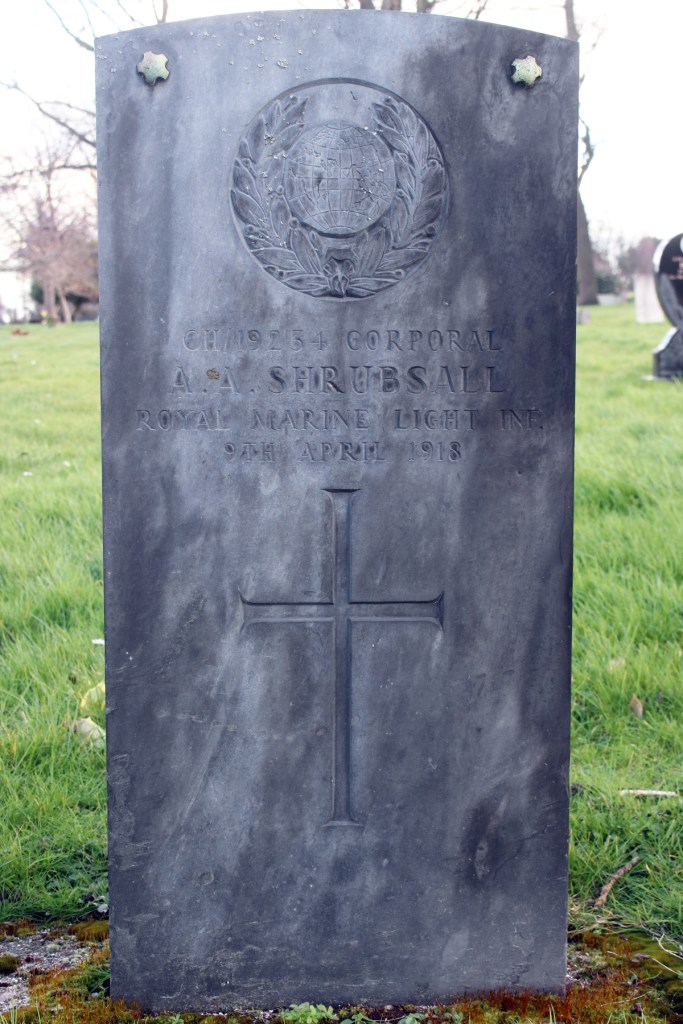
Details of Albert’s military service are a bit scant. He enlisted in the Royal Marine Light Infantry, although I have been unable to confirm when he joined up. He was assigned to the Chatham Division, and was based at the Naval Dockyard in Kent, ultimately being promoted to Corporal.
Albert married Gertrude Spoore – affectionately known a ‘Ginty’ – in Deptford in October 1917. Sadly, the marriage was to las less than six months, as, on 9th April 1918, Albert passed away, having contracted pneumonia and septicaemia. He was just 22 years old.
Albert lies at rest in the Woodlands Cemetery in his adopted home town of Gillingham in Kent.
Albert’s two brothers George and Alfred were also involved in the First World War.
George, had gone on to become a tailor’s assistant when he left school. He married Emily Hawkes in 1911, and the couple went on to have a son, also called George, the following year.
When war broke out, he enlisted in the Machine Gun Corps, and served on the Western Front. Sadly, he was caught up in the fighting, and was killed in action on 22nd August 1917. He was buried at the Tyne Cot Memorial in Flanders.
When he left school, Alfred went on to become a butcher’s assistant. War came along, and he enlisted straight away.
Enrolling in the Royal Field Artillery, Gunner Shrubsall was assigned to the 95th Brigade. Sadly, he had recorded less than six months’ service, as he passed away on 8th January 1915, aged just 21 years old. His brigade did not go to France until the following year, so, while no cause of death is recorded, it is likely that he died from a communicable disease like influenza or pneumonia.
Alfred is buried in the family grave in Deptford, South London.
Within a period of just three years, George had lost all three of his sons to the Great War. Given the previous death of his wife, you can only imagine the heartbreak he was going through.
Albert James Adams was born in Somerset in September 1878, the fifth of ten children to Robert and Mary. Robert was a mason, who sadly passed away when Albert was only 11 years old. Mary lived on as the head of the household, and by the 1901 census, she had four of her five sons living with her, three of them also stone masons.
Albert had taken a different route in life, and found work as a postman. He married Annie King, a young woman from Taunton, in 1910, and they set up home in the village of Selworthy near Minehead. Albert was the village postman, and the young couple lived there with their sons – Albert and Robert – and Mary.
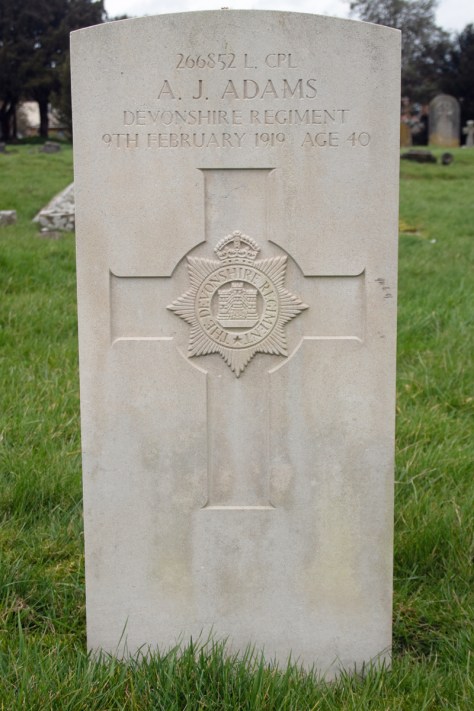
When war came, Albert enlisted, joining the 6th Battalion of the Devonshire Regiment. While his military records are scattered, his battalion served in India and Mesopotamia; during their three years in the Middle East, the 6th Battalion lost twice as many men to illness – influenza, pneumonia, malaria – as to enemy action.
Lance Corporal Adams was not immune to sickness; while I have been unable to unearth exact dates for his military service, his cause of death is recorded as malaria and pneumonia. He passed away on 9th February 1919, at the age of 40 years old.
Albert James Adams lies at rest in St John’s Cemetery in Bridgwater, Somerset.
Henry Cummings was born in the village of Wembdon, near Bridgwater in Somerset in 1876. The son of agricultural labourer John and his wife Jane, Henry was one of six children.
When he left school, Henry followed his father into agricultural labouring, as his older siblings had done before him. Jane had died when Henry had just reached his teens, so he continued to live with his widowed father, and was recorded there as late as the 1911 census.
On 4th August 1912, he married Sarah Palmer in Wembdon Parish Church; Henry was 36 by this point, and his new wife was 30. They couple may not have thought they could have children, as they went on to adopt a girl, Edith, who was six years old when they had married.
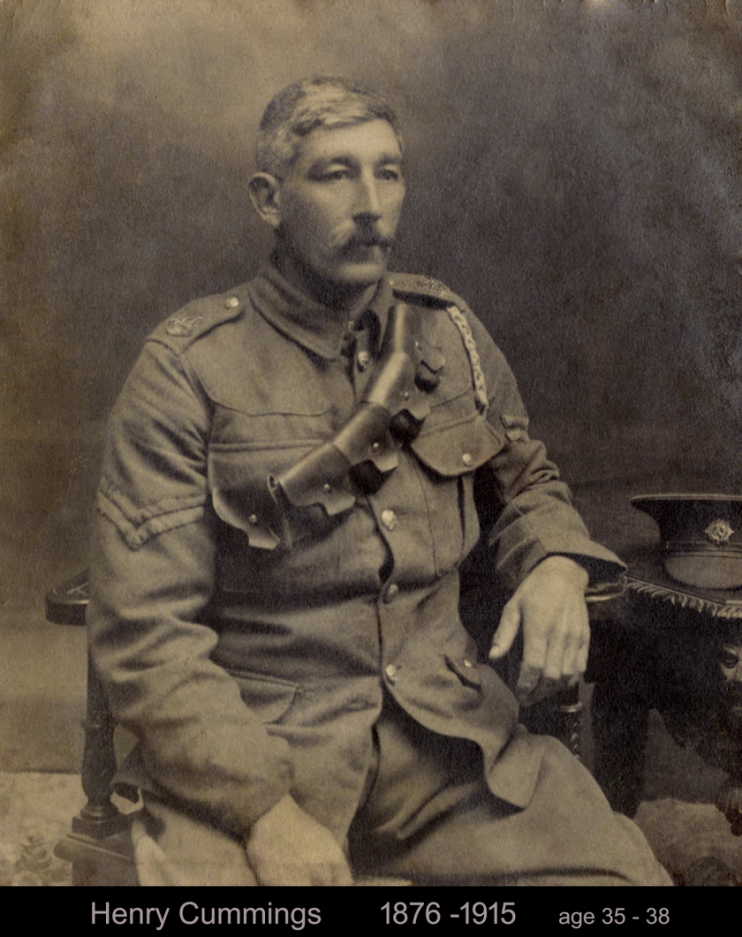
From a military perspective, it appears that Henry had initially tried to enlist in 1908. Based on his service records, it seems that he was not accepted at that point, but when war broke out, things were a different matter. He joined the Army Service Corps on 6th January 1915, attaining the rank of Sergeant.
Henry’s service was to be cruelly short, at just 85 days. Hospitalised in Rugby, Sergeant Cummings passed away from cerebrospinal meningitis on 6th April 1915. He was 38 years old.
Henry Cummings was brought back to Bridgwater for burial, and lies at rest in the Wembdon Road Cemetery there.
In September 1915, Sarah gave birth to a baby girl, Irene. Henry was never to see his little girl, and, tragically, may not even have known he was to be a father.
Stanley Arthur Robert Pearce was born in September 1895, the fourth of five children to Edwin and Rosetta Pearce from Bridgwater, Somerset. Edwin was a painter and sign-writer, and it was in the creative trades that his children followed.
Stanley’s eldest brother Clifford became a gardener; his next oldest Edwin Jr was a mason’s labourer; while his older sister Dorothy became a cardboard box maker. By the time of the 1911 census, when Stanley was 16, he was listed as a painter’s errand boy, presumably helping out his father.
War was on the horizon, and Stanley was keen to do his bit. In October 1914, he enlisted, becoming a Driver in the Royal Army Service Corps. Assigned to the 662nd Heavy Transport Company, he was based in London. There was still time for visits home, however, and the local Bridgwater newspaper reported on an ASC football match in which Driver Pearce was involved in October 1915.
By this time, Stanley had met Flossie Vickery, from nearby North Petherton. The couple married the following year, and had two children, Ada and Geoffrey.
In 1916, Driver Pearce’s battalion was shipped off to Salonica in Greece, as part of the British Expeditionary Force in the Balkans. While there, he contracted malaria and dysentery, and was evacuated back to England for treatment in September 1918.
Driver Pearce recovered well enough to enjoy a month’s recuperation, but fell ill again, with a recurrence of malaria, combined with influenza and pneumonia. He was admitted to the Brook War Hospital in South East London, but sadly not recover, and passed away on 10th November 1918, a day before the Armistice was signed. He was just 23 years old.
Stanley Arthur Robert Pearce lies at rest in the Wembdon Road Cemetery in his home town of Bridgwater.
Stanley’s older sister Dorothy – the cardboard box maker – contracted influenza around the same time as her brother and, tragically, died just five days after him. The siblings were buried in a joint funeral at the cemetery.
Hedley Walter Chinn was born in April 1900, one of six children to Walter and Kate Chinn. Walter was the butcher in the Somerset village of Middlezoy, and this is where the family had made their home.
There is little information on Hedley’s pre-war life, beyond the two census records of 1901 and 1911. With war breaking out and his older sister Lilian dying while nursing the troops (see below), it seems that Hedley was eager to do his duty.
Within months of Lilian’s death in 1917 – and basically as soon as his age allowed – Hedley enlisted in the Royal Naval Air Service as a mechanic. He carried out his initial training on the land-based ships President II, Impregnable and Cranwell, before officially joining the newly-formed Royal Air Force in May 1918.
Air Mechanic Chinn continued his service at Calshott, where he worked as a wireless operator for the flying boats guarding the Solent around Southampton. He continued in the role for the remainder of the war and beyond.
Hedley was eventually transferred to the RAF Reserve in February 1920, when, presumably, he returned to the family home in Somerset.
Little further is evident of Hedley’s life; but he passed away less than a year after being demobbed. There is nothing to confirm the cause of his death; given he died more than two years after the war, it is likely that it was as a result of an illness, although this is a presumption on my part. Either way, he died on 2nd January 1921, aged just 20 years old.
Hedley Walter Chinn lies at rest in the peaceful graveyard of Holy Cross Church in Middlezoy, Somerset.
It is worth noting that Hedley’s sister Lilian also served – and perished as a result of the Great War. Click here to learn more.
When I was researching Hedley’s life, I ran through the contemporary newspapers to trace his name. Nothing evident came up, although Hedley’s father, Walter’s name did appear.
In 1910, he declared himself bankrupt after being unable to pay for meat for his shop, that he had bought at auction. It appears that he had run up debts of over £300 (approximately £23,500 in today’s money) over a number of years; he put these debts down to a number of factors – “illness of my children, bad debts, having to maintain my mother for 14 years; and loss on sale of Middlezoy House, Middlezoy, three years ago, which realised £200 less than the amount I gave for it, and the amount expended on improvements”.
The 1921 census found Walter and Kate still running the butcher in Middezoy, their home empty but for each other. Walter’s debts were finally cleared in 1928 and the bankruptcy annulled.
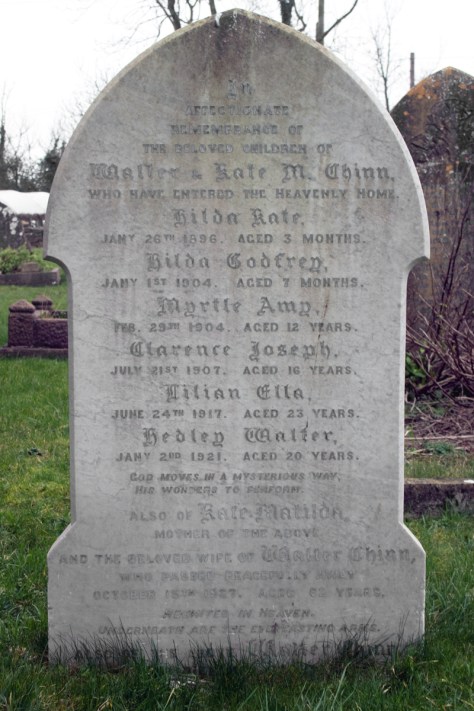
The gravestone in Holy Cross Churchyard is a haunting memorial to the tragic lives of the Chinn family.
Walter and Kat had six children, and would outlive every one of them. The stone confirms that each of their children lies in the grave:
The grave’s epitaph – God moves in a mysterious way, his wonders to perform – sounds cruelly hollow to 21st century ears. The only comfort to take, I guess, is that the whole family was destined to be together again: both Kate (who died in 1927) and Walter (who died in 1933) are also buried in the family grave.
Lilian Ella Chinn was born in 1893, one of six children to Walter and Kate Chinn. Walter was the butcher in the Somerset village of Middlezoy, and this is where the family had made their home.
There is little recorded of Lilian, and the information is confusing – another Lilian Chinn was born around the same time a few miles away, so it’s a challenge to identify the correct details.
What is known, is that, with the war raging, Lilian felt that she needed to do what she could – and enlisted in the Voluntary Aid Detachment in 1916. Serving as a nurse, she was based at the military hospital in Devonport, Plymouth.
Sadly, it is evident that nursing staff were not immune to the ailments and illnesses of the soldiers they were treating. Lilian contracted meningitis and peritonitis, passing away on 24th June 1917, aged just 23 years old.
Lilian Ella Chinn lies at rest in the peaceful graveyard of Holy Cross Church in Middlezoy, Somerset.
It is worth noting that Lilian’s brother Hedley also served – and perished – as a result of the Great War. Click here to learn more.
When I was researching Lilian’s life, I ran through the contemporary newspapers to trace her name. Nothing evident came up, although her father Walter’s name did appear.
In 1910, he declared himself bankrupt after being unable to pay for meat for his shop, that he had bought at auction. It appears that he had run up debts of over £300 (approximately £23,500 in today’s money) over a number of years; he put these debts down to a number of factors – “illness of my children, bad debts, having to maintain my mother for 14 years; and loss on sale of Middlezoy House, Middlezoy, three years ago, which realised £200 less than the amount I gave for it, and the amount expended on improvements”.
The 1921 census found Walter and Kate still running the butcher in Middezoy, their home empty but for each other. Walter’s debts were finally cleared in 1928 and the bankruptcy annulled.
The gravestone in Holy Cross Churchyard is a haunting memorial to the tragic lives of the Chinn family.
Walter and Kate had six children, and would outlive every one of them. The stone confirms that each of their children lies in the grave:
The grave’s epitaph – God moves in a mysterious way, his wonders to perform – sounds cruelly hollow to 21st century ears. The only comfort to take, I guess, is that the whole family was destined to be together again: both Kate (who died in 1927) and Walter (who died in 1933) are also buried in the family grave.
Albert Edward Matthews was born in October 1901 in the Somerset village of Tintinhull. His father James was a glove maker, and he and his wife Mary had three children in all, Percival, born in 1897, Clementina, born in 1898, and Albert, the youngest.
Sadly, Clementina died in 1909, aged just 11 years old. Percival also passed away six years later, aged just 17. James and Mary must have been distraught when Albert announced his decision to do his bit for King and country.
He enlisted almost as soon as he was able to, joining the Royal Navy on 14th September 1918, and you can almost sense his enthusiasm to get involved before missing out on the glory of military service.
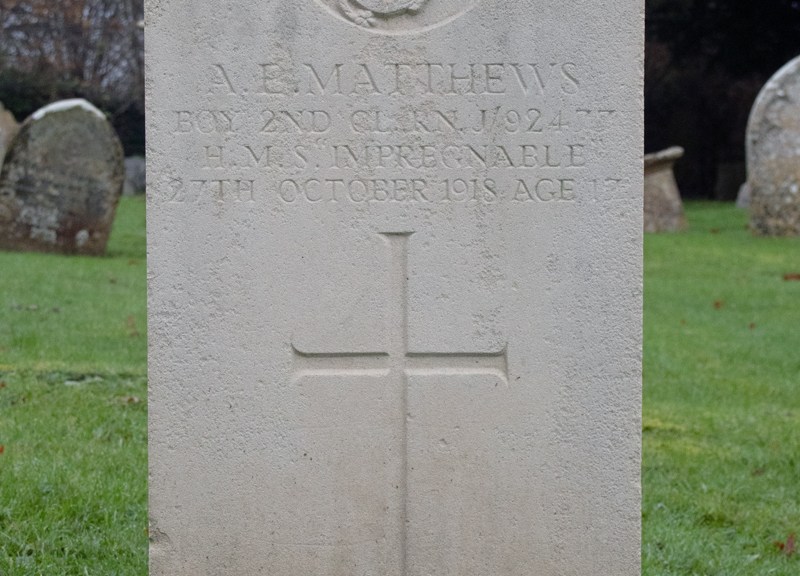
Boy Matthews was assigned to HMS Impregnable, the ship based in Devonport, Plymouth, where he was to receive his training. Standing at 5ft 8ins (1.73m) tall, with brown hair, brown eyes and a fair complexion, he was recorded as having a very good character and satisfactory ability.
Sadly, however, Albert was not destined to meet his full potential. Shortly after beginning his training, he contracted influenza and pneumonia, succumbing to the disease on 27th October 1918.
He had just turned 17 years old.
Albert Edward Matthews lies at rest in the graveyard of St Margaret’s Church in his home village of Tintinhull.
The story of this family continued to be tragic. By the time of Albert’s death, the Spanish Flu pandemic was sweeping the world and his tiny part of Somerset was in no way immune.
Just four days after Albert Matthews passed away, his mother, Mary, also fell victim to the illness.
In the space of just nine years, poor James Matthews had buried all three of his children and his wife. A newspaper reported on Mary’s funeral, recognising the “very heavy trials” he had undergone.
The same paper, reports that the influenza pandemic is fizzling out.
A large number of parishioners have been attacked with “flu”, but the epidemic is now on the wane. The school has been closed for the last fortnight.
When carrying out research on the Commonwealth War Graves, information remains tantalisingly elusive.
Sometimes just you can chance upon one document and the life of the person behind the name is laid out in front of you.
But in the majority of cases, the someone’s history has to be pieced together from a combination of sources.
Henry Harry Trevitic was born in around 1879 in Burton-upon-Trent, Staffordshire.
There are no records of Trevetics in and around that area at that time, nor are there any permutations of his surname – Trevethick or Trevithick, for example.
The first evidence I have found of Harry is on his military service records. He enlisted in the King’s Royal Rifles in August 1897, listing himself as a ‘cycle fitter’. The document asks if the applicant has previously served in the armed forces; Harry’s reply is that he is in the militia – the 4th Worcestershire Regiment.
Rifleman Trevetic’s military career is extensive; his records show continual service in the King’s Royal Rifles from 1897 to his death in 1915. This included three years in South Africa, two in India and eight months as part of the British Expeditionary Force within weeks of the outbreak of World War One.
The 1901 census finds Rifleman Trevetic at a convalescent home in Hanbury, near Droitwich, along with eleven other soldiers. He is marked as a Visitor, rather than a Resident, so it can be assumed that the owner of the home, whose brother is party of the military party, has put them up for the night (or longer).
Harry next turns up in 1902 when, in December, he married Frances Boyes in Southampton. His military career continued, however, and moving to the 1911 census, and Rifleman Trevetic is barracked in Woolwich. He is listed as married, while Frances is also based in the town, in female quarters.
While the details of his early life are pretty scarce, those surrounding his passing are much more in depth. Because of the circumstances, an inquest into his passing was ordered into his death; this included four pretty in-depth witness statements.
In January 1914, Rifleman Trevetic was appointed as an assistant to Captain Adjutant Makins in Winchester. In August of that year he was shipped with Makins to France and remained his servant.
On 14th September, Captain Makins was badly injured, and Harry helped carry him to the church in the village of Soupir in France, which was acting as a dressing station.
In Makins’ own words “there were 300 wounded closely packed, occupying the whole of the floor space. The groans and the smell, night and day were most distressing. Fresh wounded were constantly being carried in and dead carried out. Shell fire was constant and the general conditions were such as would severely try a highly strung man. During all this time, [Rifleman Trevetic] was my only attendant.”
Makins was moved to various hospitals in France, always accompanied by Rifleman Trevetic and eventually invalided home. Given the seriousness of Captain Makins’ injury, he was permitted to bring Harry back home with him.
On 1st March 1915, Captain Makins was passed fit for general service, and rejoined his battalion, along with his servant. Conscious that he may be sent back to the Front at any point, he warned Harry to be prepared for France again.
Captain Makins’ testimony takes up the tragic story.
On March 9th, he came to me and asked if I would see the Doctor on his behalf privately. He told me that every since his time in the dressing station at Soupir, his nerves had been ajar, and that he could neither eat nor sleep. He asked whether I could get the Doctor to do something for him, as he feared if he went sick in the ordinary way, he would be passed unfit for the front, and be unable to accompany me there, which he was very keen on doing.
Later in the day he came to me and asked me to take no notice of what he had said in the morning, that as a matter of fact he had taken to drink, which was the true cause of his trouble, and that he was entirely giving it up and would be right within a week.
His whole manner was strange and he appeared under the impression that I had discharged him. This was the first intimation I had of any strangeness in his manner.
Being busy I did not pay the attention to it that perhaps I should, more especially as I knew him to be a thoroughly sober and reliable man.
The following day he called me as usual.
About 8:30 am I was called from the mess and asked to proceed to my room at once. On arrival, I found the door locked, and various Officers’ servants outside. The key was on the inside of the door but so turned that the body of Rifleman Trevetic could be seen through the keyhole lying on the floor.
I broke open the door and found Rifleman Trevetic shot through the heart, my revolver lying by his side. The revolver contained one empty shell, I cannot say where this was obtained. There were a few rounds of ammunition in the room, but the marks did not correspond nor am I able to trace any similar ammunition in the Fort.
Captain G Makins’ statement, Inquest from Rifleman Trevetic’s service records
Three other servicemen gave statements into the tragic events of that day, and all summed up Harry’s demeanour in the same way as Captain Makins.
Rifleman Trevetic has throughout his service to me, been a model servant, and had during my time in hospital not only been invaluable to me, but also to the hospitals themselves. He was very happily married, and constantly spoke affectionately of his wife and as far as I can tell, was in no financial difficulties.
Captain G Makins’ statement, Inquest from Rifleman Trevetic’s service records
The inquest found that his death was self-inflicted and “at the time he shot himself he was temporarily insane, and that his mental condition was clearly caused by what he saw and went through when on Active Service in France, and that there was no other contributory cause.”
Temporary insanity, shell shock, war neurosis, combat stress, cowardice; however it was badged Post Traumatic Stress Disorder is commonly recognised these days, but was frowned upon in the Great War.
Sadly, while appearing eager to accompany his superior, it seems that the thought of actually returning to the Western Front was so terrifying to Rifleman Trevetic, that he felt there was only one route out. He was 36 years old.
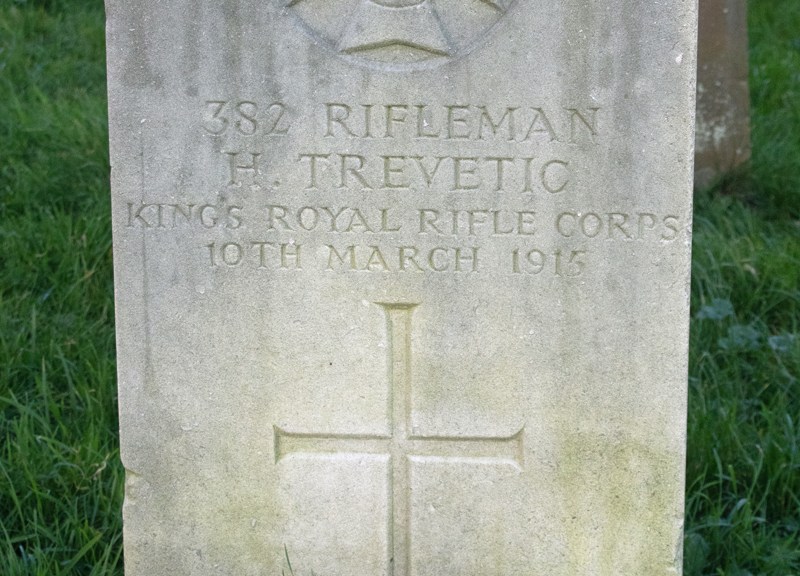
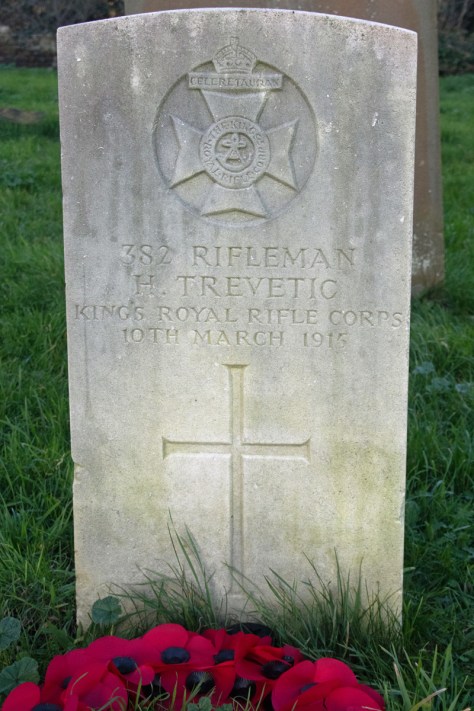
Harry Trevetic lies at rest in the quiet graveyard of St James’ Church on the Isle of Grain, metres from the fort where he ended his life.
Harry’s widow Frances lived on. Whilst there was no mention of her husband’s death in the newspapers of the time, she received a handsome war gratuity and a pension that reflected Harry’s long service. She went on to marry again in 1917, to Jack Finch, a Sergeant in Harry’s battalion.
Given the stigma around mental health in the early twentieth century, and, it is amazing that the documents have survived as part of the Harry’s military records. The inquest into his death was carried out within days of his passing, and I find the findings of the report forward thinking in the way that it was written.
Harry was obviously a man who experienced way more than his mind was able to cope with – the trauma of that dressing station must have been so much worse than he had seen before during his two decades’ military service. But the report is clear in that it apportions blame for his death on the fighting and bloodshed in France; this was clearly out of character for Harry, and it was his experiences in the field of battle that drove him to his death.
What is less clear is how much Frances was told of his death. While the inquest was decisive, suicide was as much of a stigma as shell shock at that time. Would the King’s Royal Rifles have be honest with her about how he died? Or, while they where internally open, would they have pulled ranks around their own and protected Frances from the truth and themselves from rebuke?








 Death and Service