Tag Archives: tuberculosis

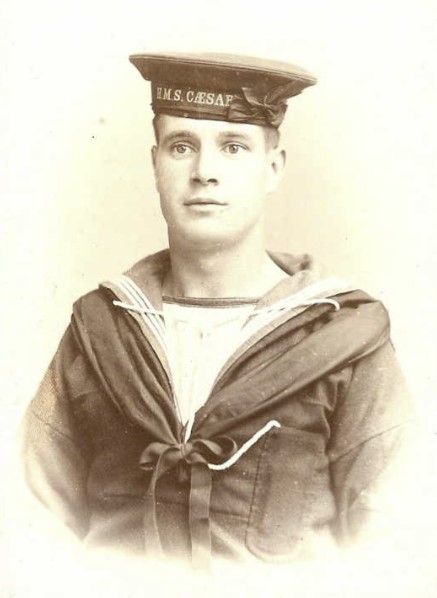
Private Frank Mayo

Private Frank Mayo

Francis James Stephen Mayo was born on 24th November 1894 in Oldland, a small Gloucestershire village near Bristol. One of eight children, his parents were collier Samuel Mayo and his wife, Diana.

Frank, as he was known, sought a life of adventure from the start. In July 1911, not content with life as a farm labourer, he enlisted in the Royal Navy as a Boy 2nd Class. His service records show that he was 5ft 5ins (1.65m) tall, had light hair, blue eyes and a fair complexion.

Sent to the training ship HMS Impregnable, Boy 2nd Class Mayo’s time there was short. When Samuel found out what his son had done, he paid £10 (the equivalent of around £1250 in today’s money) for his discharge.

Frank went back to farm work, but, with storm clouds brewing on European shores, his time was to come again. On 8th September 1914, just a month after war was declared, he enlisted. His service records show that he had gained an inch (2.5cm) in height since his attempt to join the Royal Navy.

Again, Frank’s attempt to escape what he presumably felt to be a humdrum life were thwarted. His service records confirm that he was discharged on medical grounds because he was deemed not likely to become an efficient sailor.

On Christmas Day 1915, Frank married Martha Sweet, the daughter of a chimney sweep. The couple settled down in Keynsham, not far from either of their families, and had a son, Henry. Frank, by this time, seemed to have given in to the inevitable, and looking for a regular wage, began working at one of the local collieries.

Frank still had a dream to fulfil, though, and with no end to the war in sight, he again enlisted, joining the Training Reserve in June 1917. His records show that he had gained another inch in height, and has a number of tattoos on his right forearm. His records this time show that he had a slight heart problem, and was also suffering from a touch of rheumatism.

Private Mayo was assigned to the 440th Company of the Labour Corps, and seemed, at last, to be fulfilling the role he had wanted to be doing for the last six years. As time went on, however, his health seems to have been failing him and, in the summer of 1918, he contracted pulmonary tuberculosis. He passed away from the condition on 30th August 1918, while at camp, aged just 23 years of age.

Brought back to Gloucestershire for burial, Francis James Stephen Mayo – or Frank – was laid to rest in the graveyard of St Anne’s Church in his home village of Oldland.


Private Leonard Luscombe

Private Leonard Luscombe

Leonard Luscombe was born in the spring of 1894 in the Devon village of Ipplepen. He was the fourth of five children to William and Bertha Luscombe, bakers and grocers in the village.

When he left school, Leonard found work as a clerk in a bank, but it is clear he was after bigger and better things. On 27th August 1912 he enlisted in the Royal 1st Devon Yeomanry as a Private. His service records show that he was 5ft 5ins (1.65m) tall, had good vision and was of good physical development.

Private Luscombe was sent to Salisbury Plain in Wiltshire for his training, but then returned to Devon at a base near Bovey Tracey, where he remained when war broke out in 1914. That autumn, he contracted tuberculosis, and it was to prove severe enough for him to be medically discharged from the army in February 1915.

Leonard returned to his life in Ipplepen, but his lung complaint was to dog him for the next few years. He finally succumbed to the condition on 26th October 1918, at the age of just 24 years old.

Leonard Luscombe, whose “cheerful hopefulness and intelligence gained him much popular sympathy” [Western Times: Saturday 2nd November 1918], was laid to rest in the family grave in St Andrew’s Churchyard in his home village.


Private William Jackson

Private William Jackson

Little concrete documentation remains about the life of William Henry Jackson. He was born in Bedford, Bedfordshire, on 6th February 1872, although it is not possible to identify who his parents were.

He married a woman called Edith in 1903, and the couple settled in her home town of Beeston, Nottinghamshire. By the time of the 1911 census, he was recorded working as an electrician’s labourer at the local telephone works, while Edith, who was five years his senior, earned extra money as a blouse finisher.

Information about William’s wartime efforts are also limited. He enlisted in the Royal Marine Light Infantry, and was assigned to the Chatham Division. He was given the rank of Private and based at the Royal Naval Dockyard in the Kent town.

The only other information available for Private Jackson is that he died on 16th September 1916, having contracted a combination of pneumonia and tuberculosis. He was 44 years of age.

William Henry Jackson was laid to rest in Woodlands Cemetery, Gillingham, not far from the dockyard in which he had served. His headstone gives the initial H, rather than W, although no documents suggest he went by any name other than William.


Private William Rowlands

Private William Rowlands

William Pierce Rowlands was born the summer of 1891 and was the oldest of three children to Thomas and Ellen Rowlands. Thomas was a slate dresser and quarryman from North Wales, and William was born in Ffestiniog, Gwynedd. By the time his sister Margaret was born, the young family had moved to Llanberis, settling in a small cottage on the outskirts of the village.

When he left school, William found work as a clerk, and this was the work he was carrying out when was broke out. He enlisted on 10th April 1915, joining the 14th (Service) Battalion of the Royal Welch Fusiliers. His service records show that he was 5ft 8ins (1.73m) tall.

Private Rowlands served on home soil for just over seven months, before being sent to France on 30th November 1915. He had been suffering from a cough for a couple of weeks, and this came to a head while he was overseas. He reported sick on 16th December, and was sent back to Britain for treatment a month later.

His condition was identified as pulmonary tuberculosis, aggravated by military service. Private Rowlands was medically discharged from the army on 8th February 1916, and returned home.

At this point, William’s trail goes cold. His condition appears to have worsened, however, and it was from tuberculosis that he was to die. He passed away at home on 18th February 1917, at the age of 25 years old.

William Pierce Rowlands was laid to rest in the quiet graveyard of St Peris Church, in the family home village of Llanberis.


Thomas and Ellen lived until 1932, when the passed away within a couple of months of each other (Thomas in August, Ellen in November). They were reunited with the son, and lie together in the family grave, along with Ellen’s brother, also called William, who had passed away in 1930.


Petty Officer Albert Smith

Petty Officer Albert Smith

Albert Septamus Smith was born in Maidstone, Kent, on 12th January 1881. The oldest of three children to George and Frances Ditcher, he may has been born before the couple married, and seems to have retained his mother’s maiden name throughout his life.

When he left school, Albert sought a life at sea, joining the Royal Navy as a Boy 2nd Class on 12th January 1898, when he was just fifteen. Albert’s naval career was a long and varied one which began on board HMS Impregnable, a training ship. After a month’s training, he was assigned to HMS Lion, where he spent more than a year, gaining a promotion to Boy 1st Class in the process.

In October 1897, Albert transferred to HMS Pembroke, the Royal Naval Dockyard in Chatham, Kent. In the four months that he spent on shore, he turned seventeen and, as a result, came of legal age to formally be enlisted in the navy. Ordinary Seaman Smith signed up for a period of twelve years, and his service records showed that he was 5ft 8ins (1.73m) tall, had brown hair, brown eyes and a dark complexion. He was also noted to have a scar on his right wrist, and a tattoo of a flower and bracelet on the same wrist.

Ordinary Seaman Smith was dedicated to his career. Over the next twelve years he served on board nine different vessels, and rose through the ranks, gaining promotion to Able Seaman (in May 1899), Leading Seaman (January 1903), and Petty Officer 2nd Class (September 1903). He returned to the rank of Leading Seaman, doing so in August 1906, but this seems to have been a deliberate choice, as his service record appears unblemished.

In 1910, Albert’s initial period of service came to an end and he chose not to renew his contract. He had married Ellen Miles on 6th October 1900, and, with four young children, it appears that family had become more important to him. Returning to Maidstone, he found work on the railways, joining the South East and Chatham company as a platelayer. The family home was in Bearsted, a village to the east of Maidstone, now part of its suburbs, and they shared is with Ellen’s sister, Dorothy.

Life was going well for the Smith family, but war was coming to Europe and, with his previous naval experience, Albert was to be called upon again. He was called out of reserve on 2nd August 1914 and, after an initial couple of weeks at HMS Pembroke, Leading Seaman Smith was soon back at sea.

After a couple of years on board the seaplane tenders HMS Engadine and Campania, Albert was promoted to Petty Officer again, and assigned to HMS Sandhurst, a fleet repair ship based at Scapa Flow. He was on board when an explosion in the boiler room killed seventeen seamen on 27th February 1917, although he was not hurt.

It was while Petty Officer Smith was on board HMS Sandhurst that he contracted tuberculosis. He returned to Chatham Dockyard, but the condition was severe enough for him to be medically discharged from active service in February 1918.

Albert returned to civilian life again, and his trail goes cold for a couple of years. His lung complaint continued to haunt him, however, and he passed away from tuberculosis on 4th March 1921. He was 40 years of age.

Albert Septamus Smith was laid to rest in the graveyard of Holy Cross Church in Bearsted, not far from his family home.


Petty Officer Albert Smith
(from ancestry.co.uk)

Private Herbert Towell

Private Herbert Towell

Herbert William Towell was born in the autumn of 1899, the oldest of six children to James and Prudence. James was a wool sorter in a factory, who had been born in Rockwell Green, on the outskirts of Wellington, Somerset, and this is where he and Prudence raised their children.

The Towell family were locals to Rockwell Green. James’ brother Charles lived just a few doors away from him and the 1911 census recorded James and Prudence living at 105 Rockwell Green Road, while Herbert, aged eleven, was living with his paternal grandparents, William and Charlotte, at 131 Rockwell Green Road.

When he left school, Herbert found work as an engine cleaner. War, however, was imminent and he was keen to play his part, but was initially too young do so. His time came, though, and on 30th June 1917 he was enlisted into the 34th Training Reserve Battalion.

At seventeen years and nine months, Private Towell’s service record gives his height as 5ft 11ins (1.80m), his weight as 144lbs (65.3kg) and confirms that he had a mole on his right cheek. He was initially assigned to the 53rd (Young Soldier) Battalion of the Hampshire Regiment, and posted to the army base at Durrington, close to Stonehenge.

In November 1917, Private Towell was admitted to the camp hospital with diarrhoea. Sadly, he had also contracted tuberculosis and it was recommended that he spend some time in a sanatorium. On 6th February 1918, he was discharged from service on medical grounds, and ordered to present himself for review the following year.

Herbert was not to get the chance to do so: within a month of his discharge he succumbed to the lung condition, breathing his last on 5th March 1918. He was just 18 years of age.

Herbert William Towell was brought back to Somerset for burial. He was laid to rest in Wellington Cemetery, within sight of his parents’ home.


Tragedy was to strike James and Prudence again less than a year later, when Herbert’s younger sister, Florence, passed away, aged just ten years old. No further information about her passing is available, so she may also have succumbed to one of the lung conditions running rampant across Europe in the aftermath of the war.


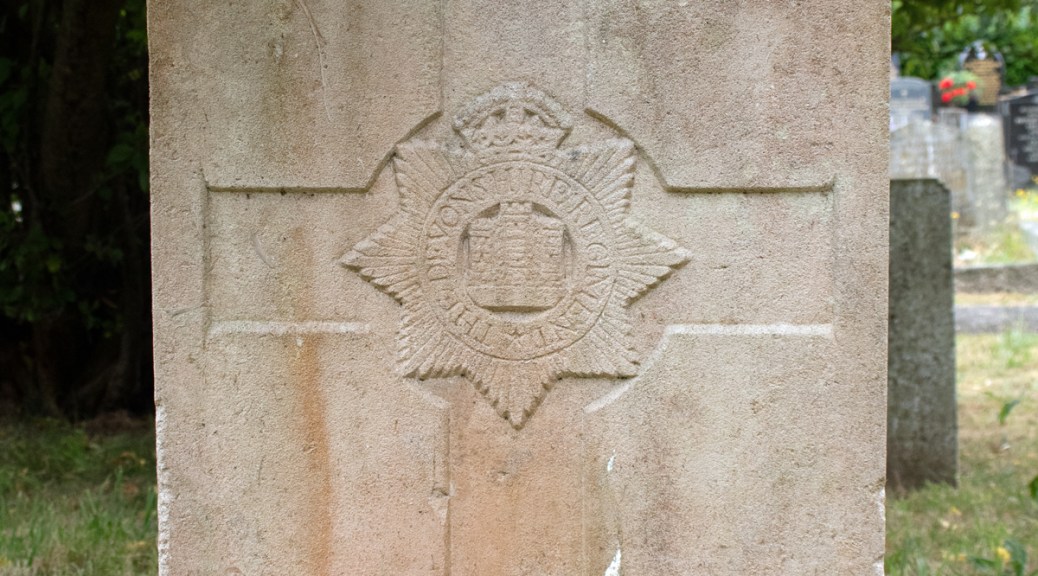
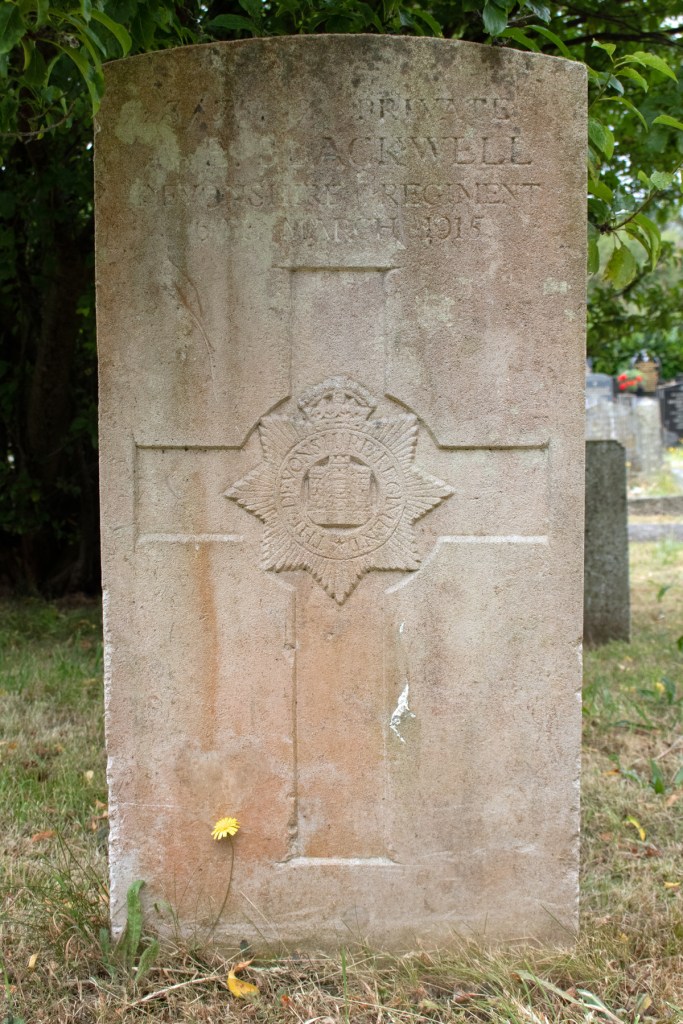
Private Albert Blackwell

Private Albert Blackwell

Albert Edward Blackwell was born in Corfe, Somerset, in the autumn of 1872. He was the third of eight children to Francis and Harriet Blackwell. Francis was a farm labourer, while Harriet supplemented their income by taking in washing. Albert didn’t follow in his father’s footsteps, however, but found work as a ropemaker when he left school.

On 21st September 1905, Albert married Mabel Hellen Fry, a factory hand and porter’s daughter from Wellington, Somerset. The couple began their married life living with Mabel’s parents, and went on to have five children. By the time of the 1911 census, Albert was working as a carter for a local coal merchant, but war was on the way.

There is little information available about Albert’s military service. He enlisted at the start of the conflict, joining the 9th Service Battalion of the Devonshire Regiment by September 1914. Private Blackwell was based at Aldershot, Hampshire, but his service was not to be a long one.

Albert was admitted to the Connaught Military Hospital near Marlborough, suffering from tuberculosis. This became bronchitis, and the lung conditions proved too much for Private Blackwell’s constitution to take. He passed away at the hospital on 6th March 1915, at the age of 42 years old.

Albert Edward Blackwell was brought back to Somerset for burial. He was laid to rest in Wellington Cemetery, not far from where Mabel was still living.


Now widowed, Mabel still had children to raise. In the spring of 1916, she married Alfred Barnfield, a greengrocer from Bath. He had served in the Coldstream Guards for two years, before he was discharged for misconduct in May 1911. Sadly, no further information is available for him and Mabel’s trail also goes cold at this point.


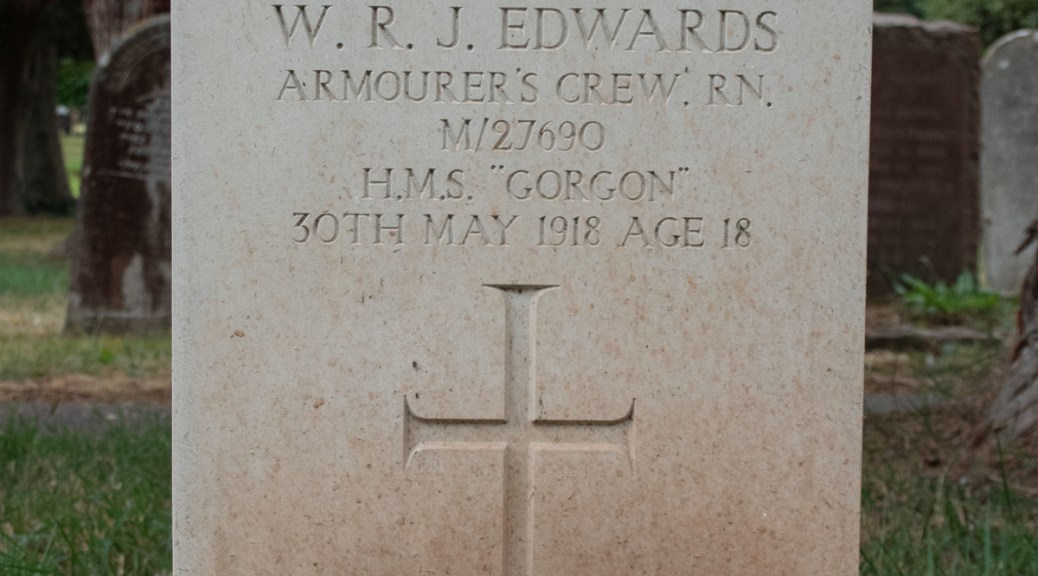
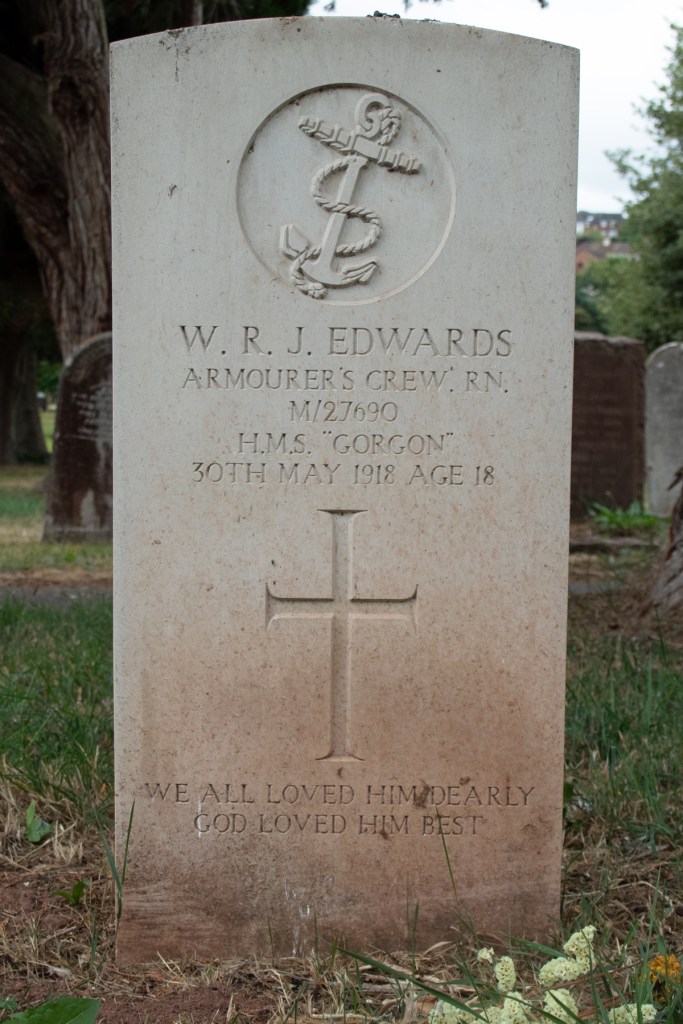
Armourer’s Crew William Edwards

Armourer’s Crew William Edwards

William Robert John Edwards was born on 10th July 1899, one of fourteen children to engine fitter William Edwards and his wife Bertha. Both of William Jr’s parents had been born in Devon, but, by the time of his birth, they had moved to the Somerset town of Wellington.

William followed in his father’s footsteps when he left school, but with war raging across Europe, he was keen to play his part as soon as he was able to do so. He enlisted in the Royal Navy on 7th September 1917, his engineering background making him perfect for a member of the Armourer’s Crew.

William’s service record show that he was 5ft 5ins (1.65m) tall, had brown hair, hazel eyes and a fresh complexion. He was initially sent to HMS Vivid – the Royal Naval Dockyard at Devonport – for training, and was given a posting on board HMS Gorgon, a coastal defence ship on 1st May 1918.

Tragically, this first assignment was to be Armourer’s Crew Edwards’ last. Within a matter of weeks, he was taken back to HMS Vivid, suffering from tubercular meningitis. Back at base, the condition proved too much for the young man: he passed away on 30th May 1918, days shy of his 19th birthday.

Brought back to Somerset for burial, William Robert John Edwards was laid to rest in the cemetery of his home town, Wellington.


Gunner William Reeves

Gunner William Reeves

William Reeves was born in the summer of 1896, one of eleven children to James and Ruth Reeves. James was a house painter from Henfield in West Sussex, and it was there that he and Ruth raised their growing family.

When war came to Europe, William was keen to play his part. He enlisted as a Gunner in the Royal Garrison Artillery, and, by October 1915, was in France.

Little information survives about Gunner Reeves’ military service, but by the time he was demobbed, he had earned the Victory and British Medals, the 1915 Star and the Silver War Badge. The latter award was given to those servicemen who had been honourably discharged from service due to wounds or sickness.

William returned to Sussex, but to a quieter home, James having passed away in the spring of 1916. William was also suffering with his health. He had contracted tuberculosis while in the army, and this is the condition to which he finally succumbed. He passed away on 16th December 1919, aged just 23 years old.

William Reeves was laid to rest in Henfield Cemetery, within walking distance of his family home.


Private Sidney Budd

Private Sidney Budd

Sidney John Budd was born in the spring of 1888, the middle of three children to Abel and Mary Budd. Abel was a gardener from Tiverton, Devon, and this is where the family were born and raised. In the late 1890s, the family moved to West Monkton, near Taunton in Somerset.

When he finished school, Sidney found work as a house painter, and, by the time of the 1911 census, was boarding in a house near Minehead. Within a few years, he had moved again, this time to Chard, and had met Florence Moulding, the daughter of a shepherd from the town. The couple married on 1st August 1914, just days before the outbreak of war.

There is little information available relating to Sidney’s military service. He enlisted before the end of 1917, joining the 3rd (Reserve) Battalion of the Somerset Light Infantry as a Private. This was a wholly territorial troop, and Private Budd would have served in Somerset and Devon.

One of the downsides to being in close proximity to servicemen from other parts of the country in tightly-packed barracks was the ease with which disease could spread. Sadly, Private Budd was not immune from this and, in the spring of 1917, he contracted pulmonary tuberculosis. He was admitted to the Ford House Hospital in Plymouth, but his condition deteriorated and he passed away on 31st May 1917. He was just 29 years of age.

Sidney John Budd’s body was brought back to Chard for burial: he lies at rest in the town’s cemetery.


Florence went on to marry again, wedding Harry Golesworthy in the spring of 1918. Sadly, her happiness was to be short-lived: she passed away just two years later, at the age of 28 years old.


Sidney’s older brother, named Abel after his father, was an interesting character. When he left school, he found work as an apprentice to a photographer.

In July 1909, though, he was brought to court for stealing a bicycle. It seems that he had rented one from a dealer in West Monkton in order to visit friends in Cullompton, but not returned it at the end of the day, as expected.

The dealer contacted Abel’s parents, and he was found to have stayed over in Cullompton. It seems that while there, he had run low on funds, and had sold the bicycle to a dealer in the town. A week later, he returned to the Cullompton dealer, asking to buy the bike back, but hadn’t brought any money with him.

Eventually, Abel’s father went to Cullompton, bought the bicycle, then took it to the original dealer in West Monkton. By this point, however, Abel had been charged with theft, and pled guilty. His father stood witness, and, according to the Taunton Courier and Western Advertiser [Wednesday 14th July 1909], admitted that Abel “was rather weak of mind” and had not intended to steal the bicycle.

Abel was bound over for twelve months, with his father standing surety of five pounds.

The later parts of Abel’s life seem a mystery. There is a record of him travelling to Brisbane, Australia, in the spring of 1914, where he was to work as a farm labourer. He must have returned home, possibly as part of the war effort, and five years later he married Annie Talbot in Taunton, Somerset.

At this point, however, he falls off the radar, and there is no further information about him.