Tag Archives: ulcer

Leading Seaman Henry Hudson

Leading Seaman Henry Hudson

Henry John Gerrard Hudson was born in Whitechapel, Middlesex, on 11th November 1873. The fourth of seven children – and one of five boys – his parents were John and Emma Hudson. John was a paper stainer, and the family were raised in rooms at 62 Fern Street, Tower Hamlets.

Money was seemingly tight, and Henry sought an escape. On 5th January 1889 he enlisted in the Royal Navy, and was sent to the Devon school ship, HMS Impregnable, for his training. As he was below the age to full enrol, he was given the rank of Boy 2nd Class.

Over the next couple of years, Henry learnt the tools of his trade. He spent a year training at HMS Ganges, the shore establishment near Ipswich, Suffolk, and rose to the rank of Boy 1st Class. On 20th November 1890, he was given his first sea-faring assignment, aboard HMS Ruby, and she would remain his home for the next eighteen months.

During his time with Ruby, Henry came of age. His service records show that he was 5ft 5ins (1.65m) tall with light brown hair, brown eyes and a fair complexion. He was also noted as having a number of abscess scars under his left arm.

The now Ordinary Seaman Hudson definitely showed signs of promise as, after just three months, he was promoted to Able Seaman, a rank he would hold for the next five years. During that time, he served on four further ships, including the torpedo boat depot ship HMS Vulcan.

On 1st June 1897, Henry was promoted to Leading Seaman, although he reverted to his previous role just nine months later, at his own request. In October 1898 he transferred to HMS Caesar and, presumably with further support, he was promoted to Leading Seaman again in August 1899.

By May 1902, Henry’s initial term of service came to an end, and he was stood down to reserve status.

In January 1907 Henry married Alice Martin. She was a carpenter’s daughter, and the couple were living on Grosvenor Terrace in Newington, Middlesex, when the exchanged vows. They would go on to have three children.

The 1911 census found the Hudsons living in Weymouth, Dorset. Henry, by this point, was working as a motor boat driver, and the family had a small cottage on South View Road, not far from the town centre. The document shows how they had travelled to where Henry’s work took them: their first child, Nancy, had been born in Walworth, Surrey, in 1908, while her sister, Gladys, was born in nearby Camberwell the following year.

The next couple of years provided a big upheaval for the Hudsons and, by the spring of 1914 the family had moved to Rugby, Warwickshire. There seems to be no family connection to the area on either Henry or Alice’s side. It can only be assumed, therefore, that an opportunity of work arose.

In June 1914, Alice gave birth to the couple’s third son, John. Just two months later, war was declared, and Henry was called back into service. Taking up his previous role, Leading Seaman was to spend the next few years on land. Initially sent to HMS Victory, the Royal Naval Dockyard in Portsmouth, Hampshire. From there he moved to a base in Gorleston, Norfolk, and would remain there until the autumn of 1916.

Leading Seaman Hudson spent six month at HMS President in London, before moving to the Royal Naval Dockyard in Chatham, Kent, also known as HMS Pembroke. By this point – the spring of 1917 – his health was suffering and, that May, he was admitted to the town’s Royal Naval Hospital, suffering from tuberculosis.

The condition was to prove too severe for Henry: he passed away from a combination of the lung condition and a gastric ulcer on 20th May 1917. Henry was 43 years of age.

Alice was still living in Warwickshire at this point. Her husband, Henry John Gerrard Hudson, was therefore laid to rest in the naval section of Woodlands Cemetery, Gillingham, Kent.
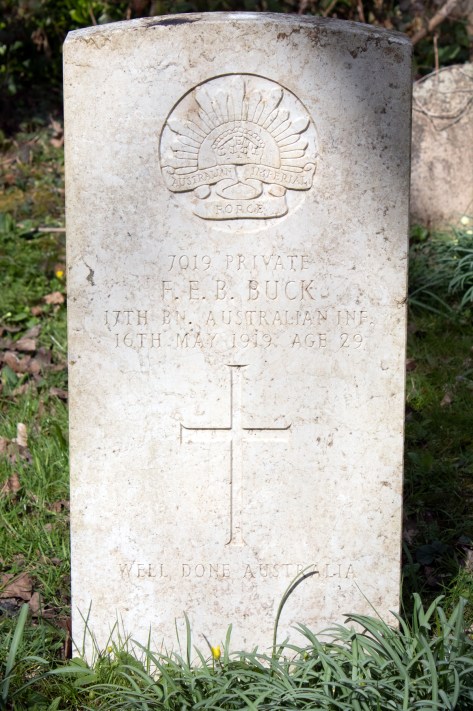
Private Frank Buck

Private Frank Buck

Frank Ernest Brydgnes Buck was born in Islington, Middlesex, early in 1889, his mother’s name was Rosina, but his father’s details have been lost to time, the 1901 census confirming that she was a widow. The document notes that Frank was the youngest of four children, and the family had taken rooms in a three-storey house on Yerbury Road.

By the summer of 1917, Frank had emigrated to Australia. Settling in the town of Inverell, New South Wales, he took employment as a clerk. However, when war came to Europe, he was called on to play his part, and enlisted in the Australian Imperial Force on 16th July 1917.

Private Buck’s service records confirm that he was 5ft 11.5ins (1.82m) tall and weighed 11st 4lbs (71.7kg). He was recorded as having dark hair, blue eyes and a dark complexion. He had a burn scar on his right forearm, and a third nipple on the right side of his chest.

Frank’s unit departed from Sydney on 31st October 1917, and he spent the next two months on board the SS Euripides. During that time he was promoted to Acting Corporal and, when he disembarked in Devonport, Devon, on 26th December, he marched to the ANZAC camp in Fovant, Wiltshire.

Assigned to the 5th Training Battalion, Frank seems to have taken this unexpected return to Britain as a free ticket home: on 6th February 1918 he went AWOL, and only surrendered back to his unit on 9th April. Help in detention for a day, he forfeited 63 days’ pay, and was demoted to the rank of Private for his actions.

On 13th May, Private Buck was dispatched to France. He was assigned to the 17th Battalion of the Australian Infantry, but his time overseas was not to be a lengthy one. In July he was admitted to the 5th Australian Field Ambulance with gastritis: he was then transferred to the 5th Casualty Clearing Station, then the 3rd General Hospital in Le Treport. Medically evacuated to Britain for treatment, he ended up in Reading War Hospital for ongoing treatment.

Placed on furlough on 16th September, Private Buck went AWOL again on just two weeks later. Arrested on 26th November 1918, he was hauled before a judge at Highgate Police Court: his crimes amounted to being absent without leave, but also stealing three blank cheques and forgery. Pleading guilty, he was sent to Wormwood Scrubs for nine months.

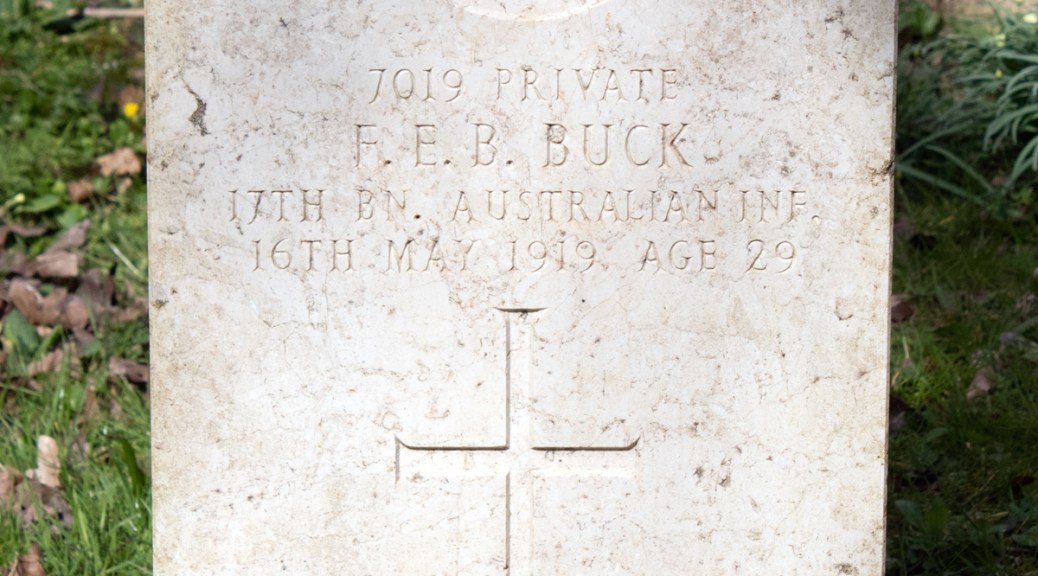
Frank would not end up serving his time, however. He was admitted to the infirmary with a perforated duodenal ulcer, and died from exhaustion on 16th May 1919. He was 29 years of age.

Frank Ernest Brydgnes Buck was laid to rest in Highgate Cemetery.


Chief Petty Officer John Henley

Chief Petty Officer John Henley

John Henley was born on 4th September 1878, and was the second of five children to William and Frances. William was a navy pensioner from Maidstone, Kent, but it was in the nearby village of Loose that John was born and the family raised.

Given his father’s background, it was inevitable that John would go to sea as well. The 1891 census recorded him as being one of nearly 1000 pupils of the Royal Hospital School in Greenwich, and just three years later he formally enlisted in the Royal Navy. Just sixteen years of age, he was given the rank of Ship’s Steward Boy. His service records confirm that he was 5ft 4ins (1.63m) tall, with dark brown hair, light blue eyes and a fresh complexion.

Initially based at HMS Pembroke, the Royal Naval Dockyard in Chatham, Kent, over the next eighteen months, John spent time on five ships. This gave him enough grounding so that when he came of age in September 1896, he could be formally inducted into the navy, with the rank of Ship’s Steward Assistant.

Over the next decade, John’s career flourished. He was promoted to Acting Ship’s Steward in January 1901, and full Ship’s Steward fifteen months later. He had spent time on a further ten ship by this point, returning to HMS Pembroke in between postings.

In July 1905, John married Maud Norton, a carpenter’s daughter from his home village. While her husband was away at sea, she set up home at 88 Kingswood Road, Gillingham, Kent, and the couple went on to have three children: John, William and Lionel.

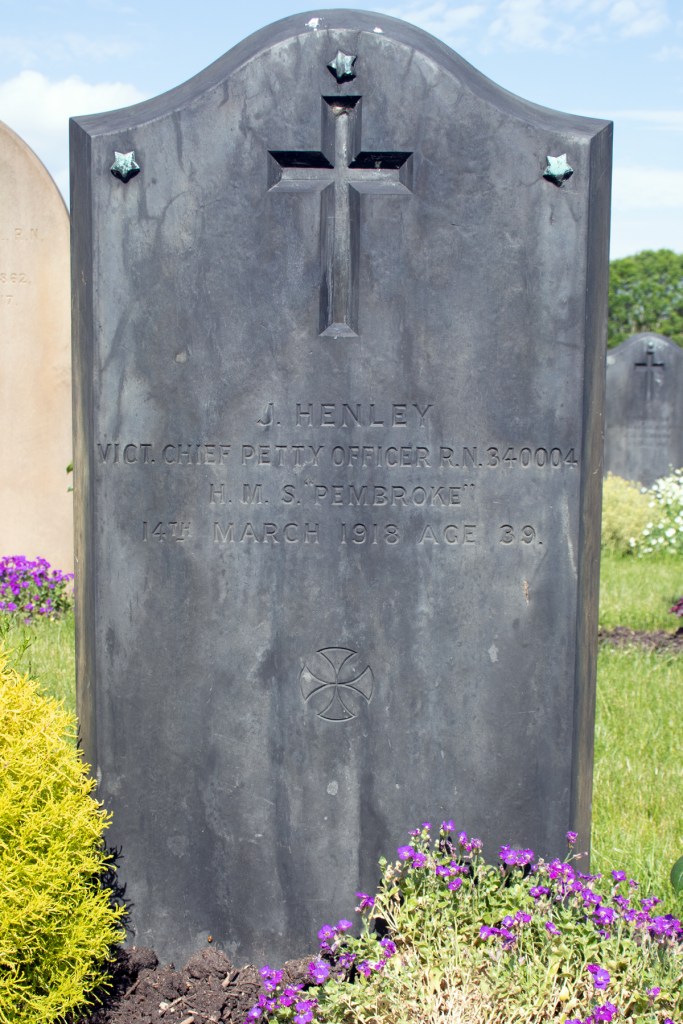
Back at sea, and by the time war broke out, Ship’s Steward Henley had completed more than twelve years in the role. In February 1918, he received a further promotion, this time to Victualling Chief Petty Officer, but this new role was to be cut tragically short. The following month, he was admitted to the Royal Naval Hospital in Chatham, Kent, suffering from a gastric ulcer. This haemorrhaged, and he passed away while still admitted. John died on 14th March 1918: he was 39 years of age.

We regret to announce the death of Mr John Henley, Victualling Chief Petty Officer (Ship Steward)… Deceased was a native of Loose and… had served 25 years in the Royal Navy, having commenced his career in the Royal Hospital School, Greenwich, at the age of eleven years. He took part in the battle off the Falkland Islands, and also in the operations in the Dardanelles whilst serving on HMS Inflexible. He leaves a widow and three sons.

[Kent Messenger & Gravesend Telegraph: Saturday 30th March 1918]

John Henley was laid to rest in the naval section of Woodlands Cemetery, Gillingham, walking distance from where his widow still lived.


Chief Petty Officer John Henley
(from britishnewspaperarchive.co.uk)

Private Harry Gurd

Private Harry Gurd

Harry John Gurd was born in the Wiltshire parish of Berwick St John in the spring of 1881. He was one of three children to dairyman Ebenezer Gurd and his wife, Elizabeth.

Details of Harry’s early life are fragmented, but by the time of the 1911 census, he had moved to West Sussex, and was working as a gardener. The document confirms that he had married Alice three years before, and that they were living in North End, Findon. By this point, the couple had three children: Alice, Ronald and Walter, and they would go on to have another daughter, Hester, in 1913.

Harry stepped up to play his part when war was declared. Full details of his service have been lost, but it is evident that he enlisted by December 1917 at the latest and, as a Private, joined the Army Veterinary Corps. He was initially attached to the 15th Veterinary Hospital, but transferred across to the Labour Corps, joining the 695th Company.

In the summer of 1918, Private Gurd fell ill. He was admitted to hospital, but his condition – a duodenal ulcer – was to prove fatal. He passed away on 25th June 1918, at the age of 37 years old.

The body of Harry John Gurd was brought back to Sussex for burial. He was laid to rest in the graveyard of St John the Baptist Church, Findon, the village that had become his home. When Alice died in the summer of 1958, she was buried alongside Harry: husband and wife reunited after forty years.


Stoker Peter Higgins

Stoker Peter Higgins

Peter Higgins was born in Thornaby, North Yorkshire, on 23rd January 1887. His parents were William and Catherine (Kate) Higgins, but of them there is very little information.

What seems likely that Peter would have had some experience with boats as, on 26th May 1909, he enlisted in the Royal Naval Reserve. His service records show that he was 5ft 7ins (1.70m) tall and was described as having blue eyes and a pale complexion. He was also noted as having a scar over his left eye and another on his left thigh.

When war broke out, Peter was officially called for duty and, over the next couple of years, he served as a Stoker on the battleship HMS St Vincent. The ship patrolled the North Sea, and would later be involved in the Battle of Jutland.

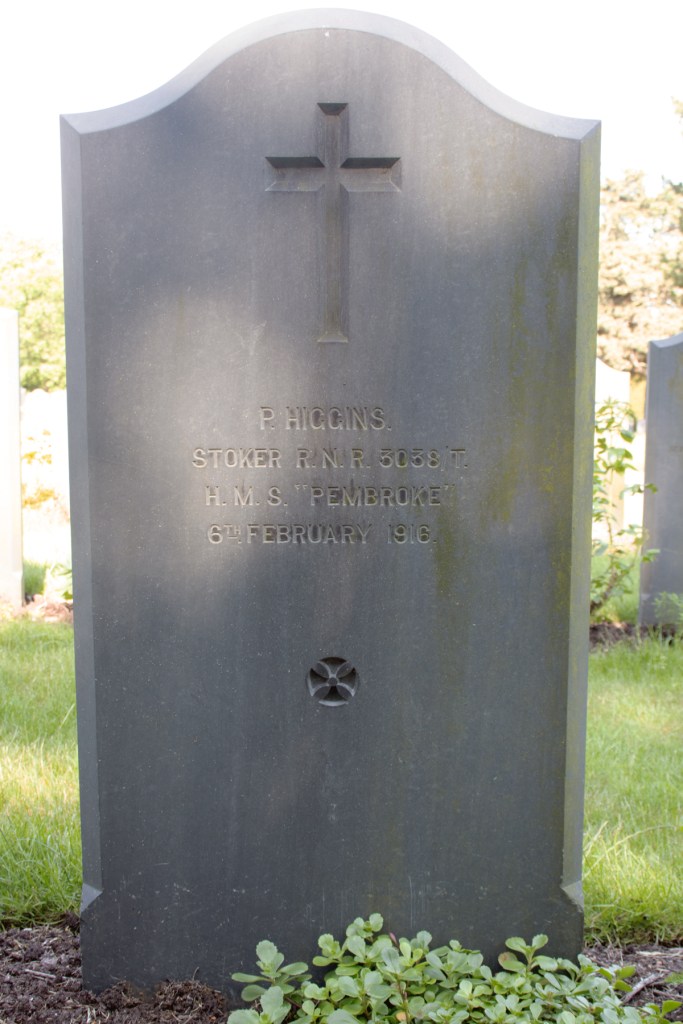
Stoker Higgins, however, was back on dry land by that point, having been assigned to HMS Pembroke, the Royal Naval Dockyard in Chatham, Kent. Peter had fallen ill with a gastric ulcer, and tragically, this was to prove fatal. He passed away on 16th February 1916, at the age of just 29 years old.

Peter Higgins was laid to rest in the naval section of Woodlands Cemetery in Gillingham, Kent, not far from the dockyard that was to prove his last posting.


Private Thomas Grabham

Private Thomas Grabham

Thomas William Grabham was born in September 1883, one of six children to Thomas Richard Grabham and his wife Emma. Thomas Sr was a labourer and drayman for a brewery and the family lived in Taunton, Somerset.

When Thomas Jr left school, he found work as a grocer’s porter, before he too found work in a brewery, working as a maltster. He married a local woman, Maria Rowsell, and the couple went on to have a son, who they named after Thomas’ father.

Details of Thomas’ military service are sketchy; he enlisted in the West Somerset Yeomanry, but there are no details of when this was.

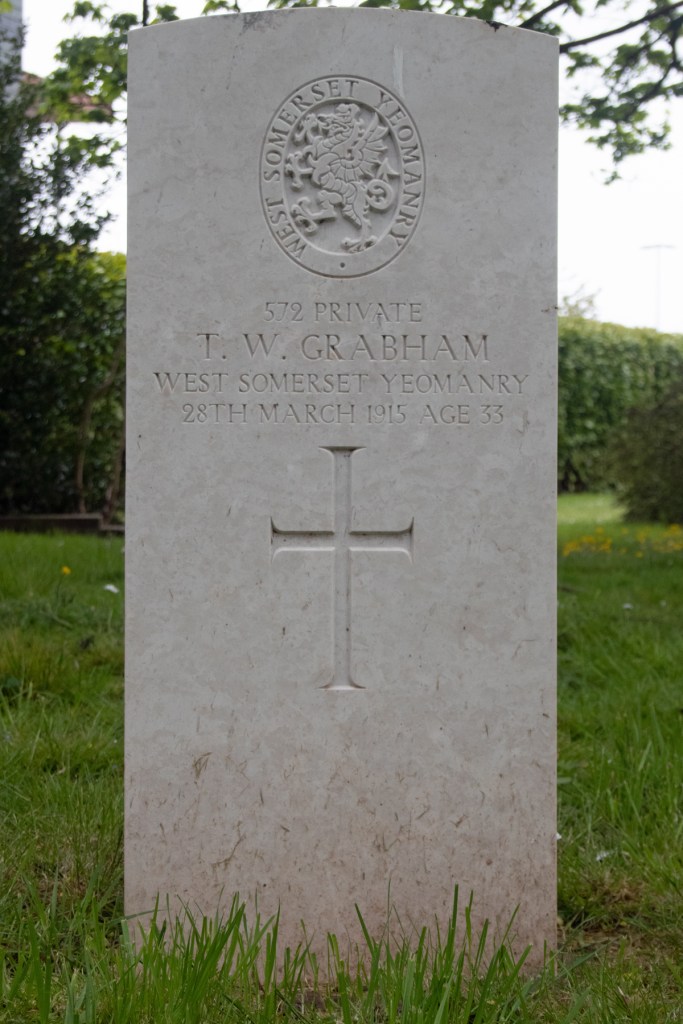
Sadly, Private Grabham’s period of service was short; his pension records show that he passed away from a perforated gastric ulcer on 28th March 1915. He was just 32 years old.

Thomas William Grabham lies at peace in St Mary’s Cemetery in his home town of Taunton.


Sadly, the tragedy for the young Grabham family was not to end there. Maria, Thomas’ widow, died just five months after her husband.

Young Thomas was just eight years old when his parents died; he seems to have been brought up by a Mrs Kate Barnes, possibly a maternal aunt. Here, however, the family’s trail goes cold.