There are some lives that just don’t want to be discovered, that just hide tantalisingly out of reach. James Davidson’s was one of those lives.
The main two research websites I use – cwgc.org and findagrave.com – only have his initial and surname, which is understandable, as this is what is inscribed on his headstone. Unfortunately, that doesn’t act as a good base on which to carry out further research.
HMS Gunner was the wartime moniker for Granton Harbour, near Edinburgh. A naval history website managed to identify Chief Artificer Davidson’s first name – James – but again, with no other information to go on, this is still too common a name – particularly in Scotland – to narrow down any real results.
Sadly, then, the story behind James Davidson is destined to remain a mystery. All that can be confirmed for certain is that he passed away on 23rd January 1919, though the cause of his passing is lost to time, as is his age.
James Davidson lies at rest in the Woodlands Cemetery in Gillingham, Kent.
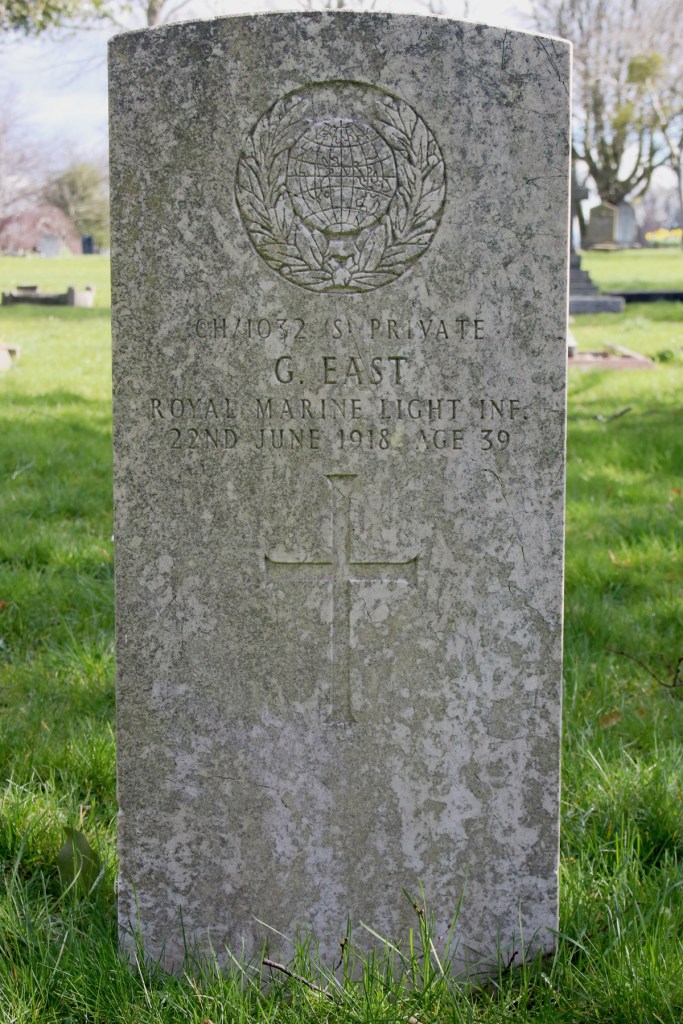
George East was born in 27th May 1879 to George and Agnes East. Agnes was George Sr’s second wife, which led to George Jr having four siblings and a further eight half-siblings. George’s father was a painter and handyman, who sadly passed away when his son was only seven years old.
Sadly, a lot about George remains a mystery, as a lot of documentation about him no longer exists. The snippets that are available give a tantalising glimpse into his life.
He married a woman called Jessie, and they had a daughter, Vera, who was born in July 1912.
George enlisted in the Royal Marine Light Infantry on 29th September 1915, and served at the Naval Dockyard in Chatham, Kent. Private East was based there for most of the war, but fell ill, succumbing to stomach cancer on 22nd June 1918. He was 39 years old.
George East lies at peace in the Woodlands Cemetery in Gillingham, Kent.
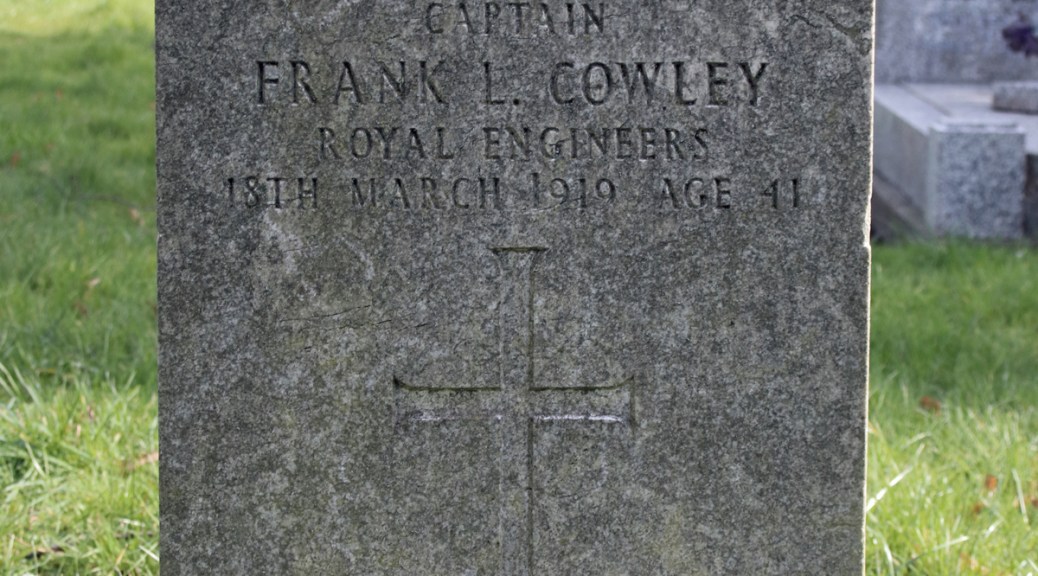
Francis Llewellyn Cowley – also known as ‘Frank’ was born in July 1877 on the Isle of Man. He was one of ten children to Thomas and Ann Cowley, farmers who owned 133 acres on the northern tip of the island.
Frank’s trail goes cold for a few years; he was still living on his father’s farm in 1891, but by 1913, had moved to to the mainland, settling in Kent.
It was here, in Gillingham, that Frank married Lily Matilda Carrington in the summer of 1913. Sadly there is little information about Lily, but the couple do not appear to have had any children.
Frank enlisted shortly after war broke out; he joined the Royal Engineers on 27th October 1914, and within a couple of years has reached the rank of 2nd Lieutenant.
Sadly again at this point Frank’s trail goes cold. He next appears in a newspaper article from 1st March 1919, when he is listed as having attended the funeral in Rainham, Kent, of Air Mechanic Herbert Holdstock. He is now listed as Captain F Cowley RE.
That was resolved to be a tantalising glimpse into Captain Cowley’s final few weeks. From this point, all the documents tell us is that he worked at the School of Military Engineering in Chatham.
Frank passed away on 18th March 1919, although no cause of death is recorded. He was 41 years old.
Francis Llewellyn Cowley lies at rest in the Woodlands Cemetery close to his home in Gillingham, Kent.
Arthur Herring was born on 5th December 1877, the third of five children to William and Constance Herring. William was a sign writer at the Naval Dockyard in Chatham, Kent, and the family lived in neighbouring Gillingham.
Arthur joined the Royal Navy in September 1899, just short of his 22nd birthday. He worked as an Engine Room Artificer (ERA), and over the twelve years of his initial service, he crewed on board ten different ships. This was in addition to his service at HMS Pembroke, the shore vessel in his home town of Chatham.
Arthur was evidently a hard worker, and he rose through the ranks from ERA 5th Class to ERA 1st Class during this time.
In September 1912, Arthur married Angela Beck; she was also born in Chatham, and was the daughter of a naval Sergeant. The couple didn’t go on to have any children.
War was looming by the time Arthur completed his twelve years’ service. Arthur was recommissioned, serving as Chief Engine Room Artificer 2nd Class on HMS Aquarius and HMS Tyne during the conflict.
In February 1917, Artificer Herring transferred to HMS Torrent. This was a naval destroyer, part of the Harwich Force, patrolling the North Sea.
One of the duties of the Harwich Force was manning the “Beef Run”; the convoys between England and the Netherlands. It was on one of these runs that tragedy struck HMS Torrent.
At about 2am on 23rd December, the convoy, including HMS Torrent, ran into a German minefield, and Torrent struck a German mine. Two of the other ships in the convoy, HMS Surprise and HMS Tornado went to rescue Torrent’s crew, but Torrent struck a second mine and quickly sank. In an attempt to rescue survivors, Surprise and Tornado also struck mines and sank.
Only the fourth convoy ship, HMS Radiant was undamaged and picked up the survivors from the three ships. In total, 12 officers and 240 other ranks were killed from the three ships. On HMS Torrent, only three of the crew survived; sixty-eight others perished that night. This included Artificer Herring, although his body was rescued from the water; he was 40 years old.
Arthur Herring lies at peace in the Woodlands Cemetery in his home town of Gillingham, Kent.
There are some people whose stories just don’t want to be unearthed. It’s rare, but occasionally the brick walls come up and you just can’t find a crack through them.
Private A Lewis seems to be one of those people.
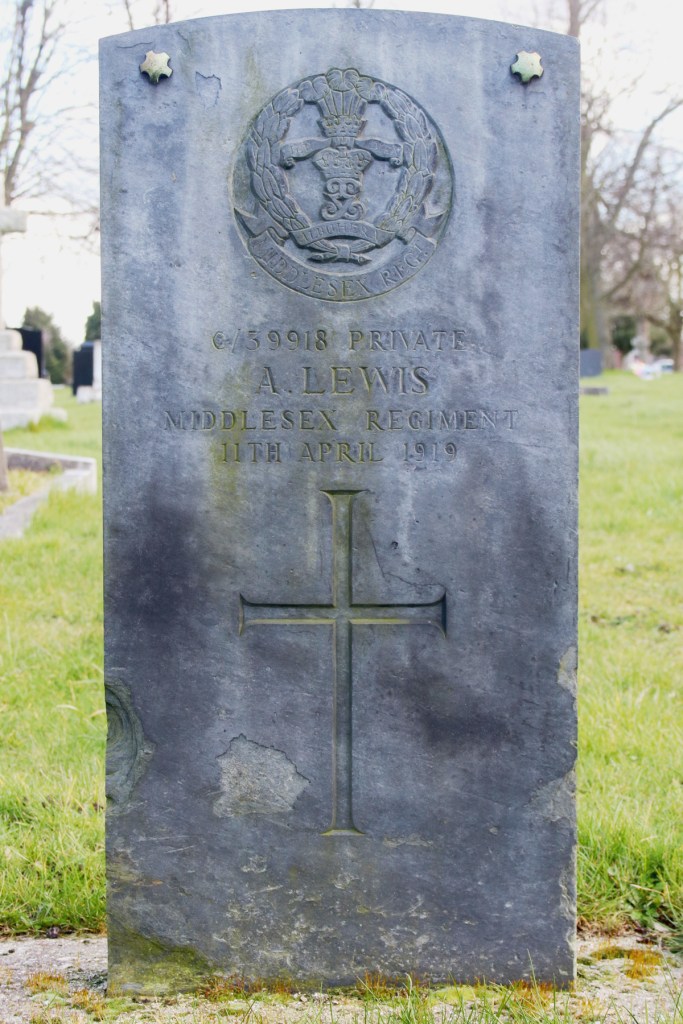
The gravestone is in Woodlands Cemetery in Gillingham, Kent. The inscription reads:
G/39918 Private
A Lewis
Middlesex Regiment
11th April 1919
Military records for the service number are scarce, which is not unusual, but unearth two things. Private Lewis’ first name was Alfred, and he was married to a woman called Amelia.
Further research leads to his wife’s full maiden name, Amelia Florence May Courtney, and that she was the daughter of a draper’s assistant, born in London. The couple married in December 1909.
Frustratingly at this point, the trail goes cold. There is a record for an Alfred and Millie Lewis living in Gillingham in the 1911 census, but I am not convinced that they are the same couple.
Alfred Lewis is too common a name to be able to pinpoint any life before his marriage with any certainty, particularly as their marriage record does not give his parents’ names.
All I can say is that Alfred Lewis enlisted in the Middlesex Regiment, although there is no confirmation of when he enrolled. He gained both the Victory and British Medals, but there is nothing to confirm whether he service abroad or part of a territorial force.
Alfred was admitted to the War Hospital in Whitchurch, which was a psychiatric hospital to the north of Cardiff. He was recorded as suffering from paralysis, though whether this was the result of a physical or mental trauma is not clear.
Sadly, Private Lewis passed away on 11th April 1919; his age is unknown. He lies at rest in the Woodlands Cemetery in Gillingham.
Christopher William Thomas Faulkner was born in 1881, one of five children to William and Harriet Faulkner. There is little information about Christopher’s early life, but the 1891 census shows him living with his mother and siblings in the St George’s Barracks in St Martin in the Fields in central London. William is not listed, so it can only be assumed that he was away on duty when the census was completed.
Christopher attended the military school; his record confirms that he was born on 17th June 1881, and spent four months at the school when he was ten years old. William is listed as a Sergeant and the family were living at the St George’s Barracks, which were located in the site now occupied by the National Portrait Gallery.
The military life was indelibly in Christopher’s life by this point. Whilst the records are sparse, he had certainly enlisted by the time he was 25. On Boxing Day 1904 he married a woman called Essie Brant, the daughter of a tailor from Croydon.
On the marriage certificate, Christopher was listed as a Lance Corporal in the Royal Marine Light Infantry and was based at the barracks in Chatham, Kent.
The young couple went on to have four children together and, by 1911, Essie was living in Gillingham, not far from the naval base in Chatham. The majority of Christopher’s career was served here, although when war broke out, he also saw conflict overseas.
By 1916, he was promoted to Sergeant and was assigned to HMS Dominion, which patrolled the North Sea. Ill health must have taken hold, however, and by the end of 1917, Sergeant Faulkner was reassigned to Chatham, before being medically discharged at the beginning of the following year.
Sadly, there is no record of the cause of his release from duty, but it appears to have been something to which he would eventually succumb. The next record is of Sergeant Faulkner’s death, on 5th January 1920, at the age of 39 years old.
Christopher William Thomas Faulkner lies at rest in the Woodlands Cemetery in Gillingham, Kent.
Christopher’s grave also acts as a memorial to his son.
Leslie Albert Gerald Faulkner was born on 9th June 1910. On leaving school, he sought military service like his father, and enlisted in the Royal Navy for a period of twelve years’ service.
Unusually, details of his service appear to end after just three years, in January 1929. However, later records confirm that he continued to serve at HMS Pembroke, the on-shore vessel in Chatham, through to the Second World War, achieving the rank of Chief Petty Officer.
Chief Perry Officer Faulkner’s military records did thrown up some further information, though. Surprisingly, his death records give specific details of the cause of his passing, stating that it was a “rupture of the liver due to secondary neoplasm of the liver, due to primary seminoma of testis”. In effect, Leslie had suffered testicular cancer, which then spread to his liver.
Leslie Albert Gerald Faulkner died on 28th November 1945, at the age of just 35 years old. He was buried in the same grave as his father, in Woodlands Cemetery, Gillingham.
Charles Frederick Caleb Miller was born on 12th December 1887 in Gillingham, Kent. His parents were Charles and Harriet Miller, and he had two younger siblings, Mabel and Harriet.
Tragically, Charles Jr’s mother died when he was only three years old; his father went on to marry again – to his widow’s younger sister, Jane – and the couple had two further children – Jane and Beatrice – who were Charles Jr’s half-sisters.
Charles Sr worked as a ship’s rigger in the Military Dockyard in Chatham, and naval life obviously caught his son’s eye. In 1903, having left school, he enlisted in the Royal Navy, started as a ‘boy artificer’, working in the engine and boiler rooms of ships.
His initial service was for twelve years, and he worked on a number of vessels, as well as being assigned to HMS Pembroke, the shore base in Chatham. He worked his way through the ranks to Engine Room Artificer 2nd Class by 1915.
In June of that year, Charles married Ellen Holden. the daughter of a dairyman from Chelsea. The couple went on to have a daughter, Joan, who was born in 1918. At the time of their wedding, Charles was based on HMS Lance, and his military service was to continue.
His period of service extended until the end of the war, Charles served on a number of other vessels, including HMS Surprise, Blenheim and Prince George and rose to Chief Engine Room Artificer 2nd Class.
It was while he was assigned to HMS Ganges in January 1920 that he became unwell, however. He had contracted bronchial pneumonia, and died of a combination of that and heart failure on 9th February 1920. He was 32 years old.
Charles Frederick Caleb Miller lies at rest in Woodlands Cemetery in his home town of Gillingham, Kent.
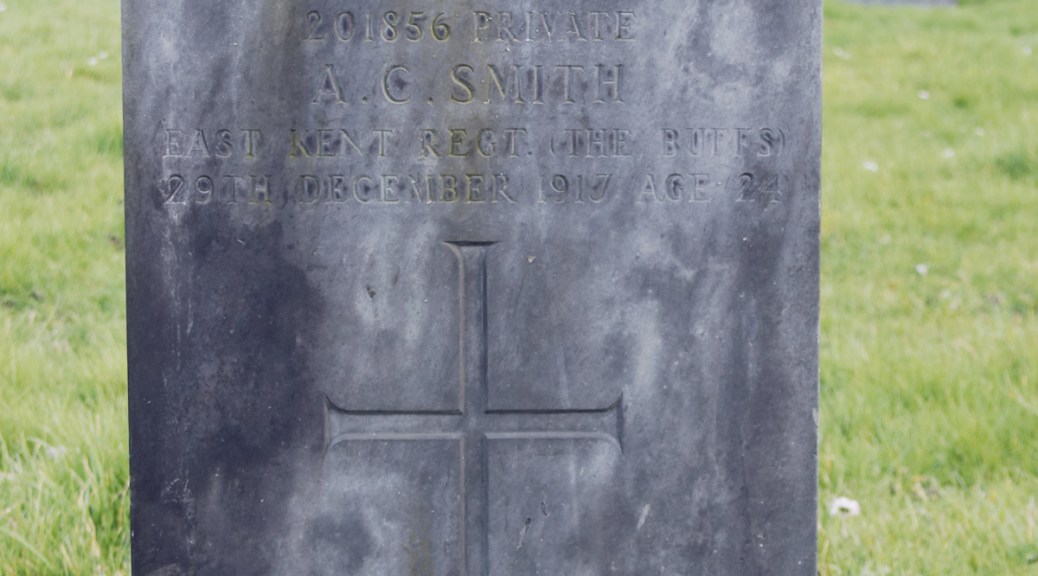
Aubert Charles Smith was born in 1893, the eldest of eight children to Charles and Mary Ann Smith. Charles worked at the Naval Dockyard in Chatham, and the family lived not far away in Gillingham, Kent.
When he left school, Aubert found work as a labourer in a ‘provision warehouse’, which may have been connected to the dockyard at which his father worked.
In July 1915, aged 22, he married Lucy Cox, who was the daughter of a mess cook at the naval base. The young couple went on to have a son, also called Aubert, in 1917.
At this point, the First World War was raging, but little documentation remains of Private Smith’s service. He enlisted in the East Kent Regiment (also known as The Buffs), but there is nothing to confirm when he enrolled or where his duty took him.
The next record for Private Smith shows that he was admitted to Fulham Military Hospital, suffering from testicular cancer. Sadly, he succumbed to the condition, and he passed away on 29th December 1917. He was just 24 years old.
Aubert Charles Smith lies at rest in the Woodlands Cemetery in his home town of Gillingham, Kent.
Herbert Stevens was born in Lincolnshire in 1873. Little record of his early life remains, but his mother, Rachel, was born in Cambridgeshire.
Herbert had at least two siblings; Arthur was ten years older than him, and had been born in Liverpool. Alice, who was six years Herbert’s junior, was also born in Lincolnshire.
By the time of the 1891 census, Rachel had been widowed. She was living with her three children in Chatham, Kent, and working as a laundress. Arthur was a labourer in the Naval Dockyard, which may be what brought the family so far south. Herbert, aged 18 by this point, was a stable hand, while Alice was still at school. To help make ends meet, the family had also taken in two lodgers, Joan Kitteridge, who was a tailoress, and her daughter, two-year-old Florence.
On Christmas Day 1898, Herbert married Sarah Beed. Her father was a ship’s carpenter, based in the Dockyard, and the couple set up home in neighbouring Gillingham. The young couple went on to have seven children.
Herbert went on to become a labourer in the Dockyard, but then found employment for the local council, working as a carman, or carter (presumably his work in the stables and his affinity with horses stood him in good stead).
War was on the horizon, however. He enlisted in May 1915, enrolling in the Royal Army Service Corps, and gave his trade as a groom. Private Stevens was assigned to the Remount Depot in Romsey, Hampshire, where he would have been partly responsible for the provisioning of horses and mules to army units both in England and abroad.
Split across ten squadrons, at times there were as many as 4,000 horses and mules stables at the Romsey Remount Depot, so Herbert’s life would have been a busy one. It seems, however, to have been a strenuous life too an, on 23rd March 1918, after nearly three years’ service, Private Stevens died of heart failure. He was 45 years old.
Herbert Stevens lies at rest in the Woodlands Cemetery in his adopted home of Gillingham, Kent.
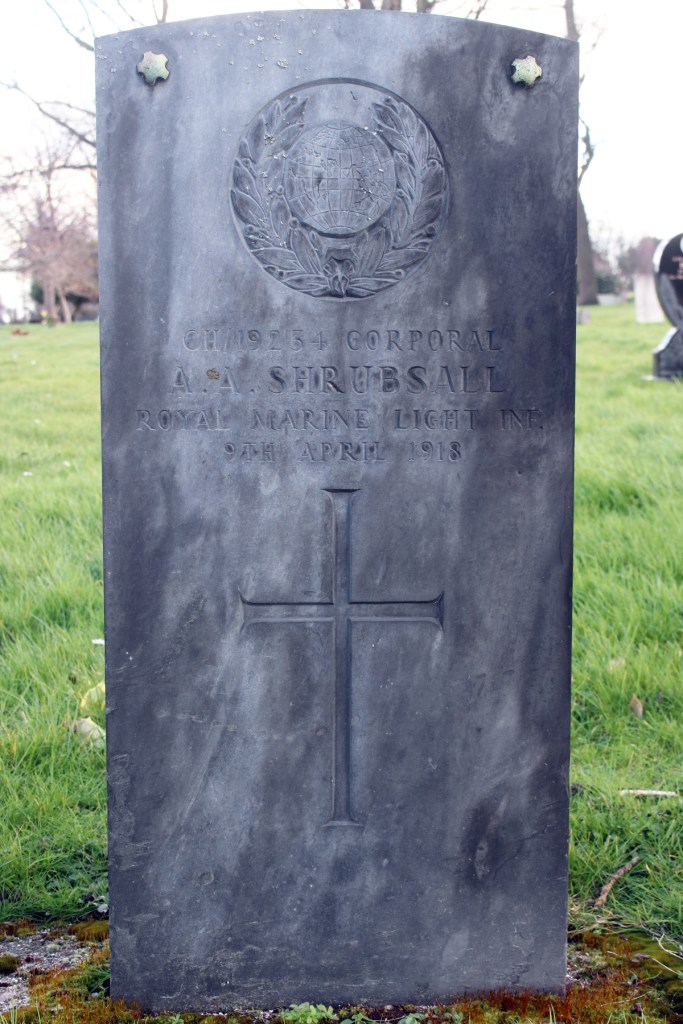
Albert Arthur Shrubsall was born in Deptford, South London, in April 1896. He was the youngest of three children – all boys – to ironmonger George Shrubsall and his wife Jessie.
While his brothers continued to live at home after they had left school and got jobs, Albert found live-in work as a pageboy, or servant, for Wilfred Lineham, who was a professor of engineering for a London college. It was while he was working here that his mother, Jessie, passed away. She died in 1913, aged just 43.
Details of Albert’s military service are a bit scant. He enlisted in the Royal Marine Light Infantry, although I have been unable to confirm when he joined up. He was assigned to the Chatham Division, and was based at the Naval Dockyard in Kent, ultimately being promoted to Corporal.
Albert married Gertrude Spoore – affectionately known a ‘Ginty’ – in Deptford in October 1917. Sadly, the marriage was to las less than six months, as, on 9th April 1918, Albert passed away, having contracted pneumonia and septicaemia. He was just 22 years old.
Albert lies at rest in the Woodlands Cemetery in his adopted home town of Gillingham in Kent.
Albert’s two brothers George and Alfred were also involved in the First World War.
George, had gone on to become a tailor’s assistant when he left school. He married Emily Hawkes in 1911, and the couple went on to have a son, also called George, the following year.
When war broke out, he enlisted in the Machine Gun Corps, and served on the Western Front. Sadly, he was caught up in the fighting, and was killed in action on 22nd August 1917. He was buried at the Tyne Cot Memorial in Flanders.
When he left school, Alfred went on to become a butcher’s assistant. War came along, and he enlisted straight away.
Enrolling in the Royal Field Artillery, Gunner Shrubsall was assigned to the 95th Brigade. Sadly, he had recorded less than six months’ service, as he passed away on 8th January 1915, aged just 21 years old. His brigade did not go to France until the following year, so, while no cause of death is recorded, it is likely that he died from a communicable disease like influenza or pneumonia.
Alfred is buried in the family grave in Deptford, South London.
Within a period of just three years, George had lost all three of his sons to the Great War. Given the previous death of his wife, you can only imagine the heartbreak he was going through.









 Death and Service