Tag Archives: war

Cadet Hubert Morley

Cadet Hubert Morley

Hubert Arthur Morley was born on 28th July 1900, the second of two children to Arthur and Annie Morley. The family were raised in Coventry, Warwickshire, but Arthur had been born in Manchester. The 1901 census recorded him as working as a cycle works timekeeper, but by 1911 he had found other employment as a dealer in hosiery and hats.

By the summer of 1918, the war was showing hints of coming to an end, and Hubert was keen not to miss out on the action. On 9th July, a few weeks before his eighteenth birthday, he enlisted in the Royal Air Force. His service record show that he was 5ft 7.5ins (1.71m) tall, with brown hair, greenish brown eyes and a fair complexion.

Cadet Morley had previously been employed as an engineer, and was sent to the No. 7 Observers School of Aeronautics in Bath, Somerset. His time here, however, was to be tragically short. Hubert contracted pneumonia, and was admitted to the Bath War Hospital. The condition was to prove his undoing: he passed away on 27th October 1918, at just eighteen years of age.

Finances may have limited Arthur and Annie’s ability to bring their son home. Hubert Arthur Morley was laid to rest in the military section of Bath’s sweeping Locksbrook Cemetery.

Private Russell Smith

Private Russell Smith

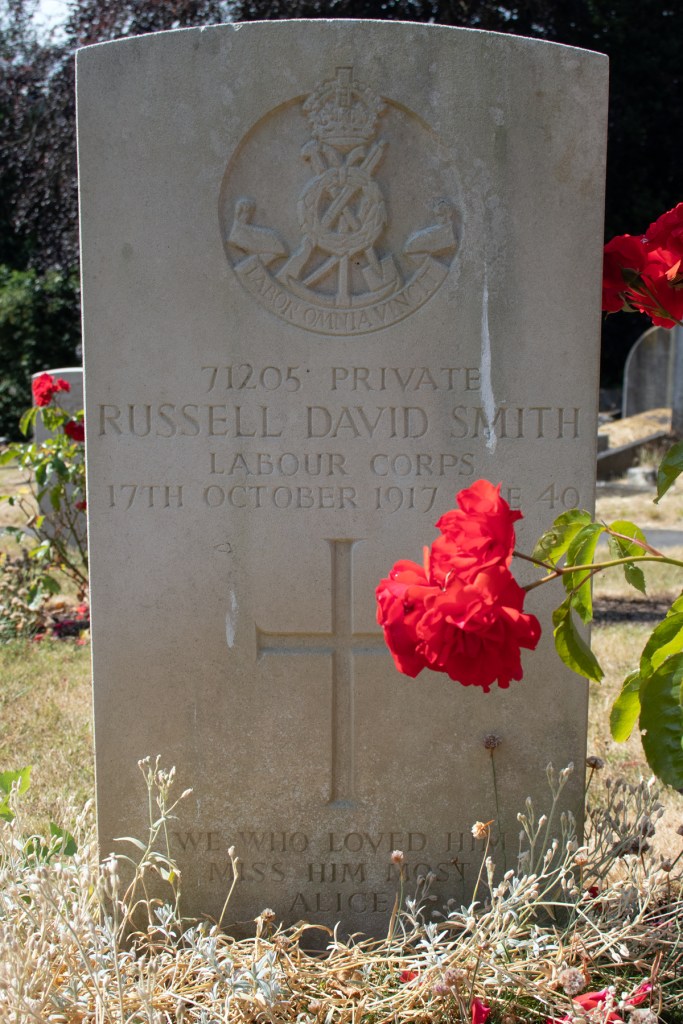
Russell David Smith was born in Shoreditch, London, in the summer of 1877. The second of four children, his parents were tailor Richard Smith and his wife, Emma.

When he finished his schooling, Russell found work as a bookbinder: by the time of the 1901 census, the family had moved to a small terraced house in Cassland Road, Hackney.

On Christmas Day 1902, Russell married Alice Stretch. A year younger than her new husband, she had been born in Islington, and was the youngest child to cabman Edwin Stretch. When the couple married, she was working as a mantle maker’s assistant, making elements for gas lamps.

The newlyweds settled in a cottage in Walthamstow, and went on to have three children. The 1911 census recorded the young family living at 39 Ritchings Avenue: they had taken in a lodger, Alice Carter, to help pay the bills.

War came to Europe in the summer of 1914 and Russell was called upon to play his part. Details of his military service are sketchy, but from the documents available, it is evident that he had enlisted by the summer of 1917 joining the Labour Corps. Private Smith was attached to the 119th Labour Coy. which seems to be been based in Somerset.

It is impossible to trace Russell’s trail any further. The next record for him is that of his passing, on 17th October 1917. The cause of his death is not readily apparent, but he was 40 years old at the time.

Finances seem to have prevented Alice from bringing her husband home. Russell David Smith was, instead, laid to rest in Locksbrook Cemetery, Bath, probably as this might have been the closest burial ground to where he had passed away.


Private Thomas Bastow

Private Thomas Bastow

Thomas Bastow was born in the spring of 1889, the youngest of five children to Frederick and Mary Bastow. Frederick was from Weston-super-Mare in Somerset, but had met his Liverpudlian wife in Lancashire, and it was in the North West of England that the Bastow family had been raised. Mary passed away in 1898, when she was jus 40 years of age. Frederick remarried in 1901, Florence Travis becoming the young Thomas’ stepmother.

Frederick was an inspector for a mineral water company, but when Thomas left school, he found work as a clerk for the land registry. In the autumn of 1916, he married Margaret Hughes. Sadly, there is little more information about her, although their wedding was registered in West Derby.

It may have been that Thomas was in the army at this point, or at least on the verge of going. He enlisted in the Royal Army Service Corps, and was attached to one of the supply units. He seems to have been based in Somerset, as this is where he was hospitalised when he came down with appendicitis.

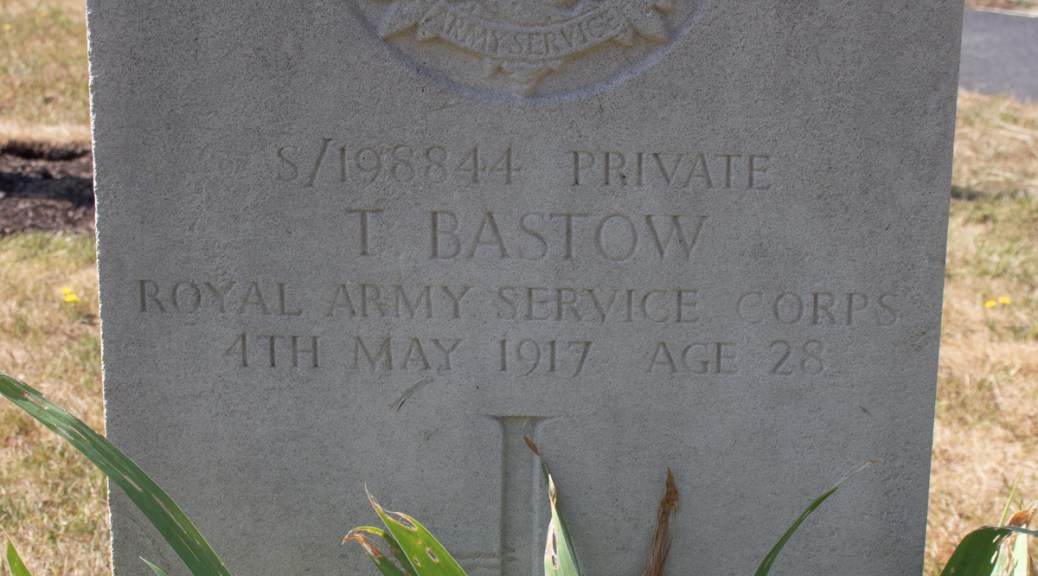
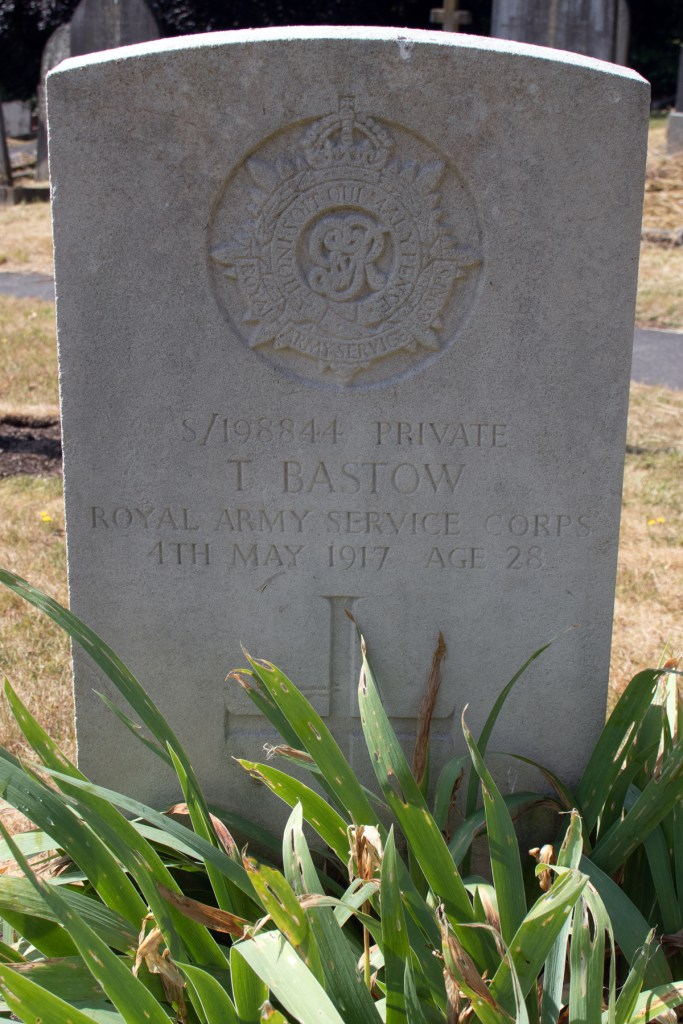
Private Bastow’s condition was to get the better of him: he passed away on 4th May 1917 while admitted to the Bath War Hospital. He was just 28 years of age.

Finances seem to have limited Margaret’s options when it came to her late husband’s funeral. Rather then being taken back to the north wet for burial, Thomas Bastow was instead interred in Bath’s Locksbrook Cemetery.


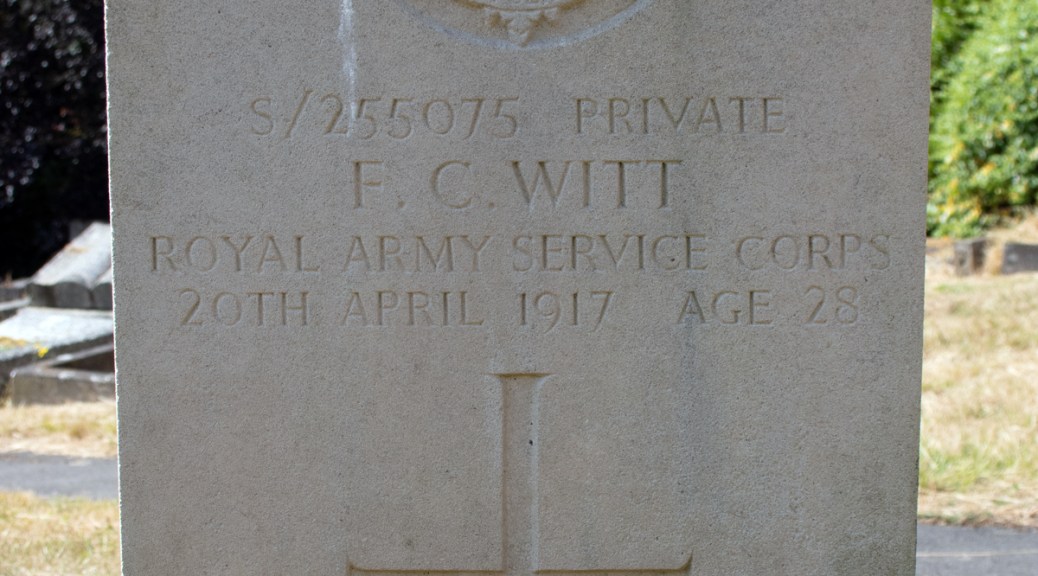
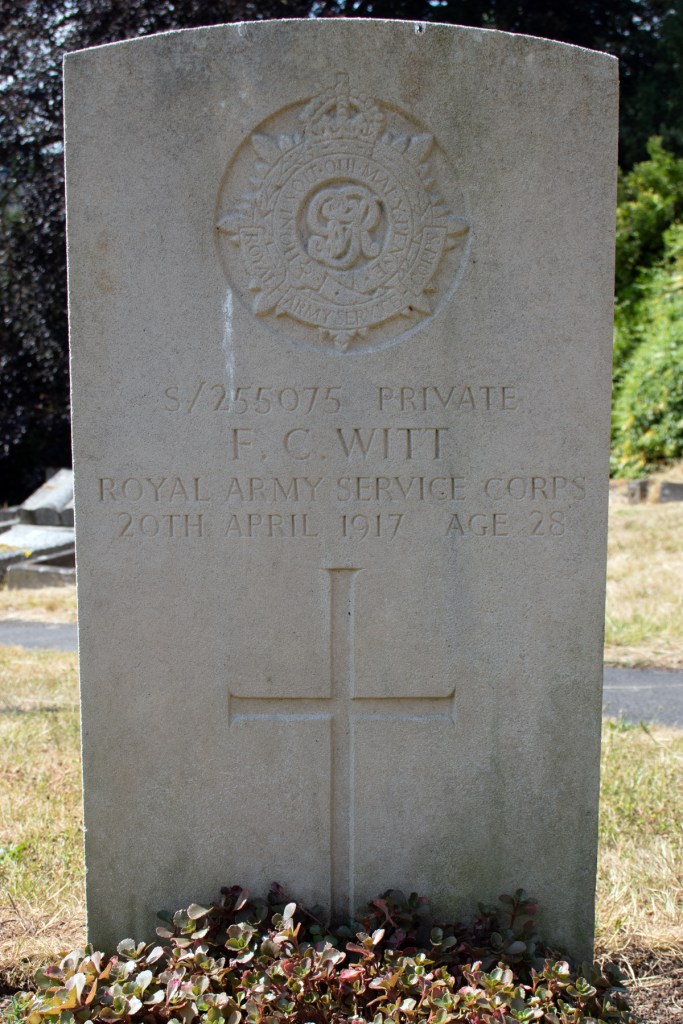
Private Frederick Witt

Private Frederick Witt

Frederick Charles Witt was born on 19th June 1888 in Amesbury, Wiltshire. The second youngest of eight children, his parents were journeyman baker Richard Witt and his wife, Elizabeth.

By the time of the 1901 census, Richard had set up a bakery in North Tidworth, ten miles north-east of Amesbury, with Frederick’s older brother, Alfred, helping out. This was a line of work that Frederick was also to go into when he completed his schooling: the next census return, in 1911, noted him as being his father’s assistant.

On 26th December 1912, Frederick married a woman called Kate Howard. The marriage took place at St Luke’s Church, Enfield, Middlesex. Kate was living in Enfield at the time, while hew new husband was based in Southampton, Hampshire. How a connection was made between the two is unclear, but the couple settled back in Southampton, and went on to have two children: Ivy and Doris.

When war was declared, Frederick was called upon to play his part. Full details of his service are unclear, but he had joined the Royal Army Service Corps by the start of 1917. Private Witt was attached to the Reserve Supply Personal Depot in Bath, Somerset, but, soon after enlisting, he contracted pneumonia.

Frederick was admitted to the Bath War Hospital in April 1917, but the condition was to prove too severe. He passed away on 20th April, at the age of 28 years old.

Frederick Charles Witt was laid to rest in Bath’s sweeping Locksbrook Cemetery. Interestingly, a newspaper report of his funeral did not mention the attendance – or existence – of Kate or their children; instead his parents seemed to take centre stage.

Private Alex Jacobs

Private Alex Jacobs

Ephraim Alex Jacobs was born in the summer of 1883 in Birmingham, West Midlands and was the youngest child to Morris and Mary Jacobs. Morris was a tailor, but when he finished his schooling, Ephraim followed in his older brother’s trade, becoming a hairdresser.

This was not to prove a long-term career, however and, by the time of the 1911 census, things had changed. Ephraim, who now went by his middle name, had moved to Seend, near Melksham, Wiltshire. The document confirms that he had been married for four years by this point, although full details of his wife, the London-born Ethel, remain elusive. Alex was employed as a rubber worker in a factory in Melksham.

When war broke out, Alex stepped up to play his part. His service records no longer exist, but it seems that he enlisted in the Royal Army Service Corps, and was attached to one of the Mechanical Transport units. He seems not to have served overseas, and was demobbed on 14th September 1919. At this point Private Jacobs was suffering from neuritis, or nerve damage.

Alex’s trail goes cold at this point. He seems to have spent some time at the Pensioner’s Hospital in Bath, Somerset, and this is where, on 22nd December 1920, he passed away. The cause of his death was noted as being a cerebral tumour and asthma. He was 37 years of age.

With finances seemingly leaving Ethel unable to bring her late husband back to Wiltshire, Alex Ephraim Jacobs was instead laid to rest in the sweeping Locksbrook Cemetery, Bath.


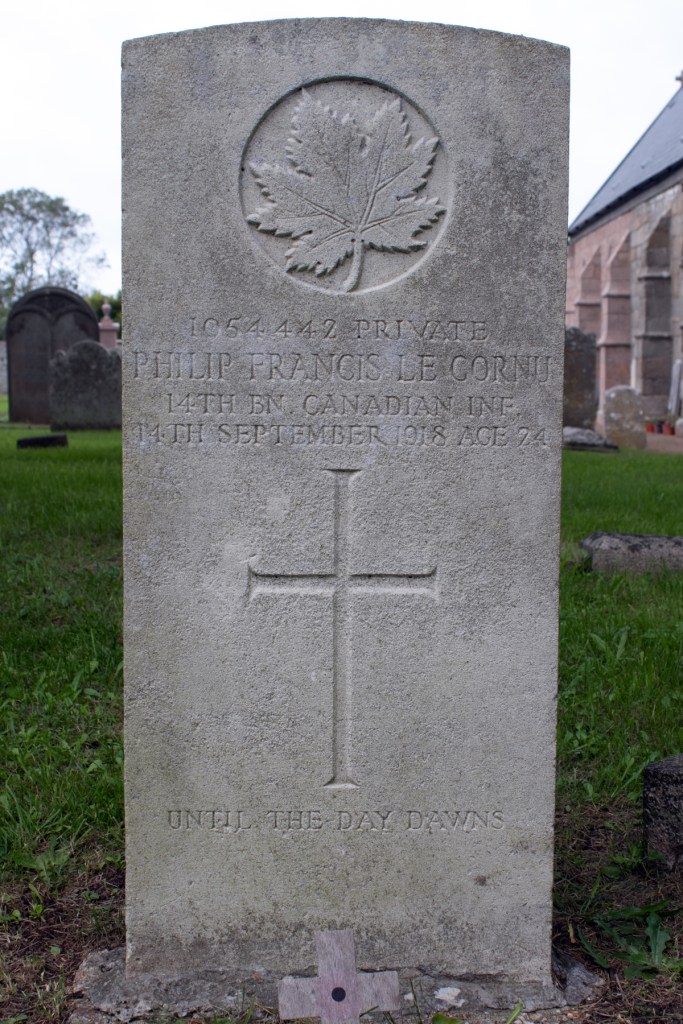
Private Philip le Cornu

Private Philip le Cornu

Philip Francis le Cornu was born on 29th July 1894 in St Peter’s, Jersey. The youngest of five children, his parents were Philip and Mary le Cornu. Philip Sr was a farmer, but it seems that both he and Mary passed away not long after his youngest son’s birth. By the time of the 1901 census the children had been split between family members, and Philip Jr was living with his maternal grandparents.

Philip finished his schooling, and seems to have sought a purpose in life. He emigrated to Canada and, by the time war broke out, was living in Grande-Mère, Quebec. He found employment as a clerk, but with conflict raging on the other side of the Atlantic, he responded to the call to arms.

Philip enlisted in the Canadian Expeditionary Force on 12th September 1916. His service records show that he was 22 years and 2 months old and stood 5ft 6ins (1.68m) tall. He had black hair, blue eyes and a dark complexion. Private le Cornu sailed to Britain, and arrived there on 7th April 1917.

Billeted in Shoreham, West Sussex, Philip was attached to the 14th Battalion of the Canadian Infantry. Within weeks he was sent to France, and, on 15th August 1917, was caught up in the Battle of Hill 70 near Lens.

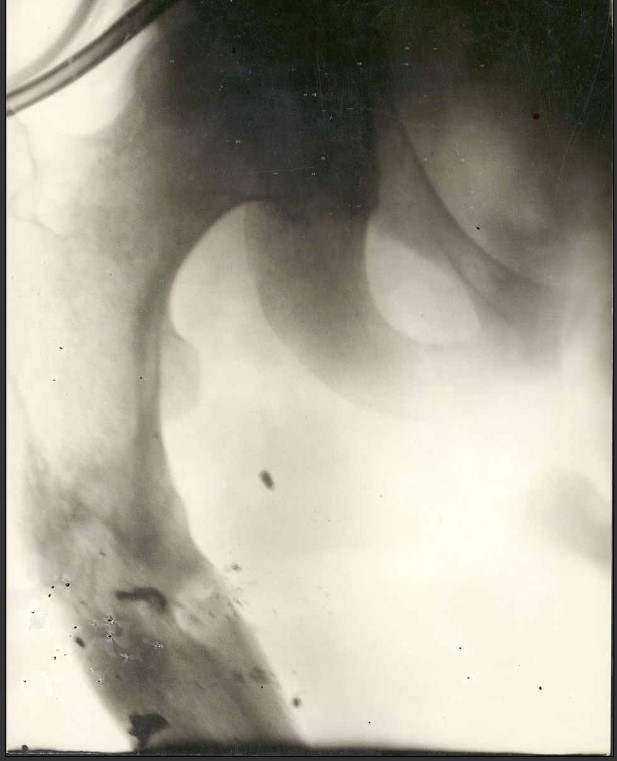
During the skirmish, Private le Cornu was badly wounded in the thigh and sent to the 58th Casualty Clearing Station. Within days he was moved to the 4th General Hospital in Camiens, but his condition necessitated medical evacuation to Britain.

Over the next year, Philip had three operations on his leg, and spent time at the 3rd Southern General Hospital in Oxford, the Manor War Hospital in Epsom, Surrey, and the 16th Canadian General Hospital in Orpington, Kent. Tragically, all of the medical treatment was to prove to no avail. Private le Cornu passed away from his injuries on 14th September 1918, more than a year after Hill 70. He was 24 years of age.

Philip Francis le Cornu’s body was taken back to the Channel Islands for burial. He was laid to rest in the quiet graveyard of St Mary’s Church on Jersey.


X-ray of Private Philip le Cornu’s left femur
(from uk.forceswarrecords.com)

Private Hélier Carré

Private Hélier Carré

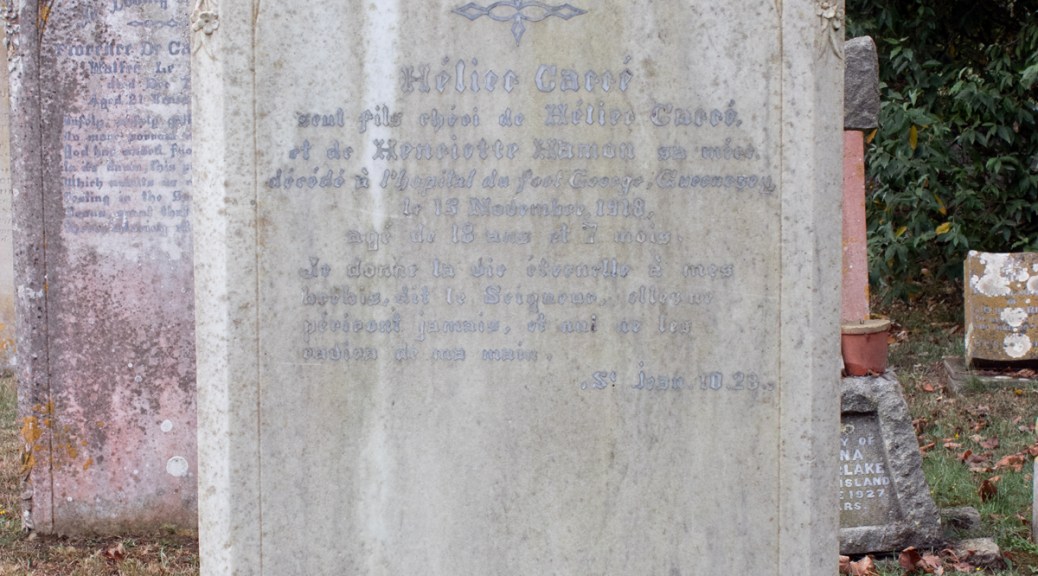
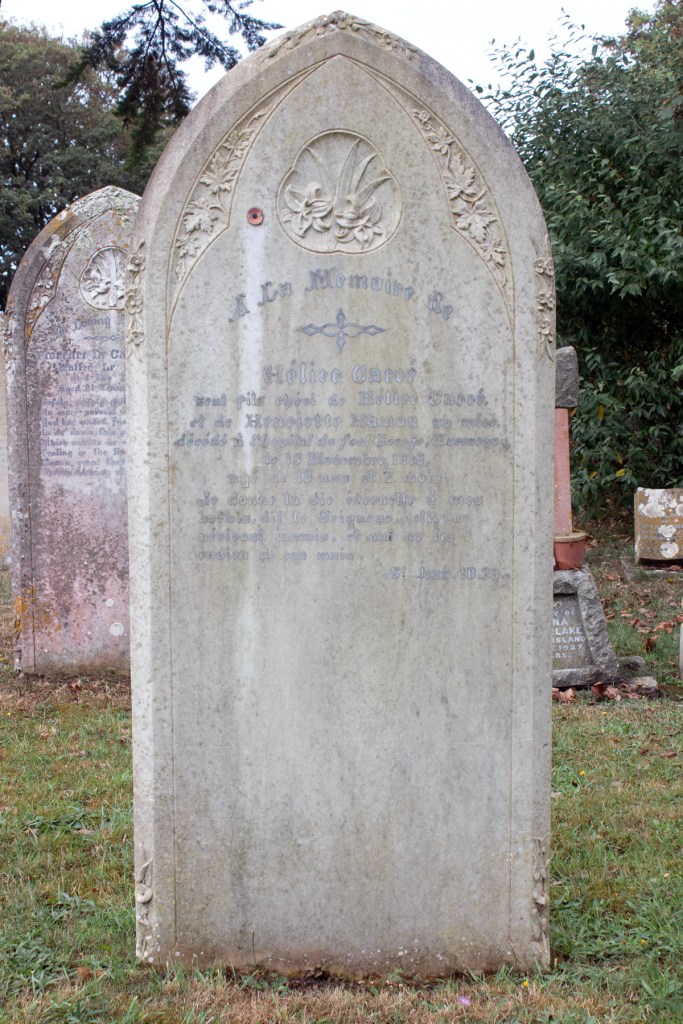
Hélier Carré was born in April 1900, on the Channel Island of Sark. He was the second of two children to Hélier and Henriette (also known as Harriet) Carré. Hélier Sr was a fisherman, and the family, including siblings Hélier Jr and Harriet Jr, lived in a four-roomed cottage, La Collinette, with Henriette’s widowed mother, also called Henriette/Harriet.

Hélier Jr was just 14 when war broke out but, with France just 25 miles (39km) across the water, he was obviously keen to play his part. It was not to be until the summer of 1918 that he enlisted, and he joined the Royal Guernsey Light Infantry as a Private. His service records confirm that he had become a fisherman like his father, and they he was 5ft 3ins (1.6m) tall.

Little additional information is available about Private Carré. He was sent to Guernsey for training, and it was there, on 13th November 1918 – just two days after the Armistice was signed – that he passed away. The cause of his death is not freely available, but he was just 18 years of age.

The body of Hélier Carré was taken back to Sark for burial. He was laid to rest in the graveyard of the island’s church, St Peter’s.


Private Frederick Tullett

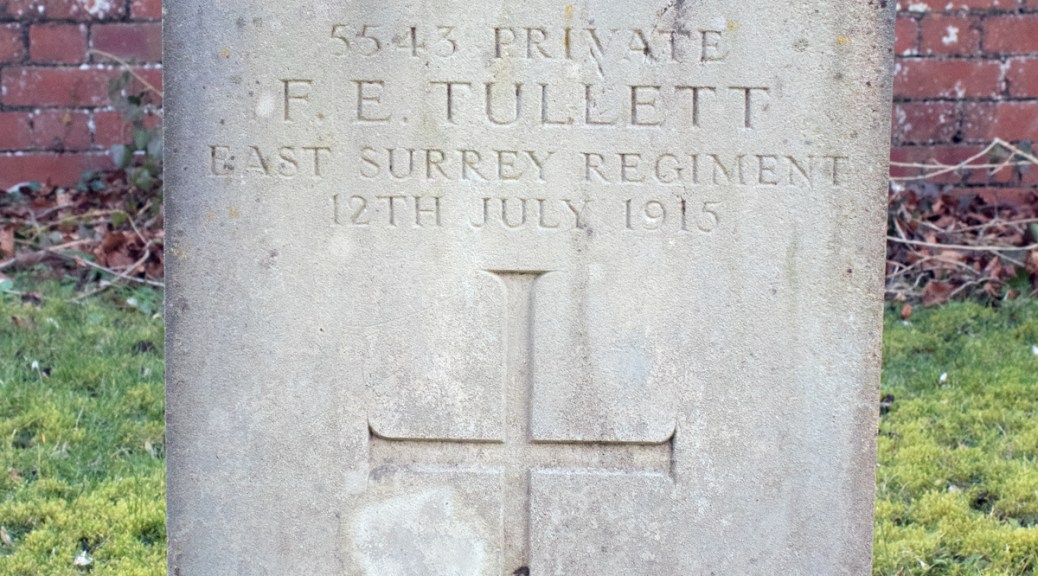
CWG: Private Frederick Tullett

Frederick Edward Tullett was born in 1885 in Islington, Middlesex. The seventh of nine children, he was the fourth son of house painter John Tullett and his wife, Sarah.

When he completed his schooling, Frederick found work as an errand boy for a greengrocer. This appears to have been a trade he enjoyed: by the time of the 1911 census, he was employed as a greengrocer’s porter; while his marriage certificate records him as a fully-fledged grocer.

Frederick’s betrothed was Eliza Gundry, the daughter of a bricklayer from Wimbledon, Surrey. The ceremony was held on 18th April 1915 in the town’s All Saints’ Church. The couple were already living at 15 Dryden Road at this point.

It would appear that Frederick had already stepped up to serve his King and Country by the time of his marriage and, while his profession was listed as greengrocer, it may be that this was the job he continued while waiting to be formally mobilised.

Frederick had enlisted in the army by the start of 1915, and was assigned to the 8th (Service) Battalion of the East Surrey Regiment. The unit was based on Salisbury Plain, Wiltshire, and this is where Private Tullett would end up by that summer.

Crowded barracks were notorious as breeding grounds for infections diseases, and Frederick, sadly, was not to be immune. He contracted pneumonia, and was admitted to a military hospital in Codford. The condition was to prove his undoing: he passed away on 12th July 1915, at the age of 30 years old.

Finances may have prevented Eliza, who had been widowed after just 12 weeks of marriage, from bring her husband back home. Instead, Frederick Edward Tullett was laid to rest in the graveyard of St Peter’s Church in Codford, Wiltshire.


Sapper Fred Vowden

Sapper Fred Vowden

Fred Vowden was born in 1889 in Wadebridge, Cornwall. One of eleven children, his parents were Thomas and Emma. Thomas was a farm labourer, and this is work that Fred also followed when he finished his schooling.

The family moved to where the work was: the 1911 census found them living in Lansallos, a village near Polperro on the county’s south coast. Fred married Doris Curtis in Liskeard in March 1915: there is little information about her, but the couple set up home back in Wadebridge, and went on to have a daughter, Dorothy, the following spring.

War had reared its ugly head over Europe by this point. Fred enlisted in December 1915, joining the Royal Engineers. He was not to be formally mobilised until July 1918, and took up work as a supernumerary platelayer for the London and South Western Railway Company. When he officially took up his role with the army, his employment stood him in good stead: he was assigned to the Railway Construction Troops Depot in Surrey.

Sapper Vowden’s service records show that he was 5ft 6ins (1.75m) tall and weighed 135lbs (61.2kg). He was of good physical development, with a fresh complexion, brown hair and brown eyes.

Fred was based near Farnham as the war drew to a close and winter neared. On 9th November 1918, he fell ill and was admitted to the Frensham Hill Military Hospital with a severe frontal headache. Over the next few days broncho-pneumonia was identified and his condition worsened. By 13th November his temperature was up to 105F, and his breathing was shallow. That evening Sapper Vowden fell unconscious and passed away. He was 28 years of age.

Fred Vowden’s body was taken back to Cornwall for burial. He was laid to rest in Egloshayle Cemetery, on the outskirts of the town in which he had been born and raised.


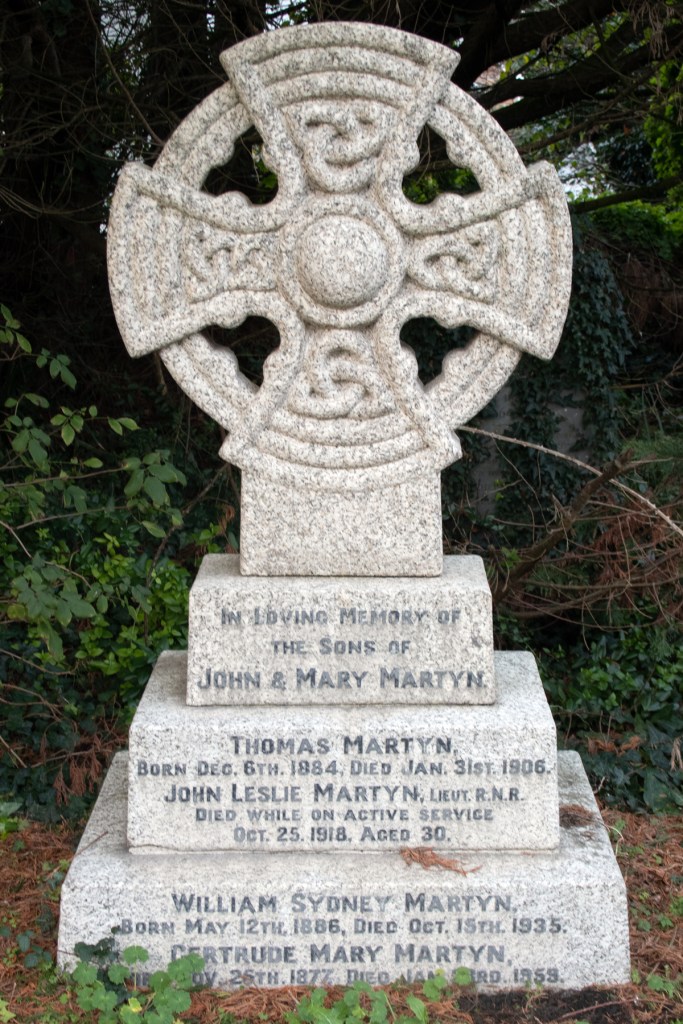
Lieutenant John Martyn

Lieutenant John Martyn

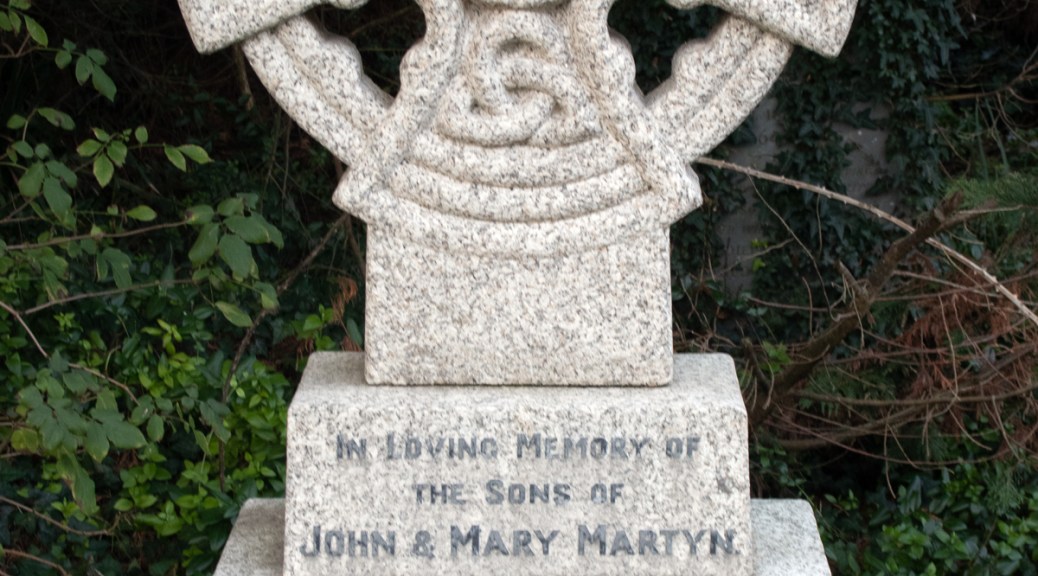
John Leslie Martyn was born in Egloshayle, Cornwall, on 15th February 1888. He was the youngest of five children, and was the third son to John and Mary Martyn. John Sr was a general merchant, and the household had a couple of live-in servants to help both with the household and the business.

When John Sr died in 1904, William, his middle son, took over the running of what was a decent family business.

John Jr, however, had sought another way of life and, was set on a life at sea. He enlisted on the training ship Conway in 1902. Based on the River Mersey, by the time of the 1911 census, he was boarding in the Sailor’s Home in Liverpool. The document confirms that he held the rank of Ship’s Mate in the merchant service, and it would seem that he was doing what he could to build on his skills.

On 26th August 1912, John received his certificate of competency to be the Master of a foreign-going ship. He received a commission in the Royal Naval Reserve, before joining the New Zealand Shipping Co. two years later. When war came to Europe, however, he was called back into naval service.

After serving a few months on the air defences in the Thames Estuary he sailed on his Majesty’s ship Laconia for the coast of German South-West Africa, where he remained. He became a Lieutenant in 1915, and in 1917 was given his first command of HMS Prattler. It is not too much to say that most promising young life has been given to his country.

Cornish Guardian: Friday 8th November 1918

In the summer of 1918, John came home on leave. On 25th July he married Lucy Dudfield in Stanway, Gloucestershire. Tragically, their married life was not to be a lengthy one.

Lieutenant Martyn returned to Devon, and, for reasons undetermined, was admitted to the Royal Naval Hospital in East Stonehouse, Plymouth in October. Whatever the cause of his ailment, he was not to survive it. He passed away while still admitted, on 25th October 1918. He was 30 years of age.

John Leslie Martyn’s body was taken back to Cornwall for burial. He was laid to rest in the family plot in Egloshayle Cemetery.