Harry John Gurd was born in the Wiltshire parish of Berwick St John in the spring of 1881. He was one of three children to dairyman Ebenezer Gurd and his wife, Elizabeth.
Details of Harry’s early life are fragmented, but by the time of the 1911 census, he had moved to West Sussex, and was working as a gardener. The document confirms that he had married Alice three years before, and that they were living in North End, Findon. By this point, the couple had three children: Alice, Ronald and Walter, and they would go on to have another daughter, Hester, in 1913.
Harry stepped up to play his part when war was declared. Full details of his service have been lost, but it is evident that he enlisted by December 1917 at the latest and, as a Private, joined the Army Veterinary Corps. He was initially attached to the 15th Veterinary Hospital, but transferred across to the Labour Corps, joining the 695th Company.
In the summer of 1918, Private Gurd fell ill. He was admitted to hospital, but his condition – a duodenal ulcer – was to prove fatal. He passed away on 25th June 1918, at the age of 37 years old.
The body of Harry John Gurd was brought back to Sussex for burial. He was laid to rest in the graveyard of St John the Baptist Church, Findon, the village that had become his home. When Alice died in the summer of 1958, she was buried alongside Harry: husband and wife reunited after forty years.
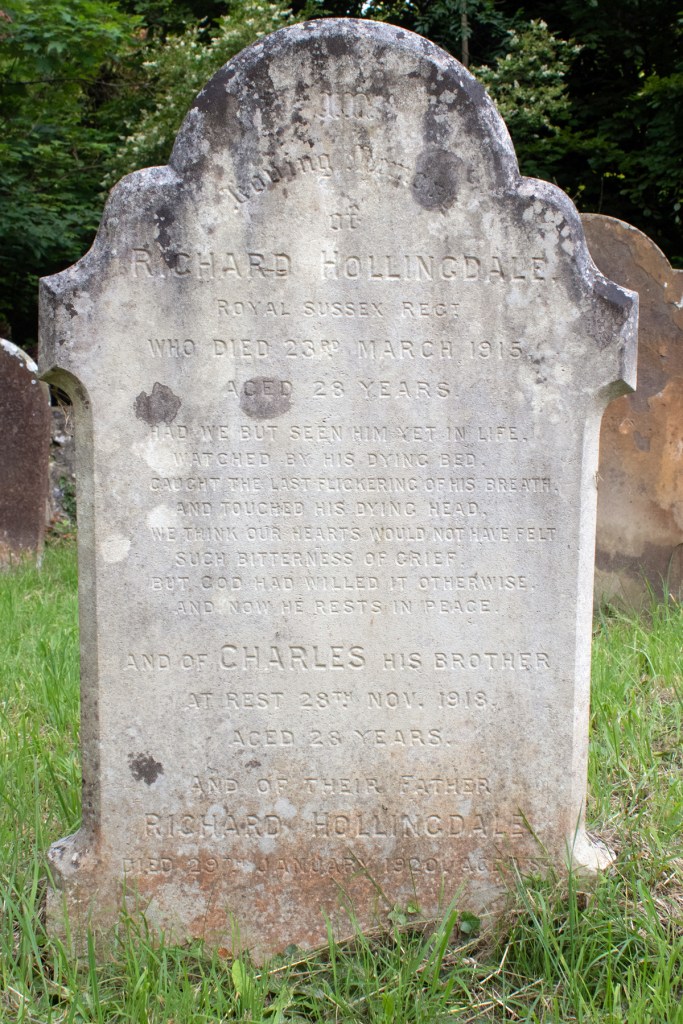
Richard Hollingdale was born at the start of 1887, and was one of nine children to Richard and Elizabeth. Richard Sr was a farm labourer from Lancing, but his namesake son was born in the Sussex village of Washington.
By the time of the 1901 census, the family had moved to Findon, a village to the north of Worthing. Attached to Muntham Farm, they lived in New Barn, a workers’ cottage on the estate. Richard Jr and his brothers all helped out on the farm and, according to the next census return, Richard Sr, now 75 years of age, was a labourer, while the three sons still living at home – William, Richard Jr and Charles – were all waggoners.
When war consumed Europe in the summer of 1914, Richard Jr stepped up to serve his country. Sadly, full details of his service have been lost to time, but it is clear from what remains that he joined up early in the conflict, and certainly no later than October 1914.
Private Hollingdale was attached to the 7th (Service) Battalion of the Royal Sussex Regiment and in the spring of 1915 his unit moved to the Ramillies Barracks in Aldershot, Hampshire. Richard had only been there for a couple of weeks, when he fell ill. He was admitted to the local Isolation Hospital with scarlet fever, and the condition was to prove fatal. He passed away on 23rd March 1915, at the age of 28 years old.
The body of Richard Hollingdale was taken back to Sussex for burial. He was laid to rest in the family plot in St John the Baptist Churchyard, Findon.
George Constable was born in the summer of 1893 in Findon, West Sussex. His parents were Albert and Ruth Constable, and they had seven children: Ruth Jr, Thomas, Albert Jr, William, George, Arthur and Rachel.
There is little concrete information about George’s early life. The 1901 census found the Constable family living at 2 Mill Cottages in Findon, with George’s oldest brother, Thomas, helping his father’s gardening work.
When war came to Europe, George and his older brothers stepped up to play their part. Thomas joined the Dorsetshire Regiment and worked his way to the rank of Lance Corporal. His time in service was to be tragically brief, however. He was killed in France on 26th October 1914, aged 27 years old. He is commemorated on both the Le Touret Memorial, and on the headstone to the family ploy in St John the Baptist Churchyard, Findon.
George also joined the Dorsetshire Regiment and, like his brother, was assigned to the 1st Battalion. During his short time with the regiment – he enlisted no later than October 1914 – he rose through the ranks, and, by the spring of 1915, had been promoted to Serjeant.
Sent to France, George was wounded in April 1915, and medically evacuated to Britain for treatment. He was admitted to the 1st London General Hospital, but his injuries were to prove too severe. He passed away on 5th April 1915 aged just 21.
Albert and Ruth had lost two of their sons to the conflict within six months. While Thomas’ body lay in France, George was brought back to Sussex for burial.
George Constable was buried in the family plot in the graveyard of St John the Baptist Church, Findon.
William Constable was assigned to the Royal Sussex Regiment when he enlisted. He too rose through the ranks, and would take on the role of Serjeant, like his younger brother. His unit, the 2nd Battalion, fought at Loos in the autumn of 1915, and this is where William would be killed. He died on 25th September 1915, aged just 23 years old.
Serjeant Constable is commemorated on the Loos Memorial, while Albert and Ruth, having now lost three sons within a year, added his name to the family headstone.
Albert Constable Jr, was also involved in the conflict. Along with George and Thomas, he had joined the 1st Battalion of the Devonshire Regiment, but unlike his brothers, he survived the horrors of the Western Front.
By the last months of the war, Lance Corporal Constable was caught on in the Battles of the Hindenburg Line, and, tragically, he too was killed. Albert passed away on 15th September 1918, at the age of 29 years old. He was buried in Cologne Southern Cemetery, Germany.
By this point, the face of the family headstone was already full with commemorations to his three brothers, Albert is remembered in lettering around the edge of the grave marker.
Wilfred Percival Bridger was born on 20th January 1885, the middle of three children to William and Emma. William was a groom from Albourne in Sussex, but, after a spell in Newmarket, the family had settled in Findon near Worthing.
William passed away just two years after Wilfred’s birth, and Emma remarried. The 1891 census found her and her new husband, George Lish, living with William and his siblings in a house on Findon Street.
When he completed his schooling, William found work as a shepherd: the next census return, taken in 1901, found the extended family living at 1 Brazil Cottages, next to the Black Horse Inn in Findon Village. George and Emma now had three children of their own, and Emma’s widowed mother, Martha, completed the household.
Shepherding was not a permanent career option for Wilfred and, on 28th April 1902, he enlisted in the army. He gave his occupation as groom, and his medical report confirmed he was 5ft 7ins (1.7m) tall and 120lbs (54.4kg) in weight. He was noted as having brown hair, grey eyes and a fresh complexion.
The Royal Sussex Regiment would definitely provide Private Bridger with the globe-trotting adventures that he may have wished for. After two years on home soil, his unit – the 2nd Battalion – moved to Malta, where he would spend close to twelve months. In May 1905 he moved to Crete, and from there to India in January 1907.
By the start of 1910 Wilfred had returned to Britain, and he was stood down to reserve status when his contract came to an end that April. He returned to Sussex, and the family home. 1 Brazil Cottages was crowded by this point, with Wilfred sharing the five-roomed house with his mother, stepfather, half-brother, niece. There were also two lodgers, widowed farm labourer Alfred Newman and his son, William.
Things were to change for Wilfred, however. In September 1911 he married Florence Herrington, a carter’s daughter from Henfield, Sussex. When the couple wed, she was working as a servant in a boarding house in Ambrose Place, Worthing. The young couple set up home in Nepcote, near Findon, and went on to have four children – William, Albert, Henry and Lilian.
When war broke out, Wilfred was called upon to play his part again. He re-joined the Royal Sussex Regiment on 31st August 1914, but when his medical was carried out the following March, he was found to have tuberculosis, and deemed not fit for service. After further tests, Private Bridger was medically discharged on 28th May 1915.
At this point, Wilfred’s trail goes cold. He returned to Findon and, it seems this is where he passed away on 13th September 1918. He was 33 years of age.
Wilfred Percival Bridger was laid to rest in the quiet surroundings of Findon’s St John the Baptist Churchyard.
Charles Pratt was born in the West Sussex village of Findon in the autumn of 1899. The oldest of five children – all boys – his parents were farm labourer Charles and his wife, Emily.
Charles Jr was still a schoolboy at the time of the 1911 census. The family were living in the five-roomed cottage called Sheepcombe by now: farm labourer Charles Sr, Emily, Charles Jr, his three younger siblings (youngest boy Albert being born in 1915), and Emily’s brother, farm horseman Daniel Hollingdale.
When war was declared, the oldest Pratt boy was still just fourteen years of age, and too young to enlist. As the fighting raged across the continent, it seems likely that he was disappointed to miss out on the adventure. Full details of his army service have been lost to time but records suggest that he joined up no later than April 1918.
Private Pratt was attached to the 9th (Service) Battalion of the East Surrey Regiment. He was certainly sent to France, and may have been caught up in the Battles of the Somme in 1918. He fought at Cambrai, and this is where he would be injured. Charles’ wounds were bad enough for him to be medically evacuated to Britain, and he was admitted to the 4th Northern General Hospital in Lincoln, Lincolnshire, for treatment.
Sadly, the soldier would succumb to his injuries. He passed away on 27th October 1918, at the age of just 19 years old.
Charles Pratt was taken back to Sussex for burial. He was laid to rest in the graveyard of St John the Baptist Church in Findon, walking distance from his family home.
Charles’ was a family plot: he would be reunited with his parents when the passed away: Charles Sr in 1953 and Emily in 1958.
Wilfred Clarence Ansfield was born in the spring of 1899, and was the youngest of eleven children to Frederick and Frances Ashfield. Frederick was an innkeeper from West Tarring in Sussex, and the family were living in the public house he ran – possible the Vine Brewery on the Hight Street.
Frederick died at the start of 1904, and by the time of the next census, taken seven years later, Frances had moved the family to Salvington. They settled at 1 Beaconsfield Terrace, with six of the Ansfield children sharing the home with their mother. Three of Wilfred’s brothers were employed as gardeners – possibly at one of the many nurseries in the area – while he was still at school.
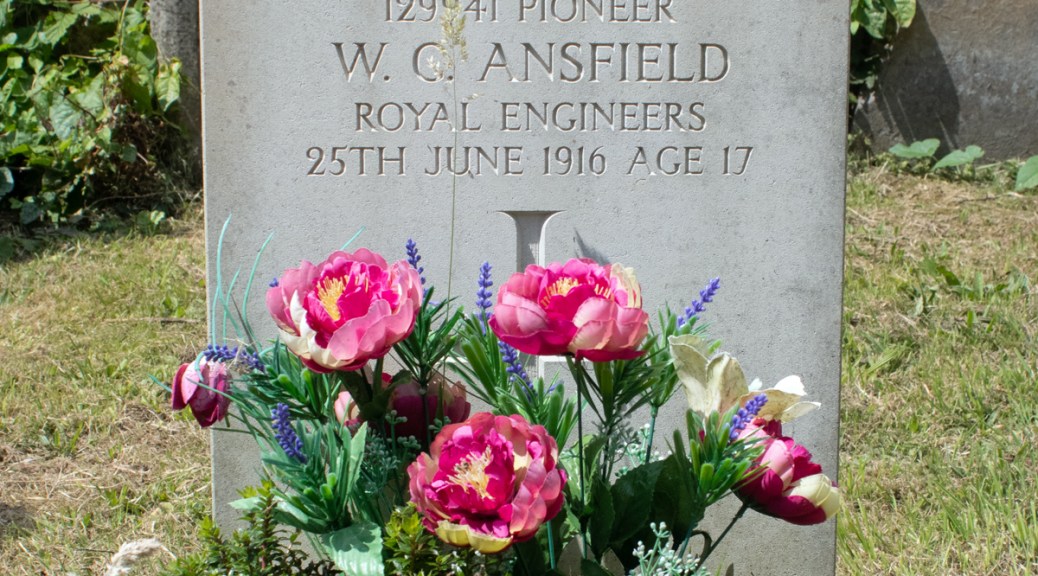
When war came to Europe, Wilfred was keen to serve his King and Country. Full service details have been lost to time, but it is clear that he enlisted in the Royal Engineers and, as a Pioneer, was assigned to the 3rd Provisional Company (later renamed the 642nd (London) Field Company). This was a territorial force, and it is unlikely that Wilfred saw any action overseas.
The only other document that can definitely connected to Pioneer Ansfield is the record of who his pension was assigned to. This confirmed Frances’ name and address, but also gives the cause of her son’s death, noted as ‘acute paralysis’. This could have been as a result of a tetanus infection, but nothing remains to confirm either way. Wilfred died on 25th June 1916: he was just 17 years of age.
Wilfred Clarence Ansfield was laid to rest in the graveyard of St Andrew’s Church in West Tarring, He was buried alongside Frederick, father and son reunited after twelve years.
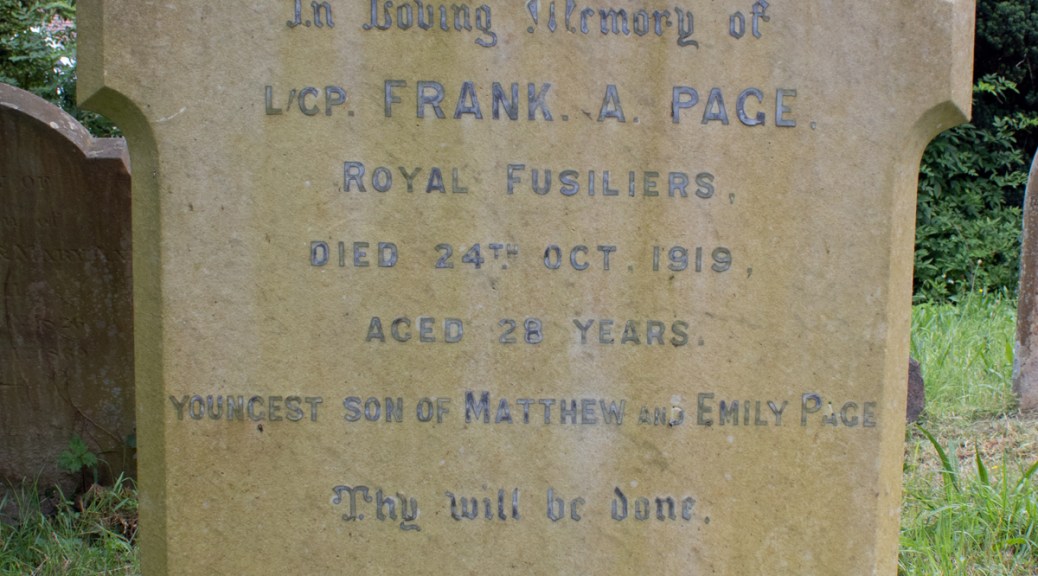
Frank Arthur Page was born early in 1891, and was one of seven children – and the youngest son – to Matthew and Emily Page. Matthew was a bricklayer’s labourer from Lancing in Sussex, while Emily had been born in Norfolk. It was in the village of Steyning, however, that the couple raised their family.
By the time of the 1901 census, Matthew had been invalided out of work. The family had moved to a small cottage in Lancing by this point, and Frank’s older brothers were working to bring in some money for the family.
The next census return, taken in 1911, found Matthew and Emily living Frank and his older brother Sydney at 2 Ivy Cottages in Lancing. Both of the Page siblings were working as market gardeners by this point, bringing in some money to help support the family.
War came to Europe in the summer of 1914, and Frank stepped up to serve his King and Country. Full details of his military service are lost in the mists of time, but it is clear that he enlisted in the Royal Fusiliers, and was attached to the 26th (Service) Battalion (Bankers).
Frank’s unit served in both France and Italy, although, without his documents, it isn’t possible to determine where, and for how long, he served. During his time in the army, however, he was promoted to the rank of Lance Corporal, underlining a level of dedication on his part.
Matthew passed away in the spring of 1917, and it appears that Frank was demobbed at some point after the Armistice. By the autumn of 1919, he was back in Sussex, living with his now widowed mother. His time in the army seems to have impacted on Frank’s health by this point, and he died ‘from disease’ on 24th October 1919. He was 28 years of age.
Frank Arthur Page was laid to rest in the graveyard of St James the Lesser Church in Lancing, not far from where his father had been buried.
Frederick George China was born in Bath, Somerset, in the summer of 1885. He was the second of children to tailor George China and his wife, Gloucestershire-born Frances.
Frederick was working as a grocer’s assistant when his father died in 1906, at the age of 52. Determined to earn money for Frances and his three sisters, he left Somerset for work. The 1911 census recorded him as living in Worthing, West Sussex, boarding with the Vitler family. Percy was a baker’s assistant, and lived at 4, Tarring Road with his wife and two daughters. The census noted two visitors to the property, railway contractor Robert Puttock and his wife, Annie.
On 26th December 1912, Frederick married Lucy Hellier. Born in Midhurst, West Sussex, she was working as a confectioner’s shop assistant in Worthing’s Montague Street, boarding with the manager, Catherine Castle, her mother and her niece. The couple wed in Stanmer Parish Church, to the north of Brighton, which is where Lucy’s family were then living.
The newlyweds moved back to Bath, and Frederick took up a job as manager of the Widcombe branch of the Twerton Co-operative Society. Their only child, son Douglas, was born in February 1915.
By this point, war was raging across Europe, and Frederick stepped up to play his part. His full service details are no longer available, but he joined the Somerset Light Infantry in June 1916, and was assigned to the 7th Battalion.
He was in a battalion of the Somersets, who were heavily engaged at Langemarck, but he and his chum came safely through the severe fighting at that place. While returning, some time after, to the front trenches, he was knocked out by a shell, and received severe injuries. The spine was so badly hurt that, if he had survived, he would never have walked again.
[Bath Chronicle and Weekly Gazette – Saturday 29 September 1917]
Private China was medically evacuated to Britain for treatment, and he was admitted to King George’s Military Hospital in South London. Lucy and Frances travelled to Surrey to see him, and were with him when he passed, his wounds being too severe for him to survive. He passed away on 21st September 1917, at the age of 32 years of age.
The body of Frederick George China was aid to rest in Bath’s sweeping Locksbrook Cemetery, not far from where his father, George, was buried.
Private Frederick China (from britishnewspaperarchive.co.uk)
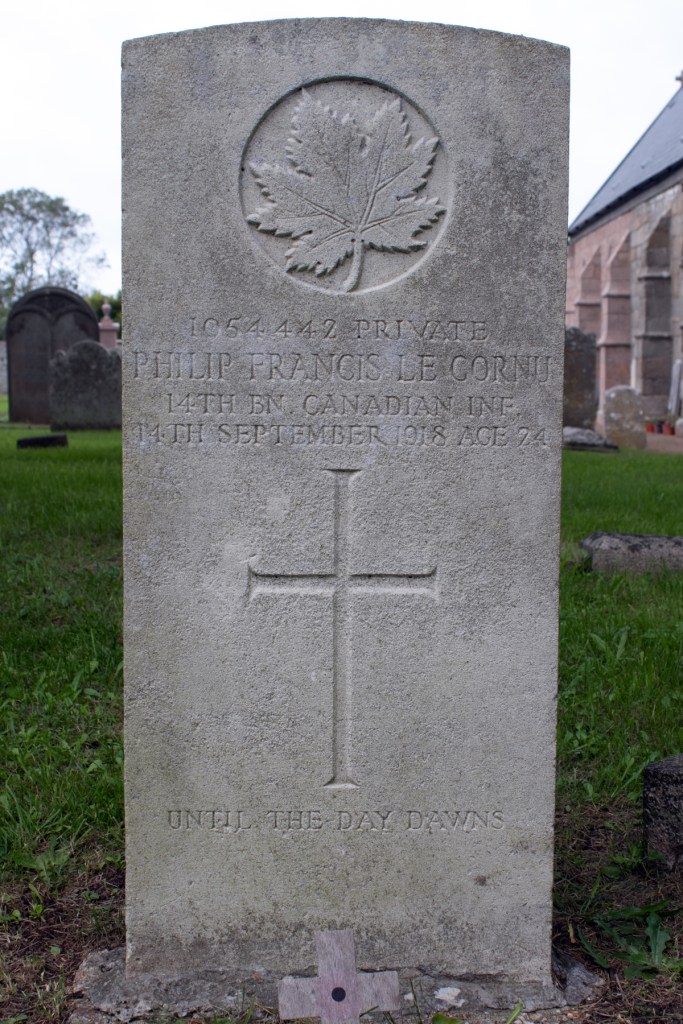
Philip Francis le Cornu was born on 29th July 1894 in St Peter’s, Jersey. The youngest of five children, his parents were Philip and Mary le Cornu. Philip Sr was a farmer, but it seems that both he and Mary passed away not long after his youngest son’s birth. By the time of the 1901 census the children had been split between family members, and Philip Jr was living with his maternal grandparents.
Philip finished his schooling, and seems to have sought a purpose in life. He emigrated to Canada and, by the time war broke out, was living in Grande-Mère, Quebec. He found employment as a clerk, but with conflict raging on the other side of the Atlantic, he responded to the call to arms.
Philip enlisted in the Canadian Expeditionary Force on 12th September 1916. His service records show that he was 22 years and 2 months old and stood 5ft 6ins (1.68m) tall. He had black hair, blue eyes and a dark complexion. Private le Cornu sailed to Britain, and arrived there on 7th April 1917.
Billeted in Shoreham, West Sussex, Philip was attached to the 14th Battalion of the Canadian Infantry. Within weeks he was sent to France, and, on 15th August 1917, was caught up in the Battle of Hill 70 near Lens.
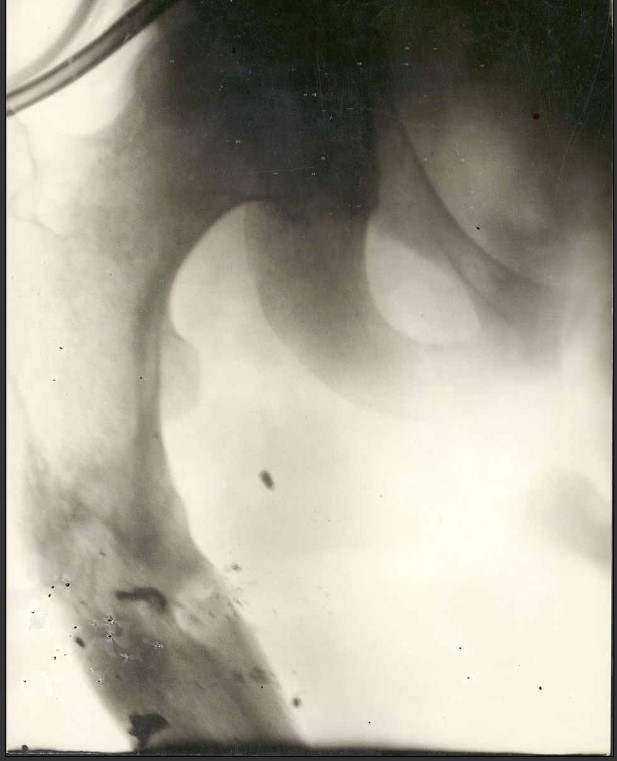
During the skirmish, Private le Cornu was badly wounded in the thigh and sent to the 58th Casualty Clearing Station. Within days he was moved to the 4th General Hospital in Camiens, but his condition necessitated medical evacuation to Britain.
Over the next year, Philip had three operations on his leg, and spent time at the 3rd Southern General Hospital in Oxford, the Manor War Hospital in Epsom, Surrey, and the 16th Canadian General Hospital in Orpington, Kent. Tragically, all of the medical treatment was to prove to no avail. Private le Cornu passed away from his injuries on 14th September 1918, more than a year after Hill 70. He was 24 years of age.
Philip Francis le Cornu’s body was taken back to the Channel Islands for burial. He was laid to rest in the quiet graveyard of St Mary’s Church on Jersey.
X-ray of Private Philip le Cornu’s left femur (from uk.forceswarrecords.com)
Victor Jordan was born on 20th November 1893 in Beeston Regis on the north Norfolk coast. The second of four children, his parents were school teachers Albert and Melletta Jordan.
By the time of the 1911 census, the family had moved from one coast to another, setting up home in Bognor Regis, Sussex. Albert had given up teaching, and had become an insurance agent for Prudential. Victor had left school and found work as a wheelwright, while his older sister, Emily, had taken up where her father had left off, teaching in an elementary school, The family of six was expanded by the inclusion of Albert’s mother, Emily, who had moved in with them.
By 1914, war was on the horizon, and Victor sought out a career beyond wheel work. On 21st May he enlisted in the Royal Navy as a Stoker 2nd Class. His service records show that he was 5ft 6ins (1.78m) tall, had light brown hair, blue eyes and a fair complexion.
Stoker Jordan was initially sent to HMS Victory, the Royal Naval Dockyard in Portsmouth, Hampshire, for training. After an initial six-month period, he was assigned to the battleship HMS Indomitable, on board which he was to serve for the next four years.
During his time on board, Victor proved to be a disciplined and determined worker. He was promoted to Stoker 1st Class in July 1915, and reached the rank of Leading Stoker in the summer of 1918. HMS Indomitable was involved in some of the key naval battles of the First World War – including Dogger Bank and Jutland – and Victor would have been on the forefront of maintaining the vessel’s power.
By October 1918, Leading Stoker Jordan was back on dry land, and was based once again in Portsmouth. As the war came to a close, however, he became unwell, and was admitted to Haslar Naval Hospital in nearby Gosport, suffering from acute tonsillitis.
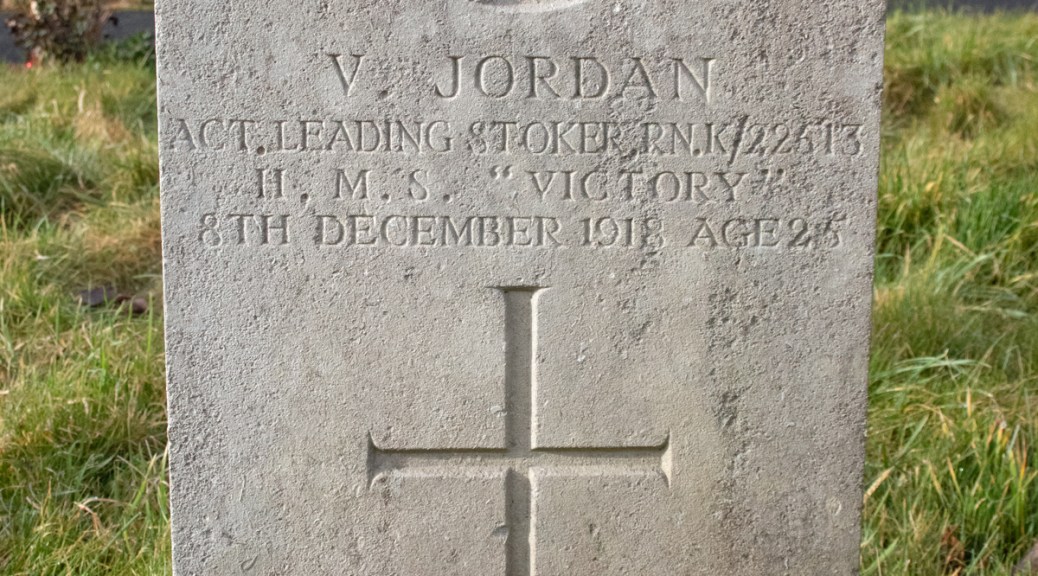
Tragically, the condition was to get the better of him: Leading Stoker Jordan died of heart failure on 8th December 1918, having not long turned 25 years old.
Victor Jordan’s family were, by now, living in the Somerset hamlet of Brewham, and this is where his body was brought for burial: he was laid to rest in the peaceful graveyard of St John the Baptist’s Church.
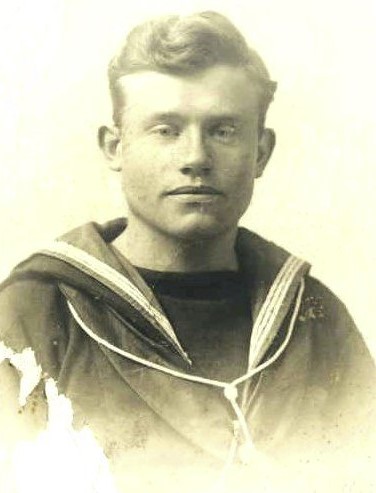
Leading Stoker Victor Jordan (from findagrave.com)
Scandal was set to rock the grieving family. Albert, who was now teaching again, was charged with indecently assaulting a nine-year-old girl three times over the winter of 1918/19. He denied the accusation and a jury found him not guilty after only a few minutes’ deliberation.
Albert and Melletta seem to have found it impossible to remain in the quiet corner of Somerset, and moved to Essex. The couple took up new teaching posts, Albert eventually becoming the headmaster of Doddinghurst Church of England School, near Brentwood, while his wife worked as a school mistress for one of the classes.
Melletta died in February 1931, and at this point, Albert came back to Somerset to live with his daughter and her family in Cheddar. He was 75 years old when he passed away at Emily’s family home – called Melletta after her mother – and was laid to rest in St Andrew’s Churchyard, Cheddar.









 Death and Service