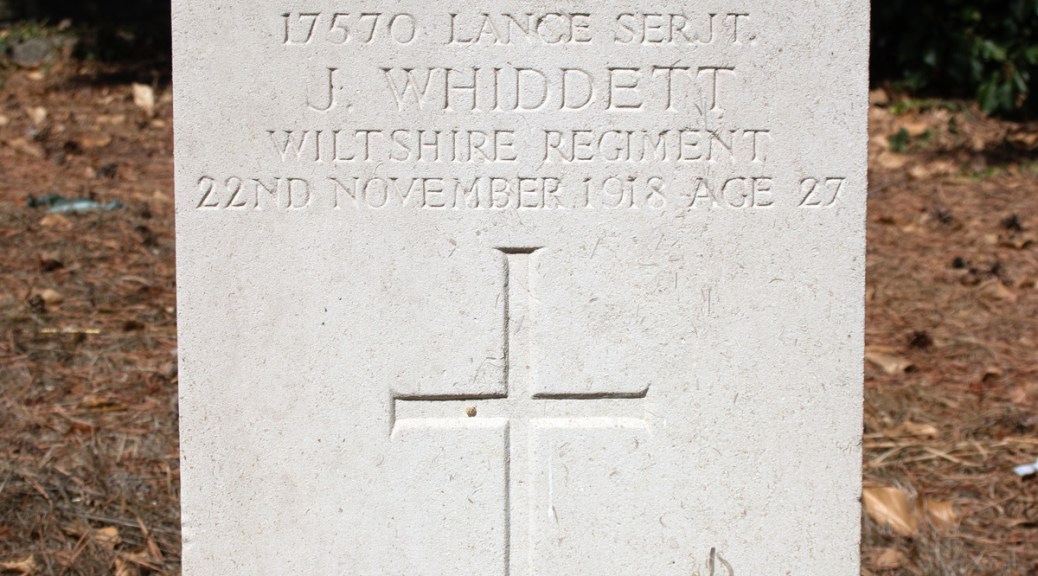
John Whiddett was born in Hammersmith, Middlesex, in 1892, and was one of thirteen children to Alfred and Mary Ann Whiddett. Alfred was a house painter while Mary Ann worked as a charwoman to bring in some additional money for the growing family.
John worked as a porter when he left school, but when war came to Europe, he stepped up to play his part. He enlisted in the Wiltshire Regiment in the summer of 1915, and was assigned to the 3rd (Reserve) Battalion.
While Private Whiddett served in France, he returned to Britain, and promoted to Corporal and then Lance Serjeant. His battalion eventually formed part of the Thames & Medway Garrison. Frederick found himself in Kent by the autumn of 1917 and served out the remainder of the war there.
At some point during the autumn of 1918, Lance Serjeant Whiddett fell ill. He was admitted to the Preston Hall Military Hospital in Aylesford, suffering from a combination of influenza and pneumonia. Sadly he was not to survive these lung conditions, and he succumbed to them on 22nd November 1918. He was just 26 years of age.
Finances may have restricted John’s family’s ability to bring his body back to Middlesex. Instead, he was laid to rest in the graveyard of St Peter and St Paul’s Church in Aylesford, Kent.
John Francis Poignand was born in St Brelade, Jersey in 1885. The oldest of four children, his parents were farmers Jean and Louisa Poignand. John followed his parents into farming and moved to nearby St Lawrence.
It was here that he met and married farmer’s daughter Lydia Helleur. The couple set up home in St Lawrence, and went on to have two children, John and Clarence.
War was closing in on Jersey’s shores and, when the call came, it seems that John was keen to play his part. Sadly, full details of his military service have been lost to time, but what remains confirms that he had enlisted in the Wiltshire Regiment by the spring of 1918.
Private Poignand was assigned to the 3rd (Reserve) Battalion, a territorial force that remained on the British mainland. He was to be based in Kent, his troop forming part of the Thames and Medway Garrison.
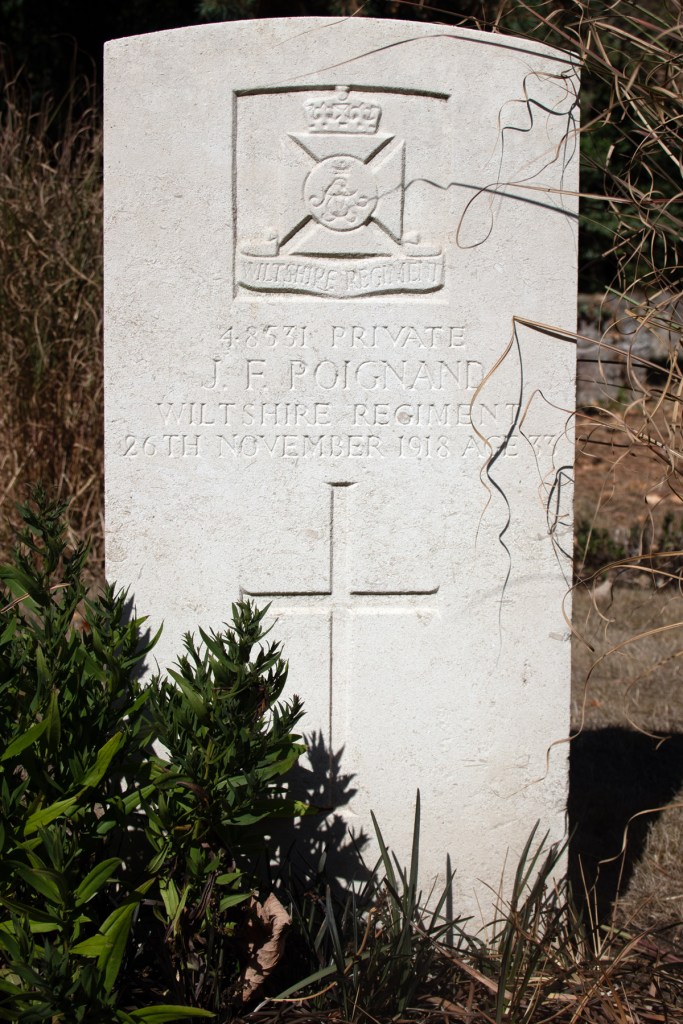
The only other records of John’s service are that of his passing: he had been admitted to the Preston Hall Military Hospital, suffering from a combination of influenza and pneumonia, and these are what were to take his life. Private Poignand died on 26th November 1918, at the age of 33 years old.
John Francis Poignand was laid to rest in the graveyard of St Peter and St Paul’s Church in Aylesford, not far from where he had died.
Lydia went on to marry a man called Robinson. Her trail goes cold, but her and John’s younger son, Clarence, does appear in later records.
Flight Sergeant Poignand served with the Royal Air Force in the Second World War, and was based at Seletar in Singapore. He was taken as a Prisoner of War by the Japanese on 11th March 1942, but there is no other record for him. His PoW record confirms that he was married and living in Romford, Essex, at the time of his capture.
Robert Cantle’s life is one of hope and of tragedy. There is very little documentation on him, but what there is gives a hint to his life.
The 1911 census recorded him a living on Temple Street in Keynsham, Somerset. The head of the household was 86 year old John Cantle, a retired platelayer for Great Western Railway. His wife, Mary, was 22 years his junior, and they shared the house with their son, stationary cutter Ernest, his wife, Elsie, and their daughter, Madge. Robert was noted as being John and Mary’s adopted son. His age was given as 13, but his place of birth is ‘unknown’.
When war broke out, Robert joined the Wiltshire Regiment. Private Cantle set off for camp in Wiltshire in August 1917, and had been there for just two days when tragedy struck.
There were heavy thunderstorms in the Warminster district on Thursday, and while men of a unit of the Wiltshire Regiment were on the parade ground, three of them were struck by lightning. Pte. Robert Cantle, aged 19 years, whose home is at Keynsham, was killed on the spot, and the other two, Pte. Rowe and Pts Murgatroyd, were severely injured…
Sergeant Major HJ Bennett, of the Wilts Regiment, stated [at the inquest] the deceased lad had only just joined them. About 3pm on Thursday a squad was on the parade ground, when the signal was given to dismiss, as a storm was approaching. Immediately after there was a flash and a crash and it seemed to stagger everybody on the parade ground. Witness was brought to his knees, and when he recovered himself he saw three men, who of whom were struggling, on the ground. Private Cantle was found to be dead, and the other men recovered after being attended by a doctor. The squad consisted of recruits, and none of them were carrying arms.
Major Stocker, medical officer, said the crown of deceased’s cap was ripped off, and the body was burned from head to foot.
The jury returned a verdict of “Death from the effects of lightning.”
Somerset Standard: Friday 17th August 1917
Robert Cantle’s body was brought back to Keynsham for burial: he was laid to rest in the town’s cemetery.
Clarence Southwood Emmett was born in September 1899 in the Devon village of Ipplepen. The middle of five children, his parents were village butcher Thomas Emmett and his wife, Annie.
There is little information about Clarence’s early life, but when war broke out in 1914, he is evident that he wanted to play his part. He enlisted in the army as soon as he turned 18, and joined the 4th Battalion of the Wiltshire Regiment.
Sadly, full details of his time in the army, although a local contemporary newspaper sheds a little more light onto his health:
He soon contracted measles, and took a chill before he recovered. Since then he has been dangerously ill at different times, and has undergone various operations. He was recently removed to a hospital at Devonport where, until a few weeks ago, it was hoped he might recover.
Western Times: Friday 14th February 1919
Private Clarence Southwood Emmett died in the hospital on 8th February 1919. He was just 19 years of age. His body was brought back to Ipplepen, and he was laid to rest in the graveyard of St Andrew’s Church there.
Clifford Frederick Alway was born on 2nd February 1903 in Wellington, Somerset. He was the fifth of fourteen children to Samuel and Ann Alway. Samuel was a farm labourer and butcher and, when war broke out, he stepped up to play his part, enlisting as a Driver in the Royal Field Artillery.
Clifford also seemed keen to be involved, and it can only be assumed that one or both of his older brothers – William (born 1898) and Wyndham (born 1901) – had joined up. By the summer of 1918, Clifford enlisted in the Wiltshire Regiment. It seems likely, given that he was only fifteen years old, that he had lied about his age, as so many young men did.
He joined the 3rd (Reserve) Battalion of the Wiltshire Regiment as a Bandsman. This was a territorial force, and Clifford was posted to Kent, as part of the Thames and Medway Garrison.
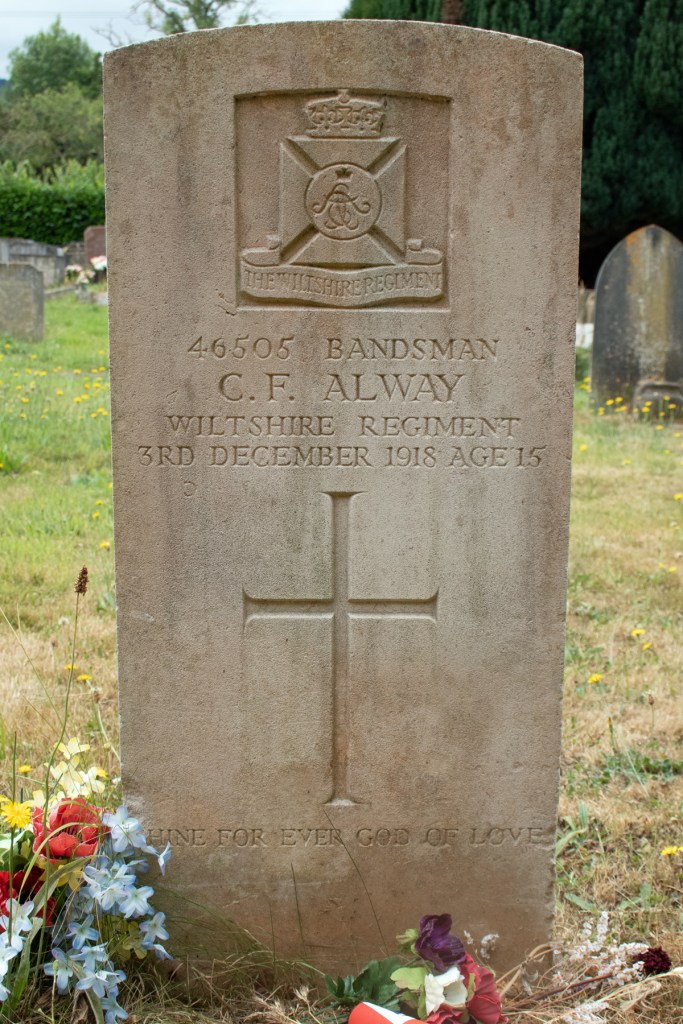
It was here, where it was billeted in crowded barracks, that Bandsman Alway contracted influenza and pneumonia. Admitted to hospital in Aylesford, the conditions proved too much for his system, and he passed away on 3rd December 1918. Tragically, Clifford was just 15 years of age.
Clifford Frederick Alway was brought back to Somerset for burial. He was laid to rest in Wellington Cemetery, not far from where his family still lived.
Samuel survived the war, spending more than three years in France – he was overseas when his son passed away, and so was unable to attend the funeral.
Bertie Richard Moody was born in Warminster, Wiltshire in April 1885, one of ten children to Joshua and Mary Moody. Joshua was a navy pensioner, who was twenty years older than his wife, and they raised their family in a small house to the west of the town centre.
When he left school, Bertie found work labouring for a man with a traction engine, but, after his parents died – Mary in 1901 and Joshua two years later – he had more need of a trade. The army offered him a life of adventure, and so he enlisted in the 1st Battalion of the Wiltshire Regiment. Full details of his military career are lost to time, but by the 1911 census, Private Moody was based in Pietermaritzburg, South Africa.
War in Europe was looming, and Bertie’s regiment was called back home. By December 1914, however, he was on the front line in France, and, over the next couple of years, earned the Victory and British Medals, the 1915 Star and a promotion to Serjeant for his service.
As time wore on, it was evident that illness was playing a bigger part in Serjeant Moody’s life. He was suffering from diabetes, and the condition led to him being medically discharged from the army in October 1916. Bertie moved to Frome, Somerset, and found work as a labourer.
He still wanted to play his part, and after making something of a recovery, he tried to enlist again, this time in the Royal Air Force. They rejected Bertie because of his condition too, however, so his time in active service came to an end.
At this point, Bertie’s trail goes cold. He died in Frome on 13th December 1918, at the age of 33, and was laid to rest in the graveyard of Holy Trinity Church in the town.
Cyril Starr Allen was born on 15th June 1891 in the village of Baughurst, near Tadley in Hampshire. He was the second youngest of five children to Charles and Martha Allen. Charles was a rate collector, and the family moved around the county during Cyril’s early years.
By the time Cyril left school, Charles had become an assistant bursar in Wootton, near Basingstoke. Cyril, meanwhile, had found similar administrative employment and was working as a clerk for a local land agent.
At the start of 1911, Cyril enlisted in the British Army. He joined the 4th Battalion of the Wiltshire Regiment as a Private and was soon based on Salisbury Plain. His service records confirm that he was 19 years and 7 months old, and stood at 5ft 5ins (1.65m) tall. Private Allen served for his initial term of four years, before being remobilised.
In November 1915, Cyril married Mabel Young. She was a printer’s daughter from Wiltshire, and the couple married in Salisbury, before settling down in Frome, Somerset. They went on to have a child, a daughter they called Kathleen.
Remobilised in the autumn of 1915 Private Allen received a series of promotions – to Lance Corporal, Corporal, Lance Sergeant and Sergeant, and, by June 1917, he found himself at the Front.
On 22nd April 1918, Cyril was injured, sustaining gunshot wounds to his shoulder and left arm. He was invalided back to England for treatment, and was hospitalised in the north of the country. He was then transferred to the Royal Welch Fusiliers with the rank of Corporal and sent to Ireland to continue his recovery and work light duties.
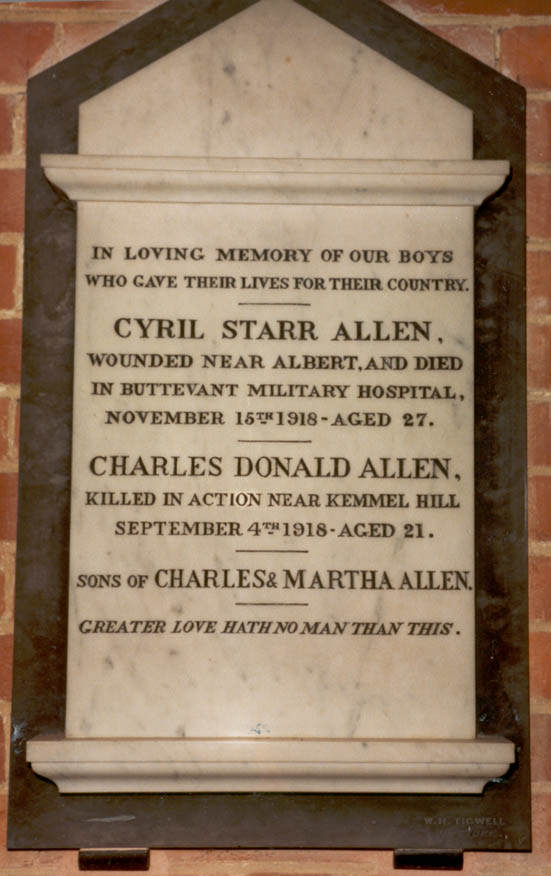
While in Ireland, Corporal Allen contracted influenza and was admitted to the Buttevant Hospital in County Cork. Sadly, in his weakened state, it was something he was to succumb to, and he passed away, with Mabel at his bedside, on 15th November 1918. He was just 27 years of age.
Cyril Starr Allen’s body was brought back to England; he was laid to rest in the graveyard of Christ Church in Frome, Somerset.
Corporal Cyril Allen (from ancestry.co.uk)
After the loss of her husband, Mabel went on to live her life. In 1923, she married James Burr, a draughtsman from Frome; they went on to have a child – a brother for Kathleen – called James.
Cyril’s two brothers, Winthrop and Charles, also fought in the First World War.
(from ancestry.co.uk)
Winthrop had emigrated to North America in 1911, but returned to Europe as part of the Canadian Expeditionary Force when war broke out.
Lance Corporal Charles Allen served with the 15th Battalion of the Hampshire Regiment. He fought on the Western Front and was killed near Kemmel Hill in Belgium on 4th September 1918. He was just 21 years old. Charles is commemorated at the Tyne Cot Memorial in Zonnebeke, Belgium.
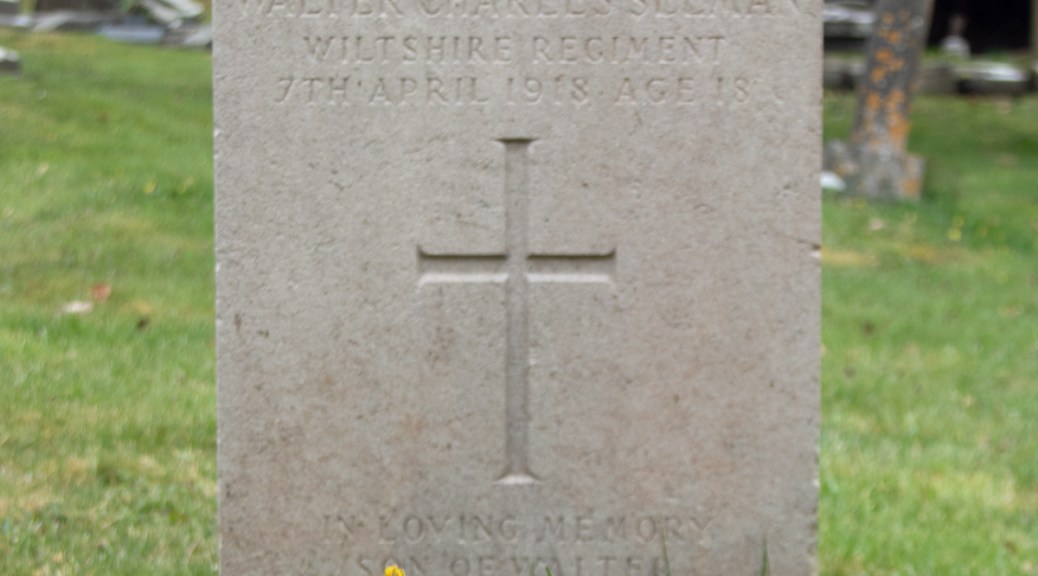
Walter Charles Selman was born on 7th June 1899, the youngest of four children to Walter and Annie Selman. Walter Sr was a gardener and, by the time of the 1911 census he had moved the family to the sleepy Somerset village of Burrington.
Sadly, there is little documentation surrounding Walter’s young life. His gravestone confirms that he enlisted in the Wiltshire Regiment; although there is no date to confirm when he enrolled, it is likely to have been in the second half of the conflict, given his age.
Private Selman was assigned to the 4th Battalion, but there is no clear confirmation of where he served. The 1/4th Battalion fought in India and Egypt; the 2/4th was also based in India but remained there for the duration. The 3/4th Battalion – the most likely to be Walter’s troop – was a reserve troop, based on home soil.
Where little is known about Private Selman’s military service, there is similarly little information about his passing. His pension records bluntly put his cause of death as ‘disease’; as with many other recruits towards the end of the war, it is likely that this was, in fact, either influenza or pneumonia.
Sadly, the mustering of the Allied armies – and the associated mixing of young men from across the country in crowded barracks – brought a real danger of disease, and lung complaints were commonplace. While there is no definite proof, it appears that Private Selman may have succumbed to one of these conditions; he passed away in a military hospital on Salisbury Plain on 7th April 1918, two months short of his 19th birthday.
Walter Charles Selman lies at rest in the graveyard of Holy Trinity Church in his home village of Burrington, Somerset.
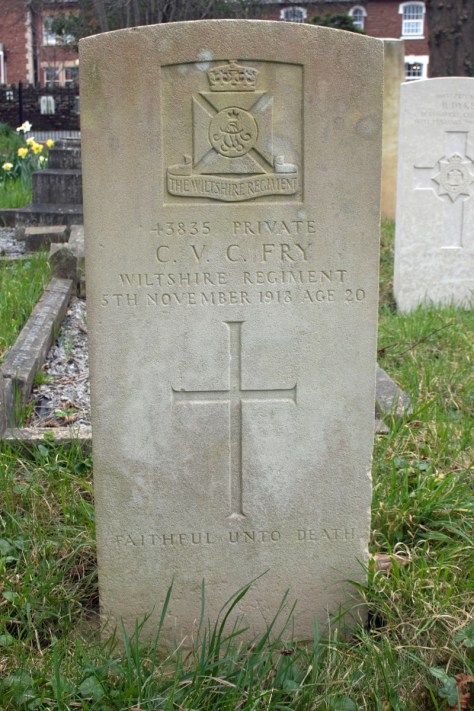
Clarence Vivian Clements Fry was born in November 1898 to William and Rosa Fry. William was a ‘provisions merchant clerk’, who went on to become a ‘cheese and provision dealer’, or grocer. Sadly, Rosa passed away in 1904, at the tender age of 31, leaving Clarence without a mother at just six years old.
William remarried in 1908, and he and new wife Amy had a daughter, also called Amy, a year later. By the 1911 census, the family of four were living in a three storey Victorian Terraced house to the south of Bridgwater town centre.
Sadly, little of Clarence’s military career remains documented. Initially joining the Royal Army Service Corps, Private Fry soon transferred over to the Duke of Edinburgh’s Wiltshire Regiment.
The 1st Battalion found in some of the key battles on the Western Front, including Mons, Ypres, Messines and Vimy Ridge. As his enlistment date isn’t known, it’s impossible to say whether Private Fry was involved in these conflicts or not.
What is likely is that Private Fry was involved in the Battle of the Selle, which took place near the towns of Cambrai and Valenciennes in northern France in October 1918. Clarence was certainly injured at this point, and was evacuated to England for treatment.
Admitted to the Cambridge Military Hospital in Aldershot, it seems that his injuries were too severe and he succumbed to them on 5th November 1918, just a week before the Armistice was signed. Private Fry was just 19 years old.
Clarence Vivian Clements Fry lies at rest in the Wembdon Road Cemetery in his home town of Bridgwater in Somerset.
Edward Lionel Gane was born in 1899 and was one of eight children. Known as Lionel, he was the son of Edwin and Joanna Gane, and lived in the quiet Somerset village of Ditcheat. Edwin began life as a pig dealer, but by the time of the 1911 census, had changed direction and become an insurance agent.
Joanna passed away in 1915, and this may have been the impetus Lionel needed to find his way in the world. He enlisted in the Wiltshire Regiment, joining the 3rd (Reserve) Battalion of the Duke of Edinburgh’s brigade.
The battalion – a depot and training unit – were initially based in Devizes, before moving to Dorset and then Kent. While there is no confirmation of when Private Gane enlisted, it would have been by September 1917, which is when the battalion became part of the Thames & Medway Garrison.
The end of the war marked another ending for the Gane family. Edwin passed away on Armistice Day – 11th November – and further tragedy was to follow, as Private Gane contracted influenza and died less than two weeks later.
Edward Lionel Gane died in a military hospital in Malling, Kent, on 24th November 1918. He was just 19 years old. He lies at rest in the graveyard of St Mary’s Church in his home village of Ditcheat.











 Death and Service