Alfred William Lowes was born in 1893, one of eight children to George and Ann. George was a railway porter from Kent, Ann was born in Berkshire, and the couple had settled in Gillingham, Kent, by the time they started a family.
The naval dockyard in Chatham was one of the main employers in the Medway area of Kent, and Alfred was drawn there for work. After leaving school, he found a job there as a messenger, following his older brother George, who was a labourer there.
In the spring of 1916, Alfred married Edith Kennett, and it seems like the timing was due to his military service. Private Lowes joined the Prince of Wales’ Own Civil Service Rifles (also known as the 15th Battalion London Regiment) and by the beginning of August his troop was bound for France.
Full details of Private Lowes’ military service is not available, although it seems not to have been a lengthy one. He would have fought on the front line, and was wounded as a result. Repatriated back to England for treatment, Alfred passed away at home on 12th November 1916. He was just 23 years of age.
Alfred William Lowes lies at rest in the Woodlands Cemetery in his home town of Gillingham.
Ernest Hart Painter was born in December 1884 one of eight children to Alfred and Elizabeth from Devon. Alfred moved the family to Cheddar, Somerset to work at a paper mill in but sadly passed away when Ernest was only eleven years old.
The family rallied round Elizabeth, however, and, by the time of the 1901 census, she was living on the outskirts of the town with her six younger children. Elizabeth worked as a domestic cook; Ernest was an agricultural labourer; his two older sisters were shirt machinists; his 13 year old brother Albert was listed as a gentleman’s servant.
Ernest, by this point, seemed to have taken on the role of head of the family; he continued work as a farm labourer, while Elizabeth earned money as a housekeeper. Alfred became a mechanic for a car dealer and, at the 1911 census, the three of them lived with the youngest member of the family, Ernest’s sister Emily, who had followed in her older sisters’ footsteps as a machinist.
As with many of the fallen men and women of the Great War, a lot of Ernest’s military service records have been lost to time. He enlisted in the Army Veterinary Corps in December 1915, his work as a farm labourer presumably having involved animals and livestock.
Private Painter must have been on the front line as, on 30th May 1918, he was shot in the ankle. Shipped back to England for treatment, he was eventually discharged from service on 19th November, a week after the Armistice. The ankle wound continued to give him trouble, however, and over the following couple of years, he had a number of operations on it.
Sadly, the last of these procedures resulted in an infection, and sepsis took hold. Private Painter passed away from blood poisoning on 15th April 1921. He was 36 years old.
Ernest Hart Painter lies at rest in the graveyard of St Andrew’s Church in Cheddar, Somerset.
William Alfred Woodbury was born in the Somerset village of Nether Stowey in April 1899, the oldest of four children to Alfred and Nellie Woodbury. Alfred was a farm labourer, and, by the time William was a couple of years old, he had moved the family to the town of Bridgwater to work as a carter.
After leaving school, William found work at Barham Brothers’ Brickworks in the town. When war broke out, he enlisted in the Somerset Light Infantry almost as soon as he was able to, at the beginning of 1916.
Assigned to the 6th (Service) Battalion and Private Woodbury was sent out to the Western Front in April. He would almost certainly have seen action at the Battle of Delville Wood – part of the Somme offensive – and was wounded in the shoulder and arm on 18th August 1916.
Shipped back to the UK for treatment, William was admitted to the Western General Hospital in Cardiff, but tragically died from his wounds less than a fortnight later on 30th August 1916. He was just 17 years old.
His funeral was reported in both the Shepton Mallet Journal and the Central Somerset Gazette; his father, who had been serving in France as part of the Army Veterinary Corps, managed to return home for his son’s funeral.
William Alfred Woodbury lies at rest in the St John’s Cemetery in his home town of Bridgwater.
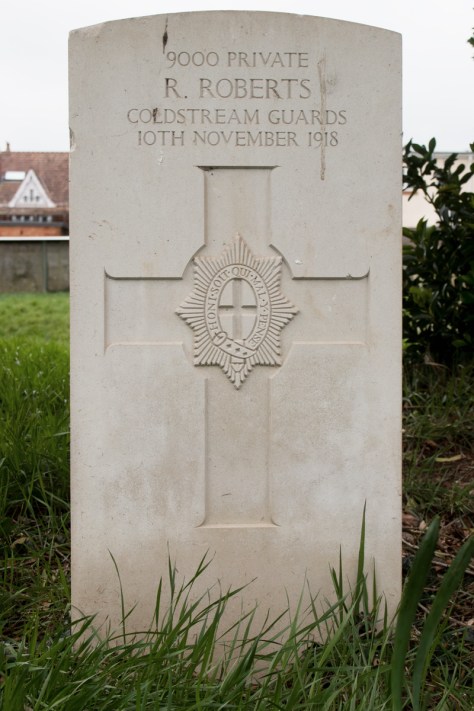
Roland Roberts was born in September 1896, one of three children – all boys – to Albert and Minnie Roberts.
Minnie, who was originally from Yeovil, had married Walter Shury, a Londoner, in 1874, and the couple had six children together. Walter then went on to have four children with Alice Norwood, and the couple married in 1898. Minnie, meanwhile, had met Albert Roberts, who was from Dundalk in Ireland, and, while no marriage seems to be confirmed, the couple had three boys, including Roland. (It is pure speculation, but as Minnie’s maiden was also Roberts, this might have provided a good enough cover for any divorce or re-marriage.)
Albert had been a Band Sergeant in the 4th Hussars, and continued that passion by becoming a music teacher Travel was also definitely in his blood: the couple’s first child, Willie, was born in South London, Roland was born in Somerset, and his younger sibling, Glencoe, was born in Penzance, Cornwall. Albert’s musical success led him to become bandmaster for the Penzance Town Band. Sadly, it was not all positive for him; in 1901, Minnie passed away, and in the same year, Willie also died, at the tender age of six.
It was the military that drew Roland in, and, in 1910, aged just 14 years old, he enlisted in the Coldstream Guards. According to the following year’s census, he was stationed at the Ramillies Barracks in Aldershot, and held the rank of Boy.
Differing from the naval rank of the same name, lads of 14 or over could serve in any regiment as musicians, drummers, tailors, shoemakers, artificers or clerks, and all were ranked as boys. It seems likely, therefore, that his father’s enthusiasm for music served him well.
When war broke out, he was of fighting age, and, as part of the “Old Contemptibles”, he was involved in the Battle of Mons, the first major confrontation for the British Expeditionary Force.
During the war, Private Roberts took part in some of the most severe fighting on the Western Front, was wounded three times, as well as being gassed. He was also recommended for the DCM for gallantry in action.
He transferred to the Labour Corps, and spent time doing land work in Somerset. It was here that Roland met and married Gladys Pyne, whose family was from Bridgwater, and the couple tied the knot in March 1918.
Sadly, it was during this war service that Private Roberts contracted influenza and pneumonia and he passed away as his in-laws’ home on 10th November 1918, the day before the Armistice was signed. He was just 22 years old.
The local newspaper reported on Roland’s continued gallantry in its article on his funeral:
[Roland] held the medal of the Royal Humane Society for saving a woman’s life.
He was also the hero of an incident that occurred in Bridgwater a few weeks ago, when he succeeded in checking the career of an infuriated bull through pluckily catching the animal by its horns.
His disposition was always most cheerful, and although suffering from his [war] wounds a good deal, he never complained.
The Cornishman: Wednesday 27th November 1918
Roland Roberts lies at rest in the Wembdon Road Cemetery in his adopted home town of Bridgwater, Somerset.
Henry Morgan was born in 1892 in Bridgwater, Somerset. He was the oldest of two children, both boys, to Charles Morgan and his wife Ellen. Charles managed the local collar works, making collars for shirts.
While Henry’s younger brother, Herbert, followed his dad’s business, according to the 1911 census, Henry was learning the farming trade. This was to stand him in good stead, and in 1912, he emigrated to Australia, to become a farmer.
Henry settled in Gunnedah, New South Wales, but was called up when war broke out. He enlisted in May 1916 and joined the Australian Machine Gun Corps. His troop left Australia on the ship Borda in November 1916, arriving in Plymouth two months later, and he finally reached France in March 1917.
Initially part of the 9th Machine Gun Battalion, Private Morgan transferred to the 3rd Machine Gun Corps in April 1918. Involved in the Allied defence of the German Spring Offensive, he was caught up in a gas attack and injured.
Wounded on 17th April 1918, Henry was evacuated back to England and admitted to the Voluntary Aid Detachment Hospital in Cheltenham. Sadly, Private Morgan was not to recover, and he died from his injuries on 8th May 1918. He was just 25 years old.
Henry Morgan lies at rest in the Wembdon Road Cemetery in his former home town of Bridgwater, Somerset.
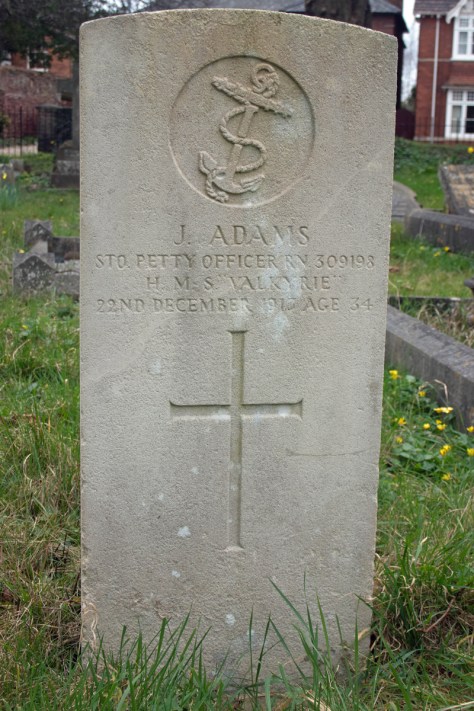
James Adams was born in June 1883, son of Robert and Eliza Adams from Bridgwater in Somerset. Robert was an agricultural labourer; James was one of seven children.
James was keen to get out and see the world. In November 1905 – aged just 12 years old – he enlisted in the Royal Navy as a stoker. After training in Devonport, Plymouth, Stoker Adams served on a number of different vessels, including HMS Victorious, Ramillies, Amphitrite, Monmouth, Andromeda and Halcyon.
By the time war broke out, James has been promoted to Leading Stoker, and was assigned to HMS Cornwall. This was an armoured cruiser that was involved in the Battle of the Falklands in December 1914.
Promoted to Stoker Petty Officer in October 1915, James continued to serve on HMS Cornwall until he was transferred to the brand new ship, HMS Valkyrie. The vessel was involved in offensive sweeps and convoy escorts based out of Harwich.
On 22nd December 1917, the Valkyrie was part of the escort for a convoy travelling to the Netherlands, when she struck a mine. In total, nineteen men were killed, twelve instantly; this included Stoker Petty Officer Adams. He was 34 years old.
James Adams lies at rest in the Wembdon Road Cemetery in his home town of Bridgwater.
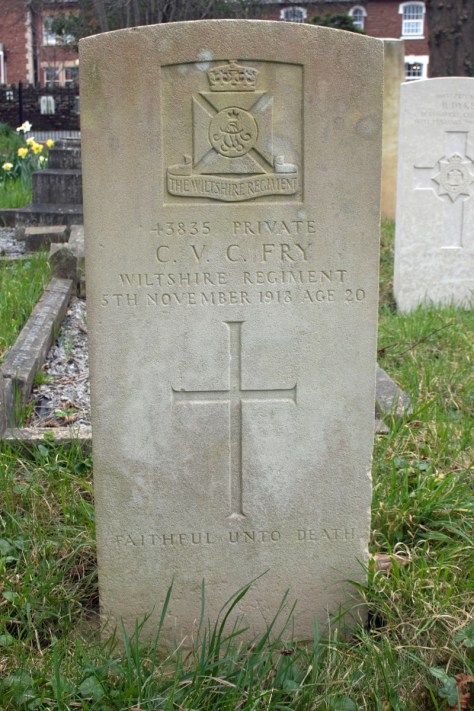
Clarence Vivian Clements Fry was born in November 1898 to William and Rosa Fry. William was a ‘provisions merchant clerk’, who went on to become a ‘cheese and provision dealer’, or grocer. Sadly, Rosa passed away in 1904, at the tender age of 31, leaving Clarence without a mother at just six years old.
William remarried in 1908, and he and new wife Amy had a daughter, also called Amy, a year later. By the 1911 census, the family of four were living in a three storey Victorian Terraced house to the south of Bridgwater town centre.
Sadly, little of Clarence’s military career remains documented. Initially joining the Royal Army Service Corps, Private Fry soon transferred over to the Duke of Edinburgh’s Wiltshire Regiment.
The 1st Battalion found in some of the key battles on the Western Front, including Mons, Ypres, Messines and Vimy Ridge. As his enlistment date isn’t known, it’s impossible to say whether Private Fry was involved in these conflicts or not.
What is likely is that Private Fry was involved in the Battle of the Selle, which took place near the towns of Cambrai and Valenciennes in northern France in October 1918. Clarence was certainly injured at this point, and was evacuated to England for treatment.
Admitted to the Cambridge Military Hospital in Aldershot, it seems that his injuries were too severe and he succumbed to them on 5th November 1918, just a week before the Armistice was signed. Private Fry was just 19 years old.
Clarence Vivian Clements Fry lies at rest in the Wembdon Road Cemetery in his home town of Bridgwater in Somerset.
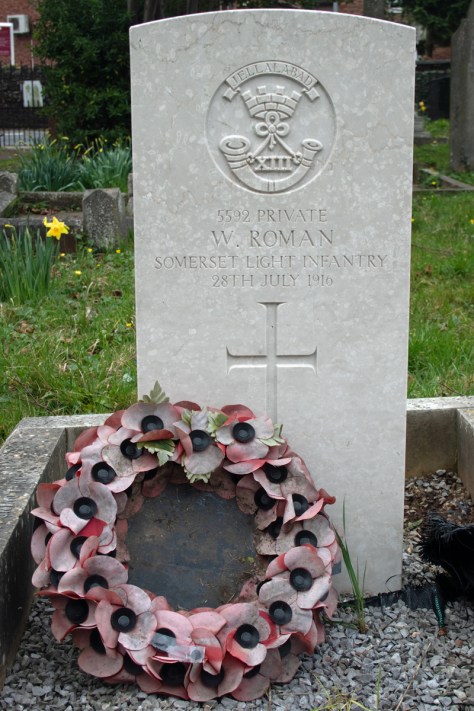
Walter James ‘Rattler’ Roman was born in July 1880, one of six children to George and Betsy Roman. George was a labourer in a brickyard, and the family lived in Bridgwater in Somerset.
Walter’s passion was rugby football, and he made the Bridgwater & Albion first team at the age of 15. Two years later had reached county level, and was playing for Somerset.
Walter enlisted in the army in around 1897, joining the Somerset Light Infantry. He spent several years abroad, serving as a Private in India and South Africa and fighting at Cawnpore and in the Second Boer War.
When Walter’s service ended, he returned to England, and continued his rugby career. He was a regular for the Bridgwater and Somerset teams, gaining the nickname ‘Rattler’, before being signed up by Rochdale Hornets in 1910.
Walter married Henriette Washer in Bridgwater in April 1911, and the couple had two children, Edna – born in 1912 – and Leonard – who was born a year later.
Continuing with rugby union, Walter was called to county level, where he joined Lancashire for a number of games. Walter also played for England, receiving a cap in the international match against Wales in February 1914, and he toured Australia and New Zealand the same year.
War broke out, and Private Roman was re-enlisted, one of twenty-five Hornets players to enlist. He served on the Western Front with the 1st Battalion of the Somerset Light Infantry and was caught up in the engagements at Ypres and Armentieres. Fighting at in the Battle of the Somme, he went over the top at Beaumont-Hamel at the start or fighting, on 1st July 1916 – his 36th birthday.
In that initial charge, he was shot several times, in both arms, a leg and the torso. Initially treated at a local field hospital, he was evacuated to England and admitted to the Voluntary Aid Hospital in Cheltenham. His condition initially improved, and he wrote letters to Henrietta, who was living back in Rochdale.
Sadly, Walter’s contracted sepsis and his health deteriorated; Henrietta was called to the hospital in Cheltenham on 27th July 1916. It is likely that she didn’t make it in time, as Walter passed away at 1pm the following day. He was just 36 years old.
Walter James Roman lies at rest in the Wembdon Road Cemetery in his home town of Bridgwater, Somerset, one of may sporting heroes to perish in the First World War.
Walter Roman (courtesy of findagrave.com)
Walter was one of 25 Rochdale Hornets players to enlist when war broke out. Of those men, five did not return: Private Walter Roman; Sergeant John Twigg; Private Archie Field; Private Tom West and Private CJ Burton.
Joseph Richard Steadman was born in Ellesmere Port, Cheshire, in 1892. One of seven children to William and Mary Ann Steadman, his father worked as a slab maker for the local council.
Sadly, Joseph’s mother died in 1899, at the age of just 40. William had moved the family to Birmingham by this point, and, on leaving school, Joseph found work at a jeweller’s as a scratch brusher.
Moving to London, Joseph met Ethel May Tambling, who was originally from Somerset, and the couple married at the beginning of 1914. Ethel already had a child – Frederick – and the young couple also had a son, Alfred, who was born in July 1914.
War was on the horizon, and Joseph was quick to enlist. He joined the Coldstream Guards, embarking for France a month after Alfred was born. An elite force, the Coldstream Guards were involved in some of the heaviest fighting of the war, including the Battles of Mons, Ypres, Loos, Somme, Passchendale and Cambrai. It is likely that Guardsman Steadman was caught up in many of these engagements.
His luck was to run out, however, and Joseph was injured towards the end of October 1917. Shipped back to England for treatment, he was admitted to the King George Hospital in London. Sadly, Guardsman Steadman did not recover from his wounds; he died on 1st November 1917, aged just 25 years old.
Joseph Richard Steadman lies at rest in the Wembdon Road Cemetery in Bridgwater, Somerset.
Joseph and Ethel Steadman (from Ancestry.com)
As a sad aside to this story, two of Joseph’s brothers also died in the war. William Steadman was 29 when he was killed at Ypres in April 1915, while Charles Steadman was just 19 when he died at Armentieres.
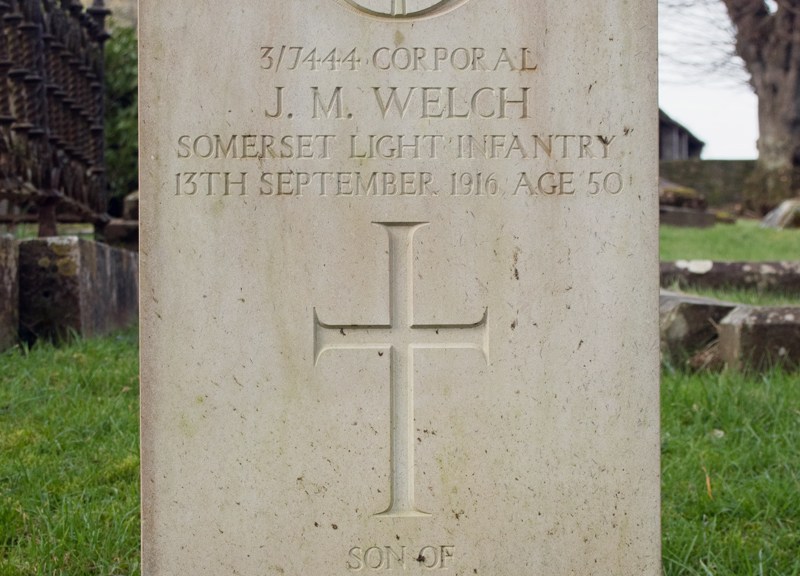
John Milton Welch was born in Yeovil on 19th February 1866, one of five children to William and Anne Welch. William was a chemist by trade, but John’s calling was elsewhere. He became a clerk, initially for a brewery, but by the time of the 1911 census, he was working for a political agency.
In that census, John can be found living with his parents – who were in their 80s by this point – and his two sisters, both school governesses. He is listed as single; although an earlier census suggests he had married a lady from the Isle of Wight called Sarah, I have found nothing to corroborate this, beyond the fact that she had wed a John M Welch, a brewery clerk from Yeovil.
War beckoned and even though he was 48 when the conflict broke out, John enlisted. Private Welch joined the Somerset Light Infantry; his service record no longer exists, but his medal record show that he arrived in France in May 1915, and was subsequently awarded the Victory and British Medals and the 1915 Star. His service obviously warranted promotion, and he was elevated to Corporal.
His troop – the 6th (Service) Battalion – was involved in several of the skirmishes of the Battle of Somme, and it is likely that Corporal Welch was injured during one of these – probably either the Battle of Delville Wood or the Battle of Flers-Courcelette. Wherever it happened, he was shipped back to England, and was treated for his injuries at the Royal Victoria Hospital in Netley, Hampshire
Sadly, Corporal Welch was not to recover; he passed away on 13th September 1916, at the age of 50.
John Milton Welch lies at rest in the graveyard of St James’ Church, in the quiet Somerset village of Milton Clevedon.