Tag Archives: wounded

Company Serjeant Major Robert Pollard

Company Serjeant Major Robert Pollard

Robert Edwin Dawe Pollard was born on 8th April 1894 in Bath, Somerset. The youngest of three children, his parents were Joseph and Elizabeth Pollard. Joseph was a gardener from Banwell, but it seems that Robert had his sights on bigger and better things.

At some point Robert emigrated to Canada, and, by the time war was declared in Europe, he was working as an insurance clerk in Winnipeg. He felt a duty to serve his country, however, and on 2nd August 1915, he enlisted in the Canadian Expeditionary Force.

Private Pollard’s service records confirm he was 5ft 6ins (1.69m) tall, with dark brown hair, brown eyes and a fair complexion. He was also noted as being a Presbyterian.

Robert’s commitment to the cause is underlined by his rise through the ranks. Attached to to the 8th Battalion of the Canadian Infantry (also known as the 90th Winnipeg Rifles), he arrived in France on 27th February 1916.

The 8th Battalion was involved in some of the fiercest fighting of the war, and, on the 1st June 1916, he was wounded in his left arm. Admitted to a hospital in Camiers, he was moved to Etaples, before returning to his unit before the month was out.

For good or for bad, this was just before the Battle of the Somme and, over the next few months, Private Pollard fought bravely and hard. Moving from the Somme, his unit fought at Passchendaele and Ypres. On 1st October 1916, Robert was promoted to Corporal, and made Sergeant just three months later.

In April 1917, Robert was admitted to hospital again, this time with an infected foot. Within six weeks he was back with his unit, though, and on 7th November 1917, he was promoted to Company Serjeant Major. He was obviously good at what he did, and this was recognised. On 28th December 1917, he was mentioned in despatches, and the following June he was awarded the Meritorious Service Medal.

As the war entered its closing months, Company Serjeant Major Pollard, still led from the front. He returned to Britain at the end of November 1918, and was attached to the 18th Reserve Battalion in Seaford, Sussex ahead of being demobbed.

It was here that Robert contracted influenza. Whether at his family’s request is unclear, but he was admitted to Bath War Hospital for treatment but, after everything that he had been through, it was a combination of the flu and toxaemia, or blood poisoning, that was to prove his undoing. Company Serjeant Major Pollard died on 23rd December 1918, aged just 24 years old. His mother, Elizabeth was by his side.

Robert Edwin Dawe Pollard was laid to rest Bath’s sweeping Locksbrook Cemetery, not far from where his family lived. His headstone recognises the Military Medal he was posthumously awarded.


Company Serjeant Major Robert Pollard
(from findagrave.com)

Gunner Daniel Davies

Gunner Daniel Davies

Daniel Rees Davies was born on 10th August 1887, one of eight children to Daniel and Katherine Rees. Daniel Sr was a coal miner, born in Brecon, South Wales, and it was in Aberdare that the family were born and raised.

By the time of the 1901 census, five of the Davies family were working as coal miners. However, something changed dramatically over the following decade. The next census return, taken in 1911, found Daniel Sr working as a butcher, with Daniel Jr employed as his assistant. The two Daniels and Katherine were living in a six-roomed house with Daniel’s younger brother, Moses, his older sister, Margaret, and her husband, another Daniel.

In the autumn of 1913, Daniel Jr married Daisy Loud. She was a milliner from Bath, and it was in the Somerset city that the couple exchanged their vows. The couple set up home in Bath, and went on to have two children, Maurice and Norman. He continued working as a butcher and, by the time war was declared, he was employed by Larkhall.

When war came to Europe, Daniel stepped up to play his part. Sadly, full details of his service have been lost to time, but it is clear that he enlisted in the Royal Field Artillery in the spring of 1917 and he was attached to the 88th (Howitzer) Brigade.

Gunner Davies served in Northern France and was badly injured on 3rd June 1918. He was initially hospitalised in Rouen, but then medically evacuated to Britain for treatment. Admitted to Netley Hospital in Hampshire, the wounds he had received to his arm and shoulder were to prove too severe. A telegram was sent to Daisy for her to come to the hospital, but her train was delayed, and she arrived too late to see her husband before he passed away. He died on 17th June 1918, at the age of 30 years old.

The body of Daniel Rees Davies was taken back to Somerset for burial. He was laid to rest in Bath’s majestic Locksbrook Cemetery.


Gunner Daniel Davies
(from ancestry.co.uk)

Lieutenant Stanley Syvret

Lieutenant Stanley Syvret

In the graveyard of St Lawrence Church in Jersey, stands an imposing monument. The dedication reads “Here reposeth Stanley de Beaudenis Syvret, Lieut. 3rd Royal Scots Fusiliers. Only son of Albert de Beaudenis Syvret. Died 14th May 1918 at Queen Alexandra’s Military Hospital as a result of his campaign during Somme Advance July 1916. Aged 27”.

Stanley de Beaudenis Syvret was born in South America in 1891. He was the only child of Anthony and Amy, both of whom were born in Jersey. Records for South America are not available, but by the time of the 1911 census, the family were living in Stamford Hill, London. Anthony was employed as an attendance officer for London County Council schools, while Stanley had found work as a clerk for a wool broker.

At this point, Stanley’s trail goes a bit hazy. The 3rd (Reserve) Battalion of the Royal Scots Fusiliers was based in Scotland for the whole of the conflict, so it is likely that he was transferred to that battalion after being injured.

There is little additional information for Lieutenant Syvret. He was brought back to Jersey after his death, and lies at rest in the churchyard close to his family home.


Rifleman Conrad Bedford

Rifleman Conrad Bedford

Conrad Thomas Bedford was born on 8th August 1891 in Bowes Park, Middlesex. The younger of two children, his parents were Thomas and Clara Bedford. Thomas was a bank clerk, who had a strong focus on education and, after his untimely death in 1899, aged just 40, Clara was keen to ensure that her only son received the best.

Conrad was educated at Seaford College in Sussex, and was boarding there at the time of the 1901 census. Whilst there, he served in the College Cadet Corps, which was attached to the Royal Sussex Engineers, and by the time he left, in 1909, he had taken the rank of Corporal.

When he completed his schooling, Conrad found work as a clerk in the London Joint Stock Bank, and soon volunteered for the London Rifle Brigade. When war broke out, he willingly stepped up to serve his country, and became attached to the regiment’s 5th Battalion.

The 1/5th (City of London) Battalion (London Rifle Brigade), to give the London Regiment’s unit it’s full title, fought on the Western Front, and Rifleman Bedford arrived in the Wallonia region of Belgium on 4th November 1914.

Early in 1915, Conrad was based near Ploegsteert, when, at around 2am on 27th February, he was shot in the right shoulder. He was medically evacuated to Britain, and admitted to the American Women’s War Hospital, in Paignton, Devon. While his injury was treated, sepsis set in, and Rifleman Bedford succumbed to it: he passed away on 15th March 1915, at the age of 23 years old.

Surprisingly, Clara did not bring her son back to London, where she was living. Instead, Conrad Thomas Bedford was laid to rest in Paignton Cemetery, not far from where he had breathed his last.


Riflemen Conrad Bedford
(from ancestry.co.uk)

Lieutenant Hugh Lorimer

Lieutenant Hugh Lorimer

Hugh Cowan Lorimer was born on 27th November 1886 in Totnes, Devon. The oldest of four children, his parents were Scots-born draper Robert and his Devonian wife, Susan.

This was a family business, with Robert’s father – also called Robert – running the drapery at 59 Fore Street since the 1871 census. By 1891, Hugh’s father had taken over, and the family remained there until at least the time of the 1911 census return.

Hugh, by this point, had also taken on the mantle of draper. With the Lorimer business firmly set up in Totnes, he moved to Paignton, and opened a shop on the central Victoria Street. By 1911 he was listed as being the main employer, with his sister Muriel at his side, and a live-in servant, Bella Loram, helping to manage the household.

In the spring of 1914, Hugh married Gwendoline Pridham. Little information about her is available, but she had been born in Newton Abbot, and was a year younger than her new husband.

When war came to Europe later that year, Hugh was called upon to play his part: “He joined the Army in June, 1915, and received a commission in the 1/5th [Duke of Cornwall’s Light Infantry] with whom he served in France for 15 months prior to March 30th, where he was severely wounded, with the result that he had to undergo several operations, and only recently rejoined his Regiment.” [Western Times: Monday 2nd December 1918]

Lieutenant Lorimer was not fully out of harm’s way, however. As the summer moved to autumn, he fell ill, contracting influenza, which became double pneumonia. Admitted to hospital in Eastbourne, East Sussex, he succumbed to the condition on 27th November 1918: his 32nd birthday.

Hugh Cowan Lorimer was brought back to Devon for burial. He was laid to rest in Paignton’s sweeping cemetery, on the outskirts of the town he had made his home.


Gwendoline was pregnant when she was widowed: the couple’s child, Joyce, was born on 29th June 1919, never to know her father.


Hugh’s younger brother Kenneth was also caught up in the Great War. He had emigrated to Canada at some point after the 1911 census, but volunteered for army duty in 1915.

Lieutenant Lorimer was attached to the 4th Battalion of the Canadian Machine Gun Corps, and was entrenched on the Western Front. “He was in command of a section that was in a tank taking part in an attack north west of Le Quesnel. The tank was put out of action by enemy shell fire, and Lieutenant Lorimer was wounded by a splinter from a shell. He was removed from the tank and received First Aid but died shortly afterwards.” [Canadian War Graves Registers (Circumstances of Casualty)]

Kenneth Lorimer died on 8th August 1918, days short of his 30th birthday. He was laid to rest in Beaucourt British Cemetery in Picardie.


Private Henry Weakley

Private Harry Weakley

Henry Weakley was born in 1885 in Bath, Somerset. The second of six children, he was the eldest son to James and Fanny. James was a cab driver, and Henry – who was better known as Harry – followed suit, becoming a coachman by the time of the 1901 census.

In 1910, Harry married a woman called Jennie. There is little information available about her, but the following year’s census return found the couple living with his family at 1 Cork Street, Bath, not far from the city’s Royal Crescent. The census had two records for that address, which confirmed the family’s living arrangements. Harry and Jennie had one room, while the rest of the Weakleys – James, Fanny, four of their children and a grandson – took up four rooms.

Harry was still employed as a coachman as this point, but, with war on the horizon, things were to change. Full details of his military service are lost in the mists of time, but it is clear that he enlisted in the Somerset Light Infantry, and that he was assigned to the 3rd (Reserve) Battalion.

Private Weakley’s unit was a territorial battalion and it remained on UK soil throughout the war. Initially based in Devonport, Devon, the 3rd moved to Londonderry, Northern Ireland, in November 1917, and Belfast the following April. Sadly, the little that remain of Harry’s records do not confirm where he served.

Harry was demobbed on 13th May 1919: his pension ledger notes that he had received gun shot wounds to his neck and back, although no further records identify when or how these injuries occurred. He returned home – 5 St George’s Buildings, Upper Bristol Road, Bath – and seems to have settled back into his pre-war life, although his health was still impacted.

Harry passed away at home on 27th March 1921. He was 36 years of age, and had died of heart failure. Despite his wartime injuries, the war office determined that his condition had been contracted after his army service: Jennie was denied a war pension.

Henry “Harry” Weakley was laid to rest in Bath’s sweeping Locksbrook Cemetery, not far from where his widow still lived.


Private Edward Vale

Private Edward Vale

Edward Charles Vale was born in the spring of 1890, one of ten children to William and Ellen. Born in Cambridgeshire, William was employed by the local railways, becoming a signalman by the time of the 1901 census. The family were raised in Great Shelford, before moving to the Ely area in the early 1900s.

By the time of the 1911 census, Edward was the oldest of three of his siblings to still be living at home. The Vales were living at 12 Granta Terrace, Stapleford, and Edward was employed as a domestic gardener.

When war broke out, Edward volunteered to serve his country. Full service details are lost to time, but he had enlisted in the Royal Fusiliers by the spring of 1915. By June of that year, Private Vale was fighting in the Balkans.

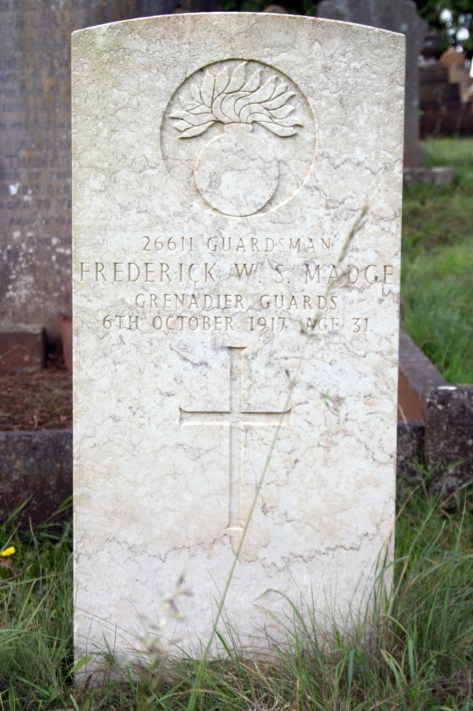
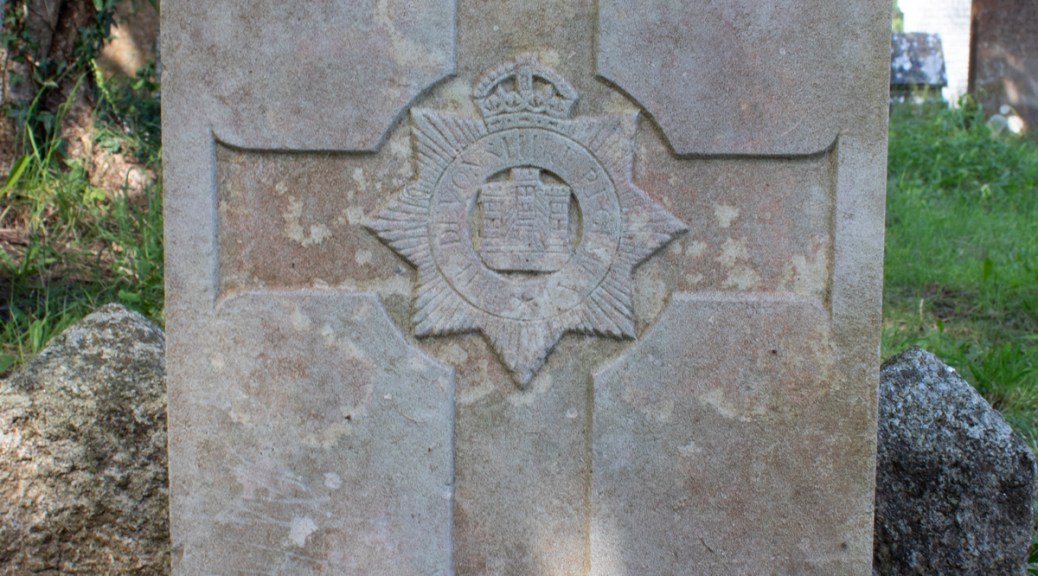
At some point during the conflict, Edward transferred to the Oxfordshire & Buckinghamshire Light Infantry. He remained in the Easter Mediterranean, but was badly wounded in the summer of 1917.

Medically evacuated to Britain, Private Vale was admitted to the Voluntary Aid Detachment hospital that had been set up at Knightshayes Court, Devon. While details are unclear, Edward’s injuries were to prove too severe. He passed away on 9th October 1917, at the age of 27 years old.

Edward Charles Vale was laid to rest in the peaceful graveyard of St Thomas’ Church in Chevithorne, not far from the hospital in which he had passed.


Private Frederick China

Private Frederick China

Frederick George China was born in Bath, Somerset, in the summer of 1885. He was the second of children to tailor George China and his wife, Gloucestershire-born Frances.

Frederick was working as a grocer’s assistant when his father died in 1906, at the age of 52. Determined to earn money for Frances and his three sisters, he left Somerset for work. The 1911 census recorded him as living in Worthing, West Sussex, boarding with the Vitler family. Percy was a baker’s assistant, and lived at 4, Tarring Road with his wife and two daughters. The census noted two visitors to the property, railway contractor Robert Puttock and his wife, Annie.

On 26th December 1912, Frederick married Lucy Hellier. Born in Midhurst, West Sussex, she was working as a confectioner’s shop assistant in Worthing’s Montague Street, boarding with the manager, Catherine Castle, her mother and her niece. The couple wed in Stanmer Parish Church, to the north of Brighton, which is where Lucy’s family were then living.

The newlyweds moved back to Bath, and Frederick took up a job as manager of the Widcombe branch of the Twerton Co-operative Society. Their only child, son Douglas, was born in February 1915.

By this point, war was raging across Europe, and Frederick stepped up to play his part. His full service details are no longer available, but he joined the Somerset Light Infantry in June 1916, and was assigned to the 7th Battalion.

He was in a battalion of the Somersets, who were heavily engaged at Langemarck, but he and his chum came safely through the severe fighting at that place. While returning, some time after, to the front trenches, he was knocked out by a shell, and received severe injuries. The spine was so badly hurt that, if he had survived, he would never have walked again.

[Bath Chronicle and Weekly Gazette – Saturday 29 September 1917]

Private China was medically evacuated to Britain for treatment, and he was admitted to King George’s Military Hospital in South London. Lucy and Frances travelled to Surrey to see him, and were with him when he passed, his wounds being too severe for him to survive. He passed away on 21st September 1917, at the age of 32 years of age.

The body of Frederick George China was aid to rest in Bath’s sweeping Locksbrook Cemetery, not far from where his father, George, was buried.


Private Frederick China
(from britishnewspaperarchive.co.uk)

Private Percy Wall

Private Percy Wall

Percy James Wall was born in the Somerset village of Kilmersden in the summer of 1880. The fifth of ten children, his parents were called Robert and Amelia. Robert was a cashier for a local colliery, but it seems that Percy did not follow into his father’s line of work.

The 1901 census found Percy working as a draper’s assistant for Jolly & Son’s in Bath. He was one of 27 boarders at the company’s lodgings on Milsom Street in the city centre. By 1911, he was still working for the same company, but as a draper’s clerk, and had moved to some new lodgings just to the north in Lansdown Road.

When war broke out, Percy stepped up to play his part. He enlisted in the Gloucestershire Regiment, although his full service records are no longer available. Private Wall was attached to the 1st/4th Battalion, and, by the autumn of 1916, he found himself caught up in fighting at the Ancre, part of the Battles of the Somme.

Percy was badly wounded, and evacuated to Britain for treatment. Full details are unclear, but his injuries were enough for him to medically discharged from the army. He was awarded the Silver War Badge – proof of his genuine discharge – but at this point his trail goes cold.

Percy struggled on with his injuries for a further two years. Hhe may have remained in hospital since his original injuries, but there are no records to corroborate this either way. At the start of 1919, he had been admitted to the Bath War Hospital, his family having also moved to the city by this point. He finally succumbed to his wounds, passing away on 3rd March 1919: he was 38 years of age.

Percy James Wall was laid to rest in the sprawling Locksbrook Cemetery, Bath, his pain finally eased.


Sapper George Bush

Sapper George Bush

George James Bush was born in the autumn of 1889 in Bath, Somerset. One of eight children, his parents were Edward and Sarah Bush. Edward was a general labourer turned fishmonger and the family lived in a ramshackle cottage in Griffin’s Court, off Milk Street towards the centre of the city.

When he finished his schooling, George found employment as a general labourer. By the time of the 1911 census, he and three siblings were still living at home with their parents, and all of them were working to bring together an income for the household. Times were obviously hard for the Bush family, and the list of trades reads like something from one of Dickens’ novels: fishmonger, charwoman, box maker, carter and daily domestic.

Edward died in 1912, and this put a further strain on the household. When war came to Europe two years later, a career in the army seemed a price worth paying for the additional financial support it would bring George and his family. He had enlisted in the Royal Engineers as a Sapper by the spring of 1917.

Attached to the 503rd Field Company, George’s full service details are lost to time. He definitely saw action overseas, however, fighting in some of the fiercest battles of the war, at the Third Battles of Ypres in 1917. It was here, at Passchendaele, that Sapper Bush was wounded, his injuries severe enough for him to be medically evacuated to Britain.

George was admitted to Sheffield War Hospital, but complications set in.

Sapper G Bush, RE, formally employed by the Corporation as a motor lorry driver, died in the Warecliffe Hospital, Sheffield, on Saturday. He was wounded a short time ago, but the cause of death was pneumonia, which supervened. Sappe Bush, who was… unmarried, was a son of Mrs R Bush, of 19, Denmark Road, Twerton. He had been in the army close on two years. He was one of three brothers, all of whom joined the army. A younger brother, who enlisted soon after the outbreak of war, is now in Egypt with the Somersets.

[Bath Chronicle and Weekly Gazette: Saturday 1st December 1917]

George James Bush died on 24th November 1917: he was 28 years of age. His body was brought back to Somerset for burial, and he was laid in the family plot in Locksbrook Cemetery, Bath, reunited with his father far too soon.