Henry Mitchell was born in the summer of 1892, the second of three children – and the only son – to George and Selina Mitchell. George was a gardener from Saltford, Somerset, and this is where he and Selina raised their young family.
By the time of the 1911 census, Henry had finished his schooling, and had followed his father into gardening for work. War was calling at England’s shores, however, and he was soon to take up a post in the army.
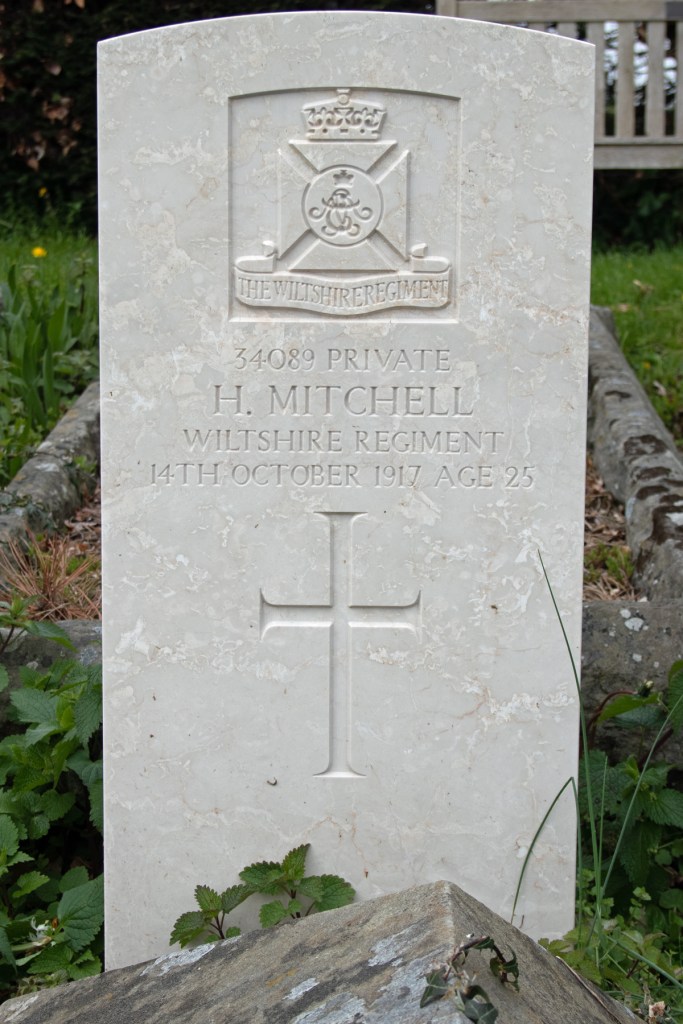
Full details of Henry’s military service are lost to time, but from his gravestone it is clear that he enlisted in the Wiltshire Regiment as a Private. From other documents it is possible to determine that he joined up by April 1917, and that he did not serve overseas. Instead, while his battalion – the 1st – fought at the Somme, Messines and Ypres, Private Mitchell was assigned to the regiment’s depot.
Henry seems to have been based in London, and he was certainly here in the summer of 1917. He was admitted to a hospital in Bethnal Green, and it was here that he breathed his last. He died on 14th October 1917, through causes unknown. He was just 25 years of age.
Henry Mitchell’s body was brought back to Somerset for burial. He was laid to rest in the family plot in the graveyard of the Blessed Mary Church in his home village of Saltford.
Sidney Goddard was born on 2nd January 1889 in the village of Oldland Common, near Bristol. The youngest of three children, his parents were Albert and Frances Goddard. Albert was a shoemaker, but by the time of the 1911 census, he and Frances had set up home in Saltford, between Bristol and Bath, where he was recorded as being a bootmaker and innkeeper at the village’s Jolly Sailor.
Sidney, by this time, had gone his own way. On 17th January 1917, he enlisted in the Royal Navy as a Stoker 2nd Class. His service records note that he had been working as a collier when he joined up, so it seemed that coal ran through him. The same records note that Sidney had dark brown hair, brown eyes and a fresh complexion. He was also recorded as being was 5ft 5.5ins (1.66m) tall, and having a number of tattoos: a true lovers’ knot on his left wrist, several dots on his left arm. He had three dots on his right arm, a scar on his back and another on the inside of his left shin.
Stoker Goddard was initially sent to HMS Vivid, the Royal Naval Dockyard in Devonport, for training. After a couple of months he was assigned to the cruiser HMS Amphitrite. It is evident that Sidney showed promise, because he was promoted to Stoker 1st Class on 22nd April, just three months after he enlisted. He returned to Devonport in May, but this was only to change assignments: he boarded HMS Blake, another cruiser, a few days later.
Over the next eight years, Stoker 1st Class Goddard served on five further vessels, returning to HMS Vivid in between assignments. On 1st July 1915, he was assigned to the newly commissioned minesweeper HMS Larkspur. In November that year, she came into Merklands Wharf in Glasgow.
[Sidney] met his death while assisting in docking his ship at Glasgow on the afternoon of Wednesday, November 3rd. By some mischance he was thrown into the dock, and in falling his head struck either on the boat’s side or on the dock. It is believed that he was rendered unconscious by the blow, as otherwise, being a good swimmer, he would have been able to keep afloat till help came.
Bath Chronicle and Weekly Gazette: Saturday 13th November 1915
Stoker 1st Class Sidney Goddard was just 26 years of age when he died. His body was brought back to Somerset for burial. He was laid to rest in the peaceful graveyard of St Mary’s Church, Saltford, within walking distance from the Jolly Sailor, where his parents still lived.
Sidney has the dubious honour of being the only member of HMS Larkspur’s crew to die during the First World War. His two older brothers also served in the conflict, Maurice in the Royal Marines and William, who was a Leading Seaman on board HMS Spitfire when he was killed during the Battle of Jutland.
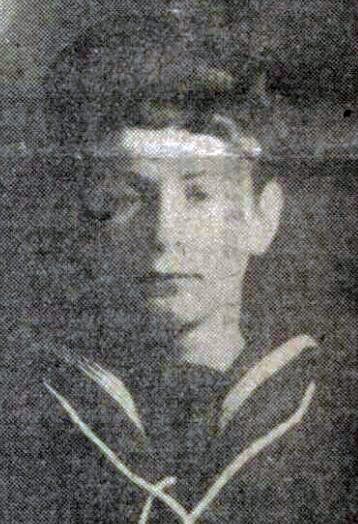
Stoker 1st Class Sidney Goddard (from britishnewspaperarchive.co.uk)
Charles Edward Fernley was born on 28th November 1874 in Stepney, East London. One of thirteen children, his parents were Richard and Eliza Fernley. Richard was a sluice keeper, who worked his way up to be an inspector of sewers and drains for London County Council. By 1888, he had been able to move his family out of the East End, to suburban Bromley, south of the river in Kent.
By the time of the 1891 census, Charles had finished his schooling, and had found work as a printer’s labourer. Ten years later, however, he was employed as a packer for a millinery warehouse. There seems to have been more need for this back in the East End, however, as he was living in Bow in the summer of 1901.
On 21st August 1901, Charles married Hannah Weston in St Faith’s Church, Stepney. She was three years younger than her husband, and was the daughter of a boatbuilder. The couple settled in a small terraced house in East Ham and had a son, Leonard, who was born in 1908.
When war came to Europe, Charles was keen to play his part. He enlisted in the Essex Regiment, and was assigned to the 1st/4th Battalion. Sent to the Balkans in August 1915, it is likely that he was caught up at Gallipoli and, in December 1915, evacuated with his battalion to Mudros on the Greek island of Lemnos.
By this point, the now Corporal Fernley had contracted dysentery, and was repatriated to Britain for treatment. He was admitted to the Newton Park VAD Hospital on the outskirts of Bath, but was to succumb to the condition on 31st December 1915. He was 41 years of age.
Charles Edward Fernley was laid to rest in the quiet Holy Trinity Churchyard in Newton St Loe, Somerset.
While Charles’ headstone is dedicated to Sergeant Fernley, all other documentation suggests that he held the rank of Corporal when he died.
Walter Frederick Lane was born in Sidcup, Kent, in the early part of 1893. The younger of two children, his parents were Frederick and Caroline Lane. Frederick was a carman and the transient nature of his work meant that the family moved on a regular basis.
The 1901 census found them in Eltham, Kent, while ten years later the family of three – Walter’s older sister having moved on – were boarding in Harton Street, Deptford. By this point, Walter was 17 years of age, and he was also working as a carman. (It is interesting to note that the earlier census recorded Walter’s parents by their first names, while the 1911 document used their middle names – Walter and Kate: transient work allowing for reinvention, perhaps?)
Walter sought a more permanent career, and, on 17th March 1913, he enlisted in the army. Full details of his military career have been lost to time and, in fact, most of his service details come from his discharge papers.
Walter enlisted in the Queen’s Own (Royal West Kent Regiment), although, as Private Lane, he was not formally mobilised until March 1914. When war broke out, his battalion, the 1st/5th, was sent to India, and he remained there for the duration of the war.
Private Lane’s time in the army was not without incident. He contracted malaria in 1915, and while he initially recovered, the condition was to continue to dog him over the following years.
By 1917 Walter’s troop was based in Jabalpur, Madhya Pradesh, but in December that year, the battalion set sail from Bombay for Basra, Mesopotamia.
While in Iraq, he had a couple of run-ins with his superiors. On 22nd December 1917 he was stopped a week’s pay for ‘disobeying an order: putting his equipment on a transport waggon’ and ‘losing by neglect his equipment.’ On 18th February 1918, a further 28 days’ pay was deducted for ‘making away with regimental necessaries (1 towel)’ and ‘neglecting to obey an order.’
During this time, though, Walter’s health was regularly impacted when malaria caught up with him. His discharge documents recorded that he had an attack about once a month, which lasted four or five days each time. In the end, he was released from active service, and left the army on 19th February 1919.
Walter had been discharged while admitted to the Dispersal Hospital in Brighton. His health did not improve, however, and he was soon moved to Somerset for respite care. It was here that he passed away on 7th August 1919. He was 26 years of age.
Walter Frederick Lane was laid to rest in the Holy Trinity Churchyard, Newton St Loe, Somerset.
My thanks go to Liz at the local parish office for her help in unpicking the details of Walter’s passing.
Thanks also go to Tim Hill, who has been researching the graves in the Newton St Loe churchyard.
On Monday the body of a man was found.. neat Newton Bridge, commonly known as the “Skew” Bridge, having been killed by a passing train… The deceased was Frank Gilbert…
The inquest was held at the Globe Inn, Newton… by the Coroner for North Somerset (Dr S Craddock), who sat without a jury.
The first witness… said the previous morning he was walking along the railway when he saw the body of a man lying on the down side. The head was separated from the body…
PC Cornish said he found four cards in the pockets of the deceased’s coat. Two were National Insurance cards, and there was an unemployment book, the last payment being dated 15-8-21.
Written on the blotting paper of the book was the following:
“It is quite dark. You still take you neck oil, and my children outside waiting. Marry the man who gave you the watch. Don’t forget to have an extra one (Guinness) over my parting. It would be murder if I ever lived with you again.”
The man’s name, “Frank Gilbert, 44 Jubilee Road, Aberdare,” was on some of the cards. Deceased was wearing a discharged soldier’s badge.
Sarah Kate Gilbert, wife of the deceased, who lives at Bristol, said she had not known her husband’s address at Aberdare. They had been living apart since he went into the Army in 1915. She had, however, met him since that date.
Witness added that she saw him on Sunday night, and went on to say that she took out a summons for a maintenance order against him last February at Gloucester. He was then working as a carpenter in Cheltenham.
The Coroner: ‘Have you ever heard him threaten to commit suicide?’
‘Yes, sir.’ She added that he did so on Sunday night when she was with him at the bottom of Park Lane, Bath. “He was always threatening me when we lived together,” she stated, and also said she had a separation order in Bath in 1913. She had a letter from him on Saturday morning in which he said that when she got the letter he would be gone. In the letter was enclosed the ticket for his suit-case, and the key.
[The letter read] “I would never dream of making a home for you as you are worth only the Gloucester man. You have ruined my life, and you will be able to sleep with… for always now. I shall be gone.”
Witness said there was no reason for him to have made any such statements, as she had had nothing to do with any man except him. He was always using threats. When she left him on Sunday night she told him to try and get on and pull himself together.
The Coroner recorded a verdict that deceased committed suicide by placing himself in front of a passing train on the Midland Railway.
Somerset Guardian and Radstock Observer: Friday 2nd September 1921
Little additional concrete information is available for Frank Gilbert’s life. No marriage certificate remains for his wedding to Sarah, nor is there any evidence for the couple in the 1911 census.
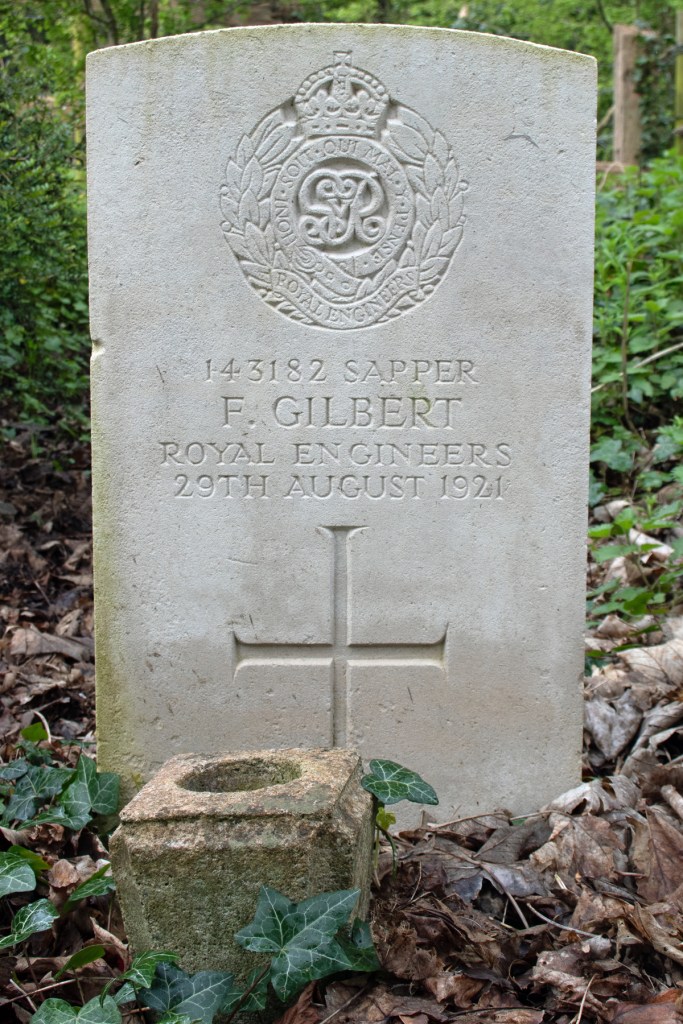
Frank’s service records no longer exist in their entirety, although his pension record give hints as to his service. He enlisted in the Royal Engineers as a Sapper on 20th November 1915, although he never saw any action overseas. He was medically discharged because of rheumatism on 11th November 1917. The document confirm he was born in 1883, and lived in Cheltenham after his discharge.
An additional newspaper report of the inquest confirmed that Sarah had two children, and that they lived with her parents in Bath. When asked by the Coroner if she intended to bury her husband’s remains, she replied that “she had no money to do it with.” [Bath Chronicle and Weekly Gazette: Saturday 3rd September 1921]
And so Frank Gilbert was laid to rest in the quiet graveyard of Holy Trinity Church in Newton St Loe, near Bath in Somerset. He was around 38 years of age when he took his life.
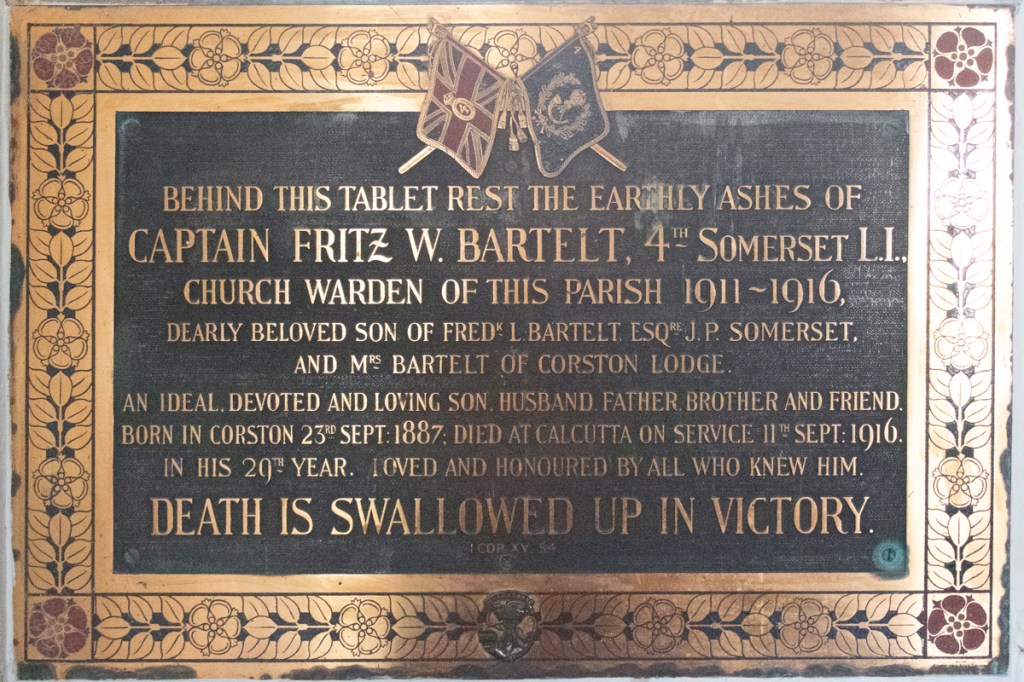
Friedrich Wilhelm Bartelt was born on 23rd September 1887 in the Somerset village of Corston. He was the younger of two children to Friedrich and Rosanna Bartelt. Born in Prussia, Friedrich Sr was an import and export merchant of oil and chemicals, who had become a magistrate and chemical manufacturer by the time of the 1901 census.
Friedrich Jr – who was also known as William or Fritz, to avoid confusion with his father – had the upbringing to be expected for the son of a prominent businessman.
He was educated first at St Christopher’s, Bath… and afterwards at Bath College, which he entered in September, 1900, and left in December, 1904. He was prominent in sport and as in the school Rugby Fifteen in 1903 and 1904, and a member of the Cricket Eleven in the summers of 1903 and 1904, and was in the second rowing four in 1904. He subsequently studied chemistry… at Bristol University College, and after a time he became a director in the company of which his father is chairman.
Somerset Guardian and Radstock Observer: Friday 15th September 1916
Fritz enlisted in the Somerset Light Infantry not long after finishing his studies, becoming a Lieutenant in H Company of the Volunteer Battalion, before taking command of G Company. Possibly because other pressures took priority, he stood down from his role in 1911.
On 2nd June 1910, Fritz had married Gertrude Isgar, a gentleman’s daughter from Bathwick, near Bath. The couple went on to have two children, both boys.
[Fritz] was a churchwarden of Corston, and always took a keen interest in all parochial matters, and his loss is very keenly felt in the village. Always kind and genial to all alike, he won the hearts of all with whom he came in contact. His readiness to help, his careful attention to the needs of those around him, and his kindly words and acts will dwell long in the memory of many in Corston.
Somerset Guardian and Radstock Observer: Friday 15th September 1916
When war was declared in 1914, Fritz stepped up to play his part, and was given the commission of Captain in the 2nd/4th Battalion of his old regiment, the Somerset Light Infantry.
On December 1, 1915, he sailed for India, when he took charge of his company, and was afterwards given an important post, being appointed in command of his station at Barrackpore [Barrackpur].
Somerset Guardian and Radstock Observer: Friday 15th September 1916
Captain Bartelt fell ill in the summer of 1916, and was admitted to a hospital in neighbouring Kolkata. While his condition is not reported on, he seemed to have been improving, but his health then took a downward turn, and he passed away while still admitted, on 11th September 1916. He was 28 years of age.
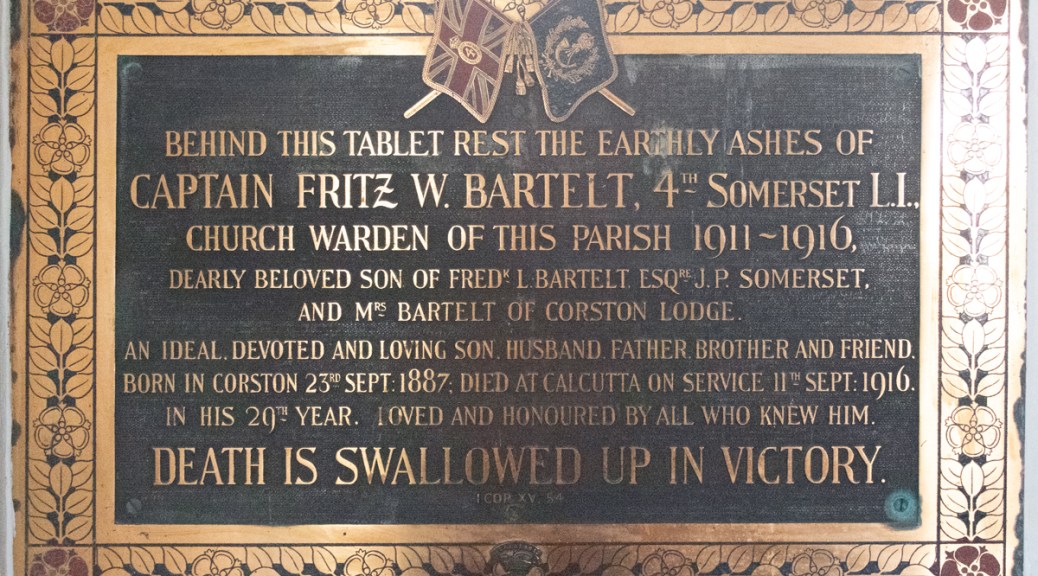
Fritz William Bartelt’s body was cremated in India. His ashes were returned to England, and were interred in All Saints’ Church in his home parish, Corston, where a plaque and a stained glass window are dedicated to his memory.
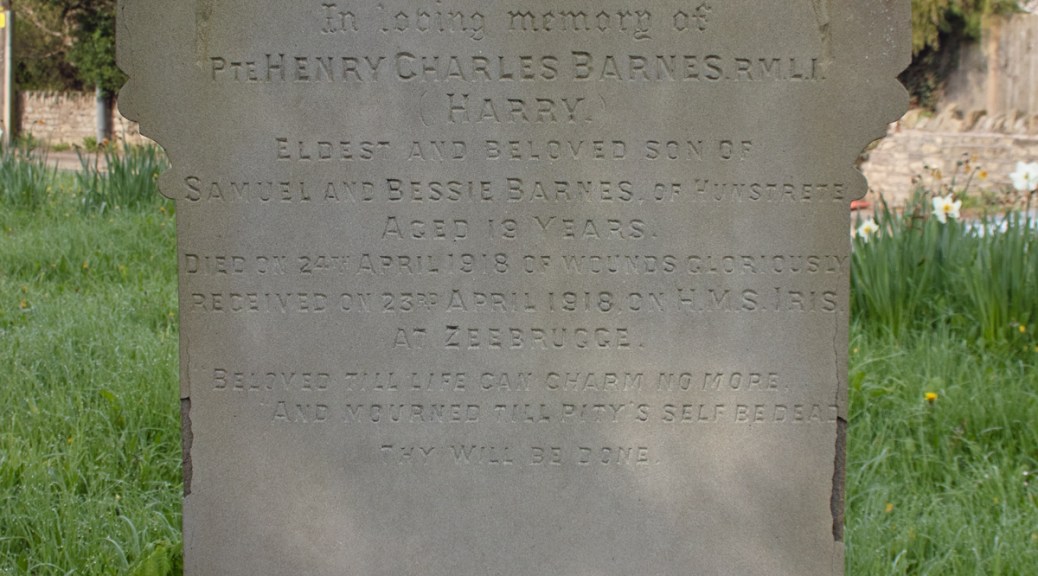
Hunstrete, Pensford was plunged into sorrow, not unmixed with pride, when is became known that one of its lads Pte. HC Barnes, RMLI… had played a hero’s part in the now famous Zebrugge raid, where he was severely wounded in the head and shoulder, from which wounds he subsequently succumbed in Chatham Naval Hospital. Before joining up at the age of 17 years and two months he was employed to look after the famous poultry of Mr HLF Popham, of Hunstrete House, taking all the honours at the Crystal Palace during one show. He was first sent to Salonika but was invalided home with malaria and was on board the Iris during the raid. The deceased lad, who was 19, was brought home and his body laid to rest at St Peter’s, Marksbury.
Somerset Guardian and Radstock Observer: Friday 10th May 1918
Henry Charles Barnes was born on 5th December 1898 in the Somerset village of Hunstrete. Also known as Harry, he was the oldest of six children to coal hewer Samuel Barnes and his wife Elizabeth, who was better known as Bessie.
After his recovery from malaria, Private Barnes was assigned to HMS Iris, a Mersey ferry requisitioned by the Royal Navy for support in the planned raid on Zeebrugge.
On 23 April 1918, Iris was towed across the English Channel to Zeebrugge by HMS Vindictive; she was carrying a couple of platoons of the 4th Battalion of the Royal Marines as a raiding party. When the Vindictive neared Zeebrugge she cast the ferry aside. Iris tried to pull up to the breakwater under heavy fire in order to off-load the raiding parties which were on board. She sustained heavy fire and a shell burst through the deck into an area where the marines were preparing to land. Forty-nine men were killed, while others, including Harry, were badly injured.
Medically evacuated to Britain, Private Barnes was admitted to the Royal Naval Hospital in Chatham, Kent, but his injuries were too severe, and he died on the day after the raid.
Henry Charles Barnes was laid to rest in the graveyard of St Peter’s church in Marksbury, the parish church for the family’s home in neighbouring Hunstrete.
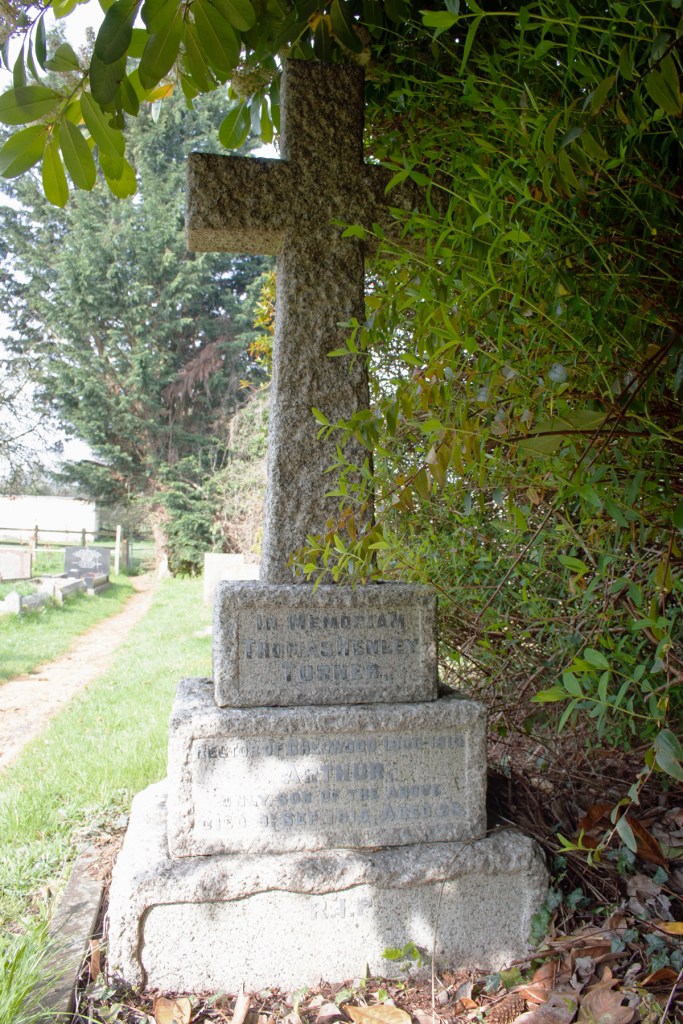
Arthur Turner was born in East Brent, Somerset, in the spring of 1892. The younger of two children to Thomas and Lucinda Turner, his older sister had passed away while Lucinda was pregnant with him. Thomas was a vicar for the Church of England, and baptised both children, although the records suggest that he did not lead his daughter’s funeral service.
In 1900, the Turners had moved on to a new parish, setting up home in the rectory in Chelwood, to the south of Bristol. They settled in well, and Thomas remained vicar of St Leonard’s Church there until the summer of 1914, when he passed away after a short illness, at the age of 64.
Conflict had not long darkened Europe by this point, and Arthur felt compelled to play his part. Full details of his military service are not available, but records suggest that he had enlisted in the Gloucestershire Regiment by March 1915.
Assigned to the 12th (Service) Battalion, Private Turner was sent north for training. Billeted in a camp in Wensleydale, North Yorkshire, Arthur would have moved south to Salisbury Plain with his troop, had he not fallen ill. He was admitted to a hospital in Darlington, in neighbouring County Durham, suffering from typhoid. The condition was to get the better of him, and he passed away on 9th September 1915. He was just 23 years of age.
Arthur Turner was brought back to Somerset for burial. He was laid to rest in the family plot in St Leonard’s Churchyard, Chelwood, alongside his father, Thomas.
Whatever her late husband’s calling, Lucinda’s own faith must have been strong. Having lost her eldest child young, she then stood witness to the burials of her husband and son within eighteen months.
The 1921 census recorded Lucinda living with her sister, Charlotte, in Bromley, Kent. Eighteen years later, the 1939 Register found her back in Somerset, where she was living in Clutton, providing support and companionship to Letty Collinson, a retired kindergarten mistress.
Lucinda passed away in March 1942, at the age of 88 years old. She was brought back to Chelwood, and buried alongside her husband and son, the family reunited at last.
Melville Franklin was born on 25th November 1890, the youngest of seven children to Edmund and Alice Franklin. Edmund had been born in Birmingham, and had taken up holy orders. He and Alice married in the UK, but their first born, a boy called Victor, had been born in Australia, while their second child, another son called Harold, had been born a year later in Birmingham.
By the late 1880s, Reverend Franklin had taken up the post of vicar of St Nicholas’ Church in Whitchurch, near Bristol, and the family moved there. Unsurprisingly, the parish record for both Melville and his older sister Elsie, both of whom had been born in the village, shows they were baptised in the church by their father.
The Franklin children’s upbringing stood them in good stead in life. The 1901 census found that Victor and Harold had both found work as clerks – Victor for a timber merchant, and Harold for an oil cake merchant – while the following census, in 1911, recorded that another brother, Percival, was a motor expert for an insurance company. Melville, aged 20 by this point, had also found employment as a clerk, his employer being a wine merchant.
Melville wanted to expand his horizons further and, on 25th February 1911, he joined the Royal Naval Volunteer Reserve. His service records are sparse, but they confirm that he was 6ft 1ins (1.85m) tall, had fair hair, grey eyes and a fresh complexion.
Melville was formally mobilised on 22nd August 1914. At this early point in the war, there was a surplus of more than 20,000 men from the Royal Naval Volunteer Reserve, and the powers that be recognised that this was enough to form three brigades of land troops – one of Marines and two Naval.
Able Seaman Franklin was assigned to the Collingwood Battalion of the Royal Naval Division, and appears to have found himself heading to Belgium via Dunkirk by the late summer.
In the general rush to get men to the front line, more than three quarters of the troops went without even the most basic of equipment – packs, mess tins, water bottles.
The Division had no artillery, field ambulances or other support. Melville’s brigade was provided with old rifles, which they were given just three days before embarking for Europe.
Able Seaman Franklin landed in Antwerp shortly before the German invasion, and in the retreat, more than 1500 troops were captured and interned in the Netherlands. Melville, it would seem, was one of those who managed to escape back to England.
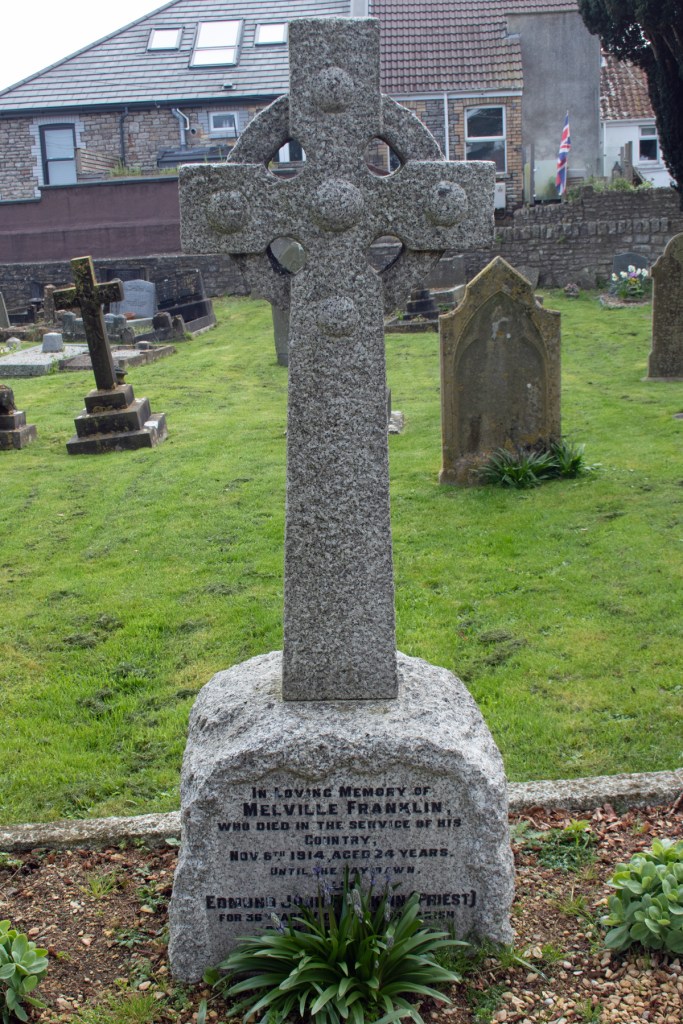
This was only to be a very temporary reprieve for Able Seaman Franklin, however. He had returned to Bristol, but had contracted enteric fever, also known as typhoid. This was to get the better of him, and he succumbed to it on 6th November 1914. He was weeks away from his 24th birthday.
Melville Franklin was laid to rest in the graveyard of St Nicholas’ Church, Whitchurch, in a funeral likely to have been presided over by his father, Edmund.
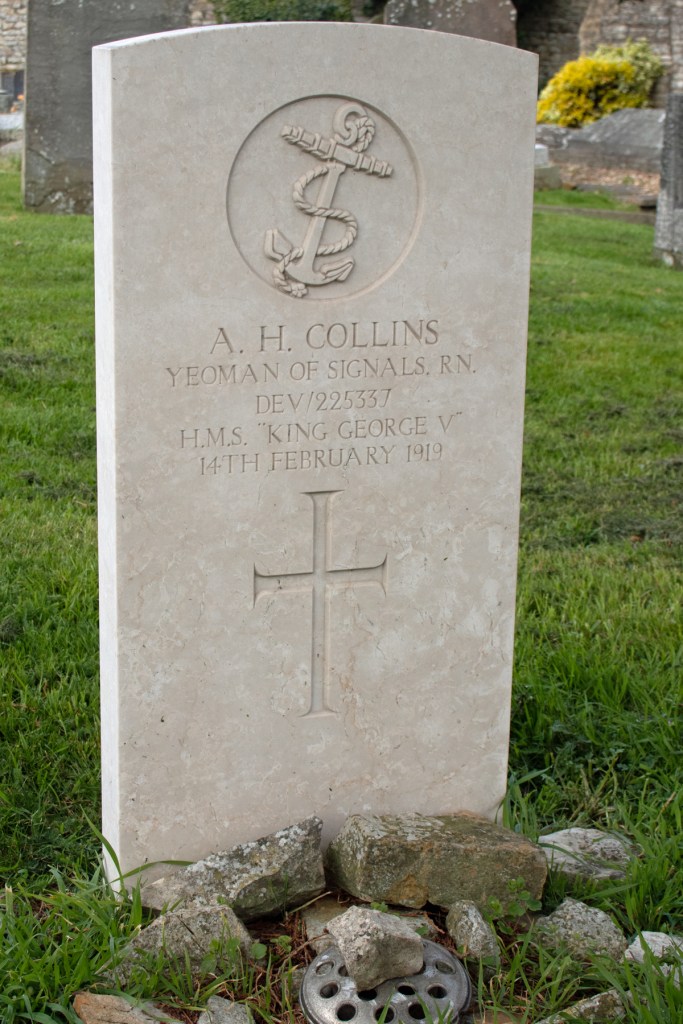
Alfred Henry Collins was born on 22nd August 1886, in the Gloucestershire village of Wotton-under-Edge. One of five children, his parents were cowman and farm labourer Samuel George Collins and his wife, Jane. Samuel’s work took the family south, and by the time of the 1901 census, the Collinses had settled in Whitchurch, near Bristol.
When Alfred finished his schooling, he also found employment labouring on a farm, but he was drawn to a more reliable career and a life at sea. On 9th March 1903, Alfred enlisted in the Royal Navy. His service records show the young man he was becoming. He was 5ft 4ins tall, with brown hair, brown eyes and a fresh complexion.
Alfred was still underage in the navy’s eyes, and so he was given the rank of Boy 2nd Class. He was assigned to HMS Northampton, a training ship, and must have shown some promise, as within three months he had been promoted.
In June 1903, Boy 1st Class Collins was assigned to HMS Victory, the Royal Naval Dockyard in Portsmouth, Hampshire, and his trajectory was still upwards. When he turned seventeen on 22nd August, Alfred was formally enrolled in the Royal Navy, and was given the rank of Ordinary Seaman. However, his training in Portsmouth continued, and by November he had become a Signalman.
In December 1903 he was posted to the cruiser HMS Isis and, over the next decade he served on ten different ships, returning to HMS Vivid, the Royal Naval Dockyard in Devonport, in between voyages. During this time he was promoted to Leading Signalman, and his annual reviews showed him as having a very good character and a superior ability.
With war now brewing across Europe, the role of the navy intensified. When conflict was declared, Leading Signalman Collins was serving on board the cruiser HMS Pomone and, after nine months back at HMS Vivid, possibly in a training role, Alfred was assigned to the newly-refitted battleship HMS Bellerophon, on board which he would serve for more than two years.
Bellerophon served at the Battle of Jutland, and remained patrolling the southern part of the North Sea for the rest of the war. In July 1917, Alfred was promoted again, to Yeoman of the Signals, and transferred to HMS King George. He remained in the North Sea, but his new ship was there to protect the convoys transporting good between the UK and Norway, so he was based in Scotland.
Yeoman of the Signals Collins survived the war, but in February 1919 he was admitted to the Royal Naval Hospital in Granton, near Edinburgh, suffering from pneumonia. Sadly, the condition was to get the better of him and he died on 14th February 1919, at the age of 32 years old. He had served for just short of sixteen years.
The body of Alfred Henry Collins was brought back to Somerset for burial. He was laid to rest in the graveyard of St Nicholas’ Church in Whitchurch.











 Death and Service