Frederick Charles Evelyn Liardet was born in Brighton, now a suburb of Melbourne, Australia, in 1888, and the eldest son of Wilbraham and Eleanor Liardet.
There is little further information about Frederick’s early life, but, when war broke out, he wanted to play his part for King and Country, and enlisted in the Devonshire Regiment.
He had an adventurous career… Having been twice wounded while on active service in France, he was appointed an instructor in the Balloon Section of the Royal Flying Corps.
Exeter and Plymouth Gazette: Tuesday 18th December 1917
On 23rd October 1915, Frederick married Kathleen Norah Liardet in Highweek, Newton Abbot, Devon. She was the daughter of a retired Lieutenant Colonel in the Royal Marine Light Infantry, and may have been a cousin (while their surname is unusual enough for there to be a connection, I have been unable to identify a specific connection). The couple went on to have a daughter, Barbara, who was born in 1917.
In 1916, while on a night flight with the Royal Flying Corps, the now Lieutenant Liardet was involved in an accident and badly injured. He returned to England to recover, he and Kathleen living with her family. While his health initially improved, he relapsed and passed away on 13th December 1917, aged just 29 years old.
Frederick Charles Evelyn Liardet was laid to rest in the graveyard of All Saints Church in his adopted home of Highweek, Devon.
Alan Edward Lloyd was born in around 1899, the second of five children – all boys – to William and Edith Lloyd. Both of his parents were Welsh, and his older brother was born in Cardiff. Railway clerk William moved around the country with work, however, and Alan was born in Lydney, Gloucestershire, his younger brother in Paddington, London, and his two youngest siblings were born in Windsor, Berkshire.
There is little information about Alan’s early life; what is clear is that, by the autumn of 1918, he had been in the army, reaching the rank of Lieutenant. He transferred across to the newly formed Royal Air Force and, in December that year was training as a Flight Cadet at Shotwick Airfield near Chester.
On the 4th December, Alan was flying his Sopwith Camel, when he got into a flat spin; the aircraft crashed and Alan was killed. He was just 19 years old.
Alan Edward Lloyd was brought to Devon – where his family were now living – for burial. He was laid to rest in the graveyard of All Saints Church in Highweek, near Newton Abbot.
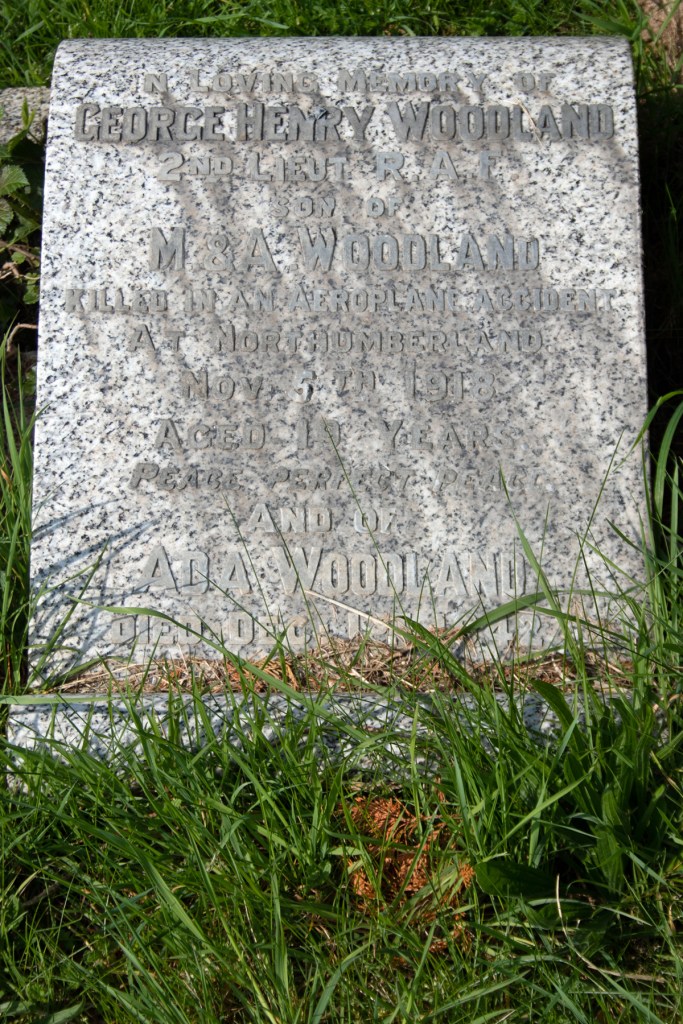
George Henry Woodland was born on 9th June 1899, and was one of six children – three boys and three girls – to Mark and Ada Woodland. Mark was a hewer in a coalmine in Radstock, Somerset, and this is where the family were raised.
George – who was better known as Harry – was still at school when war broke out. He had been taught at the Church of England School in his home town, before winning a scholarship to Shepton Mallet Grammar School. Having passed his exams there, he was taken on as a member of staff at his former school, before joining the army in June 1917 when he turned eighteen.
Initially joining the Infantry Training Reserve, Harry was subsequently transferred to the Royal Air Force. After training in Yorkshire for five months, he was transferred to the 52nd Training Depot Station at Cramlington Airfield in Northumberland.
Second Lieutenant Woodland returned home on leave in October 1918. This was the first time that he and his two brothers had been together since war had been declared – one had been serving in France, the other had been injured and was recuperating at a hospital in Bristol. Harry returned to Northumberland on 14th October.
On 5th November 1918, Harry was flying at the Cramlington base; shortly after take off, while carrying out a flat turn at a height of about 100ft, his aircraft stalled and nosedived, catching fire on impact. Tragically, Second Lieutenant Woodland and his passenger – Air Mechanic Ryder – were burnt to death. Harry was just 19 years of age.
George Henry “Harry” Woodland was brought back to Somerset for burial. He was laid to rest in the family plot in the graveyard of St Nicholas’ Church in his home town of Radstock.
Second Lieutenant George Woodland (from britishnewspaperarchive.co.uk)
James Sanders was born on 17th April 1889. One of nine children, his parents were William and Emily Sanders. William worked for a clay company in his home town of Kingsteignton, Devon. He had various roles, including caretaker, inspector and messenger.
William’s son, however, was after bigger things in life and, on 17th July 1907, he enlisted in the Royal Marine Light Infantry. James’ service records show that he was 5ft 6ins (1.67m) tall, had light brown hair, grey eyes and a fresh complexion.
Based out of Plymouth, Private Sanders signed up for an initial period of twelve years. During this time, and throughout the war, he served on six vessels, including 30 months on HMS Argyll (where he was based for the 1911 census) and more than five years on HMS Colossus.
In April 1919, Private Saunders returned to land. When his initial contract was up, he re-enlisted, this time remaining at the Naval Dockyard in Plymouth.
James’ trail goes a little cold for the next couple of years, although he continued in his role with the Royal Marine Light Infantry. On the night of the 28th March 1921, however, he encountered some trouble. The local newspaper reported on the subsequent inquest.
Kingsteignton Man’s Mysterious Death
At an enquiry held at Teignmouth on Saturday afternoon into the circumstances attending the death of Private James Sanders, RMLI… who was found drowned in the river Teign on Friday, it was stated that deceased and seven other Kingsteignton men on Monday visited Teignmouth to attend a football match, at which Sanders acted as touch-judge.
After the match they went to a public house, where deceased had three or four pints of beer and some spirits, which made him unsteady.
They left to catch a bus, but at Station Road deceased turned back. One of his companions followed him, but could not persuade him to return, so he left deceased on his own to travel back home.
The man considered Sanders was in a condition to look after himself. An open verdict was returned.
Wester Times: Friday 8th April 1921
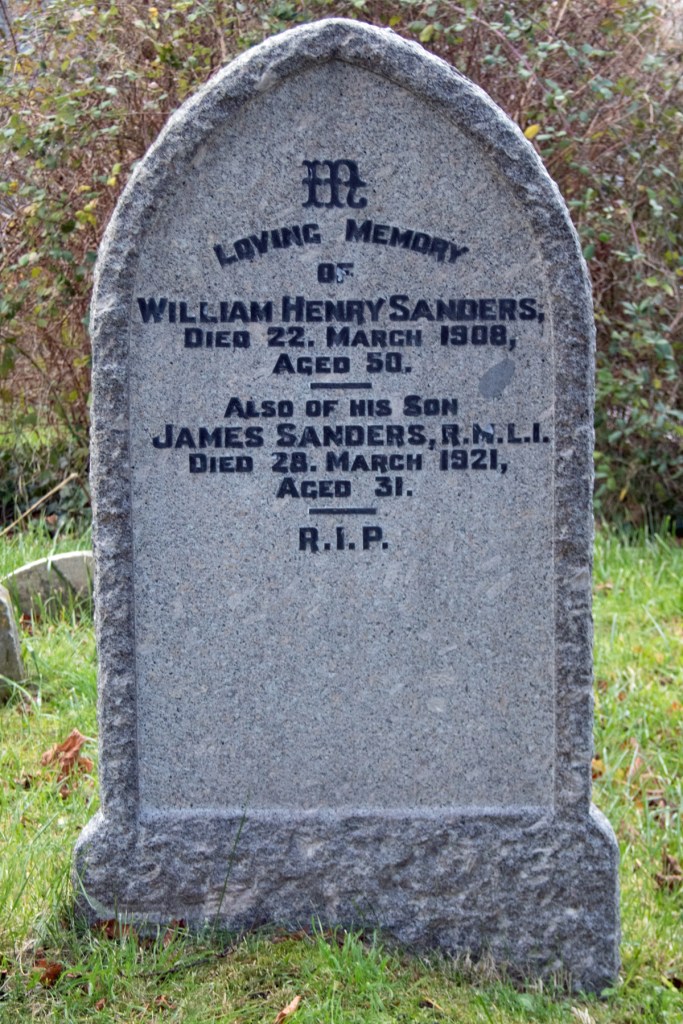
Private James Sanders died on 28th March 1921, aged 31 years old. He was laid to rest with his father, William, who had died in 1908, in the graveyard of St Michael’s Church in Kingsteignton.
James Valentine McDowell was born in Ashburton, Devon, on 2nd January 1865. He was one of eight children to William and Louisa McDowell. William was a labourer, and this was a trade that James also took up when he left school.
In the summer of 1884, James was brought up to the Devon Assizes in Exeter, on the charge of attempted suicide. A local newspaper reported that:
It appeared that on June 13th the prisoner, fully dressed, was seen lying at full length in the Yeo, his head resting on a stone, but the remainder of his body was under water. The stream, however, was but three feet deep and six feet wide at this particular point, so the actual danger was not very great.
A witness seeing the position of the prisoner called upon him to come out of the water. He did so. He was very drunk. On leaving the Yeo, the prisoner proceeded towards the Dart, and on his way wished the witness to bid his father and mother good bye. Arrived at the Dart the prisoner attempted to throw himself into the water, but was prevented and handed over to the police.
When in custody the prisoner said this was the second time he had been in the water: next time should be more lucky. Subsequently, however, he stated that he only went to the Yeo for a wash, and this statement he now repeated.
The jury returned a verdict of not guilty, and his Lordship, in discharging the prisoner, advised him next time he wanted a bath not to get drunk beforehand, or he might find himself in deeper water than that in which he was discovered on the present occasion.
Western Times: Saturday 26th July 1884
The same Assizes saw trials for embezzlement, horse stealing, larceny, stack-burning and endeavouring to conceal the birth of a child. The alleged perpetrator of a count of buggery was found not guilty (his alleged offence not named in the same newspaper), while a Henry Davy, 51, was sentenced to 18 months’ hard labour for indecently assaulting a 6 year old girl.
The following year found James back on track. He married local woman Mary Ellen Ellery; the couple set up home in Ashburton and went on to have seven children. The family settled into a routine – James worked as a mason’s labourer; in his spare time, he joined the 3rd Devon Militia. His and Mary’s daughters found work as wool spinners, while their sons also got into labouring work.
War came to Europe in 1914; despite his age, James wanted to play his part. He enlisted when the call came, joining the Royal Engineers as a Pioneer on 19th August 1915. Within a week he was sent to France, and this is where he stayed for the duration of the war.
Pioneer McDowell returned to England on furlough on 2nd February 1919, and was waiting to be demobbed. However, tragedy struck before that became a reality, the same newspaper picking up the story some thirty-five years later:
An Ashburton man named James McDowell, aged about 56 years, a private in the Royal Engineers Labour Battalion, who joined up in August 1915, and had been in France continuously since that time, was found drowned in the mill leat of the the River Yeo at the rear of the cottages in Kingsbridge-lane early on Saturday morning.
He left his home at Great Bridge about 8:30 on Friday night for a short time. To get to the town he had to pass along by the river, which was running very high through the recent heavy rain, and it is supposed that he must have fallen in and had been washed down to where he was found, which was a considerable distance.
He had been demobilised, and was on furlough, and every sympathy is expressed for the family on their sad loss. Dowell [sic] who was well known and was of a jovial disposition, leaves a widow and grown up family.
Western Times: Monday 24th February 1919
Later that week, a summary of the inquest was printed:
Dr EA Ellis said he found a ragged cut over deceased’s left eyebrow, but otherwise there was no sign of violence. The cut was inflicted before death. A post mortem revealed that the cause of death was drowning. His theory was that deceased fell into the river, his head coming into contact with a stone, which inflicted the wound and caused unconsciousness. The spot where the accident was supposed to have happened, he thought, was unsafe and dangerous.
…the jury returned a verdict that the deceased was found drowned, caused by accidentally falling over the wall at the top of North Street… and they wished… to call the attention of the responsible authorities to the danger at this spot, and to the unsatisfactory state of the lighting there.
Western Times: Friday 28th February 1919.
Pioneer James Valentine McDowell drowned on 21st February 1919: he was 56 years of age. His body was laid to rest in the graveyard of St Andrew’s Church in his home village.
John Eric Jackson-Barstow was born on 10th August 1895, and was one of seven children – and the only boy – to John and Mary Jackson-Barstow. John Sr was a Justice of the Peace from Yorkshire, who had moved his family to Somerset in the early 1890s; this is where John Jr and his sisters were born.
When war broke out, John Jr enlisted as a Trooper in the North Somerset Yeomanry and, by the autumn of 1914, he was moved to France.
On the outskirts of Ypres, his regiment were involved in a prolonged attack by German forces and Trooper Jackson-Barstow was injured. Medically evacuated to England, he received a commission and was given the role of aide-de-camp to a general based on the East Coast.
In 1917, Captain Jackson-Barstow transferred to the Royal Flying Corps – later moving to the newly-formed Royal Air Force. Over the following months, he regularly flew sorties across France and did extensive piloting in English skies.
Captain Jackson-Barstow continued in his role when the Armistice was signed. On 27th January 1919, he was flying in Surrey; it was snowing heavily, which limited what he could see. Flying low, he crashed into a hill near Oxted, and was killed instantly. He was just 23 years of age.
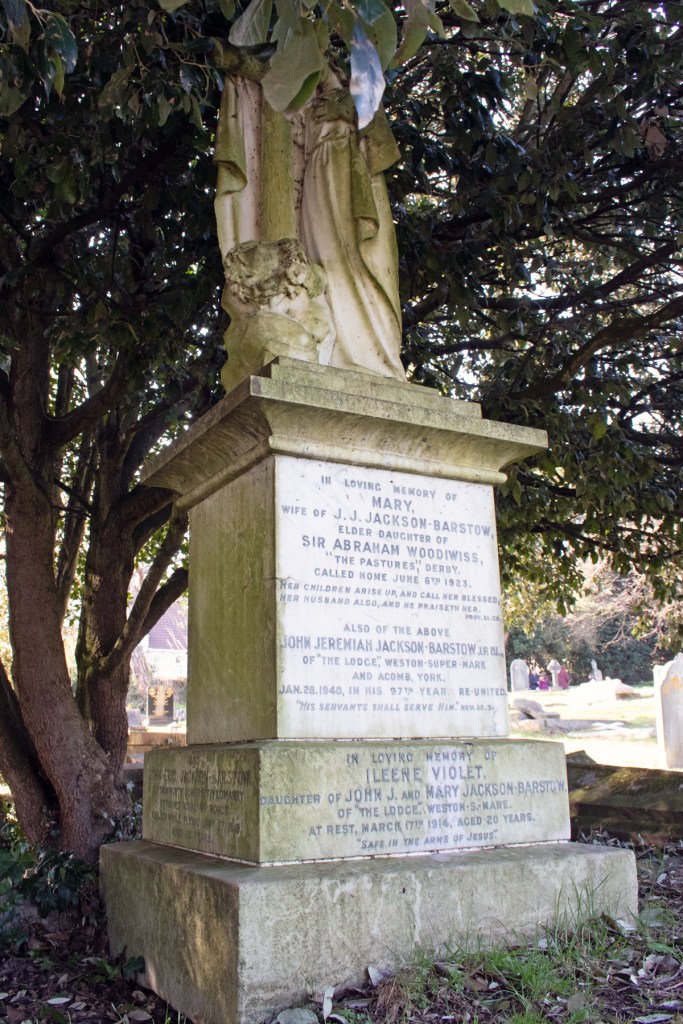
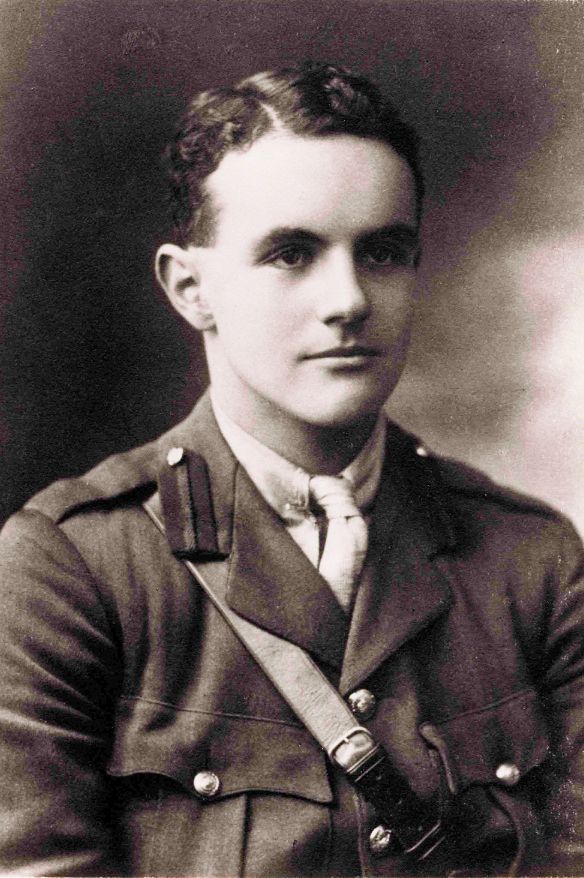
John Eric Jackson-Barstow’s body was brought back to Somerset; he was laid to rest in the family grave in the Milton Road Cemetery in Weston-super-Mare.
Captain John Jackson-Barstow (from findagrave.com)
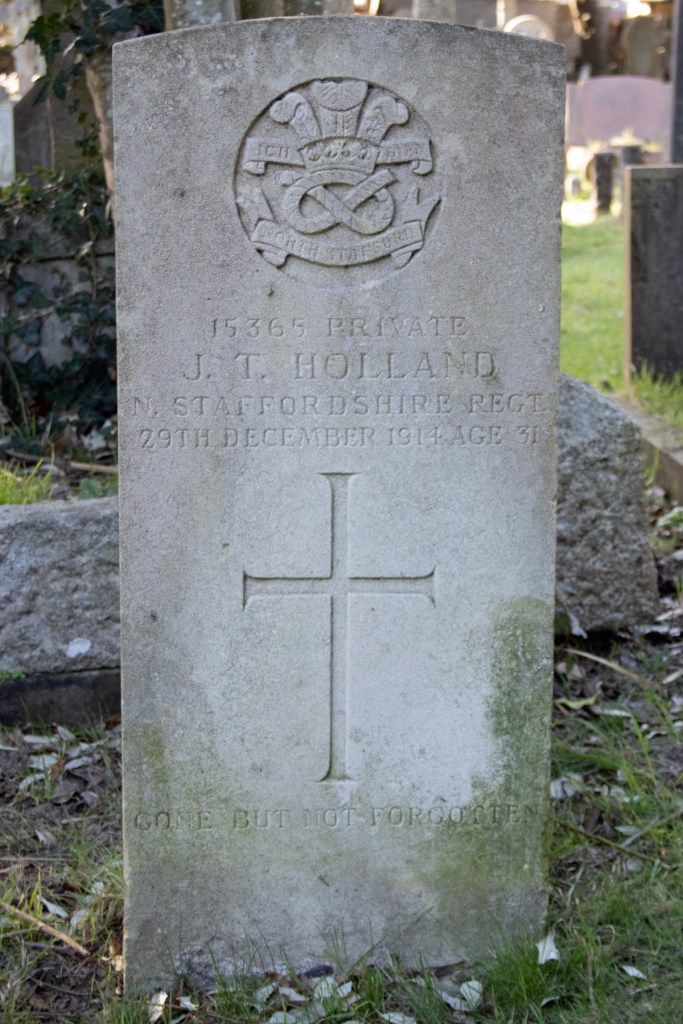
John Thomas Holland was born in 1883 in Tunstall, Staffordshire, and was the son of Jane Holland. Sadly, neither name was uncommon in that area at that time, so it is a challenge to determine any further information about his early life.
John was 31 years old when war broke out and, while his service records no longer exist, he enlisted early on, joining the North Staffordshire Regiment as a Private. He was assigned to the 8th Battalion, and was soon billeted in Weston-super-Mare, Somerset.
Sadly, the next information available for Private Holland is a coroner’s report in a local newspaper.
Considerable mystery was associated with the evidence given before Mr Craddock, at the inquest… concerning the death of Private John Holland… now billeted in the town. Deceased was found killed on the railway line near Weston-super-Mare Station on Tuesday. The evidence revealed that Holland left his billet at 8:15am on that day, and announced that he was going to see a doctor. His body was found down the line at 12:30, the legs having been severed. From enquiries, it transpired that Holland had walked along a slip of garden fringing the line at a distance of about two miles from his billet. It was stated that deceased was of sober habits, and that he bore a good character. A verdict of Accidental Death was returned.
Shepton Mallet Journal: Friday 8th January 1915
Private John Thomas Holland died on 29th December 1914: he was 31 years of age. He was laid to rest in Weston-super-Mare’s Milton Road Cemetery.
Fergusson Barclay was born in Cheltenham, Gloucestershire, towards the end of 1877 and was the oldest of six children. His father, Henry, was a retired army captain, and so it is of little surprise that Fergusson and his siblings had something of a privileged upbringing.
The 1881 census recorded Henry and his wife, Agnes, bringing up the family in Tenby, South Wales. With three children under four, the Barclays employed two live-in nursemaids to support them.
Ten years later, the family had moved to Weston-super-Mare, Somerset, living in a large house to the north of the town centre. With five children now living at home, Henry and Agnes found additional help was needed: they were now employing a governess, manservant, cook and a housemaid. The family were not alone in this support: the 1891 census shows that all of the Barclays’ neighbours had at least one domestic servant.
The new century turned, and a new census followed. Captain Barclay and his family were still living in their three-storey Victorian villa in Weston-super-Mare. By this point, however, only three of the children were still living at home. Fergusson, now 23, was working as an architect, his brother Herbert was a legal professional, and his sister, Hermione, also still lived there. The house was not empty, however, as the Barclays’ retinue of staff remained. By this point, they were employing a gardener, groom, coachman, parlour maid, cook, kitchen maid and house maid. Agnes, who was around 20 years younger than her husband, also had a live-in companion, spinster Helen Empson.
Little had changed for the family when the next census was recorded in 1911. Henry was by now 84 years old, and he and Agnes had been married 34 years. Fergusson and Herbert were still living at home, fully immersed in their jobs. Helen was still providing companionship for Agnes, and the family still employed four members of staff: butler Daniel O’Brien and his wife, Jesse, who was the cook; parlour maid Rosie Davies and house maid Edith Booden.
In March 1912, Henry passed away, and it was inevitable that things would change for the Barclay household. Fergusson had been a volunteer for the Royal Engineers since the late 1890s and had steadily worked his way up through the ranks. With the outbreak of war, he found himself called into a more formal role.
Full details of his military career are not evident, but it is clear that, by the spring of 1918, Fergusson had gained the rank of Captain. He joined the Royal Air Force and was assigned to 75th Squadron.
On the afternoon of 7th December 1918, Captain Barclay took off from Elmswell Aerodrome in Suffolk, when the engine of his Avro 504K aircraft cut out. He attempted to turn the plane to land, but it nosedived into the ground and Fergusson was seriously wounded. He was taken to hospital, and died of his injuries later that day. He was 40 years old.
Captain Fergusson Barclay’s body was taken back to Somerset – he lies at rest in the Milton Road Cemetery in Weston-super-Mare, walking distance from his family home.
Herbert William Hare Marshall was born in Ambala, India, on 19th August 1890. His father – Herbert Seymour Marshall – was a Colonel in the army, and was serving in India with his wife, Charlotte, when their children – Charlotte (known as Jessie) and Herbert Jr – were born.
The family were back in England by 1898, and had set up home in the Somerset seaside town of Weston-super-Mare. When Herbert Sr passed away that year, Charlotte was set up on a widow’s pension, and this allowed her to send her son to St Peter’s, a private boarding school in the town.
When her son’s schooling was complete, Charlotte took the family off to Canada. They settled in British Colombia, in Revelstoke, a mountain town halfway between Calgary and Vancouver. Here, Herbert found work as a bank clerk, but war came to Europe, and he felt a need to do his bit for King and Country.
Herbert enlisted in the Canadian Expeditionary Force (CEF) in November 1914; his service papers record him as being 5ft 8ins (1.73m) tall, 148lbs (67kg) in weight. He had black eyes, brown hair and a dark complexion – something that he may well have inherited through his mother’s genes.
Shipped to England, by August 1915, Private Marshall had been discharged from the CEF as part of a transfer to the New Army – also known as Kitchener’s Army, the volunteer British Army raised as a direct result of the outbreak of war.
Detailed information about Herbert’s military service is lacking, although it seems that he joined the 17th Battalion of the West Yorkshire Regiment, one of the regiments heavily involved during the Battle of the Somme.
By October 1916, however, the now Lieutenant Marshall had made another move, this time joining the Royal Flying Corps. On the afternoon of 26th August 1917, he was an observer on a flight at Marham, in Norfolk. The pilot, a Lieutenant Challington, was banking the aircraft, when it dived and crashed, killing both men. Lieutenant Marshall had turned 27 years old the week before.
Herbert William Hare Marshall’s body was brought back to his adopted home of Weston-super-Mare. He lies at rest alongside his father in the town’s Milton Road Cemetery.
Clifford Day was born on 27th November 1897 in Weston-super-Mare, Somerset. He was one of eleven children to John and Sophia Day. John initially worked as a general labourer for a stonemason, but by the time of the 1911 census, he had begun working for a gas company. The family, at this point, were living in a five-room house a short distance from the town centre.
Living in a large household, a dream of escape may have fermented in young Clifford’s mind. To see some of the world, he joined the Royal Navy on 3rd September 1913. Given he was only fifteen, he was too young to formally enlist, but he was given the rank of Boy, and set to work.
Clifford’s service papers confirmed that he stood at 4ft 11ins (1.48m) tall, had brown hair, brown eyes and a fresh complexion. It was also noted that he had a scar on his forehead.
Boy Day’s service began on HMS Impregnable, where he spent nine months learning the ropes. He moved on to HMS Gibraltar in May 1914, before transferring to HMS Vivid – the shore-based establishment in Devonport – at the outbreak of the First World War.
On 3rd October 1914, Clifford was assigned to the battlecruiser HMS Tiger. He was on board for only three weeks, when he was taken back to HMS Vivid, and sent to the Naval Hospital there. He was admitted with a fractured skull, sadly passing the next day – the 26th October 1914 – at the age of just 16 years old. I’ve been unable to locate any further information about his injury, other than that an inquest found that it was accidental death.
Clifford Day was brought back to Weston-super-Mare for burial. He was laid to rest in the Milton Road Cemetery in the town.












 Death and Service