Percy Light was born on 19th September 1898, and was one of seven children. His parents were groom-turned-motor bus driver Harry Light and his wife, Mary. Harry had been born in Hartlepool, County Durham, while Mary hailed from Penzance, Cornwall. However, the couple raised their family in Paignton, Devon.
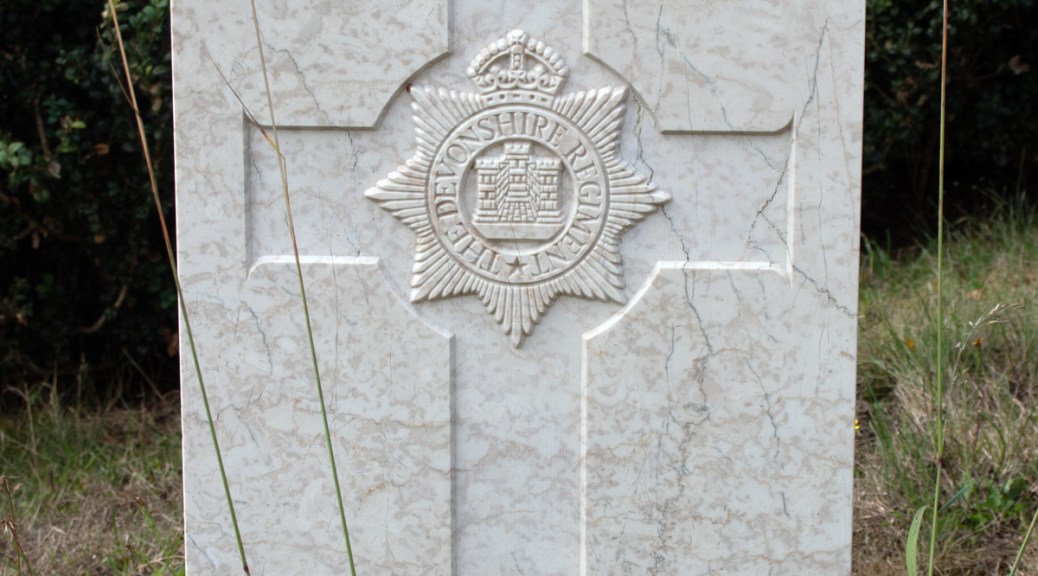
Percy’s trail is a challenge to follow. He enlisted in the army around the time of his mother’s death, early in 1914. He was assigned to the Devonshire Regiment and, as a Private, was attached to the 3rd (Reserve) Battalion. His unit was stationed in Britain throughout the First World War, and there is no evidence that he spent any time overseas.
In the spring of 1917, Private Light fell ill, contracting tuberculosis. The condition was serious enough for him to be medically discharged from the army and he was officially stood down on 22nd February.
Percy’s trail goes cold at this point: he returned to Paignton, and it seems that his poor health got the better of him. He passed away at home on 18th November 1917: he was just 19 years of age.
Percy Light was laid to rest in the sweeping ground of Paignton Cemetery, not far from where his father still lived.
Ernest James Triggs Carder was born early in 1880, the third of ten children to Samuel and Julia. Samuel was a shipwright from Devon and it was in Dartmouth that the family were born and raised.
Ernest – who went by his second name, James – found employment as a groom when he finished his schooling. In the spring of 1907, he married Elizabeth Seward. The couple wed in St Saviour’s Church, Dartmouth, setting up home in Gospel Lane.
James and Elizabeth went on to have three children – Samuel, Edward and Betty. The 1911 census found James working as a grocer’s waggoner, with his youngest brother, Frederick, living with them.
The times were trying for James and Elizabeth: both Samuel and Julia died in 1909; and Edward, their middle child, passed away in September 1911 at the age of just seven months. In the summer of 1915, Betty wad born, and the following April. James was called up to serve his King and Country.
On 14th June 1916, Private Carder was assigned to the Devonshire Regiment, and attached to the 3rd (Reserve) Battalion. The unit would remain on home soil throughout the conflict, but James was not to be part of it for long.
On 29th July 1916, Private Carder was found dead in a lavatory at the Granby Barracks in Devonport, with a razor near him. He had been complaining of eczema on his legs for a while, which made it difficult for him to sleep and had the knock-on effect of causing him headaches. His commanding officer, Corporal Stonelake, said that James “was not too quick, but was a man of good character and tried to do his best… each time he complained of his head he declined to see the doctor.” [Western Morning News: Tuesday 1st August 1916]
Private Carder had willingly enlisted, and appeared not to have any qualms about serving in the army. At the inquest following his death, the jury returned a verdict of taking his life while of unsound mind. He was 36 years of age.
Ernest James Triggs Carder was taken back to Paignton, where Elizabeth and the children were living. He was laid to rest in the town’s cemetery, having found peace at last.
Less than a year later, James’ youngest brother, Frederick, also died. Read more of his life here.
Henry Weakley was born in 1885 in Bath, Somerset. The second of six children, he was the eldest son to James and Fanny. James was a cab driver, and Henry – who was better known as Harry – followed suit, becoming a coachman by the time of the 1901 census.
In 1910, Harry married a woman called Jennie. There is little information available about her, but the following year’s census return found the couple living with his family at 1 Cork Street, Bath, not far from the city’s Royal Crescent. The census had two records for that address, which confirmed the family’s living arrangements. Harry and Jennie had one room, while the rest of the Weakleys – James, Fanny, four of their children and a grandson – took up four rooms.
Harry was still employed as a coachman as this point, but, with war on the horizon, things were to change. Full details of his military service are lost in the mists of time, but it is clear that he enlisted in the Somerset Light Infantry, and that he was assigned to the 3rd (Reserve) Battalion.
Private Weakley’s unit was a territorial battalion and it remained on UK soil throughout the war. Initially based in Devonport, Devon, the 3rd moved to Londonderry, Northern Ireland, in November 1917, and Belfast the following April. Sadly, the little that remain of Harry’s records do not confirm where he served.
Harry was demobbed on 13th May 1919: his pension ledger notes that he had received gun shot wounds to his neck and back, although no further records identify when or how these injuries occurred. He returned home – 5 St George’s Buildings, Upper Bristol Road, Bath – and seems to have settled back into his pre-war life, although his health was still impacted.
Harry passed away at home on 27th March 1921. He was 36 years of age, and had died of heart failure. Despite his wartime injuries, the war office determined that his condition had been contracted after his army service: Jennie was denied a war pension.
Henry “Harry” Weakley was laid to rest in Bath’s sweeping Locksbrook Cemetery, not far from where his widow still lived.
William Pollard was born at the end of 1887, the youngest of seven children to John and Alice Pollard. Agricultural labourer John hailed from Hinton Charterhouse in Somerset, while his wife was from Southampton, Hampshire. The family were living in the village of Buckler’s Hard when William was born, but moved back to Somerset when he was just a toddler.
As with most of his siblings, William followed in his father’s footsteps when he completed his schooling. By the time of the 1911 census, only he and his older brother Thomas we still living in the family home: the two siblings were working as carters, while their father, now 61 years of age, was a general labourer.
Alice died in the summer of 1911, and would net get to see her youngest boy wed. On 11th April 1914, William married Augusta Loveless, a carpenter’s daughter from Bath. The couple were living in 2 Rossini Cottages, on Hedgemead Road, to the north of the city centre, and would go on to have two children, William Jr and Geoffrey.
When war was declared, William was called upon to play his part. He enlisted in the Somerset Light Infantry on 30th November 1915, but soon transferred over to the 5th (Service) Battalion of the Dorsetshire Regiment. Attached to the 673th Labour Company, while his unit served at Gallipoli and in France, there is no evidence that Private Pollard spent any time overseas.
William’s brother Thomas had also been called up. He joined the Somerset Light Infantry, and, as a Private, was attached to the 1st Battalion. His unit fought at the Somme, and Thomas was badly injured. He died of his wounds, and was laid to rest in the Puchevillers British Cemetery. He was 31 years of age.
In fact, William seems to have been dogged by ill health. Full service records have been lost to time, but he was medically discharged from the army on 12th September 1917.
John had died that February, at the age of 68 years old, and was laid to rest next to his wife in St John the Baptist Church, Hinton Charterhouse.
At this point, William’s trail goes cold. He returned to Bath, and spent at least some time in the city’s War Pensions Hospital. His condition warranted an operation, but he died of heart failure following the procedure on 12th December 1920. He was 33 years of age.
William Pollard was laid to rest in Bath’s sweeping Locksbrook Cemetery.
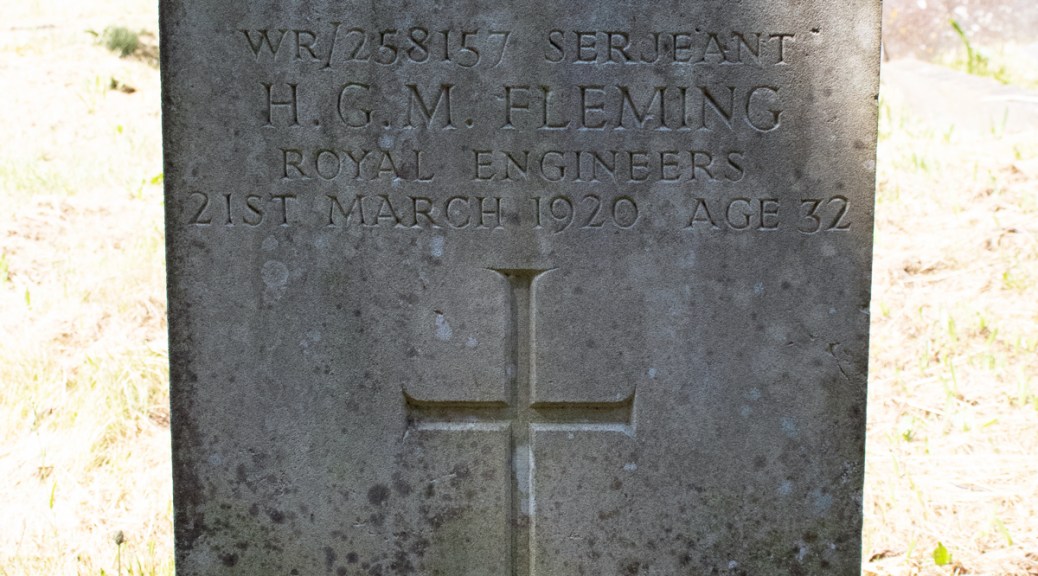
Herbert Gordon Maurice Fleming was born in Stockton, Wiltshire, on 24th March 1888. An only child, his parents were carpenter and wheelwright George Fleming and his wife, Annie.
Little further information is available about Herbert’s early life. On 25th June 1910 he married Ethel Young, a shepherd’s daughter from Wiltshire: they would go on to have four children, Herbert Jr, Ivy, George and Harold.
Herbert’s marriage certificate noted that he was employed as an engine driver. In his spare time, he also volunteered for the Wiltshire Regiment. When war broke out in the summer of 1914, he was called upon to play his part, and was formally mobilised in July 1916.
Sapper Fleming joined the Royal Engineers. His service records show that, at 28 years of age, he stood 5ft 7.5ins (1.71m) tall, and weighed 159lbs (72kg). He was of good physical development, although his medical report noted that some dental attention was required, and he had a pendulous mole on his back.
After his initial training, Herbert was sent to France. He was to remain part of the British Expeditionary Force for the next three years. While details of his service are scarce, his commitment to the army was clear: he was promoted to Lance Corporal in December 1918; full Corporal in June 1919; and Serjeant just three months later.
In October 1919, Herbert arrived back in Britain and the following month he was formally demobbed. He returned to his family, who were now living in Bath, Somerset. Back on civvy street, Herbert took up work as a motor waggon driver in the city, but his post-army life was to be short-lived.
The enquiry into the death on Saturday of Herbert John Maurice Fleming… was held at Bath Guildhall… Medical evidence proved that the cause of death was heart failure, due to an unexpected attack of pneumonia.
The widow said her husband did not complain of illness until Friday evening, when he returned from a journey to Reading. He then said he ached all over, and would go to bed at once. On Saturday evening he said he felt better, and sent her to the chemist for a tonic. He told her not to send for a doctor, as he expected to be quite well on Monday. On Sunday he still appeared fairly well, and was quite cheerful: but in the afternoon he complained of sickness, and the end came very suddenly.
[Bath Chronicle and Weekly Gazette: Saturday 27th March 1920]
Herbert John Morris Fleming was just three days short of his 32nd birthday when he died. He was laid to rest in Bath’s sweeping Locksbrook Cemetery.
The spelling of Herbert’s second middle name is variously noted as Maurice and Morris. For consistency, I have used the spelling noted on his birth certificate.
Walter Brett was born in Batheaston, Somerset, on 12th July 1896. The fourth of seven children, he was the second son of George and Louisa Brett. George was a groom and coachman from Norfolk, and his work took the family around the country. Louisa had been born in Staffordshire, their oldest child, daughter Florence, had been born in South Wales. By 1893, the family had settled in Somerset, but the next census, taken in 1901, found them in Branksome, Dorset.
When Walter finished his schooling, he found work as an errand boy for a hairdresser. By now the Bretts had moved back to Somerset, where George – and his widowed father, John – were working as coachmen for a Mr Page. There were seven in the household – George, Louisa, Walter and three of his siblings, and George Sr – and the family were living at 1 Nelson Terrace, on Walcot Street, Bath, in a six-roomed cottage.
Walter sought bigger and better things for himself. His older brother, Frederick, had left home, and was working as a grocer’s assistant in Brislington – now a suburb of Bristol – and he too wanted a career. On 23rd January 1912, he enlisted in the Royal Navy. As he was only 15 year of age, he was given the rank of Boy 2nd Class, and was sent to HMS Impregnable, a training ship based in Devonport, Devon, for his induction.
Obviously showing signs of ability and commitment to the role, Walter was promoted to Boy 1st Class just seven months later. His first assignment was on board the battleship HMS Cornwallis, and he spent the remainder of 1912 serving with her.
After a brief period back in Devonport – this time at HMS Vivid – and six weeks aboard HMS Lancaster, Boy 1st Class Brett was assigned to the ship that would become his home for the next three years. HMS Lion was a battlecruiser, and she was to serve as the flagship of her class of ships during the First World War.
Walter came of age while serving on Lion, and was given the rank of Ordinary Seaman on his eighteenth birthday. His service records show that he was 5ft 6ins (1.68m) tall, with brown hair, blue eyes and a fresh complexion. He was also noted as having a mole on his stomach.
Walter was promoted to Able Seaman in the summer of 1915, and remained on board HMS Lion until the end of April the following year. His ship had been involved in a number of skirmishes by this point, including the Battle of Heligoland Bight, the defence of the raid on Scarborough and the Battle of Dogger Bank. In June 1916, she would be caught up in the Battle of Jutland, but Able Seaman Brett was back on terra firma by this point, and was billeted in Devonport.
On 1st August 1916, Walter was given a new posting, when he was assigned to the dreadnought battleship HMS Ajax. Acting as support to the Norwegian convoys in the North Sea, he was to remain on board until the closing weeks of the war.
Walter’s brother Frederick, meanwhile, was also caught up in the conflict. He had enlisted in the Gloucestershire Regiment, and was assigned to the 12th Battalion. By the spring of 1917, his unit was based in Arras, and was Private Brett was heavily involved. Following an attack on 8th May, he was declared missing, presumed dead. He was 24 years of age, and is commemorated on the Arras memorial.
Back at sea, in October 1918, Able Seaman Walter Brett became unwell, contracting a combination of influenza and pneumonia. He was transferred to the Hospital Ship Garth Castle, but the conditions were to get the better of him. He passed away on 27th October, at the age of 22 years old.
Walter Brett was brought back to Somerset for burial. His parents had lost both of their sons, but were able to lay their youngest to rest in Locksbrook Cemetery, Bath.
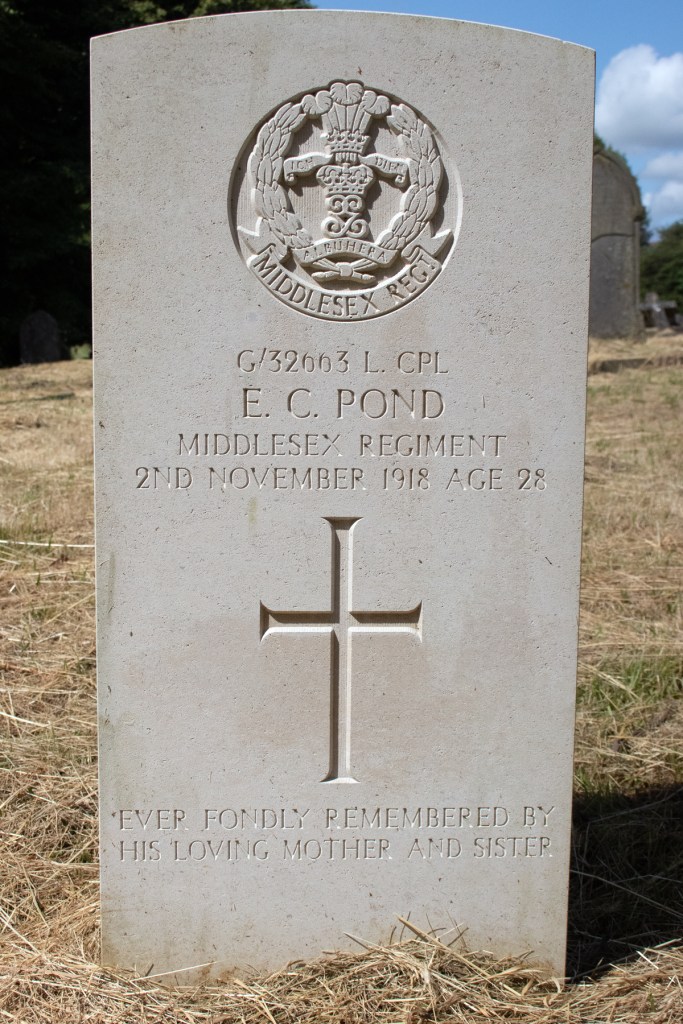
Ernest Charles Pond was born in the autumn of 1889 in Bath, Somerset, and was the younger of two children. His father, Charles, who worked as a wheelchairman, died in 1904, leaving his mother, Eliza, to raise the Ernest and his older sister, Daisy, on her own.
The 1911 census shows the determination the Pond family had in the wake of Charles’ death. Eliza had opened up a tea room in River Street Place, and was living above the business with Daisy and two servants. Daisy, meanwhile, was employed as a school teacher, something she had been doing for at least ten years. Ernest had left Bath, and headed for London: he had taken a room in a house in Tufnell Park, and was working as a furniture designer.
When war came to Europe, Ernest was called upon to play his part. Sadly, full details of his service have been lost to time, but it is clear that he had enlisted by the summer of 1918. He joined the Middlesex Regiment, and was assigned to the 6th (Reserve) Battalion. His unit formed part of the Thames and Medway Garrison, and there is no evidence that Ernest spent any time overseas.
By the autumn of 1918, Ernest had risen to the rank of Lance Corporal. With the war coming to an end, he fell ill, however, and was admitted to a military hospital in Chatham, Kent. Details of his illness are unclear, but it was severe enough that he succumbed to it: he passed away on 2nd November 1918, at the age of 28 years old.
The body of Ernest Charles Pond was taken back to Somerset for burial. He was laid to rest in Bath’s sweeping Locksbrook Cemetery, not far from where his father was buried.
William Charles Biddlecombe was born in the spring of 1896, and was the third of nine children to Robert and Eliza. Both of his parents came from Hampshire, but their older children – William included – were born and raised in Poole, Dorset. Robert was a police constable there, but moved to the village of Longburton, near Sherborne, in around 1910.
According to the 1911 census, William was two of the household of eight to be employed, having found work as a gardener when he finished his schooling. Storm clouds were brewing across Europe, however, and he would be called upon to play his part.
Full service details have been lost to time, but it is clear that William had joined the Dorset Yeomanry (Queen’s Own) by the summer of 1915. He was attached to the 3rd/1st Battalion. The unit was based on home soil and there is no evidence that Private Biddlecombe saw any action overseas.
At this point, William’s trail goes cold and, in fact, the next record for him is that of his passing: “The funeral took place on Wednesday amid every token of respect and esteem of Trooper W Biddlecombe, of B Squadron (3/1st Dorset QO Yeomanry, son of PC and Mrs Biddlecombe of Westhill Police-station.” [Western Gazette – Friday 18 February 1916]
William Charles Biddlecombe died on 15th February 1916: he was 20 years of age. He was laid to rest in the peaceful graveyard of St James the Great Church in Longburton, close to where his grieving family lived.
William’s was not the only passing that his grieving mother would have to attend to. On 18th December, Robert was on duty, which had taken him into Sherborne. He was suddenly taken ill, and rushed to the town’s Yeatman Hospital, but died the same day. He was laid to rest close to his son in Longburton.
William’s younger brother, Robert, also served during the First World War. As a Private, he was attached to the 8th Battalion of the Somerset Light Infantry, and spent time fighting in Northern France. He was caught up and was killed in the Second Battle of Cambrai. He died on 9th October 1918, and was laid to rest in Naves Communal Cemetery Extension.
The pain for Eliza at having lost her husband and two of her sons in such a short space of time is unimaginable. However, she still had children to support, and so had to keep on going. The 1921 census recorded her as living in Weymouth with her youngest boy, Bertram. She was carrying out home duties, and it is unclear how she was making ends meet. She would remain in Weymouth for the rest of her life, passing away in the autumn of 1937, aged 71.
Albert Symes was born in Dorset on 6th March 1887. Details of his early life are a challenge to piece together, as his was not an uncommon name in the county – the 1891 census has at least two potential matches, and the 1901 record at least three.
The first concrete information for Albert is that of his military service. Having been working as a general labourer, he enlisted on the 22nd September 1906, joining the Royal Navy as a Stoker 2nd Class. His service records show that he was 5ft 5ins (1.65m) tall, with brown hair, blue eyes and a fresh complexion. He was also noted as having the letters BS (presumably for Bert Symes) tattooed on his right forearm.
The service document gives his place of birth as Yeovil, Dorset, although the town is actually in Somerset. The next census, taken in 1911, suggests he was born in the village of Bradford Abbas, three miles south east and over the Dorset border.
Stoker 2nd Class Symes was first sent to the training ship HMS Nelson. Based in Portsmouth, Hampshire, this is where Albert spent three months, before being assigned to the cruiser HMS Eclipse. Over the next nine years, Albert served on eight ships, returning to a land base – HMS Victory in Portsmouth – in between voyages.
Albert’s commitment to the job is evident – his character was continually noted as being Very Good, while his ability was Superior as each of his annual reviews. In May 1907 he was promoted to Stoker 1st Class; five years later he made Acting Leading Stoker, with a full promotion to the rank in June 1913; on 1st June 1915, while serving on board HMS Hampshire, Albert was promoted again, to Stoker Petty Officer.
Things would change rapidly for Albert, however. Within a matter of weeks, he had contracted pneumonia. He was transferred to the hospital ship Garth Castle, but the condition was to prove too severe. Stoker Petty Officer Symes passed away from the condition on 3rd October 1915: he was 28 years of age.
Albert Symes’ body was brought back to Dorset for burial. He was laid to rest in the peaceful graveyard of St Mary’s Church in the village of Bradford Abbas.
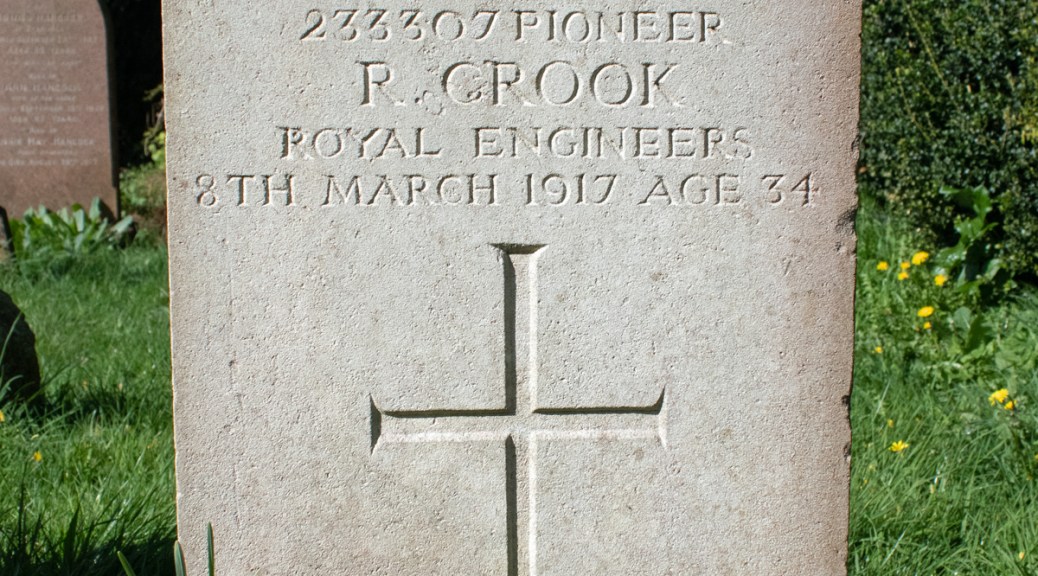
Richard Crook was born in the spring of 1883 in the Devon village of Locksbeare. The youngest of three children, his parents were Richard and Ann Crook. Richard Sr was a general labourer, and his son followed suit when he completed his schooling.
On 5th November 1904, Richard married farmer’s daughter Elizabeth May. The couple went on to have four children, and moved around Devon to wherever his farm work took them. Ann died in 1910, and by the time of the following year’s census, they had settled in Burlescombe, near Sampford Peverell.
By the start of 1917, Richard was called upon to serve his King and Country. He enlisted on 30th January and joined the Royal Engineers. His service records show that he was attached to the Inland Water Transport Corps, and given the rank of Pioneer.
Richard was sent to Kent for training, but within a matter of weeks he was admitted to a military hospital in Canterbury. He had contracted German measles, and it was so severe that he quickly succumbed to it. He passed away on 8th March 1917, at the age of 34 years old. He had been in the army for less than five weeks.
Richard Crook’s body was brought back to Somerset for burial. He was laid to rest in the graveyard of St Peter’s Church, Uplowman, Devon, not far from where his widow and children were living.