Category Archives: Devon

Private Charles Gregory

Private Charles Gregory

Charles Gregory was born in Buckfastleigh, Devon, early in 1879, the son of John and Mary Gregory. There is next to no information about his early life and, in fact, there is very little documentation for him at all.

Most of the details for Charles come from his First World War service records. These confirm that he was living in Australia, having emigrated there with his parents. His father had died by the time Charles joined up, but Mary was living in Welshpool, to the east of Perth.

Charles was 37 years old when he joined up in March 1916: his records show that he was 5ft 3.5ins (1.61m) tall and weighed 160lbs (72.5kg). He had light brown hair, grey eyes and a dark complexion, possibly from the time he spent outside, working as a groom.

As part of the Australian Imperial Force, Private Gregory sailed from Fremantle on 13th October 1916. He arrived in Plymouth, Devon, exactly two months later, and was assigned to the 4th Battalion of the Australian Infantry. He was sent to France on 8th February 1917 and, over the next few months, transferred between the 14th and 16th Battalions.

On 22nd September, Private Gregory was caught up in a bomb attack and badly injured. After initially receiving treatment to his shattered left ankle and lower ribs, he was medically evacuated to Britain for further medical intervention.

Charles was admitted to the Bath War Hospital in Somerset, but his injuries were to prove too severe. He died from tetanus on 29th October 1917, at the age of 38 years old.

With his family in Australia, the body of Charles Gregory was instead laid to rest in the military section of Bath’s sweeping Locksbrook Cemetery, next to where the war memorial would be constructed.


Private Charles Gregory
(from findagrave.com)

Private Walter Mitchell

Private Walter Mitchell

Walter Soper Mitchell was born in the summer of 1878 in Newton Abbot, Devon. The fourth of nine children, his parents were Frederick and Mary. Frederick was a house painter and handyman, and records seem to suggest that he took the family to where the work was. The 1881 census found the family living in Chelsea, West London, and it seems that they stayed in London until 1890.

By the time of the 1891 census, the Mitchells were back in Devon, living at 10 Orchard Terrace in Paignton. Frederick was now working as a plumber, while Walter’s older siblings – brothers Frederick Jr, William and Alfred – were variously employed as a sailor, a painter and a plumber.

Walter, who was 12 years old by this point, was nearing the end of his schooling. When he left, he followed the family trade, and as soon employed as a house painter. The 1901 census found him as the oldest sibling still to be living with Frederick and Mary, although his circumstances were about to change.

In September 1903, Walter married Emily Jeffery. She was a couple of years younger than her new spouse, but, sadly, there is little information about her parents. The 1891 census found her living with her grandparents, while the 1901 return noted her boarding with her aunt and uncle.

Walter and Emily went on to have three children. By the time of the 1911 census, the family were living at 25 Norton Terrace in Paignton, Walter being employed as a house painter by this point.

War came to Europe in the summer of 1914, and Walter was called upon to play his part. Full details of his military service have been lost in the mists of time, but from what remains it is clear that he enlisted in the Royal Army Ordnance Corps at some point after July 1915. He was attached to the 67th Coy., but it is unclear whether he saw any action overseas.

Private Mitchell’s time in the army was not to be a lengthy one. He seems to have been based in Essex, and a later record confirms that he contracted bronchitis and anaemia. This would prove to be his undoing: he passed away in Colchester on 17th February 1916, aged 36 years old.

The body of Walter Soper Mitchell was brought back to Devon for burial. He was laid to rest in what would become the family plot in the sweeping Paignton Cemetery.


Private Edward Brooke-Smith

Private Edward Brooke-Smith

Edward Charles Brooke-Smith was born in Muizenberg, South Africa, on 2nd March 1892. The eighth of nine children, his parents were mariner Alfred Brooke-Smith and his wife, Louisa.

Little further information about Edward’s early life is available. The 1901 census recorded the family as having returned to Britain – where both Alfred and Louisa had been born. The family had set up home in a cottage in Woodbridge, Suffolk, but by the spring of 1911 Edward had moved again, emigrating to Canada to make a life as a farmer.

When war came to Europe, the empire was called upon to fight for peace. Edward, who was working as a merchant in Valcartier, Quebec, by this point quickly stepped up to play his part. He enlisted in the Canadian Expeditionary Force on 17th September 1914 as a Private.

Edward’s service record give an insight into the man he had become. He was noted as being 5ft 11ins (1.8m) tall, with dark brown hair, grey eyes and a dark complexion. Private Brooke-Smith was also noted as having vaccination scars on his left arm, a small scar on his right knee and two moles on the centre of his back.

Details of Edward’s travel back to Europe are lost to time, but he was attached to the 7th Battalion of the Canadian Infantry and, by the spring of 1915, he was in Northern France. In March he had a bout of bronchitis, which was quickly followed by influenza, and he was hospitalised in Rouen.

Private Brooke-Smith returned to his unit in May 1915, but he was dogged by flu for the next couple of months. Sadly, things were not to improve for him.

On 19th August 1915, Edward’s unit was fighting at Wimereux, France, when he was shot. The bullet shattered the top of his right thigh and pelvis, and, after treatment on site, he was evacuated to Britain for further medical support.

Edward was to spend the next sixteen months in hospital. He was initially admitted to the Cambridge Hospital in Aldershot, Hampshire, where his primary treatment took place. In November 1915, he was moved to the Duchess of Connaught Canadian Red Cross Hospital in Taplow, Buckinghamshire for ongoing recuperation.

On 13th March 1916, Private Brooke-Smith was moved to the Auxiliary Hospital in Torquay, Devon. Here further physiotherapy and recuperation took place, before an operation to correct the position of his thigh was undertaken 9th December. Despite the precautions that had been put in place, Edward did not come round from the procedure: he was 24 years of age.

Alfred and Louisa had settled in Paignton by this point – given the year their son had spent in the hospital, it seems likely that they had moved to be nearer to him. Edward Charles Brooke Smith was, therefore, laid to rest in the family plot in the town’s cemetery. When Alfred died nine months later, he was buried alongside his son.


Gunner Francis Carter

Gunner Francis Carter

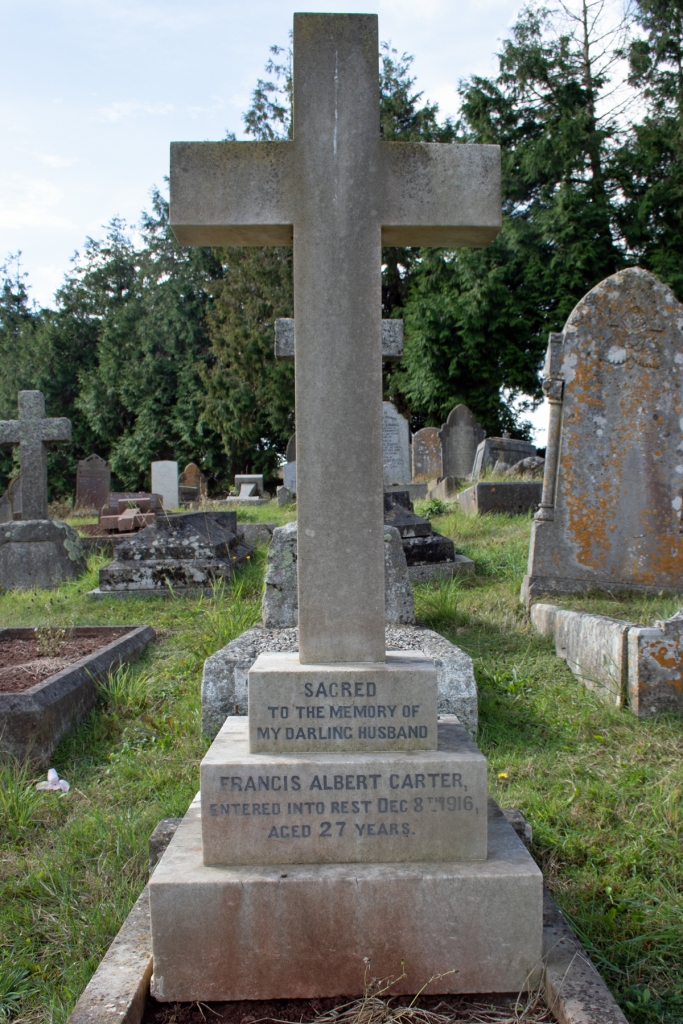
An inquest was held at Plymouth on Monday on Francis Albert Carter, 27, [Royal Garrison Artillery], late of 45 Lang-road, Paignton, auctioneer and valuer. Deceased was visiting his wife, who was staying with friends at St Hilary-terrace, St Jude’s, Plymouth, on the 8th inst., and died suddenly. Dr Ward said death was due to valvular disease of the heart. Deceased had only been in the artillery about three weeks. Deceased… was formerly in business with his brother as a house and estate agent…

[Western Times: Friday 15th December 1916]

Tracing the details of Francis Albert Carter’s life is a bit of a challenge, although the 1911 census records him living at 11 Shirburn Terrace, Torquay, Devon. At 21 years of age, he is noted as having been born in Lezayre, on the Isle of Man. He was living with his mother – the widow Sarah Carter, who was living on independent means – and his brother, 14-year-old Louis, who had been born in Halifax, Yorkshire. Francis was employed as a house agent, while Louis seems to have been his apprentice.

The previous census had recorded the family of three living in Torquay, and confirms that Sarah had been widowed by the time her youngest was four years old.

There is no information about Francis’ marriage, nor any indications as to who his wife might have been.

With regard to his time in the army, it is clear that he enlisted in the Royal Garrison Artillery as a Gunner in November 1916, and was on a break from his training when he visited his wife and her friends on the day he died.

There is little more detail available for Francis Albert Carter. He was laid to rest in Paignton’s sweeping cemetery, not far from where his mother and brother were still living.


Chief Officer Percival Boyce

Chief Officer Percival Boyce

Percival Osmond Bean Boyce was born in Calcutta, India, in January 1887. The oldest of seven children, his parents were Edward and Mary. While details of his early life are not readily available, it would seem that Edward had some military connections. He had been born in Calcutta in 1859, while Mary was Welsh. Most of Percival’s siblings had been born in India, although two – Cecil in 1891, and Dorothy in 1896 – had been born in Somerset.

The 1901 census recorded Percival as boarding at Keyford College in Frome, Somerset. His family do not appear on that census return, nor does he appear on any other census document. He went on to study at Bristol Grammar School, Gloucestershire, making the First XI rugby team.

In May 1915, Percival married Florence Cooper. There is little information available about her, but the couple exchanged vows in Paignton, Devon.

Percival seemed to have taken to a life at sea by this point, and was the Chief Officer of the cargo ship SS Indore. On 25th July 1918, she was torpedoed by the German submarine U-62, off the Irish coast. The Indore was beached, and two of the crew were killed. Chief Officer Boyce managed to get the ship re-floated and safely back to shore. 

At this point, Percival’s trail goes cold again. He survived the war, but died in Scotland on 27th November 1918, the cause of his passing unknown. He was 30 years of age.

In a traditionally Edwardian obituary, it was noted that “great sympathy is felt for Mr JH Cooper, Chairman of Paignton District Council, in the death of his son-in-law, Mr Percival OB Boyce, master mariner, at Glasgow. Both of Mr Cooper’s daughters are now widows, and he lost a son not long since.” [Western Times: Tuesday 3rd December 1918]

Percival Osmond Bean Boyce was laid to rest in Paignton’s sweeping cemetery.


Chief Officer Percival Boyce

Lieutenant William Karslake

Lieutenant William Karslake

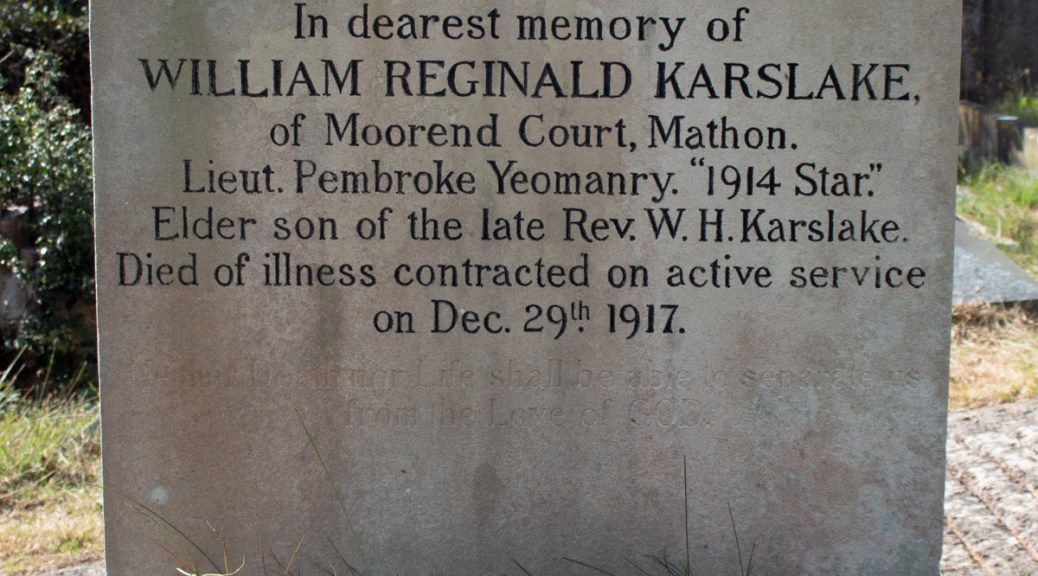
William Reginald Karslake was born in the spring of 1867 in the Surrey village of Westcott. The oldest of three children, his parents were William and Annie Karslake. William Sr was the vicar of the village’s Holy Trinity Church, and the family had a retinue of five servants to look after the household.

By the time of the 1891 census, the Karslakes had moved to Eastbourne in East Sussex. Their house, on the corner of Carlisle and Granville Roads, was a grand affair, and, while William Jr’s siblings, Henry and Mary, were 22 and 19 years old, there was still a live-in retinue of four staff to support them. William Jr is absent from this record, and he may well have been studying in Oxford at the time.

In the autumn of 1896, William Jr married Laura McKenzie. She was an admiral’s daughter who had been born in Glasgow, but their couple exchanged vows in Faringdon, Berkshire. The 1911 census found the family living in the 19-room Moorend Court in the Herefordshire village of Mathon. The couple had two children – Sam and Bridget – by this point and had a governess, parlourmaid, two housemaids, a kitchen maid and a cook to keep them in the right lifestyle.

The census recorded William’s employment as ‘formerly resident land agent’, which suggests he may have spent time overseas before marrying. His father had passed away by this point, and his brother Henry had taken up holy orders.

When war was declared, William was quick to volunteer his services. Initially acting as a driver for the British Red Cross, he found himself in France within weeks of the conflict starting. By January 1915, Lieutenant Karslake was moved to the Balkans, and at this point seems to have transferred to the Pembroke Yeomanry.

Little additional information is available to William. He passed away following an illness on 29th December 1917: he was 50 years of age.

It would seem that William Reginald Karslake was either hospitalised in Devon, or that there are additional family connections in the area. He was laid to rest in Paignton Cemetery, far from his substantial Herefordshire home.


Lieutenant William Karslake
(from findagrave.com)

Boy 1st Class Sidney White

Boy 1st Class Sidney White

Sidney James White was born on 9th April 1899 in Bath, Somerset. The second of six children – and the oldest son – his parents were Sidney and Ann White. Sidney Sr was a butcher by trade and, by the time of the 1911 census, the family were living in Walcot Buildings in the city.

Sidney Jr was only 15 years of age when war came to Europe. However, he was still keen to do hit bit and, on 13th October 1915, he gave up his job as a fitter’s mate and enlisted in the Royal Navy. As he was underage, he was given the rank of Boy 2nd Class, his service records showing that he was 5ft 7.5ins (1.61m) tall, with brown hair, blue eyes and a fresh complexion.

Boy 2nd Class White was dispatched to the ship HMS Impregnable for his initial service. Moored in Devon, she was a training vessel, used to school young recruits in the art of seamanship. In May 1916, Sidney was promoted to the rank of Boy 1st Class, but his time in the Royal Navy was to be cut tragically short.

Holed up in cramped billets, disease often ran rife in military barracks, and Sidney was not to be immune. He contracted meningitis, and was admitted to the Royal Naval Hospital in Plymouth. While initially appearing to recover, the condition was to prove too severe, and his young body succumbed on 18th June 1916: he was just 17 years of age.

Sidney James White’s body was brought back to Somerset for burial. He was laid to rest in a shady spot in Bath’s sweeping Locksbrook Cemetery.


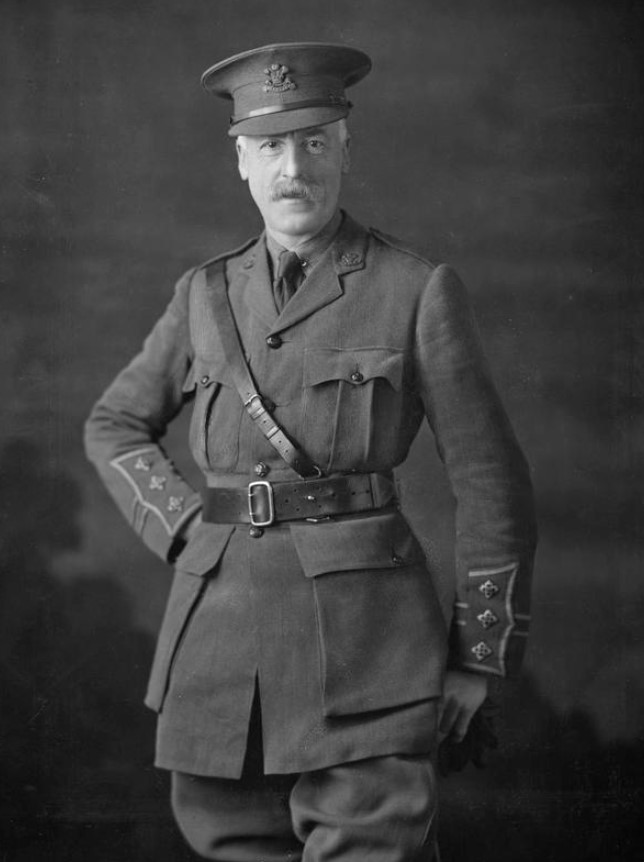
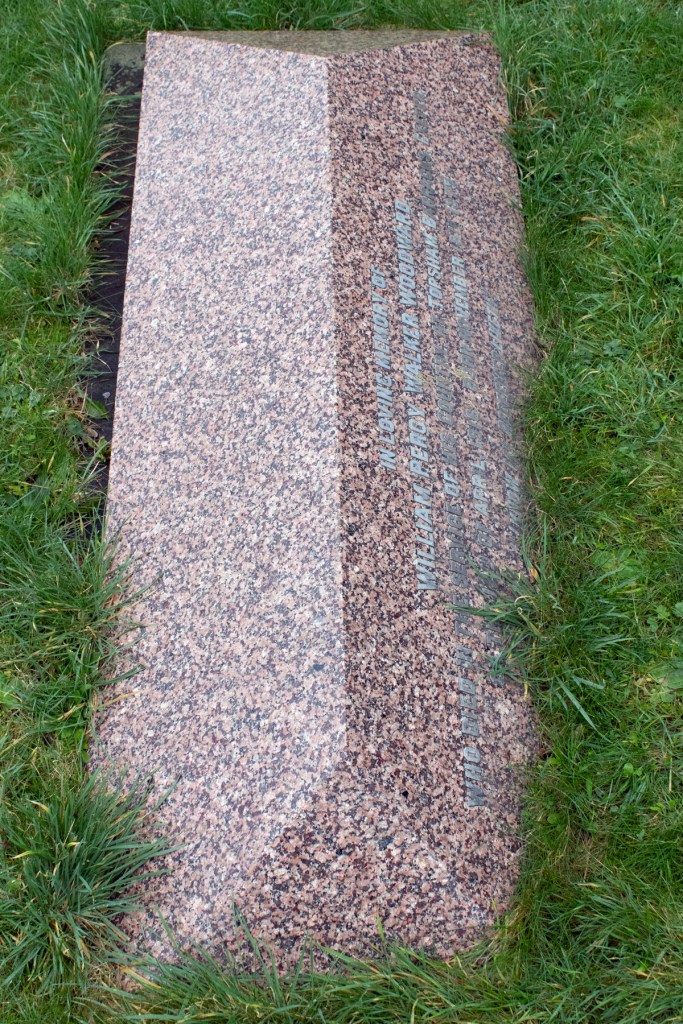
Gunner William Woodward

Gunner William Woodward

William Percy Walker Woodward was born on 18th November 1879, and was the third of six children to James and Mary Woodward. James was a manufacturer of sanitaryware and had been born in Derbyshire, but it was in Ashby-de-la-Zouch, Leicestershire that he and Mary raised their family.

James passed away in the spring of 1886, leaving Mary to raise the family on her own. His obituary in the local media underlined the business that he had built up: “Mr Woodward succeeded his father and eldest brother to the fire brick business, established by the late Mr John Hunt of Swadlincote, of 1790.In 1856 Mr Woodward added to the above trade that of glazed sewerage pipe and terra cotta earthenware, and in 1873 that of general sanitary appliances, and by industry, perseverance, and foresight developed the same into one of the largest manufactories of the kind in the Midland counties, and became well known throughout the greater part of the kingdom as a leading manufacturer of these goods. He was a large employer of labour, kind and considerate, always manifesting great interest in the welfare of his employees.” [Hinckley News – Saturday 15 May 1886]

Mary was left to raise six children, but, thanks to the business, did not do so without support. The 1891 census found the family living at High Fields in Ashby, with a cook, housemaid, children’s maid and a coachman and his family living next door. William and his siblings were all taught at home by their governess.

By the time of the next census, William seemed to have taken on the running of his late father’s business, along with two of his brothers, James and Harold. Things were to change for the Woodward family, however, as they began to go their separate ways.

The 1911 censes shows a divide: James was living on his own means in Snarestone, Leicestershire, with his young family and household retinue. Harold, meanwhile, had emigrated to Canada with another sibling, younger brother Ernest, where they had both set up as farmers.

Mary had also moved, setting up home in Weston-super-Mare, Somerset. She lived on Clarence Road South with William and her daughter, Lilian. The house – Glencathara – was twelve-roomed property, and they had a live0in cook, Emily Young, supporting them. Notably, William’s employment was listed as ‘none, on account of health’, so the move to the coast may have been brought about for medical reasons.

When war came to Europe in summer of 1914, William stepped up to play his part. His service records have been lost, but he had enlisted in the Royal Field Artillery no earlier than the autumn of 1915. He was attached to the 18th Reserve Battery, and came to be based in Topsham Barracks in Exeter.

Little is known of Gunner Woodward’s time in the army, but it was to be brief. He passed away, through causes unknown, on 13th April 1916, at the age of 36.

It is unclear where Mary was living at this point. The body of William Percy Walker Woodward was taken to Dorset for burial, and he was laid to rest in the peaceful graveyard of St Hippolyte’s Church, in Ryme Intrinseca. Interestingly, the parish records note that William was ‘a personal friend of [the] rector’.


Lieutenant Colonel Cecil Stevens

Lieutenant Colonel Cecil Stevens

Cecil Robert Stevens was born in Arrah, India, on 14th March 1867. One of six children, his parents were Charles and Mary Stevens. Charles was a civil servant who had been born in the South Sea Islands, while Mary has been born in Bengal.

The family appear to have moved to the United Kingdom by the late 1870s. Census records for them are a bit sparse, but the 1881 document found Mary living in Honiton, Devon, with four of Cecil’s siblings and three servants. Cecil, meanwhile, was a boarding student at Malvern College, Worcestershire.

By 1891, Cecil had moved to St Columb in Cornwall. He was boarding at a hotel on Fore Street, and was employed as a general medical practitioner.

Charles was later rewarded for his service to the Empire, and received a knighthood. The 1901 census found him residing in Harcourt Terrace, Kensington, Middlesex, while his wife, now Dame Mary Stevens, was visiting a friend from India in Devon. Sir Charles died at home in 1909, following a bout of influenza.

Cecil, meanwhile, had been making his own way in the world. A qualified surgeon, he married Katharine Duff, a nurse from Aberdeen. They went on to have two children, son Cecil Jr and daughter Mignonette.

On 29th July 1893, Cecil joined the Indian Medical Service as a Lieutenant. Three years later, he was promoted to Captain, and in July 1905, he rose to the rank of Major. His commitment to duty is evident: he spent many years overseas, separated from his wife and young family, and in January 1913, was promoted to the rank of Lieutenant Colonel.

Cecil’s time in the Indian Medical Service was not without danger. In 1895, he was involved in the Relief of Chitral, for which he received a medal and clasp. He was caught up in the Tirah Campaign of 1897/98, and received a further two clasps for his role.

Lieutenant Colonel Stevens’ role during the First World War is lost in the mists of time. Given his role in the Indian Medical Service, it is likely that he served overseas, but he returned to Britain after the war, coming by way of Egypt.

By the autumn of 1919, he was back in Devon, at the family home on Elmsleigh Park Road in Paignton. His health was failing at this point, having come down with diabetes while in North Africa. him. Cecil passed away on 18th November 1919: he was 52 years of age.

Cecil Robert Stevens was laid to rest in the sprawling grounds of Paignton Cemetery.


Lieutenant Colonel Stevens’ will left £4123 13s 10d (around £180,000 today) to his sister-in-law, Alice Duff.

Katharine outlived her husband by only eight years. She passed away on 22nd December 1927 at the Field Officers’ Quarters in Gibraltar: she was 61 years of age.


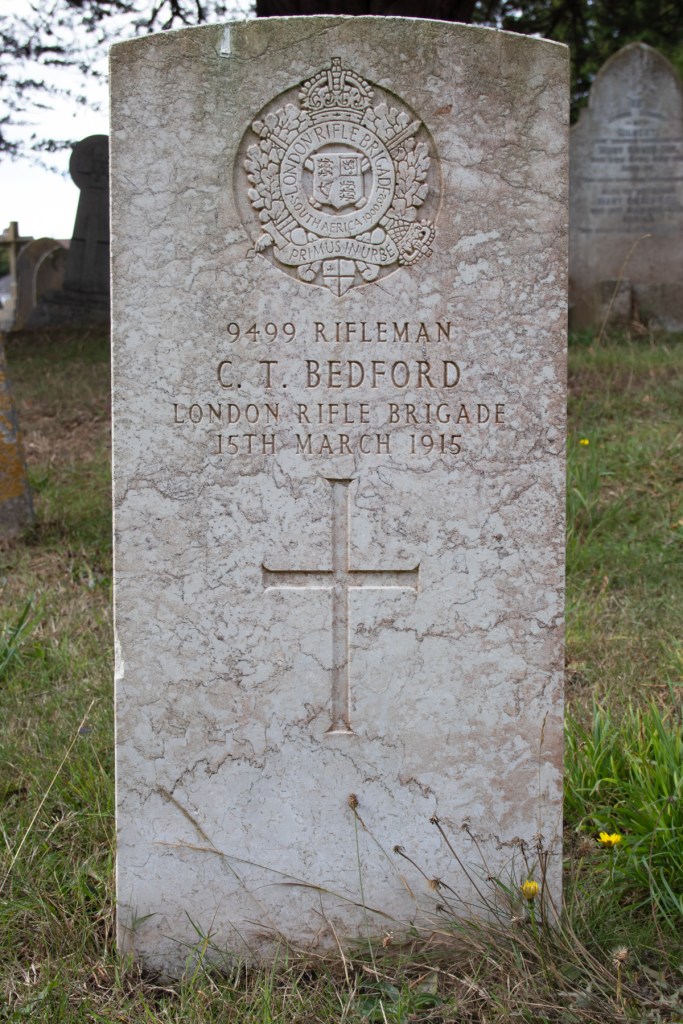
Rifleman Conrad Bedford

Rifleman Conrad Bedford

Conrad Thomas Bedford was born on 8th August 1891 in Bowes Park, Middlesex. The younger of two children, his parents were Thomas and Clara Bedford. Thomas was a bank clerk, who had a strong focus on education and, after his untimely death in 1899, aged just 40, Clara was keen to ensure that her only son received the best.

Conrad was educated at Seaford College in Sussex, and was boarding there at the time of the 1901 census. Whilst there, he served in the College Cadet Corps, which was attached to the Royal Sussex Engineers, and by the time he left, in 1909, he had taken the rank of Corporal.

When he completed his schooling, Conrad found work as a clerk in the London Joint Stock Bank, and soon volunteered for the London Rifle Brigade. When war broke out, he willingly stepped up to serve his country, and became attached to the regiment’s 5th Battalion.

The 1/5th (City of London) Battalion (London Rifle Brigade), to give the London Regiment’s unit it’s full title, fought on the Western Front, and Rifleman Bedford arrived in the Wallonia region of Belgium on 4th November 1914.

Early in 1915, Conrad was based near Ploegsteert, when, at around 2am on 27th February, he was shot in the right shoulder. He was medically evacuated to Britain, and admitted to the American Women’s War Hospital, in Paignton, Devon. While his injury was treated, sepsis set in, and Rifleman Bedford succumbed to it: he passed away on 15th March 1915, at the age of 23 years old.

Surprisingly, Clara did not bring her son back to London, where she was living. Instead, Conrad Thomas Bedford was laid to rest in Paignton Cemetery, not far from where he had breathed his last.


Riflemen Conrad Bedford
(from ancestry.co.uk)