Robert Reginald Atkins was born in the Kent village of Sarre, on 8th January 1900. The younger of two children, his parents were carter Reginald Atkins and his wife, Alice. Alice died in 1908, aged just 30, and her widower moved the family to the village of Martin, near Dover, where he took up work as a miller.
Robert found work as a grocer’s assistant when he completed his schooling. Being so close to the English Channel, the conflict in Europe must have seemed unavoidable. On 7th August 1917, he stepped up to play his part, and enlisted in the Royal Navy.
Boy 2nd Class Atkins was sent to HMS Powerful, the training ship in Devonport, Devon, for his initial instruction. After just two months he was promoted to the rank of Boy 1st Class, and given a posting to the battleship HMS Dominion.
Robert’s time on board was to be brief. By 3rd November he stepped ashore at HMS Pembroke, the Royal Naval Dockyard in Chatham, Kent. He would remain there for the next few months, during which time he came of age. His service records show that Robert was 5ft 7ins (1.71m) tall, with brown hair, blue eyes and a fresh complexion.
While stationed at Pembroke, Boy 1st Class Atkins fell ill. He was admitted to the Royal Naval Hospital in Chatham, but his condition, pulmonary tuberculosis, was to prove fatal. He died on 21st April 1918, at just 18 years of age.
Robert Reginald Atkins was laid to rest in the Naval section of the Woodlands Cemetery in Gillingham, Kent, not far from the dockyard he had briefly called home.
Following Alice’s death, Reginald re-married. By the time of the 1921 census, he was living in Ashford, Kent, with his new wife, Rosa, and their two children, William and Frank. He was still employed as a miller, but this time was working for Mersham Mills.
According to the same census, Robert’s older sister, Monica, was employed in domestic service. She was working for stockbroker Frank Newton-Smith and his family, in their Dover home.
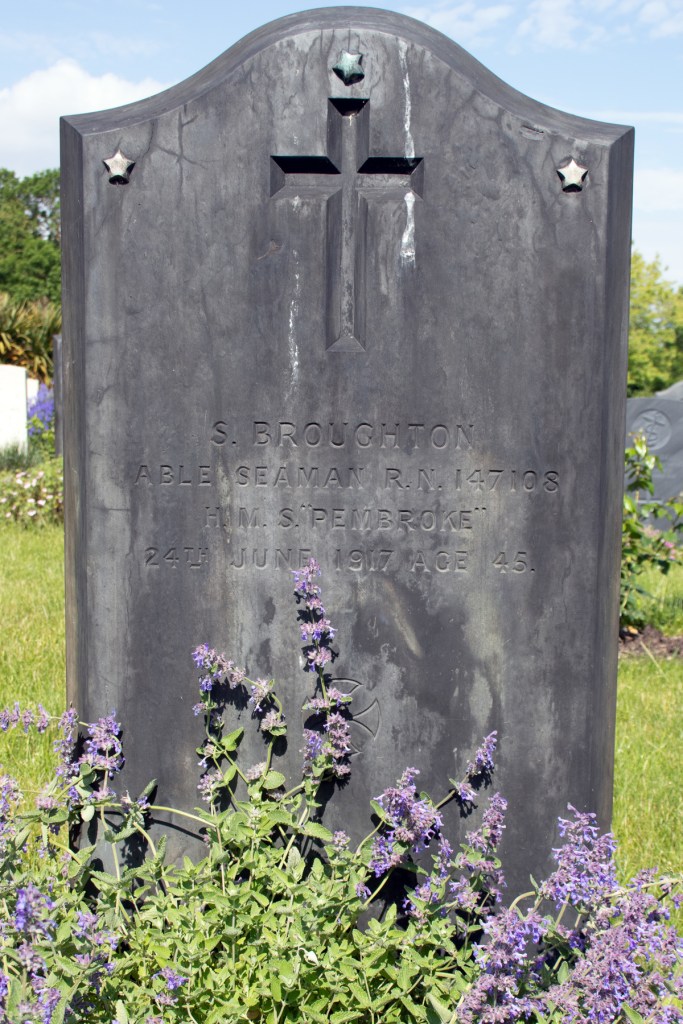
Sydney Broughton was born on 21st November 1872 in the Lincolnshire village of East Halton. The sixth of nine children – of whom eight were boys – his parents were William and Emma Broughton.
William was a boot an shoe dealer, and his older sons were destined to follow him into the business. Sydney, however, sought bigger and better things and, on 13th November 1888, he joined the Royal Navy. Being only 15 years of age, he wasn’t able to full enlist, and was taken on as a Boy 2nd Class.
Sydney was sent to Devonport, Devon, for his training. Assigned to the training vessel HMS Impregnable, she would become his home for just over two years. On 12th March 1890 he was promoted to Boy 1st Class and on his eighteenth birthday, he was formally enlisted in the Royal Navy.
Ordinary Seaman Broughton’s service records show that he was 5ft 4ins (1.63m) tall, with dark brown hair, light grey eyes and a fair complexion. He was also noted as having a slight scar under his right eye. Now of age, Sydney was moved to barracks at HMS Vivid, onshore at the heart of Devonport itself.
On 28th January 1891, Ordinary Seaman Broughton was given his first posting, on board the cruiser HMS Tauranga. He would remain there for only six months, however, as the ship was in the process of being transferred to the Australian Navy. His new assignment would be the survey sloop HMS Penguin, and she would be his home for the next two years.
Shortly before leaving Penguin, Sydney was promoted to the rank of Able Seaman. He spent the next nine months split between HMS Victory, the Royal Naval Dockyard in Portsmouth, and HMS Excellent, a base that was also connected to the dockyard.
On 26th January 1894 Able Seaman Broughton was posted to the cruiser HMS Galatea. He remained there for the rest of the year, including fourteen days spent in cells for an unknown offence that April. He then moved to the battleship HMS Edinburgh, with whose crew he would spend the next two years.
In September 1896, Sydney transferred to what would become his home base, HMS Pembroke, also known as the Royal Naval Dockyard in Chatham, Kent. Over the remaining six years of his twelve year contract, he would keep returning there, also spending time in the dockyard’s training base, HMS Wildfire.
On 10th February 1901, Able Seaman Broughton was imprisoned for 42 days for misappropriating mess funds, while based in the Dockyard. Surprisingly, the misdemeanour seems not too have impacted his career too adversely, however, and when his contract came up for renewal the following year, he voluntarily remained with the navy.
Sydney was on board the cruiser HMS Amphritite when his new term of service began. In March 1902 he was promoted to Leading Seaman and, over the next five years, he would go on to serve on a further five ships. In October 1907 he was reduced in rank to Able Seaman once more, although his service records don’t confirm whether this was through his own choice or not.
Over the next six years, Sydney would serve on three further ships. When was formally stood down to reserve status on 19th January 1913, his home was HMS Actaeon, the navy’s torpedo school in Chatham: he had been assigned there for nearly three years, and in the Royal Navy as a whole for more than 24 years.
When war broke out in the summer of 1914, Able Seaman Broughton was called back into action. He remained on solid ground, however, and split the next three years between HMS Pembroke and HMS Wildfire, places he knew well. Sydney’s health may have been a factor in his lack of seaworthiness: in the spring of 1917 he was admitted to the Royal Naval Hospital in Chatham, suffering from mouth cancer. The condition was to prove fatal: he passed away on 24th June 1917, at the age of 44 years old.
Sydney Broughton’s body was laid to rest in the naval section of Woodlands Cemetery in Gillingham, Kent, not far from his beloved dockyard.
Sydney’s next-of-kin was noted as being his wife, Edith Mary Broughton. There is no record of their marriage, but her details on his records correspond to an entry on the 1921 census.
The document recorded Edith living in Sittingbourne, Kent. 45 years and seven months old, she was sharing her home with her widowed mother, Harriett Pearce, and her two-year-old granddaughter, Edith May.
Further digging suggests that Edith had been a widow when she and Sydney exchanged vows: the 1911 census found her married to Herbert Busbridge, the couple having a daughter, Edith Nellie, who had been born in 1896.
Widowed twice, Edith Mary carried on as best she could: she passed away in the spring of 1963, at the age of 87.
Charles Percival Churchill was born on 31st January 1892 in Marylebone, London. The oldest of three children, his parents were Charles and Annie Churchill.
Charles Sr was a farrier, and was 18 years his wife’s senior. When he died in 1904, at the age of 54, Annie got married again. At this point, Charles Jr found work as a houseboy to John and Florence Cassley-Whitaker, a couple living on their own means in Frinton-on-Sea, Essex.
When war came to Europe, Charles would be called upon to play his part. Conscripted in the autumn of 1916, he enlisted in the Royal Navy, and was given the rank of Ordinary Seaman. His service records show that he was 5ft 6.5ins (1.69m) tall, with brown hair, blue eyes and a dark complexion.
Ordinary Seaman Churchill was initially sent to HMS Pembroke, the Royal Naval Dockyard in Chatham, Kent, for training. He remained there until March 1917, when he was assigned to the battleship HMS Hibernia. Part of the Nore Command she helped patrol the Thames Estuary and protect the north Kent coast.
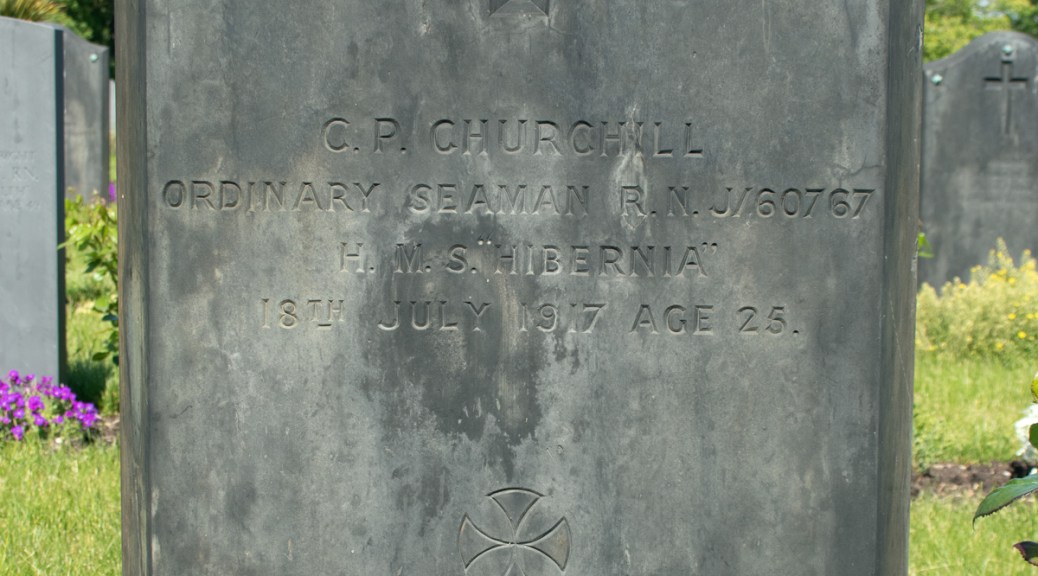
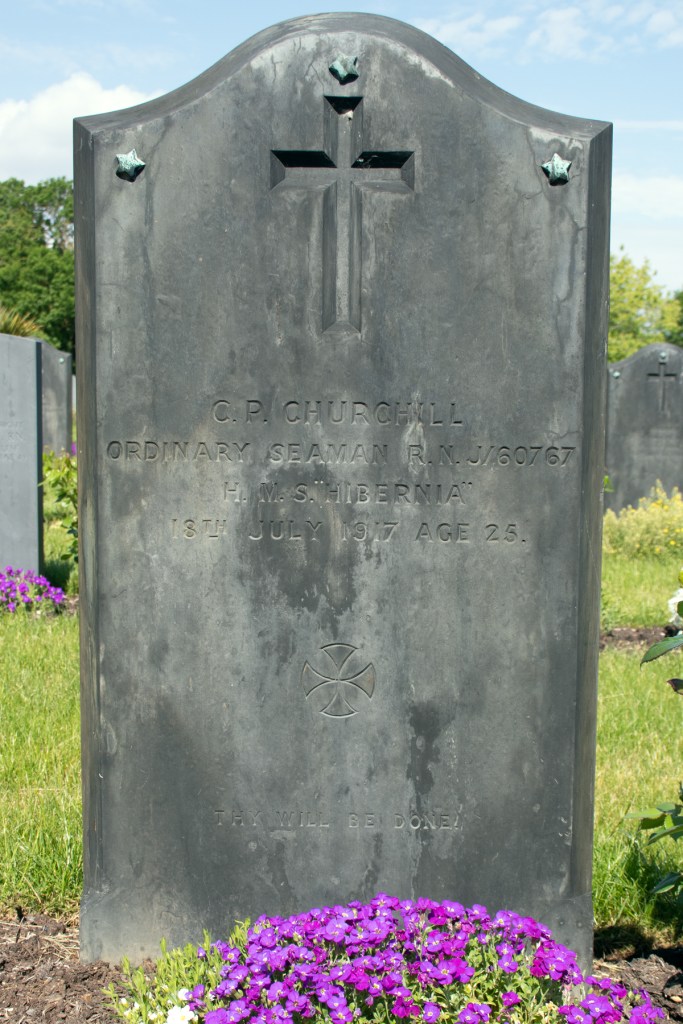
Charles’ time at sea was not to be a lengthy one. In July 1917 he was admitted to the Royal Naval Hospital in Chatham, Kent, having contracted anthrax. The condition was to ravage his body, and he died on 18th July: he was 25 years of age.
The body of Charles Percival Churchill was laid to rest in Woodlands Cemetery, Gillingham, Kent, not far from the naval base he had so briefly called home.
It was reported to the Chatham Town Council on Wednesday that a fatal case of anthrax had occurred at the Royal Naval Hospital. The deceased bought and used a cheap shaving brush from a shop in the borough, and a similar brush purchased at the same shop for experimental purposes was found at the Royal Naval Laboratory to contain a bacillus similar to the anthrax bacillus. The Medical Officer took possession of the whole of the stock of brushes and sent some to the County Council Laboratory and others to the Local Government Board for examination. Some of the brushes had been found to contain anthrax spores, and further tests were being made.
South Eastern Gazette: Tuesday 18th September 1917
While Ordinary Seaman Churchill’s name is not mentioned in the article, the severity of the condition, and the timing of the report would suggest that this was how Charles had met his fate.
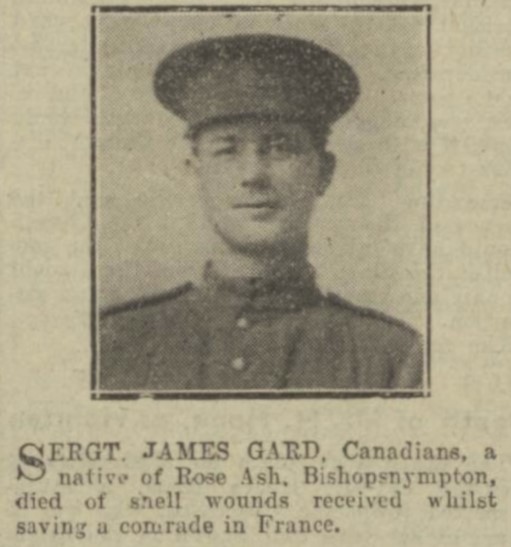
James Gard was born on 8th March 1889 in the Devon village of Rose Ash. One of fourteen children, he was the fourth of six sons to George and Mary Gard. George was a poultry dealer, but when both he and Mary died within two months of each other in 1897, their children were suddenly left as orphans.
The 1901 census found 12-year-old James visiting the Cole family, farmers who lived a few miles away in Bishops Nympton. James’ older brother Philip had plans, however, and in 1907, the two of them set out for a new life in Canada.
Boarding the SS Saxonia in Liverpool, they arrived in Boston with 50s (approx. £390 in today’s money) between them. Their final destination was to be Winnipeg in Manitoba, but the soon moved further north, setting up neighbouring homes in the town of Fisher Branch.
Both siblings found farming work, but when war broke out in Europe, James stepped up to play his part. On 24th February 1916 he enlisted in the Canadian Expeditionary Force, and was assigned to the Canadian Infantry. His service records show that he was 6ft (1.83m) tall and weighed 155lbs (70.3kg). He had dark brown hair, blue eyes and a ruddy complexion.
Private Gard set sail for Britain within a matter of weeks, arriving in Shorncliffe, Kent, on 12th May 1916. His unit – the 44th Battalion – moved to their base in Bramshott, Hampshire, and this is where he would receive his training.
James’ unit was involved in the fighting at the Somme and Ancre, and his commitment was rewarded when, on 20th January 1917, he was promoted to the rank of Sergeant. Just days later, however, he was badly injured.
A high explosive shell exploded near Sergeant Gard that day, bursting both of his eardrums. Initially treated on site, he was medically evacuated to Britain for treatment, and was admitted to the Military Hospital in Tooting, Surrey. He developed mastoiditis in both ears, and this, combined with septicaemia, lead to his ultimate death. He passed away on 1st April 1917, at the age of 28 years of age.
The body of James Gard was taken back to Devon for burial. He was laid to rest in the graveyard of St Peter’s Church in his home village, Rose Ash.
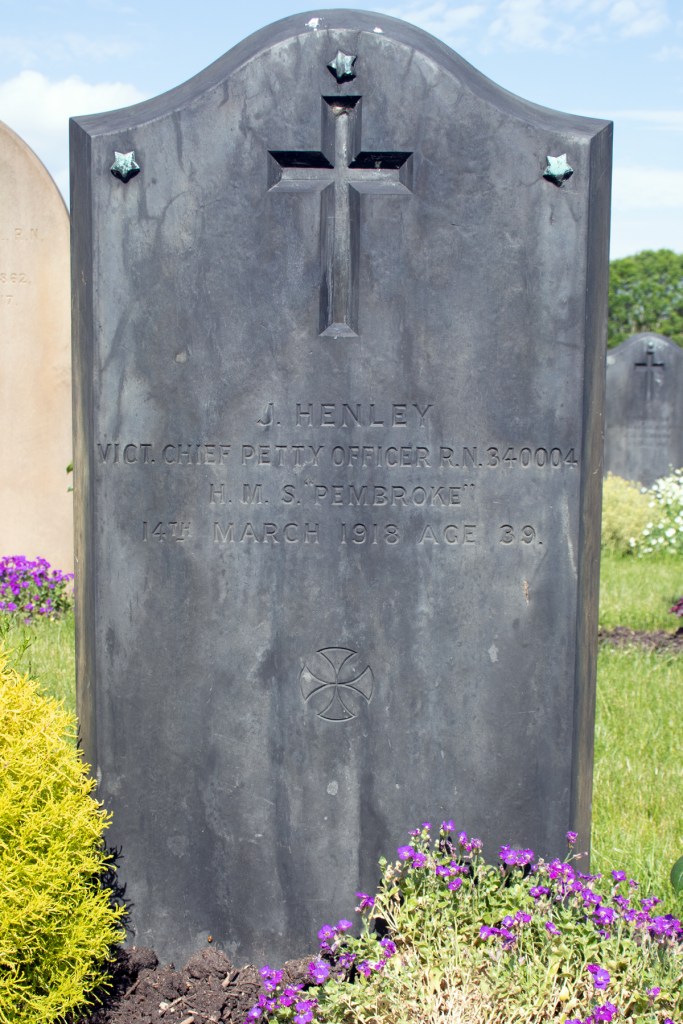
John Henley was born on 4th September 1878, and was the second of five children to William and Frances. William was a navy pensioner from Maidstone, Kent, but it was in the nearby village of Loose that John was born and the family raised.
Given his father’s background, it was inevitable that John would go to sea as well. The 1891 census recorded him as being one of nearly 1000 pupils of the Royal Hospital School in Greenwich, and just three years later he formally enlisted in the Royal Navy. Just sixteen years of age, he was given the rank of Ship’s Steward Boy. His service records confirm that he was 5ft 4ins (1.63m) tall, with dark brown hair, light blue eyes and a fresh complexion.
Initially based at HMS Pembroke, the Royal Naval Dockyard in Chatham, Kent, over the next eighteen months, John spent time on five ships. This gave him enough grounding so that when he came of age in September 1896, he could be formally inducted into the navy, with the rank of Ship’s Steward Assistant.
Over the next decade, John’s career flourished. He was promoted to Acting Ship’s Steward in January 1901, and full Ship’s Steward fifteen months later. He had spent time on a further ten ship by this point, returning to HMS Pembroke in between postings.
In July 1905, John married Maud Norton, a carpenter’s daughter from his home village. While her husband was away at sea, she set up home at 88 Kingswood Road, Gillingham, Kent, and the couple went on to have three children: John, William and Lionel.
Back at sea, and by the time war broke out, Ship’s Steward Henley had completed more than twelve years in the role. In February 1918, he received a further promotion, this time to Victualling Chief Petty Officer, but this new role was to be cut tragically short. The following month, he was admitted to the Royal Naval Hospital in Chatham, Kent, suffering from a gastric ulcer. This haemorrhaged, and he passed away while still admitted. John died on 14th March 1918: he was 39 years of age.
We regret to announce the death of Mr John Henley, Victualling Chief Petty Officer (Ship Steward)… Deceased was a native of Loose and… had served 25 years in the Royal Navy, having commenced his career in the Royal Hospital School, Greenwich, at the age of eleven years. He took part in the battle off the Falkland Islands, and also in the operations in the Dardanelles whilst serving on HMS Inflexible. He leaves a widow and three sons.
[Kent Messenger & Gravesend Telegraph: Saturday 30th March 1918]
John Henley was laid to rest in the naval section of Woodlands Cemetery, Gillingham, walking distance from where his widow still lived.
Chief Petty Officer John Henley (from britishnewspaperarchive.co.uk)
Joseph Ward was born in Wednesbury, Staffordshire, on 13th January 1890. The four of five children – all boys – his parents were William and Caroline. William was a coal miner-turned-weighman, but Joseph found work as a riveter when he completed his schooling.
It seems that Joseph sought any employment to avoid going down the mines, and, on 26th August 1910, he enlisted in the Royal Navy. His service records show that he was 5ft 3ins (1,6m) tall, with brown hair, grey eyes and a sallow complexion. He was also noted as having a dot or mole on the back of this left forearm and another on the back of his left hand.
Joseph was given the rank of Stoker 2nd Class, and was sent to HMS Vivid, the Royal Naval Dockyard in Devonport, Devon, for training. This would be his base of operations, and he would return there a number of times in the coming years.
On 4th January 1911, Stoker Ward was given his first posting, on board the armoured cruiser HMS Cumberland. he remained on board for more than two-and-a-half years, and gained a promotion to Stoker 1st Class during this time.
In October 1913, Joseph returned to Devonport, remaining on shore for more than three months. His service record notes he was confined to the Dockyard Sick Quarters for three days, although the cause is not given. In January 1914, he returned to sea again, on board another cruiser, HMS Highflyer. This would prove another lengthy assignment, and Stoker Ward would not return to HMS Vivid for more than three years.
During his short spell ashore, Joseph returned to Staffordshire. He married Lily Wright, a tailoress from Wednesbury. Their honeymoon was brief, however, and he was given a new assignment.
Stoker Ward was attached to HMS Valkyrie, a newly commissioned destroyer attached to the Harwich Force. On 22nd December 1917, she was escorting a convoy to the Netherlands when she struck a mine. Twelve of the crew – including Joseph – were killed, while a further seven subsequently succumbed to their injuries. The Valkyrie was towed to the Royal Naval Dockyard in Chatham, Kent, for repairs.
Joseph Ward was 27 years of age when he was killed. He was laid to rest in the naval section of Woodlands Cemetery in Gillingham, not far from the Kent naval base.
Tragically, Lily was pregnant when her husband was killed. On 25th February 1918, she gave birth to their child, Flora, the daughter Joseph would never know.
Thomas Henry Jago was born on 3rd June 1872 in Romney Marsh, Kent. The second of ten children, his parents were James and Elizabeth. James was a coastguardman, and his son was destined to be connected to the sea.
Thomas joined the Royal Navy on 19th December 1887. Given the rank of Boy 2nd Class, his records show that he was just 5ft (1.52m) tall, with dark brown hair, grey eyes and a fresh complexion. He was sent to HMS St Vincent, the training ship based in Haslar, Hampshire, and would remain there until June 1889. During this time, he was promoted and given the new rank of Boy 1st Class.
Thomas’ first ocean assignment was on board the corvette HMS Active. She would be his home for the next three years. In June 1890 he came of age, and was formally inducted into the Royal Navy as an Ordinary Seaman. By November 1890, he had proved his worth again, and was promoted to Able Seaman.
Over the next seventeen years, Thomas would serve on 21 ships. Frustratingly, the dates on his service records become a little muddled as time goes on, but it was while he was on board the RMS Empress of India in the late 1890s that he was promoted to Leading Seaman, then Petty Officer 2nd Class and Petty Officer 1st Class, all within a matter of three years.
In March 1903 he was demoted to Petty Officer 2nd Class, but the higher rank was reinstated eighteen months later. In September 1907, while serving on HMS Magnificent, Thomas seems to have been in some sort of trouble. This resulted in the removal of his ranking, and he was downgraded to Able Seaman once more, a rank that he would then hold until the end of his naval career.
In between voyages, Able Seaman Jago would have a shore base to return back to. His most common port seems to have been Chatham, and HMS Pembroke, the town’s Royal Naval Dockyard, features on his records more and more as time goes by.
In June 1912, after 22 years of service, Thomas was stood down to reserve status. Over the next few years his trail goes cold, although a later document suggests that he had moved to Sandgate, Kent, where he was renting rooms at 18 High Street.
War was soon raging across the world, and Able Seaman Jago was called upon to serve again. Assigned to London’s HMS President in December 1915, he quickly returned to Chatham Dockyard again. Over the next couple of years, Thomas serves on two further ships – HMS Diligence and HMS Mars – but HMS Pembroke definitely became a home from home.
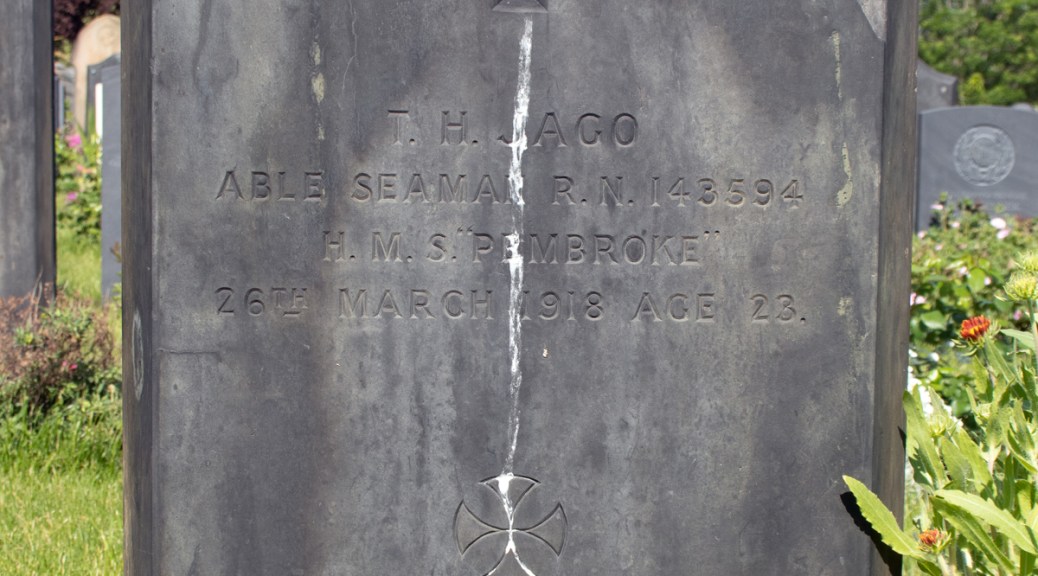
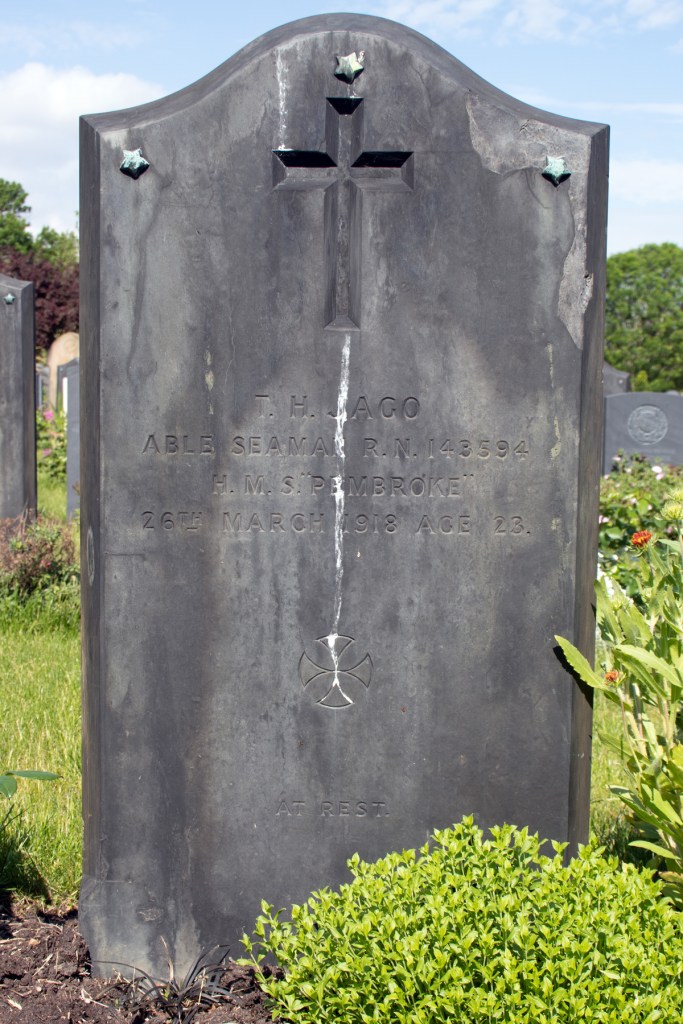
In February 1918, Able Seaman Jago returned to the Royal Naval Dockyard in Chatham one last time. He was unwell by this point, and was admitted to the the town’s Royal Naval Hospital for an operation on his mouth. Thomas was suffering from carcinoma of the tongue, and the condition was to prove fatal. He passed away on 26th March 1918, at the age of 45 years old.
Thomas Henry Jago was laid to rest in the naval section of Woodlands Cemetery in Gillingham, Kent, not far from the base he had called home for so many years.
Leonard Bentley was born in Strood, Kent, on 6th December 1896. One of six children, his parents were John and Emma Bentley. John was a barge captain, transporting ship-loads of cement from the local works to where it was needed.
The 1911 census found an extended Bentley family living at 85 Cliffe Road in Strood. John and Emma shared their home with Leonard, his older brother Arthur, and Arthur’s wife and son. Eleven years younger than Arthur, who was his next oldest sibling, Leonard was still at school by this point.
Education was obviously important to Leonard, and by the end of the year, he had enrolled in the Royal Navy as a Boy Artificer. He would spend the next few years at HMS Fisgard, the training establishment in Woolwich, Kent, learning his trade.
When he came of age in December 1914, Leonard was officially inducted into the Royal Navy, taking on the rank of Engine Room Artificer 5th Class. He remained at Fisgard until January 1916, when he transferred to HMS Victory, the Royal Naval Dockyard in Portsmouth.
This was a temporary move, however, and on 11th April Leonard was assigned to HMS Africa, and a few weeks later, he was promoted to Engine Room Artificer 4th Class. A battleship, the Africa would become his home for the next eighteen months and he would travel with to the Mediterranean and Adriatic Seas.
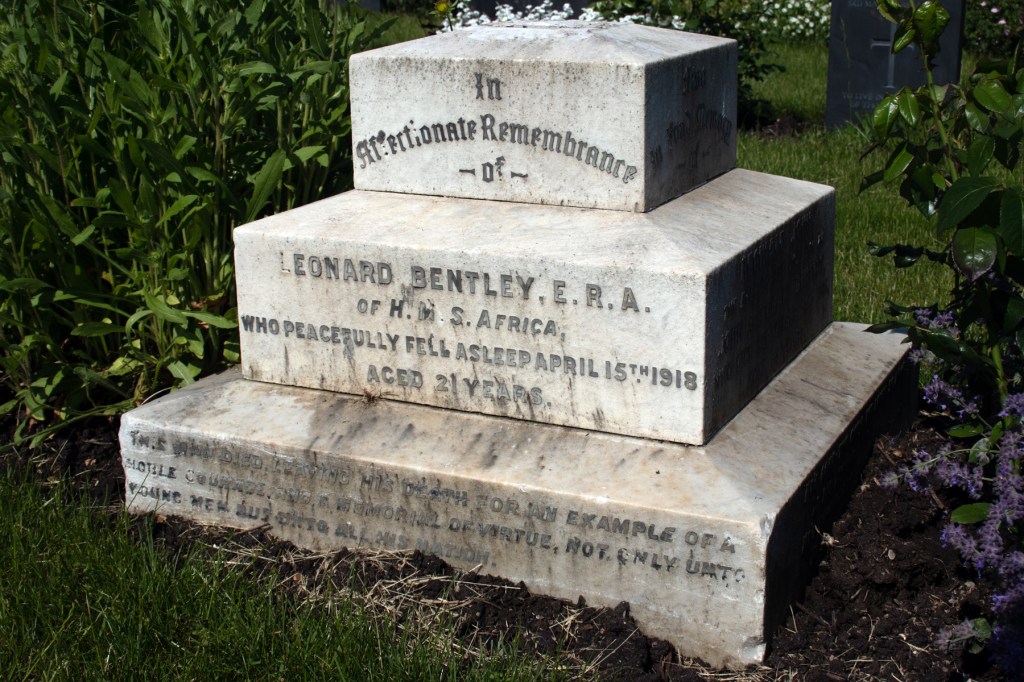
In January 1918, Engine Room Artificer Bentley would return to solid ground. He transferred to HMS Pembroke, the Royal Navy’s base in Chatham, Kent. The reason for his move appears to have been health related, and he was soon moved the the town’s Naval Hospital, suffering from pulmonary tuberculosis. The condition was to prove fatal. Leonard died on 15th April 1918: he was 21 years of age.
Leonard Bentley was laid to rest in the naval section of Woodlands Cemetery, Gillingham, Kent, not far from his family home, or his final naval base.
Charles John Crane was born in Canning Town, Essex, on 14th April 1879. One of at least five children, his parents were Charles and Sarah Crane. Charles Sr had been born in Bath, Somerset, but was working in London as a hairdresser when he met his wife, and settled in West Ham. The family lived in rooms at 52 Burnham Street, sharing the house with Sarah’s parents, Daniel and Rebecca King, and siblings.
By the time of the 1891 census, the family set-up had changed. Charles Jr was now living with Daniel and Rebecca at 56 Burnham Street, but his parents and siblings are nowhere to be found. Daniel was a dock labourer, and his job seems to have ignited a passion for the sea that was to direct his grandson’s life.
Charles took to a life at sea, working his way up to the rank of Master, and settling in the Montrose area of Scotland. He married Margaret McIntosh, and they went on to have six children.
When war broke out, Charles was assigned to the SS Innescroone, and served his time on board during the conflict.
FATAL BLOW WHILE WORKING AN ANCHOR.
An inquest was held at the Royal Naval Hospital, Gillingham, into the circumstances attending the death of Charles John Crane, aged thirty-nine, master of the s.s. Innescroone. The deceased met with an accident on the 8th inst. while working the anchor of his vessel, and was removed to the hospital, where he died from the injuries he sustained on 12th inst.
The Coroner (Mr. C. B. Harris) remarked that the deceased’s vessel was at sea, so that it would not be possible to conclude the inquiry that day, as witnesses from the ship would have to be called. Only necessary evidence would be taken, and the inquest would be adjourned. Evidence of identification was given by Mrs Crane, who stated that her husband was conscious when she saw him at the hospital, but he was in too bad a condition to tell her anything about the accident.
Surgeon Percy Gibson, R.N. stated that the deceased was admitted to the hospital from Sheerness, suffering from a blow in the stomach, which he received owing to the winch handle flying back. He was suffering from severe shock. He was operated on the same morning. He had ruptured a small intestine. Peritonitis set in, and he died on Sunday (12th inst.) from rupture of the intestine and general peritonitis. There was a bruise on the abdominal wall just over where the rupture was found, which showed that it was due to the accident.
At the adjourned inquest, the mate (Boynton) gave evidence as to the cause of the mishap. It appeared that the Inniscroone was lying at anchor near the Edinboro’ Channel on the morning of May 8. There was a strong wind blowing either from the north-east or the south-east. It was desired to heave the anchor, but owing to the strong wind the motor failed. In consequence it was intended to use hand power for the purpose. The winch handle was fitted to the winch, but the actual heaving process by hand had not commenced. Owing to a lurch of the ship the grip holding the anchor chain came open, and this sudden strain broke the pivot and part of the frame of the winch’s pawl. As a result the chain started, and many fathoms ran out. In revolving at high speed the winch handle flew off and struck deceased a blow in the stomach, knocking him down. He was attended to by the ship’s doctors, who were called, and admitted to the Sheerness Sickquarters in the afternoon of that day, and removed the next day to the Royal Naval Hospital, Chatham.
The jury found death to be due to peritonitis caused by the accidental blow from the flying winch handle.
The deceased, who belonged to London, had been resident in Montrose for the past sixteen years, and leaves to mourn his loss his widow and a family of six, who reside at 12 Gibson Place. For seven years he sailed on the local ketch Spartan. Full naval honours were given to his burial, which took place on 16th inst. to Gillingham Cemetery, Kent.
[Montrose Standard: Friday 31st May 1918]
Charles John Crane was 39 years of age when he passed away. He was laid to rest in the naval section of Woodlands Cemetery in Gillingham, Kent.
Joseph Frederick Yeoman was born on 28th December 1880, the sixth of eight children to John and Eliza. John was a brewer’s drayman from Harbertonford in Devon, but it was on the coast in Paignton that the Yeoman family were born and raised.
When he finished school, Joseph found work as a mason’s apprentice. The 1901 census found the family of seven living in a small terrace cottage on Hill Park Terrace, to the south of Paignton town centre, with all but Eliza bringing in a wage.
In 1906, Joseph married Lydia Gill. She was the daughter of a general labourer from Chudleigh, Devon, who was working as a domestic servant for an architectural surveyor and his wife. The couple went on to have two children – Joseph Jr, who was born the following year, and Lilian, who was born in 1910, but who died when just a babe-in-arms.
The 1911 census found Joseph and Lydia living at 20 Nuneham Terrace, Joseph Jr is missing from the document, and it seems likely that, with his sister’s death, he had been taken in by another relative to allow his grieving parents some space.
When war broke out, Joseph stepped up to play his part. Full details of his military service have been lost to time, and a clear chronology is a challenge to piece together. Lydia passed away in January 1915, but it is not clear whether Joseph had enlisted by this point. His entry in the Army Register of Soldiers’ Effects confirms that he had joined up by September 1915 at the latest, and that he was in the Royal Engineers.
Sapper Yeoman was assigned to the 1st/3rd (Wessex) Field Company. It is unclear from his records whether he served overseas, but by the spring of 1916, he was in Kent.
The news will be received with deep regret of the death of Sapper JF Yeoman… which took place on Sunday from enteric fever at Nackington Hospital, Canterbury. Deseased was in the employ of Mr WF Pearce before joining up, and frequently assisted the old Rugby Football Club.
South Devon Weekly Express: Friday 10th March 1916
Joseph Frederick Yeoman was 35 years of age when he died on 5th March. His body was brought back to Devon for burial, and he was laid to rest in Paignton Cemetery.
Joseph Yeoman Jr was just nine years old when his father, and had lost both of his parents within a space of just over a year. Emma Augusta Gill, possibly Lydia’s sister-in-law, was given guardianship of him, and he moved to East Brent, Somerset, for a new life.











 Death and Service