Category Archives: Northern Ireland

Stoker 1st Class Albert Cairns

Stoker 1st Class Albert Cairns

Albert Cairns was born on 22nd October 1894, one of ten children to Wilson and Maria Cairns. Both of his parents were born in Northern Ireland, and flax dresser Wilson raised his family in the capital, Belfast.

When he left school, Albert began shop work, but he wanted bigger and better things. On 2nd March 1912, having already been a volunteer in the Royal Inniskilling Fusiliers, he enlisted in the regiment full time. His service records show that he was 5ft 4.5ins (1.64m) tall, weighed 125lbs (56.7kg) and had blue eyes, brown hair and a fresh complexion.

Private Cairns’ army service was brief, however, as, on 23rd March he was discharged for “having made a mis-statement as to [his] age on enlistment.”

Undeterred, six months later, Albert tried again, this time enlisting in the Royal Navy as a Stoker 2nd Class. His determination was clear, as he lied about his age again, giving his year of birth as 1893. This was overlooked (or at the very least not checked), and he was sent to HMS Pembroke, the Royal Naval Dockyard in Chatham, Kent, for his training.

In February 1913, Stoker Cairns was assigned to the cruiser HMS Blonde. He spent the next two years on board, and was promoted to Stoker 1st Class.

For all his desire to serve, Albert’s military career was a chequered one. Over the period of five years, he served on four ships, returning to Chatham after each voyage. His character began as Very Good, but as time went on this slipped to Good and then to Indifferent. On four separate occasions he was detained for going AWOL, and he spent a total of 159 days in the brig.

In May 1917 he returned to HMS Pembroke; that summer was a busy time for the base, and Stoker 1st Class Cairns found himself billeted in overflow accommodation set up in the barracks’ Drill Hall.

On the night of 3rd September, Chatham came under attack from a German air raid, and the Drill Hall received a direct hit. Stoker Cairns was among those to be killed that night. He was 22 years of age.

Albert Cairns was laid to rest in the Woodlands Cemetery in Gillingham, Kent, alongside the other victims of the Chatham Air Raid.


Tragically, Albert was not the first boy of that name to be born to the family. Albert Wilson Cairns was born in 1888, but died when only a toddler.

Wilson and Maria also had three sons called Wilson: the first, born in 1889, died at the age of two. The second was born in 1892, but passed away at the age of seven months.

The third Wilson Cairns was born in 1896. He went on to become a mill labourer, before joining the Royal Inniskilling Fusiliers in February 1913. Just like his older brother had done before him, however, he had lied about his age, and was soon discharged. Two years later he tried again, and this time succeeded in joining up.

Private Cairns was assigned to the 2nd Battalion, and soon found himself in France and in the thick of it. Fighting in the Battle of Ancre, he was killed on 23rd November 1916. He was just 20 years of age, and was laid to rest in the Waggon Road Cemetery near Beaumont-Hamel.

Private Wilson Cairns
(from findagrave.com)

The Belfast Telegraph reported on Albert’s death, and noted Wilson’s death ten months previously. It also confirmed that Wilson and Maria’s oldest son, George, had also been wounded, and was recovering in a convalescent camp.

The same newspaper ran a number of messages of condolence for Albert, including one from his loving sweetheart, Katie Rollins.


Major Stafford Douglas

Major Stafford Douglas

Stafford Edmund Douglas was born on 4th January 1863, the second of four children to Stephen and Mary Douglas. Stafford came from a military family, his father having been a Captain in the Royal Navy. This led to a lot of travelling and, having been born in Donaghadee, County Down, he then moved to South Wales.

By the 1880s, when Stephen and Mary had set up home in Portsmouth, Stafford had started to carve out a career for himself, and was a Lieutenant in the Argyll and Sutherland Highlanders, based at Edinburgh Castle.

Over the coming years, Lieutenant Douglas, who stood 5ft 8.5ins (1.74m) tall and also spoke French, travelled the world, serving in South Africa, Ceylon (Sri Lanka) and Hong Kong. By 1894 he had made Captain, and he finally retired in 1903, after nineteen years’ service.

On 29th April that year, at the age of 40, Stafford married Mary Louisa Harris. She was the daughter of an army colonel, and the couple wed in St George’s Church, Hanover Square, London. The couple set up home in Exeter, Devon, and went on to have two children – Violet and Stafford Jr.

At this point, Stafford’s trail goes cold. When war broke out in 1914, he was called back into duty, working as a Railway Transport Officer in Norwich. He continued in this role until 1919, before being stood down and returning home.

Stafford Edmund Douglas passed away on 15th February 1920, at the age of 57 years old, although no cause of death is immediately apparent. He was laid to rest in the Milton Road Cemetery in Weston-super-Mare, presumably where his family were, by this time, residing.


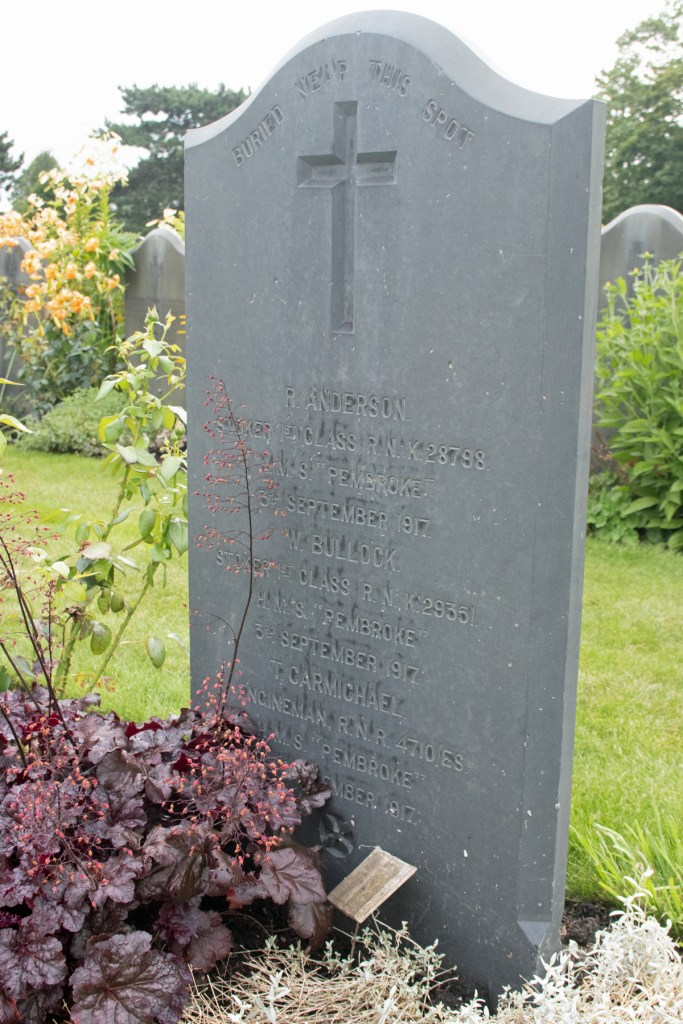
Stoker 1st Class Robert Anderson

Stoker 1st Class Robert Anderson

Robert Anderson was born on 4th September 1889, one of ten children – of whom tragically only three survived – to James and Emily Anderson. James was a storekeeper from Belfast, who had moved his family to Preston, Lancashire, but who had subsequently moved them back to Northern Ireland after Robert had been born.

In 1911, while working as a town labourer, Robert had met and married Rebecca Barkley; the couple went on to have to children, Mary and Agnes.

War was coming to Europe, however, and Robert was keen to play his part. He enlisted in the 3rd Battalion of the Royal Irish Rifles and, according to a subsequent newspaper report, saw action at Mons and the Marne early in the conflict.

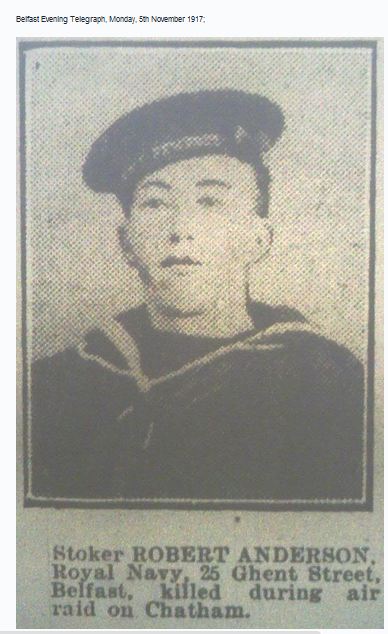
The Belfast Evening Telegraph reported that “He completed his time, and instead of re-enlisting in the Army, he joined the Navy.” [Thursday 4th October 1917] Given that Robert enlisted in the Royal Navy in the autumn of 1915, this raises the question of how he left the army at the height of the conflict, particularly given that the same report suggests that he had come through the major battles “unscathed“.

Either way, Private Anderson made the move to Stoker 2nd Class on 10th November 1915. He record show that he stood 5ft 5.5ins (1.66m) tall, had fair hair, brown eyes and a fresh complexion. On his arms he sported a number of tattoos; a lady, crossed flags and a ship on his right, and his initials on the left.

Robert’s first posting was HMS Pembroke, the Royal Naval Dockyard at Chatham, Kent, where he received a couple of months’ training. He was then assigned to HMS Egremont, also known as Fort St Angelo in Birgu, Malta, where he spent a couple of months. Stoker Anderson then returned to England, serving at HMS Victory, the Royal Naval Dockyard in Portsmouth, and gaining a promotion to Stoker 1st Class in the process.

By August 1917, he had returned to HMS Pembroke. The Dockyard was particularly busy that summer, and the large number of extra servicemen meant that Robert was billeted in temporary accommodation in Chatham Drill Hall.

On the 3rd September 1917, the first night air raid carried out by the German Air Force bombarded the town, and scored a direct hit on the Drill Hall; Stoker 1st Class Anderson was among those killed instantly. He was a day short of his 28th birthday.

Robert Anderson was laid to rest, along with the other victims of the Chatham Air Raid, in the Woodlands Cemetery, Gillingham.


Larger memorial image loading...
Stoker 1st Class Robert Anderson
(from findagrave.com)