Cuthbert Kean was born on 2nd October 1862, the eldest of four children to John and Jane Kean. John was a tailor from Manchester, who brought his young family up in the town of Crook, County Durham.
Cuthbert followed in his father’s footsteps and, by the time of the 1891 census – when he was 26 years old – was lodging in central Edinburgh, and was working as a tailor.
There is little more information available on Cuthbert’s early years. When war broke out, he enlisted in the Royal Navy, joining up on 26th October 1914. His papers show that he stood 5ft 2ins (1.57m) tall, had a fair complexion and grey eyes.
By 1917, having turned 55, he was transferred to the Royal Naval Reserve, and worked as a Trimmer – an alternative title for a Stoker. He had served on a number of vessels, joining HMS Firefly towards the end of the war.
Early in 1919, Trimmer Kean was admitted to the Royal Naval Hospital in Chatham, Kent, suffering from a sarcoma of the neck. Sadly, he was to succumb to this, and he passed away on 4th March 1919. He was 58 years old. His records give his next of kin as his sister Mary, who was living in Durham.
Cuthbert Kean was laid to rest in the Woodlands Cemetery in Gillingham, Kent.
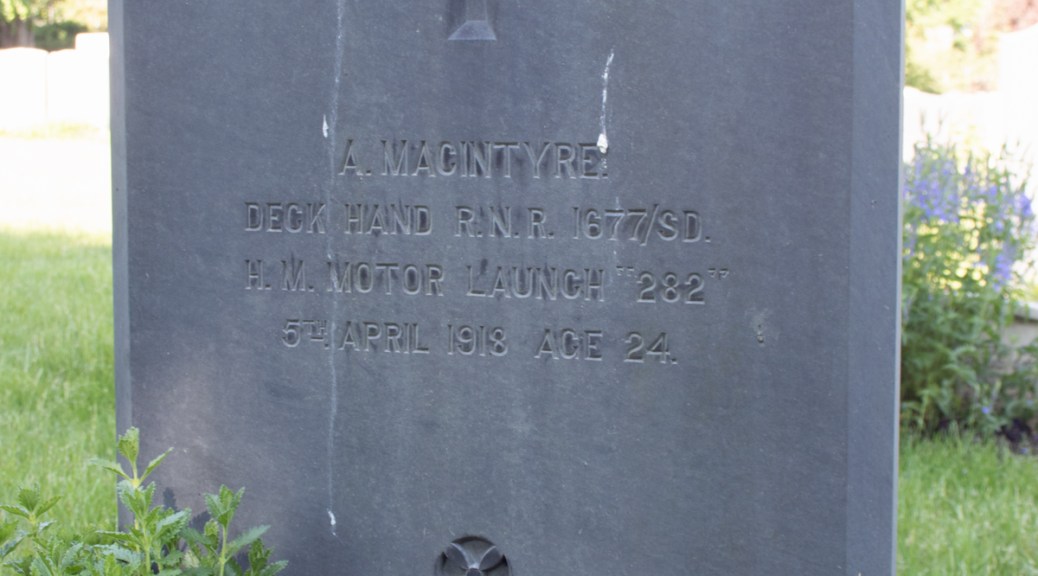
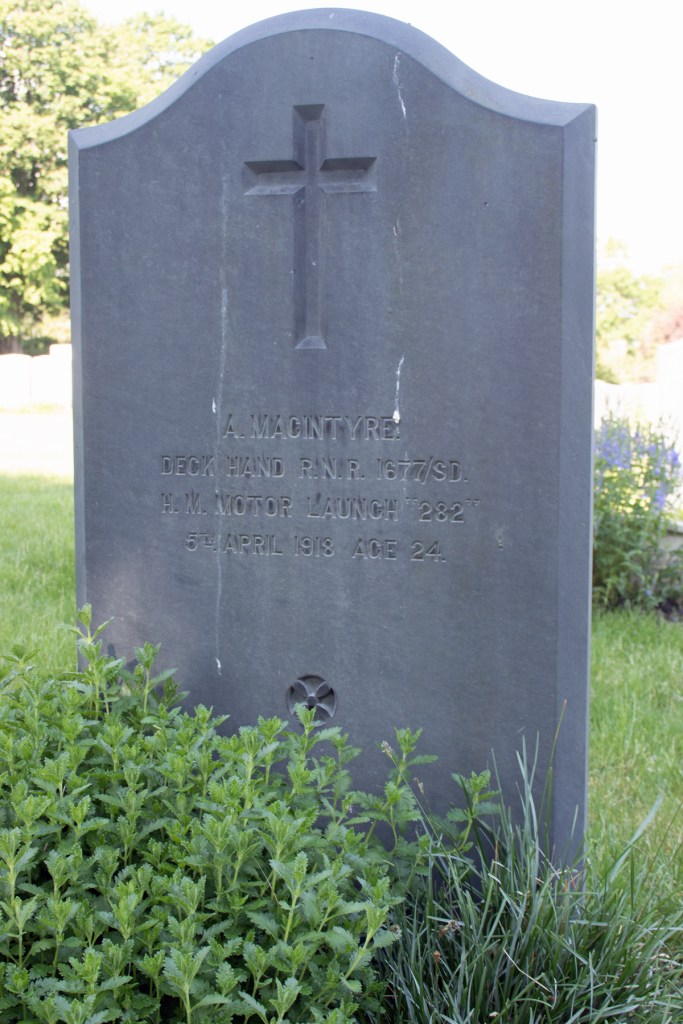
Angus MacIntyre was born on the island of Eriskay in the Outer Hebrides on 9th October 1894. One of eleven children, his parents were fisherman Malcolm McIntyre and his wife Flora.
Sadly, there is little information on Angus’ early life and military service. He was still living in the Scottish Islands by the time of the 1911 census, and enlisted in the Royal Naval Reserve when war broke out.
In April 1918, Angus was acting as a Deck Hand on Motor Launch 282 in the North Sea, supporting the “Zeebrugge Raid”, an attempt by the Royal Navy to block the Belgian port by scuppering obsolete vessels in the canal entrance.
Full details are not clear, but it would seem that the vessel Deck Hand MacIntyre was serving on was ferrying men between some of the ships that were being scuppered. When it was trying to manoeuvre it’s way out of the Zeebrugge Canal, it came under heavy machine gun fire, and a number of people on board were shot.
The motor launch managed to get clear of the fighting and returned to England. Unfortunately, Angus was one of the victims of the German gunfire. He was just 23 years of age.
The boat sailed back to the Naval Dockyard in Chatham, Kent. Angus MacIntyre was laid to rest in the nearby Woodlands Cemetery.
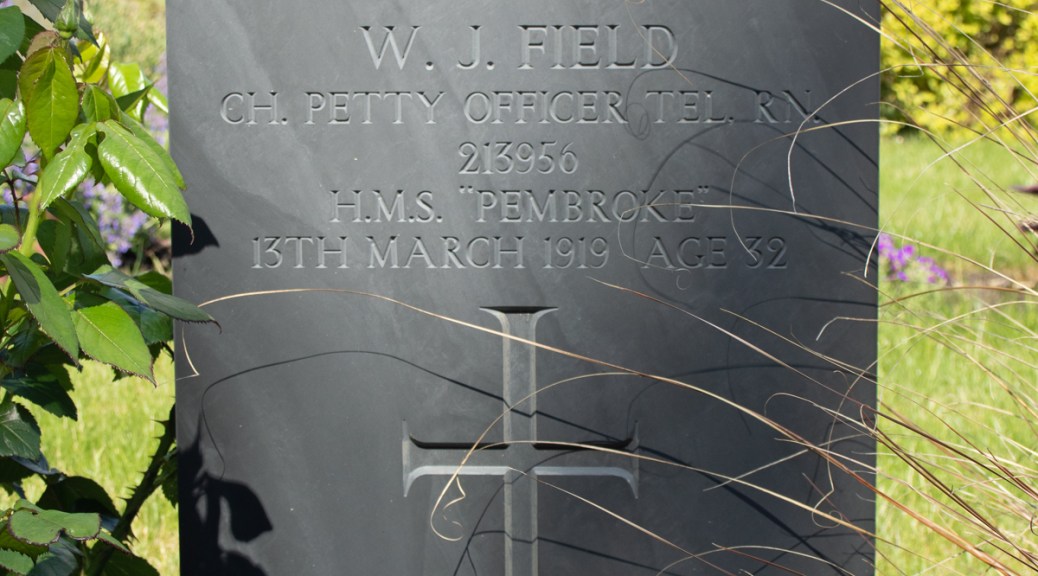
William John Field was born on 8th October 1885 in Boston, Lincolnshire. The eldest of four children, his parents were Charles and Ellen. Charles was a boatman for the coastguard; his job, by the time of the 1891 census, had taken the family to the village of Dawdon on the County Durham coastline.
Given his father’s job, it is not unsurprising that William was destined for a life at sea. As soon as he left school in the spring of 1901, he joined the Royal Navy and was sent to HMS Ganges, the shore-based training establishment in Suffolk. Being underage, he was initially assigned the role of Boy, moving, after a year, to HMS Pembroke, also known as the Naval Dockyard in Chatham, Kent.
By November 1902 Boy Field was moved to HMS Venerable, a ship that was to be his home for the next three years. During this time, William came of age, and was formally enrolled in the Royal Navy as a Signalman. He evidently worked hard on the Venerable, rising through the ranks to Qualified Signalman and Leading Signalman.
In June 1905, William was moved to HMS Leviathan, where he was again promoted, to Second Yeoman of Signals, before again being assigned to Chatham Naval Dockyard six months later.
While based in Kent, William met Nelly Watt, the daughter of a labourer at the dockyard. The couple married in 1906, and went on to have four children.
Over the next few years, the now Petty Officer Telegraphist Field spent an almost equal amount of time at sea and on shore. War was coming and when his initial term of service came to an end in October 1915, he immediately renewed his contract through to the end of the hostilities.
All of William’s time was now spent on land, primarily at HMS Pembroke, but also at HMS Actaeon in Portsmouth, HMS Victory VI at Crystal Palace, London and HMS Bacchante in Aberdeen.
While Chief Petty Officer Telegraphist Field’s naval service records are quite detailed, his passing is anything but. The war over, he moved back to Chatham Dockyard in January 1919. At some point he was admitted to the Royal Naval Hospital in the town, and died from ‘disease’ on 13th March that year. He was just 33 years of age.
William John Field was laid to rest in the Woodlands Cemetery in nearby Gillingham.
A sad aside to the story is that, at the time of he husband’s death, Nellie was pregnant with the couple’s fourth child. John William Field was born on 16th October 1919, destined never to know his father.
Arthur William Langdon was born on 23rd December 1882, the son of Rose Langdon, from the Somerset village of Chiselborough. While Arthur’s father is lost to time, Rose married Frederick Hockey in 1886, and the couple went on to have three children – half-siblings to Arthur.
Arthur was destined for a life of adventure, and in 1902, at the age of 19, enlisted as a Rifleman in the King’s Royal Rifles, a career that was to last more than a decade.
On 13th April 1903, Arthur married Florence Beatrice Druce, who was also from Chiselborough. Noticeably absent from the marriage certificate was the name of the groom’s father; he was simply marked as ‘unknown’. The newlyweds would go on to have a son, also called Arthur, the following year.
Rifleman Langdon was soon destined for service overseas, however. After 18 months in South Africa, he returned to England for a year. He was sent to India for four years; it is likely that Florence went with him, or at least that Arthur returned home on leave during this time, as two further children – Henry and Reginald – were born in 1907 and the summer of 1910 respectively.
Arthur returned to England in February 1910, and remained on reserve home service – supplementing his income by working as a gardener – until the outbreak of the First World War. During this time he and Florence had two further children, Frederick, born in 1912, and Ivy, born just a month before war broke out.
With the start of the conflict, Rifleman Langdon was send to France as part of the British Expeditionary Force. After five months on the Western Front, he had a brief respite back in England, before being shipped back to France in May 1915, and on to Salonika in the Balkans that November.
Rifleman Langdon did not stay in Greece for long, however. Within a couple of months he was back in England and on 14th April 1916, he was discharged from the army on medical grounds. Sadly, details of the cause of his exit from the army are not detailed.
Arthur was not one to rest on his laurels, however, and continued work as a gardener and labourer. Military life wasn’t far away, though, and in June 1918, he enlisted again, this time joining the Royal Air Force as a Private.
Initially based at Long Sutton, Arthur moved to Edinburgh Castle in March 1919. Full details of his time there are lost, but he remained in Scotland until being demobbed at the end of April 1920.
Details of Arthur’s life back on civvy street are not available. All that can be confirmed is that he passed away on 28th February 1921, at the age of 38 years old. Arthur William Langdon was laid to rest in the graveyard of St Margaret’s Church in the Somerset village of Middle Chinnock, where his widow now lived.
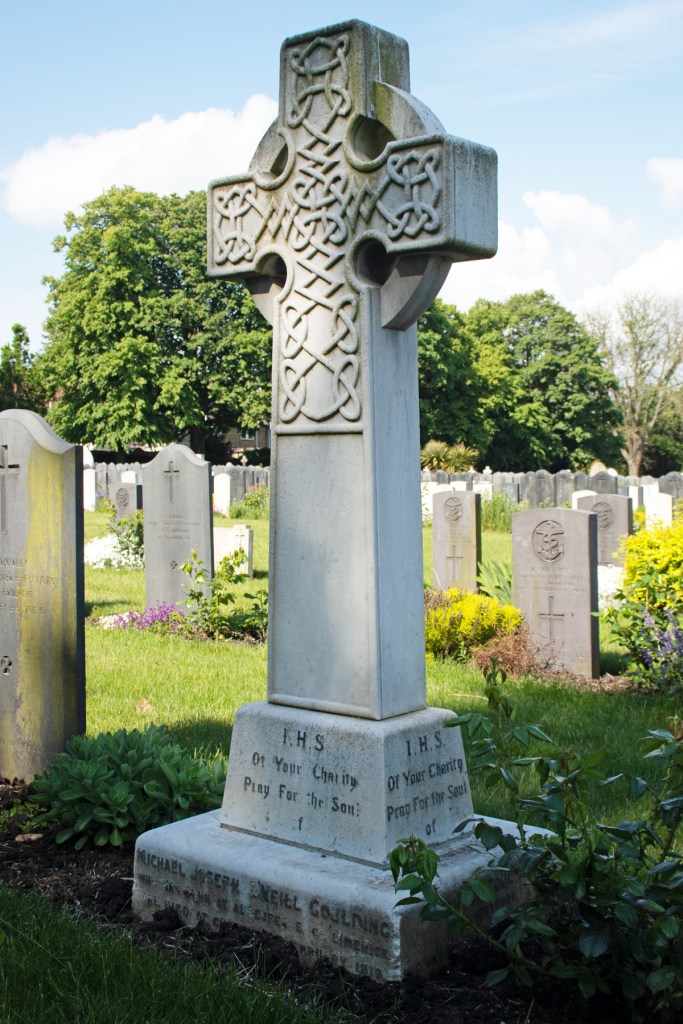
Michael Joseph O’Neill Goulding was born on 5th May 1884, the oldest of six children to Michael and Ellen Goulding (née O’Neill). Michael Sr worked for the inland revenue and his job took him around most parts of the British Isles.
Michael Jr had been born in Limerick – both of his parents came from Ireland – but his subsequent three siblings (Patrick, Margaret and William) had all been born in Scotland. His second youngest sibling, Lily, was born in County Durham, the youngest back in Scotland, while, by the time of the 1901 census, the whole family were living in Forest Gate, East London.
The census also shows that Michael Jr, having left school, was working at Customs House (presumably where his father was employed), as a boy copyist on tea accounts. The inland revenue at that time was a career for life; by the next census in 1911, the family had moved to Hertford, where Michael Sr was a customs and excise supervisor, and Michael Jr was an assistant clerk at the same place of employment.
War was on its way, but Michael seems not to have enlisted immediately. While specific dates for his joining up are not available, it appears that he was still working for the Inland Revenue when he got married in Shoreditch, in April 1917. His wife was called Bridget Mary Gough (known as Bryde), and she had also been born in Ireland. The couple went on to have a daughter, Ellen (or Eileen), the following year.
By this time, Michael had definitely enlisted. He joined the Royal Naval Volunteer Reserve, and was based at HMS Pembroke, the shore-based establishment in Chatham, Kent. This was the location for the Navy’s main accounting base, so it is likely that he was employed for financial, rather than his military, skills.
Able Seaman Goulding served through to the end of the war and beyond, and it was while he was based in Kent that he became unwell. Admitted to the Royal Naval Hospital in Chatham, he succumbed to a combination of bronchitis and pneumonia on 22nd February 1919. He was 34 years of age.
Michael Joseph O’Neill Goulding was laid to rest in the Woodlands Cemetery in nearby Gillingham. His family were still in Hertford, while his widow and daughter moved back to Ireland.
Michael Joseph O’Neill Goulding (courtesy of ancestry.co.uk)
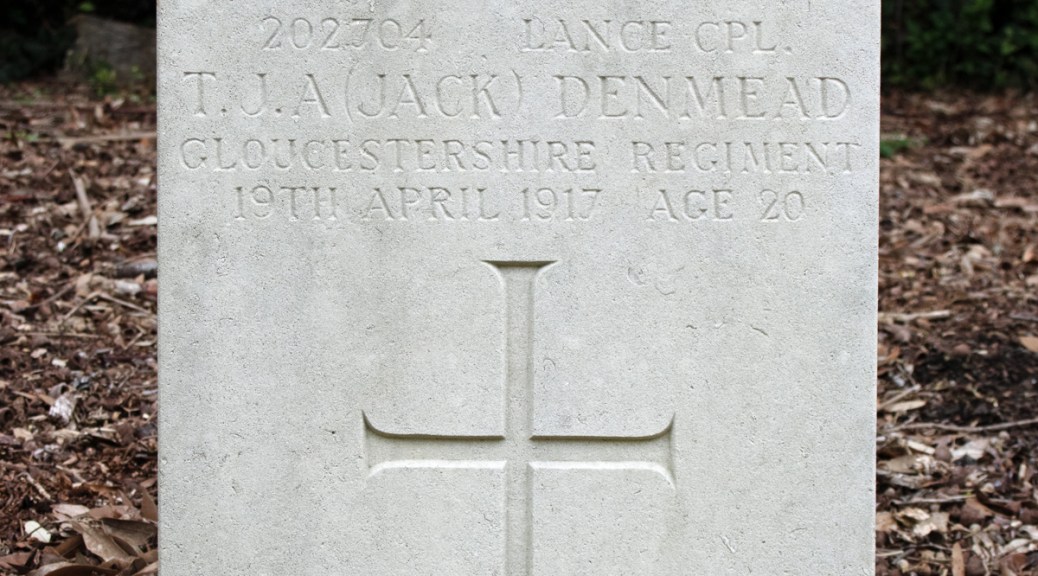
Thomas John Ambrose Denmead – better known as Jack – was born in Yeovil in the summer of 1896. The oldest of seven children, his parents were Thomas and Elizabeth Denmead. Thomas was a glover – the key industry in the Somerset town – who raised his young family in the middle of the town.
When he left school, Jack found work as a clerk at Petters’ Ltd, a local engine manufacturer and iron foundry. War was on the horizon, though, and he enlisted in the spring of 1916.
Jack joined the Gloucestershire Regiment, and was assigned to the 2nd/4th (City of Bristol) Battalion. He was sent to France in May 1916, and was involved in the Attack at Fromelles, part of the larger Somme offensive. He had started as a Private, but rose to the rank of Lance Corporal.
Towards the end of 1916, Jack fell ill. He was medically evacuated to the UK, and was admitted to the Royal General Infirmary in Paisley, Scotland. His condition was serious enough to need an operation, but the Lance Corporal sadly passed away not long after this treatment. He was just 20 years of age.
Jack’s body was brought back to Somerset for burial. He was laid to rest in the cemetery in his home town, Yeovil.
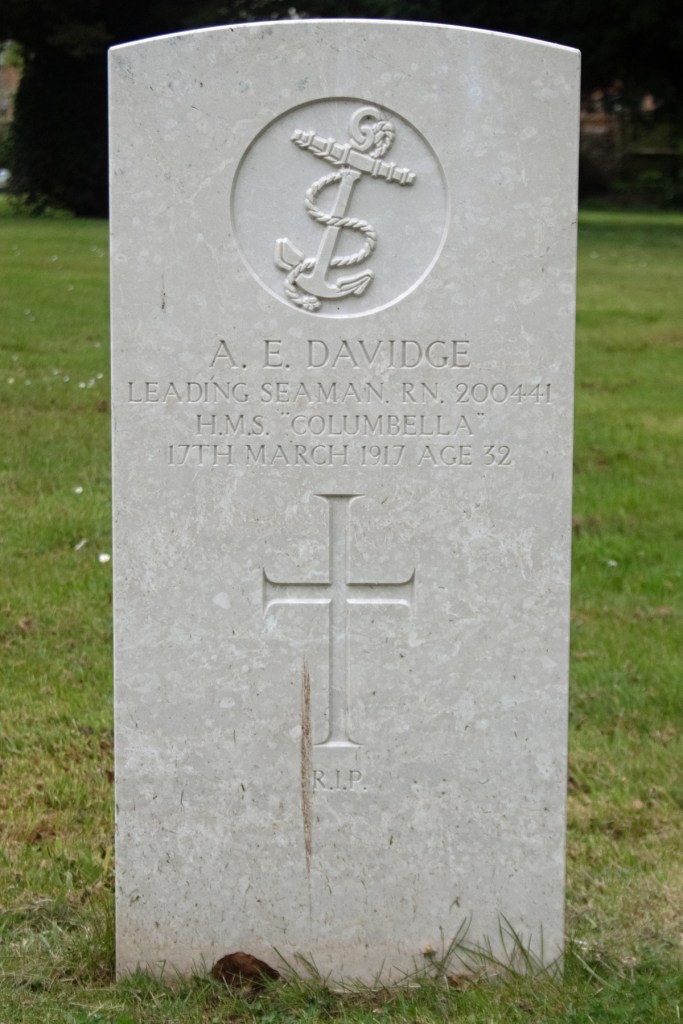
Alfred Ernest Davidge was born on 22nd July 1882, one of six children to Richard and Ermina. Richard was a boilermaker from Bristol, but brought his family up in the Wiltshire town of Swindon.
Alfred was keen on adventure, and sought out a live on the open seas. In August 1898, at the age of sixteen, he joined the Royal Navy. After serving two years at the rank of Boy, he officially enlisted for a term of twelve years.
Starting as an Ordinary Seaman, Alfred had worked his way up to Leading Seaman by 1905. He continued in this role until 7th June 1909, when he was knocked back a rank for misconduct. He evidently realised the error of his ways, however, as, just over a year later, he was promoted again.
Leading Seaman Davidge’s term of service came to an end in July 1912, and, having been assigned to seventeen vessels during that time, he became part of the Royal Naval Reserve.
Back on home soil, and Alfred set up home in Taunton. He found work as a labourer and, in October 1913, married local lady Louisa Pomeroy. The couple went on to have a daughter, Hilda.
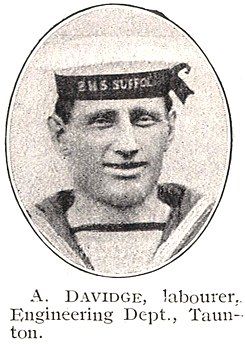
Storm clouds were gathering over Europe by now, and Alfred was soon recalled to the Royal Navy. He took up his previous role, and, after a period of training at HMS Vivid in Plymouth, he was assigned to HMS Suffolk.
Leading Seaman Davidge spent eighteen months aboard HMS Suffolk (during which time the photo below was taken), before being transferred to HMS Columbella in November 1916. His time there was short, however, as he became unwell.
Admitted to the Royal Infirmary in Glasgow with influenza, Leading Seaman Davidge sadly succumbed to the condition on 17th March 1917. He was 34 years old.
Alfred Ernest Davidge was brought back to Taunton for burial. He lies at rest in the St James Cemetery in the town.
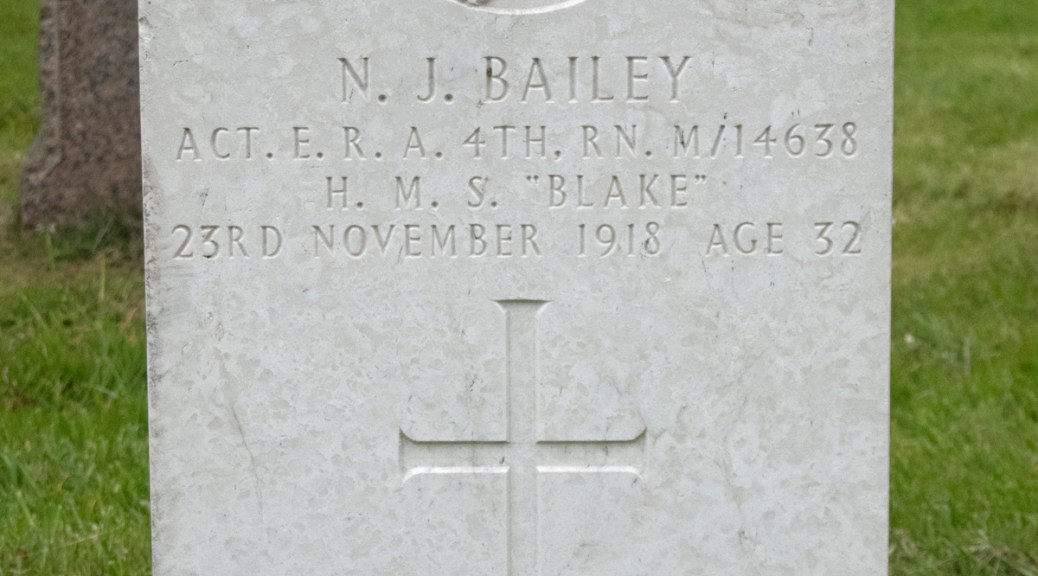
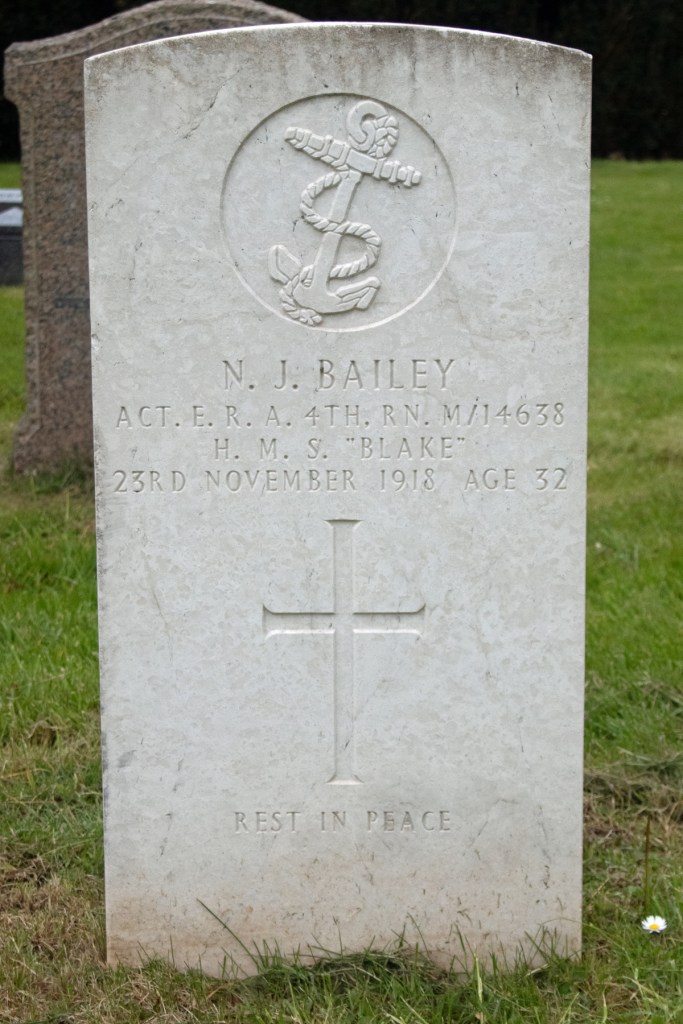
Newman Joynt Bailey was born on 1st August 1887, the eldest of five children to Newman Bailey and his wife Anna (née Joynt). Newman Sr worked as a switchman and signalman for Great Western Railway and had been born in Bath. He married Anna (whose maiden name was Joynt, and who had been born in Ireland) in 1885 and, after a short stint living across the county border in Devon – where Newman Jr was born – he settled his young family in Taunton.
When Newman Jr left school, he became an office boy, but he soon found himself following in his father’s footsteps. He became a fitter for the railways and, by 1910, was living with spitting distance of the GWR depot in the town.
It was here, in William Street, that he set up home with his new wife, Lily Gill, who he had married on 31t July 1910. Lily was the daughter of a Taunton lamplighter, and, to help make ends meet, worked as an ironer at the town’s collar factory.
War was on the way, and in July 1915, Newman enlisted in the Royal Navy. After initial training aboard Vivid II, the shore establishment in Devonport, he was deployed on HMS Blake as an Engine Room Artificer.
HMS Blake was an auxiliary ship designed to provide maintenance support to a flotilla of destroyers or other small warships. With his experience with steam engines at GWR, his knowledge of mechanics would have made him ideally suited to this type of role.
While he survived the war, Artificer Bailey was to be struck down with something much closer to home. In the immediate post-war period, the Spanish Flu pandemic swept the globe, and Newman was to fall victim to it. Admitted to the Royal Naval Hospital in South Queensferry, near Edinburgh, he passed away from the lung condition on 23rd November 1918. He was just 32 years old.
Brought back home, Newman Joynt Bailey was laid to rest in St James Cemetery in his home town of Taunton.
There are some lives that just don’t want to be discovered, that just hide tantalisingly out of reach. James Davidson’s was one of those lives.
The main two research websites I use – cwgc.org and findagrave.com – only have his initial and surname, which is understandable, as this is what is inscribed on his headstone. Unfortunately, that doesn’t act as a good base on which to carry out further research.
HMS Gunner was the wartime moniker for Granton Harbour, near Edinburgh. A naval history website managed to identify Chief Artificer Davidson’s first name – James – but again, with no other information to go on, this is still too common a name – particularly in Scotland – to narrow down any real results.
Sadly, then, the story behind James Davidson is destined to remain a mystery. All that can be confirmed for certain is that he passed away on 23rd January 1919, though the cause of his passing is lost to time, as is his age.
James Davidson lies at rest in the Woodlands Cemetery in Gillingham, Kent.
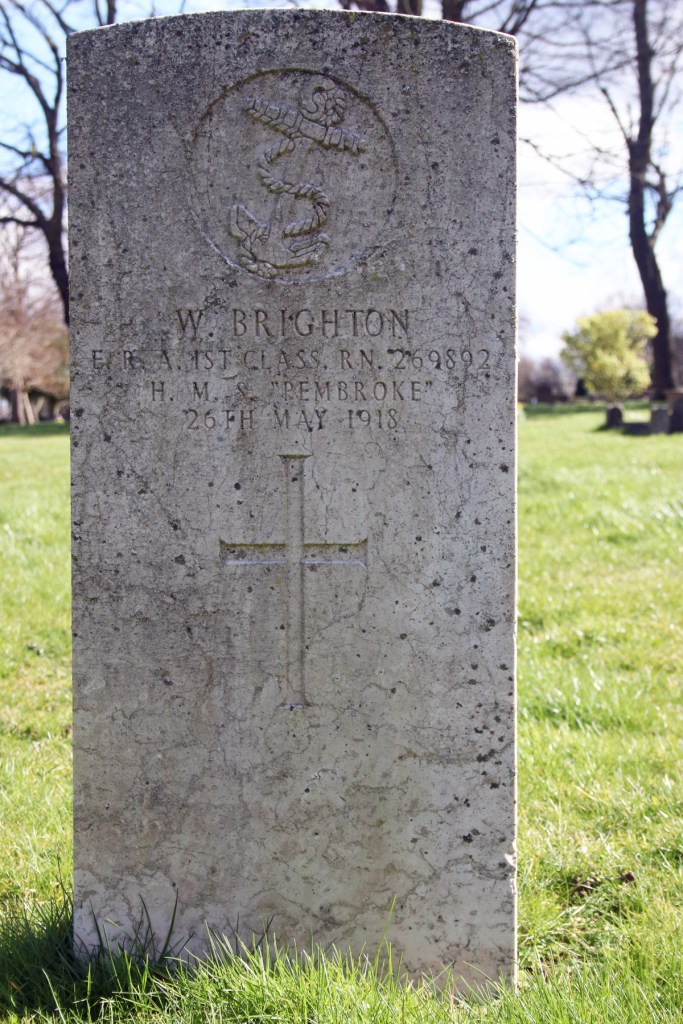
William Brighton was born on 13th August 1877 in Peterborough, Northamptonshire. Sadly, details of his early life are lost to time, so his parents’ names, and details of any siblings are a mystery.
William chose a military life early on; he enlisted in the Royal Navy in October 1899 for twelve years’ service. Working as an Engine Room Artificer, he was an engine fitter and repairer on a number of vessels in his time, including the battleship HMS Repulse and the cruisers HMS Andromache and Scylla.
William married Lily Franklin in the autumn of 1904, and the couple went on to have three children; Mona, Lily and John. With William away at sea a lot of the time, Lily set up home in Gillingham, Kent, close to the shore facility – HMS Pembroke – where her husband was based.
The uncertainty around potential conflict meant that William extended his service when it initially came to an end in November 1911. He continued to serve on a number of vessels during the war and was based on a ship off the Scottish coast when he fell ill in May 1918.
William was transferred to the US Hospital in Strathpeffer, near Inverness, suffering from an abdominal aneurysm. Sadly the treatment did not work, and he passed away on 26th May 1918. He was 40 years old.
William Brighton lies at rest in the Woodlands Cemetery in Gillingham, Kent.











 Death and Service