Category Archives: Somerset

Private Henry Yard

Private Henry Yard

Henry George Yard was born on 25th October 1884 in the Somerset village of Burnham-on-Sea. The second of seven children, his parents were John and Elizabeth Yard. John was a railway porter, but Henry chose a different route, becoming a mason’s labourer.

Henry’s work took him to South Wales, where he took up a position as a pit mason. The 1911 census recorded him as boarding in a six-roomed house in Abertillery, Monmouthshire. From the document there can be no mistaking that this was a mining community. The head of the household for 70 New Gladstone Street was 28-year-old Albert Francis, colliery banksman. He lived there with his wife, Martha, who was fifteen years older than him, and her three children: William, Herbert and Horace.

Martha had been married previously, to coal miner Walter Mutter. Both had been born in Somerset, and had come to South Wales like so many other families, because of the work. Walter died at the beginning of 1909, leaving his widow to raise three children on her own. It seems likely that this is where Albert stepped up: it was not unknown for mine workers to support each other in times of dire need. He married his former colleague’s widow in the autumn, securing a future for her and her family.

According to the census record, the Francis family had one other boarder and all but Martha and Horace worked in the local colliery in one way or another.

There seemed to have been money in Henry’s career move, as it set him up to marry Gertrude Coombes on 6th August 1912. She was a gardener’s daughter from Berrow in Somerset, and eight years younger than her husband. The couple married at St Mary’s Church, Berrow, and appeared to settle back in South Wales. They went on to have two children: Gertrude, who was born the following year, and Daisy, who came along in 1916.

When war came to Europe, Henry was called upon to play his part. He enlisted in October 1915, and was initially assigned to the 3rd Battalion of the Welch Regiment. His service records show that he was 5ft 6ins (1.68m) tall, and weighed 133lbs (60.3kg). He was noted to be of good physical development, although dental treatment was required.

Private Yard transferred to the Machine Gun Corps at some point, and by the autumn of 1916 was sent to Greece. He remained there for nearly two years, but became dogged by malaria in later months there. Initially coming down with the condition in August 1917, he spent the remainder of the war in and out of hospital as attacks of the condition came and went.

Initially returning to home soil and placed on reserve status, Henry was eventually discharged on medical grounds at the end of 1918. He returned to the family home. He was not to be there for long, however: debilitated by malaria, Henry passed away in Bedwellty on 23rd March 1919, at the age of 34 years old.

With strong family connections in Somerset, Gertrude took her husband back there to be laid to rest. Henry George Yard was buried in the tranquil graveyard of St Mary’s Church in Berrow.


Private Henry Yard
(from ancestry.co.uk)

Gunner Lot Evans

Gunner Lot Evans

Lot Evans was born in Street, Somerset, on 30th October 1895. The second of two children, his parents were George and Elizabeth Evans. Lot’s mother had four children from a previous marriage and, by the time of the 1901 census, the family had set up home in the coastal village of Brean. George was employed as a farm labourer there, as were Lot’s older half-brothers.

When Lot completed his schooling, he also found work as a farm labourer. The next census return, in 1911, recorded the family of four still living in Brean. George had eased up on the manual work – he was 67 by this point – and was employed as a domestic gardener. Lot’s older brother Ben was a bricklayer’s labourer, so there were three wages – albeit probably meagre ones – coming in to support the household.

When war came to European shores, both Lot and Ben stepped up to play their part. Lot enlisted on 10th November 1915, but was not actually mobilised until January 1918. He joined the Royal Garrison Artillery as a Gunner, and was assigned to the 4th Siege Battery.

On 28th March 1918, Lot married his sweetheart, Hester Puddy. Theirs was to be a brief honeymoon, as he was sent to France just three days later.

Gunner Evans remained overseas until the end of the year, returning home on 5th February 1919 in advance of being demobbed.

He was very ill with influenza. He went to bed and we had the Doctor. It developed into pneumonia and he died last night [13th February 1919].

Letter from Private Ben Evans to the Royal Garrison Artillery

Gunner Evans was just 23 years old when he died. The letter sent by his brother – who was also at home and waiting to be demobbed from the Wiltshire Regiment – explained that Hester was living with their family and his question to the regiment concerned how to claim his brother’s pension.

Lot Evans was laid to rest in the graveyard of St Bridget’s Church in Brean. Now surrounded by caravan parks and holidaymakers, at the time, this would have been a place of sanctuary bordering the Somerset coastline.


Private Victor Sperring

Private Victor Sperring

Victor William Sperring was born in the spring of 1897, in Lympsham, Somerset. One of nine children, his parents were James and Catherine Sperring. James was a farmer, 22 years older than his wife and, when he died in 1904, she was left to bring up the family alone. She remarried, to dairy farmer Frederick Butler, continuing the farming life.

Frederick died in 1914, and with her older children now in their 20s, Catherine’s sons took up the reins to keep the farm going. War was on the horizon now, and tragedy was never going to be far from the Sperring household.

Of the five brothers, at least two – Victor and his older brother, Hubert – stepped up to serve their King and Country. Hubert joined the Gloucestershire Regiment, rising to the rank of Lance Corporal in the 1st/6th Battalion. He was caught up at the Battle of the Somme, and was recorded as missing, presumed killed, on 21st July 1916. He was just 23 years of age, and is one of the tens of thousands of names commemorated on the Thiepval Memorial in Northern France.

Victor also joined the Gloucestershire Regiment, but his story is less clear. Certainly by 1918 he was attached to one of the regiment’s depots, possibly on home soil. He was admitted to the 2nd Southern General Hospital in the autumn of 1918, and this is where he passed away on 16th November. He was just 21 years of age.

Victor William Sperring was brought back to Lympsham for burial. He was laid to rest in the family plot in St Christopher’s Churchyard.


It seems likely that illness is what took Victor’s life. Just a month later, his sister, Annie, also passed away: she was interred next to her brother.

Catherine’s grief must have been indescribable, having lost a husband and three children in a matter of years. She continued on, however, and, by the time of the 1939 England and Wales Register, she was living with her son Roland, supporting him with his farm. She died in October 1941, at the age of 77: she was buried with her family in St Christopher’s.


Cadet Richard Whitting

Cadet Richard Whitting

Richard Harcourt Whitting was born on 21st March 1900 in the Somerset village of Uphill. The younger of two children, his parents were local landowner and Justice of the Peace Charles Whitting and his second wife, Jessie. The 1911 census records father, mother and two children residing at Uphill Grange, where they were supported by six live-in staff: a cook, parlour maid, two house maids, a kitchen maid and a nurse.

As the son of a gentleman, education was an expected prospect for young Richard. Indeed, after finishing his schooling locally, he was sent to the Royal Military College in Sandhurst.

He entered the school in 1913 and left in April 1918. He was then Head of the Modern Side, and also a good runner who achieved a fine record when he won the Junior Athletic Cup and, still more, as mentioned in a notice of him in the Meteor of October 16th, 1918… “he had very delightful manners, and a sympathetic appreciation of the difficulties of other people, which is less rare in women than in men. These qualities, combined with a great fund of common sense, made him a particularly helpful and agreeable companion in all kinds of occupations, from spraying a potato field to managing a House.

He was intended for the University and the Bar, but the War caused him to leave School early and to go to the [Royal Military College], Sandhurst. There he showed himself a most promising Cadet, and continued his athletic successes by winning the Mile and being in the winning team in the Relay Race.

Memorials of the Rugbeans Who Fell in The Great War, Volume VIII

It was while he was at the college, that Richard met his untimely end.

On Saturday [21st September 1918] a cadet of the Royal Military College, named Richard H Whitting, was killed while cycling along the Bagshot main road near St Alban’s Church. Deceased, who was accompanied by two other cadets’ names respectively Money and Shute, was holding on to the rear of a motor vehicle, when his bike swerved, and he was thrown on his head. At the inquest a verdict of “Accidental death” was returned.

Reading Mercury: Saturday 28th September 1918

Cadet Whitting was just 18 years of age when he died. His body was brought back to Somerset for burial: he was laid to rest in the family plot at St Nicholas’ Church in Uphill.


Cadet Richard Whitting
(from fold3.com)

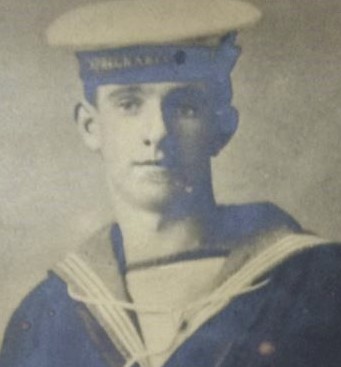
Ordinary Seaman Walter Nipper

Ordinary Seaman Walter Nipper

Walter Henry Nipper was born on 21st September 1900 in Bleadon, Somerset. The oldest of four children, his parents were Gilfred and Rose Nipper. Gilfred was an agricultural labourer turned butcher and poultry dealer, and, by the time of the 1911 census, he had set up a retail business in the middle of the village.

Walter turned to farm work when he finished his schooling, but with war raging across Europe, he seems to have been one of the young men desperate not to miss out on the action. On 16th September 1918, just five days before he turned 18, Walter enlisted in the Royal Naval Volunteer Reserve. His service records confirm that he stood just 5ft 1.5ins (1.56m) tall, had black hair, hazel eyes and a fresh complexion. The document also noted that he had a scar on the back of his right hand.

Ordinary Seaman Nipper was sent to HMS Victory VI, the shore-based training vessel in Crystal Palace, Surrey, for his induction. It is likely that, when he left Somerset for the capital, that was the last time his parents saw him. Billeted in cramp barracks, with young men from across the country, Walter fell ill: he passed away on 10th October, just 24 days after joining up. He was barely 18 years of age.

Walter Henry Nipper’s body was brought back to Somerset for burial. He was laid to rest in the tranquil graveyard of St Peter and St Paul’s Church in his home village.


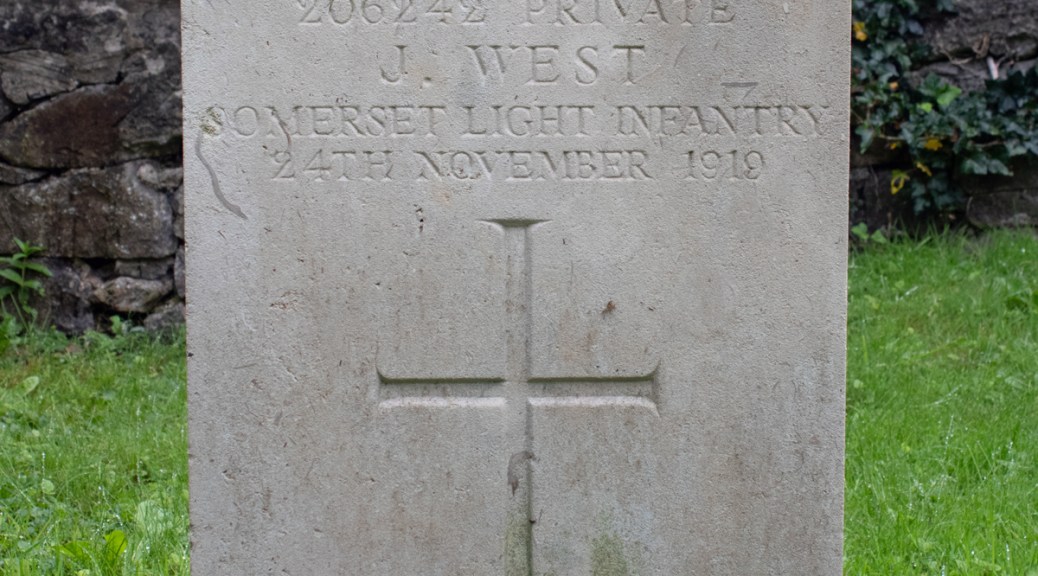
Private Jeremiah West

Private Jeremiah West

Jeremiah West was born in the spring of 1892, the oldest of eight children to John and Laura West. John was an agricultural labourer from Somerset, and it was in the village of Bleadon that the family were born and raised.

When he finished his schooling, Jeremiah followed in his father’s footsteps. By the time of the 1911 census, he was working as a servant on the nearby Shiplette Farm, where he was employed by Kate Poole.

War came to Europe in 1914, and Jeremiah stepped up to play his part. He enlisted in the Somerset Light Infantry in 1915, and was assigned to the 4th Battalion. Private West set sail for India that August, and seems to have remained overseas for some time.

Records are not clear, but it would appear that Jeremiah returned to Britain at some point, and became attached to the 3rd Battalion of the Bedfordshire Regiment. This was a garrison troop, based in Harwich, Essex, and Jeremiah found himself part of the battalion’s Labour Corps.

Private West survived the war, but came down with pneumonia in the autumn of 1919. He passed away on 24th November 1919: he was 27 years of age.

Jeremiah West was brought back to Somerset for burial. He was laid to rest in the peaceful graveyard of St Peter and St Paul’s Church in his home village of Bleadon.


Private William Griffin

Private William Griffin

William Richard Griffin was born in the summer of 1899, the fourth of six children to James and Joice Griffin. James was from Somerset and worked as a superintendent for a life assurance company. He met his wife while working in Wales, and this is where their oldest three children had been born. By the time of William’s birth, however, James had moved the family back to Somerset, setting up home in the Weston area of Bath.

There is little information about William’s life. When war was declared, he joined the Devonshire Regiment, and was assigned to the 51st (Graduated) Battalion. His troop remained on home soil – remaining in Norfolk for the duration – so it is unlikely that Private Griffin saw any active service overseas.

William survived the conflict and returned home. He passed away, possibly due to an infection, based on what little is documented, on 22nd July 1920. He had not long turned 21 years of age.

William Richard Griffin was laid to rest in the graveyard of St Martin’s Church in Worle, near Weston-super-Mare.


Serjeant Thomas Wood

Serjeant Thomas Wood

Thomas Wood was born in Bristol, Gloucestershire, in the summer of 1862. The third of ten children, he was the oldest son to Thomas and Emma Wood. Thomas Sr was a cabinet maker, but his son was not to follow in his father’s footsteps, seeking a life of adventure instead.

Thomas enlisted in the army and, while documents relating to his early life are not readily available, the 1891 census recorded him as being billeted at the Cambridge Barracks in Portsmouth, Hampshire. A member of the Royal Artillery, he seems to have been enlisted for a while, as he had risen to the rank of Corporal.

In 1894, Thomas married Leah Barrett, who was born in Oxfordshire. The army life underscored where the family would settle. They had four children and, according to their ages, the Woods were in Liverpool by 1895, Gosport, Hampshire, in 1896 and Cork in Ireland by 1899. The 1901 census found the family living in Wicklow, with Thomas having now achieved the rank of Company Sergeant Major.

Ten years later, and Thomas had stepped away from the army life. Now 48 years of age, he and Leah had been married for 17 years. The couple had settled in the Worle, on the outskirts of Weston-super-Mare, Somerset, where Thomas had set himself up as a butcher, with Leah assisting him.

War came to Europe in 1914, and it seems that Thomas felt drawn to play his part once more. He joined the Royal Defence Corps as a Serjeant when it was formed in the spring of 1916, and was assigned to the regiment’s 263rd Company.

Little information is available about Serjeant Wood’s army service, but by the autumn he had been admitted to the Shell Shock Hospital (now the Maudsley Hospital) in Denmark Hill, London. His entry to the hospital, however, was actually due to kidney disease, and this was what would claim his life. Thomas died from a combination of nephritis and uraemia on 21st November 1916. He was 54 years of age.

Thomas Wood was brought back to Somerset for burial. He was laid to rest in the graveyard of St Martin’s Church in Worle.


Serjeant Thomas Wood
(from ancestry.co.uk)

Private Ernest Badman

Private Ernest Badman

Ernest John Badman was born in Wick St Lawrence, Somerset, on 28th September 1898. The second youngest of ten siblings, although only six survived childhood, his parents were farm labourer William Badman and his wife, Fanny.

There is little specific documentation for Ernest. War came to Europe in the summer of 1914, and he had enlisted in the Wiltshire Regiment by the winter of 1916.

Attached to the 4th (Reserve) Battalion, Private Badman seems to have been in his initial training period by the following spring. However, this was not to last long. He passed away while on home soil on 21st March 1917: he was just 19 years of age.

Ernest John Badman was brought back to his home village for burial. He was laid to rest in the sleepy graveyard of St Lawrence’s Church.


Private Maurice Lock

Private Maurice Lock

Maurice Lock was born in Nailsea, Somerset, the seventh child to William and Rebecca Lock. Dates of birth vary according to documents available: census records suggest he was born around 1884, although his military records put his year of birth as 1877.

Maurice had a total of eleven siblings, with names including Merrick, Britannia and Cinderella. His father was a licensed hawker and this was something of a family trade.

The 1891 census recorded the family living at The Heath in Nailsea, although, unusually, it was noted that “this family now residing in a house occupy a travelling van in summer.” By the time of the next census return, the family business was continuing, with eight members, Maurice included, recorded as being peddlers, hawkers and horse dealers.

On 23rd January 1909, Maurice married Emily Hughes. There is little information available about her, but the couple continued Maurice’s parents’ travelling lifestyle, and went on to have four children: Albert, Mary, Gladys and Agnes.

Maurice was called upon to do his duty when war came to Britain. He enlisted on 4th September 1916 and was initially assigned to the Duke of Cornwall’s Light Infantry. Private Lock’s service record shows that he was 39 years and 10 months old when he joined up, and that he stood 5ft 8ins (1.73m) tall. He was working as a basket maker and farm labourer when he received the call to enlist.

Private Lock spent a couple of months on home soil, before his troop – the 12th (Labour) Battalion – were sent to France. He remained overseas for some sixteen months, before three separate bouts of trench fever within a month saw his return to Britain’s shores.

Maurice was transferred to the Labour Corps at this point and, once he had recovered, it was to be presumed that his previous farm work would be called upon once more. However, his age and the conditions on the Western Front conspired against him, and he developed rheumatism, which led to his discharge from the army. His medical records at this point noted that “he walks very lame with the aid of a stick. His left leg is especially [bad]. He has pains in his back, legs and shoulders. These pains are aggravated by pressure and weather changes.”

Maurice returned home, but his time back in Somerset was to be brief. His health deteriorated, and he passed away at home on 29th June 1918: he was in his late 30s or early 40s when he died.

Maurice Lock was laid to rest in the peaceful graveyard of Christ Church in his home town of Nailsea.