Category Archives: Surrey

Private William Bellham

Private William Bellham

William Harry David Bellham was born in September 1888, the only child to William and Rosina Bellham. William Sr was a foreman for a collar manufacturer, and the young family lived in Taunton, Somerset, in a house they shared with Rosina’s mother, Mary Hale.

Life continued pretty much unchanged. When William Jr left school, he became a stenographer for a coal merchant, and, when war erupted in 1914, he didn’t sign up as soon as you would expect for someone of his age.

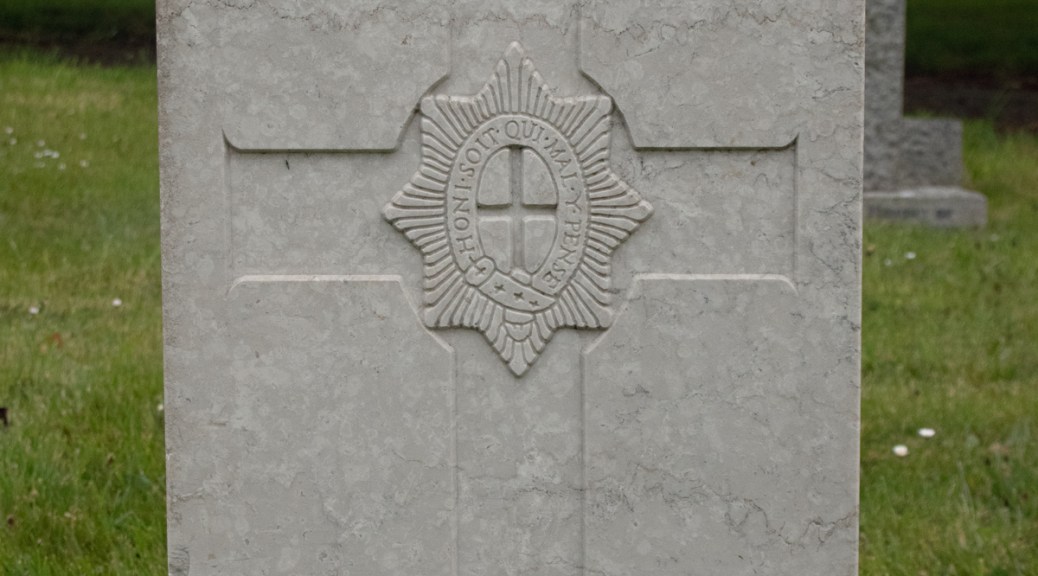
William enlisted in February 1916 and was assigned to the Coldstream Guards – given he stood 5ft 11ins (1.8m) tall, this probably went in his favour. Initially placed on reserve duty, Private Bellham was eventually mobilised in January 1917, and sent to Caterham for training.

Within a matter of weeks, William had an accident. Slipping on some ice, he suffered an inguinal hernia, which subsequently became strangulated, causing him severe pain. After initial treatment in hospital, he was discharged, but was then admitted again five months later when the hernia returned. A further operation was ruled out by the medical examiner, and he was discharged from the army on medical grounds at the end of June 1917.

Once back in Taunton, it did become necessary for William to undergo an additional operation. This was carried out in the local hospital and, according to the records, was a success. Sadly, however, William subsequently contracted pneumonia, and he died on 10th December 1917. He was just 29 years old.

William Harry David Bellham was buried in St Mary’s Cemetery in his home town of Taunton.


Cruelly, the contemporary local media had a less sympathetic take on the incident that caused William’s troubles. The Taunton Courier and Western Advertiser [on Wednesday 26th December 1917] suggested that he “was not really strong enough to stand the strain and hardships of military training and was invalided out after some months’ service.” Not exactly the picture that his medical records had outlined.


Private Richard Taylor

Private Richard Taylor

Richard Edmundson Taylor was born in 1895, one of nine children to Frederick and Emma Taylor. Frederick was from Portsmouth, Emma from Blackburn, but the couple had settled their family in Kent, where Frederick worked as an engineer and pattern maker at the Naval Dockyard in Chatham.

When he left school, Richard took work as an apprentice photographer – his older sister Mildred worked as a re-toucher in the same studio. The 1911 census reveals that his eldest sister, Alice, was working as a governess; the family of eleven were living in a small terraced house in Seaview Road, Gillingham – a road that, ironically, had no view of the nearby River Medway or Thames Estuary.

At this point, Richard’s trail goes cold. He enlisted in the Royal West Surrey Regiment – also known as the Queen’s – but there is no documentation to confirm when this was.

Private Taylor’s battalion, the 2/4th, would go on to fight at Gallipoli, but he would not have been involved, and, more than likely, did not see any overseas service. The prefix to his service number (T/2711) may well have indicated he was in training when he passed away, although, again, there is no physical evidence to confirm this.

Nor is there any indication of the cause of Private Taylor’s death. His name does not appear on any contemporary newspaper reports, so it is unlikely that it was due to any misadventure; more probably, he passed away from one of the many communicable diseases that became common in the training camps of the 1910s.

Whatever the cause, Private Taylor died at home on 4th February 1915. He was just 19 years old.

Richard Edmundson Taylor lies at rest in the Woodlands Cemetery in his home town of Gillingham, Kent.


Sergeant Ernest Coombs

Serjeant Ernest Coombs

Ernest Frederick Coombs was born in the summer of 1866. One of four children to cabinet maker Frederick Coombs and his wife Julie, the family lived in Leatherhead, Surrey.

Unfortunately, the documentation around Ernest’s life is a little scattered. What we do know is that he married Alice Amelia Kinnear in June 1889, and the couple went on to have fourteen children.

Jumping forward, and by the time of the 1911 census, the family were living in a small terraced house on the outskirts of Dover. Ernest listed his trade as a canteen managed for a provision merchant.

Sadly, Ernest’s military records are also lost to time. He enlisted in the Royal Marines Light Infantry, and was promoted to Serjeant during his time there.

The only other information available about him comes from the obituaries section of a local newspaper in March 1917:

COOMBS: On February 13th, at the Royal Naval Hospital, Chatham, after a short illness, Ernest Frederick Coombs, aged 50 [sic] years (late of 14 Leighton Road, Dover). RIP

Dover Express: Friday 2nd March 1917

Ernest Frederick Coombs was actually 49 when he died; he lies at rest in the Woodlands Cemetery in Gillingham, Kent.


Ernest’s grave was also the last resting place for his youngest son, Raymond, who died aged just twelve years old, two months after his father, and his widow, Alice, who passed away in 1954, at the age of 82.


Private Charles Embleton

Private Charles Embleton

Charles Embleton was born in Alexandria, Egypt, in 1891. One of five children, his father John was a captain in the army, and his wife, Sarah was based wherever he was.

Military service was obviously in Charles’ blood. He joined up in 1908, and was assigned to the Army Ordnance Corps. After three years’ service, he was moved back to the Reserves.

Charles had met Mary Cooper, a baker’s daughter, from Farnham. They married in September 1911, and, two months later, Mary gave birth to their daughter, Florence. Her baptism records show that, by this time, Charles was working as a registry clerk for his former Corps.

When war broke out, Private Embleton was remobilised and by 14th August 1914, he was in France. His service abroad was brief, however. Within a fortnight he had been shipped back to England and there he stayed until he was medically discharged in March 1915.

While no cause for his dismissal is evident from his service records, his war pension document confirms that, when he passed away, it was from tuberculosis, contracted while on active service. It is reasonable to assume, therefore, what his lung condition was the cause for his initial discharge.

It seems that Charles and his family had relocated to the south west of England when his service was completed. It was here that he died – on 20th July 1916 – at the age of just 25 years old.

Charles Embleton lies at peace in Shepton Mallet Cemetery in Somerset.