Category Archives: Tyne & Wear

Chief Yeoman of Signals Charles Welling

Chief Yeoman of Signals Charles Welling

Charles James Welling was born on 23rd October 1860, and was the oldest of three children to Charles and Ann Welling. The Wellings were a military family, Charles Sr employed as a Serjeant Instructor of Musquetry in the Parkhurst Barracks on the Isle of Wight when his son was born.

Ann had been born in South Africa while her Irish parents were based out there. She and Charles Sr married in Farnham, Surrey, presumably where the families were based by that point.

Charles Jr’s mother died in 1863, just a month after giving birth to his youngest sibling. His father married again, to Sarah Ash, and by 1871, the Wellings were living in barracks at the School of Musketry in Hythe, Kent.

Being his father’s son, Charles Jr was set to make his own mark on the world and, on 21st January 1876, he joined the Royal Navy. Too young to formally enlist, he was given the rank of Boy 2nd Class, and sent off to HMS Impregnable, the shore base in Devonport, Devon, for his training.

Over the next eighteen months, Boy Welling learnt his trade, spending time at HMS Ganges – another shore base near Ipswich, Suffolk – and the sloop HMS Penguin. It was here that Charles came of age in 1878, and he officially joined the Royal Navy with the rank of Ordinary Seaman. His service papers show that he was just 4ft 10.5ins (1.49m) tall, with light brown hair, blue eyes and a fair complexion.

Ordinary Seaman Welling career was to take a turn in 1880, when he began training as a signaller. His initial contract with the navy was for ten years, and, by the time that came to an end in May 1889, he had served on eight ships in all, rising through the ranks from Signalman 3rd Class, to Signalman 2nd Class in August 1881 and Qualified Signalman seven years later.

When Charles’ term of service came to an end, he immediately renewed it, and with the new contract came a promotion to Leading Signalman. The next decade saw him travel the world, returning to HMS Pembroke, the Royal Naval Dockyard in Chatham, Kent, in between voyages. His commitment to the role paid off: in March 1894 he was promoted to 2nd Class Yeoman of Signals. Just eight months later he took the rank of Yeoman of Signals.

It was around this time that Charles married the love of his life, Harriet Carlaw. Born in London, the couple exchanged vows in St Pancras, Middlesex, on 13th January 1894 and had a son, also called Charles, the following year.

Charles’ naval career continued its upward trajectory, and on 1st March 1898, he was awarded the rank of Chief Yeoman of Signals. By this point HMS Pembroke had become his permanent base and, at the end of his contract in 1899, he was stood down to reserve status.

The 1901 census shows what may have been a downward step for the Wellings: it recorded the family living in rooms at 136 Bayham Street, Camden, Middlesex, where Charles was working as a messenger.

Opportunities come in the most unexpected of places, however, and the following census found them living at Pier House, Sunderland, Tyne and Wear, where Charles was employed as a lighthouse keeper.

By this point, Charles had been invalided out of the navy for medical reasons. The writing on his service papers is unclear, and his dismissal seems to have been as a result of disease of gestes, possibly the neurological disorder dystonia.

When war broke out in 1914, however, anyone with experience was called upon to play their part. Given his age at the time, it seems likely that Charles volunteered for service, reporting to HMS Pembroke on 2nd August 1914. He was given his old rank of Chief Yeoman of Signals, and remained at the naval base for the next two years.

Charles’ health was definitely suffering by this point, and he was admitted to the Royal Naval Hospital in Chatham, in September 1916. Suffering from the heart condition endocarditis, this would take his life. He passed away on 16th September, at the age of 55 years old.

With Harriet still living in Sunderland, Charles’ body was laid to rest in Woodlands Cemetery, Gillingham, Kent, not far from the base he had called home for so long.


Charles and Harriet’s son had also stepped up to play his part when war broke out. Enlisting in the Royal Engineers, Pioneer Welling soon found himself in the Middle East. While serving in Palestine, he contracted malaria, and passed away from the condition on 16th October 1918. Charles was just 23 years of age, and was laid to rest in Haifa War Cemetery.

It is tragic to note that Harriet had lost her husband and her son within two years.


Second Lieutenant Clement Edwards

Second Lieutenant Clement Edwards

Clement Edward Arthur Edwards was born in the summer of 1898, and was the oldest of six children to Clement and Caroline Edwards. Clement Sr was a colonel in the army, and had been born in Dublin, Ireland. His wife hailed from Cheltenham, Gloucestershire, but it is clear that the family travelled as it grew, as each of the Edwards children were born in a different location. Clement Jr was born in Devon, while Caroline had given birth to his younger siblings in locations as distant as Sussex, Hampshire and the West Indies.

By the time of the 1911 census, Clement Sr had retired from duty. The family had settled back in Devon, and were living in the 12-roomed North Grange in the village of North Lew. Clement and Caroline employed five staff, including a cook, a nurse, a housemaid, a kitchen/parlour maid and a stable boy.

It seemed inevitable that Clement Jr would have followed his father into the army. Sadly his service records are lost to time, but a later newspaper report gives an insight into this time in the army:

Colonel and Mrs Edwards of Townsend House, Halberton, have the sympathy of all their friends and neighbours in the loss they have sustained by the death of their eldest son, 2nd-Lieut. Clement Edwards Alexander Edwards, of the Worcestershire Regiment, from pneumonia, following influenza, at the Northern General Hospital, Newcastle-on-Tyne [sic]. Edwards was formerly at Blundell’s School. He joined up at the earliest possible opportunity, obtaining a commission in his father’s regiment. He was a great favourite with all who knew him.

[Tiverton Gazette: Tuesday 10th December 1918]

Clement Edward Alexander Edwards died on 5th December 1918: he was just 20 years of age. His body was taken back to Devon for burial. He was laid to rest in the peaceful graveyard of St Andrew’s Church in Halberton.


Private George Babb

Private George Babb

George Henry Babb was born on 6th October 1900 in the village of Halberton, Devon. One of ten children, his parents were stonemason Clem Babb and his wife, Emily.

There is little documented about George’s life. The 1911 census records that he was still at school, and there is nothing to confirm the work he found when he completed his education.

George was not yet 14 years old when was was declared, and the Army Register of Soldiers’ Effects suggests that he didn’t enlist until the late spring of 1918. He was assigned to the Royal Warwickshire Regiment and was attached to the 5th Battalion.

Private Babb was sent to the north east for training, and it seems that he became unwell while there. He was admitted to the 1st Northern General Hospital in Newcastle-upon-Tyne, suffering from a combination of influenza and pneumonia. The conditions were to prove fatal: Private Babb passed away on 8th November 1918, a month after his eighteenth birthday.

George Henry Babb was taken back to Devon for burial. He was laid to rest in the peaceful graveyard of St Andrew’s Church in his home village of Halberton.


Corporal John Ashton

Corporal John Ashton

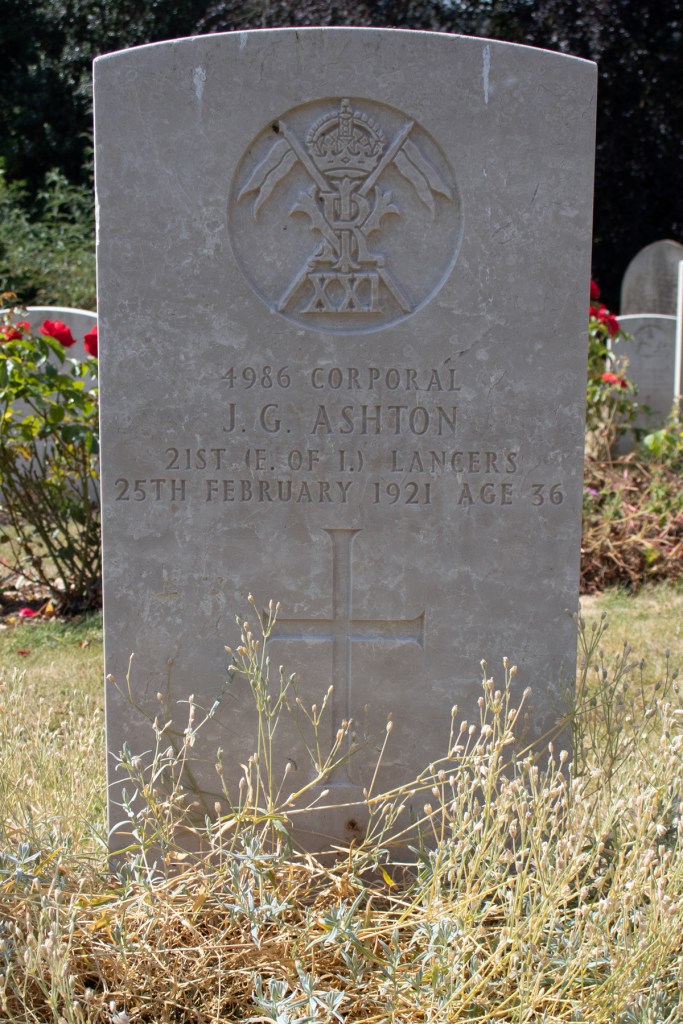
John Gordon Ashton was born at the start of 1885, and was one of at least two children to John and Elizabeth. Little information is available about his early life, although later records confirm that he was born in Newcastle-upon-Tyne, and that the family were living on Elswick Road, leading west out of the city, by 1900.

John found work as a musician, but sought a bigger and better career for himself. On 3rd October 1900, he enlisted in the army, joining the 21st (Empress of India’s) Lancers. His service records show that, at not yet sixteen years of age, he was just 5ft 1in (1.55m) tall, and weighed 101lbs (46kg). He had brown hair, grey eyes and a dark complexion, and two moles on the front of his left shoulder.

Private Ashton joined up for a period of 12 years’ service, and spent most of it on home soil. The army seemed to suit him, and he steadily rose through the ranks. By August 1901, John was promoted to Bandsman; five years later, he took the rank of Trumpeter; the start of 1908 brought with it a promotion to Lance Corporal.

In September 1910, John’s unit was sent to Egypt: the move brought him a further promotion. Corporal Ashton spent two years in Cairo, before returning to Britain in the autumn of 1912. He had completed his contract of service with the 21st Lancers, and was formally discharged from service on 4th October.

Back on civvy street, John once again found work as a musician. Life outside of the army seemed not to suit him, however, and he joined the reserve forces in March 1913. The now Lance Sergeant’s service records show the man he had become: he now stood 5ft 9ins (1.75m) tall, and bore a large oval scar on the underside of his right knee.

When war was declared the following summer, John was formally mobilised once more. He was attached to the 9th (Queen’s Royal) Lancers and, by 27th August 1914, was in France. Lance Sergeant Ashton’s time overseas was not to last long, however; he returned to Britain just before Christmas that year, and was based at Tidworth Camp in Wiltshire.

John’s military record was not without its hiccups. On 11th March 1910, while based in Canterbury, he was severely reprimanded for being in neglect of his duty whilst in charge of a barrack room. In 1915, however, he received a more severe punishment: on 23rd January, he was found guilty of using insubordinate language to his superior officer – in front of six ranking witnesses – and was demoted to Corporal.

It would seem that John’s health was beginning to suffer, and, after a career of nearly sixteen years, he was medically discharged from the army because of a heart condition.

At this point, his trail goes cold. He remained in the Wiltshire area, and seems to have been receiving ongoing medical treatment. At some point, he married a woman called Mary, although no other information is readily available for her.

Early in 1921, John was admitted to the Pensions Hospital in Bath, Somerset, having contracted pneumonia. He passed away there on 25th February following an aneurysm of the heart. He was 36 years of age.

John Gordon Ashton was laid to rest in the sweeping Locksbrook Cemetery in Bath.


Private John Mahaffey

Private John Mahaffey

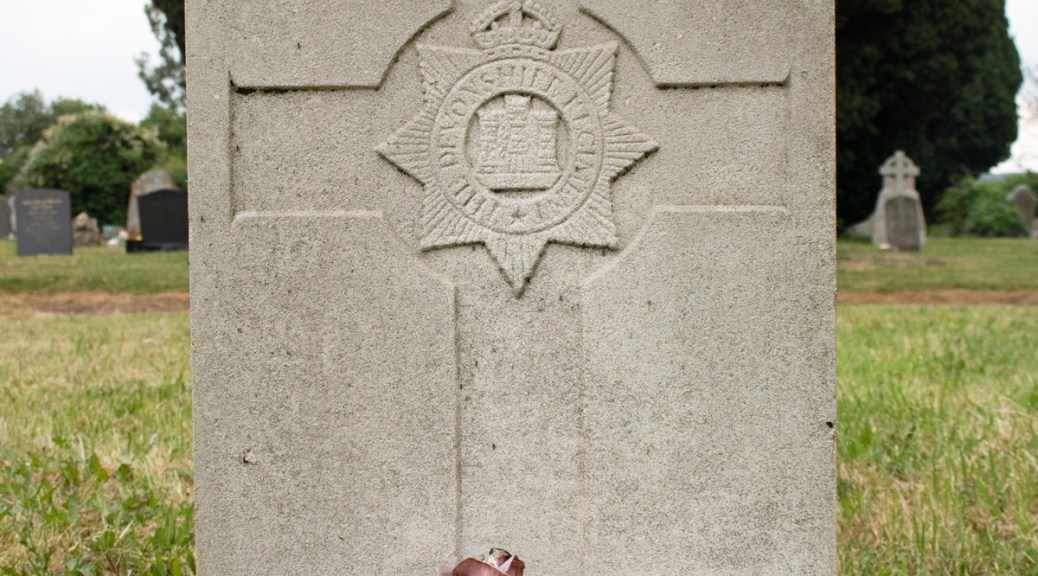
In a quiet spot in North Petherton Cemetery, Somerset, is a headstone dedicated to Private J Mahaffey of the Devonshire Regiment. He died on 5th February 1916, but there is little further information available for him.

Private Mahaffey’s service number leads you to one military record, his army pension ledger card. This confirms a little more information: his first name was John, he had two children noted (underage, and therefore eligible for part of his pension) – Elsie and Thomas – and a guardian is also given – Mrs Elizabeth Broom, who lived in Kentisbeare, Devon. The pension card also confirms the cause of John’s death: heart failure due to disease contracted on active service.

An unusual surname made searching contemporary newspapers easier, and a mystery was unveiled:

Private John Mahaffey, a native of Devonport.. was found dead in the Great Western Railway train at Durston on Saturday.

Deceased, who was in the Devon Regiment (86th Battalion Provisional Territorial Force), was 49 years of age, and had served twelve years in the Army. At the outbreak of war he re-enlisted, and latterly had been quartered at Blythe. It appears that he had been on a visit to his children at Devonport, and was upon his return journey when his death occurred. At Taunton he conversed with the guard of the train by while he travelled, and was then apparently in good health.

PS Hill, North Petherton, state that on Saturday, he… saw the body of the deceased… He examined the body, and found a bruise above the left eye and a scar on the nose. He found upon him his regimental pass and the return railway ticket. There was also money in his pockets.

George William Grinnett, a guard on the GWR, said… he was approached by deceased, who asked as to the train service to Newcastle. Witness understood that he had travelled from Exeter… He advised him to… change at Bristol. He then appeared to be all right, and in good health. On arrival at Durston [George] walked the train, and when passing the compartment that deceased entered at Taunton he noticed a man on the floor in the corridor. He went inside and found that the man was dead. He then communicated with three soldiers, who said they had not travelled with deceased. They had merely opened the door, and, seeing a man there, had walked away without telling anybody.

Dr William C Ghent… said her was called to see deceased. He was quite unable to form an opinion as to the cause of death. There was a good deal of blood on the face, and a slight wound on the nose. From a post-mortem examination he found that one of the valves of the heart was incompetent, and in his opinion death was due to heart failure. The blood on the nose might have been caused by a fall. There was no serious injury from the blow which would cause death.

Taunton Courier and Western Advertiser: Wednesday 9th February 1916

John’s previous twelve years in the army may relate to a Royal Marine Light Infantry service document for a John Mahaffoy. Born on 24th May 1864 in Newcastle-upon-Tyne, he enlisted in Bristol as a Private on 24th April 1888. Primarily based out of Plymouth, he served until the summer of 1900, and was assigned to the Royal Fleet Reserve for a further seven years.

Further complexity is added to John’s story, with a marriage record for 6th April 1896. This confirms his wife’s name as Elizabeth Brown, the couple marrying in Devon. The 1901 census confirms two older children for the couple, Kathleen (mentioned in the newspaper report, who was born in 1897) and Margaret, who came along two years later.

The next census, however, shows a divided family. John was recorded as being one of 1200 patients in the Devon County Lunatic Asylum in Exminster. Elizabeth was living in Portsmouth, with their son, Thomas. She also had a boarder, Bertram Bound, an Able Seaman in the Merchant Navy. Kathleen was a patient in the Sanatorium for Devon and Cornwall Consumptive Patients in South Brent, Devon. Elsie, meanwhile, was recorded as living in Kentisbeare with her grandparents, Edmund and Elizabeth Broom.

This would suggest that John’s wife Elizabeth had died by the time of his death, and that guardianship of his children passed to his mother-in-law when he too passed away.

The last sad element of this tale is that John Mahaffey was not to be reunited with his children. There may have been a financial element, with the Brooms possibly unable to cover the cost of bringing him down to Devon. John was laid to rest in North Petherton Cemetery, a few miles from Durston Station, where his body had been discovered.


Private Albert Warr

Private Albert Warr

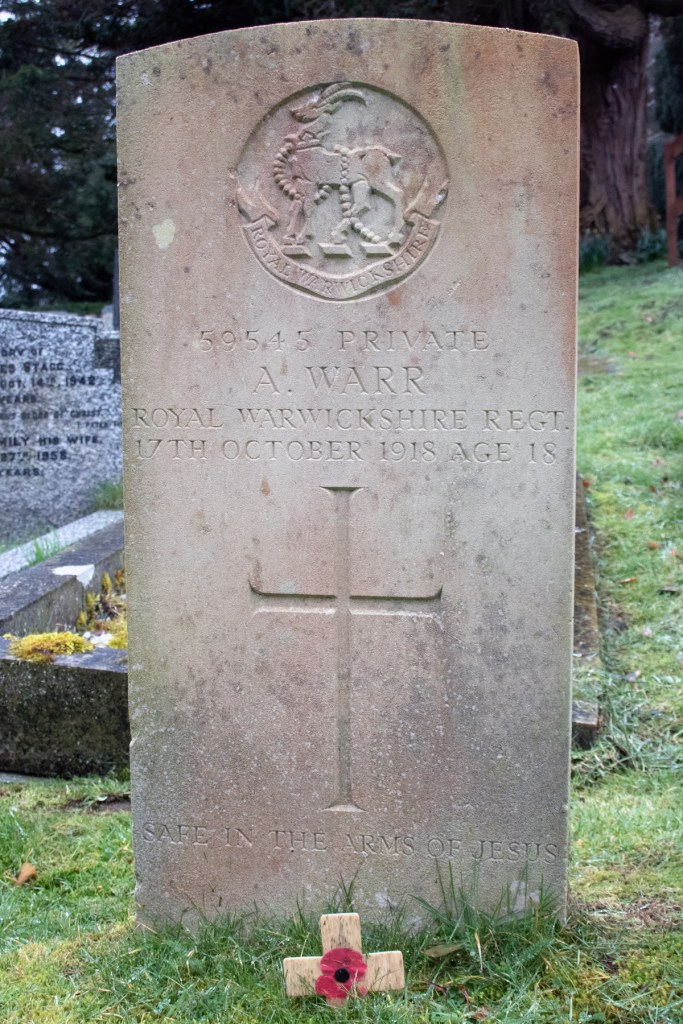
Albert Warr was born in Chaffcombe, near Chard, Somerset, in the spring of 1900. He was the middle of three children to William and Edith. Edith, who was also known as Sophie or Sophia, was nine years older than her husband, and had been married previously. When her first husband passed away, she was left with three children under ten years old – half-siblings to Albert – and so married William to provide them and her a home.

William was an agricultural labourer, but by the time of the 1911 census, the family had moved east to Crewkerne, where both he and Edith took up work in a laundry. The household was complemented by the two older of Edith’s children – Edith, who helped with the laundry work, and Samuel, who was a fishmonger.

Little information is available for Albert’s military service, so his time in the army is a challenge to piece together. He enlisted no earlier than April 1918, and was assigned to the 5th Battalion of the Royal Warwickshire Regiment. Private Warr’s troop fought in France and Italy, although it is unlikely that he saw any action overseas.

All that can be confirmed is that he was admitted to the 1st Northern General Hospital in Newcastle-upon-Tyne, although his condition is unknown. Private Warr passed away on 17th October 1918, aged just 18 years old.

The body of Albert Warr was brought back to Somerset for burial. He was laid to rest in the Townsend Cemetery, within walking distance of the family home in Crewkerne.


Private Warr’s pension ledger notes that Edith had passed away, and that the beneficiary was to be William instead. As this document is not dated, it is not possible to determine when Albert’s mother died, but it is likely to have been between 1917 and 1919.


Officer’s Steward 3rd Class Harry Macklin

Officer’s Steward 3rd Class Harry Macklin

Harry Ernest Macklin was born in the Frome area of Somerset in the autumn of 1893. The oldest of four children, his parents were Henry and Elizabeth Macklin. Henry Sr was a groom who travelled with work, and by the time of the 1901 census, the family were living in East Adderbury, Oxfordshire, which is where the third of the four siblings, Evelyn, was born.

Harry Jr seems to have been known as Ernest, probably to avoid confusion with his father. When he left school, he found work as a page. The family had moved again by 1902, to Witham Friary, to the south east of Frome. Harry Sr was now working as a farm labourer, while Minnie, his and Elizabeth’s second child, was employed as a house maid. The two younger children – Evelyn and George – were both at school, while Elizabeth’s widowed father, also called George, was visiting his daughter and their family.

Ernest changed jobs, becoming a gardener – possibly a euphemistic way of saying he had followed his father into agricultural labouring – but when war was declared he found the need to play his part. On 15th February 1915 he joined the Royal Navy as an Officer’s Steward 3rd Class, possibly drawing on his experience as a page.

For some reason, Ernest’s service records give his date of birth as 18th October 1894: they also confirm he was 5th 7.5ins (1.71m) tall, had dark brown hair, brown eyes and a fresh complexion. They also note that he had a scar on his left thigh.

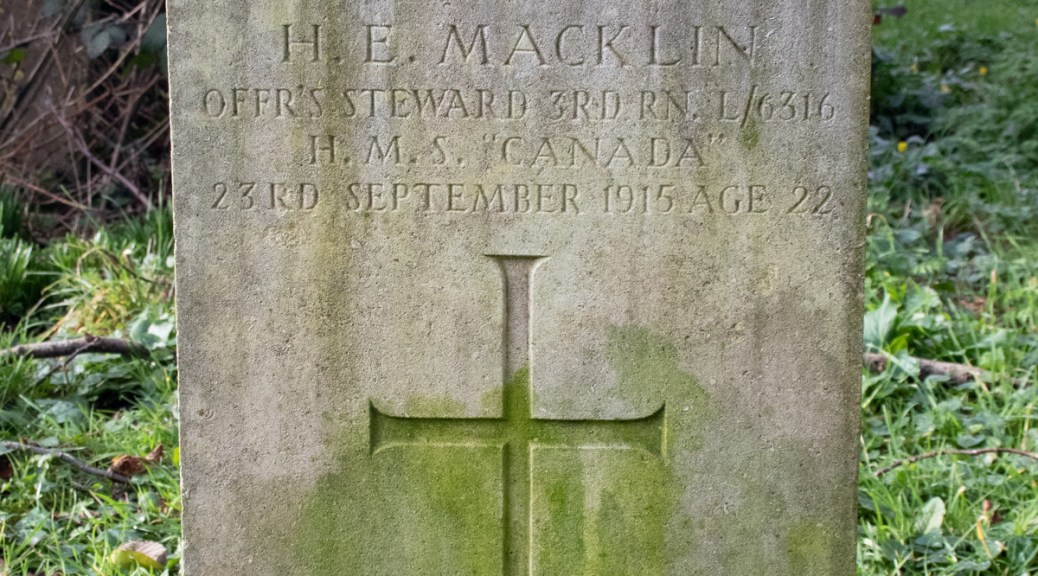
Officer’s Steward 3rd Class Macklin’s first posting was HMS Victory, the Royal Naval Dockyard in Portsmouth, Hampshire. This is where he received his training and, on 10th August 1915, he was given his first posting, on board the Chilean-built HMS Canada.

The ship sailed to Scapa Flow, following the North Sea Coast. When it reached Newcastle-upon-Tyne, however, Ernest was disembarked, and admitted to the Armstrong College Hospital, suffering from an ear infection. Tragically his condition turned septic, and he died of blood poisoning on 23rd September 1915, having served just 43 days at sea. Officer’s Steward 3rd Class Macklin was just 22 years of age.

Harry Ernest Macklin’s body was brought back to Somerset for burial. He was laid to rest in the quiet graveyard of St Mary’s Church in Witham Friary. “He was a promising young fellow, liked by all who knew him, and he was a member of the Witham Church Choir from boyhood.” [Somerset Standard : Friday 1st October 1915]


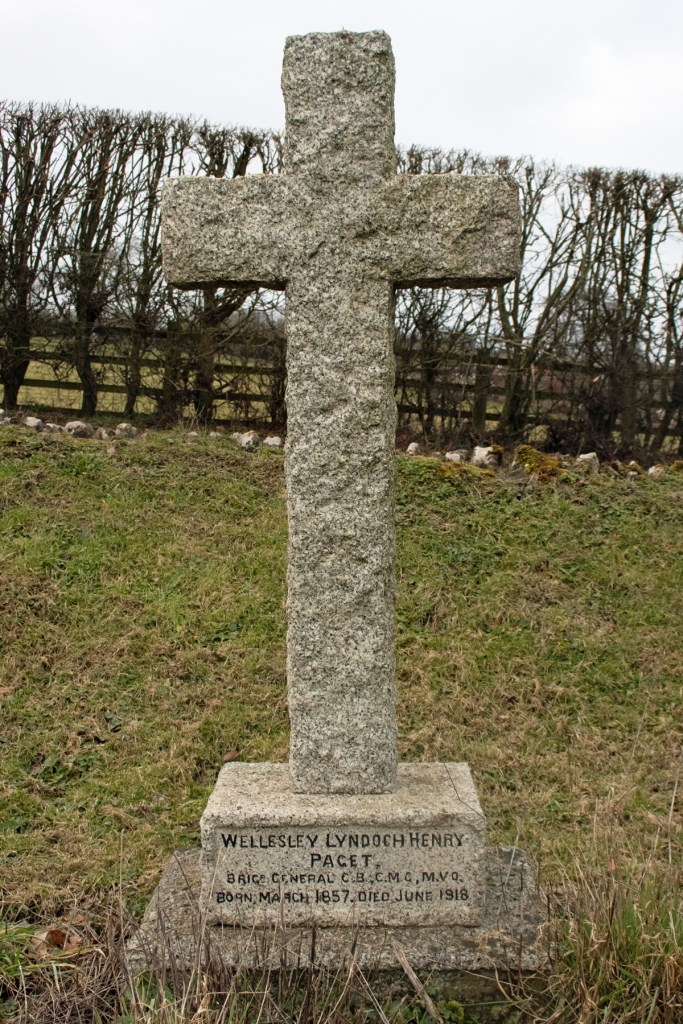
Brigadier General Wellesley Paget

Brigadier General Wellesley Paget

Wellesley Lyndoch Henry Paget was born on 2nd March 1858 in Belgaum, India. The sixth of nine children – all boys – his parents were Leopold and Georgina Paget. Leopold was a Colonel in the Royal Artillery, and Wellesley was always destined to follow a military career.

The young Wellesley was schooled at Wellington College, Sandhurst and, went straight into the army: the 1881 census records him as being a Lieutenant in the Royal Artillery, based at the barracks in Newcastle-upon-Tyne. While a baptism record confirms the location of his birth, Wellesley may have been prone to embellishment – the census record suggests he was born on board the ship HMS Charlotte, off Goa in the East Indies.

On 29th February 1888, Wellesley married Isabelle Swire, a merchant’s daughter from Liverpool. The couple made their vows in All Saints’ Church, Leighton Buzzard, presumably not far from where Lieutenant Paget was then based. The couple went on to have two children, Leo and Mary.

[Wellesley] became Adjutant of the Royal Horse Artillery in 1895… He served in the South African War, where he commanded the 2nd Brigade Division, Royal Field Artillery, and took part in the relief of Ladysmith and operations in Natal and in the Transvaal. He took command of the A Battery (the Chestnut Troop), Royal Horse Artillery, in 1900 and went on service with them in the North-East Transvaal. He was mentioned three times in dispatches for his services in South Africa, was promoted Brevet-Lieutenant-Colonel, and received the Queen’s Medal with six clasps.

Somerset Standard: Friday 21st June 1918

The now Major Paget returned to Britain, and set up home with Isabelle in Dorchester, Dorset. They lived comfortably in a villa in Cornwall Road, and had four servants – a nurse, a cook and two housemaids – to tend their needs.

Leo was sent away to school, and followed his father – and grandfather – into the army. He joined the Rifle Brigade, while his family moved to pastures new. By 1911, Wellesley and Isabelle had moved to Ireland, settling in the village of Ballyellis, near Mallow in County Cork. Again, the family had a retinue of staff, including a teacher for Mary, a cook, a kitchen maid, parlour maid and two housemaids.

Despite being in his fifties when war was declared in 1914, Wellesley stepped up again to play his part. With the rank of Brigadier General, he was again mentioned twice in dispatches for his actions, and was awarded the Companion of the Order of Bath in 1914, and made Companion of the Most Distinguished Order of Saint Michael and Saint George in the King’s Birthday Honours the following year.

By 1916, Wellesley seems to have taken a step back from military life. The Pagets moved to Somerset, setting up home in North Cheriton, near Wincanton. The Brigadier General kept himself busy, however, and, in 1917, was appointed Agricultural Commissioner for Somerset.

At this point, Wellesley Lyndoch Henry Paget’s trail goes cold. He passed away at his home on 11th June 1918, at the age of 60 years old. He was laid to rest in the North Cheriton Cemetery, not far from where his widow still lived.


Private William Saunders

Private William Saunders

William Edgar Saunders was born in the summer of 1900 in Limington, Somerset. He was one of nine children to labourer and drainage contractor William Saunders and his wife, Rhoda.

There is little further information documented about William Jr’s life. During the First World War, he enlisted in the Royal Warwickshire Regiment, and was assigned to the 5th Battalion which served in France and Italy. All that can be confirmed, however is that he joined after March 1918 – presumably once he came of age – and was sent to the North of England for training.

Tragically, Private Saunders’ tale is a common one for young men of his age. Billeted at close quarters with other men from across the country, disease was rife, and he was not immune. William was admitted to the 1st Northern General Hospital in Newcastle-upon-Tyne, suffering from a combination of influenza and pneumonia.

This combination of conditions was to prove too much for young Private Saunders’ body to bear. He passed away on 25th October 1918, aged just 18 years old.

William Edgar Saunders’ body was brought back to Somerset for burial. He was laid to rest in the graveyard of St Mary’s Church in his home village of Limington.


Private Howard Richards

Private Howard Richards

Howard Charles Richards was born in the summer of 1900, the youngest of seven children to George and Henrietta Richards. George was a sewing machine salesman from Combe St Nicholas in Somerset, and this was where the family were raised.

Howard was too young to join up when war was declared, but it seems to have been important to him. He enlisted in the 5th Battalion of the Royal Warwickshire Regiment soon after his eighteenth birthday and was sent for training.

Tragically, Private Richards’ time in the army was to be a short one. The next record for him confirms that he was admitted to the 1st Northern General Hospital in Newcastle-upon-Tyne, and that he passed away on 19th October 1918. The cause of his passing is not recorded, but he was just 18 years of age.

Howard Charles Richards’ body was brought back to Somerset for burial. He lies at rest in the graveyard of St Nicholas’ Church in his home town.