Charles Bayliss was born in Birmingham in 1861. Little concrete information is available about his early life, but later documents confirm his father was called John, and he was one of at least five children.
Charles married Ellen Kimberley on 8th April 1888. The couple wed at St Mary’s Church in Kidderminster, Worcestershire, and went on to have four children – Nellie, Charles, Burt and Eva.
Charles took up manufacturing work, and ended up being a machine belt maker. He also served in the South Staffordshire Regiment, although whether this was on a paid or voluntary basis is not clear.
When was came to Europe, Charles felt the need to serve his country once more. He enlisted on 23rd August 1917, taking five years off his age to ensure he was accepted. He was assigned to the Royal Engineers, and attached to the Inland Waterways and Docks unit.
Private Bayliss was based at Portbury Camp near Bristol, and records suggest that Ellen moved to be near him, finding lodgings on Myrtle Hill in Pill.
Charles was respected for the work that he was doing, and was promoted to Lance Corporal in May 1918. His health was against him, however, and just two months later he collapsed and died from a heart attack while at work. He was 58 years of age.
Charles Bayliss was laid to rest in the graveyard of St George’s Church, Easton-in-Gordano, not far from the docks where he had served, and the riverside home in which his widow still lived.
Fred Vowden was born in 1889 in Wadebridge, Cornwall. One of eleven children, his parents were Thomas and Emma. Thomas was a farm labourer, and this is work that Fred also followed when he finished his schooling.
The family moved to where the work was: the 1911 census found them living in Lansallos, a village near Polperro on the county’s south coast. Fred married Doris Curtis in Liskeard in March 1915: there is little information about her, but the couple set up home back in Wadebridge, and went on to have a daughter, Dorothy, the following spring.
War had reared its ugly head over Europe by this point. Fred enlisted in December 1915, joining the Royal Engineers. He was not to be formally mobilised until July 1918, and took up work as a supernumerary platelayer for the London and South Western Railway Company. When he officially took up his role with the army, his employment stood him in good stead: he was assigned to the Railway Construction Troops Depot in Surrey.
Sapper Vowden’s service records show that he was 5ft 6ins (1.75m) tall and weighed 135lbs (61.2kg). He was of good physical development, with a fresh complexion, brown hair and brown eyes.
Fred was based near Farnham as the war drew to a close and winter neared. On 9th November 1918, he fell ill and was admitted to the Frensham Hill Military Hospital with a severe frontal headache. Over the next few days broncho-pneumonia was identified and his condition worsened. By 13th November his temperature was up to 105F, and his breathing was shallow. That evening Sapper Vowden fell unconscious and passed away. He was 28 years of age.
Fred Vowden’s body was taken back to Cornwall for burial. He was laid to rest in Egloshayle Cemetery, on the outskirts of the town in which he had been born and raised.
John Phippen Dyer was born in the spring of 1896, and was the oldest of four children. His parents, John and Fanny Dyer, were from Somerset and it was in the town of Highbridge that they raised their family.
John Sr worked as a coach body maker for the railways, and his eldest boy joined him as an apprentice when he finished his schooling. When war broke out, however, John Jr was keen to be seen to be playing his part.
John Jr enlisted in Taunton on 15th November 1915, joining the Wessex Division of the Royal Engineers. His service records confirm that he was 5ft 7.5ins (1.71m) tall and of god physical development. He was sent off to Essex for training, but came down with influenza the following January.
Sapper Dyer was admitted to hospital in Great Bentley, spending a fortnight there. He was released back to his unit, but his health continued to suffer. He had had bouts of rheumatism going back to 1911, and, by the spring of 1916, this had recurred, and was recorded as possible rheumatic appendicitis.
John’s condition led to him being declared permanently unfit for was service: he was discharged from the army on 30th March 1916, having served for just four-and-a-half months.
John Jr returned to Somerset, but at this point his trail goes cold. The next record for him is that of his passing, on 26th May 1919. He was just 23 years of age.
John Phippen Dyer was lair to rest in the cemetery of his home town, Highbridge, Somerset.
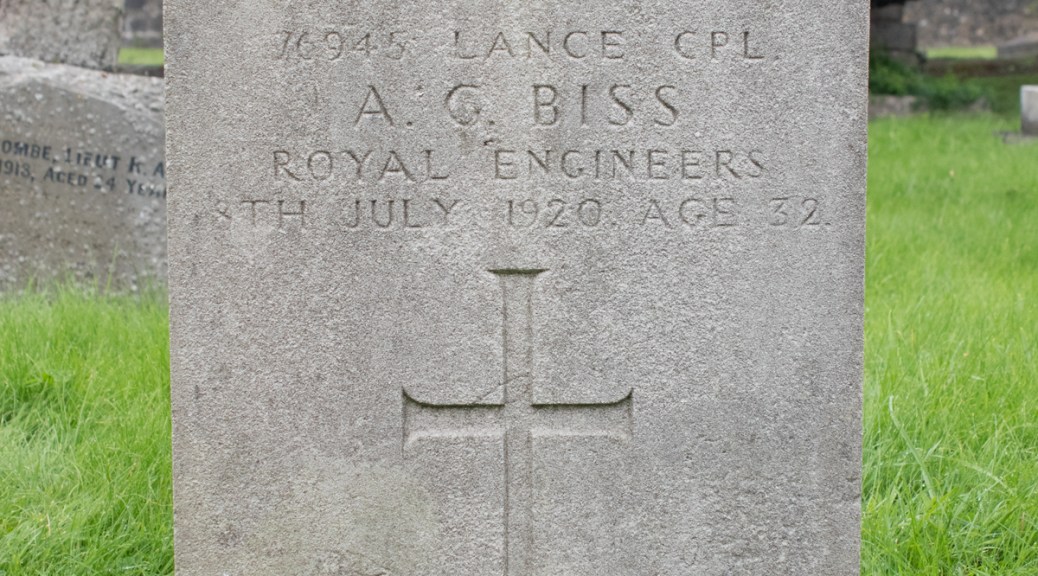
Albert Gillard Biss was born in Highbridge, Somerset, on 3rd July 1888. The middle of five children, he was the oldest surviving son of Richard and Rosanna Biss. Richard was a tin worker twelve years older than his wife and when he died, in September 1907, Rosanna was left to raise her family alone.
By the time of the 1911 census, Rosanna was living in a five-roomed cottage in Highbridge. Albert and his two younger brothers were living with her, and all three were working as building labourers to bring in money for the family. They also had a boarder, 87-year-old widow Henrietta Crandon, to bring in a little extra each month.
Albert was also saving up for other things. On 15th November 1911, he married Ada Alice Vincent. The couple went on to have three children – Albert Jr, Richard and Irene – before Ada’s untimely death in August 1915, just five weeks after Irene’s birth. At this point Albert had enlisted in the army, and it seems that his sister, Sarah, took on responsibility for her nephews and niece.
Albert was working as a telegraphist for the Post Office when he signed up. He had previously volunteered for the 3rd Somersets, but was assigned to the Royal Engineers when he enlisted. His service records show that he joined up in Weston-super-Mare, was 27 years and three months old, and stood 5ft 10.5ins (1.79m) tall.
Sapper Biss initially served on home soil, but was subsequently moved to the Base Signal Depot as part of the East Africa Expeditionary Force. He was promoted to Lance Corporal in April 1918, but over the next twelve months his health began to deteriorate.
On 6th April 1919, Albert was medically discharged from the army, suffering from a combination of malaria, epileptic fits and tuberculosis. He returned home to Somerset, and moved back in with Rosina. His sister Sarah was living in London by this point, and it is not clear whether Albert’s children came back to Highbridge or not.
Over the next year Albert’s health went from bad to worse. On 8th July 1920 he finally succumbed to a combination of pulmonary tuberculosis, acute nephritis, meningitis and uraemia. He had just turned 32 years of age.
Albert Gillard Biss was laid to rest in the sweeping grounds of Highbridge Cemetery.
After Albert’s death, his two sons fell under the guardianship of their aunt Sarah. Responsibility for Irene, however, was given to an Ebenezer and Eliza Monks, who lived in Clapham Common, London. The 1938 Electoral Register found Irene, who went by the name Monks-Biss, still living with here adopted family.
George Bartraham was born in the autumn of 1868 in the Somerset village of Sampford Brett. One of seven children, his parents were George and Sarah Bartraham. George Sr was a farm labourer and, while his son initially followed suit, he sought a life of adventure in the wilder world.
George Jr had found work as a tailor, and was apprenticed to a Charles Taylor, who lived in the village. That bigger and better life was niggling away, however, and, on 11th June 1888, he enlisted in the Royal Engineers. His service records show that he was 5ft 5.5ins (1.66m) tall, with black hair, dark eyes and a fair complexion. Sapper Bartraham was also noted as having a scar on his left foot.
George initially signed up for seven years’ service, with an additional 5 years on reserve status once that was completed. The 1891 census recorded him as being based at Fort Blockhorse in Alverstoke, Hampshire. Early in 1894, he married Mary Bowden, in Portsmouth: the couple would go on to have two children, George and Albert. The following year, Sapper Bartraham opted to remain on full service with the Royal Engineers, partially, it is fair to assume, as the pay would be better to support his family than on reserve.
By 1901, George had been moved to barracks in Pembroke Docks, Wales. Mary and the children remained in Hampshire, living with her parents in Unicorn Street, close to the town’s naval base. Wales was not to be the last stop for George, however, and in October 1902, he was sent to Ceylon, where he remained for the next three years.
During his time in the army, George did not sit on his laurels. He received a certificate as a master tailor, became skilled in submarine mining, and also received a qualification in signalling. He was promoted to Lance Corporal in 1899, and full Corporal four years later.
George returned to Britain in January 1906, and seems to have returned to a base in Hampshire. It was here, on 28th December 1908, that an altercation led to him being convicted of assault. He was charged with ‘unlawfully and maliciously wounding one Albert Edward Bartraham, by stabbing him with a pair of scissors, at Aldershot… and counts for assault occasioning actual bodily harm and common assault’ [Calendar of Prisoners, 1868-1929]
Albert was George’s older brother, and he was convicted to six months’ hard labour for the assault. Corporal Bartraham returned to base on 6th June 1909, and was discharged a few days later, having completed 21 years’ service in the Royal Engineers.
The next census record, taken in 1911, found a family divided by work or circumstance. Mary and the children remained firmly ensconced in Portsmouth with her parents, while George was living in Aldershot, where he was employed as a tailor. His employer is noted as being the Government, so it seems likely that he was still connected to the army camp there.
When war came to Europe, George was called upon to play his part once more. Promoted to the rank of Serjeant, he was attached to the 136th Fortress Company of the Royal Engineers. He arrived in Egypt in June 1915, although it is unclear how long he remained overseas.
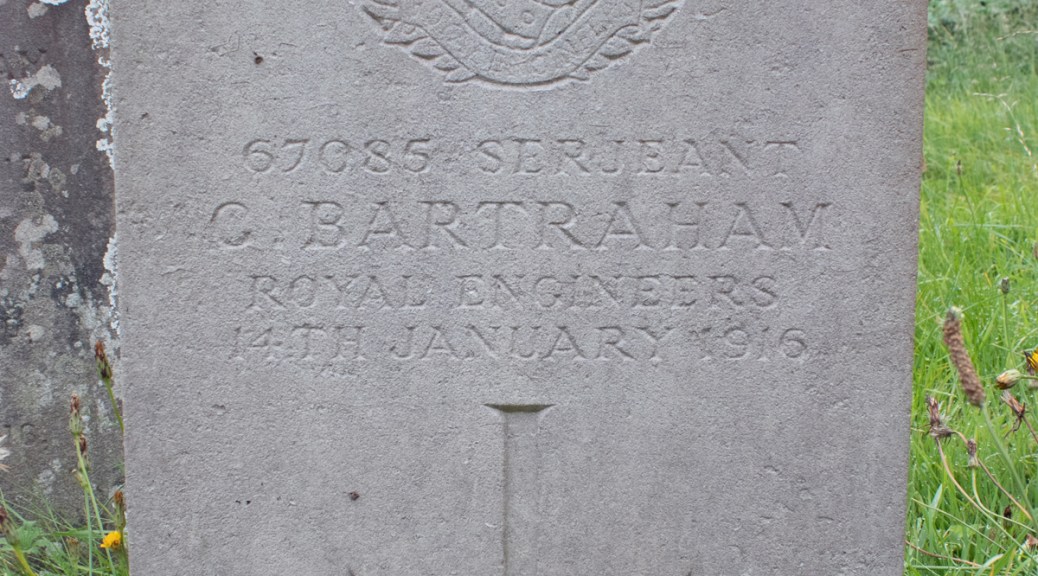
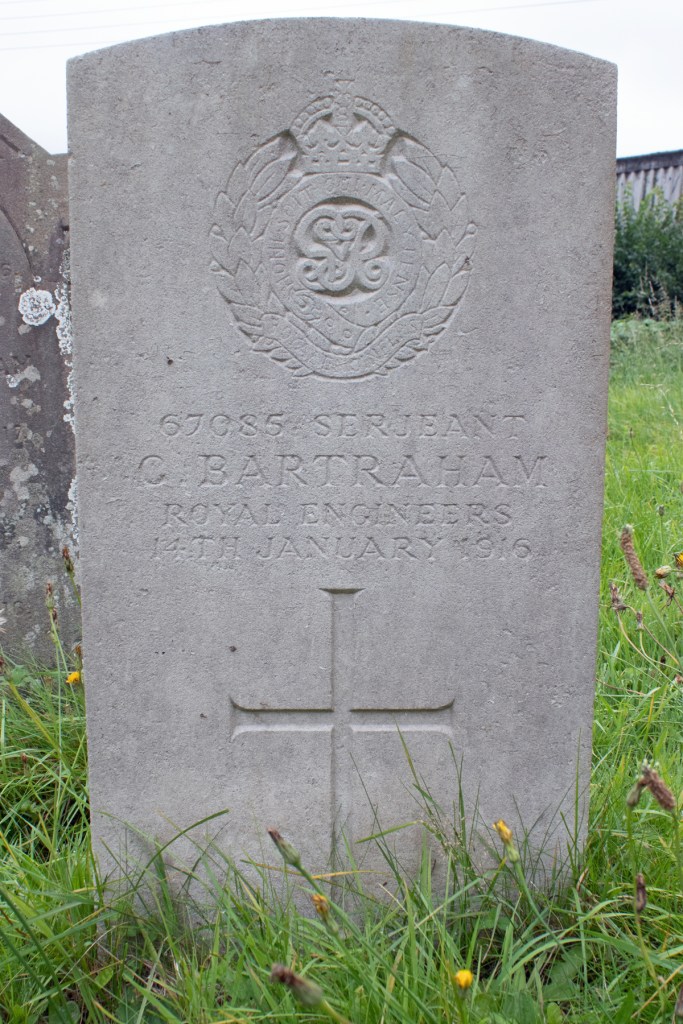
By the start of 1916, Serjeant Bartraham was back in Britain, primarily because of ill health. He had come down with nephritis, or inflamed kidneys. Admitted to hospital in South London, he died from the condition on 14th January 1916, at the age of 47 years old.
Brought back to Somerset, George Bartraham was laid to rest in the peaceful graveyard of St George’s Church in the village of his birth, Sampford Brett.
This was a time of tragedy for the Bartraham family.
George’s father, George, had died around the same time as his son, and was buried near him.
George and Mary’s son, George, had enlisted in the Hampshire Regiment when war was declared and, by the summer of 1916, was based in Iraq. He died on 23rd September 1916, through causes unclear, and was laid to rest in Baghdad War Cemetery.
Three generations of Bartrahams, all called George, had passed away within nine months.
In the summer of 1917, Sarah Bartraham also passed away. She was laid to rest with her husband and son in St George’s Churchyard.
Oliver Banwell was born in Burnham-on-Sea, Somerset, in 1882. One of nine children, his parents were mason William Banwell and his wife Jane. When he completed his schooling, Oliver followed his father into manual work and, by the time of the 1901 census, he was employed as a bricklayer.
In 1910, Oliver married Mary Ann Burrows, a carter’s daughter from Axbridge: the couple settled down in lodgings on Oxford Street, near the centre of Burnham-on-Sea, and went on to have three children: Stanley, Primrose and Violet.
When war came to Europe, Oliver stepped up to serve his King and Country. He gave up his new employment as a groom and enlisted on 13th September 1915, joining the Royal Engineers as a Sapper. His service records give some idea of the man he had become. He was 5ft 8.5ins (1.74m) tall, weighing 141lbs (64kg), and was noted to be of good physical development, although he had slight varicose veins in both legs.
Sapper Banwell found himself in France by the end of April 1916. He spent six months overseas, before being posted back to Britain. Initially attached to the 82nd Training Reserve Battalion at the Royal Engineers Barracks in Chatham, Kent, by July 1917, he had moved again, to the 39th Fortress Company, in Sheerness.
In July 1918, Oliver was back in France again, where he was to remain until after the Armistice. By this point his health was beginning to fail and, on his return to Britain in December 1918, a medical examination deemed him no longer fit for army service. He was formally discharged from the Royal Engineers on 30th January 1919, suffering from cancer of the rectum.
Oliver returned to Burnham-on-Sea, and spent the next ten months with his family. His battle with cancer finally proved too much: he passed away on 4th December 1919, at the age of 37 years old.
Oliver Banwell was laid to rest in the family plot in Burnham Cemetery. Mary Ann was buried alongside him when she passed away in 1965, husband and wife reunited after 46 years.
The early life of Joseph Maguire is challenging to decipher. Born in Dublin in 1878, his name is sadly too common to pin down any specific family relationships. Later records suggest that he had a sister, Jane, but again, this does not help narrow down documentation.
It would appear that he had moved to England for work by the time war broke out: he enlisted in the Royal Engineers in Carlisle by November 1917. As a Pioneer, he was attached to the Inland Water Transport Battalion, although it is not possible to ascertain whether he served on the Home or Western Fronts.
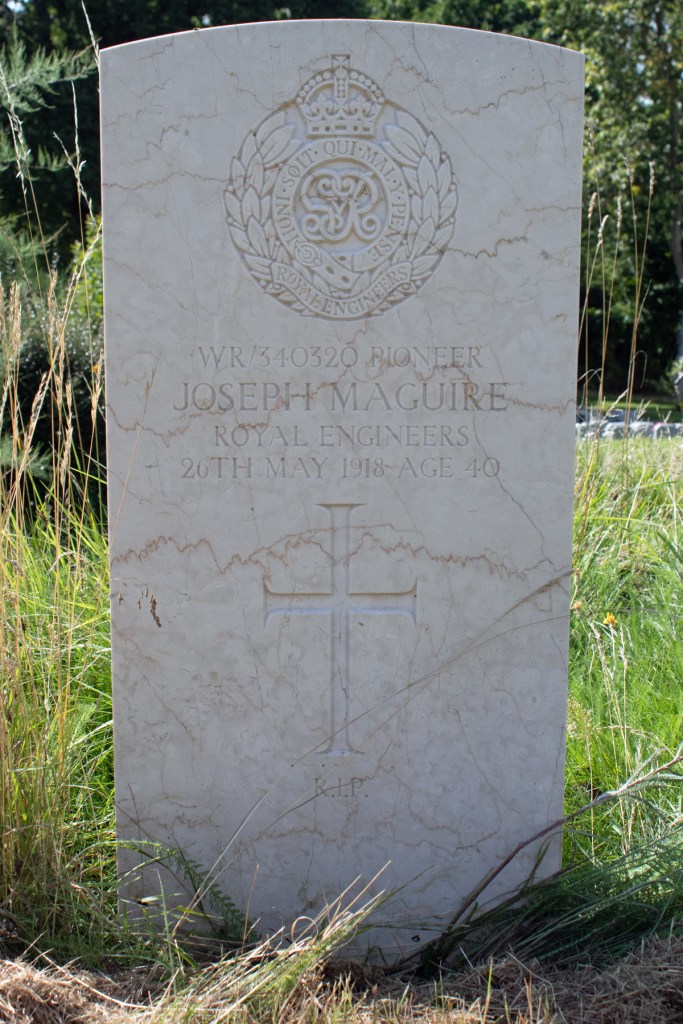
Pioneer Maguire died at the Second Southern General Auxiliary Hospital in Weston-super-Mare, Somerset. The cause of his passing is not freely documented, but it seems likely to have been the result of an illness. He was 40 years of age.
Joseph Maguire was laid to rest in the sweeping ground of Minehead Cemetery. Commonwealth War Grave Commission records note that he is interred in the Roman Catholic section of the grounds, and that, when it was erected, his CWGC headstone was paid for by the Honourable Secretary of the British Legion.
Walter John Greedy was born in the spring of 1889, the eighth of nine children to Theophilus and Mary Greedy. Theophilus was an agricultural labourer from Wiveliscombe in Somerset, and it was here that the Greedy family were born and raised.
When he finished his schooling, Walter found work as a carter for a brewery. In 1906 his oldest sister, Charlotte, was widowed, and he moved in with her and her children to help provide some additional support. He soon found alternative employment, however, and within a couple of years was employed by Great Western Railways as a plate-layer.
On 26th December 1913, Walter married Irene Hobbs. She was a blacksmith’s daughter from nearby Fitzhead, who was working as a domestic servant when the couple wed. They went on to have three children: Frederick, Winifred and Dorothy.
When war was declared, Walter stepped up to play his part. Full details of his military service no longer remain, but he had certainly enlisted by the summer of 1918. Walter joined the Royal Engineers, and, based on his previous employment, was assigned to the 278th Railway Company.
Sapper Greedy served in Northern France, and was based in and around Boulogne. He survived the war, and was back on home soil by December 1918. This may have been because of illness: Walter was admitted to Exeter War Hospital in Devon, having contracted influenza and pneumonia. Sadly, the combination of conditions was to prove a fatal one: he passed away on 22nd December 1918, at the age of 29 years old.
Walter John Greedy was brought back to Somerset for burial: he was laid to rest in the peaceful graveyard extension of St Nicholas’ Church in Brushford, where Irene and their children were now living.
Reginald Cuthbert Langford was born in Frome, Somerset, in the spring of 1899, the youngest of thirteen children to Albert and Charlotte Langford. Albert was a chalk seller turned jobbing gardener, who, by the time of the 1911 census, had moved the family to Bath.
Reginald appears to have helped his father with his work when he finished his schooling, but, during the First World War, he enlisted in the Royal Engineers as a Driver. His service records no longer remain, but a later newspaper report shed some light onto his time in the army: “[He] enlisted when he was just over 16, and went to the Wessex Engineers to Salonica. He returned to England and then went to France with the Glamorgan Engineers.” [Bath Chronicle and Weekly Gazette: Saturday 16th October 1920]
All did not fare well for Driver Langford: he contracted malaria and dysentery, and a combination of the conditions led to his ultimate discharge from the army. He left the Royal Engineers on 24th June 1919, and returned home to Somerset.
When he had recovered his health, Reginald took up employment as a gardener once more. On September 1920, he was in the employ of a Mr J Milburn, in Bath, when he felt a nail drive through his boot, scratching his foot. The following Tuesday, he visited his doctor – a Mr John Jarvis – complaining that his malaria had returned. According to a later inquest:
[He] did not make any mention of a wound in the foot. On Thursday, at about 10 o’clock, [Jarvis] was asked to go and see Langford, who was in bed. He was covered with a cold sweat, he could speak only with difficulty, and complained that he could not swallow anything, especially the medicine… His limbs were rigid, but he had not all the symptoms of tetanus. [Jarvis] decided to send Langford to the hospital at once, suspecting that he was suffering from tetanus. He did not know till later that there was an injury to [Reginald’s] foot.
Bath Chronicle and Weekly Gazette: Saturday 16th October 1920
Reginald’s landlady, Amelia Baily, also gave evidence at the inquest:
Langford had lodged with her for about nine months. His inly complaint was of his head when he had malaria… He came home saying his foot was sore and that he had thought it was gathering. He had hot water to soak it, and he did the same the next night, an afterwards sad it was alright… he went to work, but returned at dinner time again complaining of his head and perspiring terribly. He was ill and witness looked after him during the night. He complained of pains in the stomach and aid they were going up to the throat. Next morning [Amelia] sent for the doctor.
Questioned as to the injury to Langford’s foot, [she] said he told her he had a nail enter the toe while he was in the army, and that it was festering again. He wad worn the army boots up to just before he became ill, when he bought new ones.
Bath Chronicle and Weekly Gazette: Saturday 16th October 1920
Admitted to the Pensions Hospital, Bath, Reginald was to be there only one day. He passed away on 8th October 1920, aged just 21 years old. Medical evidence at the inquest diagnosed tetanus as the cause of his death, but Reginald’s older brother, George, contested this.
George’s challenge was that, having some medical background, he felt that his brother’s death was caused not by tetanus, but by malaria. He was a sufferer himself, and he knew the symptoms. He had examined Reginald’s body, and could not see how the small scratch on his foot could have induced tetanus to the extent of causing his brother’s passing.
The Coroner at the inquest, a Mr F Shum, declined George’s assertion, on the basis that separate medics had determined tetanus as the cause:
“It may not have been from the foot, but the evidence is clear. Dr Jarvis said he formed the opinion before any suggestion was made to him, that the man was suffering from tetanus. He saw the symptoms, and the man was brought here [to the Pensioner’s Hospital]. Two doctors saw him here and came to the same conclusion, and a medical specialist confirmed the diagnosis. Therefore, it is quite clear to me, and my verdict will be that he died from tetanus. It is a very unfortunate thing, and I am sorry for you.
Bath Chronicle and Weekly Gazette: Saturday 16th October 1920
George’s challenge was as much about the financial aspect as it was his late brother’s wellbeing. Had Reginald’s death been the result of malaria, it could have been attributable to his military service, and therefore any funeral costs – or at least a proportion of them – would have been paid for by the army. As the inquest had identified tetanus as the cause of his passing, however, the family would have to pay for the burial themselves.
Following the inquest, Reginald’s funeral was held: he was laid to rest in the sweeping Locksbrook Cemetery, Bath, not far from where his bereaved family still lived.
There are two other intriguing aspects of Reginald’s case.
The first is that of his being awarded a war grave. Amongst other criteria, which can be seen here, the Commonwealth War Graves Commission (CWGC) are responsible for the commemoration of personal who died after they were discharged from a Commonwealth military force, if their death was caused by their wartime service.
Based on the inquest, Reginald’s passing was clearly not – the tetanus having come on after his medical discharge for malaria and dysentery. Technically, therefore, his should not be designated a war grave.
The second confusing thing is that of the date on Reginald’s headstone. The CWGC headstone gives the date of his death as 13th October 1920, as do his grave registration documents. While newspaper reports are not always a reliable source of information, the first media report of the inquest came on Tuesday 12th October.
The Bath Chronicle and Weekly Gazette article confirms that Dr Jarvis’ visit to Reginald was on Thursday 7th October. He was admitted to hospital straight away, “where he died the following day” [Bath Chronicle and Weekly Gazette: Saturday 16th October 1920]. This would suggest that Reginald died on Friday 8th October.
While the newspapers do not confirm the date of the inquest, it is likely to have been held soon after Reginald’s passing. The date provided by the CWGC, therefore, looks to be either that of the conclusion of the inquest, or of Reginald’s burial.
Godfrey George Beames was born in the spring of 1891, in Henbury, Gloucestershire. One of eleven children, his parents were Thomas and Minnie Beames. Thomas was in the navy, which meant that Minnie was left to her own devices a lot of the time. While her husband came home often enough for them to build a large family, the 1891 and 1901 censuses record Minnie and the children living with her farm labourer brother-in-law, George Watkins.
The 1911 census gives the same information for Minnie and the children – living with George in Redwick, Gloucestershire. Minnie is, however, noted as a widow, although this seems to be out of convenience, as the now naval pensioner Thomas was living with his wife of eight years, Louisa, in Arundel, West Sussex.
Godfrey, now 21 years old, was working as a farm labourer. In the autumn of 1913, he married a woman called Lily Ball, although little information about her remains today. War was coming to Europe, and things were to change for the young couple.
Godfrey stepped up to play his part. While his full service records no longer exist, what remains paints a picture of his time in the army. He had enlisted by the spring of 1917, joining the Royal Engineers. At some point, however, he moved to the Worcestershire Regiment, and was assigned to the 10th (Service) Battalion.
While it’s not possible to determine exactly where Private Beames fought, he was definitely caught up in the fighting on the Western Front and, by October 1917, was entrenched at Passchendaele. It was here that he was wounded, and he was medically evacuated to Britain for treatment.
Private Beames was admitted to the General Hospital in Nottingham, but his injuries were to prove too severe. He died on 15th November 1917, at the age of just 26 years old.
Godfrey George Beames’ body was brought back to Somerset for burial. He was laid to rest in the graveyard of Ss Mary and Peter’s Church in Winford, where Lily was now living.










 Death and Service