Category Archives: Royal Naval Reserve

Trimmer Cook Douglas Ferguson

Trimmer Cook Douglas Ferguson

At Dartmouth on Saturday, Mr AM Dawson held an inquest on Douglass [sic] Davidson Mitchell Ferguson, cook, aged 30, of a Government trawler, whose body was recovered from the boat float the previous afternoon.

TG Elliott, of the Britannia Inn, said deceased had one drop of whiskey at his house on Thursday.

W Bursey, seaman, said he saw deceased at the King’s Arms Hotel, the same evening. He was very quiet and chatted with others.

Frank Lavers, coal lumper, said he thought he saw Ferguson at 9.50 on his way to the Embankment. Deceased asked the time and spoke quite rationally.

After evidence as to the recovery of the body, and Dr GM Soper’s evidence that the death was due to drowning, an open verdict was returned.

Lieut. PN Taylor [Royal Naval Reserve], commander of the vessel to which deceased had belonged, said Dartmouth was the most dangerous place for the embarkation at night that he had visited, owing to the restricted lighting. He thought rails should eb placed not only around the Boat Float, but along the whole of the Embankment.

Members of the jury agreed that lights in the vicinity of the Boat Float were inadequate, and the jury added a rider to their verdict urging the authorities to provide adequate lighting as advised by the Town Council, for the benefit of persons embarking in the vicinity of the Boat Float, and with a view to preventing further tragedies.

[Western Times: Tuesday 29th February 1916]

Douglas Davidson Ferguson was born in Stirling, Scotland, on 28th August 1896. One of four children, his parents were Andrew and Mary Ferguson. There is little information available about his early life, unfortunately, but it is clear that he enlisted in the Royal Naval Reserve on the 6th September 1915.

Assigned the role of Trimmer Cook, Douglas’s records show that he was 5ft 3ins (1.6m) tall, with brown eyes and a pale complexion. He was also noted as having a tattoo of a dancing girl on his left arm.

Douglas was initially assigned to the cruiser HMS Pactolus, and travelled from Scotland to Devon, where the Royal Naval Dockyard in Devonport would become his base. He remained stationed there for the next few months, working on ships’ galleys as they patrolled out the Channel coastline. It was during one of these voyages that he fell into the River Dart and drowned.

It would seem that Douglas Davidson Ferguson’s family were unable to cover the cost of taking his body back to Scotland for burial. Instead, he was laid to rest in the graveyard of Dartmouth’s St Clement’s Church.
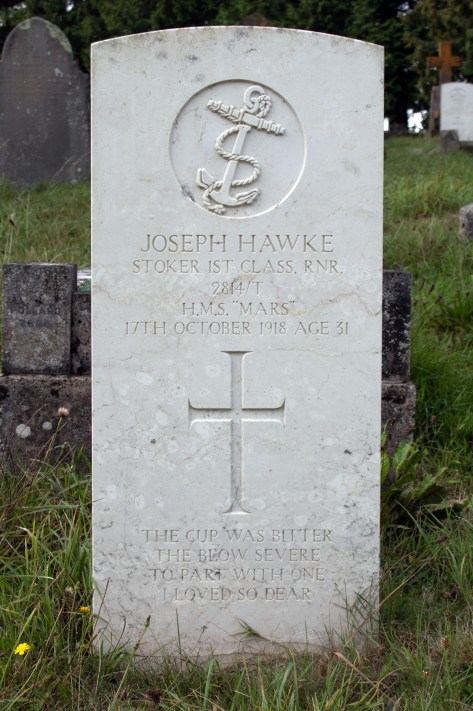
Stoker 1st Class Joseph Hawke

Stoker 1st Class Joseph Hawke

Joseph Hawke was born in Paignton, Devon, on 8th January 1887. Details of his early life are lost to time, although the 1891 census suggests that he was one of five children to Maria Hawke, who had been widowed by that point. The family had taken rooms at 104 Pembroke Street in Devonport.

When he finished his schooling, Joseph initially found work as a packer. However, possibly driven by his proximity to the Devon dockyards, he soon stepped up to take a job in the Royal Navy. Joining the training cruiser HMS Northampton, he was given the rank of Boy 2nd Class, as he was under the age to enlist.

Over the next few years, Joseph proved his mettle. In May 1904 he was promoted to Boy 1st Class and, when he came of age on 8th January 1895, he was formally inducted into the Royal Navy, taking the rank of Ordinary Seaman. His service papers show that he was 5ft 3ins (1.6m) tall, with fair hair, hazel eyes and a fresh complexion. It was also noted that he a mole on his right shoulder and abdomen, a scar on his chin, and tattoo marks on the back of his left hand and on his right forearm.

Ordinary Seaman Hawke would serve on three ships in total. On 26th February 1906 he became a Stoker 2nd Class, a role change that might be seen as a semotion, although his records suggest he was of very good character. By November 1906 Joseph had become Stoker 1st Class, but within twelve months, he gave up his life at see, buying himself out of the Royal Navy.

This change of heart may have been driven by love as, on Christmas Day 1908, he married Ellen Saunders, in Tower Hamlets, London. Their wedding certificate gives Joseph’s father’s name as cabinet maker George Hawke, but doesn’t suggest that he is deceased.

The document also gives Joseph’s job as a stoker, later confirmation suggesting that he was employed by the electrical works in Paignton, Devon. Joseph and Ellen would go on to have five children – Marie, Joseph, Albert, Harry and Ellen – between 1909 and 1917.

When war broke out, Joseph was called upon to play his part once more and, as part of the Royal Naval Reserve, he was assigned to HMS Gibraltar in November 1914. Over the next four years, he would serve as a Stoker 1st Class on four more ships, each time returning to HMS Vivid, the Royal Naval Dockyard in Devonport, in between voyages.

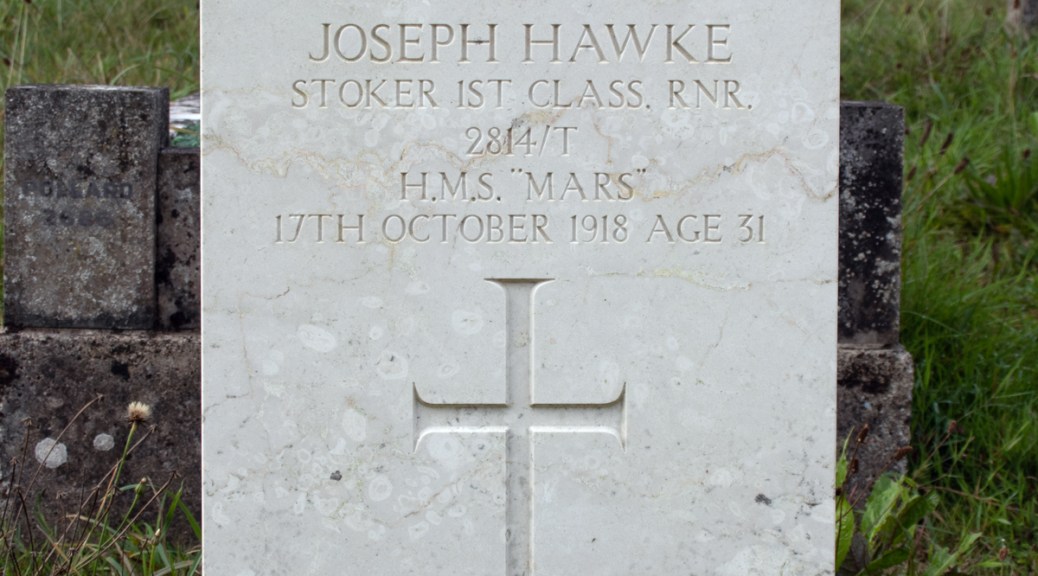
By the spring of 1918, Joseph’s health was struggling. He was medically dismissed from active service on 22nd May, and returned home to Paignton. His condition was to worsen, however, and on 17th October 1918 he passed away froma combination of dysentery and influenza. He was 31 year of age.

Joseph Hawke was laid to rest in Paignton’s sweeping cemetery, not far from his family home in Laura Terrace.


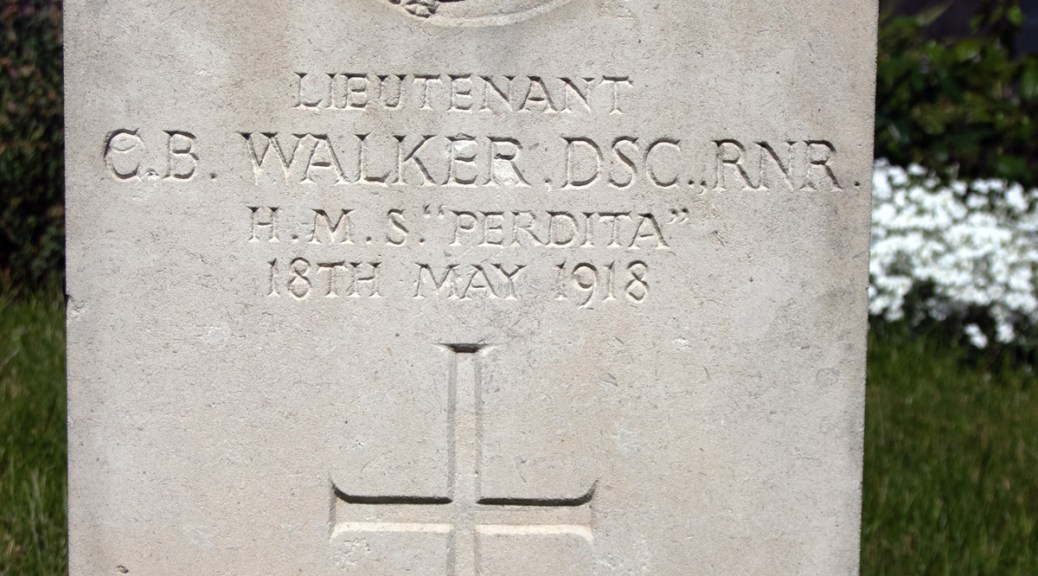
Lieutenant Claude Walker

Lieutenant Claude Walker

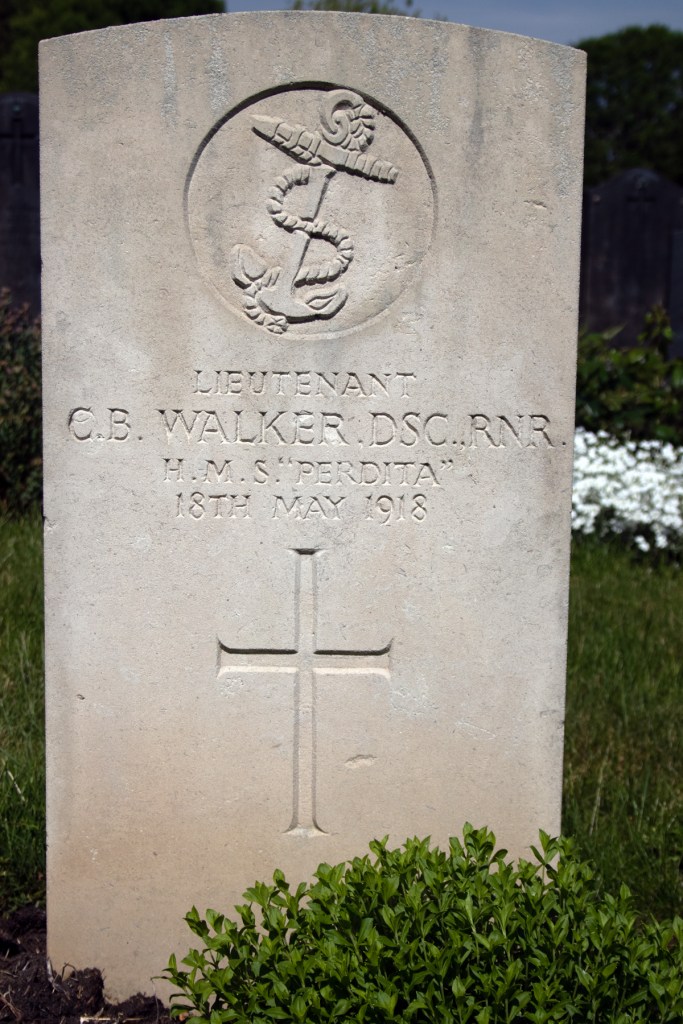
“The funeral took place on Wednesday with naval honours of Lieut. Claude Bennett Walker, RNR, whose home is a 23, Overcliffe, Gravesend, and who died at the Royal Naval Hospital, Chatham, on Saturday. His death was a naval casualty, and it was only on Friday, a day before his death, that he was taken to the Chatham Hospital.”

[Kent Messenger & Gravesend Telegraph: Saturday 25th May 1918]

Claude Bennett Walker was born on 6th July 1882 in Deal, Kent. The oldest of five children, his parents were George and Amelia Walker. George was a Trinity pilot, navigating ships off the Kent coast and beyond, and it was only natural that his first born followed in his stead.

Claude set to a life at sea when he completed his schooling. By August 1904, he was a registered Second Mate on board sea-going vessels, and within two years, he was deemed competent to become a First Mate. By 1909 he was certified as a Master of a foreign-going ship. At some point he joined the Royal Naval Reserve, and on 5th July 1912, was given the rank of Sub-Lieutenant.

That autumn, Claude married Gwen Case. The wedding took place in her home town of Melksham, Wiltshire, and the couple would go on to have two children – son Alec in 1913, and daughter Alison three years later.

When war broke out, Claude would be called upon to play his part, serving on the battleship HMS Majestic and the destroyer HMS Recruit early on in the conflict. By the spring of 1915, he was assigned to the minelayer HMS Biarritz, and that October, he was promoted to full Lieutenant.

On 9th March 1917, Claude was given command of the minelayer HMS Perdita. She served in the Mediterranean, and would be caught up in some skirmishes. In October 1917, Lieutenant Walker was awarded the Distinguished Service Cross, and the following April he was mentioned in dispatches.

The Perdita was back in Kent by the spring, by which point Claude had fallen ill. He was admitted to the Royal Naval Hospital in Chatham with cerebrospinal meningitis, and this would be the condition to which he would succumb. He passed away on 18th May 1918, at the age of 35 years of age.

Claude Bennett Walker was laid to rest in the naval section of Woodlands Cemetery, Gillingham, Kent.


Acting Leading Seaman William Wood

Acting Leading Seaman William Wood

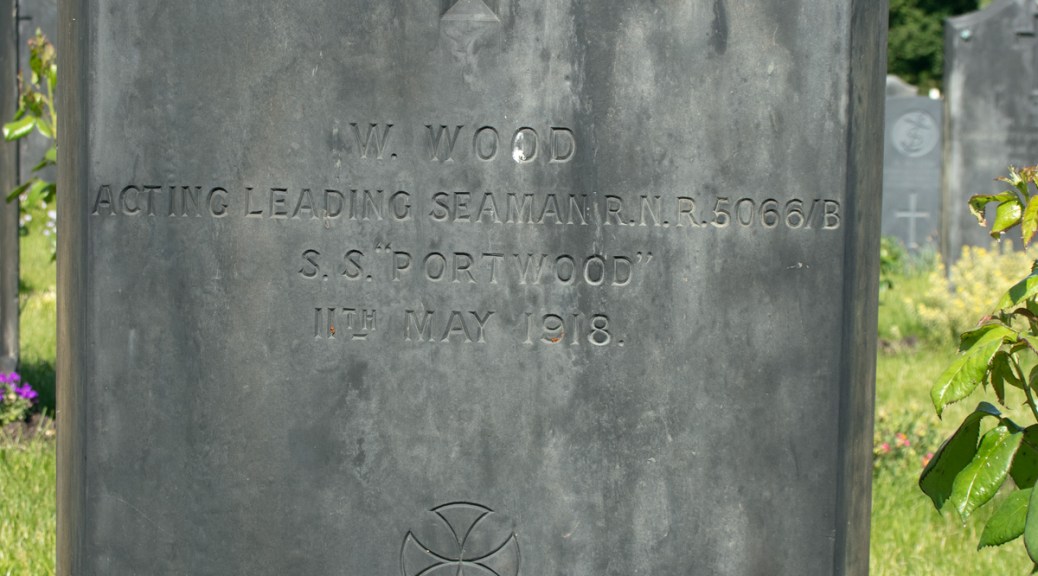
The life of William Wood, who is buried in Woodlands Cemetery in Gillingham, Kent, is a challenge to piece together. His headstone confirms that he held the rank of Acting Leading Seaman in the Royal Naval Reserve, and that he was assigned to SS Portwood at the time of his death.

Full service records for William have long since disappeared, but his pension ledger index card gives his widow as Catherine Rose Wood, of Greenfield Street in Govan, Scotland. It also suggests that the couple did not have any children under full age.

The Royal Navy and Royal Marine War Graves Roll provides William’s date of birth – 28th December 1887 – and goes on to suggest that he was born in London. Sadly, his name is far too common to narrow down census records, and there are no documents relating to his and Catherine’s marriage, so any additional family connections are also lost.

Acting Leading Seaman Wood’s entry on the pension ledger confirms his died of general paralysis of the insane, and his burial in the Gillingham cemetery would suggest that he had passed away in the Royal Naval Hospital in Chatham, Kent. He died on 11th May 1918, at the age of 29 years old.

William Wood was buried in the military section of Woodlands Cemetery, Gillingham, Kent.


Stoker Henry Souter

Stoker Henry Souter

Henry Souter was born in Thornaby, Yorkshire, on 10th August 1887 and was the youngest of four children. His father, John, died when he was just a year old, leaving his mother, Jane to raise the family single-handedly. To do this she found piecemeal work as a charwoman, sharing their home – 3 Edward Street – with two other families.

Henry is absent from the 1901 census, but his mother had moved to Willesden, Middlesex. His sister, Isabella, had married the year before, and she and her husband had relocated to London, presumably for work, taking Jane with them.

By the 1911 return, Henry was boarding with his brother James and his family. The siblings were living at 44 Spring Street, and both were working at a local iron works, James as a pipe moulder, Henry as a rolling miller.

When war came to Europe in the summer of 1914, Henry was called upon to play his part. His service records are long since lost, but he was attached to the Royal Naval Reserve as a Stoker, suggesting previous employment in the navy.

By the end of the year Stoker Souter had been assigned to the battleship HMS Formidable. A key vessel in the Channel Fleet, her role was part of a convoy patrolling the seas of the southern coast of Britain.

Early on the morning of 1st January 1915, while off the Dorset coast, the battleship was torpedoed by a German submarine. Other ships in her convoy came to her aid, but it would prove fruitless. After a couple of hours – and another torpedo strike – she sank, taking more than 540 officer and crew – including Stoker Souter – were lost. He was 27 years of age.

Henry Souter’s body was recovered, and was able to be identified. He had been brought ashore in Lyme Regis, Dorset, and he was laid to rest in a communal grave in the town’s cemetery.


Henry’s next-of-kin were identified as his sister, Annie, who was living in Thornaby, and his mother, Jane. Her address was given as 25 Melville Road, Stonebridge Park, London: she was still living with Isabella and her family – husband George and their six children.


Stoker James Clark

Stoker James Clark

In the regimented Woodlands Cemetery in Gillingham, Kent, stands the headstone dedicated to Stoker James Clark of the Royal Naval Reserve. The grave marker, and associated documents, confirm James’ age at the time of his passing as 48 years, but gives no details of next of kin or any relatives.

Stoker Clark’s service records are sparse, but confirm a date and place of of birth – 13th December 1867 in Glasgow, Scotland – and his parents’ names, William and Catherine. Sadly, while the document also gives the names of two of James’ siblings – Mary and William – it has not been possible to match these with any census documents from the Glasgow area.

James’ service records state that he joined the Royal Naval Reserve on 1st October 1897. He was 5ft 8.5ins (1.74m) tall, with grey eyes and a fresh complexion. He was also noted as having a number of tattoos on his right arm, including a sunrise and a heart.

Stoker Clark’s time in the Royal Naval Reserve are a bit patchy, but it seems that he was called into full duty in 1914. Over the next couple of years he served on three different ships, each time returning to HMS Pembroke, the Royal Naval Dockyard in Chatham, Kent.

While his overall service seems to have gone well, in July 1915, he deserted. Full details are not evident, but he was captured, and seems to have returned to duty by the end of the month.

The next record for Stoker Clark is that of his passing. His service records state that he “died suddenly at [Royal Naval Barracks] Chatham on 2nd May 1916 (cause of death at present unknown)”. There is no other information about his death, and, while his siblings were informed of his death, it appears they were unable – or unwilling – to bring his body back to Scotland for burial.

Instead, James Clark was laid to rest in Woodlands Cemetery, Gillingham, not far from the dockyard he had called his home.


Seaman Charles English

Seaman Charles English

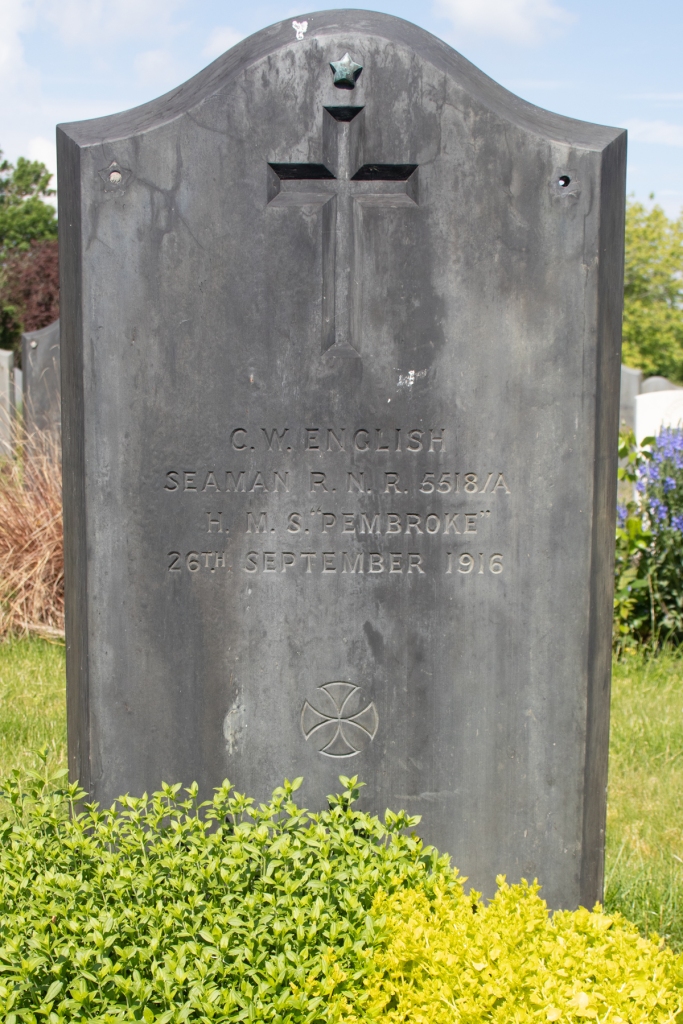
Charles William English was born on 30th August 1895 in the Suffolk town of Southwold. According to his later naval service records, his parents were Ellis and Sarah English, although there is little other information available to back this up.

Charles evidently had a draw to the sea and, when he enlisted in the Royal Naval Reserve on 10th January 1914, he was working as a fisherman. His service records confirm that he was 5ft 9ins (1.75m) tall, with grey eyes and a fresh complexion.

Over the next few years, Seaman English served off the east coast, and was attached to HMS Mantua, a former cruise ship taken over by the Royal Navy to patrol the North Sea. In between trips, Charles made HMS Pembroke, the Royal Naval Dockyard in Chatham, Kent, his home and it was to here that he returned in the autumn of 1916 when he fell ill.

Charles was admitted to the Royal Naval Hospital in the town, tests showing that he was suffering from lymphatic leukaemia. This was to prove fatal, and Seaman English passed away on 26th September 1916, aged just 21 years of age.

It seems likely that Charles William English’s family were unable to foot the bill for bringing their son back to Suffolk. Instead, he was laid to rest in Woodlands Cemetery, Gillingham, not far from the base he had come to call home.


Seaman Peter Bennoit

Seaman Peter Bennoit

Peter Bennoit was born in 1897 in St George’s, Newfoundland. The son of fisherman and sporting guide Peter Bennoit and his wife, Selina, little more is known about his early life.

When war was declared in Europe, he was quick to take up the call to arms. He made the journey to St John’s, and enlisted in the Newfoundland Royal Naval Reserve on 14th October 1914. He set sail for Britain on board the training ship HMS Calypso and, having arrived in November, he was transferred to HMS Pembroke, the Royal Naval Dockyard in Chatham, Kent.

Seaman Bennoit remained in Chatham for the next couple of month, presumably to await a formal posting. This was not to happen, however: he was admitted to the Royal Naval Hospital in Chatham with mastoiditis, a bacterial infection of the inner ear. The condition was so serious that Peter succumbed to it: he passed away on 20th January 1915, at the age of just 18 years old.

Peter Bennoit was 2500 miles (4000km) from home, so it was not possible for him to be interred in Newfoundland. Instead, he was laid to rest in the Roman Catholic section of Woodlands Cemetery in Gillingham, Kent, not far from where he had passed.


Lieutenant John Martyn

Lieutenant John Martyn

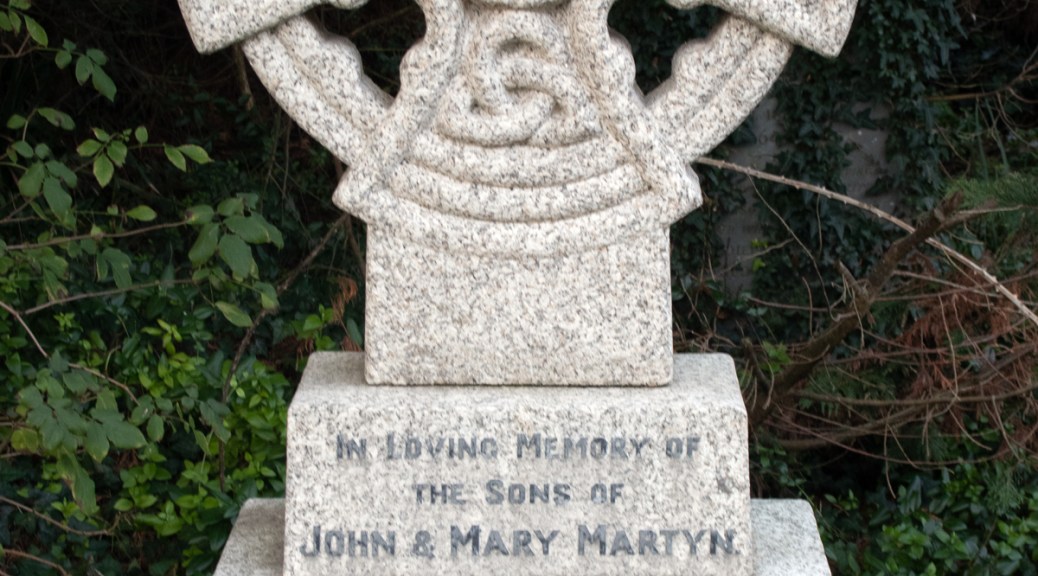
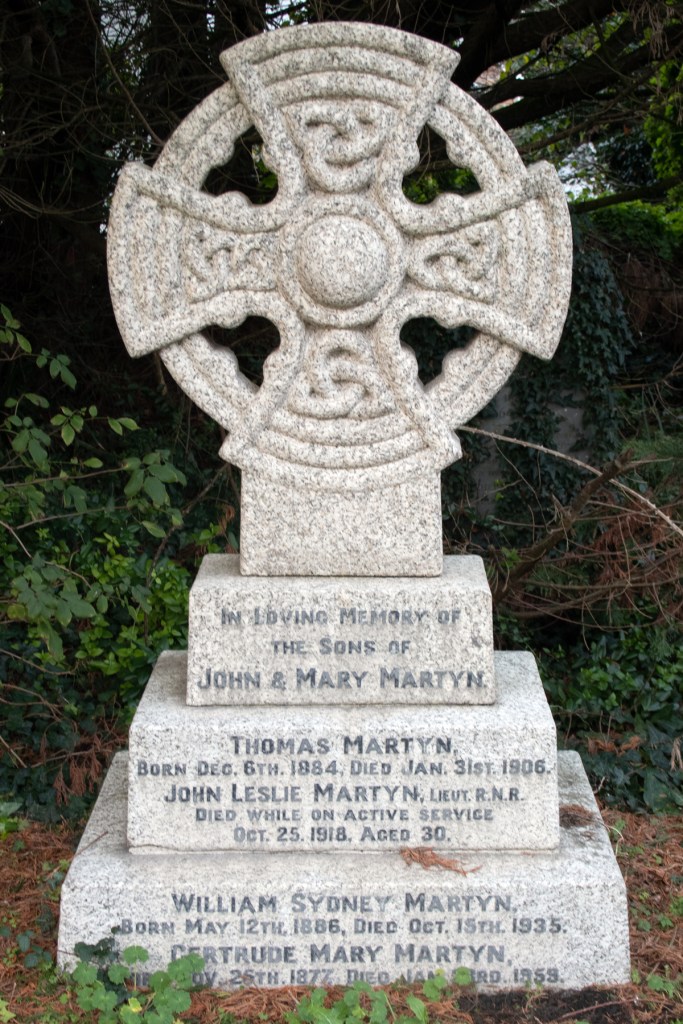
John Leslie Martyn was born in Egloshayle, Cornwall, on 15th February 1888. He was the youngest of five children, and was the third son to John and Mary Martyn. John Sr was a general merchant, and the household had a couple of live-in servants to help both with the household and the business.

When John Sr died in 1904, William, his middle son, took over the running of what was a decent family business.

John Jr, however, had sought another way of life and, was set on a life at sea. He enlisted on the training ship Conway in 1902. Based on the River Mersey, by the time of the 1911 census, he was boarding in the Sailor’s Home in Liverpool. The document confirms that he held the rank of Ship’s Mate in the merchant service, and it would seem that he was doing what he could to build on his skills.

On 26th August 1912, John received his certificate of competency to be the Master of a foreign-going ship. He received a commission in the Royal Naval Reserve, before joining the New Zealand Shipping Co. two years later. When war came to Europe, however, he was called back into naval service.

After serving a few months on the air defences in the Thames Estuary he sailed on his Majesty’s ship Laconia for the coast of German South-West Africa, where he remained. He became a Lieutenant in 1915, and in 1917 was given his first command of HMS Prattler. It is not too much to say that most promising young life has been given to his country.

Cornish Guardian: Friday 8th November 1918

In the summer of 1918, John came home on leave. On 25th July he married Lucy Dudfield in Stanway, Gloucestershire. Tragically, their married life was not to be a lengthy one.

Lieutenant Martyn returned to Devon, and, for reasons undetermined, was admitted to the Royal Naval Hospital in East Stonehouse, Plymouth in October. Whatever the cause of his ailment, he was not to survive it. He passed away while still admitted, on 25th October 1918. He was 30 years of age.

John Leslie Martyn’s body was taken back to Cornwall for burial. He was laid to rest in the family plot in Egloshayle Cemetery.


Deck Hand James Gore

Deck Hand James Gore

James Gore was born on 13th May 1876 in Steart, a community on the Somerset coast near Bridgwater. An only child, his parents were Robert Brewer and Elizabeth Gore, but parental duties were shared with Robert’s family, and Elizabeth went on to marry Thomas Dibble when James was just 4 years old.

Robert was a fisherman, as was his father, and this was a life into which James would also follow. By 1891 he was working with his paternal grandfather, John Brewer, and within ten years he was running his own boat.

On 12th December 1901, James married Emily Chilcott at the parish church in Stogursey, Somerset. She was the daughter of Richard, Chilcott, a labourer employed on the expanding road network for the area. The couple initially set up home in Steart, but had moved to Burnham-on-Sea by the time of the 1911 census. They would go on to have four children – Harold, Reginald, Margaret and Olive – between 1905 and 1916.

When war broke out, James was 38 years old. He wasn’t called up immediately, but by the closing months of the conflict, the needs of the Royal Navy were strong enough for him to be conscripted. He joined up on 21st August 1918 and, having built a career as a fisherman, he was assigned to the Royal Naval Reserve. His service records confirm that he was 5ft 6ins (1.67m) tall, with a fresh complexion and blue eyes.

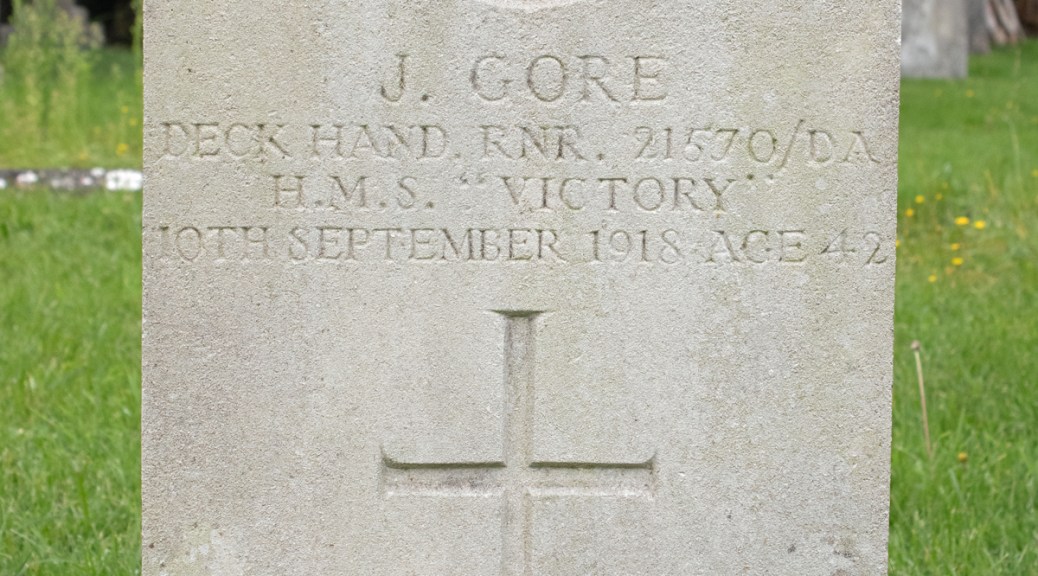
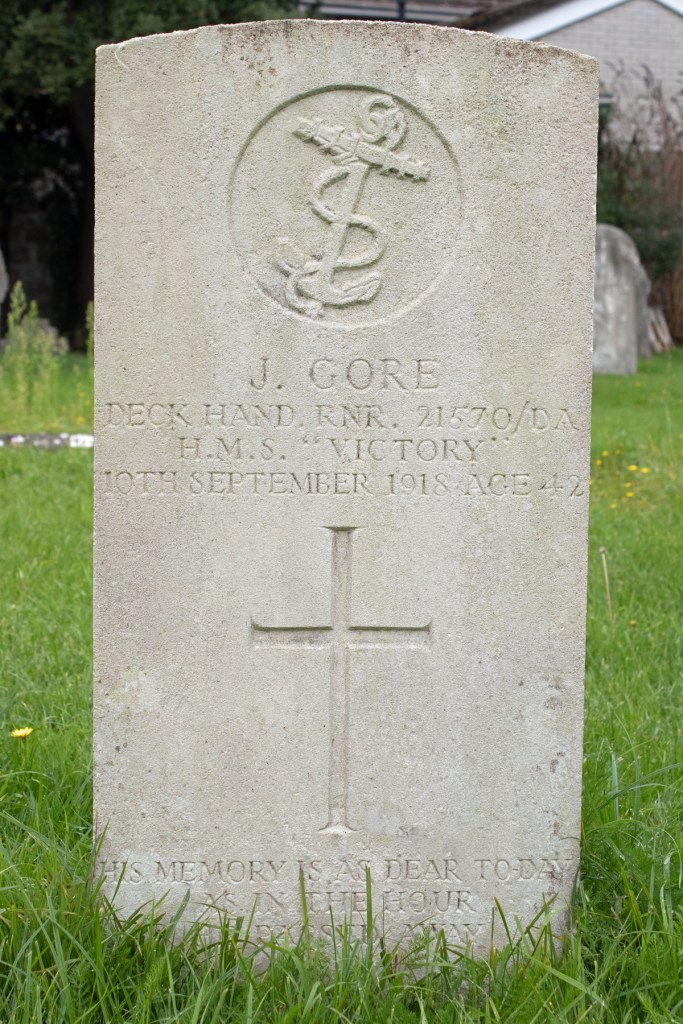
Deck Hand Gore was sent to HMS Victory, the Dockyard in Portsmouth, Hampshire, for his initial training. Here, billeted in cramped barracks, perfect breeding grounds for germs and disease, he quickly became ill. Having contracted pneumonia, James was admitted to the Haslar Hospital in Gosport. The condition was to take his life: he passed away on 10th September 1916, less than three weeks after enlisting. He was 40 years of age.

James Gore’s body was taken back to Somerset for burial. He was laid to rest in the peaceful cemetery in Burnham-on-Sea, not far from where Emily and the children were still living.