Category Archives: Royal Naval Reserve

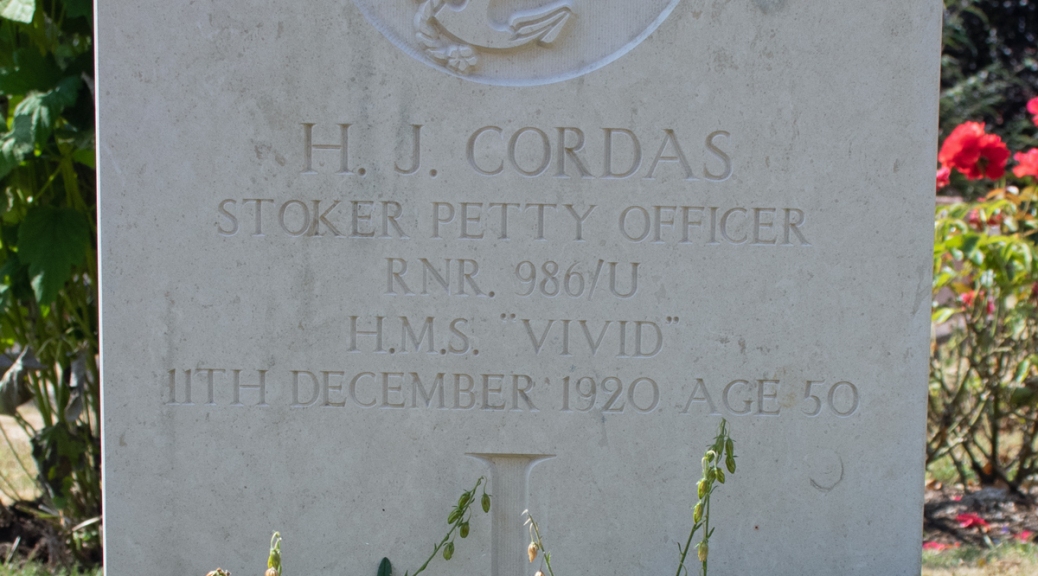
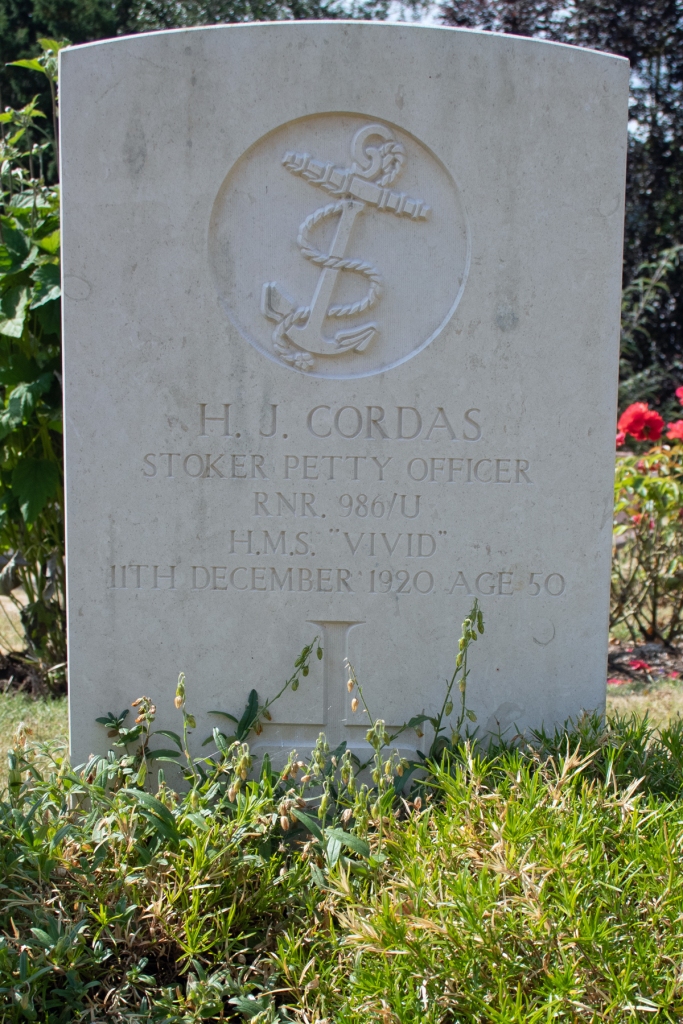
Stoker Petty Officer Henry Cordas

Stoker Petty Officer Henry Cordas

Much of Henry John Cordas’ early life is destined to remain a mystery. The first record for him is the 1881 census, which gives is his address as St Mary’s Orphanage in Heston, Middlesex, where he was one of 650 children.

The 1891 census recorded Henry as living in Humber Street, Grimsby, Lincolnshire, right next to the town’s docks. He is noted as being a fisherman, and is married to a woman called Mary, who was born in Deptford, Surrey.

The next available census record for Henry adds confusion to his story. The document, dating from 1911, confirms that he and Mary are now living in Hotwell Road, Bristol, Gloucestershire, again within spitting distance of the docks. Henry was employed as a marine fisherman in the merchant service. The document suggests that the couple had been married for ten years, and give Mary’s place of birth as Swansea, Glamorganshire.

While the document matches previous information for Henry, it seems unlikely that the Marys in the 1891 and 1911 censuses are one and the same. Either way, the couple were sharing their house with Mary’s niece, Ellen.

Henry seems to have joined the merchant fleet in a more official capacity in the autumn of 1900. His records show that he was 5ft 11ins (1.8m) tall, with blue eyes and a fair complexion. He served out of Bristol and, in the years leading up to the outbreak of war, he was assigned to a number of ships, travelling the Atlantic to Montreal and Jamaica, amongst other far-flung places.

When hostilities commenced, Henry was assigned to the Royal Naval Reserve. Over the next few years, he served on a number of ships, including the armoured cruisers HMS Suffolk and HMS Doris. He worked as a Stoker, but by the end of the conflict had been promoted to Stoker Petty Officer.

In December 1918, Henry’s service came to an end. He was, by now, based at HMS Vivid, the Royal Naval Dockyard in Devonport, but his health was suffering. Medically discharged with a combination of chronic bronchitis and rheumatic pain, he seems to have returned to Bristol.

On 6th December 1920, Henry was admitted to Bath War Hospital in Somerset, as he was coughing up blood. The plan was to transfer him to Greenwich Hospital in Surrey, but he suffered an aneurysm before that move could be made. He passed away on 11th December 1920, at the age of 50 years old.

The body of Henry John Cordas did not travel far for burial. He was laid to rest in the peaceful expanse of Bath’s Locksbrook Cemetery.


Seaman James McNichol

Seaman James McNichol

James McNichol was born on 21st December 1884, in Greenock, Renfrewshire. His parents were James and Elizabeth McNichol, but there is little additional information about his early life.

On 22nd May 1908, James enlisted as a Seaman in the Royal Naval Reserve. Again, little information is available, although he appears to have spent most of his career based out of his home town or on the ship Spindrift, based out of Glasgow.

James’ service records do shed some light on him. His height was recorded as 5ft 4ins (1.63m), he had a fair complexion and blue eyes. He also had a tattoo of a tombstone on his right arm and the words True Love on his right.

James had married a woman called Elizabeth at some point, and, while the marriage documents are lost to time, she is noted as his next of kin on his naval death records.

By the summer of 1912, Seaman McNichol was assigned to the battleship HMS Bulwark. The ship patrolled the English Channel at the outbreak of war, but by that autumn of 1914, she had moved to North Kent, guarding the waters around the Isle of Sheppey against potential German invasion.

James was on board Bulwark on the morning of 26th November 1914, when an explosion ripped through the ship and sinking it. More than 740 lives were lost, Seaman McNichol among them. He was just 29 years of age.

James McNichol was laid to rest in a marked grave in Woodlands Cemetery, Gillingham, not far from a mass grave where scores of his colleagues had been buried.


Seaman James McNichol
(from findagrave.com)

Seaman Rendle Pike

Seaman Rendle Pike

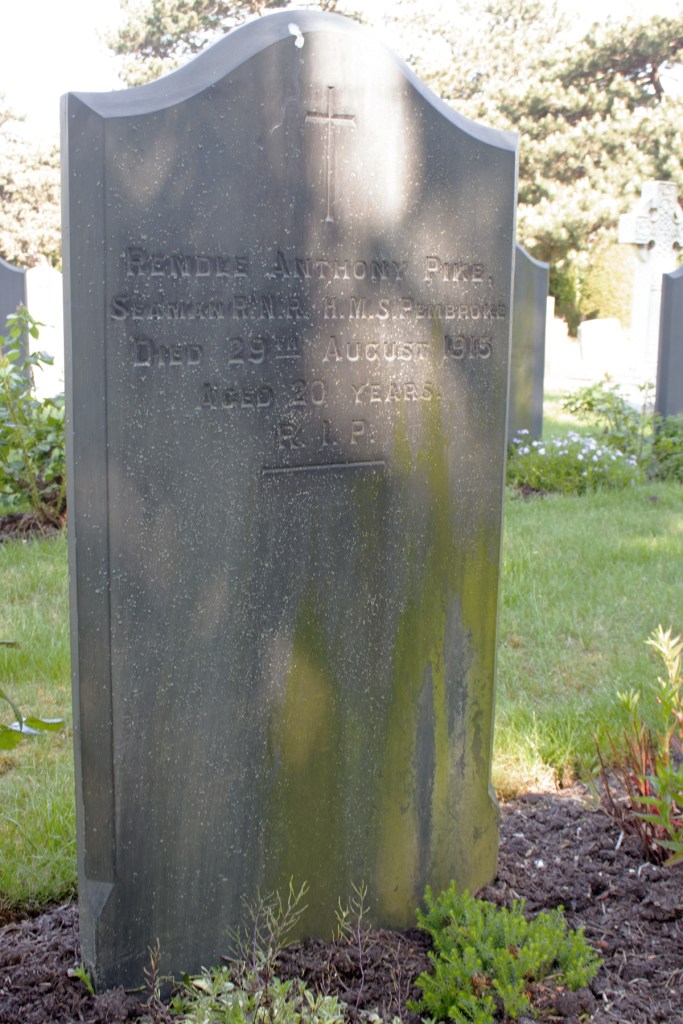
Rendle Anthony Pike was born on 9th May 1895 in Newfoundland. He was one of nine children to Lewis and Mary Pike, but there is little additional information about his early life.

Lewis was a fisherman, and it seems likely that Rendle would have had experience of seafaring when he was growing up. When war broke out, therefore, it made sense that he enlisted in the Royal Naval Reserve.

Again, full details of his service was unavailable, but Seaman Pike joined up within the first year of the war and, by the summer of 1915, he was based at HMS Pembroke, the Royal Naval Dockyard in Chatham, Kent.

Tragically, Rendle’s time in the navy was to be a short one. The next record available for him is that of his passing. According to his service documents, he died ‘of disease‘ on 29th August 1915. He was just 20 years of age.

Rendle Anthony Pike was laid to rest in Woodlands Cemetery in Gillingham, Kent, not far from the dockyard at which he had been based.


Stoker John Campbell, AKA John Connolly

Stoker John Campbell, AKA John Connolly

John Connolly was born on 7th April 1887 in Liverpool, Lancashire. There is little information available about his early life, although his parents were Thomas and Marianne Connolly. A Roman Catholic, he was baptised at St James Church and went on to marry a woman called Bridget, although details for the wedding are lost to time.

John must have had a level of proficiency when it came to ships and sea-faring as, when war had broke out, he was call up for service with the Royal Naval Reserve (RNR). He enlisted as a Stoker on 1st October 1915, using the surname Campbell. His records show that he was 5ft 6ins (1.68m) tall, had blue eyes and a fair complexion.

Stoker Campbell was based at HMS Pembroke, the Royal Naval Dockyard in Chatham, Kent. His time in service, however, does not seem to have been a happy one. In fact, within a few months of being conscripted, John had absconded and made his way back to Liverpool.

John was caught and was being brought back to Kent under escort, when the unimaginable happened.

John Connolly, a stoker of the RNR, attached to the Royal Naval Barracks, Chatham, was found dead on the railway near Warren House Crossing, between Sole Street and Cuxton, on Wednesday, with terrible injuries to his head.

Connolly, who is known also as Campbell, had been arrested as a deserter at Liverpool, and was returning to Chatham under escort on Tuesday… The train was very full, and deceased, with his escort, stood in the corridor, where several soldiers were also standing.

Some time after the train had left Herne Hill the escort, Leading Stoker John Edward Craig, left his prisoner to proceed to the lavatory, and when he returned one of the soldiers shouted “Jack, your prisoner had gone out the window.” The train was stopped, but the guard suggested that Craig had better proceed to Rochester instead of searching for the deceased, as the night was very dark. At Rochester Bridge the matter was reported to the military authorities, and a search along the line, then ordered, resulted in the discovery of the body of deceased…

A Lance Corporal of the 2/5th King’s Liverpool Regiment, one of the soldiers in the corridor, gave evidence at the inquest… He said he was standing close by deceased, but did not see him go out of the window, which was open at the time.

It was stated that is was usual in the Navy for one man only to act as escort, as all expenses connected with desertions had to be paid by the prisoners.

The jury found the death resulted from injuries received by deceased in a fall from the train, but that there was not sufficient evidence to prove whether the fall was intentional or otherwise.

South Eastern Gazette: Tuesday 8th February 1916

Whether John had intended to throw himself from the train will never be known. All that can be confirmed is that he died of his injuries on 1st February 1916, aged just 28 years old.

John Connolly was laid to rest in Woodlands Cemetery, Gillingham, not far from the dockyard at which he had been based. His epitaph mentioned both of the names he chose to go by, and the inscription: “Beloved husband of Brigid, her one and only love. Re-united RIP. Jesus mercy Mary help.


Stoker Alexander Maguire

Stoker Alexander Maguire

Alexander Maguire was born on 28th March 1880 in Glenarm, County Antrim, Northern Ireland. Little is known about his early life, apart from his parents’ names – James and Ellen.

Glenarm is a coastal village, and it is likely that Alexander would have had experience of seafaring from an early age. This seems to have spurred him into building a career and, on 16th December 1903, he enlisted in the Royal Naval Reserve as a Stoker.

With war getting closer, Stoker Maguire was called into formal service, and was assigned to the steamer SS Rathlin Head. He sailed the Atlantic in March 1914, and disembarked an New Orleans. It seems, however, that he missed his passage back home, although at this point, his whereabouts become a bit hazy.

Alexander was back in Britain by 13th January 1915, as his service papers record him in Liverpool. He then travelled to HMS Pembroke, the Royal Naval Dockyard in Chatham, Kent. This looks to have been his last move, however, as he passed away just two days later. The cause of death is simply recorded as ‘disease’: he was 34 years of age.

Alexander Maguire was laid to rest in the Roman Catholic section of Woodlands Cemetery in Gillingham, Kent, not far from the dockyard to which he had been assigned.


Stoker Peter Higgins

Stoker Peter Higgins

Peter Higgins was born in Thornaby, North Yorkshire, on 23rd January 1887. His parents were William and Catherine (Kate) Higgins, but of them there is very little information.

What seems likely that Peter would have had some experience with boats as, on 26th May 1909, he enlisted in the Royal Naval Reserve. His service records show that he was 5ft 7ins (1.70m) tall and was described as having blue eyes and a pale complexion. He was also noted as having a scar over his left eye and another on his left thigh.

When war broke out, Peter was officially called for duty and, over the next couple of years, he served as a Stoker on the battleship HMS St Vincent. The ship patrolled the North Sea, and would later be involved in the Battle of Jutland.

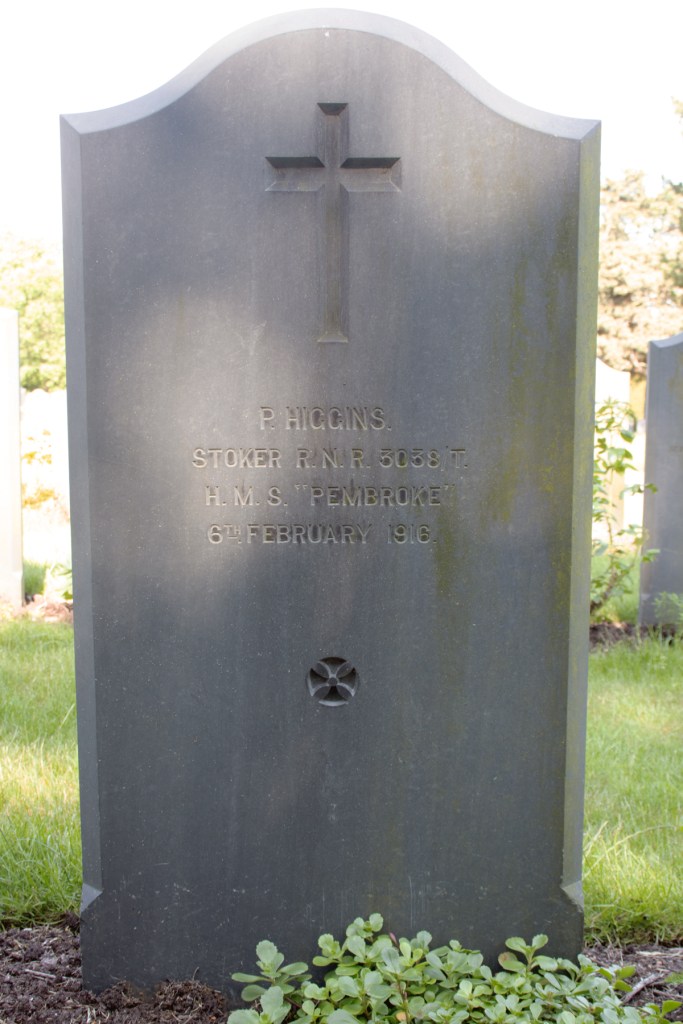
Stoker Higgins, however, was back on dry land by that point, having been assigned to HMS Pembroke, the Royal Naval Dockyard in Chatham, Kent. Peter had fallen ill with a gastric ulcer, and tragically, this was to prove fatal. He passed away on 16th February 1916, at the age of just 29 years old.

Peter Higgins was laid to rest in the naval section of Woodlands Cemetery in Gillingham, Kent, not far from the dockyard that was to prove his last posting.


Deck Hand Philemon Richards

Deck Hand Philemon Richards

Philemon Witheridge Richards was born on 9th July 1891 in Porthleven, Cornwall. He was one of at least seven children to George and Ann Richards. George was a sailor, as were he two oldest sons and, by the late 1890s, the family had made the move to Penarth in Glamorganshire.

When he left school, Philemon followed his father and older brothers into sailing. By the time he turned eighteen, George had passed away and Philemon wanted bigger and better things. On 16th July 1909, he enlisted in the Royal Garrison Artillery. His service records show that he stood 5ft 9.5ins (1.76m) tall, had good vision and was of good fitness.

Gunner Richards was posted to No. 6 Company and remained part of the territorial force. On 1st July 1911, after twenty months’ service, he was, at his own request, discharged from the army.

The trail goes cold for a while, and Philemon seems to have returned to a life at sea. This changed, however, when war broke out and, in October 1915, he was drafted into the Royal Naval Reserve as a Deck Hand.

Philemon’s time in service seems to have been shore-based however. After an initial posting to HMS Vivid, the Royal Naval Dockyard in Devonport, he moved to HMS Victory, which was the name given to the dockyard in Portsmouth, Hampshire. He moved on again in the autumn of 1916, by which point he was based at HMS Pembroke, the Royal Navy’s shore-base in Chatham, Kent.

It was here that Deck Hand Richards fell ill. It is unclear what the condition was, but he was admitted to the Military Hospital in Chatham on 20th October 1916. His illness worsened, and he passed away there on 2nd November. He was just 25 years of age.

Philemon Witheridge Richards was brought back to Glamorganshire for burial. He lies at rest in the graveyard of St Augustine’s Church in Penarth.


Philemon’s gravestone is also dedicated to his brother, Thomas Witheridge Richards. Eighteen years Philemon’s senior, Thomas had been a sailor, and, while no records remain, it seems likely that he may also have been called into service during the First World War. He died at home on 4th July 1918, at the age of 45 years old. He was laid to rest in the same plot as his younger brother.


Boy Sidney Buttle

Boy Sidney Buttle

Sidney Alfred Buttle was born on 7th November 1900, one of eight children to Walter and Alice Buttle. Walter was a brickyard labourer from the Somerset hamlet of Churchstanton, but it was in nearby Wellington that he and weaver Alice raised their young family.

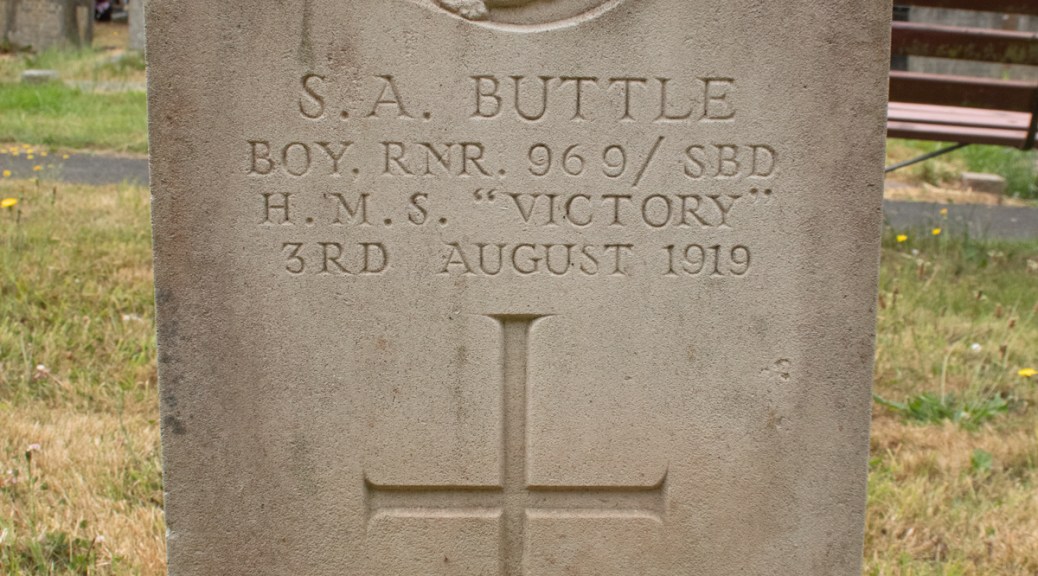
Sidney was just 13 years old when war broke out, but he was a young man who appeared keen to play his part. On 31st July 1917, he enlisted in the Royal Naval Reserve, a regiment that suggests that, even at his young age, he had some experience of working with boats.

His service records show that Sidney was just 5ft 2.5ins (1.59m) tall, had a fresh complexion with hazel eyes. Given the rank of Boy, he was initially posted to Falmouth, Cornwall, where he spent nine months training. After this, he spent a further six months on short postings as a deck hand, before being sent to HMS Victory, the Royal Naval Dockyard in Portsmouth, Hampshire.

Boy Buttle was, by this point, suffering from neurasthenia, a nerve disorder, and it was this condition that led to his eventual discharge from naval service in December 1918.

Sidney returned home, but seems to have been weakened by the condition. He passed away at home on 3rd August 1919, at the tender age of just eighteen years of age. He was laid to rest in Wellington Cemetery, not far from where his family still lived.


Seaman Albert Cluett

Seaman Albert Cluett

Albert Cluett was born on 2nd August 1896, one of three children to fisherman Richard Cluett and his wife, Johanna. The couple were third generation immigrants to North America, and had made their home on the remote Fogo Island, to the north of Newfoundland.

There is little concrete information about Albert’s life; given his father’s occupation, it seems likely that he would have had a good working knowledge of seafaring, and this led him to enrol in the Newfoundland Royal Naval Reserve when war broke out.

Details of Seaman Cluett’s military life are scant. All that we know is that, by the summer of 1917, he was based at HMS Pembroke, the Royal Naval Dockyard in Chatham, Kent. He was billeted in the Drill Hall, which had been set up with temporary accommodation because the barracks themselves had become overcrowded.

On the night of the 3rd September 1917, the German Air Force carried out an air raids on Chatham. The town was heavily bombed and the Drill Hall received a direct hit. Seaman Cluett was badly injured and died of his wounds in hospital the following day. He had just celebrated his 21st birthday.

Albert Cluett was laid to rest, along with the other victims of the Chatham Air Raid, in the Woodlands Cemetery, Gillingham.


Seaman Albert Cluett
(from ancestry.co.uk)

Another young man from Fogo, Seaman Thomas Ginn, also died during the bombing raid; given the remoteness of the Newfoundland town, it seems very unlikely that he and Albert did not know each other.


Trimmer Gilbert McLoughlin

Trimmer Gilbert McLoughlin

Gilbert McLoughlin was born in Grimsby, Lincolnshire, on 19th August 1896, one of eight children to Charles and Isabella McLoughlin. Being a fishing port, it is likely that Charles was involved in the industry, and it is no surprise that Gilbert and his siblings followed suit.

When war came to Europe, his skills at sea led to him being brought into the Royal Naval Reserve, and indeed Gilbert joined up on 20th March 1916. His service records show that he stood 5ft 2.5ins (1.59m) tall, had brown eyes and a sallow complexion, and had tattoos on his left arm.

Trimmer McLoughlin was based at HMS Pekin, a shore establishment in Grimsby, from which he would have served on ships patrolling the Lincolnshire coast. He remained posted in his home town until the end of 1916, at which point he moved down the coast to HMS Ganges, the naval base in Ipswich.

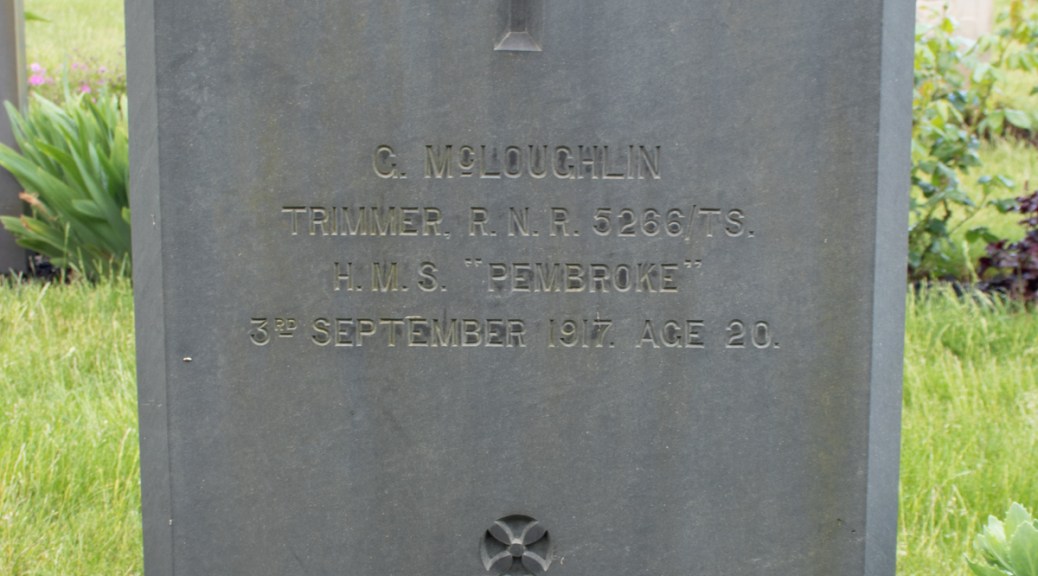
Gilbert made a further move in July 1917, when he was posted to HMS Pembroke, the Royal Naval Dockyard in Chatham, Kent. The base was particularly crowded that summer, and he was billeted in temporary accommodation set up in the barracks’ Drill Hall.

On the night of 3rd September, Chatham came under attack from a German air raid, and the Drill Hall received a direct hit. Trimmer McLoughlin was among those to be killed that night. He was just 20 years of age.

Gilbert McLoughlin was laid to rest in the Woodlands Cemetery in Gillingham, Kent, alongside the other victims of the Chatham Air Raid.


Gilbert’s older brother Joseph McLoughlin was also a victim of the First World War. As the conflict began, he continued his work as a trawlerman, although the role of his ship – the Kilmarnock – now also included elements of mine location.

On the afternoon of the 22nd September 1914, the Kilmarnock left Grimsby on a routine trip. She was around thirty miles offshore when the captain spotted floating mines ahead.

The skipper put out a buoy to mark the position, and intended returning to port to report the matter to the Admiralty authorities, but seeing some naval vessels in the distance he made towards them instead with the object of reporting.

Whilst doing so an explosion occurred amidships, and the vessel was blown into two parts, which sank immediately.

The skipper was blown to pieces on the bridge and the chief engineer badly injured.

The naval vessels, attracted by the explosion, hurried to the spot, picked up the wounded engineer, mate, and one member of the crew.

Boston Guardian: Saturday 26th September 1914

Joseph was one of the six crewmen to be killed in the incident. He was just 19 years of age.