Category Archives: Lieutenant

Lieutenant Colonel Cecil Stevens

Lieutenant Colonel Cecil Stevens

Cecil Robert Stevens was born in Arrah, India, on 14th March 1867. One of six children, his parents were Charles and Mary Stevens. Charles was a civil servant who had been born in the South Sea Islands, while Mary has been born in Bengal.

The family appear to have moved to the United Kingdom by the late 1870s. Census records for them are a bit sparse, but the 1881 document found Mary living in Honiton, Devon, with four of Cecil’s siblings and three servants. Cecil, meanwhile, was a boarding student at Malvern College, Worcestershire.

By 1891, Cecil had moved to St Columb in Cornwall. He was boarding at a hotel on Fore Street, and was employed as a general medical practitioner.

Charles was later rewarded for his service to the Empire, and received a knighthood. The 1901 census found him residing in Harcourt Terrace, Kensington, Middlesex, while his wife, now Dame Mary Stevens, was visiting a friend from India in Devon. Sir Charles died at home in 1909, following a bout of influenza.

Cecil, meanwhile, had been making his own way in the world. A qualified surgeon, he married Katharine Duff, a nurse from Aberdeen. They went on to have two children, son Cecil Jr and daughter Mignonette.

On 29th July 1893, Cecil joined the Indian Medical Service as a Lieutenant. Three years later, he was promoted to Captain, and in July 1905, he rose to the rank of Major. His commitment to duty is evident: he spent many years overseas, separated from his wife and young family, and in January 1913, was promoted to the rank of Lieutenant Colonel.

Cecil’s time in the Indian Medical Service was not without danger. In 1895, he was involved in the Relief of Chitral, for which he received a medal and clasp. He was caught up in the Tirah Campaign of 1897/98, and received a further two clasps for his role.

Lieutenant Colonel Stevens’ role during the First World War is lost in the mists of time. Given his role in the Indian Medical Service, it is likely that he served overseas, but he returned to Britain after the war, coming by way of Egypt.

By the autumn of 1919, he was back in Devon, at the family home on Elmsleigh Park Road in Paignton. His health was failing at this point, having come down with diabetes while in North Africa. him. Cecil passed away on 18th November 1919: he was 52 years of age.

Cecil Robert Stevens was laid to rest in the sprawling grounds of Paignton Cemetery.


Lieutenant Colonel Stevens’ will left £4123 13s 10d (around £180,000 today) to his sister-in-law, Alice Duff.

Katharine outlived her husband by only eight years. She passed away on 22nd December 1927 at the Field Officers’ Quarters in Gibraltar: she was 61 years of age.


Lieutenant Stanley Syvret

Lieutenant Stanley Syvret

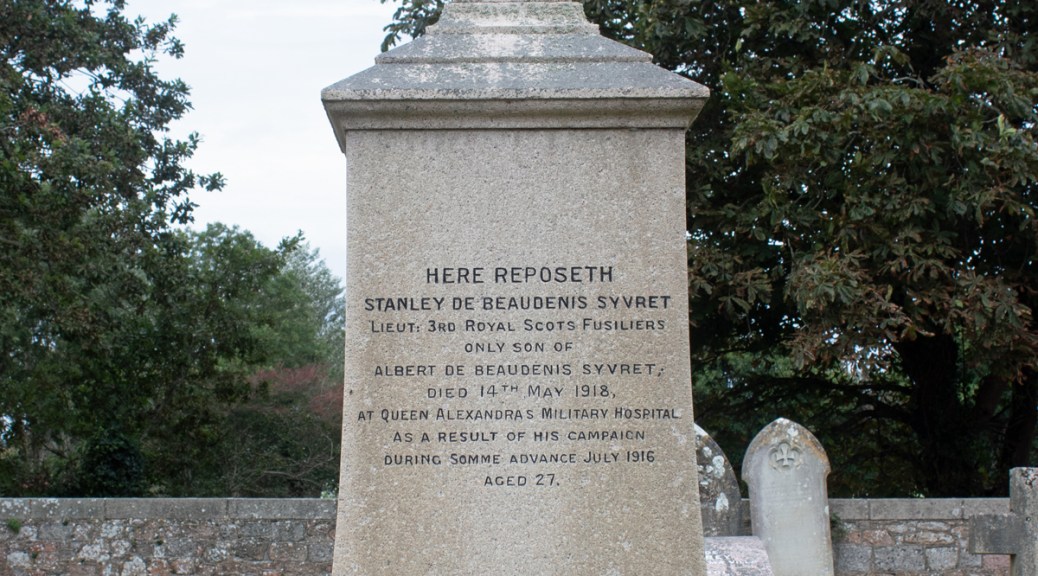
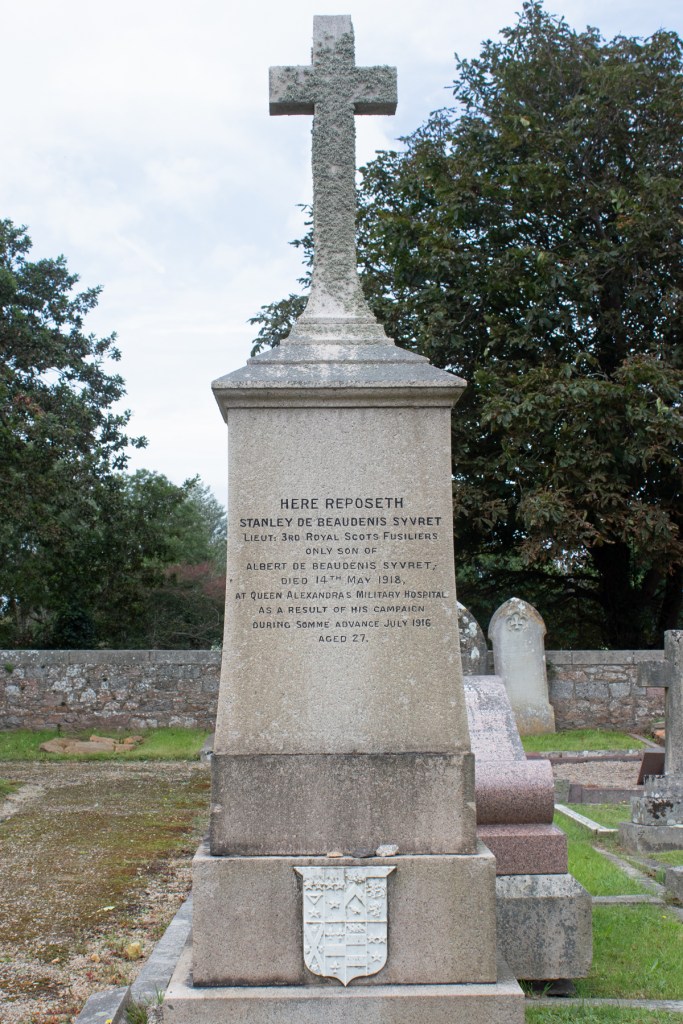
In the graveyard of St Lawrence Church in Jersey, stands an imposing monument. The dedication reads “Here reposeth Stanley de Beaudenis Syvret, Lieut. 3rd Royal Scots Fusiliers. Only son of Albert de Beaudenis Syvret. Died 14th May 1918 at Queen Alexandra’s Military Hospital as a result of his campaign during Somme Advance July 1916. Aged 27”.

Stanley de Beaudenis Syvret was born in South America in 1891. He was the only child of Anthony and Amy, both of whom were born in Jersey. Records for South America are not available, but by the time of the 1911 census, the family were living in Stamford Hill, London. Anthony was employed as an attendance officer for London County Council schools, while Stanley had found work as a clerk for a wool broker.

At this point, Stanley’s trail goes a bit hazy. The 3rd (Reserve) Battalion of the Royal Scots Fusiliers was based in Scotland for the whole of the conflict, so it is likely that he was transferred to that battalion after being injured.

There is little additional information for Lieutenant Syvret. He was brought back to Jersey after his death, and lies at rest in the churchyard close to his family home.


Lieutenant Hugh Lorimer

Lieutenant Hugh Lorimer

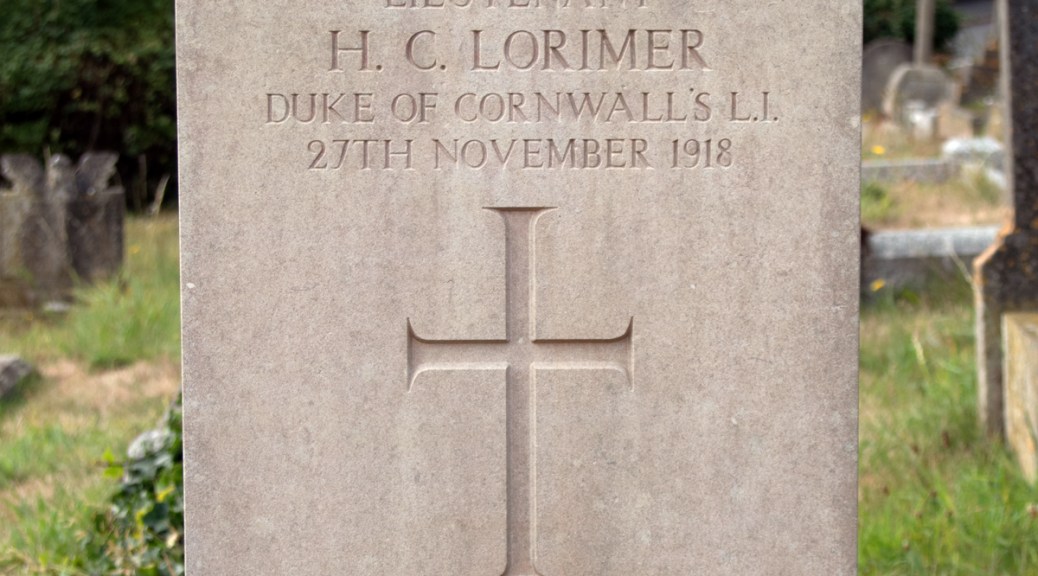
Hugh Cowan Lorimer was born on 27th November 1886 in Totnes, Devon. The oldest of four children, his parents were Scots-born draper Robert and his Devonian wife, Susan.

This was a family business, with Robert’s father – also called Robert – running the drapery at 59 Fore Street since the 1871 census. By 1891, Hugh’s father had taken over, and the family remained there until at least the time of the 1911 census return.

Hugh, by this point, had also taken on the mantle of draper. With the Lorimer business firmly set up in Totnes, he moved to Paignton, and opened a shop on the central Victoria Street. By 1911 he was listed as being the main employer, with his sister Muriel at his side, and a live-in servant, Bella Loram, helping to manage the household.

In the spring of 1914, Hugh married Gwendoline Pridham. Little information about her is available, but she had been born in Newton Abbot, and was a year younger than her new husband.

When war came to Europe later that year, Hugh was called upon to play his part: “He joined the Army in June, 1915, and received a commission in the 1/5th [Duke of Cornwall’s Light Infantry] with whom he served in France for 15 months prior to March 30th, where he was severely wounded, with the result that he had to undergo several operations, and only recently rejoined his Regiment.” [Western Times: Monday 2nd December 1918]

Lieutenant Lorimer was not fully out of harm’s way, however. As the summer moved to autumn, he fell ill, contracting influenza, which became double pneumonia. Admitted to hospital in Eastbourne, East Sussex, he succumbed to the condition on 27th November 1918: his 32nd birthday.

Hugh Cowan Lorimer was brought back to Devon for burial. He was laid to rest in Paignton’s sweeping cemetery, on the outskirts of the town he had made his home.


Gwendoline was pregnant when she was widowed: the couple’s child, Joyce, was born on 29th June 1919, never to know her father.


Hugh’s younger brother Kenneth was also caught up in the Great War. He had emigrated to Canada at some point after the 1911 census, but volunteered for army duty in 1915.

Lieutenant Lorimer was attached to the 4th Battalion of the Canadian Machine Gun Corps, and was entrenched on the Western Front. “He was in command of a section that was in a tank taking part in an attack north west of Le Quesnel. The tank was put out of action by enemy shell fire, and Lieutenant Lorimer was wounded by a splinter from a shell. He was removed from the tank and received First Aid but died shortly afterwards.” [Canadian War Graves Registers (Circumstances of Casualty)]

Kenneth Lorimer died on 8th August 1918, days short of his 30th birthday. He was laid to rest in Beaucourt British Cemetery in Picardie.


Lieutenant Albert Bendell

Lieutenant Albert Bendell

The life Albert Bendell is one of dedication to naval service. Born in Portsmouth on 28th May 1865, his parents were Master at Arms John Bendell and his Jersey-born wife, Eliza.

The family had moved to St Martin, Jersey, by the time of the 1871 census. Given the amount of time her husband spent at sea, it would seem likely that Eliza, who had three young children to raise on her own, wanted to be close to her family.

Albert was keen to follow in his father’s footsteps and, on 6th December 1880 he enlisted in the Royal Navy. Just fifteen years old, his service records show that he was just 5ft 1.5ins (1.56m) tall, with blue eyes, light hair and a fair complexion.

Albert’s dedication to the role was obvious: starting off as Boy 2nd Class, he steadily – and rapidly – rose through the ranks. Over the next twelve years, he served on seven ships and shore bases. He was promoted to Boy 1st Class in September 1891, while serving on the training ship HMS St Vincent.

When he came of age in May 1883, he was given the rank of Ordinary Seaman: within a year he had risen to Able Seaman, and achieved the role of Leading Seaman in January 1888. Just three months later, Petty Officer Bendell was beginning a two-year service on board HMS Fearless.

In April 1893, Albert received a further promotion, and a change in direction within the Royal Navy. He was now a Gunner, a standing officer’s role, permanently attached to HMS Duke of Wellington – returning to the first ship he had been assigned to nine years earlier.

On 17th September 1900, Albert married Amelia Renouf, the daughter of a land proprietor from St Martin, Jersey. The couple wed in St Helier, Albert giving his profession as Warrant Officer. At 37, Amelia was a year older than her new husband: the couple would not go on to have any children.

Albert’s rise through the ranks continued. The 1911 census found him moored in Malta. He was Chief Gunner on HMS Egmont: the importance of his role on board highlighted by the fact that he was the 11th person out of 188 to be recorded on the document.

When war came to Europe, Albert served his King and Country proud. He was promoted to the rank of Lieutenant and, in June 1919, he was awarded the MBE “for valuable services as Officer-in-Charge, Defensively Armed Merchant Ships, Southampton.” [The Edinburgh Gazette, 1st July 1919]

This distinguished life was beginning to take its toll, however, and, on 16th March 1920, after nearly 40 years in naval service, Albert was medically stood down. Suffering from dyspepsia, he returned to Jersey, and his home, La Rosaye, in St Martin.

Albert Bendell’s health was to get the better of him. He passed away on 26th April 1920, at the age of 54 years of age. He was laid to rest in the peaceful graveyard of St Martin’s Church, Jersey.


Amelia remained on the island for the remainder of her life. She passed away on 31st August 1943, at the height of Jersey’s German occupation, at the age of 80 years old. She was laid to rest with Albert, husband and wife reunited after more than 23 years.


Lieutenant Keith Beddy

Lieutenant Keith Beddy

Keith Charles Beddy was born in Port Elizabeth, South Africa. His parents were Walter and Isabella Beddy, and he was the sixth of eight children.

Little additional information is available about Keith’s early life. When war broke out, he enlisted in the army, eventually becoming assigned to the 5th Battalion of the Hampshire Regiment. Rising through the ranks to the rank of Lieutenant, he eventually transferred to the Royal Flying Corps.

Lieutenant Beddy was based on Boscombe Down, near Amesbury, Wiltshire. On 6th February 1918, he was flying his RAF BE 2e aircraft when he attempted a turn at a low altitude. The plane nose-dived and crashed into the ground, and Keith was killed instantly. He was just 21 years of age.

With his family on the other side of the world, Keith Charles Beddy was laid to rest in Amesbury Cemetery, not far from the airfield where he had been based.


Major Charles Hall

Major Charles Hall

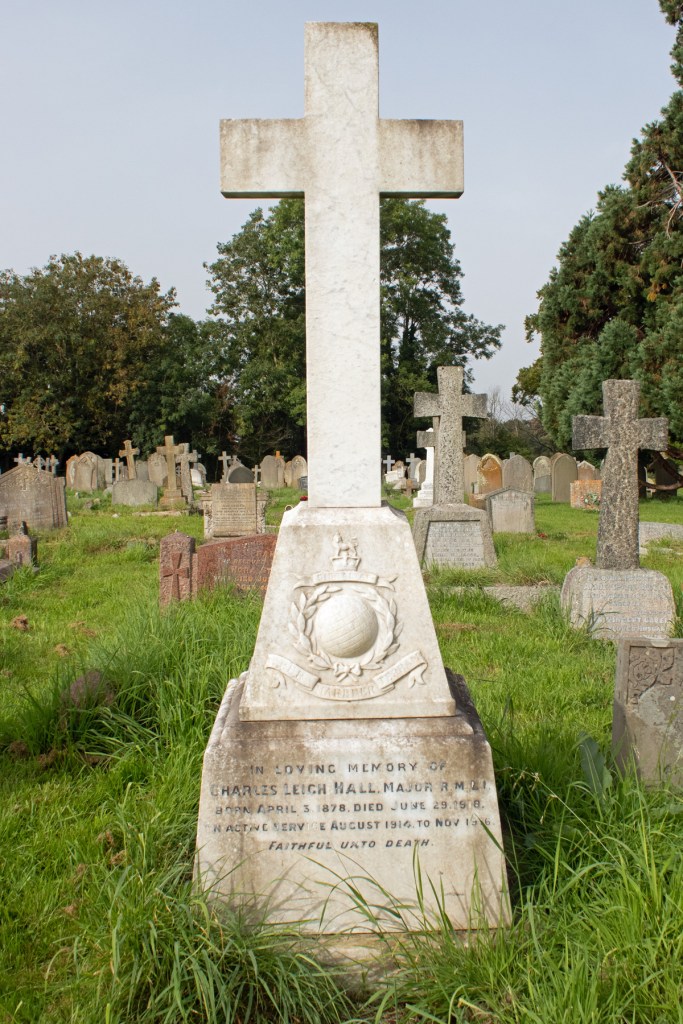
Charles Leigh Hall and his twin Maud, were born on 3rd April 1878 in Clifton, Gloucestershire. Two of eight children, their parents were Pedro and Anne Hall. Pedro, whose full name was Pedro Henrique Sinclair Hall, was better known as Henry, and was a mathematics tutor and Assistant Master at Clifton College, and it goes without saying that the Hall children had a educated upbringing.

Charles was always to be destined for great things. By the time of the 1901 census, when he was 22 years of age, he was a Lieutenant in the Royal Marines Light Infantry. Based on the cruiser HMS Amphion, he travelled the Pacific and, on the night the return was taken, was moored in Vancouver, Canada.

On 15th June 1910, Charles married Sophia Elinor Veale. Born in Caledon, South Africa, the couple wed in the village of Littleham, Devon. They set up home in Gosport, Hampshire – presumably as the now Captain Hall’s work was based from the docks there – and went on to have two children, Anthony and Nicholas.

By September 1915, Charles had been promoted again, this time to the rank of Major. His wartime service included a lot of work in Africa, including in Cameroon in 1914 – for which he was mentioned in Dispatches – German East Africa (Burundi, Rwanda and Tanzania today) in 1915 and Saadani (Tanzania) in 1916.

In October 1916, he was invalided out of the Royal Marine Light Infantry for reasons that are unclear, and returned to Britain from Simonstown, South Africa. While Charles seems not to have gone to sea any more, his experience was still respected, and, on 15th January 1917, he was promoted to Brigade Major.

The family settled back down in Portsmouth, Hampshire, and remained there for the next eighteen months. By the summer of 1918, Charles was in Bristol – either based at the docks there, or hospitalised in the city – and passed away on 29th July 1918. He was 40 years of age.

Sophia and her boys were still in Portsmouth, but Charles Leigh Hall was laid to rest in the graveyard of St George’s Church in Easton-in-Gordano, Somerset. The headstone incorrectly gives the month of death as June. Charles’ will divided his estate – £4467 (£318,000 in today’s money) – between his brother, Arthur, and Charles Garnett, a barrister, possibly as a trust for his sons.


Lieutenant Hubert Cavell

Lieutenant Hubert Cavell

Hubert John Cavell was born on 12th August 1882 in Bristol, Gloucestershire. The middle of three children, his parents were John and Annie Cavell. The 1901 census recorded John as a cycle manufacturer, and both he and Annie were keen to educate their children.

Hubert studied to be an architect, and was employed as such when, on 17th February 1910, he married Florence Shellard. Also born in Bristol, she was the daughter of an insurance agent. Hubert’s father, however, had changed career by the time of his son’s nuptials, and was working as a manufacturer of steel rope.

After their wedding, Hubert and Florence moved out to Easton-in-Gordano, Somerset, and went on to have two daughters: Phyllis, who was born in November 1910; and Dorothy, born in April 1912.

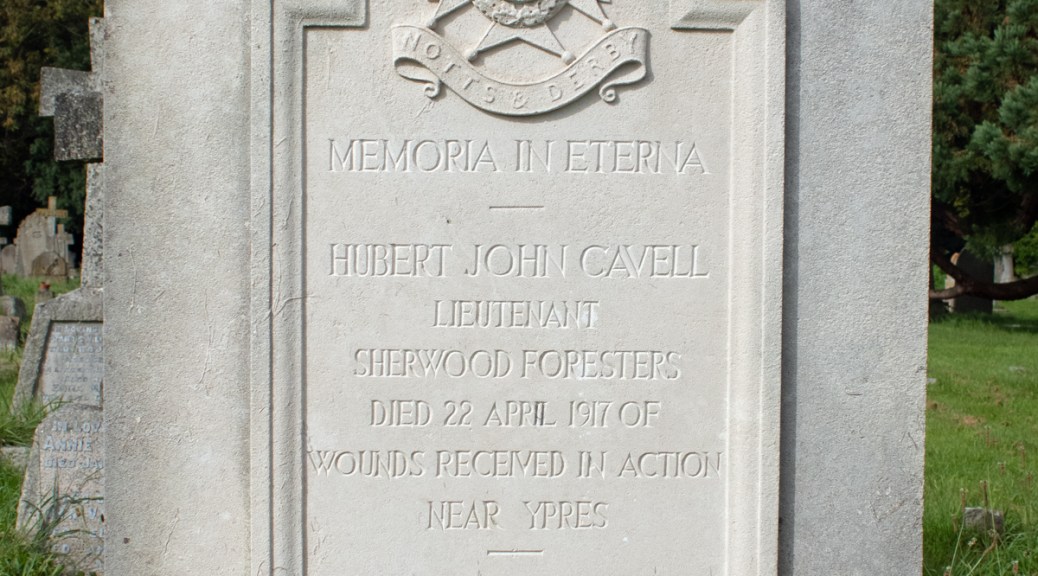
War was brewing across Europe by this point, and, when hostilities were announced, Hubert stepped up to play his part. Full service records for him are lost to time, although is it clear that he joined the Sherwood Foresters (the Nottinghamshire & Derbyshire Regiment). He was assigned to the 11th (Service) Battalion, and, by the spring of 1917, was firmly entrenched on the Western Front.

News has just been received of the death from wounds, received in action, of Lieut. Hubert John Cavell, of Easton-in-Gordano. The deceased officer was educated at the Cathedral School, and had been associated with the firm of Messrs. Paul and James, architects, for the past 16 years. He was for some years a member of the Church Ringers’ Society, being engaged in that capacity at St James’s Church, Bristol. He joined the Sherwood Foresters in January, 1916, received his commission, and had for the past three months held the position of acting-adjutant. He was 34 years of age, and leaves a widow and two little daughters.

Western Daily Press: Tuesday 24th April 1917

Lieutenant Cavell had been caught up in the fighting near Ypres, and was medically evacuated to a military hospital in Dorking, Surrey. It was here that he succumbed to his injuries on 22nd April 1917.

Hubert John Cavell’s body was brought back to Easton-in-Gordano for burial. He was laid to rest in the family plot in St George’s Churchyard. He was reunited with Florence, when he died in 1971, and Dorothy, when she passed away in 1997.


Lieutenant John Martyn

Lieutenant John Martyn

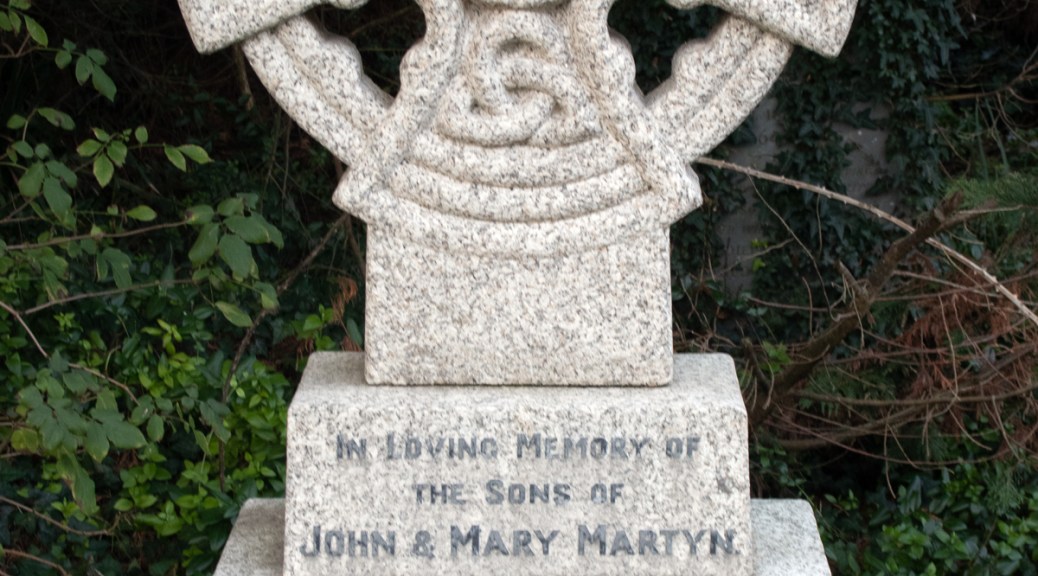
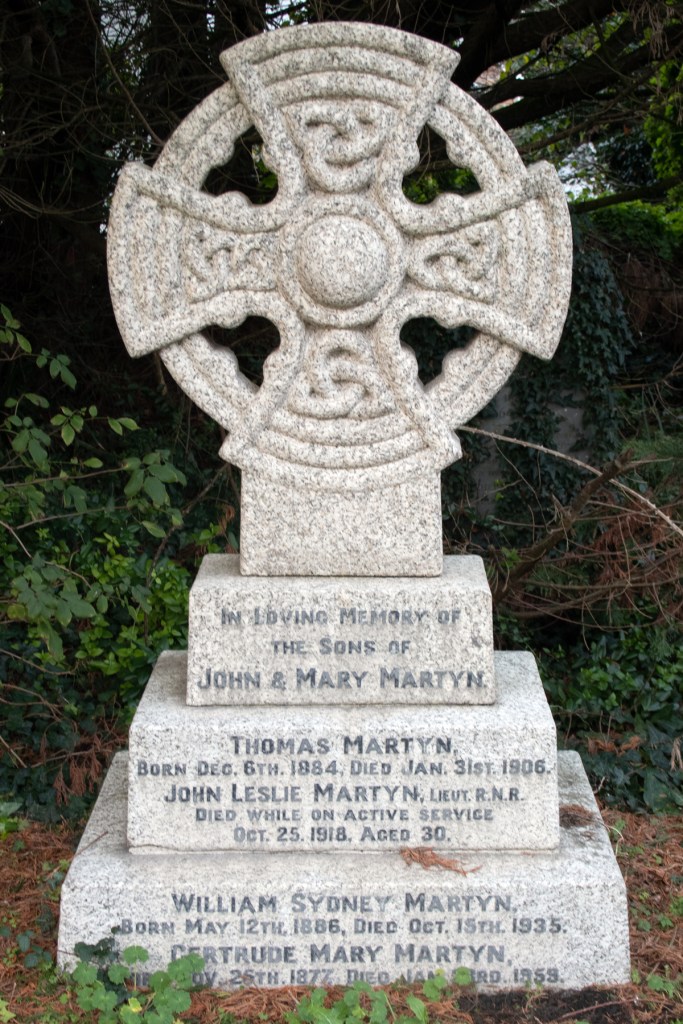
John Leslie Martyn was born in Egloshayle, Cornwall, on 15th February 1888. He was the youngest of five children, and was the third son to John and Mary Martyn. John Sr was a general merchant, and the household had a couple of live-in servants to help both with the household and the business.

When John Sr died in 1904, William, his middle son, took over the running of what was a decent family business.

John Jr, however, had sought another way of life and, was set on a life at sea. He enlisted on the training ship Conway in 1902. Based on the River Mersey, by the time of the 1911 census, he was boarding in the Sailor’s Home in Liverpool. The document confirms that he held the rank of Ship’s Mate in the merchant service, and it would seem that he was doing what he could to build on his skills.

On 26th August 1912, John received his certificate of competency to be the Master of a foreign-going ship. He received a commission in the Royal Naval Reserve, before joining the New Zealand Shipping Co. two years later. When war came to Europe, however, he was called back into naval service.

After serving a few months on the air defences in the Thames Estuary he sailed on his Majesty’s ship Laconia for the coast of German South-West Africa, where he remained. He became a Lieutenant in 1915, and in 1917 was given his first command of HMS Prattler. It is not too much to say that most promising young life has been given to his country.

Cornish Guardian: Friday 8th November 1918

In the summer of 1918, John came home on leave. On 25th July he married Lucy Dudfield in Stanway, Gloucestershire. Tragically, their married life was not to be a lengthy one.

Lieutenant Martyn returned to Devon, and, for reasons undetermined, was admitted to the Royal Naval Hospital in East Stonehouse, Plymouth in October. Whatever the cause of his ailment, he was not to survive it. He passed away while still admitted, on 25th October 1918. He was 30 years of age.

John Leslie Martyn’s body was taken back to Cornwall for burial. He was laid to rest in the family plot in Egloshayle Cemetery.


Lieutenant David Slocombe

Lieutenant David Slocombe

David William Slocombe was born on 9th November 1893, the oldest of seven children to William and Kate. William was a tin worker from Huntspill, Somerset, and it was in nearby Highbridge that the family were born and raised.

David appears to have been a bright lad, receiving a sponsorship from the King James Foundation to attend Dr Morgan’s School in Bridgwater. He spent six years there, from September 1906 to July 1912, and went on to become a customs and excise clerk when he left.

When war arrived in Europe, David was called upon to play his part. He initially enlisted on 1st December 1915, but was placed on reserve for nearly a year. His service records show that he was 22 years of age and 5ft 8.5ins (1.74m) tall. When he was finally mobilised, he was given a commission in the Royal Flying Corps.

At this point, David’s trail goes cold. Later documents confirm that he transferred across to the Royal Air Force when it was founded in April 1918, and that he rose to the rank of Lieutenant. He served in France and Italy and, by the end of the war, was attached to the 44th Training Depot Station in Oxfordshire.

By the autumn of 1918, Lieutenant Slocombe had come down with pneumonia. He was admitted to the 3rd Southern General Hospital in Bicester, and this is where he was to breathe his last. David died on 24th October 1918, aged just 24 years old.

David William Slocombe was brought back to Somerset for burial. He was laid to rest in Highbridge Cemetery.


Lieutenant John Davey

Lieutenant John Davey

John Burnaford Davey was born on 28th April 1887 in Cannington, Somerset. The youngest of nine children, his parents were farmers Thomas and Emma Davey. Emma died in 1899, and the next census, two years later, found John and two of his siblings living with their father at Beere Manor Farm on the outskirts of the village.

John’s trail goes cold at this point, and it seems that he may have emigrated to South Africa. When war broke out, he enlisted in the Natal Light Horse, and was awarded the 1915 Star in Pretoria for his involvement in fighting in Africa. Private Davey’s troop later moved to England, and it was here that he transferred to the Royal Field Artillery.

The move, in September 1915, included a promotion to Second Lieutenant. Within a couple of years his dedication meant that he advanced to the rank of Lieutenant. By this point, John was based in London, and it was here, on 16th July 1917, that he married Katherine Trayler, a tanner’s daughter from Bridgwater, who had gone on to become a teacher of gymnastics. The couple went on to have a daughter, Jean, who was born in November 1918.

Illness caught up with John and, with the Armistice signed, he was invalided out of service on 8th February 1919. The family were now living in Bridgwater, and this is where John returned. His time back with family was to be tragically short, however, as he passed away just weeks after leaving the army, on 2nd March 1919. He was 31 years of age.

John Burnaford Davey was laid to rest in the peaceful graveyard of St Mary’s Church in Holford, Somerset.