Category Archives: Role

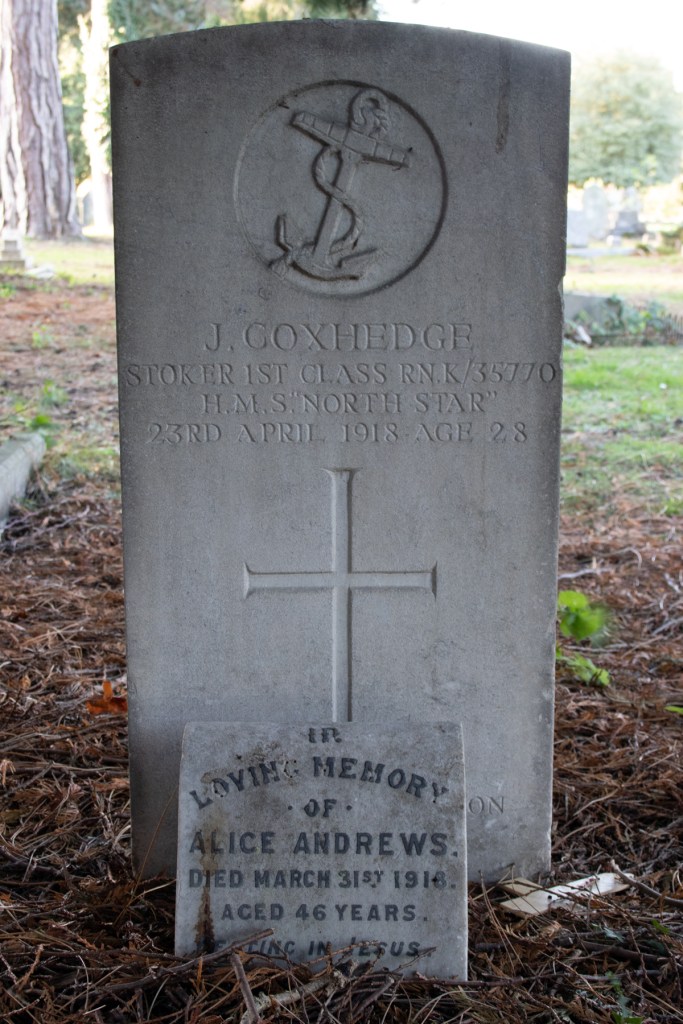
Stoker 1st Class John Coxhedge

Stoker 1st Class John Coxhedge

John Coxhedge was born on 28th October 1889 in Faversham, Kent. It seems that he and his siblings were brought up by an aunt and uncle, Mr and Mrs John Hodge, although why this was the case is lost to time. John attended Davington School, to the north of the town, and, for four years, was a chorister at his local church.

When a youth, [John] went to America and worked in some steel works, but after a year or so he returned home, and for a while prior to joining the Navy he was working at the Cotton Powder Works.

Faversham News: Saturday 27th April 1918

John married a woman called Louisa, and they went on to have five children. He enlisted in the Royal Navy as a Stoker 2nd Class on 21st August 1916. His service records show that he was 5ft 6ins (1.68m) tall, had fair hair, hazel eyes and a fresh complexion.

After his initial training at HMS Pembroke, the Royal Naval Dockyard in Chatham, Kent, Stoker Coxhedge was assigned to the boom defence vessel HMS Wallington. He served on board for nine months, gaining a promotion to Stoker 1st Class, before returning to HMS Pembroke.

While back in Chatham, in the summer of 1917, he would have been involved in the German Air Raid on the Dockyard. Unlike dozens of his colleagues, however, he seems to have escaped unscathed.

On 3rd October 1917, Stoker Coxhedge was given another assignment, this time at HMS Attentive, the Dover Patrol. In April 1918, the patrol was involved in some raids on Ostend and Zeebrugge. The local newspaper again picked up John’s story:

No operation in the present war, distinguished though it has been all along by the indomitable heroism of the sons of Britain, has so thrilled the Empire as that of last week – an exploit, which, as has been remarked, recalls some of the undying deeds of the days of Drake and Nelson.

Stoker Coxhedge… was one of the crew of a vessel detailed for covering duty. This vessel got on a sandbank and could not get off, and so in the brilliant light of star shells, which made the night as bright as day, it became a target for the enemy’s guns and a heavy fire was concentrated upon it. It was during this fire that Stoker Coxhedge was badly wounded. Later he, with others of the ship’s complement, was transferred to another vessel, and his death took place in hospital ashore.

Faversham News: Saturday 4th May 1918

John Coxhedge had died of his injuries on 23rd April 1918. He was 28 years of age. He was laid to rest in Faversham Borough Cemetery, not far from where his widow and family lived.
Gunner George Boorman

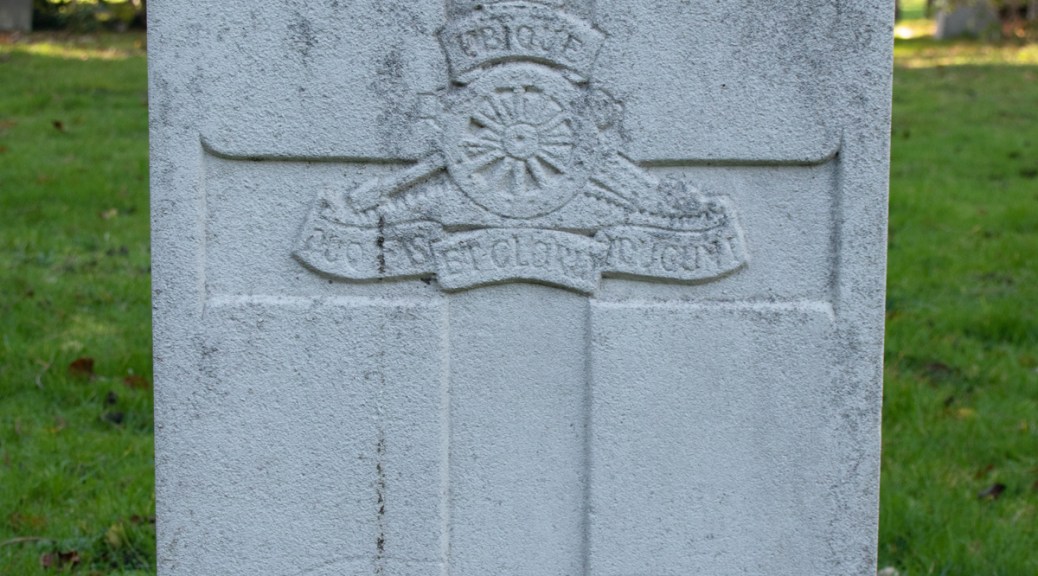
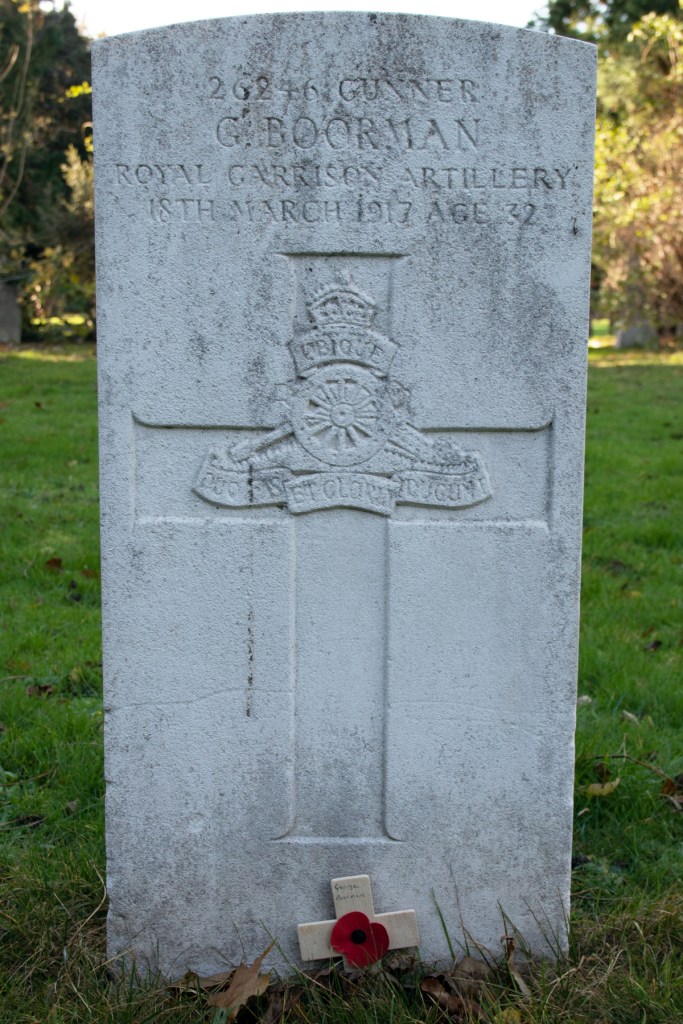
Gunner George Boorman

George Boorman was born in Lenham, Kent, in the spring of 1886, one of thirteen children to farm labourer George Boorman and his wife, Sarah. There is little further information about his early life, other than that he went into labouring when he finished school.

And agricultural life was not enough for George, however, and, on 15th January 1907, he enlisted in the Royal Garrison Artillery. His records show that he was 5ft 9.5ins (1.77m) tall and weighed 134lbs (60.8kg). George had hazel eyes, brown hair and a fresh complexion.

Full details of Gunner Boorman’s military service are not available, but the 1911 census records him as being attached to the 64th Company, based in Aden.

Further information about George’s life is difficult to piece together. His father died in 1913, and the next evidence of Gunner Boorman is that of his passing, on 18th March 1917. The cause of his death is lost to time, but he was 31 years of age.

George Boorman was laid to rest in the Borough Cemetery in Faversham, Kent.


Tragedy struck Sarah Boorman on more than one occasion. Four of George’s brothers died before they turned eighteen, while only six of her thirteen children outlived their mother.


Private Joseph O’Hara

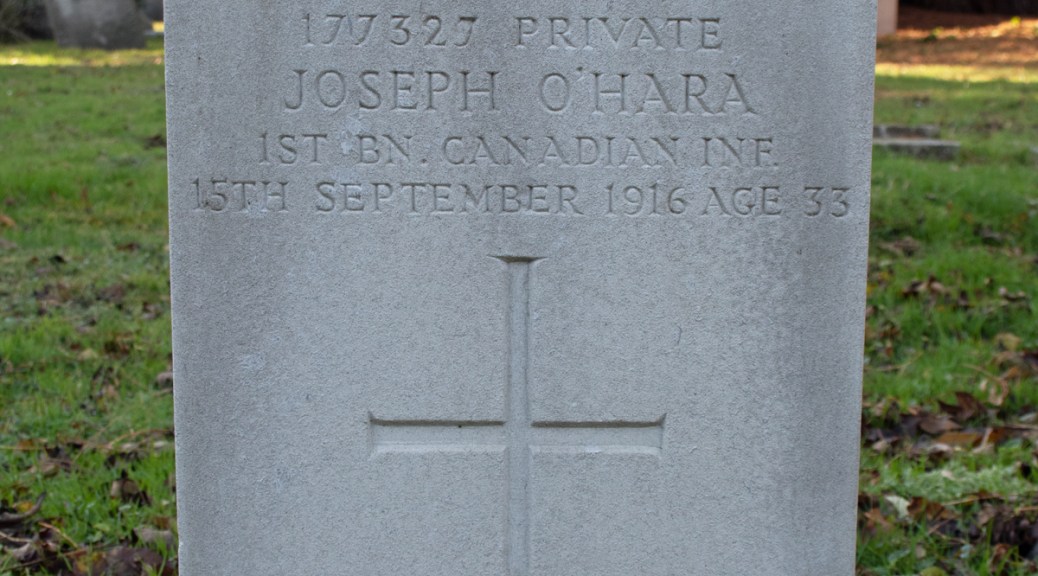
Private Joseph O’Hara

Joseph O’Hara was born in Manchester on 30th May 1882, the son of John and Kate O’Hara. There is little information available about his early life, although it is clear that at some point the family emigrated to Canada, settling in Toronto.

When war broke out, Joseph enlisted, joining the 1st Battalion of the Canadian Infantry. By 1916 Private O’Hara was not only back in Europe, but fighting on the Western Front. Details are scarce, but a contemporary newspaper sheds a little light on what happened to him next.

A contingent of 132 wounded men was detrained at Faversham last Friday morning. Forty-four of the number were taken to The Mount, seventy-one to Lees Court, and seventeen to Glovers (Sittingbourne).

With one exception the cases were all “sitting up” cases and were in a separate train by themselves. This train, however, was preceded by a train of “cot” cases which was going through to Chatham, but owing to the serious condition of one of the men – Joseph O’Hara, of the Canadian Expeditionary Force – the train was stopped at Faversham for his removal to the Mount Hospital. O’Hara had been badly wounded in both legs and he died at the Mount a few hours after his arrival there.

Faversham News: Saturday 23rd September 1916

Private Joseph O’Hara was 34 years of age when he passed away. He was laid to rest in the Faversham Borough Cemetery.


Private Joseph O’Hara
(from findagrave.com)

Private George Knight

Private George Knight

George Albert Knight was born in Dover, Kent, on 27th September 1888, the second of seven children to Thomas and Frances Knight. Thomas was a railway porter from Hampshire, and the family lived in a small terraced house a few minutes’ walk from his workplace, Dover Priory Station.

By the turn of the century, the family had moved to Faversham: Thomas was working a signalman, and two of George’s brothers also worked for the railway – one as a clerk, the other as a number taker. George, meanwhile, was working as a butcher.

In the summer of 1916, George married Alice Smith, who was working as a domestic servant for an government inspector in Willesborough, Kent. George was still working as a butcher at this point, and continued to do so up until the spring of 1918, when he was eventually called up.

Private Knight enlisted in March 1918, joining the Royal Naval Air Service shortly before it merged with the Royal Flying Corps to become the fledgling Royal Air Force. He was based in Cornwall, and his role included mechanic work.

On the evening of 21st September 1918, George collapsed and, despite being rushed to hospital in Truro, he passed away the following morning. It appears that he had not been unwell before, and his death came as a shock. He was just short of his 30th birthday.

George Albert Knight was brought back to Kent for burial. He was laid to rest in Faversham Borough Cemetery, not far from where his widow and family were living.


Private Thomas Townsend

Private Thomas Townsend

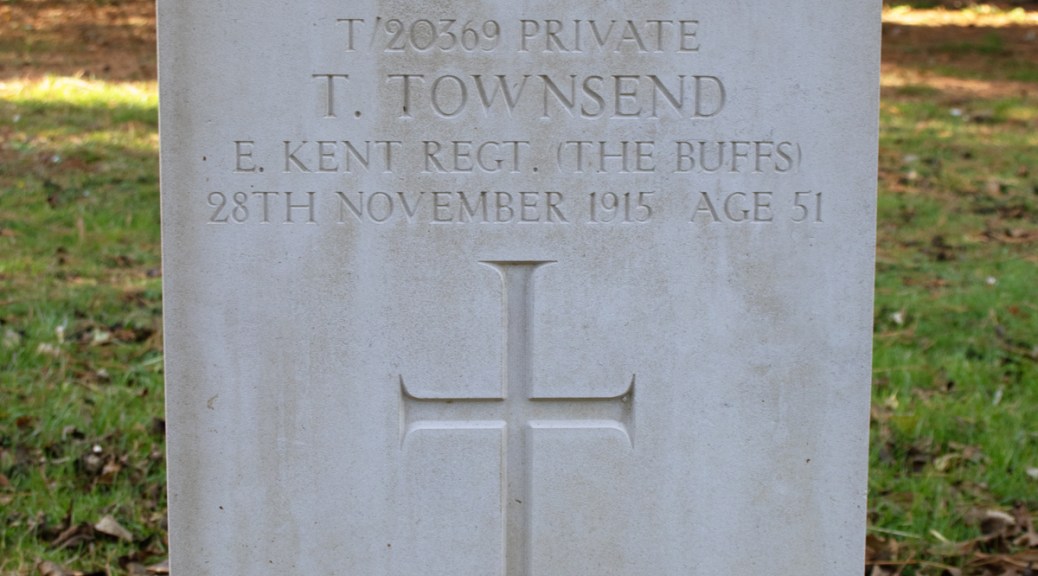
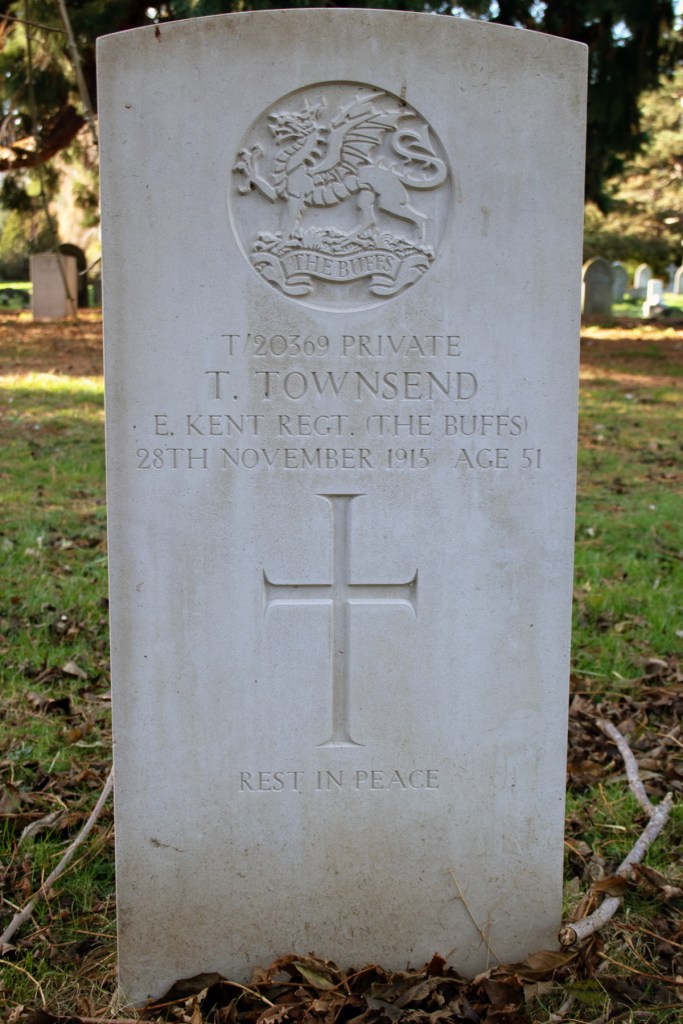
Thomas Townsend was born in Maidstone, Kent, in around 1864. Details of his early life are sketchy, but his mother was Mary Townsend, and he had an older brother, Henry.

Thomas worked as a labourer, mainly in brickyards, and, at the turn of the century, was living in to the north of Maidstone. The 1901 census records him as sharing his home with his wife, Lydia Townsend, her son, George Andrews, and a visitor, seven-year-old John Lassam.

The next census, in 1911, Thomas and Lydia are both shown as living in the same house, although it notes they had been married for eight years. John Lassam is still living at the property, by now as a boarder, while he was also working as a labourer.

Conflict was closing in on Europe and, despite being 50 when war was declared, Thomas was keen to play his part. He initially enlisted in the Queen’s Own Royal West Kent Regiment, but soon transferred across to The Buffs (East Kent Regiment). Full details of his service as unclear, but it seems he was assigned to the National Reserve Guard at Faversham, Kent.

Private Townsend’s role was guard duty, possibly at the munitions factory in the town. While carrying out this role in the autumn of 1915, he caught a chill, which then became pneumonia. He was admitted to the Faversham Military Hospital, but the lung condition was to get the better of him, and he passed away on 28th November 1915. He was 51 years of age.

Thomas Townsend was laid to rest in Faversham Borough Cemetery, not far from where he carried out his military role.


Private Edward Hopson

Private Edward Hopson

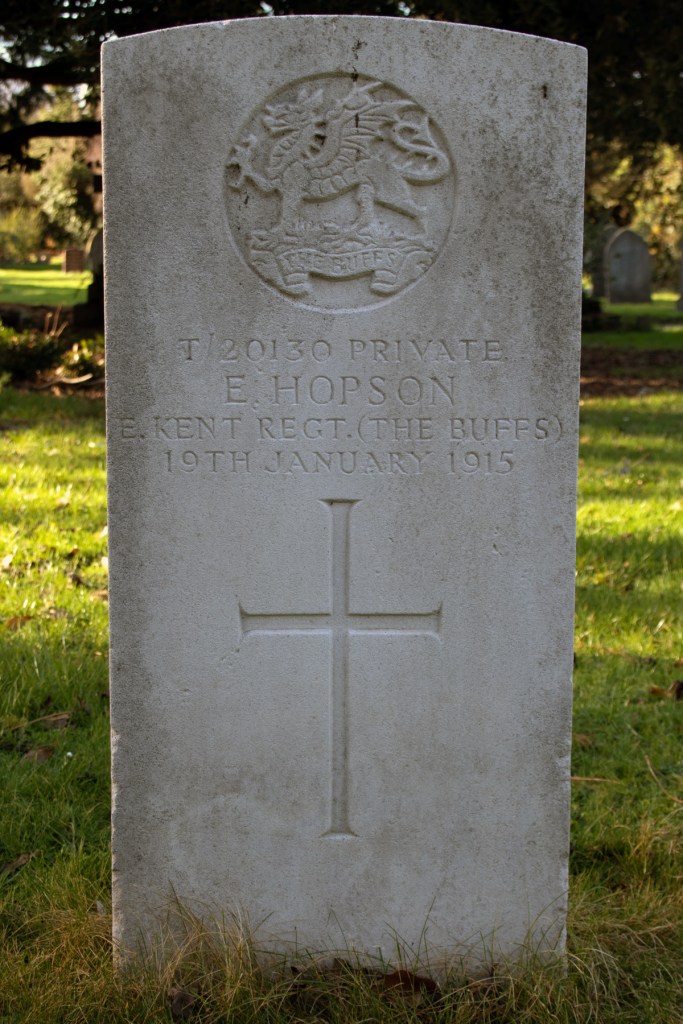
The life of Edward Hopson looks likely to remain a mystery, and what can be pieced together is done from a few fragmented documents. His gravestone sits in the Faversham Borough Cemetery in Kent.

A local newspaper, contemporary to his passing in January 1915, acts at the starting point:

Edward Hopson, a Maidstone [Kent] man, belonging to the National Reserve Guard doing duty at the Explosives Works at Faversham, died suddenly while proceeding on duty on Tuesday night.

Evidence of identification was given by Joseph Cornelius, a Lance Corporal in the Guard, who stated that so far as was known, the deceased’s only relative was a half-brother. The deceased gave his age as 49 when he enlisted, but witness believed his correct age was 61. He was apparently in good health when passed for duty on Tuesday at the works of the Explosives Loading Company at Uplees.

Charles John Link, engaged on patrol duty at the works, stated that about 10:30 on Tuesday night he was accompanying deceased to the point where he was to do guard duty. On the way deceased complained that he could not see, and shortly afterwards, as they came to a style, he exclaimed “Oh! dear,” and then, dropping his rifle, he fell into the witness’s arms and expired.

South Eastern Gazette: Tuesday 26th January 1915

The cause of death was given to be heart disease, and, at the inquest, a verdict of “Death from Natural Causes” was given.

The report suggests that Edward was born either in around 1866 or 1854. The Commonwealth War Graves Commission give his parents as Jack and Annie Hopson, but there are no surviving census records from the 1800s that would corroborate this.

The 1911 census records an Edward Hopson, aged 57 and from Maidstone, Kent, residing in the Maidstone Union Workhouse. He is listed as a former farm labourer, and his marital stated us given as widowed.

If this is the Edward Hopson commemorated in Faversham Cemetery, it seems likely that he used the outbreak of war – and the opportunity to enlist – as his escape route from the workhouse.

He joined The Buffs (The East Kent Regiment), and was assigned, as a Private, to the 4th Battalion. This particular troop was dispatched to India in October 1914, and it seems likely that Private Hopson was reassigned to the National Reserves Guard, and posted to Faversham.

This is all conjecture, of course, but, either way, Private Hopson died of a heart attack on the night of the 19th January 1915, aged approximately 61 years old.


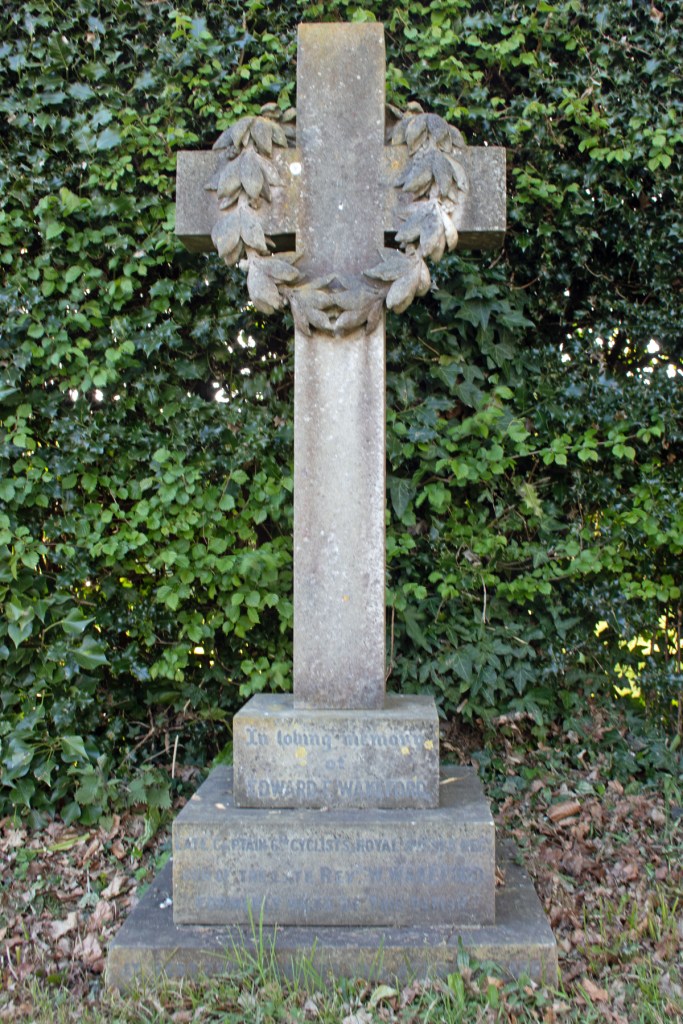
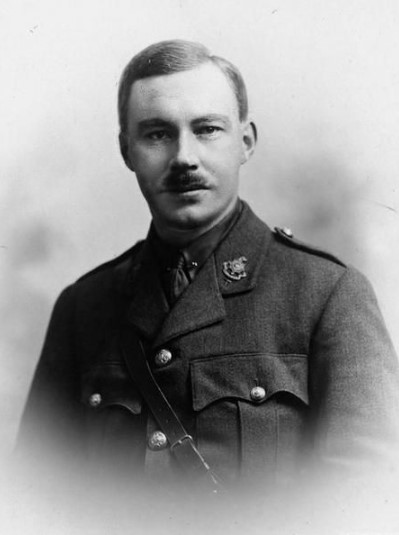
Captain Edward Wakeford

Captain Edward Wakeford

Edward Francis Wakeford was born in Rottingdean, near Brighton, Sussex, in February 1881. He was the younger of two children to curate William Wakeford and his wife, Eliza.

The family home was always a busy one; the 1881 census records one visitor, four boarders and a servant. Ten years later, confirms one boarder and two servants.

By 1901, William had taken up a post in St Peter’s Church, Henfield. This seems to have been a step up: helping look after the family and a visitor were four servants – a gardener, a cook, a housemaid and a kitchenmaid.

In March 1907, Edward married Annie West Thornton; she was the daughter of a well-to-do family – the census records show that her father, William West Thornton, lived by private means, while Annie was sent to Surrey to attend a boarding school.

Edward and Annie couple set up home on the Sussex coast, and, when William passed away in 1912, were soon also living by private means. They went on to have three children: two girls, Olive and Iris, and a boy, who they named William after both of their fathers.

War was coming to Europe by this point. While full details of Edwards military service are not available, he appears to have given a commission in the Royal Sussex Regiment. Initially serving as a Lieutenant, but October 1914, he was promoted to Captain.

Edward was assigned to the 6th (Cyclist) Battalion, and served in East Anglia. It seems that he fell ill while there, and was admitted to the Norfolk and Norwich Military Hospital, suffering with appendicitis. Sadly the condition proved too much, and Captain Wakeford passed away following the operation. He died on 23rd February 1915, not long after his 34th birthday.

Edward Francis Wakeford’s body was brought back to Sussex. He was laid to rest in Henfield Cemetery, not far from the church where his father had served for so long.


Captain Edward Wakeford
(from findagrave.com)

The now widowed Annie wed again, marrying Reverend John Gurney in October 1917. Tragedy was to strike again, though, when she passed away just a year later, on 20th October 1918. She was laid to rest Henfield Cemetery, in the plot next to her late husband, Edward.

John Gurney went on to live a full live. He never married again, and settled in Buxted, near Uckfield. He passed away in November 1956, at the age of 76 years old. He was also laid to rest in Henfield Cemetery, where he was buried in the same plot as Annie.

Edward and Annie’s children also went on to have full lives, despite the early loss of their parents.

Olive never married, and passed away in Nottingham in 1986, aged 78 years old.

Iris married in Liverpool in 1934, and went on to have two children. When the marriage failed in the 1940s, she got wed again in 1949. She passed away in Cheltenham in 1965, at the age of 54.

William got married in 1940, at which point he was serving as a Lieutenant in the 1st King’s Shropshire Light Infantry. He saw action in Italy towards the end of the war, and was awarded a Military Cross for his service. When peace came to Europe again, he and his wife settled into a normal life, before emigrating to Australia. William passed away in May 1967, at the age of 54 years old.


Gunner William Reeves

Gunner William Reeves

William Reeves was born in the summer of 1896, one of eleven children to James and Ruth Reeves. James was a house painter from Henfield in West Sussex, and it was there that he and Ruth raised their growing family.

When war came to Europe, William was keen to play his part. He enlisted as a Gunner in the Royal Garrison Artillery, and, by October 1915, was in France.

Little information survives about Gunner Reeves’ military service, but by the time he was demobbed, he had earned the Victory and British Medals, the 1915 Star and the Silver War Badge. The latter award was given to those servicemen who had been honourably discharged from service due to wounds or sickness.

William returned to Sussex, but to a quieter home, James having passed away in the spring of 1916. William was also suffering with his health. He had contracted tuberculosis while in the army, and this is the condition to which he finally succumbed. He passed away on 16th December 1919, aged just 23 years old.

William Reeves was laid to rest in Henfield Cemetery, within walking distance of his family home.


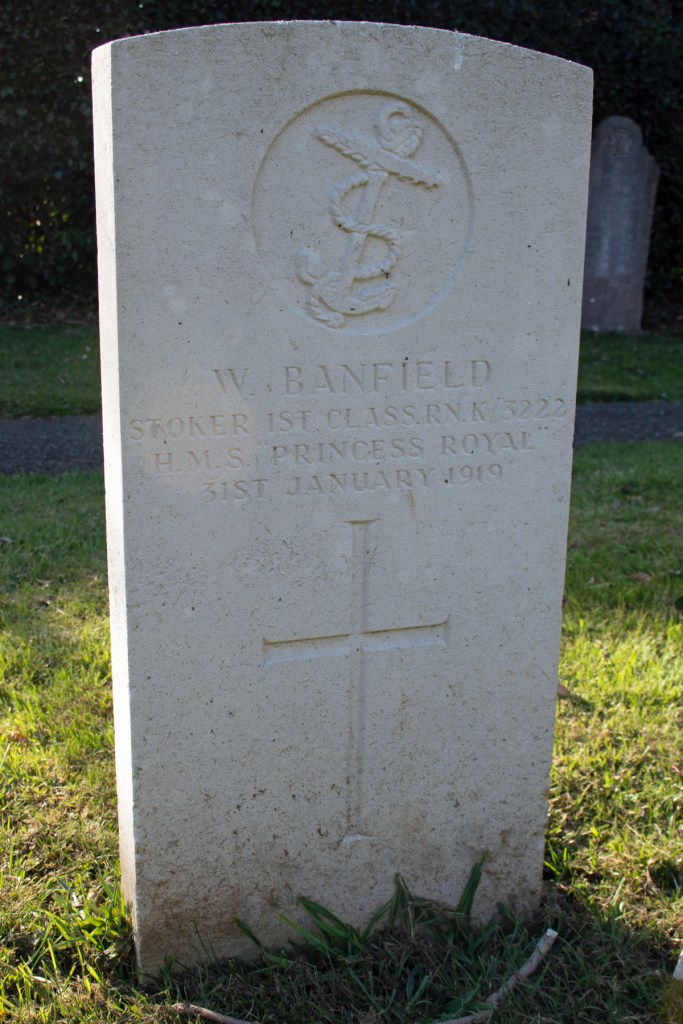
Stoker 1st Class William Banfield

Stoker 1st Class William Banfield

William Banfield was born on 7th November 1890, in Henfield, near Horsham, West Sussex. He was the second youngest of seven children to George and Ellen Benfield. George was a carpenter, and this was a trade his two sons – William and his older brother, George – were initially both to follow as well.

William had a longing for the sea, however, and, on 11th June 1909, he enlisted in the Royal Navy as a Stoker 2nd Class. His service records show that he was 5ft 7.5ins (1.71m) tall, had brown hair, blue eyes and a fair complexion.

Stoker Banfield was based out of HMS Victory, the Royal Naval Dockyard in Portsmouth, Hampshire, but, over the eventual decade of his service, he spent no more than seven months ashore. Instead, he served on a total of nine ships. This included the battleship HMS Exmouth where, during the eighteen months he spent on board, he was promoted to Stoker 1st Class, and also spent 14 days in the brig, for reasons undisclosed.

On 27th September 1915, William was assigned to HMS Princess Royal. He served aboard for nearly three and a half years, patrolling the North Sea, coming under fire during the Battle of Jutland, and providing support during the Second Battle of Heligoland Bight.

Towards the end of January, Stoker 1st Class Benfield fell ill, and was admitted to the Edinburgh City Hospital. Suffering from encephalitis, sadly the condition proved too much for his system to bear and he passed away at the hospital on 31st January 1919. He was 28 years of age.

William Banfield was brought back to Sussex for burial. He was laid to rest in the cemetery of his home town, Henfield.


William’s older brother, George, was also to fall victim to the First World War. He had enlisted in the Royal Navy three years before his younger sibling, and also served as a Stoker 2nd Class (subsequently being promoted to Stoker 1st Class in 1907).

George was also based out of HMS Victory, and, in April 1911, was stood down to the Royal Naval Reserve, having completed an initial five years’ service.

When war broke out, George was called back into service, and was assigned to HMS Good Hope, travelling from English shores to Nova Scotia, before heading to South America and into the Pacific.

Caught up in the Battle of Coronel on 1st November 1914, the Good Hope was sunk by the German cruiser SMS Scharnhost. All souls on board – all 926 of them – were lost; this included Stoker 1st Class George Banfield. He was only 27 years of age.


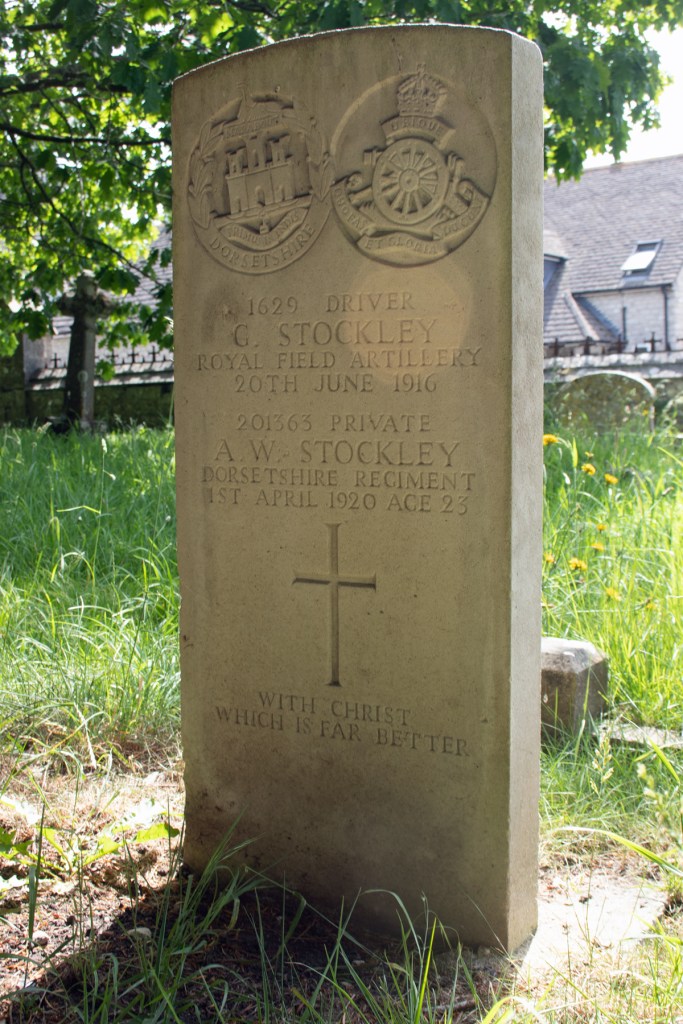
Private Albert Stockley

Private Albert Stockley

Albert William Stockley was born in the spring of 1897, the youngest of twelve children to Frank and Mary Ann Stockley. Frank was a clay cutter from Dorset, and he and his wife raised their family in the picturesque village of Corfe Castle.

Sadly, much of Albert’s life is lost to time. He would have been 17 years old when war broke out, so it seems likely that he would not have been in the first wave of men to enlist.

Albert joined the Dorsetshire Regiment and, as a Private, was assigned to the 1st/4th Battalion. His troop was based in India for the first part of the war, before moving to Mesopotamia in 1916. There is nothing to confirm, however, whether Private Stockley served abroad, or if he remained as part of a territorial force.

Private Stockley was demobbed on 22nd May 1919, and awarded the Victory and British Medals for his service. He returned to Dorset, but is it at this point that his trail goes cold.

All that is evident is that Albert William Stockley passed away on 1st April 1920, ages just 23 years old. was laid to rest in the Old Church Cemetery in his home town of Corfe Castle.


Albert shares his grave with his older sibling, George Stockley, who died in June 1916. The brothers are commemorated on the same headstone.