Category Archives: Role

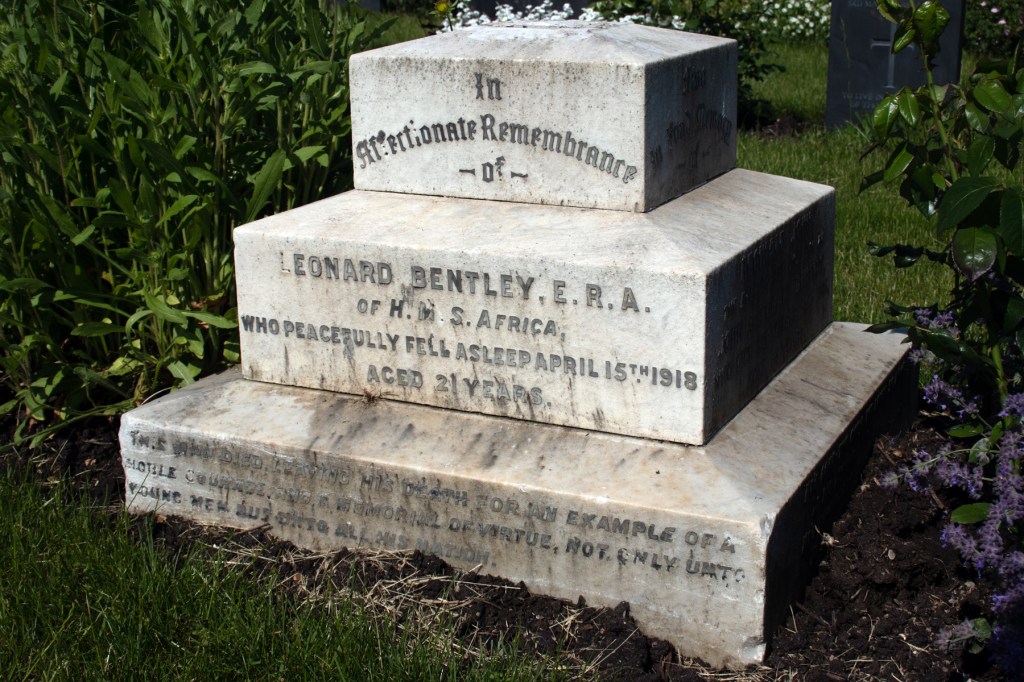
Engine Room Artificer 4th Class Leonard Bentley

Engine Room Artificer 4th Class Leonard Bentley

Leonard Bentley was born in Strood, Kent, on 6th December 1896. One of six children, his parents were John and Emma Bentley. John was a barge captain, transporting ship-loads of cement from the local works to where it was needed.

The 1911 census found an extended Bentley family living at 85 Cliffe Road in Strood. John and Emma shared their home with Leonard, his older brother Arthur, and Arthur’s wife and son. Eleven years younger than Arthur, who was his next oldest sibling, Leonard was still at school by this point.

Education was obviously important to Leonard, and by the end of the year, he had enrolled in the Royal Navy as a Boy Artificer. He would spend the next few years at HMS Fisgard, the training establishment in Woolwich, Kent, learning his trade.

When he came of age in December 1914, Leonard was officially inducted into the Royal Navy, taking on the rank of Engine Room Artificer 5th Class. He remained at Fisgard until January 1916, when he transferred to HMS Victory, the Royal Naval Dockyard in Portsmouth.

This was a temporary move, however, and on 11th April Leonard was assigned to HMS Africa, and a few weeks later, he was promoted to Engine Room Artificer 4th Class. A battleship, the Africa would become his home for the next eighteen months and he would travel with to the Mediterranean and Adriatic Seas.

In January 1918, Engine Room Artificer Bentley would return to solid ground. He transferred to HMS Pembroke, the Royal Navy’s base in Chatham, Kent. The reason for his move appears to have been health related, and he was soon moved the the town’s Naval Hospital, suffering from pulmonary tuberculosis. The condition was to prove fatal. Leonard died on 15th April 1918: he was 21 years of age.

Leonard Bentley was laid to rest in the naval section of Woodlands Cemetery, Gillingham, Kent, not far from his family home, or his final naval base.

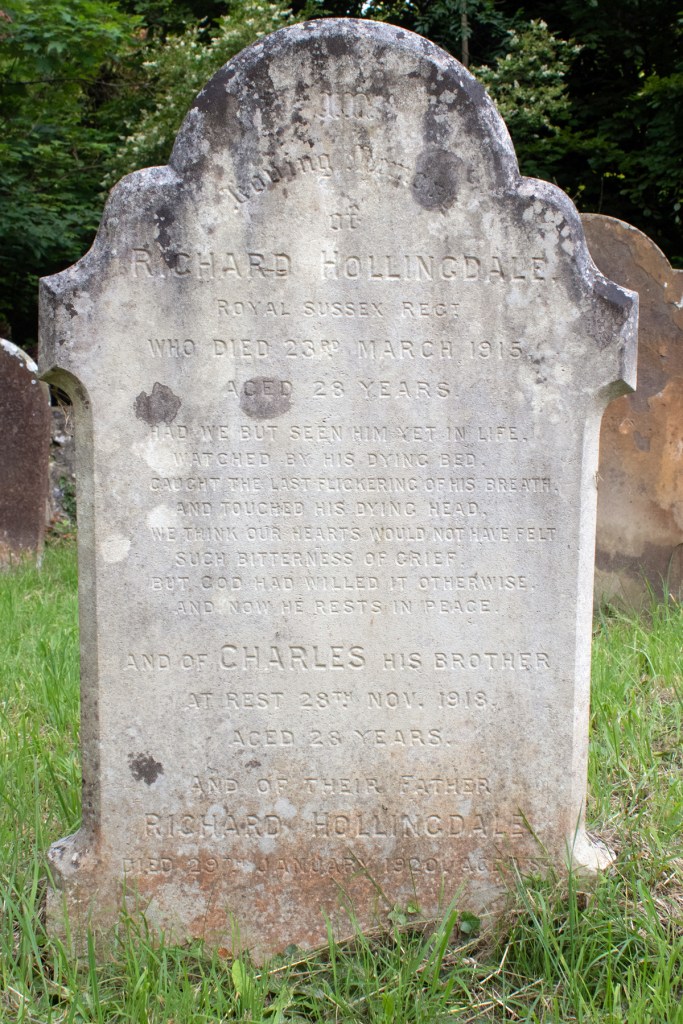
Private Richard Hollingdale

Private Richard Hollingdale

Richard Hollingdale was born at the start of 1887, and was one of nine children to Richard and Elizabeth. Richard Sr was a farm labourer from Lancing, but his namesake son was born in the Sussex village of Washington.

By the time of the 1901 census, the family had moved to Findon, a village to the north of Worthing. Attached to Muntham Farm, they lived in New Barn, a workers’ cottage on the estate. Richard Jr and his brothers all helped out on the farm and, according to the next census return, Richard Sr, now 75 years of age, was a labourer, while the three sons still living at home – William, Richard Jr and Charles – were all waggoners.

When war consumed Europe in the summer of 1914, Richard Jr stepped up to serve his country. Sadly, full details of his service have been lost to time, but it is clear from what remains that he joined up early in the conflict, and certainly no later than October 1914.

Private Hollingdale was attached to the 7th (Service) Battalion of the Royal Sussex Regiment and in the spring of 1915 his unit moved to the Ramillies Barracks in Aldershot, Hampshire. Richard had only been there for a couple of weeks, when he fell ill. He was admitted to the local Isolation Hospital with scarlet fever, and the condition was to prove fatal. He passed away on 23rd March 1915, at the age of 28 years old.

The body of Richard Hollingdale was taken back to Sussex for burial. He was laid to rest in the family plot in St John the Baptist Churchyard, Findon.


Serjeant George Constable

Serjeant George Constable

George Constable was born in the summer of 1893 in Findon, West Sussex. His parents were Albert and Ruth Constable, and they had seven children: Ruth Jr, Thomas, Albert Jr, William, George, Arthur and Rachel.

There is little concrete information about George’s early life. The 1901 census found the Constable family living at 2 Mill Cottages in Findon, with George’s oldest brother, Thomas, helping his father’s gardening work.

When war came to Europe, George and his older brothers stepped up to play their part. Thomas joined the Dorsetshire Regiment and worked his way to the rank of Lance Corporal. His time in service was to be tragically brief, however. He was killed in France on 26th October 1914, aged 27 years old. He is commemorated on both the Le Touret Memorial, and on the headstone to the family ploy in St John the Baptist Churchyard, Findon.

George also joined the Dorsetshire Regiment and, like his brother, was assigned to the 1st Battalion. During his short time with the regiment – he enlisted no later than October 1914 – he rose through the ranks, and, by the spring of 1915, had been promoted to Serjeant.

Sent to France, George was wounded in April 1915, and medically evacuated to Britain for treatment. He was admitted to the 1st London General Hospital, but his injuries were to prove too severe. He passed away on 5th April 1915 aged just 21.

Albert and Ruth had lost two of their sons to the conflict within six months. While Thomas’ body lay in France, George was brought back to Sussex for burial.

George Constable was buried in the family plot in the graveyard of St John the Baptist Church, Findon.


William Constable was assigned to the Royal Sussex Regiment when he enlisted. He too rose through the ranks, and would take on the role of Serjeant, like his younger brother. His unit, the 2nd Battalion, fought at Loos in the autumn of 1915, and this is where William would be killed. He died on 25th September 1915, aged just 23 years old.

Serjeant Constable is commemorated on the Loos Memorial, while Albert and Ruth, having now lost three sons within a year, added his name to the family headstone.


Albert Constable Jr, was also involved in the conflict. Along with George and Thomas, he had joined the 1st Battalion of the Devonshire Regiment, but unlike his brothers, he survived the horrors of the Western Front.

By the last months of the war, Lance Corporal Constable was caught on in the Battles of the Hindenburg Line, and, tragically, he too was killed. Albert passed away on 15th September 1918, at the age of 29 years old. He was buried in Cologne Southern Cemetery, Germany.

By this point, the face of the family headstone was already full with commemorations to his three brothers, Albert is remembered in lettering around the edge of the grave marker.


Private Wilfred Bridger

Private Wilfred Bridger

Wilfred Percival Bridger was born on 20th January 1885, the middle of three children to William and Emma. William was a groom from Albourne in Sussex, but, after a spell in Newmarket, the family had settled in Findon near Worthing.

William passed away just two years after Wilfred’s birth, and Emma remarried. The 1891 census found her and her new husband, George Lish, living with William and his siblings in a house on Findon Street.

When he completed his schooling, William found work as a shepherd: the next census return, taken in 1901, found the extended family living at 1 Brazil Cottages, next to the Black Horse Inn in Findon Village. George and Emma now had three children of their own, and Emma’s widowed mother, Martha, completed the household.

Shepherding was not a permanent career option for Wilfred and, on 28th April 1902, he enlisted in the army. He gave his occupation as groom, and his medical report confirmed he was 5ft 7ins (1.7m) tall and 120lbs (54.4kg) in weight. He was noted as having brown hair, grey eyes and a fresh complexion.

The Royal Sussex Regiment would definitely provide Private Bridger with the globe-trotting adventures that he may have wished for. After two years on home soil, his unit – the 2nd Battalion – moved to Malta, where he would spend close to twelve months. In May 1905 he moved to Crete, and from there to India in January 1907.

By the start of 1910 Wilfred had returned to Britain, and he was stood down to reserve status when his contract came to an end that April. He returned to Sussex, and the family home. 1 Brazil Cottages was crowded by this point, with Wilfred sharing the five-roomed house with his mother, stepfather, half-brother, niece. There were also two lodgers, widowed farm labourer Alfred Newman and his son, William.

Things were to change for Wilfred, however. In September 1911 he married Florence Herrington, a carter’s daughter from Henfield, Sussex. When the couple wed, she was working as a servant in a boarding house in Ambrose Place, Worthing. The young couple set up home in Nepcote, near Findon, and went on to have four children – William, Albert, Henry and Lilian.

When war broke out, Wilfred was called upon to play his part again. He re-joined the Royal Sussex Regiment on 31st August 1914, but when his medical was carried out the following March, he was found to have tuberculosis, and deemed not fit for service. After further tests, Private Bridger was medically discharged on 28th May 1915.

At this point, Wilfred’s trail goes cold. He returned to Findon and, it seems this is where he passed away on 13th September 1918. He was 33 years of age.

Wilfred Percival Bridger was laid to rest in the quiet surroundings of Findon’s St John the Baptist Churchyard.


Private Wilfred Bridger
(from ancestry.co.uk)

Private Charles Pratt

Private Charles Pratt

Charles Pratt was born in the West Sussex village of Findon in the autumn of 1899. The oldest of five children – all boys – his parents were farm labourer Charles and his wife, Emily.

Charles Jr was still a schoolboy at the time of the 1911 census. The family were living in the five-roomed cottage called Sheepcombe by now: farm labourer Charles Sr, Emily, Charles Jr, his three younger siblings (youngest boy Albert being born in 1915), and Emily’s brother, farm horseman Daniel Hollingdale.

When war was declared, the oldest Pratt boy was still just fourteen years of age, and too young to enlist. As the fighting raged across the continent, it seems likely that he was disappointed to miss out on the adventure. Full details of his army service have been lost to time but records suggest that he joined up no later than April 1918.

Private Pratt was attached to the 9th (Service) Battalion of the East Surrey Regiment. He was certainly sent to France, and may have been caught up in the Battles of the Somme in 1918. He fought at Cambrai, and this is where he would be injured. Charles’ wounds were bad enough for him to be medically evacuated to Britain, and he was admitted to the 4th Northern General Hospital in Lincoln, Lincolnshire, for treatment.

Sadly, the soldier would succumb to his injuries. He passed away on 27th October 1918, at the age of just 19 years old.

Charles Pratt was taken back to Sussex for burial. He was laid to rest in the graveyard of St John the Baptist Church in Findon, walking distance from his family home.


Charles’ was a family plot: he would be reunited with his parents when the passed away: Charles Sr in 1953 and Emily in 1958.


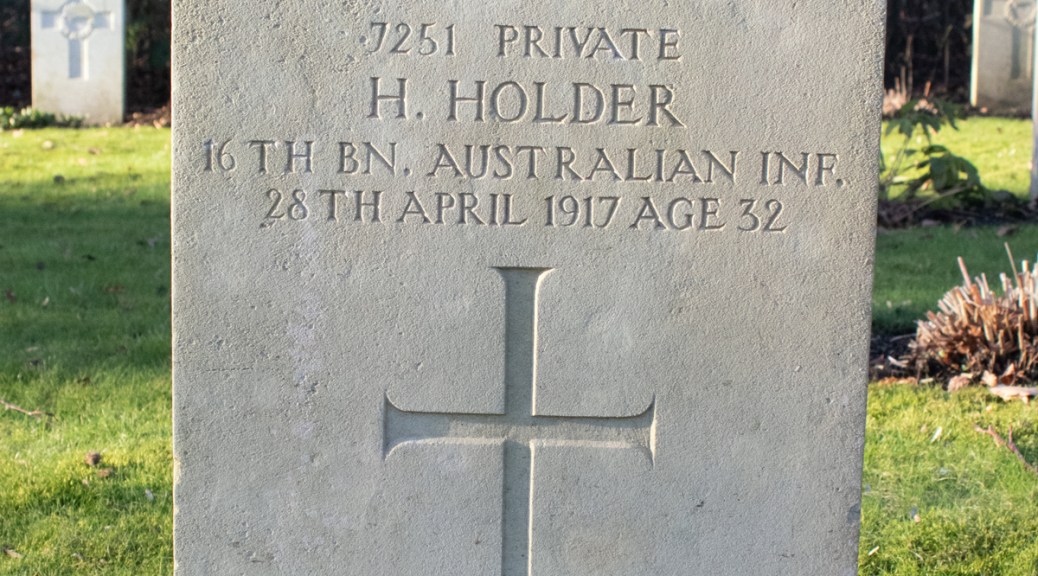
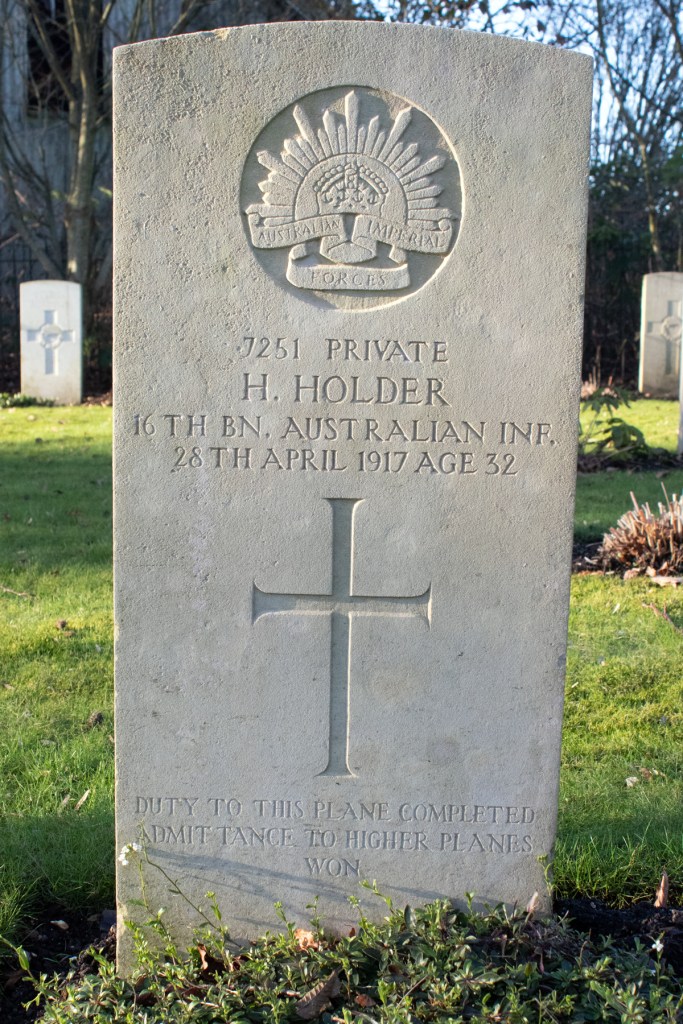
Private Harry Holder

Private Harry Holder

Harry Holder was born in the village of Ludgvan, Cornwall, in the summer of 1885. The oldest of fourteen children, his parents were Harry and Grace Holder. Harry Sr was a market gardener, and his oldest son was to follow in his footsteps.

By the time of the 1911 census, the Holders had moved to Cheltenham, Gloucestershire. Settling in a seven-room house in Leckhampton Road, the household of eleven people had six wages coming in, split between market gardening for the men and floristry for the women.

The following year, Harry Sr took his family on the long journey to Australia for a new life. They found work on a farm near Perth, and Harry Jr was employed as an agricultural labourer when war broke out. When the call came, he stepped up to play his part and his service records suggest that he had spent four years in the territorial army back in Britain. Harry had been turned down for service because of the state of his teeth just a month before trying to enlist again. The second time, however, he was successful, and he joined the Australian Imperial Force on 13th September 1916.

Private Holder’s medical report confirmed the man he had become. At 31 years of age, he was 5ft 10.5ins (1.79m) tall, and weighed 140lbs (63.5kg). A Roman Catholic, he had brown hair, blue eyes and a fresh complexion.

Assigned to the 16th Battalion of the Australian Infantry, Private Holder’s unit departed from Fremantle on 21st January 1917, travelling no board the ship Miltiades. Just under two months later, on 27th March, Harry arrived back in Britain, docking at Devonport, Devon, before moving with his battalion to a camp on the outskirts of Codford, Wiltshire.

A significant proportion of the ANZAC troops became unwell within weeks of arriving at the camp, and Harry was not to avoid illness. On 27th April he was admitted to the barracks’ hospital with cerebrospinal meningitis, but the treatment was to prove too little, too late. Private Holder died on 28th April 1917: he was 31 years of age.

Harry Holder was laid to rest in a new extension to St Mary’s Churchyard in Codford, close to the base where he had breathed his last.


Private Harry Holder
(from findagrave.com)

Private Thomas Bickley

Private Thomas Bickley

Thomas George Bickley was born in Fremantle, Australia, in 1881, and was the second of six children to Absolom and Mary Bickley. May had been married and widowed twice before wedding Thomas’ father, and so he had eight half-siblings as well.

Thomas’ early life is a challenge to piece together, but his service records from the First World War fill in some of the detail. He confirms that he had served in the 1st Imperial Light Horse for eleven months, and that he fought in South Africa – presumably as part of the Boer War of 1899-1902.

At the time of enlisting on 13th September 1916, he was working as a carpenter, and had completed a five-year apprenticeship. He married Rose Buck in 1907, but they did not have any children.

Private Bickley was assigned to the 16th Battalion of the Australian Infantry, and his medical report confirms the man he had become. He was 5ft 10ins (1.77m) tall and weighed 170lbs (77.1kg). At 34 years of age, he had light brown hair, blue eyes and a fresh complexion.

Thomas’ unit left Fremantle on the Argyllshire. The troop ship arrived in Devonport, Devon, two months later, and his battalion was sent to their base near Codford in Wiltshire. The journey impacted a lot of soldiers, and Thomas was not to be immune from this.

On 12th February Private Bickley was sent to the camp hospital as he was suffering from bronchitis. The severity of his condition meant he was immediately transferred to an army hospital in nearby Sutton Veny, but it was to prove too late. Thomas died from the lung condition on 23rd February 1917: he was 35 years of age.

Thomas George Bickley was laid to rest in the ANZAC extension to St Mary’s Churchyard, Codford, not far from the based that had so briefly been his home.


Gunner Arthur Putt

Gunner Arthur Putt

Arthur Sidney Putt was born on 22nd October 1895 in Paignton, Devon. The youngest of five children, his parents were James and Elizabeth. James died when his son was jest five years old, leaving Elizabeth to raise the family in her own. By the time of the 1901 census, they Putts were living at 22 Roundham Cottages (four doors down from the fellow future soldier Charles Baker and his family), where Elizabeth was working as a charwoman to bring in the rent money.

When he finished his schooling, Arthur found employment as a wood chipper. At 15 years of age, he and his older brother, Frederick, were both bringing a wage into the household, and were the only two of Elizabeth’s children to still be living at home.

War broke out in the summer of 1914, and Arthur was one of the first to step up and play his part. He enlisted on 16th August, giving up his new job as a hairdresser, with the view of better prospects in the army. He joined the Royal Field Artillery, and was assigned to the 2nd Devon Depot Battery.

Gunner Putt’s initial medical report showed that he was 5ft 7ins (1.7m) tall, with good vision and normal physical development. He was sent for training, but a later, fuller, medical found that he was, in fact, not physically fit for army service. The report of the medical board of 27th April 1915 found that he had both rheumatism and valvular heart disease. He was dismissed from military service on 10th May 1915, after 267 days’ duty.

At this point, Arthur’s trail goes cold. It seems likely that he returned to Paignton, and to the life he had before the war, and the next record for him is that of his passing. He died on 14th May 1919, at the age of 23 years old.

Arthur Sydney Putt was buried in Paignton Cemetery, overlooking the town in which he had been born and raised.


Gunner Charles Baker

Gunner Charles Baker

Charles Baker was born on New Year’s Day 1884, the youngest of six children to Henry and Mary Baker. Henry, was 64 when his son was born, and 21 years his wife’s senior, was a fisherman from Dartmouth, Devon. By the 1870s, however, the family had settled in Paignton, and this is where Charles had been born and raised.

The 1901 census found Henry, Mary, Charles and the oldest Baker daughter, Emma, living at 25 Roundham Cottages, to the south of Paignton town centre. He would have known the Putt family at No. 22, being of a similar age to Arthur Putt, another future soldier. Charles’ father Henry, now 81, was living off his own means, while Charles had completed his schooling, and was employed as a house painter.

In the spring of 1905, Charles married Helen Davey. Born in Hayle, Cornwall and six years her husband’s senior, there is little information about the new Mrs Baker, other than her father’s name, Thomas. The 1911 census found the couple living in a 5-roomed house on Norton Terrace, Paignton. At this point Charles was still employed as a house painter.

When war came to Europe, Charles stepped up to serve his King and country. Initially enlisting on 11th December 1915, he was not formally mobilised until the following September, when he was assigned to the Royal Garrison Artillery as a Gunner. His service records show hat he was 5ft 8ins (1,73m) tall and weighed 159lbs (72.1kg).

As part of the 257th Siege Battery, Gunner Baker was sent to Mesopotamia on 10th March 1917. He would remain in the Middle East for the next couple of years, returning home in March 1919. Charles returned to Devon, and was placed on furlough, awaiting to be demobbed.

Within a matter of weeks, however, Charles had fallen ill, contracting pneumonia. The condition was to prove his undoing, and he passed away on 7th May 1919. He was 35 years of age.

Charles Baker was laid to rest in Paignton Cemetery, overlooking his home town.


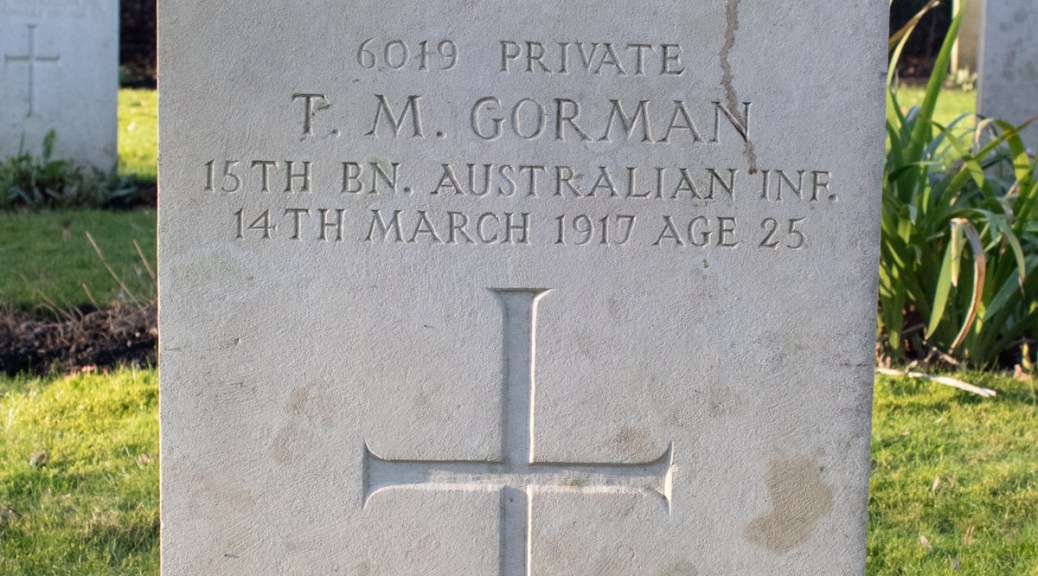
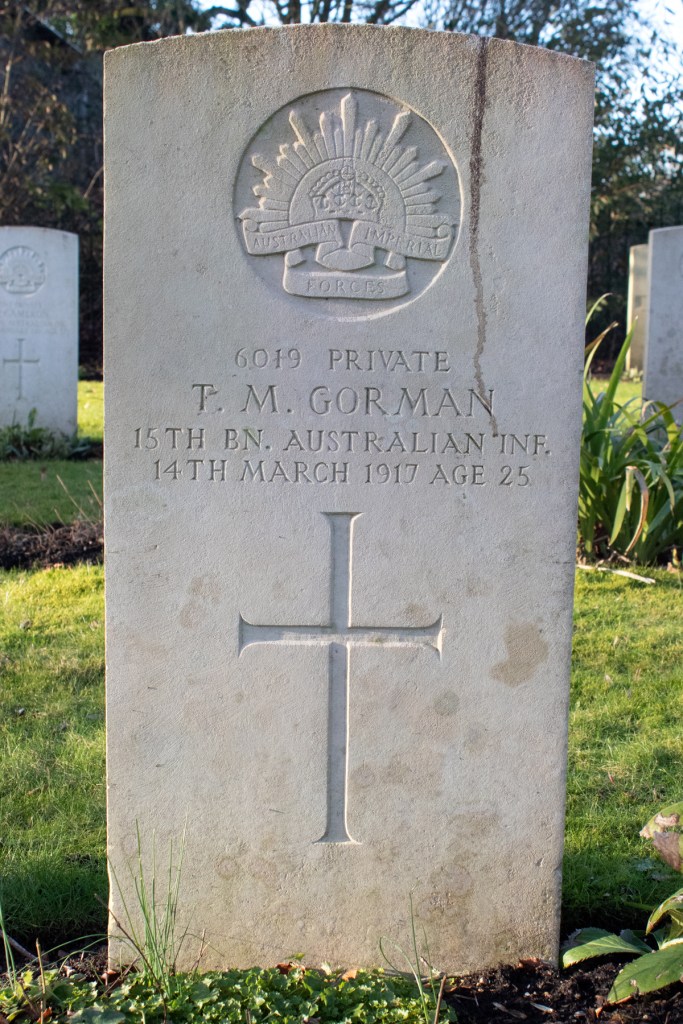
Private Thomas Gorman

Private Thomas Gorman

Thomas Michael Gorman was born on 6th April 1887 and was the seventh of ten children. Both of his parents – Patrick and Mary Gorman – were Irish, and had followed Patrick’s work around the world as an army Quartermaster Serjeant. By the time Thomas came along, the family had settled in Australia, and he was born in Brisbane.

There is little information about Thomas’ early life. When he completed his schooling, his father took him on as an apprentice and, by the time war broke out, he was working as a mechanic.

Thomas enlisted in the Australian Imperial Force in March 1916. His service records show that he was 5ft 8ins (1.72m) tall, and weighed 138lbs (62.6kg). A Roman Catholic, he was recorded as having dark hair, light blue eyes and a fair complexion. It was also noted that he had two scars – one relating to his appendix, and another to a hernia operation.

Private Gorman’s unit – the 15th Battalion of the Australian Infantry – set sail for Europe on 8th August 1916. After just over two months on board the Itonus, they arrived in Plymouth, Devon, from where they were sent to Codford, Wiltshire, which is where several of the ANZAC battalions were based.

Thomas’ service was a mixed one, and his record is not without blemish. In October 1916, he was confined to barracks for seven days for going absent without leave. The following month, the same thing happened, and he we detained for a further seven days.

In December 1916, Private Gorman was admitted to a military hospital in Fovant, near Salisbury, suffering from jaundice. By February 1917 he was back in Codford, and was held in detention for two weeks, for going absent without leave, being drunk in the lines and for urinating in the lines.

Thomas’ jaundice had returned, and he was admitted to the camp hospital again. This time, however, he luck was to run out. He passed away on 14th March 1917, at the age of 29 years old.

Thomas Michael Gorman was laid to rest in the graveyard extension to St Mary’s Church in Codford, Wiltshire.