Category Archives: Role

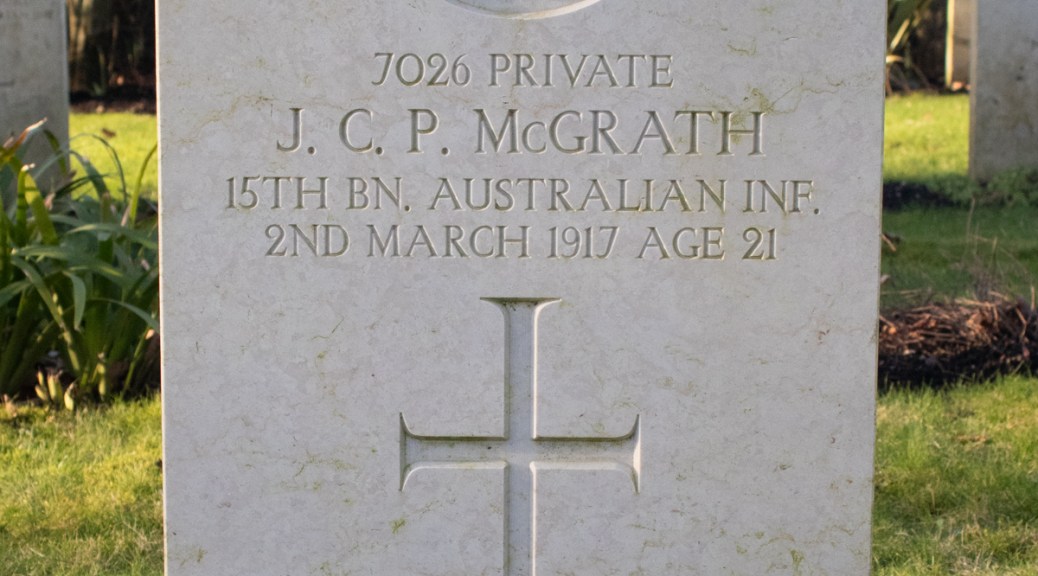
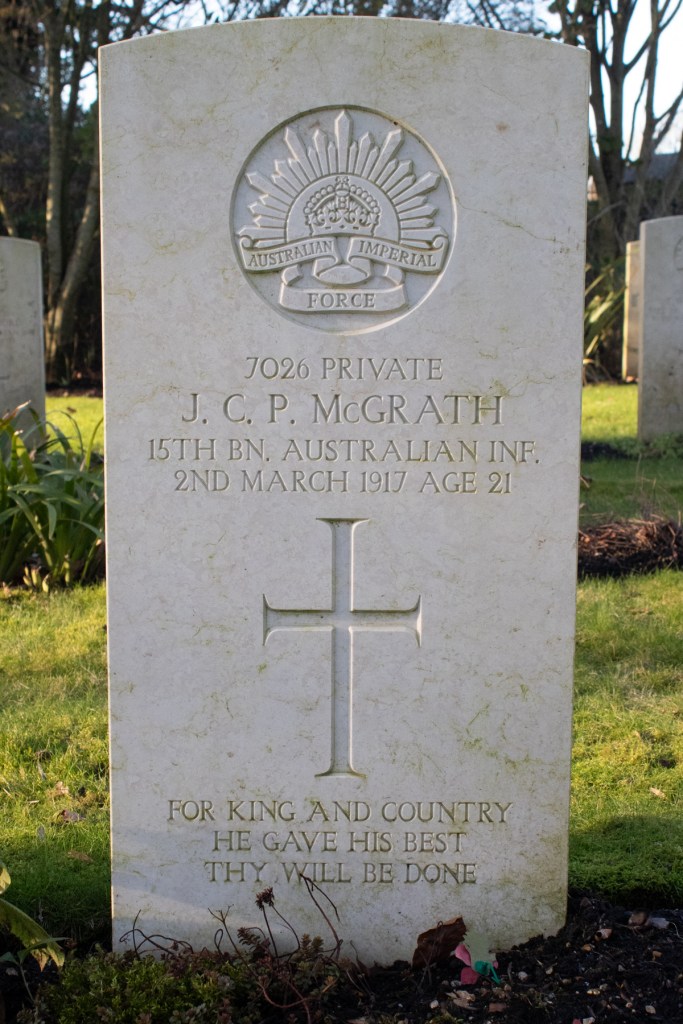
Private James McGrath

Private James McGrath

James Charles Patrick McGrath was born in June 1895 in the town of Marlborough, Queensland, Australia. He was the only child of Patrick and Margaret McGrath.

Little information is available about James’ early life. His father died in 1912, and he found work as a station hand when he completed his schooling.

When war broke out in Europe, James stepped up to play his part. Seeking adventure, and a reliable wage, he enlisted in the Australian Imperial Force in August 1916.

Private McGrath’s service records suggest he must have cut quite a figure, being 5ft 11.5ins (1.81m) tall, and weighing 172lbs (78kg). A Roman Catholic, he had hazel eyes, fair hair and a fair complexion.

James’ unit – the 15th Battalion of the Australian Infantry – departed Australia on 25th November 1916. Leaving from Sydney, his ship, the Beltana, took just under two months to reach its destination, Devonport, Devon. From here, Private McGrath’s battalion made the 130 mile (210km) journey to their base on the outskirts of the Wiltshire village of Codford.

James arrived in Codford on 30th January 1917, but soon fell ill. He was admitted to the camp hospital with influenza on 17th February, but his condition worsened. He passed away from pneumonia on 2nd March 1917: he was just 21 years of age.

Thousands of miles from home, James Charles Patrick McGrath was laid to rest in the cemetery extension to St Mary’s Church in Codford.


Private James McGrath
(from findagrave.com)
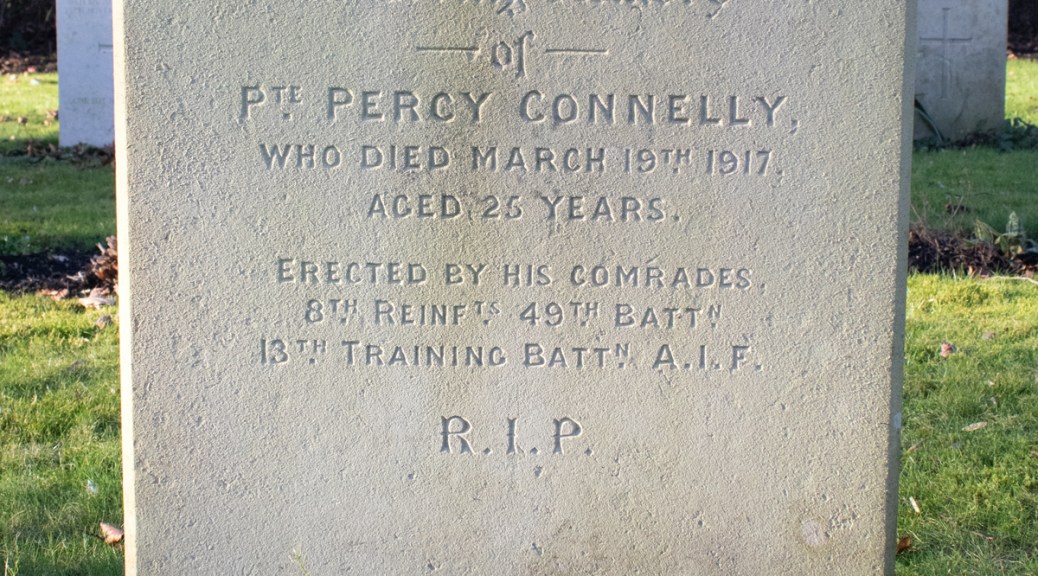
Private Percy Connelly

Private Percy Connelly

Percy Francis Connelly was born in October 1892 in Goulbourn, New South Wales, Australia. One of nine children – eight boys and one girl – his parents were Francis and Emily.

There is little information available about Percy’s early life. When he completed his schooling, he found work as a labourer and this is what he was doing when war was declared.

Percy stepped up to serve his King in November 1916, joining the Australian Imperial Force. His service records show that he was 5ft 8ins (1.72m) tall and weighed 147lbs (66.7kg). A Roman Catholic, he was also noted as having brown eyes, cark brown hair and a dark complexion.

Private Connelly’s unit – the 49th Battalion of the Australian Infantry – departed from Sydney on 22nd December 1916. His ship – the Demosthenes – took ten weeks to reach Britain. During this time, Percy was admitted to the ship’s isolation hospital, as he was suffering with venereal disease.

Percy’s unit arrived in Plymouth, Devon, on 5th March 1917. They were sent to their base near Codford in Wiltshire, for further training and preparation for a move to the continent. Private Connelly, however, would not be going with them. Just a week after arriving at the camp he was admitted to hospital, having contracted bronchial pneumonia.

The lung condition was to prove Percy’s undoing. He took his last breath on 19th March 1917: he was 24 years of age.

Percy Francis Connelly was laid to rest in the ANZAC section of St Mary’s Churchyard, Codford.


Percy’s younger brother, Francis, was also caught up in the First World War. Attached to the 42nd Battalion of the Australian Infantry, he had arrived in Britain more than a year before his older sibling.

Sent to France in November 1916, Francis was wounded just a couple of months later. He was medically repatriated to Britain for treatment, and eventually re-joined his unit in September 1917. He would spend most of the next year on the Western Front, and was killed in action on 29th September 1918. He was just 23 years of age.


Sapper Joseph Yeoman

Sapper Joseph Yeoman

Joseph Frederick Yeoman was born on 28th December 1880, the sixth of eight children to John and Eliza. John was a brewer’s drayman from Harbertonford in Devon, but it was on the coast in Paignton that the Yeoman family were born and raised.

When he finished school, Joseph found work as a mason’s apprentice. The 1901 census found the family of seven living in a small terrace cottage on Hill Park Terrace, to the south of Paignton town centre, with all but Eliza bringing in a wage.

In 1906, Joseph married Lydia Gill. She was the daughter of a general labourer from Chudleigh, Devon, who was working as a domestic servant for an architectural surveyor and his wife. The couple went on to have two children – Joseph Jr, who was born the following year, and Lilian, who was born in 1910, but who died when just a babe-in-arms.

The 1911 census found Joseph and Lydia living at 20 Nuneham Terrace, Joseph Jr is missing from the document, and it seems likely that, with his sister’s death, he had been taken in by another relative to allow his grieving parents some space.

When war broke out, Joseph stepped up to play his part. Full details of his military service have been lost to time, and a clear chronology is a challenge to piece together. Lydia passed away in January 1915, but it is not clear whether Joseph had enlisted by this point. His entry in the Army Register of Soldiers’ Effects confirms that he had joined up by September 1915 at the latest, and that he was in the Royal Engineers.

Sapper Yeoman was assigned to the 1st/3rd (Wessex) Field Company. It is unclear from his records whether he served overseas, but by the spring of 1916, he was in Kent.

The news will be received with deep regret of the death of Sapper JF Yeoman… which took place on Sunday from enteric fever at Nackington Hospital, Canterbury. Deseased was in the employ of Mr WF Pearce before joining up, and frequently assisted the old Rugby Football Club.

South Devon Weekly Express: Friday 10th March 1916

Joseph Frederick Yeoman was 35 years of age when he died on 5th March. His body was brought back to Devon for burial, and he was laid to rest in Paignton Cemetery.


Joseph Yeoman Jr was just nine years old when his father, and had lost both of his parents within a space of just over a year. Emma Augusta Gill, possibly Lydia’s sister-in-law, was given guardianship of him, and he moved to East Brent, Somerset, for a new life.


Private Alfred Hurrell

Private Alfred Hurrell

Alfred Hurrell was born in the Devon village of Ugborough, in the autumn of 1885. He was the second of eleven children – of which five did not survive childhood – to Agricultural labourer Frank Hurrell and his wife, Hannah.

Soon after Alfred was born, the family moved to the village of Modbury, four miles to the south-west. Frank has found work on Hockenbridge Farm, on the edge of the village and, when he finished his schooling, Alfred also started working there, initially living in.

By the time of the 1911 census, Alfred was back living with his parents, on Galpin Street, Modbury. They shared their home with three of Alfred’s siblings, and his sister Jane’s two children.

When war broke out, Alfred was among the first to enlist. Full details of his military service have been lost, but it is clear from what remains that he had joined up by September 1914. Private Hurrell was attached to the 11th (Reserve) Battalion of the Devonshire Regiment, and seems to have remained in the county for his training.

The only other document relating to Alfred is his entry on the Army Register of Soldiers’ Effects. This confirms that he passed away on 16th February 1915 in Paignton, Devon. He was 29 years of age.

The body of Alfred Hurrell was laid to rest in Paignton Cemetery, not far from where he had breathed his last. It is unclear why he was buried there, rather than being brought back to Modbury.


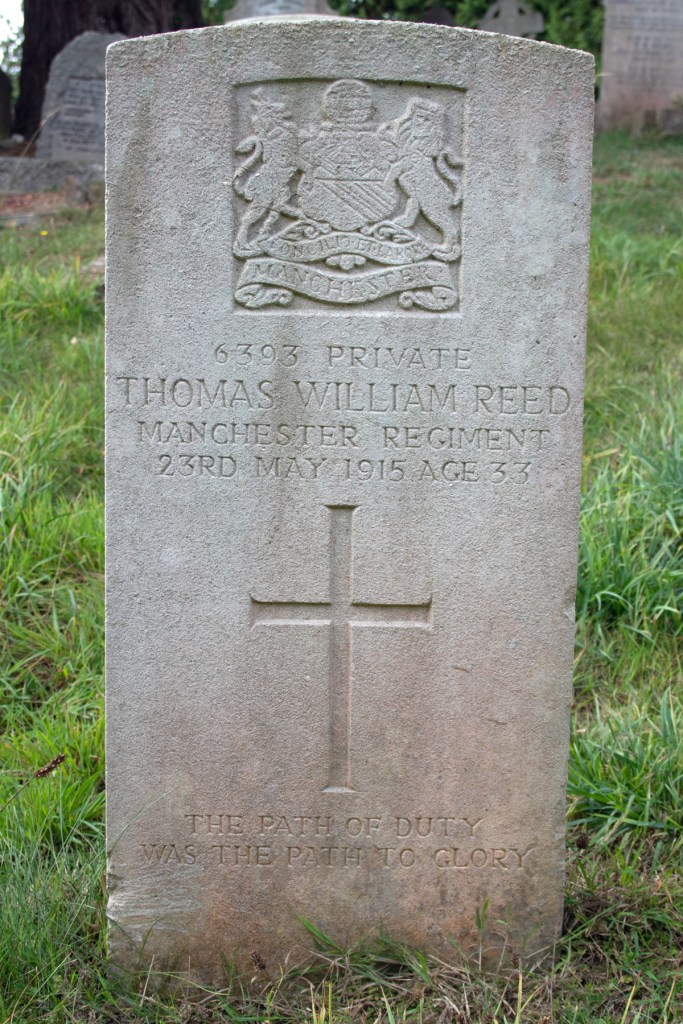
Private Thomas Reed

Private Thomas Reed

Thomas William Reed was born in 1883 and was one of nine children to George and Catherine. George was a general labour and he and his wife were born in Alton, Hampshire. It was in South London, however, that they raised their family.

Thomas found work as a house painter when he completed his schooling. The 1911 census recorded him as being the only one of his siblings still living in the family home, 16 Valentine Row in Blackfriars.

When war came to Europe, Thomas stepped up to play his part. Full service records have been lost to time, but from what remains it is clear that he had enlisted in the army in the opening months of the conflict. Private Reed was assigned to the Manchester Regiment and, as part of the 2nd Battalion, would have quickly found himself on the Western Front.

Thomas’ time in the army was to be tragically brief. By the spring of 1915 he was back in Britain, hospitalised in Devon with nephritis, or inflamed kidneys. His condition worsened, and he passed away on 23rd May: he was 32 years of age.

Thomas William Reed was laid to rest in Paignton Cemetery, not far from the Devon hospital in which he had breathed his last.


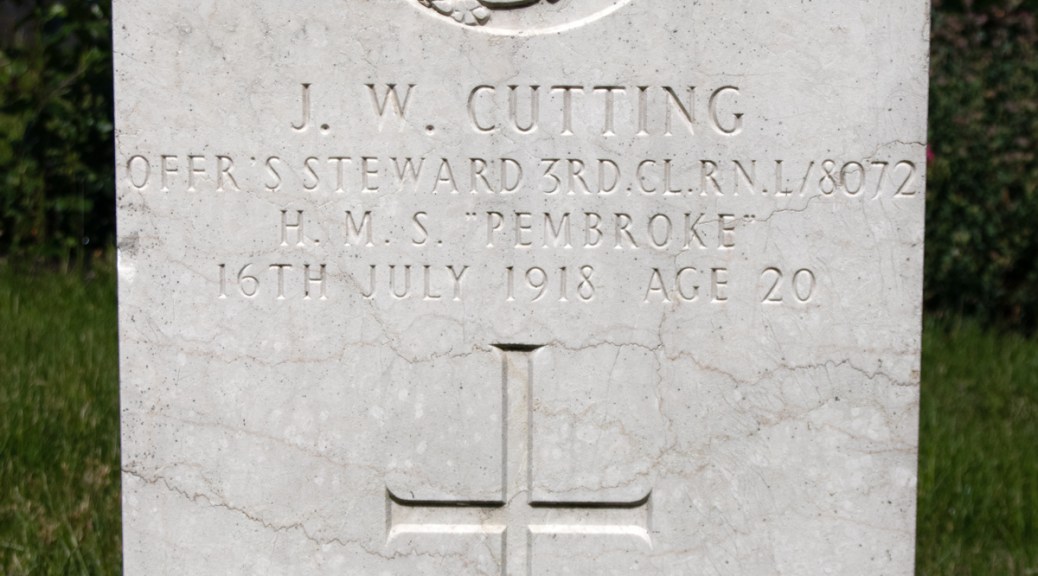
Officer’s Steward 3rd Class Joseph Cutting

Officer’s Steward 3rd Class Joseph Cutting

Joseph William Cutting was born on 10th September 1897 in Stratford, Essex. The middle of three children, his parents were Alfred and Clara. Alfred was a stoker in a carpenter’s workshop, but when he completed his schooling, his son found work as a clerk.

When war broke out, Joseph stepped up to play his part. He enlisted in the Royal Navy on 22nd September 1915, joining as an Officer’s Steward 3rd Class. His service records show that he was 5ft 8ins (1.72m) tall, with dark brown hair, blue eyes and a fresh complexion. He was also noted as having a scar in the middle of his forehead.

Officer’s Steward Cutting was based at HMS Pembroke, the Royal Naval Dockyard in Chatham, Kent, and would continue in his role for the next two and a half years. His annual review recorded a very good character, and moderate to satisfactory ability, which may be why he did not rise above his junior rank.

In the summer of 1918, Joseph was admitted to the Royal Naval Hospital in Chatham, suffering from tuberculosis. The lung condition was to prove his undoing, and he succumbed to it on 16th July 1918. He was just 20 years of age.

Joseph William Cutting was laid to rest in the naval section of Woodlands Cemetery in Gillingham, Kent, not far from the base he had called home for so long.


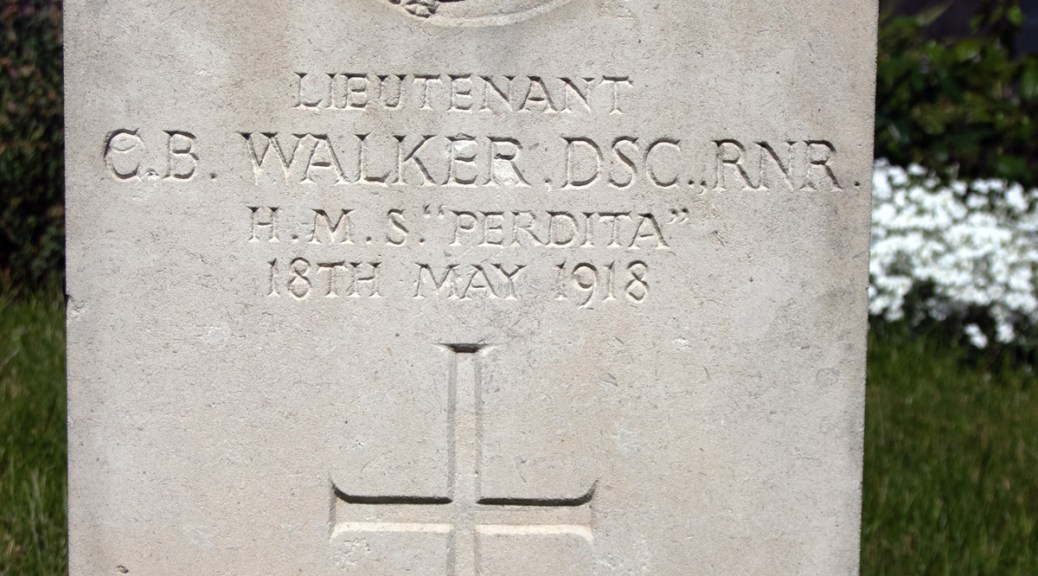
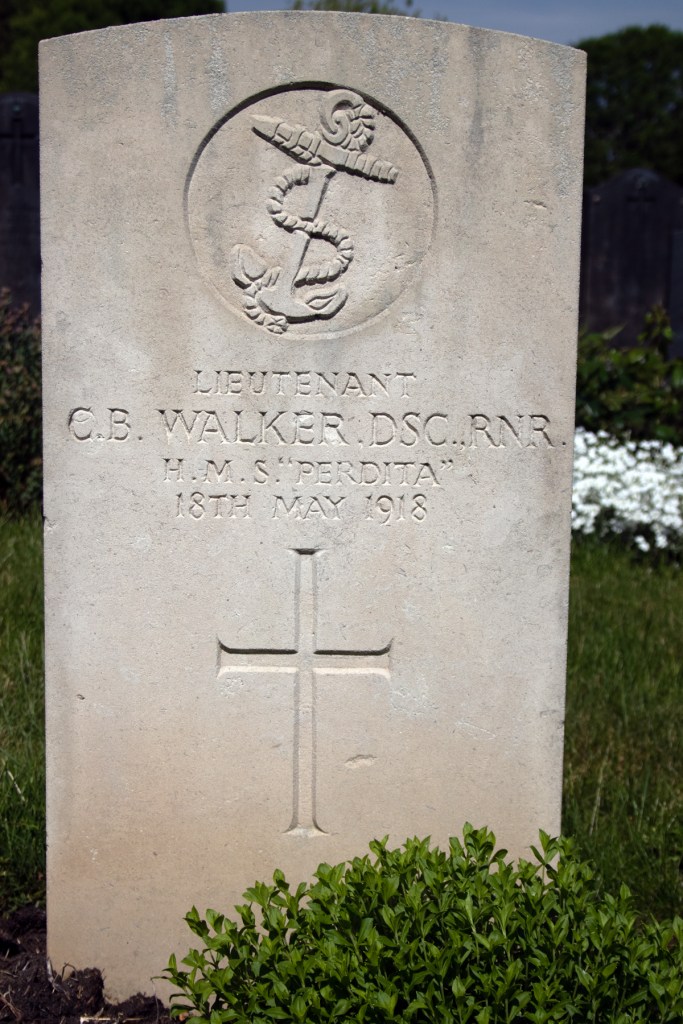
Lieutenant Claude Walker

Lieutenant Claude Walker

“The funeral took place on Wednesday with naval honours of Lieut. Claude Bennett Walker, RNR, whose home is a 23, Overcliffe, Gravesend, and who died at the Royal Naval Hospital, Chatham, on Saturday. His death was a naval casualty, and it was only on Friday, a day before his death, that he was taken to the Chatham Hospital.”

[Kent Messenger & Gravesend Telegraph: Saturday 25th May 1918]

Claude Bennett Walker was born on 6th July 1882 in Deal, Kent. The oldest of five children, his parents were George and Amelia Walker. George was a Trinity pilot, navigating ships off the Kent coast and beyond, and it was only natural that his first born followed in his stead.

Claude set to a life at sea when he completed his schooling. By August 1904, he was a registered Second Mate on board sea-going vessels, and within two years, he was deemed competent to become a First Mate. By 1909 he was certified as a Master of a foreign-going ship. At some point he joined the Royal Naval Reserve, and on 5th July 1912, was given the rank of Sub-Lieutenant.

That autumn, Claude married Gwen Case. The wedding took place in her home town of Melksham, Wiltshire, and the couple would go on to have two children – son Alec in 1913, and daughter Alison three years later.

When war broke out, Claude would be called upon to play his part, serving on the battleship HMS Majestic and the destroyer HMS Recruit early on in the conflict. By the spring of 1915, he was assigned to the minelayer HMS Biarritz, and that October, he was promoted to full Lieutenant.

On 9th March 1917, Claude was given command of the minelayer HMS Perdita. She served in the Mediterranean, and would be caught up in some skirmishes. In October 1917, Lieutenant Walker was awarded the Distinguished Service Cross, and the following April he was mentioned in dispatches.

The Perdita was back in Kent by the spring, by which point Claude had fallen ill. He was admitted to the Royal Naval Hospital in Chatham with cerebrospinal meningitis, and this would be the condition to which he would succumb. He passed away on 18th May 1918, at the age of 35 years of age.

Claude Bennett Walker was laid to rest in the naval section of Woodlands Cemetery, Gillingham, Kent.


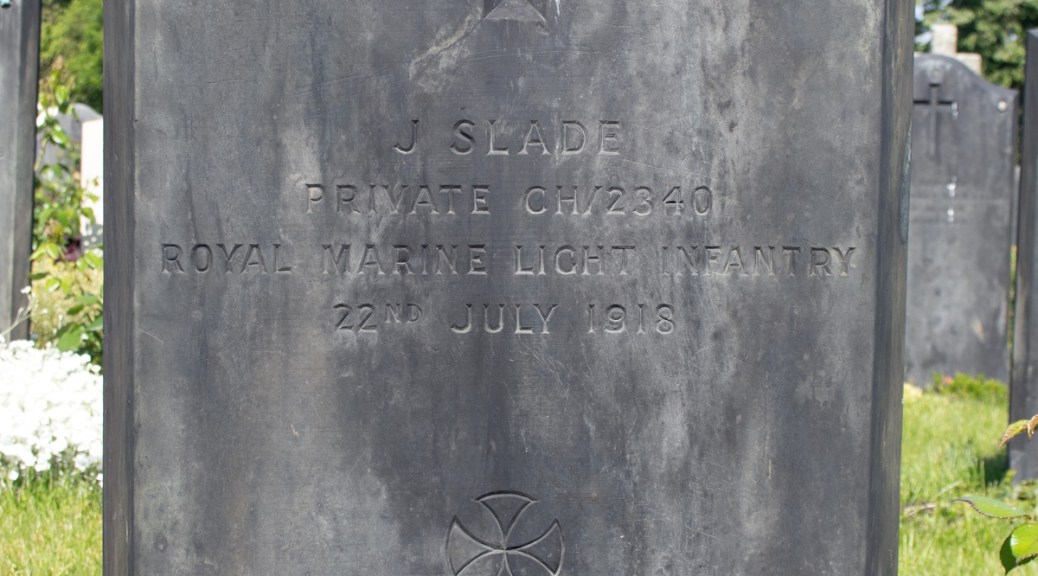
Private John Slade

Private John Slade

John Slade was born in Winchmore Hill, Buckinghamshire, in 1865. One of three children to Edward and Mary, he also had three half-siblings from his mother’s previous marriage. Edward was a hawker, but when he left school, his son sought bigger and better things. By the time of the 1891 census he was recorded as being a Private in the Royal Marine Light Infantry, and was based in Chatham, Kent.

Sadly, Private Slade’s service records have been lost to time, so it is not possible to identify where his role took him. The 1901 census, however, shed some light on his time in the navy. It found him living at 36 Cross Street in Gillingham, Kent, with his wife, Annie, and his adopted daughter, Lillie. They had also taken on three boarders – Frank Hall, Harry Monk and Charles Barwell – all of whom were in the navy as well.

Ten years later on, and thing had changed once more. Still living in Gillingham, it seems that John’s time in the Royal Marine Light Infantry had come to an end. Instead, he was living at 54 James Street and giving his trade as an unemployed labourer. Still noted as being married, there is no sign of either Annie or Lillie: instead John was living with widow Laura Greyson and her two teenage boys, Charles and George.

At this point, John’s trail goes cold. As he was formally granted a Commonwealth War Grave, he must have stepped up to serve his country once more when war broke out in 1914. He would, however, have been getting on in years at this point, so how for long that service continued is anyone’s guess. He passed away from ‘disease’ on 22nd July 1918, at the age of 53 years of age.

John Slade was laid to rest in the military section of Woodlands Cemetery, Gllingham, the town that had been his home for more than three decades.


Stoker 1st Class Thomas Ellis

Stoker 1st Class Thomas Ellis

Thomas Ellis was born in 1896 in St Leonard’s, Sussex. The third of twelve children, his parents were George and Ellen Ellis. George was a general labourer, but when he finished his schooling, Thomas found work as a golf caddy. The 1911 census recorded the Ellis family living in four rooms at 7 Caves Road to the east of the town centre.

There is little additional information about Thomas, sadly. He joined the Royal Navy when war broke out, and was working as a Stoker 1st Class by the closing months of the conflict. He passed away, through causes unknown, on 7th July 1918, at the age of just 23 years old.

Thomas Ellis was laid to rest in the naval section of the Woodlands Cemetery in Gillingham, Kent, not far from the Royal Naval Dockyard in Chatham – HMS Pembroke – at which he was based.


Acting Leading Seaman William Wood

Acting Leading Seaman William Wood

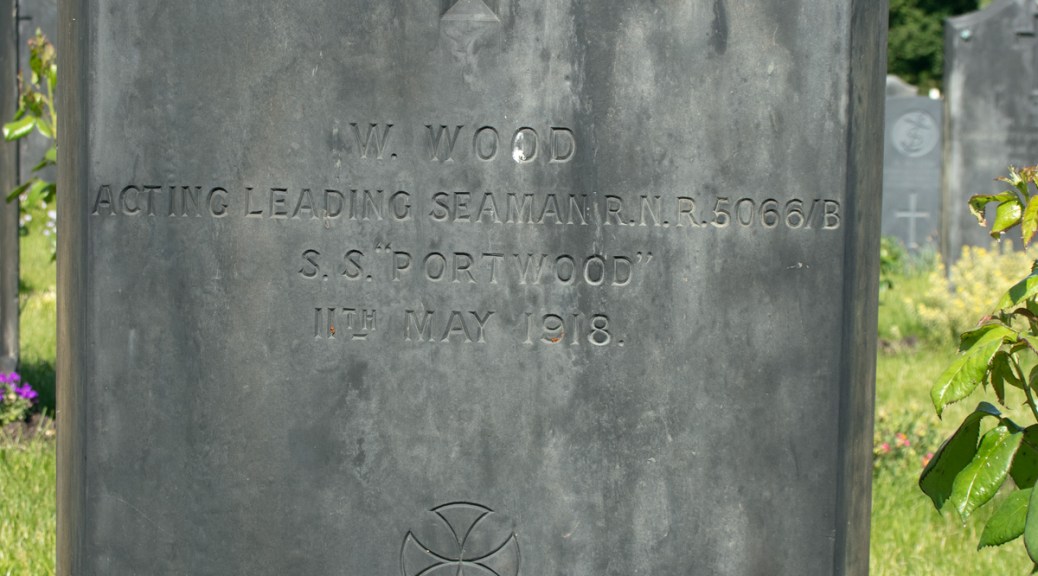
The life of William Wood, who is buried in Woodlands Cemetery in Gillingham, Kent, is a challenge to piece together. His headstone confirms that he held the rank of Acting Leading Seaman in the Royal Naval Reserve, and that he was assigned to SS Portwood at the time of his death.

Full service records for William have long since disappeared, but his pension ledger index card gives his widow as Catherine Rose Wood, of Greenfield Street in Govan, Scotland. It also suggests that the couple did not have any children under full age.

The Royal Navy and Royal Marine War Graves Roll provides William’s date of birth – 28th December 1887 – and goes on to suggest that he was born in London. Sadly, his name is far too common to narrow down census records, and there are no documents relating to his and Catherine’s marriage, so any additional family connections are also lost.

Acting Leading Seaman Wood’s entry on the pension ledger confirms his died of general paralysis of the insane, and his burial in the Gillingham cemetery would suggest that he had passed away in the Royal Naval Hospital in Chatham, Kent. He died on 11th May 1918, at the age of 29 years old.

William Wood was buried in the military section of Woodlands Cemetery, Gillingham, Kent.