Sidney Powell was born in the Walcot area of Bath, Somerset, in the spring of 1892. One of five children, his parents were corporation gardener Albert Powell, and his wife, Mary. The family lived at 2 Hedgemead Terrace for at least fifteen years, presumably as it was close to the park where Albert worked.
By the time of the 1911 census, Sidney had completed his schooling, and was employed as a draper’s porter. His was one of four wages being brought into the household: his father was gardening, his younger brother Frank was a law clerk, while his older step-brother, Mary’s son William, also worked as a draper’s porter.
When war came to Europe, Sidney stepped up to play his part. Sadly, details of his service have been lost to the mists of time, but it would appear that he enlisted in the Somerset Light Infantry no later than April 1916. Private Powell soon moved to the Machine Gun Corps, although documents do not confirm whether he spent any time overseas.
In the autumn of 1916, Private Powell was admitted to Birmingham War Hospital, having contracted pneumonia. The condition was to prove his undoing: he died while still admitted on 30th October. He was 24 years of age.
The body of Sidney Powell was taken back to Somerset for burial. He was laid to rest in the majestic grounds of the Bath’s Locksbrook Cemetery.
Alfred William King was born in the autumn of 1872, the oldest of eight children to Alfred and Caroline King. Alfred Sr was a labourer from Bath, Somerset, and this is where the family were raised.
Times were tough for the King family. The 1891 census recorded most of them living at 89 Avon Street in the city. Alfred Jr, meanwhile, seems to have been an inmate at the Bath Union Workhouse in Lyncombe.
On 24th May 1896, Alfred Jr married Mary Pemberton. She was the daughter of a coachman, in the next street to her in-laws. Both Alfred and his father were, by this point employed as carters, and the new groom was back living in Avon Street. The young couple went on to have two children, Alfred and Dorothy, and made their home in a small terraced house in Avondale Road, Bath.
The 1911 census recorded Alfred as being an army pensioner and night porter. While previous service records no longer exist, his enlistment papers for the First World War suggest he had spent time in both the Somerset Light Infantry and the Royal Garrison Artillery. Certainly, Alfred’s eagerness to serve his country – he joined up on 18th September 1914, at the age of 42 – suggests he had had military service in the past.
Private King’s medical report confirms that he was 5ft 5.5ins (1.66m) tall and weighed 145lbs (65.8kg). He was noted as having grey hair, light brown hair and webbed toes on both feet.
Alfred’s time in the army was to be brief. A later medical report noted that the had a “dilated stomach of old standing. [He was] absolutely unable to retain food unless stomach is washed out twice a week.” He was medically dismissed from the army on 3rd November 1914, after just 45 days.
Alfred’s incapacity for military service may have been what prompted his son, Alfred, to enlist. After time in the Somerset Light Infantry, and a rise to the rank of Lance Corporal, he was to die of wounds in February 1916. His father would live on for just five more years. He passed away on 1st April 1921 at the age of 48 years.
Alfred William King was buried alongside his son in Bath’s majestic Locksbrook Cemetery.
Read about Lance Corporal Alfred Frederick King here.
Alfred Frederick King was born at the start of 1897, and was the oldest of two children to Alfred and Mary. Alfred Sr was an army pensioner-turned-carman, and both he and his wife were born in Bath, Somerset. By the time of the 1911 census, the family of four were living at 31 Avondale Road, in the Walcot area of the city.
Alfred Jr had completed his schooling by this point, and was working as an errand boy. War was not far off, however, and it would result in the ultimate sacrifice for the King family.
Alfred Sr enlisted in the Somerset Light Infantry in September 1914, but was deemed not fit for service, as he was suffering from chronic stomach issues. This may have prompted his son to join up, and he did so in October 1915.
Sadly, Alfred Jr’s full service details no longer remain, but from what is left, it is clear that he joined the Somerset Light Infantry, and was assigned to the 8th (Service) Battalion. His unit was sent to France, and he would spend the rest of the year on the Western Front.
Private King was involved in a number of skirmishes in the coming months, and soon gained a promotion to the rank of Lance Corporal. In late January or early February 1916, he was wounded, and medically evacuated to Britain. He was admitted to the East Suffolk Hospital in Ipswich, but his injuries would prove too great: he passed away on 22nd February 1916, at the age of just 19 years old.
Alfred Frederick King’s body was taken back to Somerset for burial. He was laid to rest in the sweeping grounds of Bath’s Locksbrook Cemetery.
Alfred Sr would be buried alongside his son. You can read more about his life here.
Arthur William Bence was born in the village of Box, Wiltshire, in the spring of 1887. The oldest of eight children, his parents were James and Sarah. James was an engineer from Bathampton, Somerset, and by the time of the 1901 census, the young family had moved to 14 Hampton Row in nearby Bathwick.
Ten years later, and the Bence family had relocated again, this time to the northern outskirts of Bath, in a terraced cottage at 6 Brooklyn Road. By this point, Arthur had finished his schooling, and had found employment, working as a baker and bread maker. This was not to be a permanent career, however, and he sought out more of a career.
Arthur had long been a volunteer in the local militia, and on 14th November 1905 he enlisted in the army. Now known by his middle name, William Bence joined the Coldstream Guards as a Private. His service records show that he was 5ft 11ins (1.82m) tall, and weighed 148lbs (67.1kg). He was noted as having brown hair, brown eyes and a fresh complexion. Hs also had several tattoos on his left forearm, including a heart, cross, anchor, man’s face, crown and crossed flags.
Private Bence spent the first two years of his military career on home soil in Windsor, Berkshire, and London. In January 1908, his unit – the 3rd Battalion – transferred to Africa, and William would remain in Egypt and Sudan for more than three years. In March 1911 he returned to home soil, and that year’s census record noted his address as the Tower of London.
By the end of 1913 Private Bence had been formally stood down to reserve status. During his eight years on active service, he had been hospitalised a couple of times: for a sprained wrist in 1906, and for a bout of pneumonia in July 1910.
War was a matter of months away, however, and in the summer of 1914, William was to be mobilised again. By 12th August he was sent to France, and his battalion would be caught up at Marne and Aisne before the end of the year.
On 27th September 1914, William rose to the rank of Lance Corporal. This was not to last, however, and within six weeks the promotion was retracted for misconduct. He remained on the Western Front for nearly two and a half years, and had a mixed time of it. In April 1915, he Private Bence was confined to barracks for 14 days for being drunk on duty. In November that year, he was promoted to Lance Corporal for a second time.
This advancement coincided with William’s marriage. He had wed Amelia Oakley at St Saviour’s Church in Bath on 3rd November. There is little information available about her, other than that she had been born in Bath in 1888.
Back in France, and Lance Corporal Bence’s battalion fought at Loos and was heavily involved at the Somme. William would remain on the Western Front until December 1916, at which point his health forced him back to Britain. He had contracted tuberculosis, and this would lead to his ultimate discharge from military duty on 9th January 1917. William returned home, but his condition was to get worse. He passed away on 1st April 1917: he was 30 years of age.
The body of Arthur William Bence was laid to rest in the sweeping grounds of Bath’s Locksbrook Cemetery, in the city that was his home.
George Henry Higgins was born in Bath, Somerset, in the spring of 1888. The fifth of fifteen children, his parents were Charles and Sarah Higgins. Charles was a carter-turned-labourer for the city’s corporation, and this is work into which George also went.
The 1911 census recorded the Higgins family living in a six-roomed house at 15 London Place, Bath. By this point, Charles and Sarah were sharing their home with ten of their children – including George – plus four of their grandchildren by their married third-oldest daughter, Sarah. Five of the household were bringing in a wage: George and his father were employed by the Corporation, daughter Rose was a factory hand, while two of George’s younger brothers were errand boys.
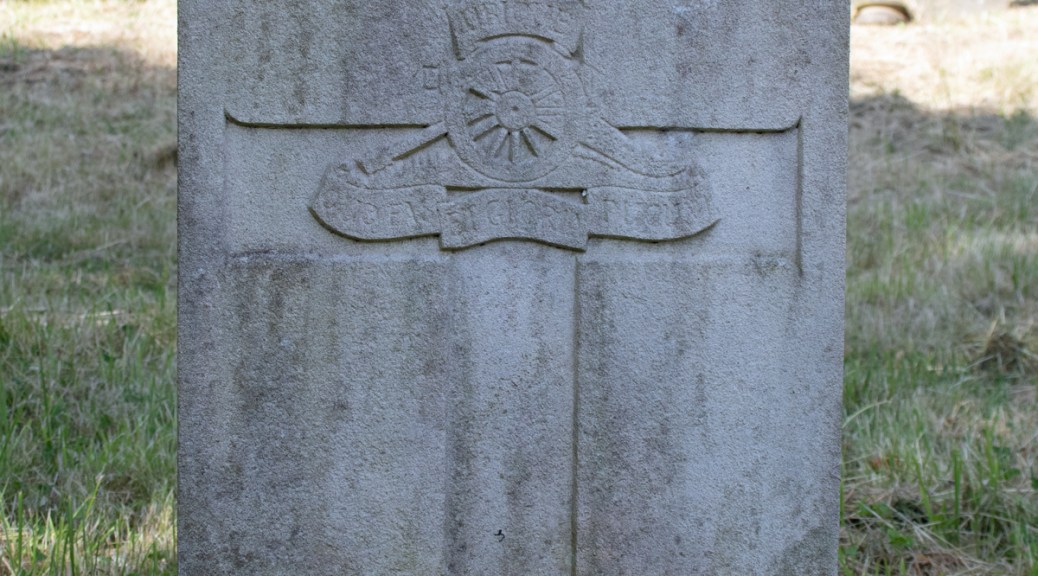
Charles died in the autumn of 1914, and George was suddenly the head of the household, with war raging across Europe. The following summer he enlisted in the Royal Field Artillery: this may have been out of duty to his King, but it is likely that, as the oldest man in the house, the army offered the prospect of a regular, decent wage.
Full service details for Gunner Higgins have been lost in the annals of time, but his unit – the 92nd (Howitzer) Brigade – served in some of the fiercest battles of the conflict. Arriving in France for training on 21st July 1915, it is likely that George saw fighting at the Somme in 1916 and 1918, and at Ypres in 1917. By the end of the war, he had been promoted to the rank of Lance Bombardier for his service.
George’s older brother, Charles, died in the fighting in Northern France, but by the start of 1919, George himself had returned to home soil, and was attached to the regiment’s Clearing Office in Woolwich, Kent.
His health was being impacted by this point, and he was admitted to the Royal Herbert Hospital in nearby Shooter’s Hill. His records simply record that he was suffering from ‘disease‘, and it was this that was to kill him. He died on 17th February 1919, at the age of 30 years old.
The body of George Henry Higgins was taken back to Somerset for burial. He was laid to rest in the sweeping grounds of Bath’s Locksbrook Cemetery, not far from where Sarah still lived.
Arthur Wellesley Harcourt was born on 18th June 1895 in Brentford, Middlesex. He was the youngest of five children to Charles and Eliza Harcourt.
The son of a Baptist minister, Charles was a banker’s clerk, but “practically the whole of [his] leisure in a busy life [was] spent in mission work, mainly in Middlesex…” [Middlesex & Surrey Express – Saturday 13 October 1900] When he died in 1900, at the age of 57, Eliza was left to raise her younger children alone.
Arthur’s young life was to be one of travel. The 1901 census, taken just six months after his father’s death, found him living in Walton le Soken (now Walton-on-the-Naze), Essex. Eliza had taken rooms for the family in a lodging house at 9 New Pier Street, yards from the town’s stony beach.
The next record for Arthur is from 1908. Surprisingly, for the grandson of a Baptist minister and the son of a missionary, he seems not to have been baptised when he was born. The document shows that he was christened on 26th April, at St Mary’s Church in the village of Sporle with Palgrave in Norfolk. There is nothing to confirm why he was in Norfolk, or why he chose to be baptised there: the 1911 census found Eliza and his siblings living back in Middlesex.
By this point, Arthur was on the move again. Now fifteen years of age, the same census found him visiting George and Amelia Kerswill at their home in Exeter, Devon. George was a retired nurseryman and florist from Hendon, and it seems likely that the couple were friends of the family.
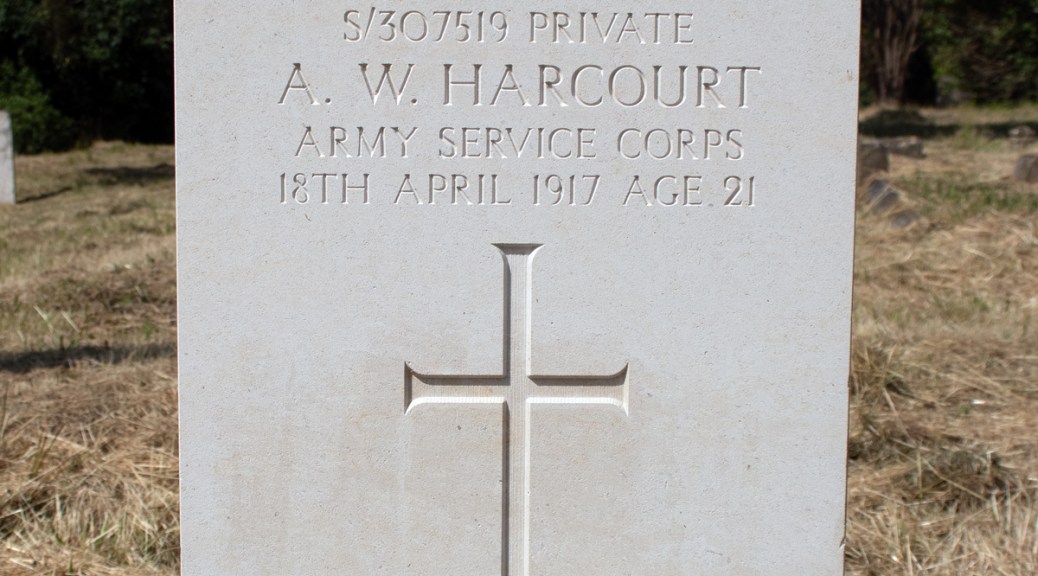
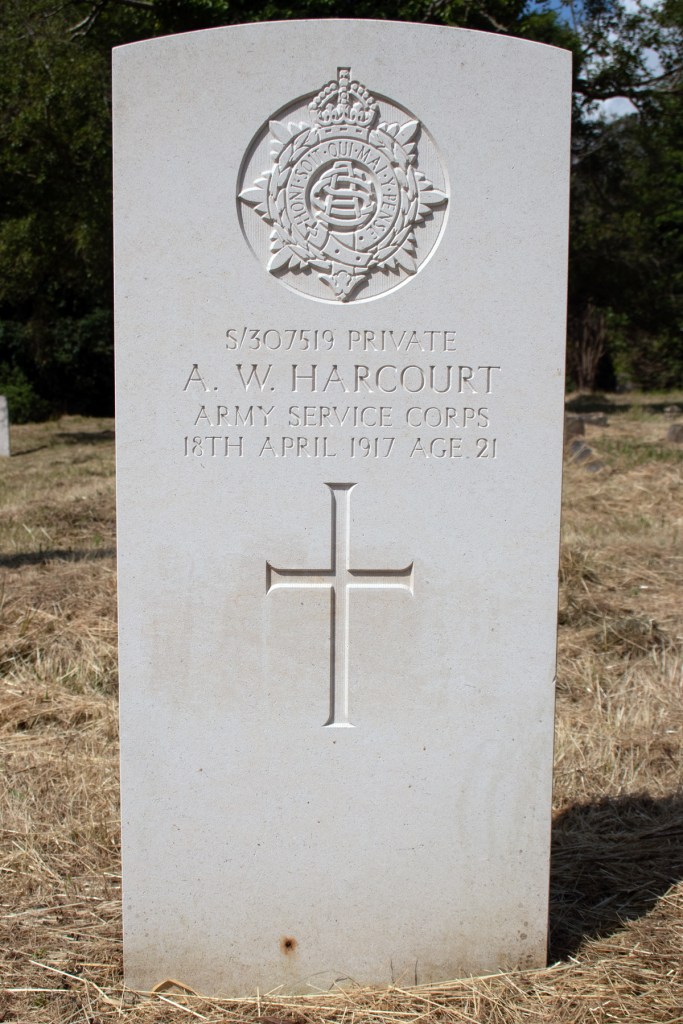
By the time war broke out, the Harcourts had moved once again, this time setting up home in Reculver, Kent. Arthur was working as a surveyor’s assistant, but felt drawn to play his part. On 8th March 1917, he enlisted, joining the Army Service Corps as a Private. His records show that he was 5ft 4.5ins (1.61m) tall, and weighed 96lbs (43.5kg). He was of fair physical development, but it was noted that he had an understandard chest, but was deemed fit for military service.
Private Harcourt was sent to Somerset for training. Tragically, however, his health was to take a dramatic downturn. Admitted to the Bath War Hospital on 1st April with influenza, this quickly developed into double pneumonia and pleurisy. The strain was to be too much for his young body to bear: Arthur passed away on 18th April 1917, at the age of just 21 years old.
Surprisingly, Eliza, whilst able to live on her own means, did not chose to lay her son to rest close to home. Instead, Arthur Wellesley Harcourt was buried in Locksbrook Cemetery, Bath, not far from the hospital in which he had breathed his last.
Frank Nicholas Patience was born in Mullewa, Western Australia, on 6th March 1898. The tenth of fifteen children (of which four did not survive childhood), his parents were Joseph and Elizabeth Patience.
There is little concrete information about Frank’s early life. When he finished his schooling, he found employment as a farm hand, and this is what he was working as when he stepped up to serve his country.
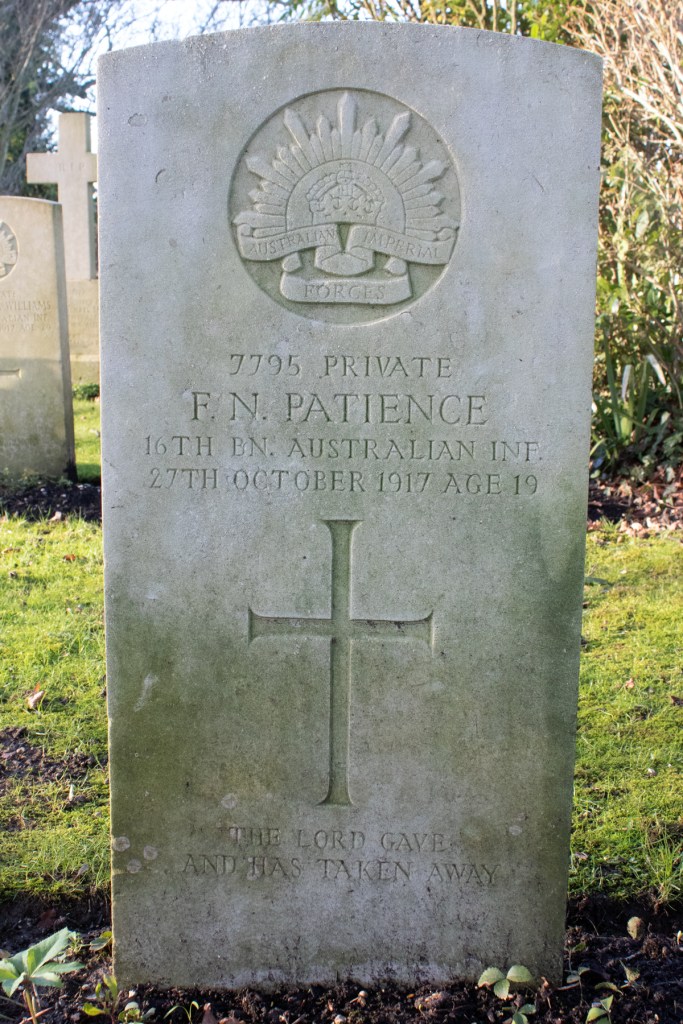
Frank enlisted in the Australian Imperial Force on 18th June 1917. Within six weeks he left his homeland for Europe, arriving in Liverpool, Lancashire, on 3rd October. Assigned to the 16th Battalion of the Australian Infantry, he was barracked in Wiltshire, at a camp not far from the village of Codford.
Tragically, Private Patience’s time in the army, and in Britain, was to be brief. Within weeks of arriving in Wiltshire, he contracted pneumonia, and was admitted to the camp hospital. The condition was to prove his undoing, however, and he passed away on 27th October 1917. He was just 19 years of age.
Frank Nicholas Patience was 9,000 miles (14,500km) from home. He was laid to rest in the extended graveyard of St Mary’s Church in Codford, Wiltshire.
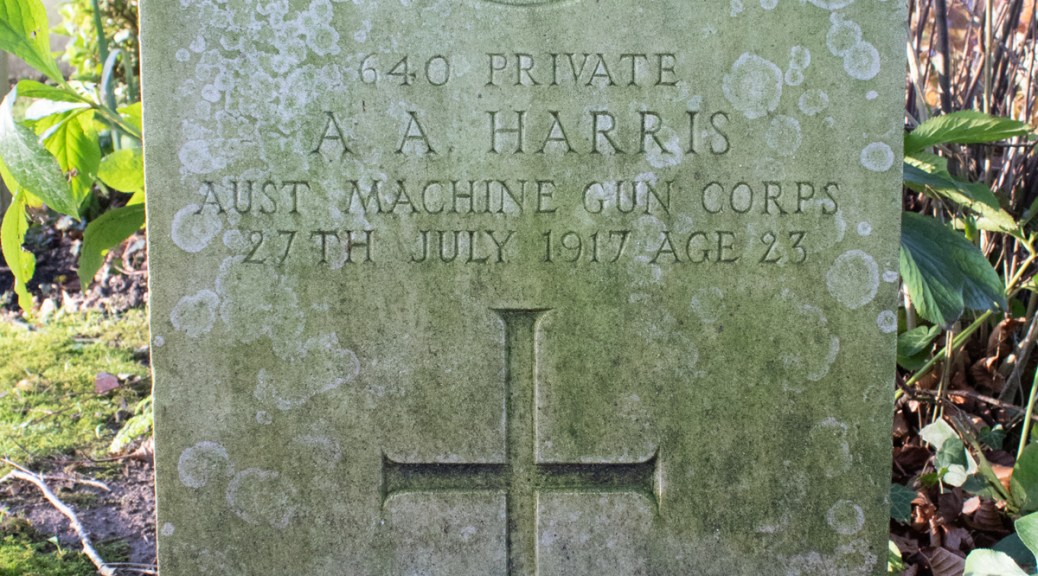
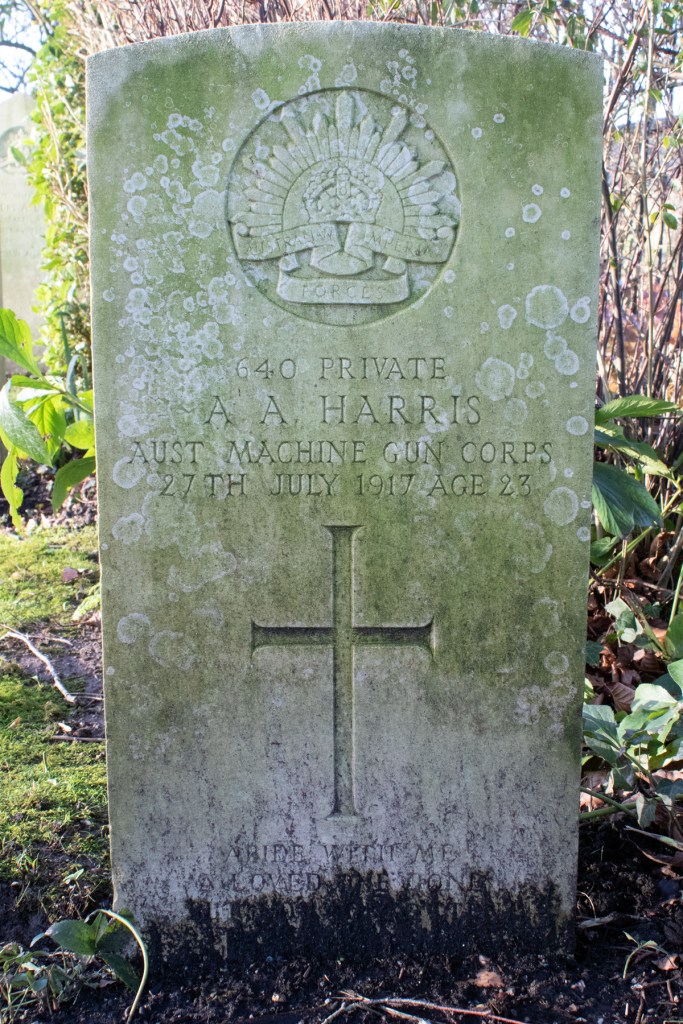
Albert Arthur Harris was born on 14th December 1893 in Huon, Tasmania, Australia. The second of seven children – and the oldest son – his parents were Arthur and Eliza.
There is little information available about Albert’s early life. When he finished his schooling, he found work as an orchardist, and this was his line of work when, on 12th April 1916, he stepped up to serve his King and Empire.
Albert joined the Australian Imperial Force, and his records suggest that he had tried to enlist before, but had been turned down because of varicose veins. His medical report confirms that he was 6ft (1.83m) tall and weighed 155lbs (70.3kg). He had fair hair, blue eyes and a fair complexion.
Private Harris set sail from Australia on 11th May 1917, arriving in Plymouth, Devon, two months later. He was billeted near Codford in Wiltshire, and assigned to the Australian Machine Gun Corps.
Albert’s time in Britain was to be brief. While in camp, he came down with peritonitis, and hospitalised. He developed septicaemia, and died on 27th July 1917: he was just 23 years of age.
Albert Arthur Harris was laid to rest in the newly extended graveyard of St Mary’s Church in Codford.
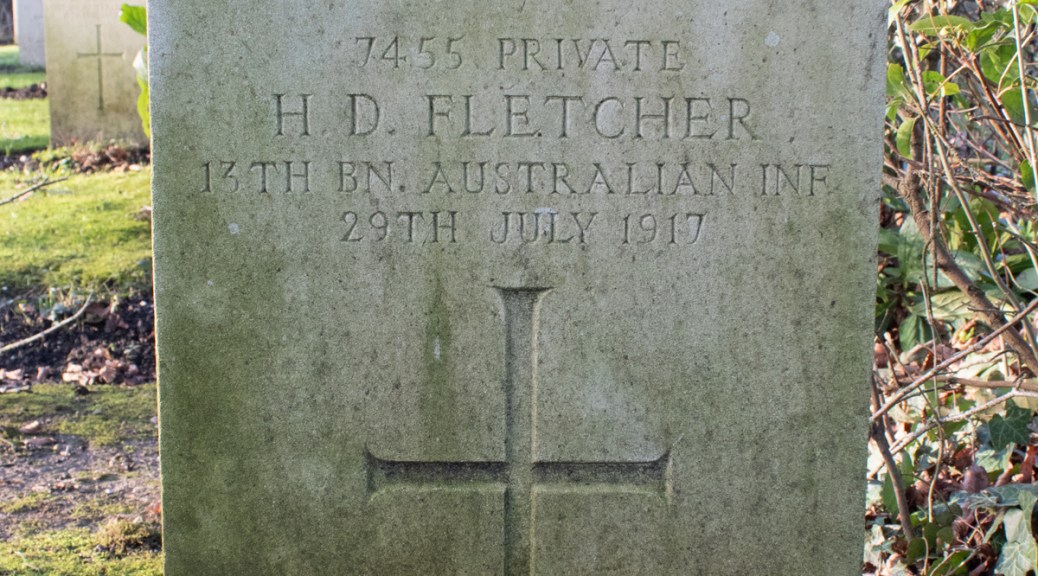
Harry David Fletcher was born in Leichhardt, New South Wales, Australia, on 1st November 1883. The seventh of ten children – and the only surviving son – his parents were Daniel and Charlotte Fletcher.
There is little information about Harry’s early life: he found work as a labourer when he finished school and, on 11th March 1911, he married Lillian Bosworth. The couple went on to have a son, Harold, who was born the following February.
When war came to Europe, the British Empire was called upon to play its part. On 19th February 1917, Harry enlisted in the Australian Infantry, although he did so under the alias of Harry Conway. His service records show that he had dark brown hair, hazel eyes and a medium complexion. He was also 5ft 7.75ins (1.72m) tall and weighed 140lbs (63.5kg). He had two noticeable scars: one on the inside of his right arm, the other on his right shin.
Private Conway/Fletcher set sail for Europe on 10th May 1917, arriving in Britain two months later. His unit – the 13th Battalion – was billeted in Wiltshire, near the village of Codford. Tragically, his time in the army was to be brief: he suffered issues with his gallbladder, and died in the camp hospital from cholecystitis and septicaemia on 29th July 1917. He was 33 years of age.
Harry David Fletcher was laid to rest in the Australian section of the new churchyard of St Mary’s Church in Codford. His burial records note that the service was officiated by Chaplain Captain Collins, with six of his friends from the battalion acting as pallbearers. He was buried in an elm and brass coffin, with a small oak cross being erected over the grave.
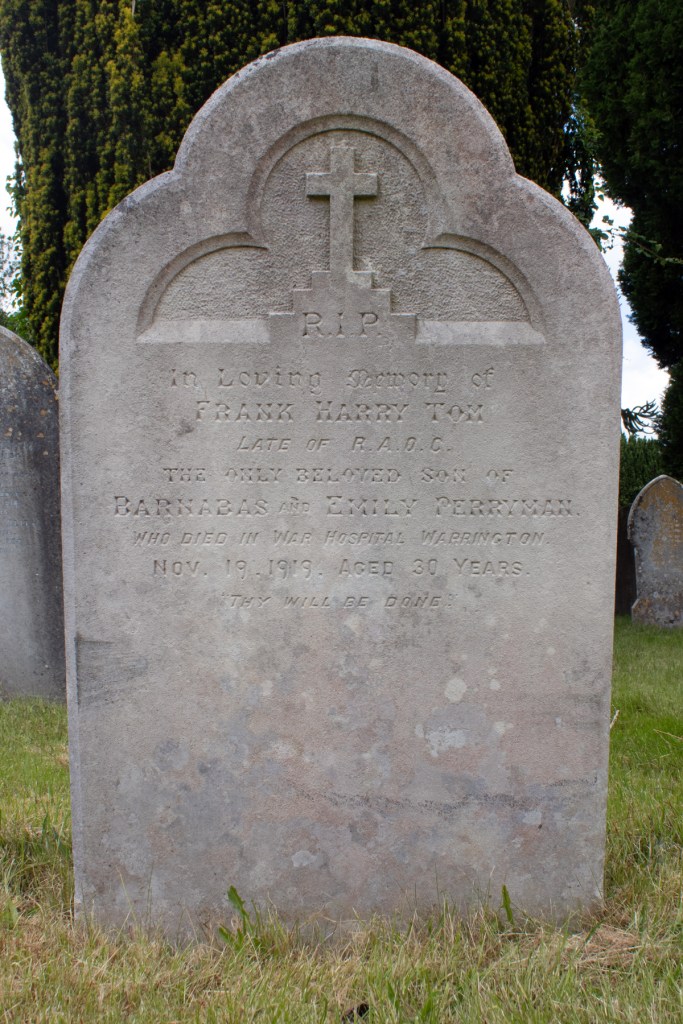
Frank Harry Tom Perryman was born in Axminster, Devon, on 16th October 1889. The third of six children – and the only boy – his parents were Barnabas and Emily. Barnabas was a carpenter and joiner, and the family lived in the centre of the town: first next door to the Red Lion Inn on Lyme Street, then around the corner on South Street.
By the time of the 1911 census, an opportunity had arisen to take Frank away from Devon. The document records him as one of four servants (in addition to a maid, butler and cook) for Eumenia Hime and her law student son, Stanley. Eumenia’s husband, Edward, was a merchant in Brazil, and their son had been born in Rio de Janeiro. Ste Georgian Croyland House on Cornwall Gardens in South Kensington, was the family’s London residence, and this is where young Frank was employed.
When war came to Europe, Frank was called upon to play his part. Sadly, his service records have been lost to time, but it is evident that he enlisted in the Royal Army Ordnance Corps. Private Perryman’s Medal Roll suggests that he served on home soil, and certainly by the end of the war – presumably while waiting to be demobbed – he was based in Cheshire.
In November 1919, Frank was admitted to the War Hospital in Warrington. Details are unclear, but it is likely that he had contracted one of the many lung conditions prevalent at the time. He passed away while still admitted on 19th November: he had not long turned 30 years of age.
The body of Frank Harry Tom Perryman was taken back to Devon for burial. He was laid to rest in Axminster Cemetery, on the outskirts of the town that had been his childhood home.









 Death and Service