Category Archives: Role

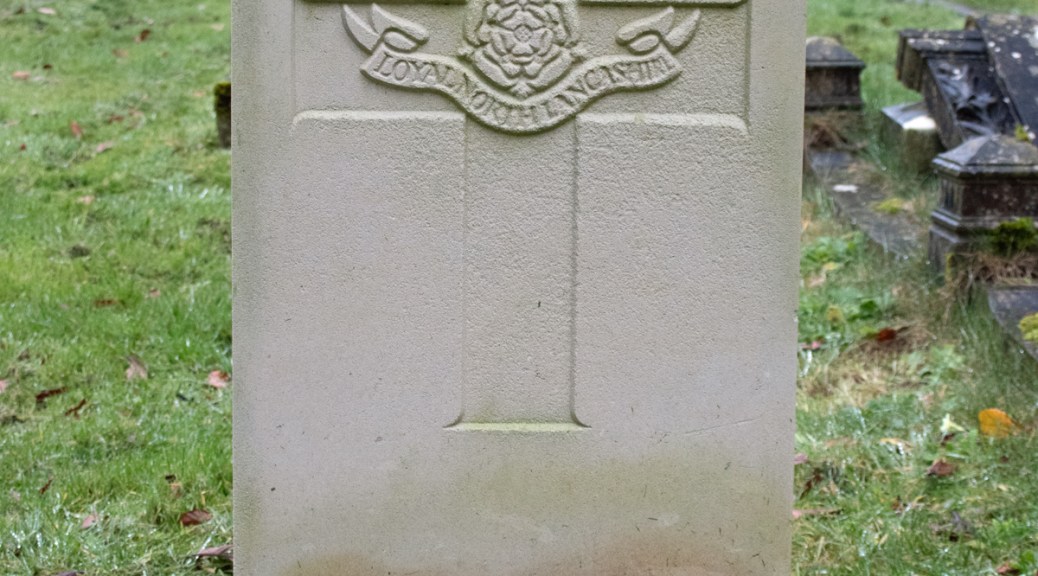
Private William Pinney

Private William Pinney

The details of William Pinney’s life seem destined to remain a mystery. His headstone – in Crewkerne Cemetery, Somerset – confirms that he was a Private in the Loyal North Lancashire Regiment, and that he died on 14th August 1919.

The British Army Register of Soldiers’ Effects expands a little on this, identifying that he was in the 2nd Battalion of the regiment. The document states that he died of wounds and had been admitted to the War Hospital in Southampton, Hampshire (this is likely to have been the Royal Victoria Hospital in Netley). It also confirms that his effects were to be passed to his widow, Sarah Pinney.

From this point on, some elements of supposition come in to the research.

There is a marriage certificate for a William Pinney and Sarah Jane Witheyman at the parish church in Crewkerne on 6th January 1911. This record gives William’s age as 23, and shows that he was a weaver and the son of weaver William Pinney Sr. Sarah, meanwhile, was five years older than her new husband, worked as a factory hand, and was the daughter of another factory hand, George Witheyman.

The same year’s census gives more information about William Pinney. He was one of eleven children to William and Mercy Pinney, and every member of the family over school age was involved in weaving and spinning. It should be noted, however, that the census was taken on 2nd April 1911, three months after William’s marriage and, while the ages on the document match, the document states that he is single.

The same census for Sarah tells a similar story. She is noted as being one of twelve children to George and Amelia Witheyman. George is noted as being a ‘hand ackler’, or handyman, while Sarah and the two of her teenage brothers still at home are all working as mill hands. The same anomaly arises as William, however, as she is also noted as being single.

Returning to the marriage certificate, an answer to the anomaly in the dates seems to resolve itself, however. The marriages are noted in chronological order, and the previous wedding to be solemnised in Crewkerne Parish Church was on 26th December 1911, while the following one was on 14th February 1912. It would appear, therefore, that Leonard Jackson, the curate of the church, entered the incorrect date on the certificate.

The census records and marriage certificate all seem to fit the William and Sarah Pinney who were separated by William’s death in 1919. There are certainly no documents suggesting another William Pinney in the Crewkerne area around that time period. It is reasonable to assume, therefore, that they do all connect to the gravestone in the town’s cemetery.

Private Pinney’s military records are missing, or no longer available, so it is not possible to trace his actions during the First World War. The 2nd Battalion of the Loyal North Lancashire Regiment served in India during the first half of the conflict, moving to Egypt in 1917 and to France the following year. It is not possible to confirm where William served, but wherever he fought, he was wounded, and these injuries were to prove fatal. He passed away in the Southampton hospital on 14th August 1919, nine months after the end of the war, aged around 31 years old.

Private William Harris

Private William Harris

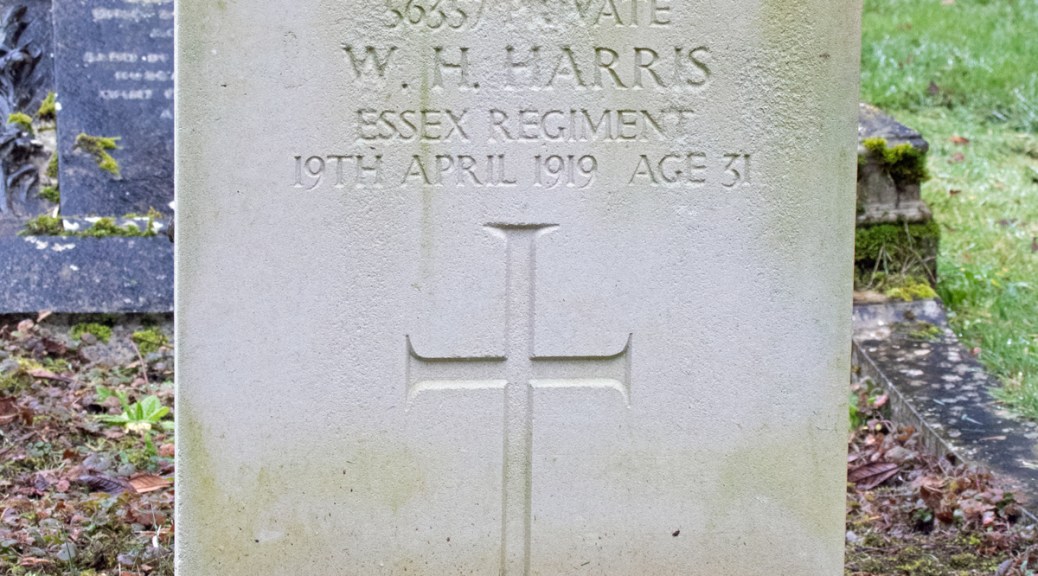
The life of William Henry Harris is destined to remain shrouded in the mists of time. His headstone, in the Townsend Cemetery in Crewkerne, confirms he was a Private in the Essex Regiment, and that he died on 19th April 1911, at the age of 31 years old.

The Army Register of Soldiers’ Effects confirms that he was attached to to the 1st/5th Battalion and that he died of sickness in Rugeley Camp, Staffordshire. His widow, who is noted as Ada Harris, received a war gratuity, which suggests that he had enlisted prior to October 1918.

Private Harris’ Pension Ledger shows that Ada was living in Hermitage Street, Crewkerne, and that the couple did not have any children.

While William’s name is too common to try and identify family links through census records, his marriage index provides Ada’s maiden name, Furzer, which is easier to track.

Ada Furzer was born in Crewkerne on 22nd November 1887, the second of eight children to James and Ellen Furzer. James was a haulier, while Ada and her older sister Mabel, found work as machinists in a local shirt factory when they left school.

Ada did not remarry when William passed away: she died in Yeovil in the autumn of 1971, at the age of 83.


Private Reginald Bainton

Private Reginald Bainton

Reginald Thomas Bainton was born in Bath, Somerset, in the spring of 1889. The second of five children, his parents were bakers and confectioners Thomas and Mary Bainton.

While Reginald’s older brother Robert followed in his father’s trade, the 1911 census recorded that he had followed a different route, and was working as a hairdresser and tobacconist.

On Christmas Day 1913, Reginald married Henrietta Skinner, who was the daughter of a farmer. The couple went on to have a son, Reginald, who was born in July 1916.

War was, by this point, raging across Europe, and Reginald stepped up to play his part for King and Country. He enlisted in the autumn of 1916, and was assigned to the Royal Army Service Corps. Initially stationed in London, he moved to a camp near Reading, Berkshire, in March 1917.

One evening towards the end of that month, tragedy occurred.

[Private Bainton] was missing from his company, and when his service cap was found on the banks of the Thames there were fears that the worst had befallen him. On receipt of the news of his disappearance his wife proceeded to Reading in the hope of getting some information respecting him, and she remained there until the discovery of the body in the Thames on Monday. During the short period he was in the Reading camp, Private Bainton acted as the storekeeper.

At the inquest… the much-decomposed body was identified by [Reginald’s] father, and medical evidence was given that it had probably been in the water for three weeks to it is highly probable that Private Bainton was drowned on the first day he was mussed. There was not the slightest evidence as to how he got into the river, and the jury returned a verdict of “Found drowned”.

Bath Chronicle and Weekly Gazette: Saturday 28th April 1917

The date of Private Bainton’s death was recorded as 23rd April 1917 – the day he was found. He was 27 years of age.

Reginald Thomas Bainton’s body was brought back to Somerset for burial. He was laid to rest in St James’ Cemetery in his home city of Bath.


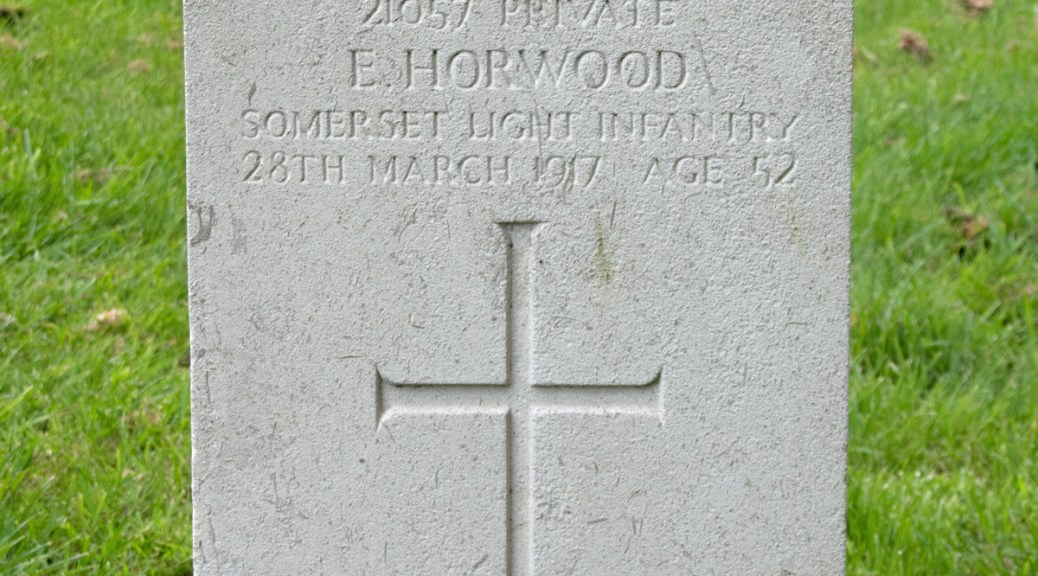
Private Edward Horwood

Private Edward Horwood

Albert Edward Horwood was born in Bath, Somerset, in the spring of 1864. The middle of five children, his parents were Joseph and Agnes Horwood. Joseph was a stone mason and, when Agnes passed away in 1872 he married again, this time to a woman called Elizabeth.

When he left school Albert – who became better known as Edward – found work in a local foundry. Joseph died in 1888, and just two years later, Edward married Emily Wheeler. She was the daughter of labourer from North Bradley, Wiltshire, and it was in the parish church that the couple exchanged vows.

The couple set up home in the Lyncombe area of Bath, and went on to have nine children, all but one of them girls. Edward continued with labouring work for the next twenty years, as his children grew in the family home in Cheltenham Street.

Despite his age, when was broke out in Europe, Edward stepped up to play his part. He enlisted in the Somerset Light Infantry on 6th November 1914, and was assigned to the 4th Battalion. His service records show that he was 44 year of age and 5ft 11ins (1.8m) tall.

Attached to one of the regiment’s supply companies, Private Horwood remained on the Home Front. He remained on active duty for more than eighteen months until, in June 1916, he was medically discharged because of a large ulcer and epithelioma (lesion) on his tongue. Edward’s medical notes suggest that he was offered an operation to remove the potentially malignant growth, but that he had declined.

At this point Edward’s trail goes cold. He returned home, and passed away on 28th March 1917 and, while the cause is not publicly documented, it seems likely to have been related to the growth in his mouth. He was 52 years of age.

Albert Edward Horwood was laid to rest in the St James Cemetery in his home town of Bath.


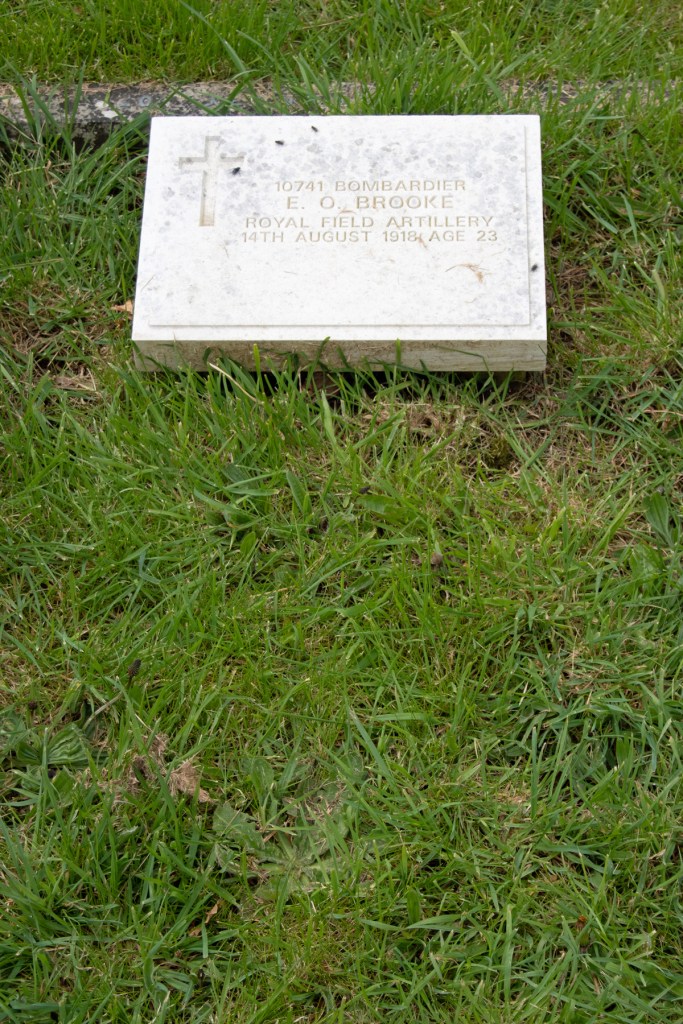
Bombardier Ernest Brooke

Bombardier Ernest Brooke

Ernest Oliver Brooke was born in 1895 in Bath, Somerset. The oldest of four children, his parents were tailor Oliver Brooke and his wife, Kate. Ernest did not follow in his father’s footsteps, however, and, by the time of the 1911 census, when the family were living in a Georgian town house in the Lyncombe area of the city, he was noted as being employed as an engine fitter.

Storm clouds were brewing over Europe by this point and, when war was declared, Ernest was one of the first to step up to play his part. He enlisted in 1st September 1914, and was assigned to the Royal Field Artillery.

Gunner Brooke’s service records show that he was 5ft 10ins (1.78m) tall and weighed 138lbs (62.6kg). He had brown hair, grey eyes and a fresh complexion.

Ernest spent ten months on the Home Front, learning and honing his skills. In July 1915 he was sent to the Mediterranean, and found himself in Gallipoli. After nearly a year in Eastern Europe, he was sent to serve on the Western Front in France.

His service records show that the now Bombardier Brooke was wounded on 10th November 1916. Little additional information about this is available, and he was certainly fit enough not to be sent back to Britain for treatment or recuperation.

Things had changed for Ernest, however, and by December 1916, he was transferred back to the UK, to serve on the Home Front once more. While serving in Gallipoli, he had contracted tuberculosis. Over the ensuing months, he had gradually lost weight and developed a distressing cough, which occasionally resulted in haemoptysis, or coughing up blood.

By the summer of 1918, Bombardier Brooke was admitted to a sanitorium. His health led to him being medically discharged from the army on 20th June, and his condition slowly deteriorating. On 14th August 1918 he finally succumbed, aged just 23 years old.

Ernest Oliver Brooke was laid to rest in the family plot in St James’ Cemetery, Bath.


Petty Officer Stoker William Dyer

Petty Officer Stoker William Dyer

William Henry Dyer was born on 26th March 1895, in Bath, Somerset. He was the only child of William and Elizabeth Dyer. Elizabeth had had a son prior to her marriage to William Sr, and so William Jr had a half-brother, Sidney.

Elizabeth tragically passed away in December when her youngest was only a toddler. William Sr went on to marry again, to a Sarah Chivers. The couple went on to have a family of their own, giving William Jr and Sidney a further five half-siblings.

William Sr was a carman and, when his son left school, he also found carting work, the 1911 census recording him as being a milk carrier. He wanted bigger and better things, however, and, on 8th April 1913, a fortnight after his eighteenth birthday, he joined the Royal Navy.

William’s service records show that he was working as a van guard on the railway at the time of his enlistment. He was 5ft 7ins (1.7m) tall, with light hair, grey eyes and a fresh complexion. He joined as a Stoker 2nd Class, and was initially assigned to HMS Vivid, the Royal Naval Dockyard in Devonport.

After six months’ training, William was assigned to the dreadnought battleship HMS Ajax. She became his home for the next four years, patrolling the North Sea during the conflict and, in June 1916, was involved in the Battle of Jutland. During his time on board, William rose through the ranks, becoming Stoker 1st Class in August 1914, Leading Stoker in August 1916 and Petty Officer Stoker in October 1917.

In January 1918, William returned to HMS Vivid for a few weeks He was then given a new posting, on board HMS Sandhurst, based at Scapa Flow in the Orkneys. Petty Officer Stoker Dyer was to spend the next ten months here, albeit with a short break that autumn.

It was during this period of leave that William married Lily Sarah Bethia Durbin. She was the daughter of a miner, and the couple married in Clutton, Somerset. Their time together was to be brief, however, as William soon returned to Scotland.

It was while Petty Officer Stoker Dyer was back at HMS Sandhurst that he developed pneumonia. Sadly, the condition was to get the better of him. He passed away on board on 27th November 1918, at the age of just 23 years old.

William Henry Dyer’s body was brought back to Somerset for burial. He was laid to rest in St James’ Cemetery in Bath.


Lily had been a wife for just a matter of weeks, and was now left a widow. In 1926 she remarried, to baker and confectioner Albert Farmer. The couple lived a long and happy life, celebrating their 59th wedding anniversary before Albert died in 1985. Lily lived on, passing away in January 1997, at the ripe of age of 98 years old.


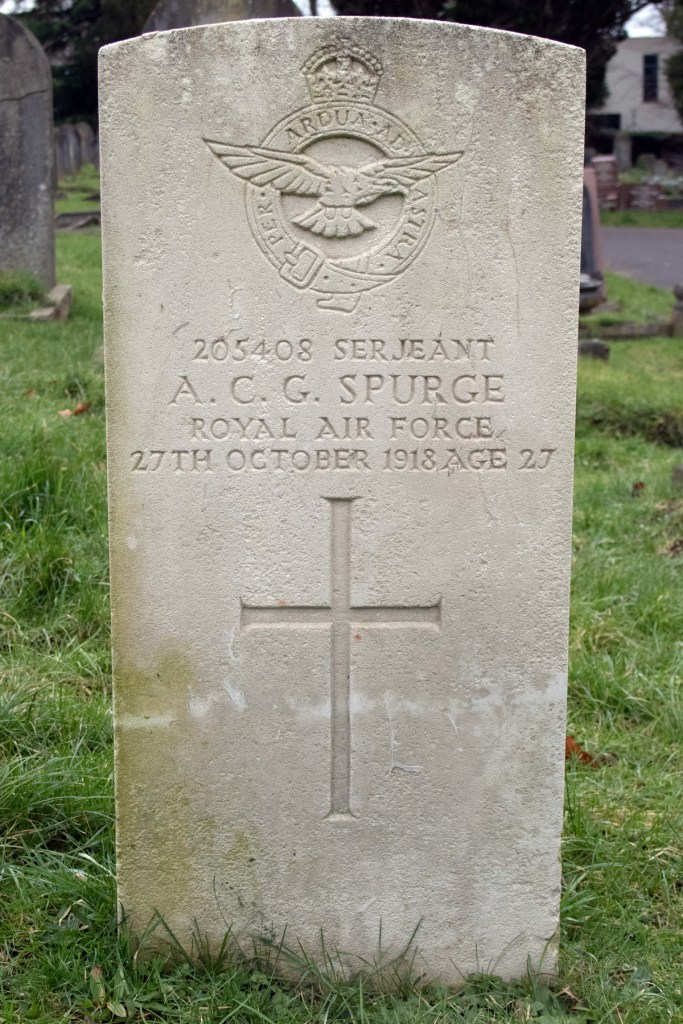
Serjeant Algernon Spurge

Serjeant Algernon Spurge

Algernon Carlyle Graham Spurge was born on 27th August 1891 in Bath, Somerset. The middle of five children, his parents were Algernon and Ida Spurge.

Algernon Sr was a portrait photographer, based in the Twerton area of the city, and this was very much a family business. The 1901 census recorded the Spurges as living in Victoria Road, Bath, with Ida’s brother, Tom Leaman, who was working as a photographic reloader.

Later that year, however, things were to take a turn for the worst. Algernon Sr seems to have been having some business worries and, on the morning of 16th December, he set off for work as usual. His and Ida’s daughter, also called Ida, arrived at the studio to find her father in some distress, a bottle of potassium cyanide – used as part of the photographic process at the time – next to him. He asked Ida to fetch him some water and salt, but when she returned, he declared it was too late, and lost consciousness. A doctor was called, but Algernon passed away shortly after he arrived.

A note was found, which read “My dearest wife, I really cannot stand the worry and anxiety of another day, to say nothing of weeks and perhaps months. Ask Mr Ashman and Mr Withy to be kind enough to help you straighten out matters a little. My best love to you and all my dear ones. AS” [Somerset Guardian and Radstock Observer – Saturday 21 December 1901] Ashman and Withy were family friends, who were also in the photography business.

An inquest was held and a verdict of suicide while temporarily insane was recorded.

The family rallied round, and Algernon’s widow and children moved in with Ida’s widowed mother in Bristol. Algernon’s daughter Ida continued working in photography, and Algernon Jr also took up the business. The 1911 census found him boarding with, and working for, his uncle Tom in Bath.

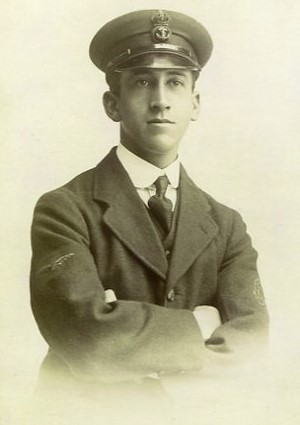
War was closing in on Europe by this point and, when it was declared, Algernon stepped up to play his part. He enlisted in the Royal Naval Air Service on 4th June 1915 as a Leading Mechanic (Photography). His service records show that he was 5ft 5ins (1.66m) tall, with dark brown hair, brown eyes and a dark complexion.

Algernon was initially assigned to the shore establishment HMS President in London for three years, rising to the rank of Petty Officer Mechanic (Photography). In April 1918, when the Royal Air Force was created he transferred across to HMS Daedalus in Lee-on-Solent, Hampshire, and rising to the rank of Sergeant Mechanic.

That autumn, with the end of the war in sight, Algernon fell ill. He contracted influenza, and this developed into pneumonia. He was admitted to the Military Hospital in York, but the conditions were to prove too much for his body to take. He died on 27th October 1918, aged just 27 years old.

The body of Algernon Carlyle Graham Spurge was brought back to Somerset for burial. He was laid to rest in St James Cemetery, Bath, not far from his father. When Ida passed away in 1926, she was buried in the same cemetery, father, mother and son reunited once more


Serjeant Algernon Spurge
(from ancestry.co.uk)

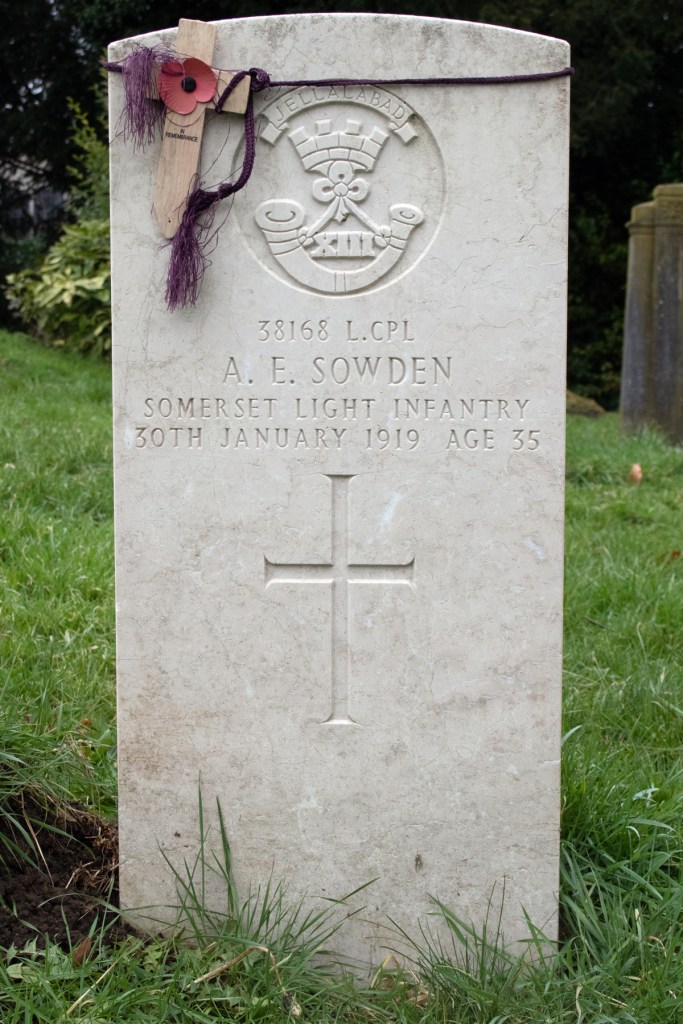
Lance Corporal Alfred Sowden

Lance Corporal Alfred Sowden

Alfred Edward Sowden was born in the autumn of 1883, in Bath, Somerset. He was the youngest of seven children to Robert and Mary Sowden. Robert had died by the time of the 1891 census, and Mary turned to charring to bring in money for the family.

In the summer of 1904, Alfred married Harriet Sumsion, a baker’s daughter also from Bath. The couple set up home in a small cottage on the main road to Bristol, and had a son, William, who was born the following year. Alfred was working as a house painter by this point, and the young family had a lodger, William Gabb, who was a local chef.

When war came to Britain’s shores, Alfred stepped up to play his part. He may have had some previous military experience, because he joined the Somerset Light Infantry as a Lance Corporal. Assigned to the 2nd/4th Battalion, by August 1915, he was on his way to India. His troop remained there for two years, before moving to Egypt in the autumn of 1917, then on to France the following June.

With the end of the conflict, the Empire’s forces were slowly demobbed. While he was waiting to be stood down, Lance Corporal Sowden fell ill. He developed influenza and septic pneumonia, and the combination was to prove fatal. He passed away on 30th January 1919, at the age of 35 years old.

Alfred Edward Sowden’s body was brought back to Bath for burial, where he was laid to rest in the city’s St James’ Cemetery.


Alfred’s widow had had a tragic few years. Her father, Walter, had passed away in February 1916, and her mother died just three months after Alfred.

Harriet never remarried after her husband’s passing. She remained in the family home for the rest of her life and, by the time of the 1939 Register, had a boarder, billiard marker James Jones. She was close to family, however, as her brother William lived just three doors away.

Harriet died in September 1941 at the age of just 56. She was laid to rest near her husband, reunited after 22 years.


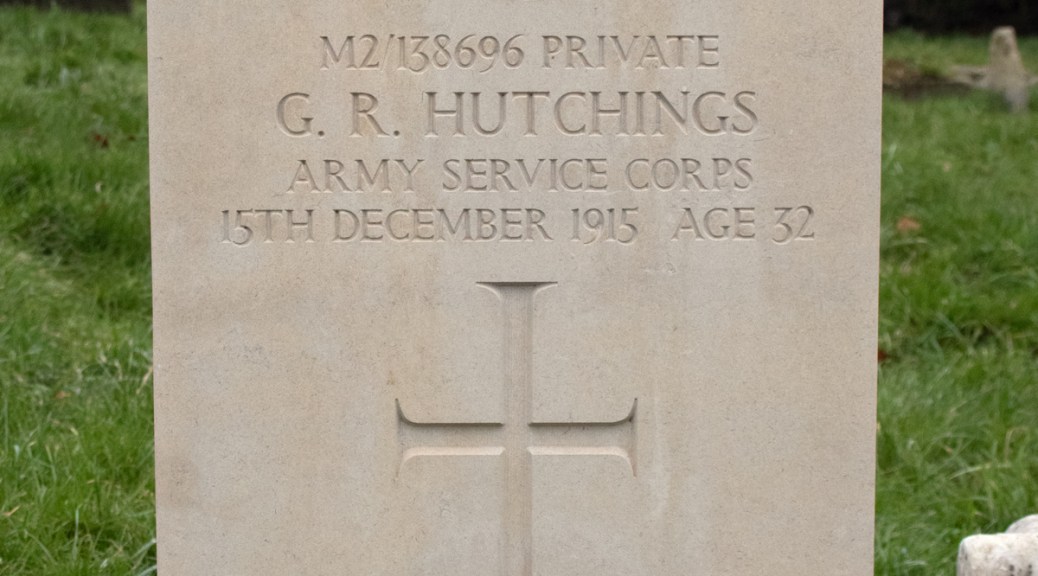
Private George Hutchings

Private George Hutchings

George Robert Hutchings was born towards the end of 1883 in Forest Gate, Essex. He was the oldest of four children to George and Mary Ann Hutchings. George Sr was a labourer for the railways, and this led to the family relocating to Swindon, Wiltshire, in the 1890s.

George Jr took up work with the Great Western Railway when he left school, while his father switched employment and, by the time of the 1911 census, he was working as a collector for a clothing supply company.

On 13th July 1911, George Jr married Daisy Smale in the Sanford Street Congregational Church, Swindon. Daisy was a school teacher, and was the daughter of an iron moulder. It is likely that the couple met through George’s workplace. The newlyweds had a son, Raymond, who was born in 1914 and, at some point moved to Bath in Somerset.

When war came to Europe, George stepped up to play his part. He enlisted in the Royal Army Service Corps and, unsurprisingly, given the work he was doing, was assigned to the Mechanical Transport division. Little information about his military service remains, but is it clear that he had enlisted in the second half of 1915.

The next available record for Private Hutchings is that of his passing. He had been admitted to the Royal Herbert Hospital in Woolwich, South East London, and died there on 15th December 1915. No cause for his death is evident, but he was 32 years of age.

George Robert Hutchings was brought back to Somerset for burial. He was laid to rest in Bath’s St James Cemetery.


When her husband died, Daisy was pregnant. In March 1916 she gave birth to a daughter, Winifred, who was never to know her father.

Daisy never remarried. By the time of the 1939 register, she was living in Northampton Street, Bath, sharing the house with a Mr and Mrs Spreadbury. Her employment was listed as unpaid domestic duties.

Daisy and George’s son Raymond was focused on his education. He made an eventual move to Birmingham, where, at the outbreak of war, he was working as a research chemist. He died in Bath in 1982, at the age of 68.

Winifred married grocer Kenneth Batten in Bath in 1938. The couple had three children and emigrated to Australia after the war, and settled in Coffs Harbour, New South Wales. Kenneth died in 1988, at the age of 72; Winifred died in 2003, aged 87.


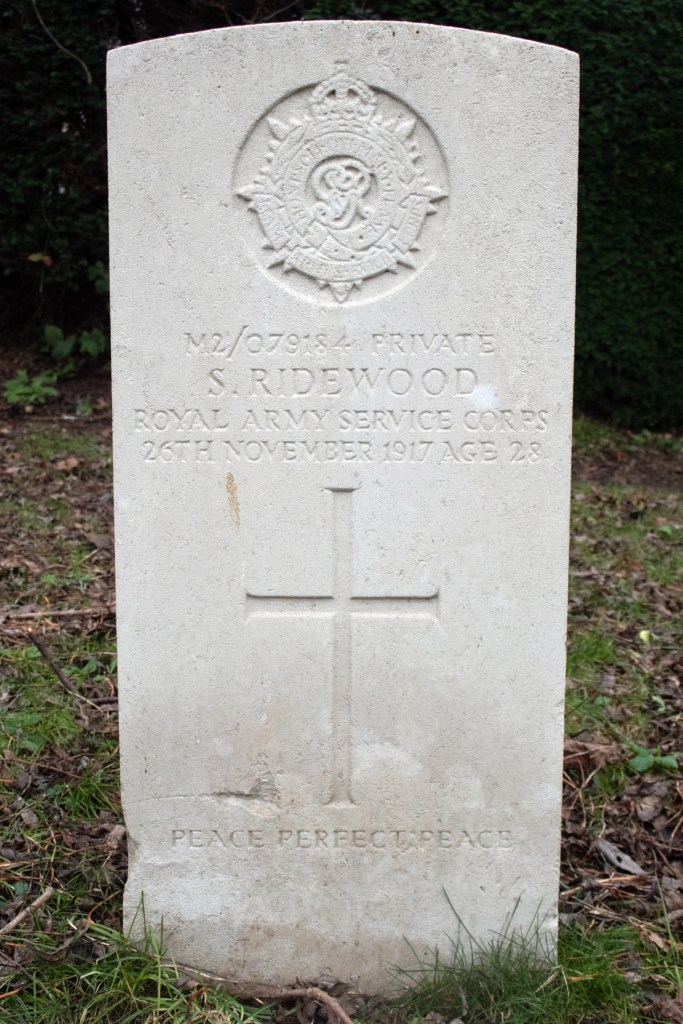
Private Sydney Ridewood

Private Sydney Ridewood

Sydney Ridewood was born in Bath, Somerset, on 31st March 1891, and was one of eleven children. His parents were labourer and sometime butcher James Ridewood and his wife Mary.

When Sydney left school, he found work as a baker, although this seems to have been as piecemeal a job as his father’s.

In January 1910, Sydney married Kathleen Scudamore. She was the daughter of a carpenter from the Twerton area of Bath and had a bit of a chequered background herself.

On 10th June 1896, Kathleen had married Edward Edwards, who was twelve years older than her seventeen years. Their marriage certificate suggested he was a clerk, although the 1901 census – which included their two children, Charles and Percy – recorded him as being a draper’s porter. Beyond that document, there is no record of Kathleen’s husband and, by the time of her marriage to Sydney, she had reverted to her maiden name.

By the time of the 1911 census Sydney and Kathleen were living in central Bath, with their nine-month old daughter, Olive, and Kathleen’s two sons. Kathleen’s widowed father, Edmund, her brother Claude and sister-in-law Nora were also in the household.

The document recorded Sydney as still employed as a journeyman baker, while his wife was a cook for the Post Office. Edmund was working as a carpenter, Claude was a sawyer, Nora a shop assistant and 14-year old Charles was a messenger boy, also for the Post Office. Six pay cheques coming in to support the extended family in the four-roomed house.

An additional member of the Ridewood family came along on 22nd October 1913, when Kathleen gave birth to a second child, Sydney Jr.

War was on the horizon by this point, and, on 20th April 1915, Sydney stepped up to play his part. He enlisted in the Royal Service Corps, and was assigned to the Mechanical Transport Corps. There is little detail about Private Ridewood’s service, although his records show that he was 5ft 3ins (1.6m) tall, with auburn hair, brown eyes and a fresh complexion.

Sydney was sent to France a month after enlisting, and his may role seems to have been that of a driver. He remained on the Western Front for a little over two years, before contracting pleurisy. He was initially treated in France, but soon returned to Britain to recuperate. The lung condition, however, was to get the better of him, and he passed away at home on 26th November 1917, weeks before he was to be medically discharged from service. He was just 28 years of age.

Sydney Ridewood was laid to rest in St James’ Cemetery, a few minutes’ walk from his family home.