Category Archives: Private

Private Albert Chapple

Private Albert Chapple

Albert Chapple was born early in 1895, and was the son of Elizabeth Chapple. She was just 16 years of age when he was born, and her parents, John and Sarah, unofficially adopted him as their own. John was a church sexton from the village of Knowstone, Devon, and this is where the Chapple family were raised.

Elizabeth married William Dart, a fishmonger from Dawlish, in 1909, and by the time of the census two years later, they had set up home in Beach Street, close to the town’s railway station.

Albert, meanwhile, was still living with his grandparents back in Knowstone. John, now 66 years of age, was employed as an agricultural labourer, while his grandson was working as a cattle boy on the same farm.

When war broke out, Albert was called upon to play his part. Sadly, full details of his military service have been lost, but it is clear that he had enlisted by June 1916. He enlisted in the Royal Army Medical Corps as a Private, with his entry in the British Army of Soldiers’ Effects suggesting that his unit was attached to the 2nd/1st Wessex Field Artillery.

Private Chapple’s pension record confirms that he had been admitted to the 2nd Western General Hospital in Exeter, Devon. He passed away on 10th December 1916, following an operation, although the document gives no clue as to why he had needed surgery. He was just 21 years of age.

Albert Chapple’s body was taken back to Knowstone for burial. He was laid to rest in the graveyard of St Peter’s Hospital in the village.


The next census return, taken in 1921, found Elizabeth and William still plying their trade in fish in Dawlish. By this point, they had had a son, Edmund, who was five years old. Elizabeth’s sister, Rosie, was living with them, and assisting in the business.

Private Gilbert Nott

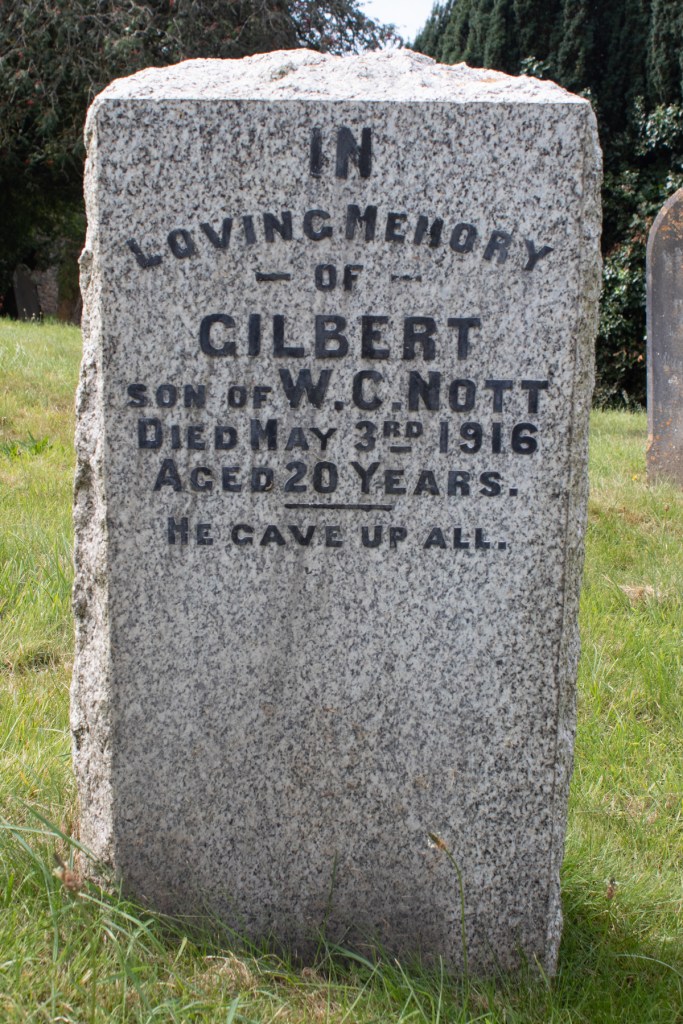
Private Gilbert Nott

Gilbert Charles Nott was born in the autumn of 1895, and was the older of two children to William and Eleanor. William was a plumber and ironmonger from Bampton in Devon, and this is where the family were born and raised.

For the whole of Gilbert’s life, the Notts lived on Brook Street in the centre of the town. The 1901 census found the family at numbers 9 and 10, while the 1911 record confirmed they had moved up the road to number 7 Brook Street. At this point, however, Gilbert was recorded as living with his widowed maternal grandmother, Eleanor Besley. At 15 years of age, he was working, and was employed as a bookkeeper at the Bampton Lime & Stone Company.

When war broke out across Europe, Gilbert was called upon to play his part. He enlisted after December 1915, and was assigned to the 3rd/4th Battalion of the Devonshire Regiment. Sent to Hursley Park near Winchester, Hampshire, for training, his time in the army was to be brief.

In the spring of 1916, he was admitted to the Victoria Hospital in Winchester, passing away there on 3rd May. The cause of his death is not readily confirmed, but his sparse service records suggest that he died from ‘disease’. He was just 20 years of age.

At the family’s request, the body of Gilbert Charles Nott was taken back to Devon for burial. He was laid to rest in the graveyard of St Michael’s Church in Bampton, the church in which he had been baptised just two decades before.


Private William Thomas

Private William Thomas

William James Thomas was born in Manordeifi, Pembrokeshire, in 1894. The older to two children his parents were Benjamin and Ellen Thomas. Benjamin was a groom, and, at the time of the 1891 census, the family were living at Cilwendeg Lodge at the entrance to the Welsh estate.

The family moved to Aberporth on the Cardigan coast by the 1901 census. Benjamin had become a farmer, and William, now 17 years of age, was helping out.

Something changed dramatically for William, however, and by 1914, he was living in the West Sussex village of Ferring, some 200 miles (320km) from his birthplace. By this point he was working as a motor driver and, on 25h March, he married Winifred May Knight at St Mary’s Church in Goring-by-Sea.

William stepped up to serve his country when war broke out, enlisting on 18th February 1915. His service records show that he was 5ft 4ins (1.63m) tall, and weighed 138lbs (62.6kg). He was noted as having a mole on his right cheek, and that several teeth were missing. The document confirms his marriage to Winifred, but also gives details of a child, Evelyne Winifred, who had been born in 1905: there is nothing to confirm whether she was his, or was born to Winifred before the couple met.

Private Thomas was assigned to the Army Service Corps Mechanical Transport Division, and sent to nearby Worthing for his training. His time in the army was to be tragically brief, as within a fortnight he had been admitted to the town’s Red Cross Hospital, suffering from cerebrospinal fever.

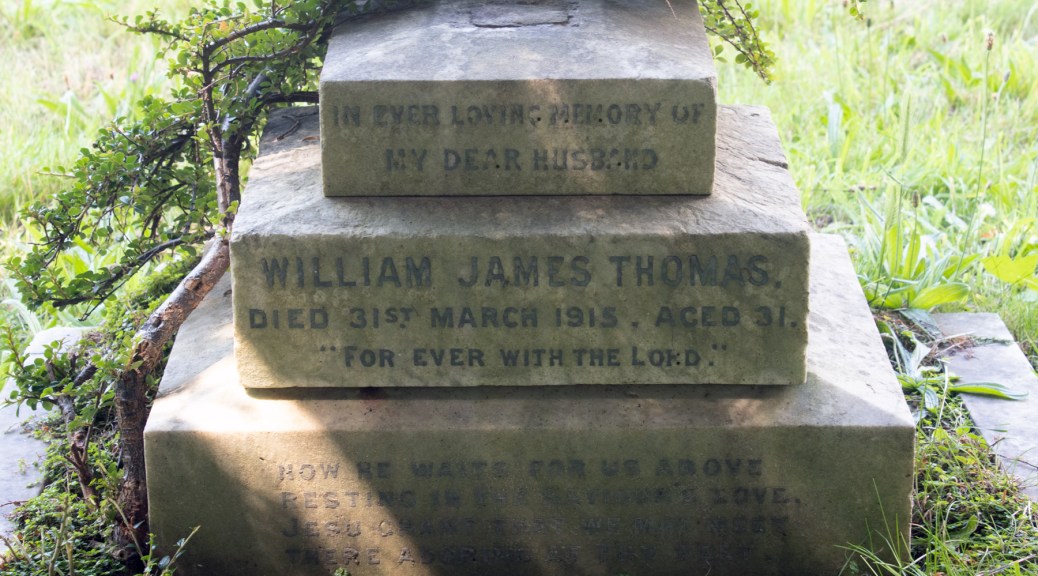
On 23rd March, William was transferred to Worthing Civil Infections Hospital, but any treatment he was receiving was to prove ineffective. He passed away on 31st March 1915, at the age of 31 years old.

The body of William James Thomas was laid to rest in the graveyard of St Mary’s Church, Goring, where just over a year before he and Winifred had been married.


Private Ernest Pointing

Private Ernest Pointing

Ernest Arthur Pointing was born on 21st March 1896 in Goring-by-Sea, Sussex. The second-to-last of thirteen children, his parents were William and Kate. William was a baker from Brighton, but by the time of the 1901 census, the family were living at The Cottage, next to Goring Hall.

When Ernest left school, he found work as a stable boy. The next census, taken in 1911, found him and his parents – William now having retired – living at 1 Elm Tree Cottages in the centre of Goring itself. The three of them shared the house with Ernest’s older sister, Louisa, and his nephew, seven-year-old Herbert.

Alongside his paid work, Ernest also volunteered for the Royal Sussex Regiment and, within a week of turning eighteen, he stepped up to enlist with them. His medical report, undertaken on 18th March 1914, show that he was 5ft 4.5ins (1.64m) tall, and weighed 112lbs (50.8kg). He had dark brown hair, brown eyes and a fresh complexion. He as noted as having two scars on his left thumb, and two more on his right knee.

Assigned to the 2nd Battalion of the Royal Sussex Regiment, Private Pointing would spend the next nine months training on home soil. By the middle of January 1915, however, he was sent to France. Intriguingly, he was to spend only two months overseas, before returning to home soil. There is no evidence of him being injured, but it would not be until September 1915 that he returned to the fray.

In January 1916, Private Pointing transferred to the Machine Gun Corps. He remained overseas until March 1916, at which point his health seemed to have become affected. Ernest returned to Britain, and was ultimately discharged from military on 28th March 1917. He was suffering from pulmonary tuberculosis, the condition that would ultimately take his life less than six months later.

Ernest Arthur Pointing died on 5th October 1917. He was just 21 years of age. He was back in Sussex by this point, and he was laid to rest in the family plot in the graveyard of St Mary’s Church in Goring. He was buried alongside his father, William, who had died two years earlier.


Private Francis Holland

Private Francis Holland

Francis Arthur Holland was born in Maryborough, Victoria, Australia, the fifth of seven children to Matthew and Elizabeth. Details of his early life are lost to time, although a later document confirms his date of birth as 19th July 1887.

Matthew died in 1901, and the New South Wales Police Gazette of 16th February 1910 included a request seeking a missing person:

Francis Arthur Holland, 22 years of age, 6feet high, about 13 stone weight, dark complexion; a sleeper-getter or labourer. Inquiry at the instance of his brother, James Holland, Bradshaw’s College, 250 Flinders-street, Melbourne, Victoria.

The 2nd March edition of the same publication noted that Francis had been found.

By 1916, Francis had moved to New Zealand, and was working as a bushman at the Grosvenor Hotel, New Plymouth. It was while here that he was called upon to serve in the war, and he enlisted on 29th June 1916 in Trentham, North Island. His service records confirm his height, and give his weight as 174lbs (78.9kg). It also noted that he had brown hair, hazel eyes and a fair complexion. He had a scar across the based of his right foot, and another on the left side of his throat.

Private Holland was assigned to the New Zealand Auckland Regiment, and his unit spend the next few months training. On 22nd September 1916, Francis was promoted to the rank of Lance Corporal, but reverted to his previous rank just a matter of weeks later. On 11th October, his unit boarded a ship and set sail for Europe.

Francis arrived in Plymouth, Devon, on 29th December, and set off for France just over a month later. His unit would serve on the Western Front, and, within a matter of months, Private Holland was admitted to field ambulance hospitals twice, for an undisclosed illness in May 1917, and a sprained ankle in June.

This second injury led to a transfer to Britain, and from here on in Francis’ health become more and more impacted. Admitted to hospital in London, he developed tonsillitis and, as he was recovering from this, he was moved again, this time to the ANZAC military camp near Codford, Wiltshire.

While in the camp hospital, it was determined that Private Holland was suffering from a heart infection, endocarditis. Sadly, his health had been tested to the limits by this point, and this was the condition to which he would succumb. Francis passed away on 6th September 1917, at the age of 30 years old.

Having been born in Australia, emigrated to New Zealand and fought on the Western Front, Francis Arthur Holland was now thousands of miles from wherever he might call home. He was laid to rest in the extension to St Mary’s Churchyard in Codford, not far from the camp in which he had spent his last days.


Private Francis Holland
(from findagrave.com)

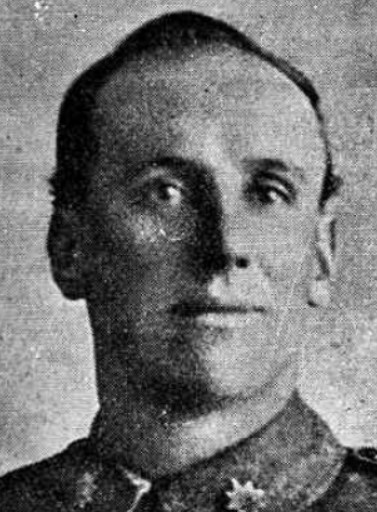
Driver William Protheroe

Driver William Protheroe

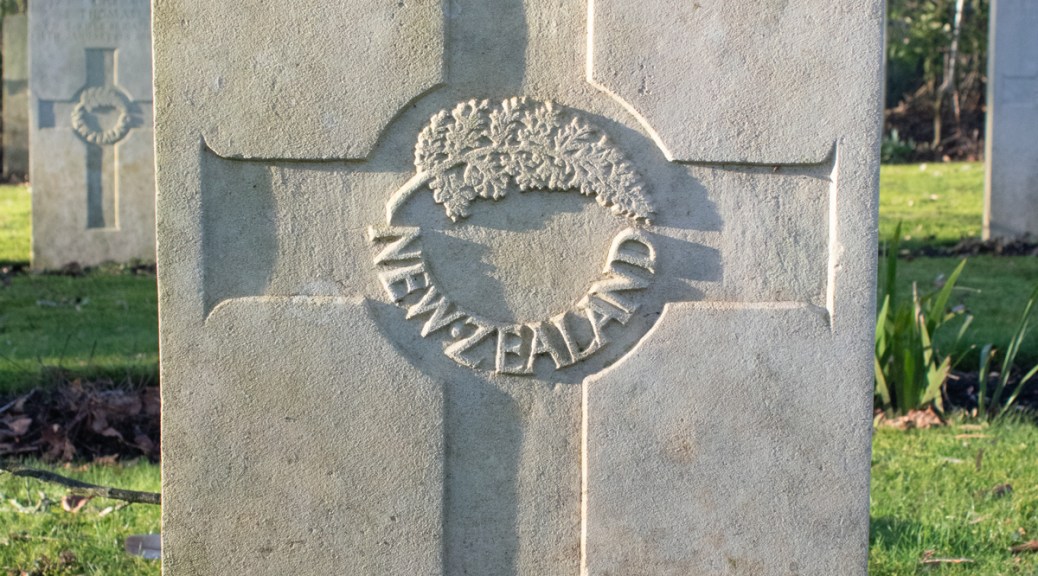
William Protheroe was born in Rangiora, New Zealand, on 3rd January 1878. One of eleven children, his parents were Welsh-born Alexander Protheroe and his English wife, Mary.

There is little concrete information about William’s early life, but later documentation gives his trade as ‘traveller’, and confirms his marriage to Elizabeth Marshall in 1906, although she had passed away by the summer of 1915.

When the Empire was called upon to support Britain in the First World War, William stepped up to play his part. He enlisted on 14th June 1915, and was initially assigned to the Canterbury Infantry Regiment. His service records confirm that at 36 years of age, he was 5ft 9.5ins (1.77m) tall, and weighed 156lbs (70.8kg). William had brown hair, grey eyes and a fair complexion.

After his initial training, William was sent to Europe. On 18th November 1915, he arrived in Suez, and it was here that he transferred to the New Zealand Army Service Corps as a Driver. By the following spring he was on the move again, and he arrived in France in May 1916.

Driver Protheroe was dispatched to a field hospital, as he had contracted influenza, but was well enough to re-join his unit after a few weeks. December 1916 proved eventful for William. He was admitted to hospital in Wimereux, France, the records for the time confirming that he was suffering from rheumatism. Intriguingly, a corresponding entry advises that ‘Soldier was on duty at time of accident and in no way to blame.’

Medically evacuated to Britain, William was admitted to the No. 1 New Zealand General Hospital in Brockenhurst, Hampshire. He spent the month of January 1917 there, before moving to the ANZAC camp near Codford, Wiltshire.

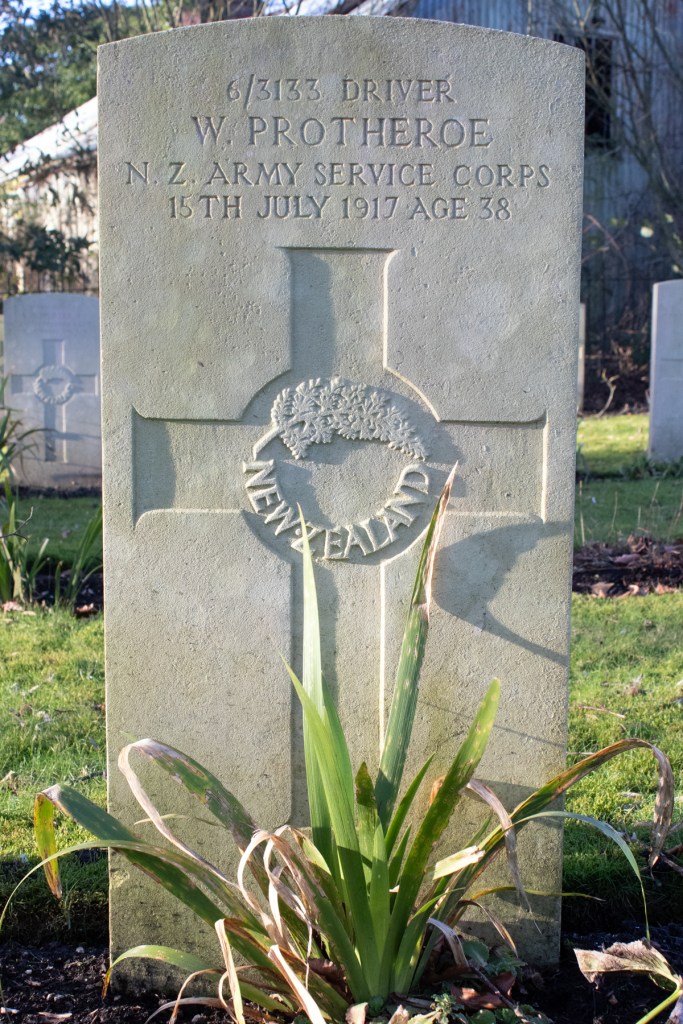
Driver Protheroe would remain in Codford for the next few months. His health was still causing some concern, however, and he was admitted to the camp hospital on 30th June. William was suffering from nephritis, and this was the condition to which he would ultimately succumb. He passed away on 15th July 1917, at the age of 39 years old.

William Protheroe was laid to rest in the graveyard extension of St Mary’s Church, Codford, Wiltshire, alongside fallen colleagues from his regiment.


Private Andrew Wishart

Private Andrew Wishart

Andrew Anderson Wishart was born in Mokoreta, New Zealand, on 9th July 1896. The fourth of eight children, his parents were George and Agnes Wishart.

There is little information available about Andrew’s early life, but when he completed his schooling, he found work in the local sawmills, not an uncommon trade for the rural southern part of the country. In his spare time, he enlisted in the cadets, and had spent a year with them when he stepped up to join the war effort.

Andrew signed up on 19th November 1915, and was assigned to the 1st Battalion of the New Zealand Otago Infantry Regiment. His service records show the mad he had become: he gave his age as 20 years old (he was, in fact, only 19), he was 5ft 10.5ins (1.79m) tall and weighed 166lbs (75.3kg). He was initially trained near Wellington, and seemed to enjoy his freedom, as he spent a month in hospital in Trentham, suffering from gonorrhoea.

Private Wishart’s battalion set out from Wellington on 1st April 1916, arriving in Suez a month later. After three weeks’ pause in Egypt, his unit continued on to France, disembarking in Etaples on 28th May, and heading for the Western Front. Andrew soon found himself in the thick of the action.

The 1st Battalion was heavily involved at the Somme in the summer of 1916, and Private Wishart was not to come out unscathed. He was wounded on 30th September, and evacuated for treatment, first to Rouens, then to Britain. Wounded in the left thigh, he was admitted to the 1st New Zealand Hospital in Brockenhurst, Hampshire, and would end up spending two months there.

In December 1916, Private Wishart moved to the ANZAC camp in Codford, Wiltshire. He remained on site for the next few months, although this time was not without incident, as he was admitted to the camp hospital for with venereal disease once more.

Andrew returned to camp on 10th April 1917, but his health seems to have been impacted. He became jaundiced, and was once again admitted to the camp hospital. Atrophy of the liver was identified, and the condition would prove too severe for his body to recover from. He died on 10th July 1917, the day after his 21st birthday.

Andrew Anderson Wishart was laid to rest in the extension to St Mary’s Churchyard in Codford, Wiltshire, not far from the base he had called his home.


Andrew’s younger brother James had also enlisted in the Otago Regiment when war broke out. As a Private, he was assigned to the 2nd Battalion, his path followed a similar one to that of his older sibling. He was killed in action on the Western Front on 15th November 1916, aged just 18 years old.

Private James Wishart is buried in the Cité Bonjean Military Cemetery in Armentieres.

Private James Wishart
(from findagrave.com)

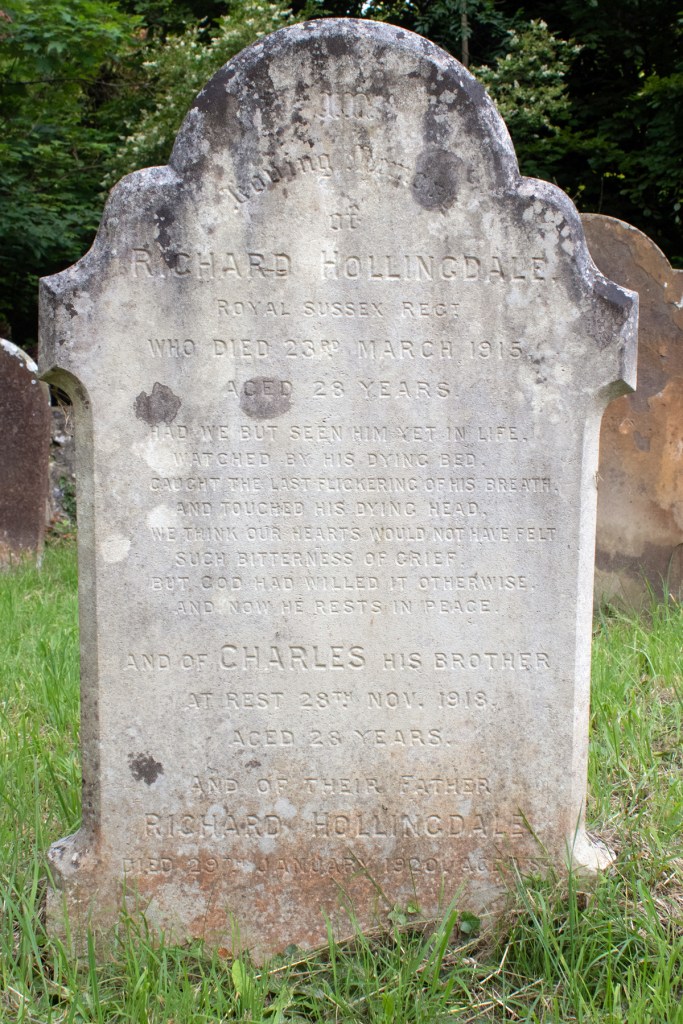
Private Richard Hollingdale

Private Richard Hollingdale

Richard Hollingdale was born at the start of 1887, and was one of nine children to Richard and Elizabeth. Richard Sr was a farm labourer from Lancing, but his namesake son was born in the Sussex village of Washington.

By the time of the 1901 census, the family had moved to Findon, a village to the north of Worthing. Attached to Muntham Farm, they lived in New Barn, a workers’ cottage on the estate. Richard Jr and his brothers all helped out on the farm and, according to the next census return, Richard Sr, now 75 years of age, was a labourer, while the three sons still living at home – William, Richard Jr and Charles – were all waggoners.

When war consumed Europe in the summer of 1914, Richard Jr stepped up to serve his country. Sadly, full details of his service have been lost to time, but it is clear from what remains that he joined up early in the conflict, and certainly no later than October 1914.

Private Hollingdale was attached to the 7th (Service) Battalion of the Royal Sussex Regiment and in the spring of 1915 his unit moved to the Ramillies Barracks in Aldershot, Hampshire. Richard had only been there for a couple of weeks, when he fell ill. He was admitted to the local Isolation Hospital with scarlet fever, and the condition was to prove fatal. He passed away on 23rd March 1915, at the age of 28 years old.

The body of Richard Hollingdale was taken back to Sussex for burial. He was laid to rest in the family plot in St John the Baptist Churchyard, Findon.


Private Wilfred Bridger

Private Wilfred Bridger

Wilfred Percival Bridger was born on 20th January 1885, the middle of three children to William and Emma. William was a groom from Albourne in Sussex, but, after a spell in Newmarket, the family had settled in Findon near Worthing.

William passed away just two years after Wilfred’s birth, and Emma remarried. The 1891 census found her and her new husband, George Lish, living with William and his siblings in a house on Findon Street.

When he completed his schooling, William found work as a shepherd: the next census return, taken in 1901, found the extended family living at 1 Brazil Cottages, next to the Black Horse Inn in Findon Village. George and Emma now had three children of their own, and Emma’s widowed mother, Martha, completed the household.

Shepherding was not a permanent career option for Wilfred and, on 28th April 1902, he enlisted in the army. He gave his occupation as groom, and his medical report confirmed he was 5ft 7ins (1.7m) tall and 120lbs (54.4kg) in weight. He was noted as having brown hair, grey eyes and a fresh complexion.

The Royal Sussex Regiment would definitely provide Private Bridger with the globe-trotting adventures that he may have wished for. After two years on home soil, his unit – the 2nd Battalion – moved to Malta, where he would spend close to twelve months. In May 1905 he moved to Crete, and from there to India in January 1907.

By the start of 1910 Wilfred had returned to Britain, and he was stood down to reserve status when his contract came to an end that April. He returned to Sussex, and the family home. 1 Brazil Cottages was crowded by this point, with Wilfred sharing the five-roomed house with his mother, stepfather, half-brother, niece. There were also two lodgers, widowed farm labourer Alfred Newman and his son, William.

Things were to change for Wilfred, however. In September 1911 he married Florence Herrington, a carter’s daughter from Henfield, Sussex. When the couple wed, she was working as a servant in a boarding house in Ambrose Place, Worthing. The young couple set up home in Nepcote, near Findon, and went on to have four children – William, Albert, Henry and Lilian.

When war broke out, Wilfred was called upon to play his part again. He re-joined the Royal Sussex Regiment on 31st August 1914, but when his medical was carried out the following March, he was found to have tuberculosis, and deemed not fit for service. After further tests, Private Bridger was medically discharged on 28th May 1915.

At this point, Wilfred’s trail goes cold. He returned to Findon and, it seems this is where he passed away on 13th September 1918. He was 33 years of age.

Wilfred Percival Bridger was laid to rest in the quiet surroundings of Findon’s St John the Baptist Churchyard.


Private Wilfred Bridger
(from ancestry.co.uk)

Private Charles Pratt

Private Charles Pratt

Charles Pratt was born in the West Sussex village of Findon in the autumn of 1899. The oldest of five children – all boys – his parents were farm labourer Charles and his wife, Emily.

Charles Jr was still a schoolboy at the time of the 1911 census. The family were living in the five-roomed cottage called Sheepcombe by now: farm labourer Charles Sr, Emily, Charles Jr, his three younger siblings (youngest boy Albert being born in 1915), and Emily’s brother, farm horseman Daniel Hollingdale.

When war was declared, the oldest Pratt boy was still just fourteen years of age, and too young to enlist. As the fighting raged across the continent, it seems likely that he was disappointed to miss out on the adventure. Full details of his army service have been lost to time but records suggest that he joined up no later than April 1918.

Private Pratt was attached to the 9th (Service) Battalion of the East Surrey Regiment. He was certainly sent to France, and may have been caught up in the Battles of the Somme in 1918. He fought at Cambrai, and this is where he would be injured. Charles’ wounds were bad enough for him to be medically evacuated to Britain, and he was admitted to the 4th Northern General Hospital in Lincoln, Lincolnshire, for treatment.

Sadly, the soldier would succumb to his injuries. He passed away on 27th October 1918, at the age of just 19 years old.

Charles Pratt was taken back to Sussex for burial. He was laid to rest in the graveyard of St John the Baptist Church in Findon, walking distance from his family home.


Charles’ was a family plot: he would be reunited with his parents when the passed away: Charles Sr in 1953 and Emily in 1958.