Category Archives: Private

Private Wallace Parsons

Private Wallace Parsons

Wallace Waterman Parsons was born in the autumn of 1893 and was one of thirteen children. His parents were both Somerset-born, David and Mary Parsons, and it was in a small terraced house in Bampton Street, Minehead, that the family were raised.

David was a chimney sweep and by the time of the 1911 census, eight of the then household of nine people were earning a wage. Six of the Parsons children – ranging in age from 15 to 33 – were living with their parents, working variously as a chair caner, a labourer and a French polisher. Wallace, 17 years old by this point, was employed as a stone worker, presumably alongside his older brother, David, who was a mason.

When war came to European shores, at least two of the Parsons brothers enlisted. While full service records no longer exist, it is clear that Wallace joined the Somerset Light Infantry, and was attached to the 8th (Service) Battalion.

Private Parsons arrived in France on 11th October 1915, and may have been involved in the closing days of the Battle of Loos. Over the next year, he would have been caught up in the fighting at the Somme, but by the autumn of 1916, he had fallen ill and returned to Britain.

Whatever condition Wallace had contracted led to his discharge from the army: his final day in service was 19th December 1916. He was awarded a Silver Star for his service: this confirmed his honourable discharge, and he wore it to show that he had served his country and was not, in effect, a coward for walking the streets of his home town, while other sons, brothers and fathers were fighting for their country.

At this point, Wallace’s trail goes cold. It is likely that he returned home, but his health continued to dog him. He passed away from anaemia on 17th July 1920, at the age of 26 years old.

Wallace Waterman Parsons was laid to rest in the sweeping vista of Minehead Cemetery.


Wallace’s older brother Hubert also served in the Somerset Light Infantry. Attached to the 1st/5th Battalion, he fought in the Middle East and rose to the rank of Corporal. Hubert fell ill with enteritis, dying from the condition on 13th April 1916. He was laid to rest 3,500 miles (5632km) from home, in the Kut War Cemetery, Iraq.
Private Charles Bagley

Private Charles Bagley

Charles Sainsbury Bagley was born in the autumn of 1889, one of eleven children to Benjamin and Jane Bagley. The couple’s early life was an intriguing one: they had both been born in Shoreham-by-Sea, West Sussex. The 1891 census recorded the couple living on board the barque Mizpah, with their three oldest children. Benjamin was the vessel’s master and there were ten other members of crew on board.

By the time Charles was born, the family had returned to shore and settled in Minehead, Somerset. By now Benjamin was working as a hairdresser and tobacconist on Park Street near the centre of the town.

Benjamin died in 1910, but left a thriving business to support Jane. At least three of the Bagley siblings went into hairdressing, while Charles’ older brother, Joseph, set up a bakery and confectioner’s in the town with his wife. Charles is absent from the 1911 census, although later records would suggest that he had moved to Lancashire, where he was also working as a hairdresser.

On 3rd July 1915, Charles married Celia Rogers in Lancaster. War was raging across Europe at this point and, in August 1916, he enlisted in the army. His service records confirm that he was 5ft 7.5ins (1.71m) tall and weighed 128lbs (58kg). Private Bagley joined the 5th Battalion of the King’s Own (Royal Lancaster Regiment) and by the end of the year he was on the Western Front, based around the Ypres salient.

The early part of 1917 proved relatively quiet for Private Bagley’s troop. At the end of July, however, he was caught up in the battle of Pilkem Ridge, and was shot in his left leg. Initially treated on site, the wound was severe enough for him to be medically evacuated to Britain for treatment.

Charles was admitted to the Royal Surrey County Hospital in Guildford, but his wounds were to prove to be too severe. He passed away on 28th October 1917, at the age of 27 years old.

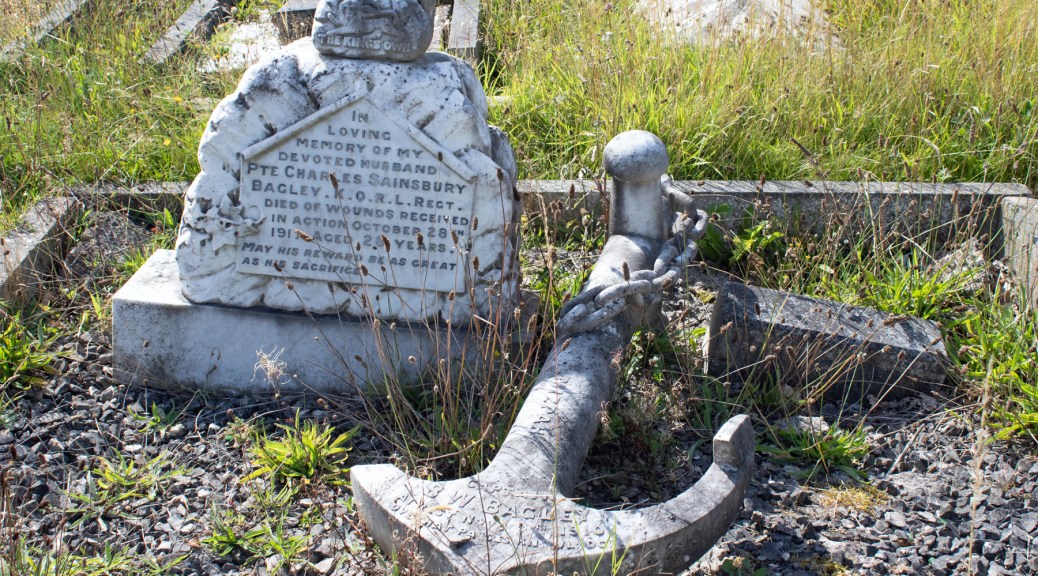
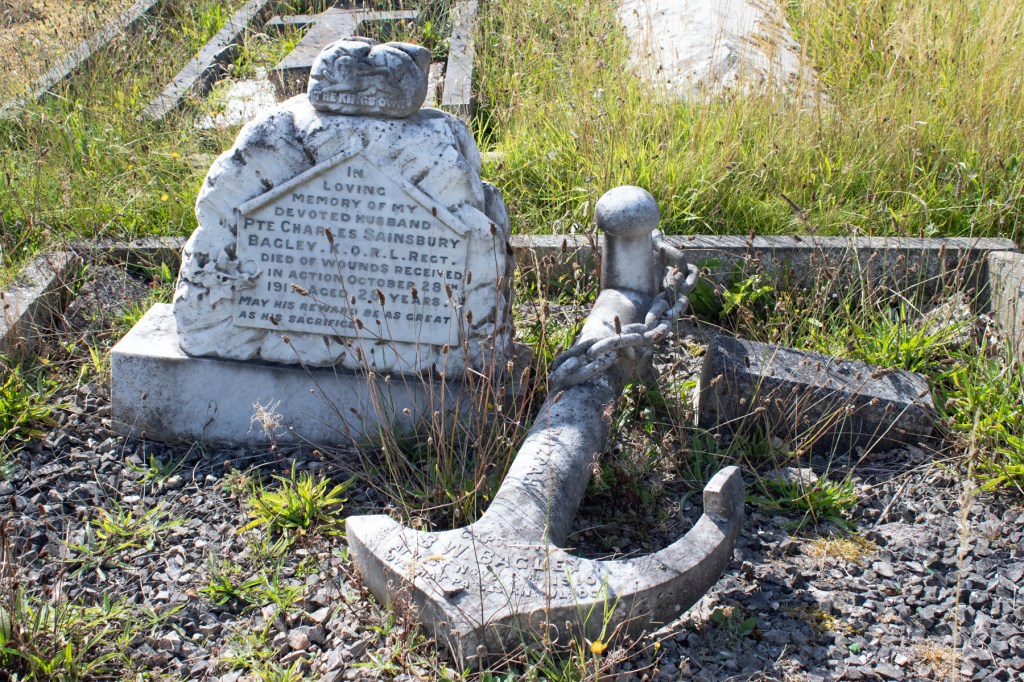
The body of Charles Sainsbury Bagley was taken back to Somerset for burial. He was laid to rest in the family plot in Minehead Cemetery, reunited with his parents, Jane having died at the beginning of 1917. The seafaring headstone paid homage to his father’s maritime service.


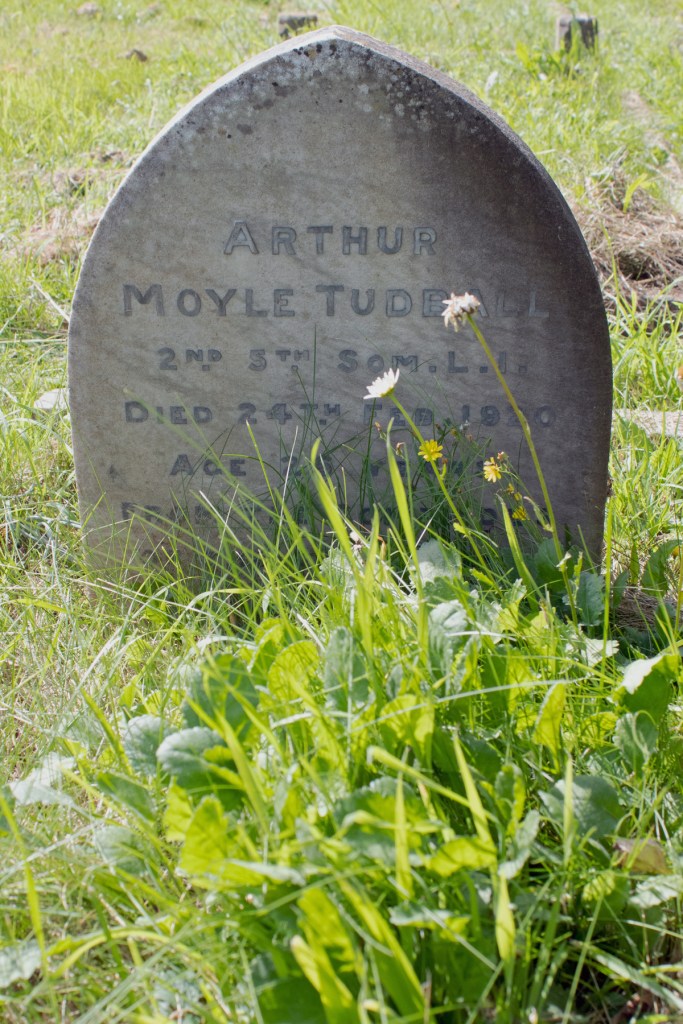
Private Arthur Tudball

Private Arthur Tudball

Arthur Moyle Tudball was born in the spring of 1893 in Minehead, Somerset. One of seven children, his parents were William Tudball and his Cornish wife, Mary.

When he completed his schooling, Arthur found work as a hairdresser. By the time of the 1911 census, there were seven in the Tudball household: William, Mary, four of their children, including Arthur, and their nephew, four-year-old William, who had been born in Ontario, Canada. There were four wages coming in: William, who was working as a general labourer, Arthur’s hairdressing salary. His older brother was a carpenter, and two sisters were employed as dressmakers.

Details of Arthur’s time in the army are sketchy at best. He certainly enlisted when war broke out, joining the Somerset Light Infantry. His Medal Roll Index Card seems to suggest that he didn’t serve overseas, despite both battalions he served with – the 1st/5th and 2nd/5th – fighting in India.

Private Tudball survived the war, returning to Somerset at the end of the conflict. The next record for him is that of his passing. His death, from disease, was recorded in the Taunton district, which would suggest that he was either still based at the army barracks in the town, or has been hospitalised there. He died on 24th February 1920, at the age of 26 years old.

Arthur Moyle Tudball was buried in Minehead Cemetery, not far from where his grieving family lived. His modest headstone was donated by his army colleagues.


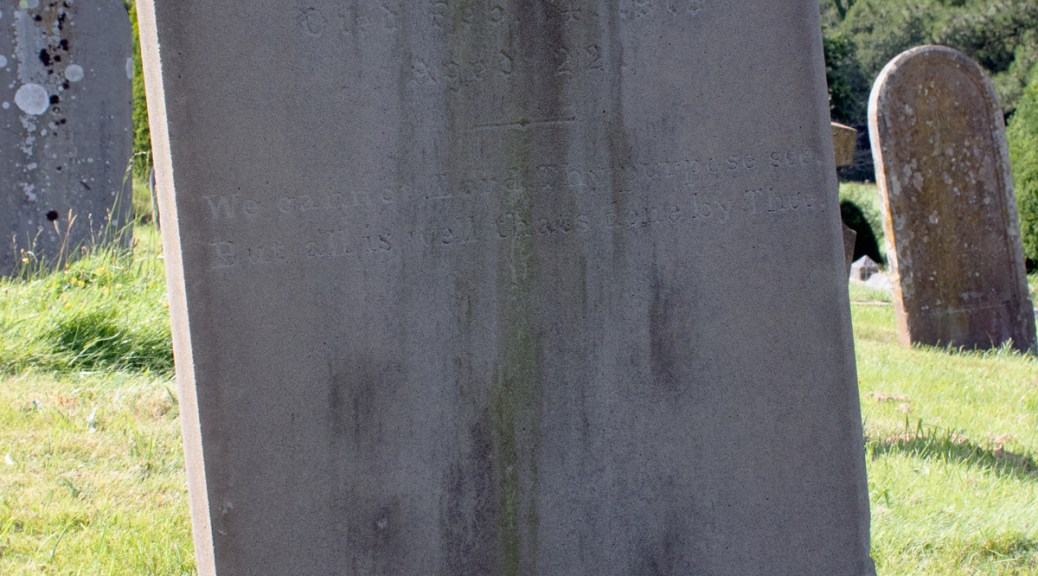
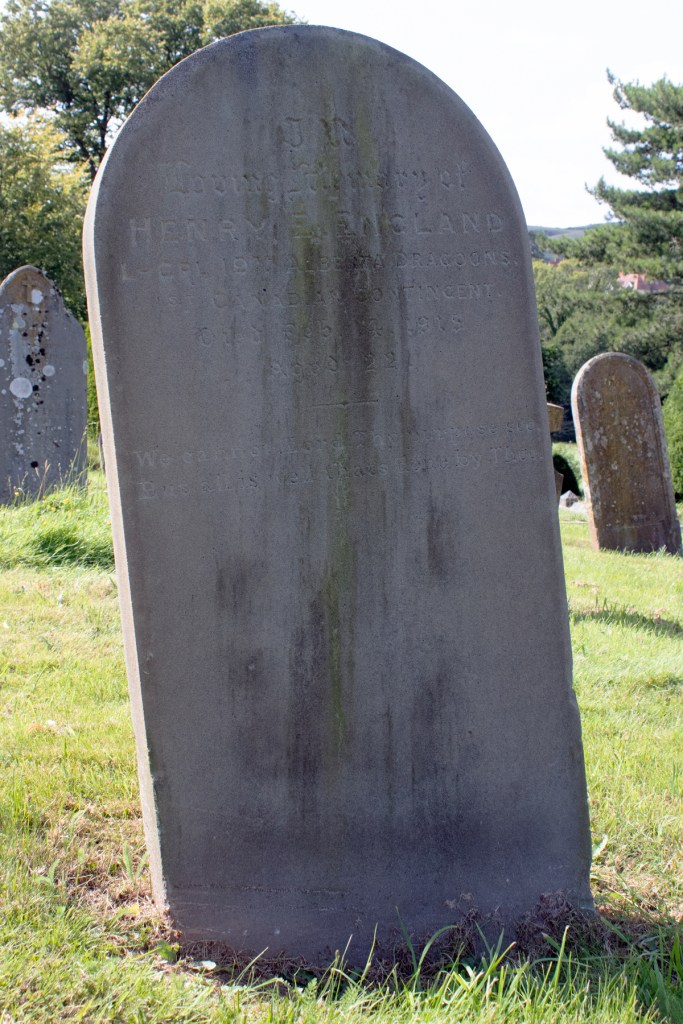
Private Henry England

Private Henry England

Henry Edward England was born in Gloucestershire on 7th October 1893. One of seven children, his parents were Charles and Unity England. Charles was coachman and groom to Sir Charles Cuyler, and the family were raised in Bristol.

There are gaps in Henry’s life that are a challenge to fill. He seems to have sought to better himself, emigrating to Canada and becoming a bank clerk in Quebec.

When war broke out, Henry was quick to enlist. He joined up on 21st September 1914, becoming a Private in the 19th Battalion of the Alberta Dragoons. His service records show that he was 5ft 8ins (1.73m) tall and weighed 140lbs (63.5kg). He was noted as being of average physical development with dark hair, brown eyes and a dark complexion.

Private England returned to home shores by December 1914, at which point he transferred to the 6th (Reserve) Battalion of the Canadian Infantry. His troop proceeded to Tidworth Camp in Wiltshire, on the edge of Salisbury Plain.

Army barracks at this time were melting pots: hundreds of men from different parts of the world cramped together in small billets proving breeding grounds for illness and disease. Henry was to prove a victim of the conditions: in the winter of 1914, he contracted meningitis. Admitted to the camp hospital, he was to succumb. Private England breathed his last on 14th February 1915, aged just 21 years of age.

Henry Edward England’s body was taken back to Somerset for burial. He was laid to rest in the sweeping vista of Minehead Cemetery, not far from where his family now lived.


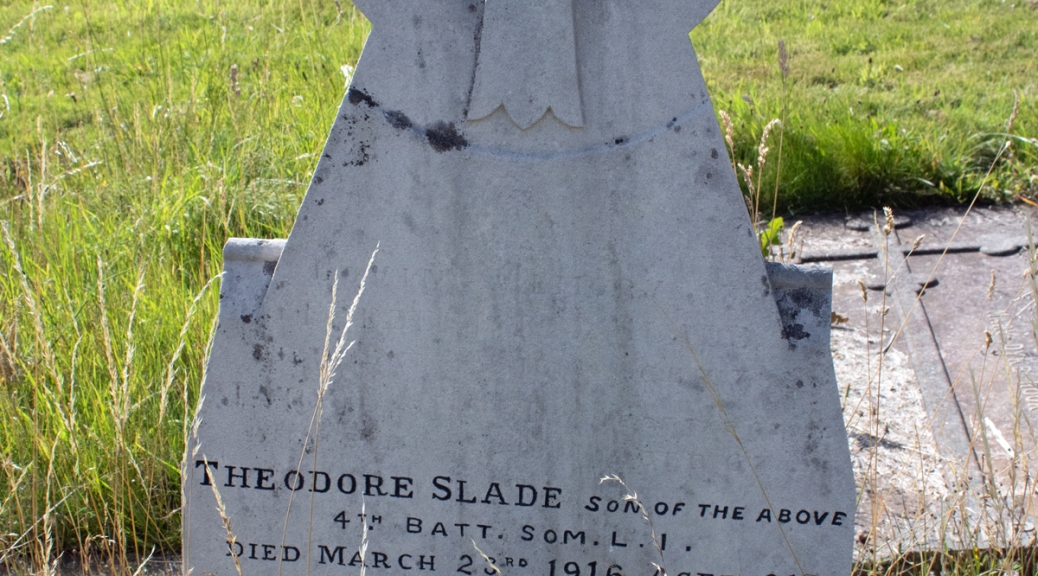
Private Theodore Slade

Private Theodore Slade

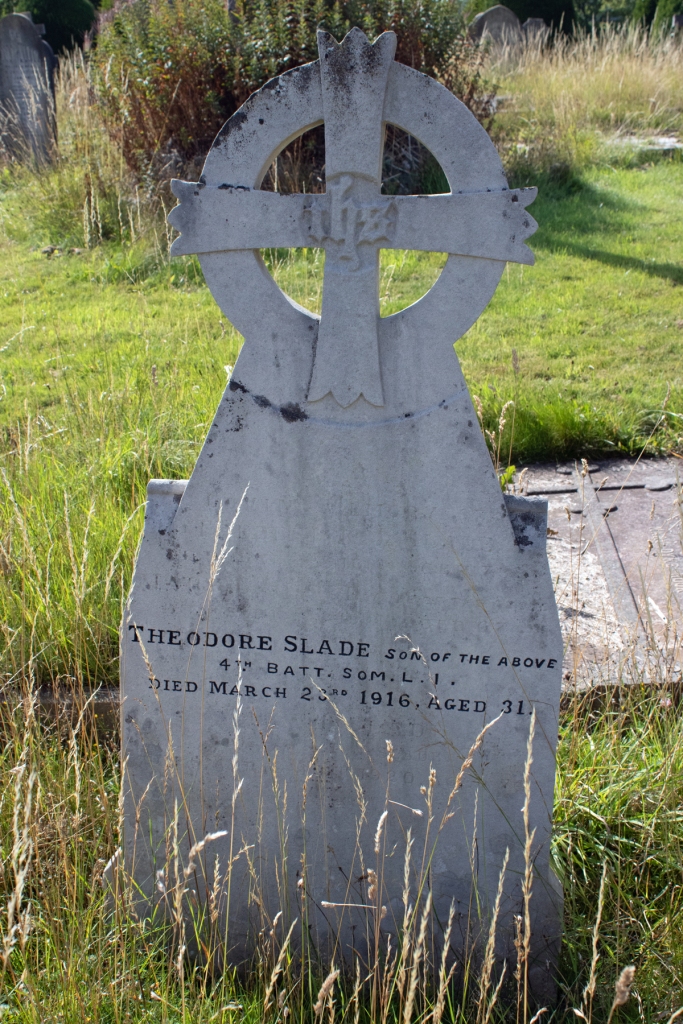
Theodore Slade was born early in 1885 in Buckfastleigh, Devon and was the second of two children to Frederick and Mary Slade. The 1891 census recorded the family four living with Frederick’s widowed mother and younger sister in Minehead, Somerset, where he had himself been born. Frederick was listed as a schoolmaster, while Mary was working as an organist.

Music definitely ran through the Slade family. The next census, in 1901, found Frederick now working as a gunsmith. Mary, meanwhile, was now noted as being a professor of music, while Theodore and his older brother, appropriately named Beethoven, were both employed as music teachers.

Ten years further on, and Beethoven had moved out of the family home, for a life with his wife and her widowed mother. Frederick was still working as a gunsmith, while Mary and Theodore were still teaching music. All three were self-employed, Theodore also working as an organist at St Andrew’s Church, Minehead, for more than a decade.

An interesting side note to the three document is how the census takers relied fully on the information they were given by residents. In 1891, Frederick gave his age as 41 and Mary 40; ten years later, Frederick was noted as being 56 and Mary 53; the 1911 census gave their ages as 71 and 63 respectively.

When war broke out, Theodore enlisted early on. He joined the Somerset Light Infantry, and was initially attached to the 4th (Reserve) Battalion. Private Slade was transferred across to the 1st Battalion, and soon found himself ensconced at Ypres.

Towards the end of 1915 Theodore came down with tuberculosis, and was medically evacuated to Britain for treatment. He was admitted to St John’s Hospital in Penarth, Glamorganshire, and remained in hospital over the winter months. His lungs weakened, he contracted pneumonia, passing away from the condition on 23rd March 1916, at the age of 31 years old.

Theodore Slade’s body was brought back to Somerset for burial. He was laid to rest in the family plot in the sweeping vista of Minehead Cemetery.


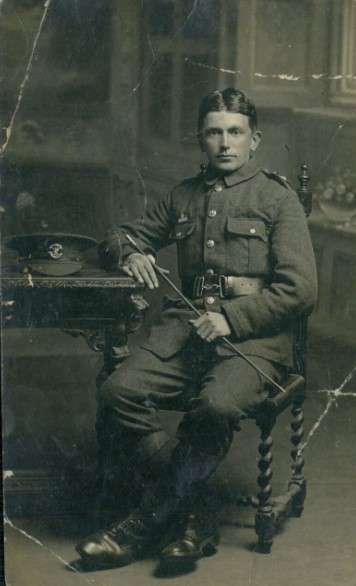
Private Theodore Slade
(from findagrave.com)

Private Leonard Floyd

Private Leonard Floyd

Leonard Lionel Floyd (or Floyde) was born in the Somerset village of Watchet in 1898. The eldest of five children, his parents were journeyman tailor Thomas Floyde and his wife, Louise.

Interestingly, at the time of the two censuses in 1901 and 1911, Leonard was away from the family home: the earlier document recorded him living with his maternal grandparents on the outskirts of Minehead. Ten years later he was back in Watchet, residing with his mother’s brother and sister.

Little additional information is available to document Leonard’s young life. With war raging across Europe, he appears to have joined up as soon as he came of age. He was assigned to the 1st Battalion of the Princess Charlotte of Wales’ (Royal Berkshire Regiment) and sent to Portsmouth, Hampshire, for training.

Tragically, it seems that Private Floyd fell ill while billeted in the cramped barracks there. He was admitted to the 5th Southern General Hospital in the city, but died soon after. He breathed his last on 21st April 1917, aged just 18 years old.

Leonard Lionel Floyd’s body was brought back to Somerset for burial. He was laid to rest in the sweeping Minehead Cemetery, not far from where his parents lived, on the outskirts of the town.


Private Henry Webber

Private Henry Webber

Henry James Webber was born in Plaistow, Essex, in 1889. One of ten children, his parents were Frederick and Etty Webber. Frederick hailed from Somerset, but worked as a sergeant in the Metropolitan Police. By the time of the 1901 census, he had been promoted to Inspector: the family moved to Somerset when he retired in around 1905, settling in Minehead.

Of Henry, there is little information documented. He does not appear on the 1911 census, and there are no military records to confirm his service in the army. He had certainly enlisted by the summer of 1916, joining the Somerset Light Infantry.

Private Webber was attached to the 7th (Service) Battalion and certainly saw action overseas. His troop was heavily involved in the Battles of the Somme in 1916, and it was here that he was injured. Again, full details are not available, but his wounds were severe enough for him to be medically evacuated to Britain for treatment.

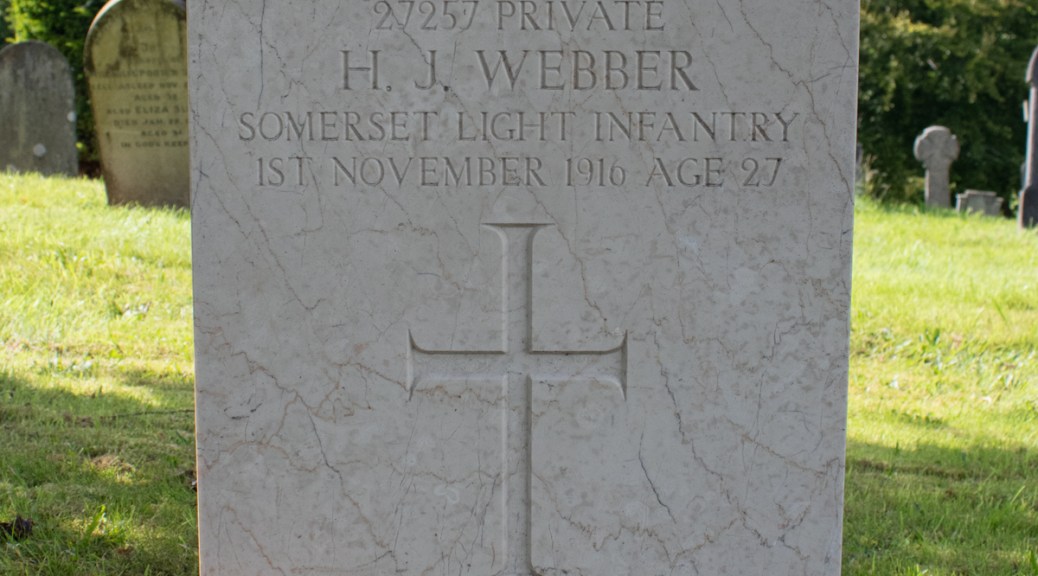
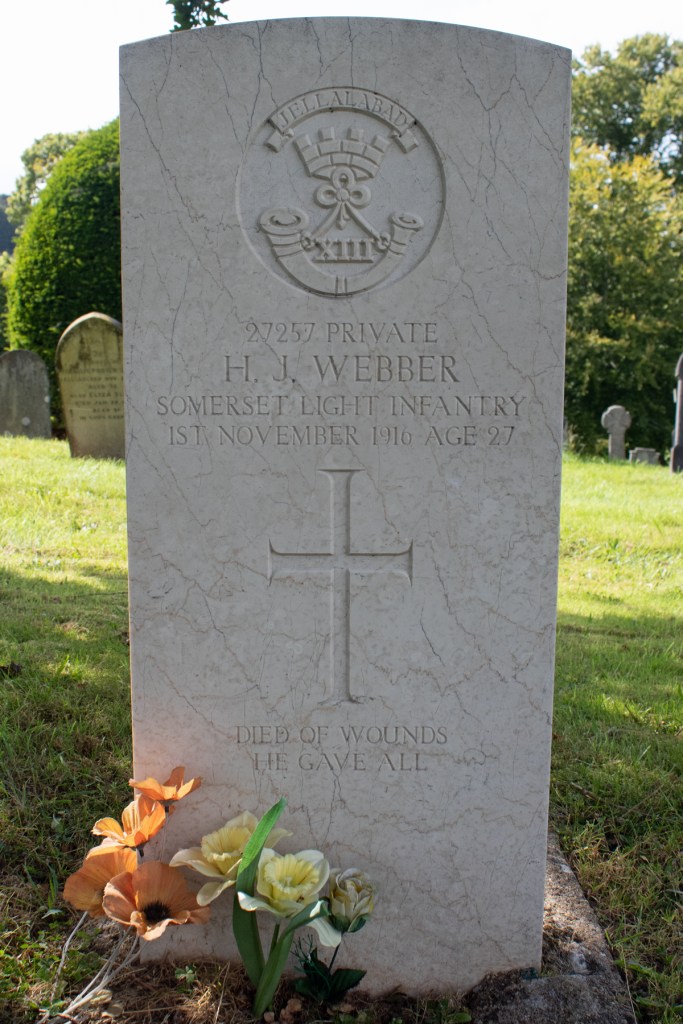
Henry was admitted to the 1st Southern General Hospital in Birmingham, but his injuries proved too severe. He died on 1st November 1916, at the age of 27 years old.

Henry James Webber’s body was taken back to Somerset for burial. He was laid to rest in Minehead Cemetery, not far from where his grieving family were living in Cher Street.


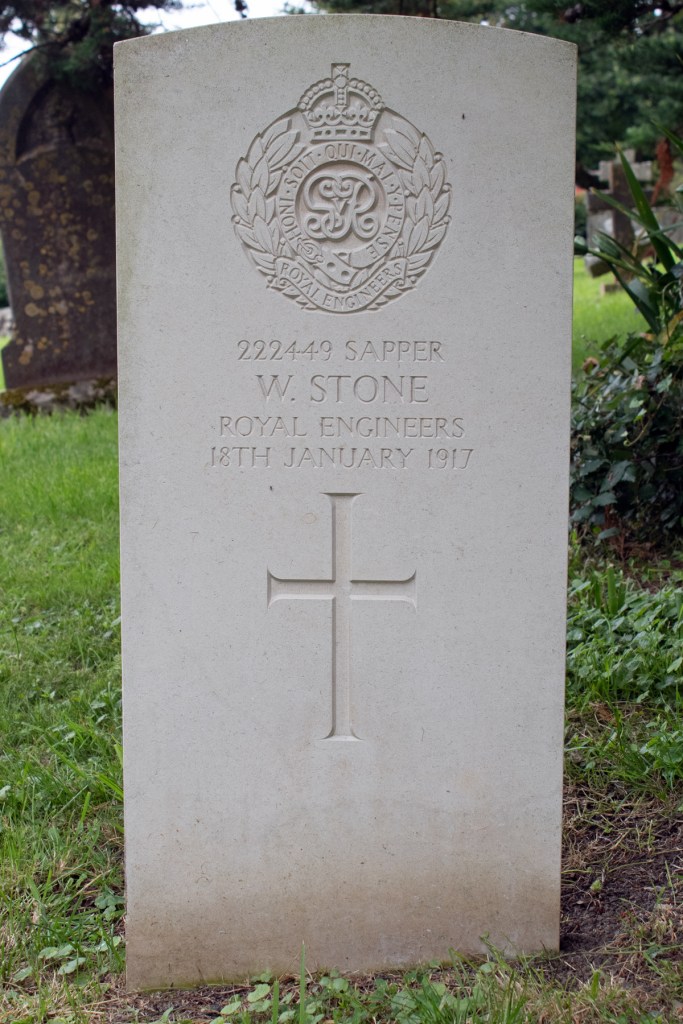
Sapper Walter Stone

Sapper Walter Stone

Walter Stone was born at the start of 1880 in Lympsham, Somerset. The middle of three children, his parents were coal merchant George Stone and his wife, Ellen.

When he finished his schooling, Walter found work as a painter and plumber. In January 1902 he married Alice Charman. Eighteen years older than Walter, she was the widow of a milkman from Bristol, and had raised her son, Edgar, since her husband had passed away a few months before. The couple settled in the village of Brent Knoll, and went on to have three children of their own: Albert, Florence and Alice.

When war came to Europe, Walter was called upon to play his part. He enlisted after June 1916, and joined the Royal Engineers as a Sapper. He was attached to the Inland Waterways and Docks division, but, as no documentation remains to confirm his service, it is not possible to confirm whether he saw any action overseas

Sapper Stone’s time in the army was not to be a long one. The next record for him is that of his admission to a military hospital in Herne Bay, Kent. He was suffering from pneumonia, and this would take his life on 18th January 1917. He was 36 years of age.

Walter Stone’s body was brought back to Somerset for burial. He was laid to rest in the tranquil graveyard of St Michael’s Church in Brent Knoll.


Further tragedy was to strike Walter’s widow, Alice. Edgar, her son from her first marriage, enlisted in the Somerset Light Infantry when war broke out. Attached to the 7th (Service) Battalion, he found himself on the Front Line by the end of July 1915.

Private Stone is reported to have been accidentally killed on 1st May 1917. No other detail is given, but he was just 24 years of age when he passed. He was buried at the Thiepval Memorial at the Somme.

Alice had lost her husband and her oldest child within a matter of months.


Private Henry Yard

Private Henry Yard

Henry George Yard was born on 25th October 1884 in the Somerset village of Burnham-on-Sea. The second of seven children, his parents were John and Elizabeth Yard. John was a railway porter, but Henry chose a different route, becoming a mason’s labourer.

Henry’s work took him to South Wales, where he took up a position as a pit mason. The 1911 census recorded him as boarding in a six-roomed house in Abertillery, Monmouthshire. From the document there can be no mistaking that this was a mining community. The head of the household for 70 New Gladstone Street was 28-year-old Albert Francis, colliery banksman. He lived there with his wife, Martha, who was fifteen years older than him, and her three children: William, Herbert and Horace.

Martha had been married previously, to coal miner Walter Mutter. Both had been born in Somerset, and had come to South Wales like so many other families, because of the work. Walter died at the beginning of 1909, leaving his widow to raise three children on her own. It seems likely that this is where Albert stepped up: it was not unknown for mine workers to support each other in times of dire need. He married his former colleague’s widow in the autumn, securing a future for her and her family.

According to the census record, the Francis family had one other boarder and all but Martha and Horace worked in the local colliery in one way or another.

There seemed to have been money in Henry’s career move, as it set him up to marry Gertrude Coombes on 6th August 1912. She was a gardener’s daughter from Berrow in Somerset, and eight years younger than her husband. The couple married at St Mary’s Church, Berrow, and appeared to settle back in South Wales. They went on to have two children: Gertrude, who was born the following year, and Daisy, who came along in 1916.

When war came to Europe, Henry was called upon to play his part. He enlisted in October 1915, and was initially assigned to the 3rd Battalion of the Welch Regiment. His service records show that he was 5ft 6ins (1.68m) tall, and weighed 133lbs (60.3kg). He was noted to be of good physical development, although dental treatment was required.

Private Yard transferred to the Machine Gun Corps at some point, and by the autumn of 1916 was sent to Greece. He remained there for nearly two years, but became dogged by malaria in later months there. Initially coming down with the condition in August 1917, he spent the remainder of the war in and out of hospital as attacks of the condition came and went.

Initially returning to home soil and placed on reserve status, Henry was eventually discharged on medical grounds at the end of 1918. He returned to the family home. He was not to be there for long, however: debilitated by malaria, Henry passed away in Bedwellty on 23rd March 1919, at the age of 34 years old.

With strong family connections in Somerset, Gertrude took her husband back there to be laid to rest. Henry George Yard was buried in the tranquil graveyard of St Mary’s Church in Berrow.


Private Henry Yard
(from ancestry.co.uk)

Private Victor Sperring

Private Victor Sperring

Victor William Sperring was born in the spring of 1897, in Lympsham, Somerset. One of nine children, his parents were James and Catherine Sperring. James was a farmer, 22 years older than his wife and, when he died in 1904, she was left to bring up the family alone. She remarried, to dairy farmer Frederick Butler, continuing the farming life.

Frederick died in 1914, and with her older children now in their 20s, Catherine’s sons took up the reins to keep the farm going. War was on the horizon now, and tragedy was never going to be far from the Sperring household.

Of the five brothers, at least two – Victor and his older brother, Hubert – stepped up to serve their King and Country. Hubert joined the Gloucestershire Regiment, rising to the rank of Lance Corporal in the 1st/6th Battalion. He was caught up at the Battle of the Somme, and was recorded as missing, presumed killed, on 21st July 1916. He was just 23 years of age, and is one of the tens of thousands of names commemorated on the Thiepval Memorial in Northern France.

Victor also joined the Gloucestershire Regiment, but his story is less clear. Certainly by 1918 he was attached to one of the regiment’s depots, possibly on home soil. He was admitted to the 2nd Southern General Hospital in the autumn of 1918, and this is where he passed away on 16th November. He was just 21 years of age.

Victor William Sperring was brought back to Lympsham for burial. He was laid to rest in the family plot in St Christopher’s Churchyard.


It seems likely that illness is what took Victor’s life. Just a month later, his sister, Annie, also passed away: she was interred next to her brother.

Catherine’s grief must have been indescribable, having lost a husband and three children in a matter of years. She continued on, however, and, by the time of the 1939 England and Wales Register, she was living with her son Roland, supporting him with his farm. She died in October 1941, at the age of 77: she was buried with her family in St Christopher’s.