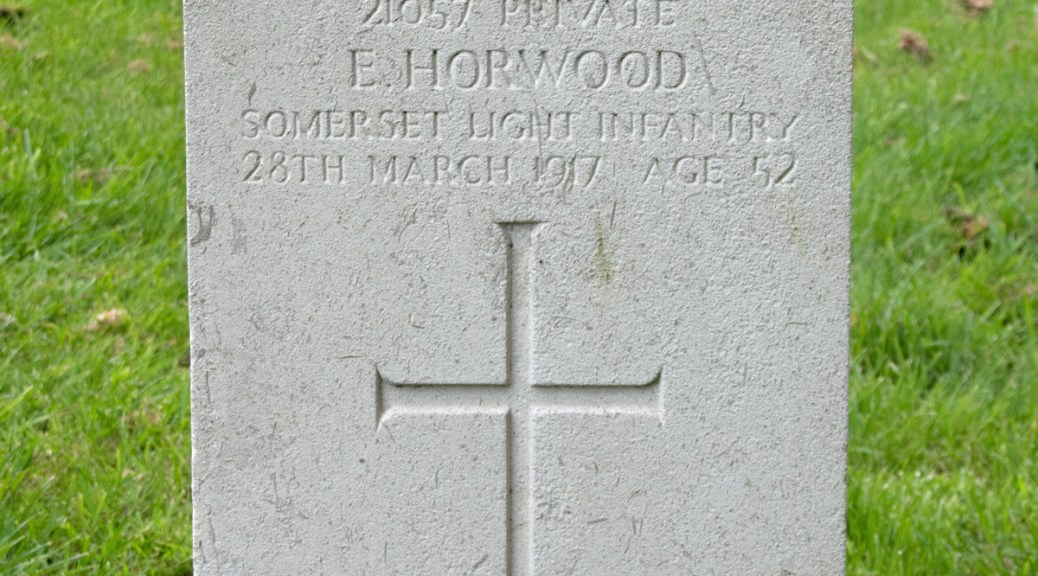
Albert Edward Horwood was born in Bath, Somerset, in the spring of 1864. The middle of five children, his parents were Joseph and Agnes Horwood. Joseph was a stone mason and, when Agnes passed away in 1872 he married again, this time to a woman called Elizabeth.
When he left school Albert – who became better known as Edward – found work in a local foundry. Joseph died in 1888, and just two years later, Edward married Emily Wheeler. She was the daughter of labourer from North Bradley, Wiltshire, and it was in the parish church that the couple exchanged vows.
The couple set up home in the Lyncombe area of Bath, and went on to have nine children, all but one of them girls. Edward continued with labouring work for the next twenty years, as his children grew in the family home in Cheltenham Street.
Despite his age, when was broke out in Europe, Edward stepped up to play his part. He enlisted in the Somerset Light Infantry on 6th November 1914, and was assigned to the 4th Battalion. His service records show that he was 44 year of age and 5ft 11ins (1.8m) tall.
Attached to one of the regiment’s supply companies, Private Horwood remained on the Home Front. He remained on active duty for more than eighteen months until, in June 1916, he was medically discharged because of a large ulcer and epithelioma (lesion) on his tongue. Edward’s medical notes suggest that he was offered an operation to remove the potentially malignant growth, but that he had declined.
At this point Edward’s trail goes cold. He returned home, and passed away on 28th March 1917 and, while the cause is not publicly documented, it seems likely to have been related to the growth in his mouth. He was 52 years of age.
Albert Edward Horwood was laid to rest in the St James Cemetery in his home town of Bath.
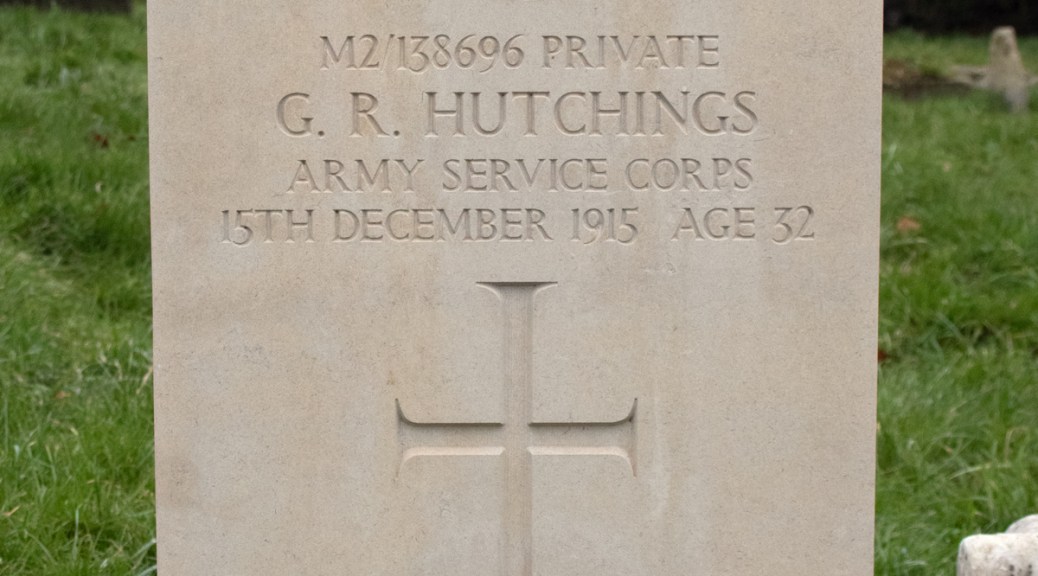
George Robert Hutchings was born towards the end of 1883 in Forest Gate, Essex. He was the oldest of four children to George and Mary Ann Hutchings. George Sr was a labourer for the railways, and this led to the family relocating to Swindon, Wiltshire, in the 1890s.
George Jr took up work with the Great Western Railway when he left school, while his father switched employment and, by the time of the 1911 census, he was working as a collector for a clothing supply company.
On 13th July 1911, George Jr married Daisy Smale in the Sanford Street Congregational Church, Swindon. Daisy was a school teacher, and was the daughter of an iron moulder. It is likely that the couple met through George’s workplace. The newlyweds had a son, Raymond, who was born in 1914 and, at some point moved to Bath in Somerset.
When war came to Europe, George stepped up to play his part. He enlisted in the Royal Army Service Corps and, unsurprisingly, given the work he was doing, was assigned to the Mechanical Transport division. Little information about his military service remains, but is it clear that he had enlisted in the second half of 1915.
The next available record for Private Hutchings is that of his passing. He had been admitted to the Royal Herbert Hospital in Woolwich, South East London, and died there on 15th December 1915. No cause for his death is evident, but he was 32 years of age.
George Robert Hutchings was brought back to Somerset for burial. He was laid to rest in Bath’s St James Cemetery.
When her husband died, Daisy was pregnant. In March 1916 she gave birth to a daughter, Winifred, who was never to know her father.
Daisy never remarried. By the time of the 1939 register, she was living in Northampton Street, Bath, sharing the house with a Mr and Mrs Spreadbury. Her employment was listed as unpaid domestic duties.
Daisy and George’s son Raymond was focused on his education. He made an eventual move to Birmingham, where, at the outbreak of war, he was working as a research chemist. He died in Bath in 1982, at the age of 68.
Winifred married grocer Kenneth Batten in Bath in 1938. The couple had three children and emigrated to Australia after the war, and settled in Coffs Harbour, New South Wales. Kenneth died in 1988, at the age of 72; Winifred died in 2003, aged 87.
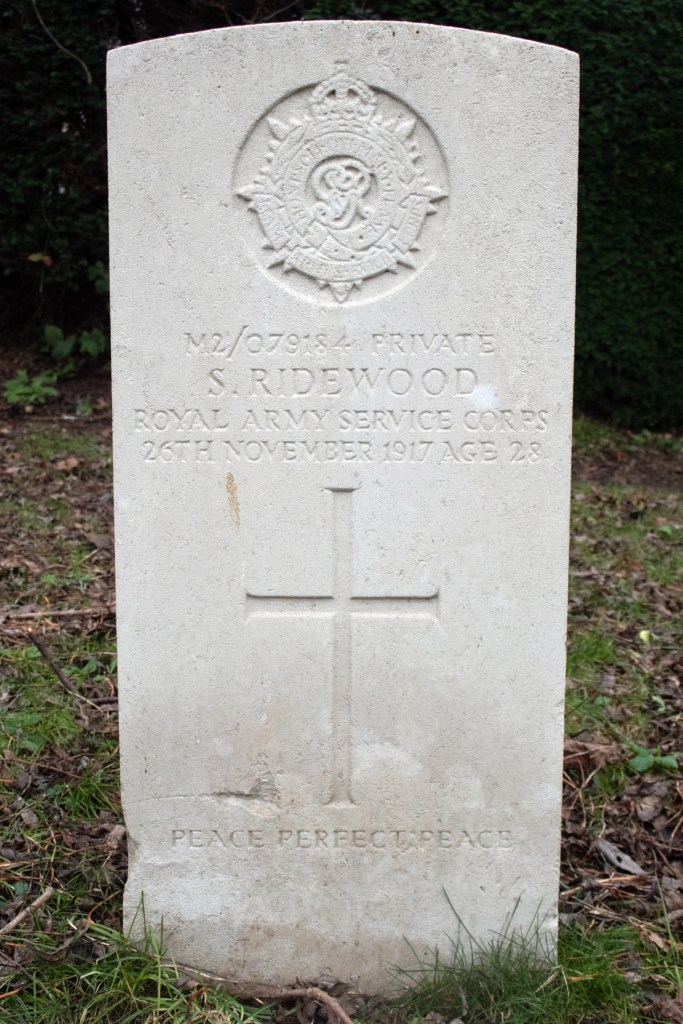
Sydney Ridewood was born in Bath, Somerset, on 31st March 1891, and was one of eleven children. His parents were labourer and sometime butcher James Ridewood and his wife Mary.
When Sydney left school, he found work as a baker, although this seems to have been as piecemeal a job as his father’s.
In January 1910, Sydney married Kathleen Scudamore. She was the daughter of a carpenter from the Twerton area of Bath and had a bit of a chequered background herself.
On 10th June 1896, Kathleen had married Edward Edwards, who was twelve years older than her seventeen years. Their marriage certificate suggested he was a clerk, although the 1901 census – which included their two children, Charles and Percy – recorded him as being a draper’s porter. Beyond that document, there is no record of Kathleen’s husband and, by the time of her marriage to Sydney, she had reverted to her maiden name.
By the time of the 1911 census Sydney and Kathleen were living in central Bath, with their nine-month old daughter, Olive, and Kathleen’s two sons. Kathleen’s widowed father, Edmund, her brother Claude and sister-in-law Nora were also in the household.
The document recorded Sydney as still employed as a journeyman baker, while his wife was a cook for the Post Office. Edmund was working as a carpenter, Claude was a sawyer, Nora a shop assistant and 14-year old Charles was a messenger boy, also for the Post Office. Six pay cheques coming in to support the extended family in the four-roomed house.
An additional member of the Ridewood family came along on 22nd October 1913, when Kathleen gave birth to a second child, Sydney Jr.
War was on the horizon by this point, and, on 20th April 1915, Sydney stepped up to play his part. He enlisted in the Royal Service Corps, and was assigned to the Mechanical Transport Corps. There is little detail about Private Ridewood’s service, although his records show that he was 5ft 3ins (1.6m) tall, with auburn hair, brown eyes and a fresh complexion.
Sydney was sent to France a month after enlisting, and his may role seems to have been that of a driver. He remained on the Western Front for a little over two years, before contracting pleurisy. He was initially treated in France, but soon returned to Britain to recuperate. The lung condition, however, was to get the better of him, and he passed away at home on 26th November 1917, weeks before he was to be medically discharged from service. He was just 28 years of age.
Sydney Ridewood was laid to rest in St James’ Cemetery, a few minutes’ walk from his family home.
Albert Henry Townsend was born on 7th November 1890 in Bath, Somerset. One of thirteen children, his parents were George and Annie Townsend. George was a painter by trade, but when he died in the autumn of 1895, Annie was left to take in laundry to earn money to support her and the four of her children still living at home.
By the time of the 1911 census, Albert was 21, and had found work as a baker. He was still living with his mother, two siblings and a nephew in a house in the centre of the city. All but Annie’s grandson were earning money by this point, and, with five rooms, the family were in a better position than some of their neighbours. Next door was Albert Smith, a coal carter, who had to support a family of ten people.
In the summer of 1914 war broke out, and within months, three of the Townsend brothers – Albert and his older brothers Arthur and Charles – had enlisted.
Arthur Townsend had joined the Duke of Cornwall’s Light Infantry earlier in the year, and within weeks of conflict being declared, he was on the Western Front. He was to be one of the early casualties of the conflict, and was killed in action during the Battle of the Marne on 9th September. He was just 29 years old and, while his body was never identified, he was commemorated on the La Ferte-sous-Jouarre Memorial.
Albert’s service records have been lost to time, so it is not possible to identify when he enlisted. He joined the Somerset Light Infantry, and was assigned to the 4th Battalion, who set sail for India in October 1914. Private Townsend was not to travel with them, however as he had contracted septicaemia while camped on Salisbury Plain, Wiltshire. He was transferred to the Royal United Hospital in Bath for further treatment, but his condition was to prove too severe. He passed away while still admitted on 19th October 1914. He was just 23 years of age.
Albert Henry Townsend was laid to rest in the St James’ Cemetery in his home city, Bath.
Annie Townsend had now been a widow for nearly twenty years and, within a matter of weeks, had lost two of her sons. Tragically, the war was not done with her family yet.
Charles Townsend was still serving, having enlisted in the 8th Battalion of the Somerset Light Infantry. He arrived in France in July 1915, and over the next year, wascaught up in some of the fiercest fighting of the conflict. On 1st July 1916, the Battle of the Somme began, the darkest day in history for the British Army. Twenty thousand soldiers were killed, and Private Charles Townsend was amongst the fallen. He was just 30 years of age. He was commemorated on the Theipval Memorial.
Annie had lost a third son to the conflict in a little under two years, and her pain must have been unimaginable. She lived on until 1923, when she died at home in Bath. She was laid to rest close to her husband and Albert, a family partly reunited once more.
Ernest James Victor Whatley was born in the spring of 1899, the youngest of three children to George and Clara Whatley. Clara passed away in 1908, and George remarried the following year, to a woman called Sarah. Ernest’s brothers were sixteen years older than him, and so by the time of the 1911 census they had moved out of their father’s home. By that point, Ernest living with his father and stepmother in their house in Bath, Somerset.
Little further information is available about Ernest. With war raging across Europe, he enlisted in the army, but this was not before September 1916, and it is likely that he came of age before joining up.
Private Whatley served in the 1st/7th (Cyclist) Battalion of the Devonshire Regiment, and was based in Suffolk. It is while he was billeted that he was admitted to a hospital in Ipswich, although the cause of his admission is unclear.
Whatever befell Private Whatley, it was to prove his undoing. He passed away in the Ipswich hospital on 9th March 1917, at the tender age of just 18 years old.
Ernest James Victor Whatley’s body was brought back to Somerset for burial. He was laid to rest in St James’ Cemetery, Bath, not far from his mother, Clara.
Sidney Charles Warren was born in the spring of 1894, and was one of a dozen children to William and Eliza Warren. William was a farm labourer and shepherd from Somerset, and it was in the village of Combe Florey, near Taunton, that Sidney was born. The Warrens’ sons all followed William into farm work, and the 1911 census found the family – then eight strong – living in a three-room cottage in the village.
When war broke out, Sidney was quick to enlist. He joined the 5th Battalion of the Somerset Light Infantry on 16th December 1914, and which was based in Prior Park, near Bath.
The following month, Private Warren became unwell. His father later reported that he had “from childhood… suffered from his chest, and if he caught the slightest cold he became very short of breath. He could not run and jump about like other boys.” [Bath Chronicle and Weekly Gazette: Saturday 6th February 1915]
On 27th January, Sidney reported sick to Captain Brimblecombe of the Royal Army Medical Corps. He was suffering from a cold, and was given quinine. He reported sick again on the 28th, and the medical officer, gave him more quinine. The following day, Private Warren returned to duty.
That afternoon, after drill duties, Sidney and a couple of friends, George Berry and George Lewis, went into Bath for a few hours. They went to the White Hart Public House and had a drink and a meal. The two of them then made their way back to Priory Park around 8pm.
On the way up the hill [Sidney] called to [his friends]… “Come quick.” They went back, and caught hold of him, and he said “I’m dying.” They laid him down on the road, and [George Berry] went up to Priory Park for a doctor. A Red Cross man came down with a stretcher, and [Sidney] was conveyed to the Police Station and then to the Hospital.
Bath Chronicle and Weekly Gazette: Saturday 6th February 1915
Private Warren passed away while at the hospital. A post mortem was held, which found that all of his organs were healthy, and that his lungs were “voluminous, but showed no signs of disease. The heart appeared perfectly healthy.” The coroner attributed Sidney’s passing to syncope after “a large undigested meal and walking up-hill”. He was just 20 years of age when he passed.
Sidney Charles Warren was laid to rest in the St James’ Cemetery in Bath, the city in which he passed away.
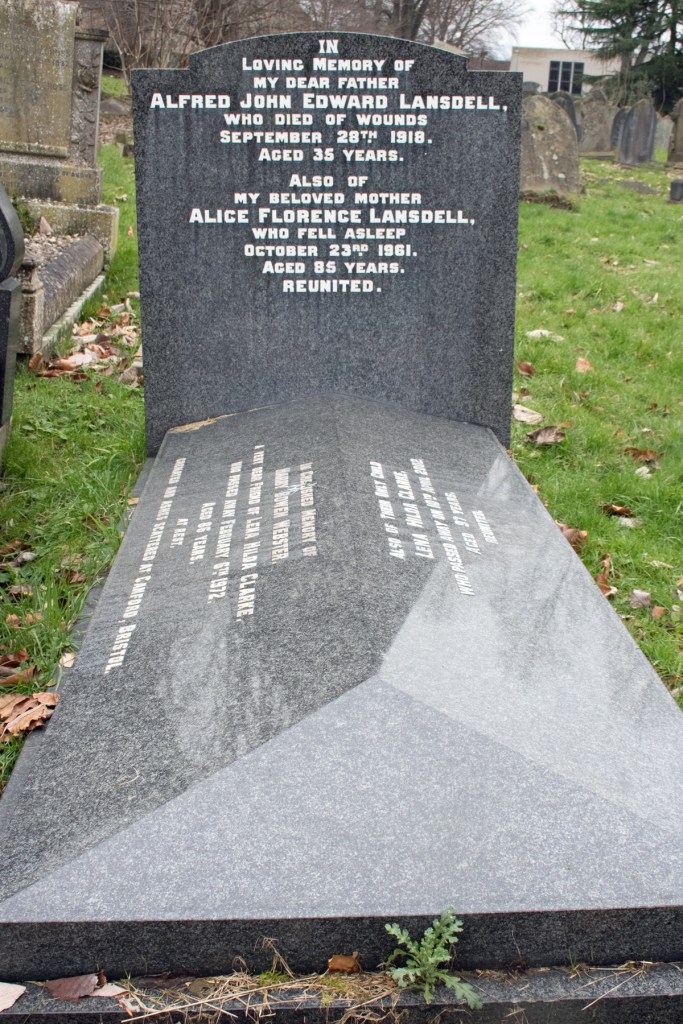
Alfred John Edward Lansdell was born on 25th October 1882 in Fulham, London. The fourth of six children, his parents were James and Matilda Lansdell.
James was a trunk maker, working in his father’s business. By the time of the 1901 census, he was recorded as living by his own means, while Alfred had taken up employment as a hotel porter in Chelsea.
By 1902, Alfred had moved to Somerset and set up home in Bath. He married local woman Alice Stevenson, and the couple went on to have a daughter, Lena, who was born in November 1904.
The 1911 census found the family living in central Bath, Alfred continuing his portering work, with one of his colleagues, lift operator Thomas Ward, boarding with them.
War came to Europe and on 9th December 1915, Alfred stepped up to play his part. He enlisted in the Worcestershire Regiment, and was formally mobilised the following June. Alfred’s service records confirm that he was, at the time of his review, he was 35 years old and 5ft 6ins (1.67m) tall.
Private Lansdell was assigned to the 1st/7th Battalion and by October 1916, he was shipped to France. He was very much on the Front Line, and was wounded on 19th August 1917, while at Ypres. His casualty record notes that “while waiting in a shell hole for a further move on he was wounded… in the back”. He has been shot, and the bullet penetrated his kidney.
Initially treated in a hospital in France, Private Lansdell was transferred to England on 25th October. He was admitted to the Norfolk War Hospital and remained there for some time.
Alfred’s injuries were too severe for him to continue in the army, and he was formally discharged on 20th March 1918. He eventually returned home to Bath, but in the end his poor health was to get the better of him. He passed away at home on 28th September 1918, at the age of 35.
Alfred John Edward Lansdell was laid to rest in St James’ Cemetery, Bath. Alice lived on until 1961, when she was buried with her late husband, a couple reunited after more than four decades.
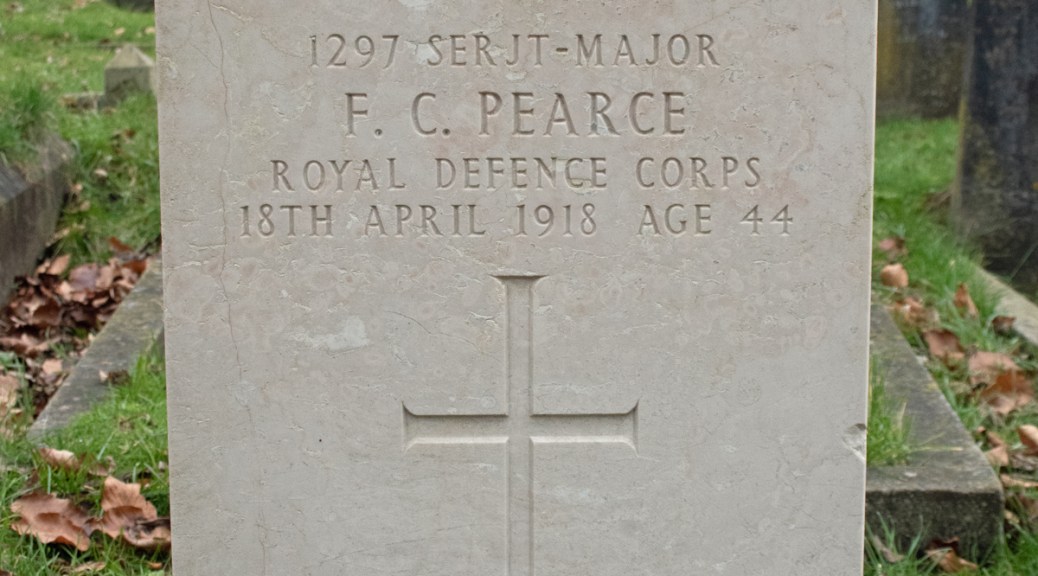
Frederick Charles Pearce was born in the spring of 1873 in the Gloucestershire town of Thornbury. The youngest of six children, his parents were Thomas and Elizabeth Pearce. Thomas was an agricultural labourer and, when he finished school, Frederick found work as a ‘rural messenger’.
This was only a step towards the career that Frederick sought, however, and on 12th July 1892, he enlisted in the Gloucestershire Regiment a a Private. His service records show that he was 5ft 5ins (1.65m) tall and weighed 128lbs (58kg). He was noted as having a fresh complexion, blue eyes and brown hair.
Private Pearce spent twelve years in the army, serving in Malta, Egypt, India and Ceylon (Sri Lanka). He had two stints in South Africa, including the 1899-1900 campaign, during which he was wounded in his chest in the battle at Farquhar’s Farm.
By the time he was discharged on 11th July 1904, he had risen through the ranks to Sergeant, his service records noting that his conduct had been “very good” (in capitals and underlined).
Thomas had died in 1896, and Frederick’s widowed brother William moved back in with his mother to help support her. Frederick also returned to Gloucestershire and, on 30th March 1905, he married Mary Rugman in the parish church in Olveston. The couple may have been childhood sweethearts, as the Pearces and Rugmans were Thornbury neighbours.
The marriage certificate noted Frederick as a groom, and it is likely that he was able to turn his hand to any role after his army career. The couple had a son Leslie, who was born in 1909, and, with the new responsibility of fatherhood, Frederick sought a more permanent career.
The 1911 census found the family living in Somerset, where Frederick was employed as a gardener at the Kingswood Reformatory School. This was a boarding school on an estate to the north of Bath, set in 57 acres of grounds, and again it seems likely that his military career stood him in good stead for such a prestigious role.
When war came to Europe, Frederick felt the pull of his military career once more. While his age did not compel it, on 20th November 1914, he re-enlisted in the Gloucester Regiment. He was enlisted with his previous rank, but within a year has been promoted to Acting Colour Sergeant.
In the spring of 1916, the Royal Defence Corps was formed, and, given his experience and age, Frederick was transferred across to the new regiment. Colour Sergeant Pearce was based in London and, over the next eighteen months served in four troops: 109, 149 and 150 Protection Companies and the 10th City of London Volunteers’ Regiment.
Frederick’s age and the demands of his role were beginning to take their toll by this point, and by the end of 1917, he had developed nephritis, or inflamed kidneys. The condition was severe enough to warrant his discharge from service, and the now Sergeant Major Pearce’s military career came to an end on 17th January 1918.
Frederick returned home to Bath, to the bosom of his family. He and Mary three children by this point, Violet and Freddie being two younger siblings to Leslie. Tragically for the Pearces, however, the family life was not to to last for long: Frederick’s condition was to get the better of him just three months later. He passed away on 18th April 1918, at the age of 44 years old.
Frederick Charles Pearce was laid to rest in St James’ Cemetery in Bath; a man of duty resting at last.
Tragedy was to strike again for poor Mary, when just six months later her youngest child, Freddie, also passed away. Details of his death are vague, but he was buried with his father, the two Fredericks reunited too soon.
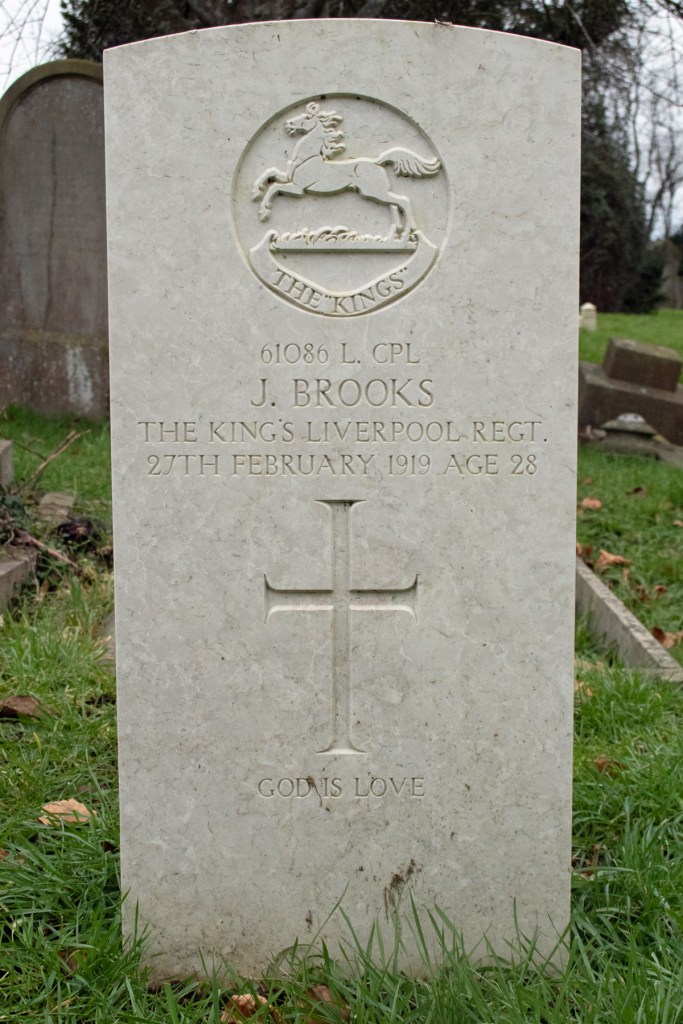
Jack Brooks was born in the autumn of 1890 and was the second of nine children. His parents, John and Kate Brooks, both came from Bath, where they ran a bakery on Queen Street, in the centre of the city. When he left school, it was natural for Jack to follow in his parents’ trade.
When war arrived on Europe’s shores, Jack stepped up to play his part and, on 7th December 1915, he enlisted in the Wiltshire Regiment as a Private. His service records show that he was 25 years and 2 months old, was 5ft 8.5ins (1.74m) tall, and weighed 156lbs (70.8kg). He was also noted to have a scrotal hernia, had flat feet and an upper set of dentures. These were enough for him to be passed for home service only, and he was formally mobilised on 10th February 1916.
Private Brooks seems to have taken a while to settle into army life. He was soon transferred across to the East Lancashire Regiment and, in May 1916, was attached to the 8th Works Coy as a Lance Corporal. In February 1917 he was transferred again, this time to the King’s Liverpool Regiment. On 6th June 1917 he was demoted to Private for ‘neglect of duty’, for not taking proper care of the stores that he was in charge of.
He married a woman called Rosina Elizabeth in 1917: the couple went on to have a son, William, who was born on 22nd November that year.
Jack continued serving after the end of the war and, by the beginning of 1919, was based in Aldershot. It was while here that he fell ill, and was admitted to the town’s Connaught Hospital on 11th February, suffering from influenza and pneumonia. Sadly the combination of illnesses was to prove to much: he succumbed to them, breathing his last on 27th February 1919. He was just 28 years of age, a boy with his mother, Kate, with him when he passed.
The body of Jack Brooks was brought back to Somerset for burial. He was laid to rest in the city’s St James’ Cemetery.
In St James’ Cemetery, Bath, is a headstone dedicated to one William Parry, once a Private in Devonshire Regiment. A lot of his life is lost to time, but his death highlights the length to which soldiers returning from the Great War were often left to fend for themselves.
On 4th November 1919, Private Parry “was found in an exhausted state lying under an arch in a suburb of [Bath], and told the police he had been there for 17 days. Crawling there to rest, he found himself afterwards too weak to move owing to trench feet” [Western Gazette: Friday 14th November 1919]
On 18th November, having been admitted to the Royal United Hospital in Bath, he passed away from pneumonia. “The police are endeavouring to ascertain something as to the man’s antecedents. He stated to them that he had no home.” [Western Gazette: Friday 21st November 1919]
An inquest into William’s death was held, and a miserable tale unfolded.
Parry was described as a seaman, and his address was given as 36 Catherine Street, Exeter…
[He had] said he was born at Swansea, had served in the 2nd Devons, and was demobilised at Exeter last March. He got into the arch because his feet were aching. He had come from Bristol. He did not say where he was going.
[When he died] Parry’s belongings… included a ration book, issued to him for the address in Exeter, his insurance card, and his out-of-work book. Parry had 10s 8d [approximately £11 in today’s money] in cash on him; but 10s 6d of this sum was given him by a lady since his arrival at the hospital. Parry had received various other gifts sent him by ladies from all over the country, who had read of the account of his discover in the Press. The last out-of-work donation received by him was on June 26th, and the ration book was issued at Exeter on March 24th. The address at Catherine Street, Exeter, as which Parry had stayed was that of a Church Army Home. He had also with him a card indicating membership of the Comrades of the Great War. The entries on his insurance card showed he was last employed on September 8th.
Inspector Lovell… gave the Coroner the result of exhaustive enquiries which he had made… regarding Parry’s antecedents… By the Exeter police he was informed that Parry registered at the Labour Exchange there as a seaman on March 25th. He then produced a certificate showing him to be a member of the Mercantile Marine. He had apparently served with the 2nd Battalion of the Devon Regiment for 2½ years. On May 16th, 1919, he obtained work as a painter in Exeter. He retained this employment till June 21st. A week later he obtained similar employment with another Exeter firm at 1s 3d [approx. £1.68] an hour and his earning averaged £2 [around £87] or more a week. He lest the Church Army Home on September 12th, explaining that he was going to Barrow-in-Furness, where he expected to obtain employment with Messrs Vickers, Sons, and Maxim. While staying at the Church Army Home he appeared to have been regarded as of a morbid disposition…
Inspector Lovell added that the members of the Exeter branch of the Comrades of the Great War had assisted him… and he was able to furnish the Court with a letter from Mr FW Drew, with whom Parry had lodged at the Church Army Home. The writer said he had met Parry in the latter part of April, and their friendship lasted until ten weeks ago, when deceased left Exeter. As they were two ex-Service men they became intimate friends, but apparently before the war he belonged to London.
After enlistment he had served in France, and was taken prisoner by the Germans. He was in their hands for three months; and acted as interpreter between his captors and the other British prisoners. He could speak German and other foreign languages, and undoubtedly was a man of superior education. Apparently, so far as his relations were concerned, he was “one of England’s lonely soldiers.” He said he was badly treated by the Germans, and suffered from a bad cough, the result of a wound in the chest. He was liable to depression when out of work, and the writer well remembered how pleased he was to think that he had obtained work at Barrow-in-Furness… “I deeply regret,” concluded the writer, “that he has come to such an untimely end. He was a good fellow, and would do anyone a good turn, if possible.”
In summing up, the Coroner remarked that exhaustive enquiries had been made into the case. There was no doubt from the medical evidence that the cause of death was pneumonia. It would appear that Parry had been on the road for some time when he crawled under the arch where he was found…
Bath Chronicle and Weekly Gazette: Saturday 22nd November 1919
Private William Parry died on 18th November 1919, aged around 44 years old. The British Federation of Discharged Soldiers and Sailors and the Comrades of the Great War jointly made arrangements for, and funded, his funeral, at which he was given full military honours. He was laid to rest in St James’ Cemetery, Bath.
Funeral of William Parry (from britishnewspaperarchive.co.uk)










 Death and Service