Tag Archives: 1916

Private Edward Paul

Private Edward Paul

Edward James Paul was born in Curry Mallet, Somerset, early in 1888, one of nine children to William and Eliza Paul. William was a stone mason, but Edward and his brothers went into agricultural labouring when they finished their schooling. Eliza and Edward’s sisters found employment making and finishing clothes.

Little further information about Edward’s early life is available but when war broke out, he stepped up and volunteered. Full details about his military service are no longer evident, but he enlisted early in 1915, joining the Prince of Wales’ Leinster Regiment.

Assigned to the 6th Battalion, Private Paul’s Medal Roll Card confirms that he was sent overseas on 9th July 1915, destined for the Dardanelles, and Gallipoli.

How long Private Paul served in the Balkans for is unclear, but he was back on British shores by early in 1916, and had been admitted to a hospital in Birmingham, having fallen ill. Again, details are sketchy, but he was to succumb to the condition on 15th February, at the age of 27 or 28.

Edward James Paul’s body was brought back to Somerset for burial. He was laid to rest in the quiet graveyard of St James’ Church, in his home village, Curry Mallet.


Serjeant Robert Priddle

Serjeant Robert Priddle

Zebulon Priddle was born in the autumn of 1876 in Curry Mallet, Somerset. One of ten children, who included Meliam, Cornelius, Absalom, Ebenezer, Lancelot and Jabez, his parents were Robert and Mary Priddle.

Robert was a farm labourer, and his son followed suit at first, but a career away from home beckoned and, on 16th January 1894, he enlisted in the Royal Artillery. Aged just 18 years and 2 months, Zebulon had volunteered in the Somerset Light Infantry, a militia group at that point. His service records confirm that he was 5ft 5ins (1.65m) tall and weighed 122lbs (55.3kg).

Driver Priddle was based on home soil for eighteen months before his wish for a life of adventure was realised. On 16th September 1894, his battalion set sail for India, and he was to remain there for more than six years. Zebulon returned to Britain in February 1902, where he was placed on reserve status. He completed his twelve years’ service in January 1906, and stepped down from the army.

Britain’s shores could not contain Zebulon, however, and at some point he emigrated to Canada. Little information of his life in North America is available, other than that the move seemed to have provided him with an opportunity to change his name, as in documents from this point on he is known as Robert Priddle.

The next record for Robert is that of his re-enlistment when war broke out. He was living in Winnipeg by this point, and, as he gives his mother, Mary, as his next-of-kin, it seems that he did not marry or have children.

Robert joined up again on 16th December 1914, and was attached to the 9th Battalion of the Canadian Infantry. Promoted to the rank of Sergeant, he arrived back in England in March the following year. His time there was to be brief, however, and within a matter of weeks, Robert arrived on the Western Front.

Over the next six months, Sergeant Priddle’s health suffered significantly, and he had several periods in hospital. Initially suffering from bronchitis, in July 1915 he was medically evacuated to Britain with cardiac angina. He remained in England and, when rheumatism set in in October, he was transferred to reserve status.

Sadly, this was not to be the last time Sergeant Priddle’s health suffered: he was admitted to hospital in Shorncliffe, Kent, with a ruptured aortic aneurysm. He succumbed quickly, passing away on 25th January 1916, at the age of 39 years old.

The body of Robert Priddle was brought back to Somerset for burial. He was laid to rest under his assumed name, in the peaceful graveyard of St James’ Church in his home village of Curry Mallet.


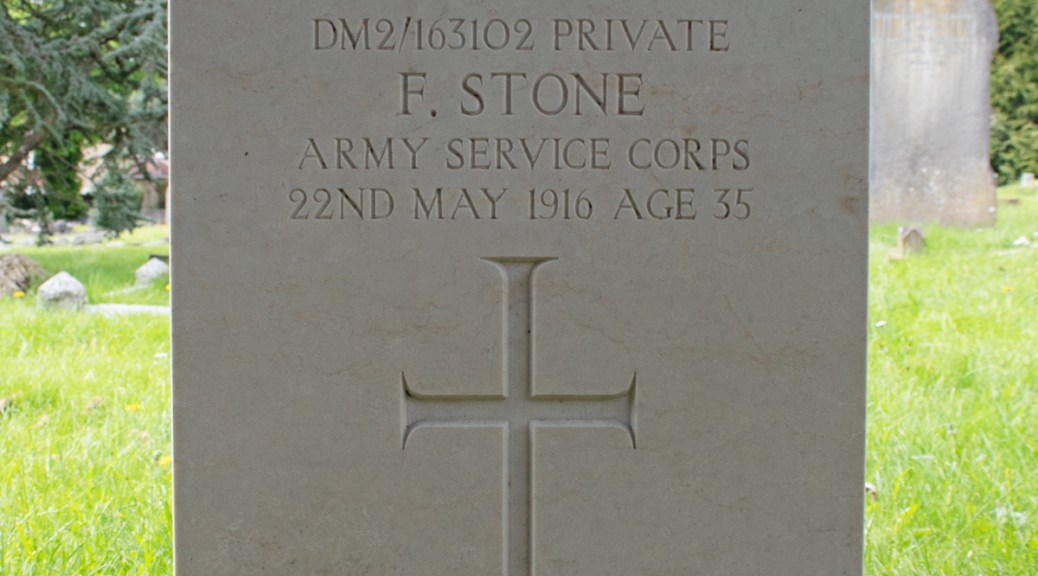
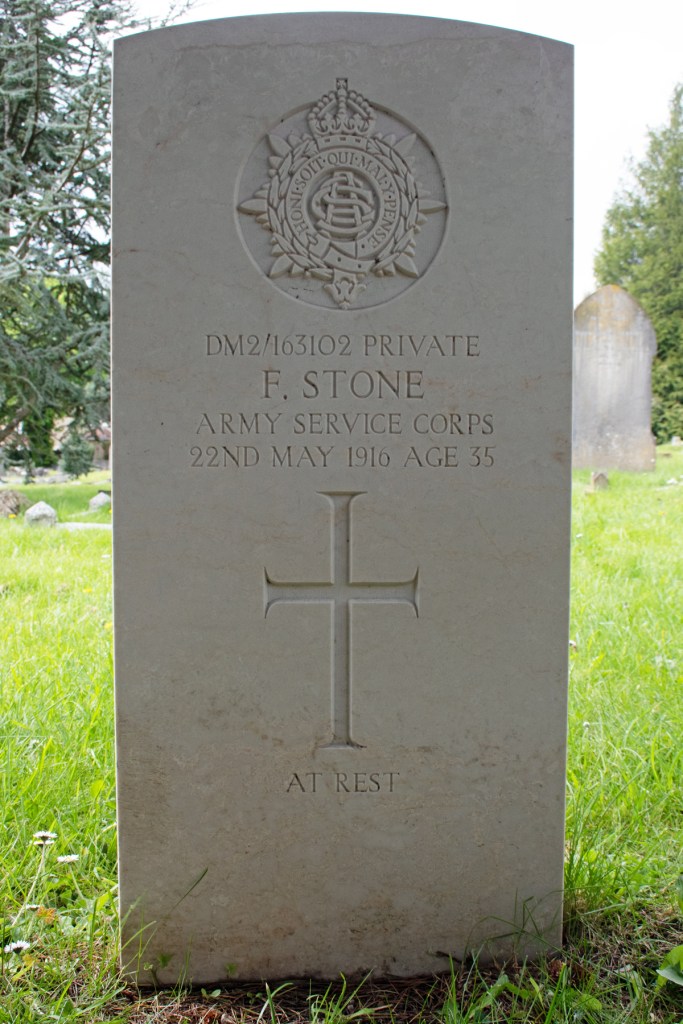
Private Frederick Stone

Private Frederick Stone

A lot of the life of Frederick Stone is destined to remain shrouded in mystery. His grave lies in the St Michael’s Cemetery, Bath, Somerset. The headstone confirms that he was a Private in the (Royal) Army Service Corps when he passed away on 22nd May 1916, at the age of 35.

The Commonwealth War Graves Commission give a little more information – he was the husband of Millie Stone, who lived at 9 Mount Road, Englishcombe. Private Stone was attached to the 623rd Mechanical Transport Company.

The 1911 census records a Fred and Millie Stone living at 22 Paragon, Bath, a twelve room Georgian terraced house near the centre of the city. Fred is listed as a gas maker for an ice factory, while Millie, who was eight years older than her husband, is noted as being a boarding house keeper. They couple were recorded as having been married for two years, and they had a seven month old daughter, Emily.

There is no marriage record for the couple, nor a baptism record for Emily, so it is not possible to glean any further information. There are four Bath-born Fred/Frederick Stones in the 1901 census, so again confirming which relates to the Private lying in the city’s cemetery is a challenge.

Private Frederick Stone’s death is not reported in the contemporary newspapers and so seems not to have been out of the ordinary. He was laid to rest in St Michael’s Cemetery, at peace.


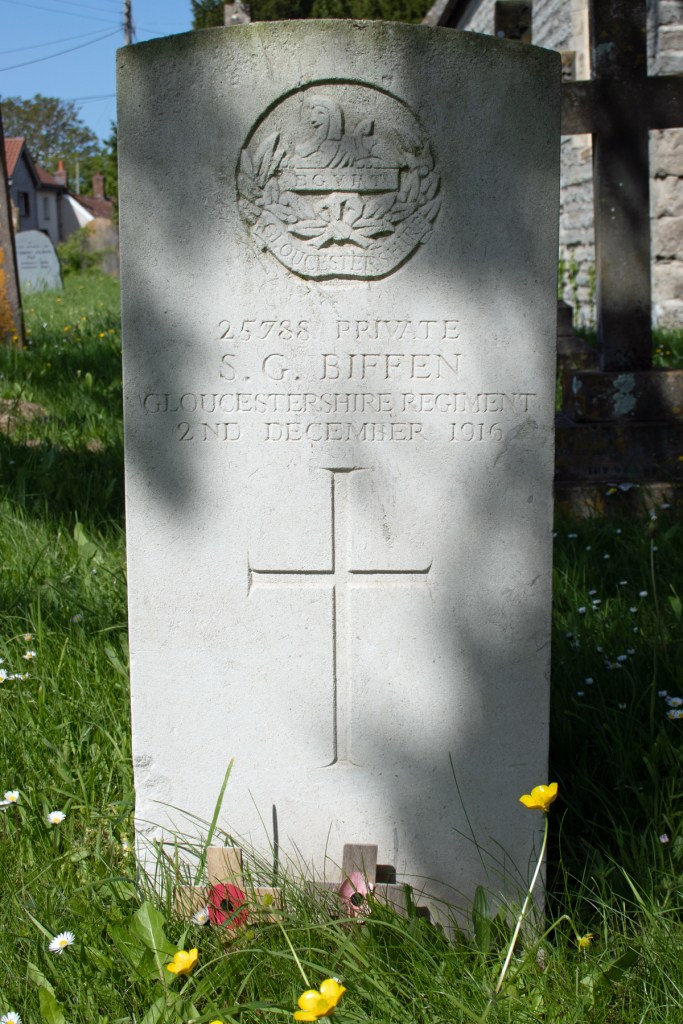
Private Stanley Biffen

Private Stanley Biffen

Stanley George Oliver Biffen was born in the autumn of 1894 in the Somerset village of East Huntspill. He was the second child to Oliver and Fanny Biffen, although his older sibling, sister Florence, had passed away at just three months of age.

Oliver was a carter and farm labourer, and the family went where the work was. The 1901 census found them living in Eastover, Bridgwater, Fanny’s widowed father, George, also living there. Ten years later, the four of them had moved to the village of Stawell. Stanley had finished his schooling, and had also taken up farm work.

When war came, Stanley stepped up to play his part. Full details of his service are lost to time, but he had enlisted in the Army by the spring of 1915. He initially joined the 1st Battalion of the Somerset Light Infantry, and by May that year, was in France.

It is not possible to track Private Biffen’s movements during the conflict, but he did transfer across to the Gloucestershire Regiment at some point. Assigned to the 7th (Service) Battalion, his was a troop that served at Gallipoli and in North Africa, although there is no evidence that Stanley fought in there.

The only other concrete evidence available for Private Biffen relates to his passing. By the autumn of 1916, he had been admitted to the 1st Western General Hospital in Fazakerley, Liverpool. He was suffering from phthitis, or tuberculosis, and this was the condition that was to get the better of him. He passed away on 2nd December 1916, at the age of just 22 years old.

The body of Stanley George Oliver Biffen was brought back to Somerset for burial. He was laid to rest in the quiet graveyard of Stawell Church.


Stanley’s parents had now lost both of their children, and this is likely to have taken a toll on them. Fanny passed away in December 1924, at the age of 64 years old. Oliver died just a year later aged 54 years old.


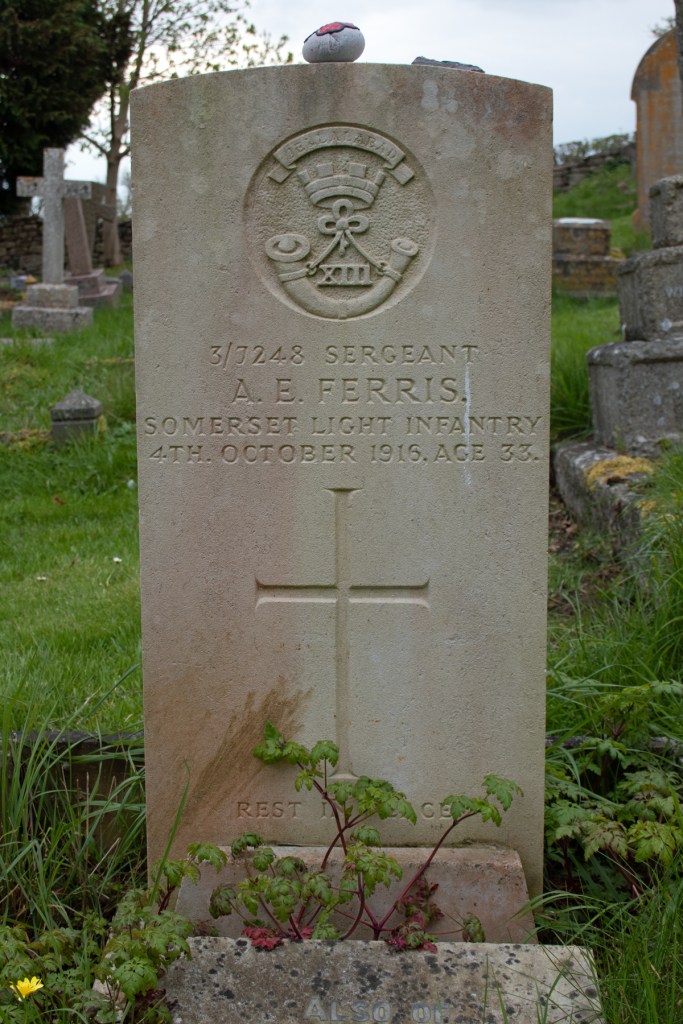
Sergeant Albert Ferris

Sergeant Albert Ferris

Albert Edward Ferris was born in the spring of 1884, one of six children to Charles and Juliana. Charles was quarryman turned farm labourer from Gloucestershire, but it was in the village of Claverton, near Bath, that the family were born and raised.

When he finished his schooling, Albert found work as a baker, but soon sought out a career in the military. On 2nd January 1903 he enlisted in the Royal Marine Light Infantry as a Private. His services records show that he was 5ft 6ins (1.68m) tall, with brown hair, blue eyes and a fair complexion.

Based out of Plymouth, over the next nine years Private Ferris served on four different ships and was recognised as having a very good character and an ability to match.

In 1910, Albert married Eliza Jane Warren, a mason’s daughter from Monkton Combe. The 1911 census found Albert on board the armoured cruiser HMS Cumberland, while Eliza was living with her parents. Military life was taking a toll on married life and, on 6th December 1911 bought an end to his naval career and was ‘discharged by purchase’.

Returning to Somerset, Albert found employment as a motor-man with Bath Electric Tramways. He and Eliza settled into married life, but war was on the horizon and things were to change.

At the outbreak of war, [Albert] promptly responded to his country’s call, and enlisted in the [Somerset Light Infantry], as a Private. When his battalion was sent to France, he distinguished himself in a short time by his excellent work as a sniper, speedily earning his first stripes as a consequence. With his battalion he participated in the heavy fighting around the Ypres district, over an extended period, without sustaining any serious injury. Later his battalion was moved further down the line to take part in the “Great Push,” where, for meritorious conduct, he was… promoted to Sergeant in the field…

Bath Chronicle and Weekly Gazette: Saturday 7th October 1916

Sergeant Ferris’ luck was not to last, however, and things took a turn in September 1916.

In the… fighting around Delville Wood… Sergt, Ferris was severely wounded in the right thigh by a machine-gun bullet. One of his officers gave him the best first-aid treatment possible under the circumstances, and later he crawled nearly three miles in an endeavour to reach the nearest field dressing station. Through loss of blood, shock, and general exhaustion he was on the point of collapse when picked up by a field ambulance, after which he was transferred to the base and later to Tooting Military Hospital, where, despite skilled treatment and the greatest care, septic poisoning intervened and he passed away…

Bath Chronicle and Weekly Gazette: Saturday 7th October 1916

Sergeant Ferris died while admitted in the Surrey hospital on 4th October 1916. He was just 32 years of age.

The body of Albert Edward Ferris was brought back to Somerset for burial. He was laid to rest in the peaceful graveyard of St Michael’s Church, Monkton Combe.


Serjeant Joseph Smith

Serjeant Joseph Smith

Joseph Smith was born at the beginning of 1879 in Bath, Somerset. The fifth of six children – all boys – his parents were William and Sarah Smith. William was a carpenter and, while he did not follow in his father’s trade, Joseph found employment as a house painter when he left school.

Joseph married Alice May Martin in 1896: the couple were young, the groom being a year older than the bride, and they went on to have a daughter, Dorothy, who was born the following year. The newlyweds moved into a small, terraced house in Bath with Alice’s mother and sister, both of whom were widowed, and Alice’s nephew.

The 1911 census found the extended family living in larger home away from the centre of the city. Joseph was still employed as a house painter, Dorothy had left school and was apprenticed to a dressmaker. Alice looks to have been looking after the household, while her mother and sister were both living on their own means.

In his spare time, Joseph was also a member of staff at Bath’s Theatre Royal. He was sporty, with a keen interest in football and partial to a game of cricket. He was also very connected to St Stephen’s Church in the city, and was involved in parish life.

War was coming to Europe, and Joseph stepped up to play his part. Full details of his military service are lost to time, but from his gravestone and linked records, it is clear that he enlisted in the 6th Battalion of the Somerset Light Infantry. Further details are outlined in a contemporary newspaper report:

Though married, he was anxious to enlist practically as soon as the war began: and on January 16th, 1915, he offered himself for service, and was at once accepted. He did not leave England till 16th August [1916]. He had been selected for inclusion in 32 drafts on various occasions prior to that date; but had been obliged to remain behind from illness or some other cause. When he actually sailed, it was not as a member of a draft, but as one of five sergeants who had volunteered for special service.

Bath Chronicle and Weekly Gazette: Saturday 28th October 1916

Sergeant Smith made it to the Western Front, and was entrenched at the Somme. The newspaper report picks up on what happened next:

He was wounded in September, being struck by a bullet while leaving the trench preparatory to advancing. The bullet struck him in the thigh, and severed an artery… After doing what he could with his first-aid dressing, Sergt. Smith crawled some three miles from the firing line amid bursting shells. After five hours of this painful progress he was picked up by a stretcher party.

Bath Chronicle and Weekly Gazette: Saturday 28th October 1916

Sergeant Smith was medically evacuated to Britain for treatment, and was admitted to the 3rd Western General Hospital in Cardiff. Alice and Dorothy were a constant presence as his bedside, but the wound was to prove too severe, and he passed away at the hospital on 25th October 1916. He was 38 years of age.

Joseph Smith was brought back to Bath for burial. He was laid to rest in the Lansdown Cemetery, overlooking the city he called home.


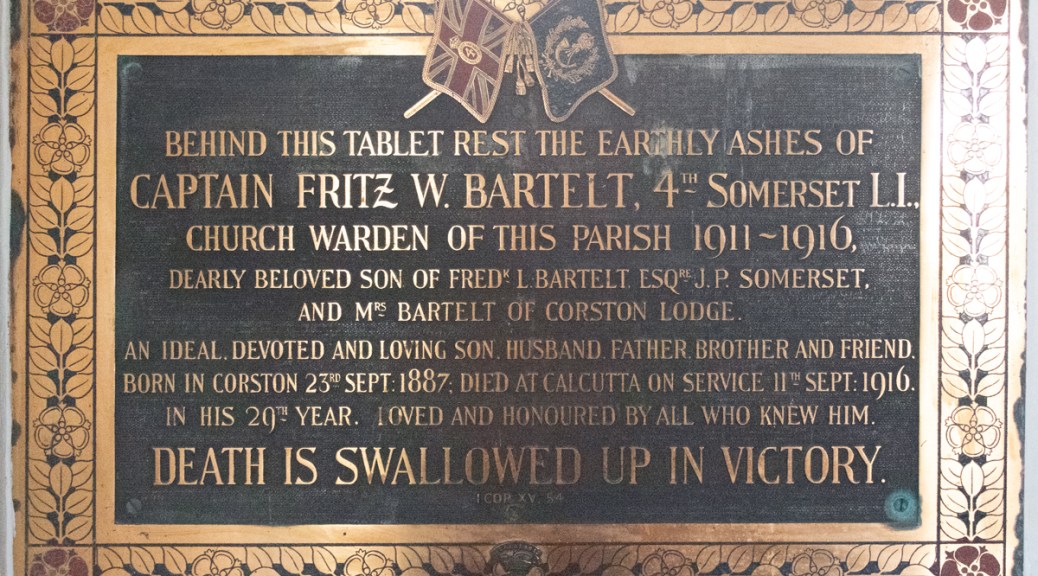
Captain Fritz Bartelt

Captain Fritz Bartelt

Friedrich Wilhelm Bartelt was born on 23rd September 1887 in the Somerset village of Corston. He was the younger of two children to Friedrich and Rosanna Bartelt. Born in Prussia, Friedrich Sr was an import and export merchant of oil and chemicals, who had become a magistrate and chemical manufacturer by the time of the 1901 census.

Friedrich Jr – who was also known as William or Fritz, to avoid confusion with his father – had the upbringing to be expected for the son of a prominent businessman.

He was educated first at St Christopher’s, Bath… and afterwards at Bath College, which he entered in September, 1900, and left in December, 1904. He was prominent in sport and as in the school Rugby Fifteen in 1903 and 1904, and a member of the Cricket Eleven in the summers of 1903 and 1904, and was in the second rowing four in 1904. He subsequently studied chemistry… at Bristol University College, and after a time he became a director in the company of which his father is chairman.

Somerset Guardian and Radstock Observer: Friday 15th September 1916

Fritz enlisted in the Somerset Light Infantry not long after finishing his studies, becoming a Lieutenant in H Company of the Volunteer Battalion, before taking command of G Company. Possibly because other pressures took priority, he stood down from his role in 1911.

On 2nd June 1910, Fritz had married Gertrude Isgar, a gentleman’s daughter from Bathwick, near Bath. The couple went on to have two children, both boys.

[Fritz] was a churchwarden of Corston, and always took a keen interest in all parochial matters, and his loss is very keenly felt in the village. Always kind and genial to all alike, he won the hearts of all with whom he came in contact. His readiness to help, his careful attention to the needs of those around him, and his kindly words and acts will dwell long in the memory of many in Corston.

Somerset Guardian and Radstock Observer: Friday 15th September 1916

When war was declared in 1914, Fritz stepped up to play his part, and was given the commission of Captain in the 2nd/4th Battalion of his old regiment, the Somerset Light Infantry.

On December 1, 1915, he sailed for India, when he took charge of his company, and was afterwards given an important post, being appointed in command of his station at Barrackpore [Barrackpur].

Somerset Guardian and Radstock Observer: Friday 15th September 1916

Captain Bartelt fell ill in the summer of 1916, and was admitted to a hospital in neighbouring Kolkata. While his condition is not reported on, he seemed to have been improving, but his health then took a downward turn, and he passed away while still admitted, on 11th September 1916. He was 28 years of age.

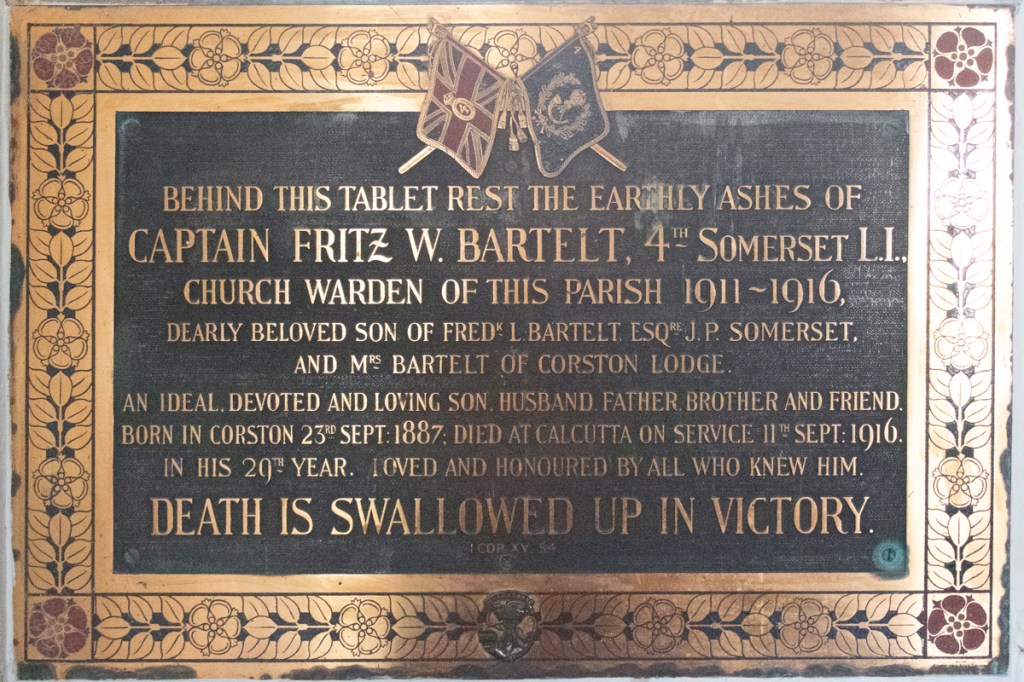
Fritz William Bartelt’s body was cremated in India. His ashes were returned to England, and were interred in All Saints’ Church in his home parish, Corston, where a plaque and a stained glass window are dedicated to his memory.


Captain Fritz Bartelt
(from ancestry.co.uk)

Private Arthur Moore

Private Arthur Moore

On Wednesday 1st March, the relatives of Private Arthur Moore, formerly of Whatley, heard with great regret the sad news that he had passed away. Private Moore, who belonged to the 5th Battalion Australian Expeditionary Force, left Whatley about fourteen years ago for Australia, where he lived until last year. When war broke out he was among the first in Australia to respond to the call of the Motherland. After undergoing his training he was sent to the Dardanelles, and there with many other brave Anzac received what was to prove his death wound, being shot in the head last August by a Turkish sniper. He was brought to King George’s Hospital, London, where he remained for some time and was thence sent to a convalescent home at Isleworth. But three weeks ago his friends, who were expecting him home, were alarmed to hear that he had been sent to the hospital to be again operated on, the wound not having satisfactorily healed. The operation took place on February 28th, but was not successful, as he never rallied, and died the next day… So has passed away another who had tried to do his duty, another of Britain’s many sons who are dying that England may liv. May he rest in peace!

Somerset Standard: Friday 17th March 1916

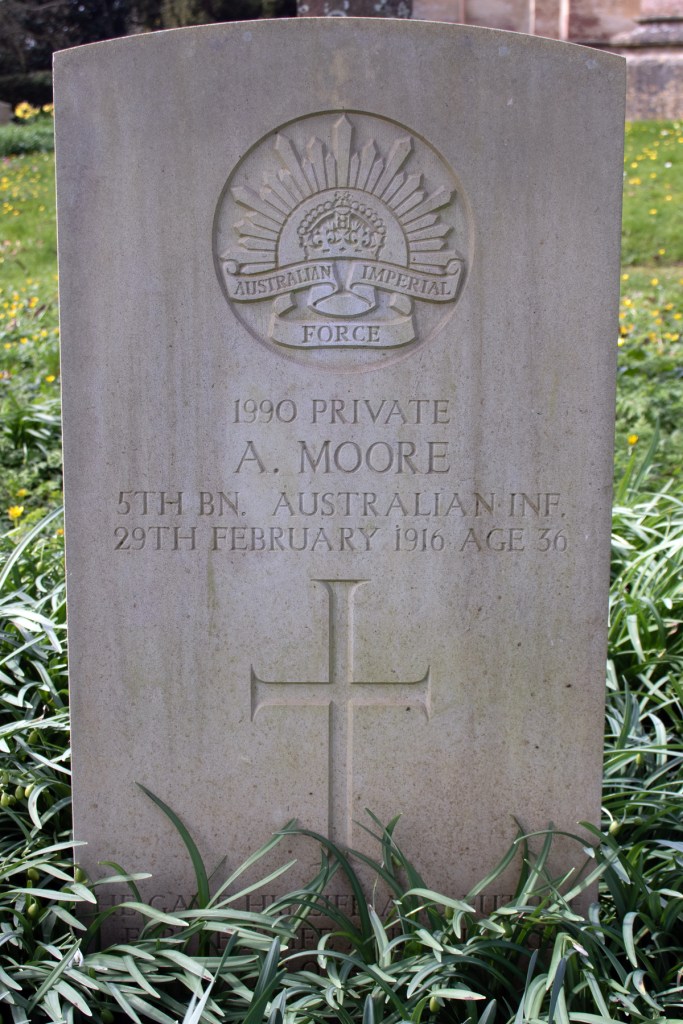
Arthur Moore had been born in Warminster, Wiltshire, in around 1880, and was the son of Henry Albert and Elizabeth Thurzia Moore. Little further information about his early life is available, but some details can be gleaned from his service records.

Private Moore enlisted on 12th January 1915 in Colac, Victoria, around 150km west of Melbourne. His service records note that he was working as a barman, and that he had spent five years volunteering in the Yeoman Cavalry. Arthur’s medical report confirmed he was 5ft 8ins (1.73m) tall and weighed 168lbs (76.2kg). He had fair hair, blue eyes and a fair complexion.

Arthur gave his next-of-kin as Francis Moore, possibly his brother, but his service documents also noted that his father had died by the time he enlisted and recorded his mother’s details as well.

The Somerset Standard summarised Private Moore’s military career, cut tragically short when the Turkish sniper attacked. After he passed, Arthur’s body was brought back to Somerset for burial. He was laid to rest next to his father, in the quiet graveyard of Holy Trinity Church in Chantry, not far from the family home.


Private George Taylor

Private George Taylor

George William Taylor was born on 14th July 1884 in Holcombe, Somerset. He was one of ten children, and his parents were John and Martha Taylor. John was a coal miner and for a while after finishing school, George followed his father to the pit. But he wanted bigger and better things, and was drawn to a career in the army.

On 16th September 1901, George enlisted in the Somerset Light Infantry. His service records confirm that he was 5ft 7ins (1.69m) tall, and weighed 131lbs (59.4kg). It was also noted that he had brown hair, grey eyes and a fresh complexion, and that he had a scar on his right shin and another on his left arm.

Private Taylor was assigned to the 2nd Battalion, and spent the next ten months training on home soil. In July 1902, however, he set off on his first big adventure, travelling to South Africa with his troop. He returned home in the spring of 1903, and spent the remainder of his seven years’ term of service on British soil.

On Christmas Day 1906, George married Ellen Hitchcock. She was the daughter of a blacksmith from Bath, and their marriage certificate adds further details to George’s life. He was living in Plymouth, Devon, when they married, and he gave his trade as a Bugler in the Somerset Light Infantry.

During the rest of his army contract, George had a number of admissions to hospital, for recurring conjunctivitis, a sprained ankle in November 1905 and a bout of scabies in January 1908. That autumn, having served for seven years, he was stood down to reserve status.

By the time of the 1911 census, George had settled back into civilian life. The young couple set up home in Holcombe, and George took up work back in the colliery there, where he was employed as a carter. A boarder helped them bring in a bit more money, but the document shows evidence of tragedy as it notes that Ellen had given birth to two children, but that both had died.

When war came to Europe in 1914, George was called back into active service. Initially assigned to the 1st Battalion of the Somerset Light Infantry, he arrived in France in July 1915. He only remained there for a matter of months, however, and, by October Private Taylor was back in Britain and reassigned to the 3rd Battalion.

It appears that his repatriation may have been for health reasons. On 31st January 1916, George was admitted to the 4th Southern General Hospital in Plymouth. The handwriting in the notes for this admission is difficult to read, but the basic headline is starkly clear: ‘bronchitis and subsequently mental’.

Private Taylor remained in hospital for a couple of weeks, before being moved to the Wells Asylum in Somerset. He was assessed by the military doctor after a couple of months’ treatment, and was declared unfit to continue in active service, due to ‘general paralysis of the insane’ or shellshock/PTSD as it is known today. His illness was wholly attributed to his military service, and sheds some light on what he must have gone through during his short time in France, compared to his previous seven years’ service. George’s last day in the army was on 13th April 1916, and he had served for a total of 14 years, 211 days.

George’s trail goes cold at this point. He passed away on 22nd December 1916, at the age of 32 years old. Although records do not confirm this, it seems likely that he died while he was still admitted to the asylum, as his death was recorded in Wells.

George William Taylor was brought back to Holcombe for burial. He was laid to rest in the family plot in the graveyard of St Andrew’s Church.


Private Robert Gillo

Private Robert Gillo

Robert Cogle Gillo was born in December 1880 in Bridgwater, Somerset. He was the only child to Jane and Robert Gillo who, in the 1881 census was listed as a wholesale photographer, employing four male and four female assistants.

The following census, a decade later, found the family living in Walcot, Bath, where Robert Sr was listed as living on his own means. The household also included Jane’s sister, Elizabeth, and a certified nurse, Jane Moreton.

When he left school, Robert Jr found work as an auctioneer’s clerk. By the time of the 1901 census, both of his parents had passed away, and he was boarding at Hanover House, Hanover Street in Bath. The document, however, throws up an anomaly, however, in that the house’s three other occupants are listed as Edna and Majorie White, who are identified as Robert’s daughters, and Lily Holvey, who was a servant. Whether the head of the household was not there at the time of the census return is not known, but given that ages of Edna and Marjorie were 9 and 5, to Robert’s 20, it is extremely unlikely that they were actually his children.

By the following summer Robert had taken up employment as an auctioneer in Dorset. On 4th June 1902 he married Kathleen Seward, an agent’s daughter from Bath. The couple would go on to have two children, Molly, in 1904, and Robert in 1911.

By the time Robert’s son was born, the family were living back in Bath. He was, by now, listed as living on his own means in his own right, and the family occupied a seven room house in a quiet cul-de-sac within spitting distance of the city’s Alexandra Park.

When war came to Europe, Robert stepped up to play his part. He had enlisted in the Army Ordnance Corps by the autumn of 1915, and was stationed in Didcot, Oxfordshire. When he wrote to Kathleen, he complained of not being able to sleep in the barracks, and this insomnia led to him suffering from headaches.

Sent home on sick leave in March 1916, he was quite depressed and worried, his short term memory was affected, and he had to write even the simplest tasks down, including remembering to shave. He was seen by his doctor, who had written to his commanding officer, suggesting that an extension to this leave was be beneficial. Whether this was granted or not is unknown, but after a short period back in camp, Private Gillo returned to Bath on 17th April.

Kathleen had gone out at about 5pm the following day and when she returned home just after 7pm, she was told that Robert had just left. This was not unusual, as far as she was concerned, because he often went out for a walk in the evening. Sadly, she was not to see him alive again.

Terrible Railway Fatality

On Wednesday morning last week [18th April] the much-mutilated dead body of Mr R Gillo… was picked up on the Great Western Railway at Bathampton… He was home on leave from Didcot. Deceased suffered from neurasthenia, and was depressed at times.

Central Somerset Gazette: Friday 28th April 1916

Robert had walked the five miles east to Bathford and, made his way to the railway track over the river in the village. He got onto the tracks as the express train from Paddington was coming through at around 10:30 that evening, and never stood a chance.

The the following morning the alert was raised by a signalman at Bathampton and the gruesome discover was made of parts of Robert’s body over the half-a-mile from Bathford Bridge. His glasses were found on the bridge itself and a note to Kathleen was found in his pocket. Blood was subsequently found on the front of the railway engine, although the driver was oblivious to anything out of the ordinary having happened the previous night.

An inquest found that Private Gillo had committed suicide while in a state of temporary insanity. He was just 35 years of age.

Robert Cogle Gillo was laid to rest in St James’ Cemetery in Bath, a short walk from the family home.


Private Robert Gillo
(from ancestry.co.uk)

Robert’s headstone notes the burial of Adelaide Julia Seward, Kathleen’s mother, who died in March 1936.