Tag Archives: 1916

Private Joseph Roe

Private Joseph Roe

Joseph Leonard Roe was born on 16th February 1892 in Totnes, Devon. The older of two children, his parents were Francis and Mary Roe. Mary died in 1898, when Joseph was only six years old, leaving Francis, who was a traveller for a wholesale grocer, to raise his sons. Tragically, he also passed away in 1902, and it seems that Joseph and his brother were left in the care of their paternal grandmother.

Hope was to come out of adversity – the 1911 census recorded Joseph as boarding in a school in Tiverton, while his brother, who was called Francis, found work as a clerk at a chartered accountant. He was living with his grandmother Mary and aunt Marian in Weston-super-Mare, Somerset.

Joseph followed in his father’s footsteps, finding work as a chemist’s merchant, and this took him travelling across the country. When war broke out, he was living in Wallasey, Merseyside, and it was from here that, on 28th August 1914, he was to enlist.

Joseph’s service records show that he was 5ft 11ins (1.80m) tall, was of good physical development and had good vision. He was accepted for enlistment into The King’s (Liverpool Regiment), and was assigned to the 10th (Scottish) Battalion.

After a coupe of months’ training, Private Roe set sail for France, arriving in Le Havre on 1st November 1914. His time overseas, however, was to be cut short, however, when he contracted a combination of myalgia, bronchitis and diarrhoea. He was medically evacuated back to Britain on 30th November, and given time to recover.

Private Roe remained on home soil for the remainder of his time in the army. However, he continued to suffer with his health. In the spring of 1916, he contracted tuberculosis and was at his grandmother’s home when he passed away on 4th April. He was just 24 years of age.

Joseph Leonard Roe was laid to rest in Totnes Cemetery, buried in the family grave, and reunited with his parents at last.


Francis, meanwhile, had also played an active part on the First World War. He joined the 2nd Battalion of the South Lancashire Regiment and fought on the Western Front.

While at Etaples, he was wounded, and succumbed to his injuries on 7th January 1916, aged just 21 years old. Second Lieutenant Francis Roe was buried at Etaples Military Cemetery in Northern France.

His sacrifice is also commemorated on the family monument in Totnes Cemetery.


Stoker John Campbell, AKA John Connolly

Stoker John Campbell, AKA John Connolly

John Connolly was born on 7th April 1887 in Liverpool, Lancashire. There is little information available about his early life, although his parents were Thomas and Marianne Connolly. A Roman Catholic, he was baptised at St James Church and went on to marry a woman called Bridget, although details for the wedding are lost to time.

John must have had a level of proficiency when it came to ships and sea-faring as, when war had broke out, he was call up for service with the Royal Naval Reserve (RNR). He enlisted as a Stoker on 1st October 1915, using the surname Campbell. His records show that he was 5ft 6ins (1.68m) tall, had blue eyes and a fair complexion.

Stoker Campbell was based at HMS Pembroke, the Royal Naval Dockyard in Chatham, Kent. His time in service, however, does not seem to have been a happy one. In fact, within a few months of being conscripted, John had absconded and made his way back to Liverpool.

John was caught and was being brought back to Kent under escort, when the unimaginable happened.

John Connolly, a stoker of the RNR, attached to the Royal Naval Barracks, Chatham, was found dead on the railway near Warren House Crossing, between Sole Street and Cuxton, on Wednesday, with terrible injuries to his head.

Connolly, who is known also as Campbell, had been arrested as a deserter at Liverpool, and was returning to Chatham under escort on Tuesday… The train was very full, and deceased, with his escort, stood in the corridor, where several soldiers were also standing.

Some time after the train had left Herne Hill the escort, Leading Stoker John Edward Craig, left his prisoner to proceed to the lavatory, and when he returned one of the soldiers shouted “Jack, your prisoner had gone out the window.” The train was stopped, but the guard suggested that Craig had better proceed to Rochester instead of searching for the deceased, as the night was very dark. At Rochester Bridge the matter was reported to the military authorities, and a search along the line, then ordered, resulted in the discovery of the body of deceased…

A Lance Corporal of the 2/5th King’s Liverpool Regiment, one of the soldiers in the corridor, gave evidence at the inquest… He said he was standing close by deceased, but did not see him go out of the window, which was open at the time.

It was stated that is was usual in the Navy for one man only to act as escort, as all expenses connected with desertions had to be paid by the prisoners.

The jury found the death resulted from injuries received by deceased in a fall from the train, but that there was not sufficient evidence to prove whether the fall was intentional or otherwise.

South Eastern Gazette: Tuesday 8th February 1916

Whether John had intended to throw himself from the train will never be known. All that can be confirmed is that he died of his injuries on 1st February 1916, aged just 28 years old.

John Connolly was laid to rest in Woodlands Cemetery, Gillingham, not far from the dockyard at which he had been based. His epitaph mentioned both of the names he chose to go by, and the inscription: “Beloved husband of Brigid, her one and only love. Re-united RIP. Jesus mercy Mary help.


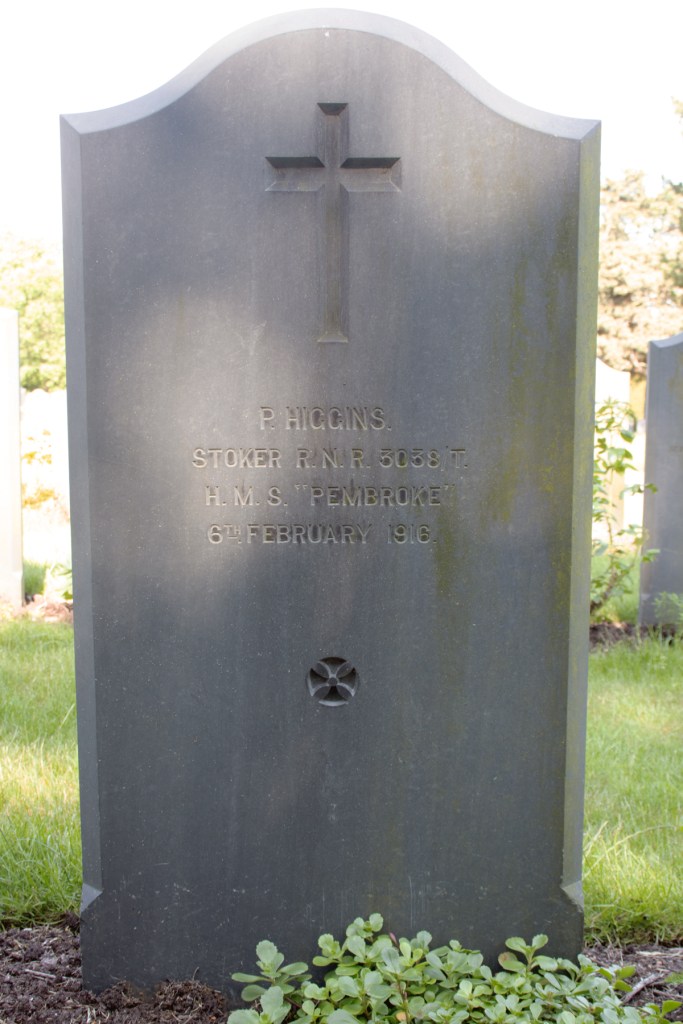
Stoker Peter Higgins

Stoker Peter Higgins

Peter Higgins was born in Thornaby, North Yorkshire, on 23rd January 1887. His parents were William and Catherine (Kate) Higgins, but of them there is very little information.

What seems likely that Peter would have had some experience with boats as, on 26th May 1909, he enlisted in the Royal Naval Reserve. His service records show that he was 5ft 7ins (1.70m) tall and was described as having blue eyes and a pale complexion. He was also noted as having a scar over his left eye and another on his left thigh.

When war broke out, Peter was officially called for duty and, over the next couple of years, he served as a Stoker on the battleship HMS St Vincent. The ship patrolled the North Sea, and would later be involved in the Battle of Jutland.

Stoker Higgins, however, was back on dry land by that point, having been assigned to HMS Pembroke, the Royal Naval Dockyard in Chatham, Kent. Peter had fallen ill with a gastric ulcer, and tragically, this was to prove fatal. He passed away on 16th February 1916, at the age of just 29 years old.

Peter Higgins was laid to rest in the naval section of Woodlands Cemetery in Gillingham, Kent, not far from the dockyard that was to prove his last posting.


Private William Jackson

Private William Jackson

Little concrete documentation remains about the life of William Henry Jackson. He was born in Bedford, Bedfordshire, on 6th February 1872, although it is not possible to identify who his parents were.

He married a woman called Edith in 1903, and the couple settled in her home town of Beeston, Nottinghamshire. By the time of the 1911 census, he was recorded working as an electrician’s labourer at the local telephone works, while Edith, who was five years his senior, earned extra money as a blouse finisher.

Information about William’s wartime efforts are also limited. He enlisted in the Royal Marine Light Infantry, and was assigned to the Chatham Division. He was given the rank of Private and based at the Royal Naval Dockyard in the Kent town.

The only other information available for Private Jackson is that he died on 16th September 1916, having contracted a combination of pneumonia and tuberculosis. He was 44 years of age.

William Henry Jackson was laid to rest in Woodlands Cemetery, Gillingham, not far from the dockyard in which he had served. His headstone gives the initial H, rather than W, although no documents suggest he went by any name other than William.


Signalman Albert Chevalier

Signalman Albert Chevalier

Albert Patrick Michael Chevalier was born in India on 16th June 1893. There is little definitive information about his early life, although his mother was called Georgina, and the family may have moved back to England when Albert was just a child.

When he left school, Albert found work as an errand boy in an office. But he wanted bigger and better things and, on 4th May 1909, aged just fifteen years old, he enlisted in the Royal Navy. Because of his age, he was given the rank of Boy 2nd Class, and for the first eighteen months, he was assigned to training bases – HMS Ganges and HMS Impregnable.

After only a few months, Albert was promoted to Boy 1st Class and, after a month at HMS Pembroke – the Royal Naval Dockyard in Chatham, Kent – he was given his first sea-going appointment on board the cruiser HMS Minerva.

Albert spent eighteen months on Minerva, during which time he came of age. He seems to have had an understanding of basic technology, as he was given the rank of Ordinary Signalman. After some more time in Chatham, Albert went to sea again, this time on board another cruiser, HMS Cressy. At the start of 1913 he was promoted again, and given the rank of full Signalman.

Signalman Chevalier went on to serve on a number of different vessels, primarily the battleship HMS Swiftsure, where he served for nearly three years, plying the waters between Britain and India. By the spring of 1916 he was back in Chatham, however, and it was here that things took a turn for the worse.

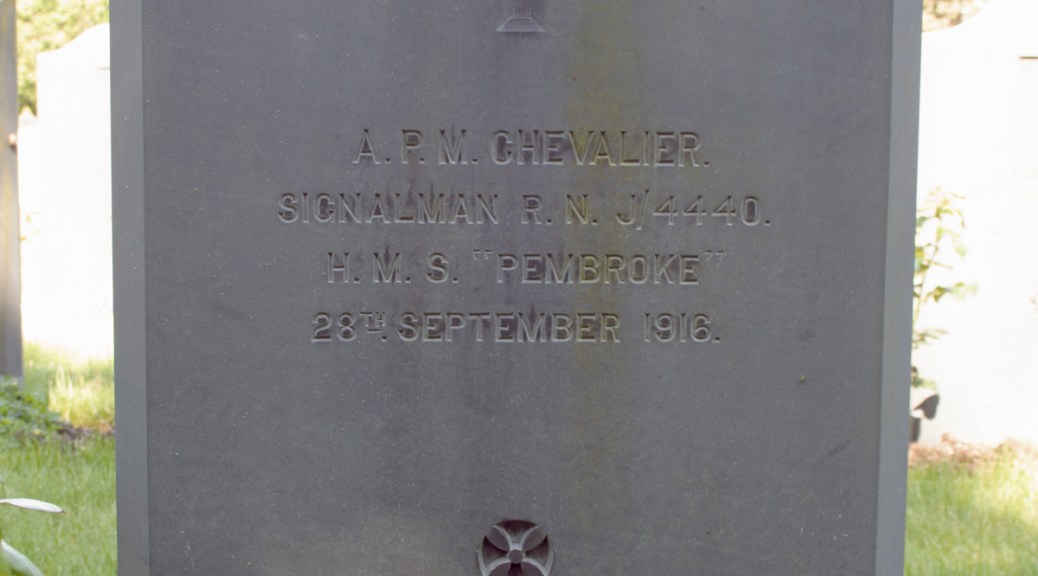
Albert was admitted to the Royal Naval Hospital in the town, suffering from pleurisy. Sadly, the condition was to get the better of him and he passed away the hospital on 28th September 1916, at the age of just 23 years of age.

Albert Patrick Michael Chevalier’s body was laid to rest in Woodlands Cemetery, Gillingham, not far from the dockyard from which he had made so many of his voyages.


Albert’s mother Georgina had not settled in England for long. The army pension record gives her as Albert’s beneficiary, but notes her address as Victoria Street, Daylesford, Victoria, Australia.


Private Owen Owen

Private Owen Owen

Owen Jonah Owen was born in 1880, the oldest of eleven children to Jonah and Elizabeth Owen. Jonah was a quarryman at one of the slate mines around Llanberis, Gwynedd, and this is where the family were raised.

Owen followed his father into the slate quarries and, on 26th September 1903, he married Ann Jones, the daughter of another quarry worker. The couple went on to have four children: Richard, Jonah, Delia and Gwyneth.

He was well known and respected in the village, had a passion for singing and “had conducted singing festivals held by the Congregationalists of the district.” [Caernarvon & Denbigh Herald: Friday 24th November 1916]

War was closing in on Europe, and Owen was keen to play his part. Sadly his service records have been lost over time, but it is clear that he had enlisted in the army by May 1916. Private Owen joined the Royal Welch Fusiliers, and was assigned to the 14th Battalion.

Part of the 38th Division, the battalion was to be caught up in some of the fiercest and most desperate fighting of the First World War. In July 1916, Owen would have been entrenched at The Somme and, after the first few horrific days, his battalion was one of those involved in the fighting at Mametz Wood.

Private Owen was badly wounded during the battle and medically evacuated to Britain for treatment. Admitted to a military hospital in Birmingham, he was to remain there for a number of months until, on 12th November 1916, his body finally succumbed to his injuries. He was 36 years of age.

Owen Jonah Owen was brought back to his home village for burial. He was laid to rest in the graveyard of St Peris Church in Llanberis.


Company Serjeant Major Henry Bird

Company Serjeant Major Henry Bird

Henry Sidney Bird was born on 2nd December 1884 in Penarth, Glamorgan. He was the second of two children to painter and glazier Frederick Bird and his wife Emma. Henry’s mother passed away when he was only eleven years old and, by the time of the 1901 census, he was boarding with a family in the town, and working as a domestic gardener.

The next census – in 1911 – found the family back together again. Henry’s brother Frederick Jr was the head of the household, and she and his family – wife, Eliza, and three children – shared their home with Henry and his father. Harry, by this time, was working as a ship’s fireman.

Little information remains about Henry’s military service. He joined up when war broke out, and records show that he had enlisted in the South Staffordshire Regiment by the start of 1916. Assigned to the 8th (Service) Battalion, it is likely that he soon found himself on the Front Line.

Henry’s bravery seems to have been without fault. He went on to reach the rank of Company Serjeant Major in his battalion and was awarded the Distinguished Service Medal. The citation confirmed this was for “conspicuous gallantry. When the enemy rushed an isolated trench he saved the situation by collecting bombs and superintending the erection of stops and barbed wire. During the whole operations he set a splendid example to his company.

Company Serjeant Major Bird’s battalion was caught up in the fighting at Ypres early in 1916 and, by the summer, was involved in the Battle of Albert. It was here that Henry was wounded, and he was quickly evacuated to Britain for medical treatment. Admitted to the General Hospital in Northampton, his wounds were to prove too severe, and he passed away from them on 18th July 1916. He was just 31 years of age.

Henry Sidney Bird’s body was brought back to Wales for burial: he was laid to rest in the graveyard of St Augustine’s Church in his home town of Penarth.


Guardsman Bertie Thomas

Guardsman Bertie Thomas

Bertie John Thomas was born in Penarth, Glamorgan, in 1890, one of twelve children to Henry and Elizabeth Thomas. Henry was a ship’s rigger, but much of Bertie’s life remains a mystery.

The 1901 census recorded the family living together in a small terraced house in Cliff Street, but ten years later, with the family having grown, many had dispersed. Bertie’s older sisters had moved on – Hannah as a live-in barmaid in nearby Barry; Gladys working as a dressmaker in the Rhondda, living with her aunt and uncle. Of Bertie himself, however, there is no record.

When war came to Europe, Bertie would have played his part. He had enlisted in the Welsh Guards by the spring of 1916, and was a Guardsman in the 1st Battalion. The Guards Division were involved in many of the key conflicts of the war, including at Loos in 1915 and at the Somme the following year.

Guardsman Thomas was caught up in the Battle of Flers-Courcelette in September 1916, and was badly wounded. He was medically evacuated to home soil for treatment, and was admitted to a hospital in Cardiff. His wounds were to prove too severe, and he died on 26th September 1916, aged just 26 years of age.

Bertie John Thomas was brought back to Penarth for burial. He was laid to rest in the graveyard of St Augustine’s Church in the town.


Lance Corporal Colin Clarke

Lance Corporal Colin Clarke

Colin Lewis Clarke was born in the spring of 1879 in Cardiff, South Wales. He was one of seven children to Bernard and Elizabeth Clarke. Bernard was a carpenter, but after Elizabeth died in 1886, he took over the running of the Windsor Hotel in Penarth.

When he left school, Colin found work as a clerk. Bernard also died in 1908, and the 1911 census records Colin and his brother Thomas living with his sister, Beatrice. They were sharing the house with Beatrice’s second husband, Charles, and her six children from her first marriage in the Cheshire village of Poulton.

Colin’s trail goes tantalisingly cold at this point. When war broke out, he enlisted to play his part, joining the 16th (Transport Workers) Battalion of the York and Lancaster Regiment by the summer of 1916. This troop was a territorial force, and Private – and then Lance Corporal – Clarke was based in the Yorkshire Dales.

At some point during the autumn Colin fell ill, and was admitted to the Military Hospital in Middlesbrough. His condition is unclear, but he was to succumb to it, passing away on 5th November 1916, the age of 37 years old.

Colin Lewis Clarke’s body was brought back to Wales for burial. He was laid to rest in the graveyard of St Augustine’s Church in Penarth, Glamorganshire.


Deck Hand Philemon Richards

Deck Hand Philemon Richards

Philemon Witheridge Richards was born on 9th July 1891 in Porthleven, Cornwall. He was one of at least seven children to George and Ann Richards. George was a sailor, as were he two oldest sons and, by the late 1890s, the family had made the move to Penarth in Glamorganshire.

When he left school, Philemon followed his father and older brothers into sailing. By the time he turned eighteen, George had passed away and Philemon wanted bigger and better things. On 16th July 1909, he enlisted in the Royal Garrison Artillery. His service records show that he stood 5ft 9.5ins (1.76m) tall, had good vision and was of good fitness.

Gunner Richards was posted to No. 6 Company and remained part of the territorial force. On 1st July 1911, after twenty months’ service, he was, at his own request, discharged from the army.

The trail goes cold for a while, and Philemon seems to have returned to a life at sea. This changed, however, when war broke out and, in October 1915, he was drafted into the Royal Naval Reserve as a Deck Hand.

Philemon’s time in service seems to have been shore-based however. After an initial posting to HMS Vivid, the Royal Naval Dockyard in Devonport, he moved to HMS Victory, which was the name given to the dockyard in Portsmouth, Hampshire. He moved on again in the autumn of 1916, by which point he was based at HMS Pembroke, the Royal Navy’s shore-base in Chatham, Kent.

It was here that Deck Hand Richards fell ill. It is unclear what the condition was, but he was admitted to the Military Hospital in Chatham on 20th October 1916. His illness worsened, and he passed away there on 2nd November. He was just 25 years of age.

Philemon Witheridge Richards was brought back to Glamorganshire for burial. He lies at rest in the graveyard of St Augustine’s Church in Penarth.


Philemon’s gravestone is also dedicated to his brother, Thomas Witheridge Richards. Eighteen years Philemon’s senior, Thomas had been a sailor, and, while no records remain, it seems likely that he may also have been called into service during the First World War. He died at home on 4th July 1918, at the age of 45 years old. He was laid to rest in the same plot as his younger brother.