John Charles Winter was born in the summer of 1898, the younger of two children to James and Henrietta Winter. James was an agricultural labourer and carter from the village of Oake in Somerset. Henrietta had been born in Ontario in the USA, and was the daughter of English immigrants.
Little is documented about John’s early life. The 1911 census shows him living with his parents and his mother’s widowed brother, an army pensioner. At 12 years old, John was still at school.
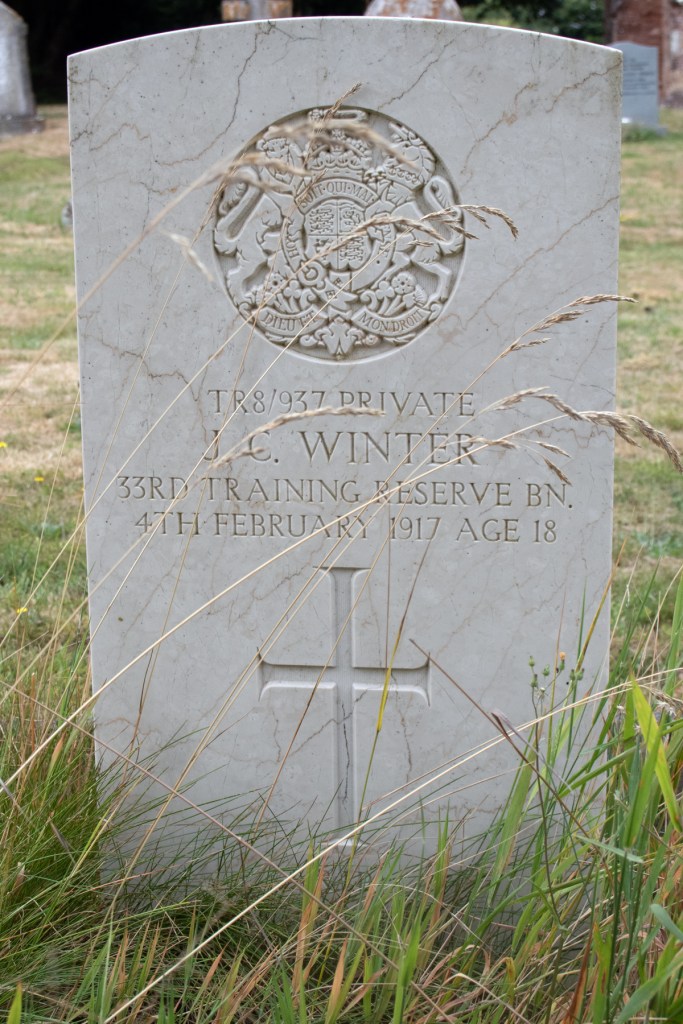
War was coming to Europe by this point, and, as soon as he was able to (and probably encouraged by his uncle), John enlisted. He joined the 33rd Training Reserve Battalion, which was connected to the Warwickshire Regiment, at some point after August 1916.
Again, the details of his military service are scarce, but it seems that he soon fell ill, presumably from one of the medical conditions that tend to run rife in barracks crowded with men from across the country. The illness was to get the better of him and, on 4th February 1917, Private Winter passed away. He was just 18 years of age.
John Charles Winter was laid to rest in the graveyard of St Bartholomew’s Church in his home village of Oake.
Lewis Morgan was born on 22nd May 1892 in Plymouth, Devon. He was one of six children to former army officer and rector Lewis Harold Gilbert Morgan and his wife, Mary.
Growing up in Plymouth, it seems inevitable that the sea life would take hold in Lewis Jr. He first took up a post in the Merchant Navy, rising to Second Mate in December 1911.
By this point, however, he had set his sights on something more formal and soon enlisted in the Royal Navy. He served on a number of vessels over the years, and was re-engaged when war broke out. By the summer of 1915, he transferred to the Royal Naval Air Service, earning his wings on 5th August that year.
The now Flight Lieutenant Morgan’s service grew as the war continued. The life of air crew at this point in the era of flight was notoriously dangerous, and Lewis was to meet his own fate. On 11th May 1917, he was flying with Probationer Flight Officer Randolph Seed around Edmonton, Middlesex, when an accident occurred. The local newspaper reported on the incident and the subsequent inquest:
Flight-Lieutenant Mitchell gave a graphic account of the accident. He said that about eight o’clock in the evening he was flying at a height of 1,000 feet, and the machine containing the deceased officers was just ahead, but 500 feet higher. The flying conditions were good, and at the time both machines were going steadily. Glancing upwards he notices that the other machine suddenly appeared to collapse, the front extension of the main plane crumpling up. The machine nose-dived, and a black object fell out of it. The machine continued its descent and fell into the Edmonton Sewage Farm… The machine was so entirely broken up that it was impossible to theorise upon the cause of the accident. Morgan was said to have fallen on a concrete path. The deaths were instantaneous.
Taunton Courier and Western Advertiser: Wednesday 23rd May 1917
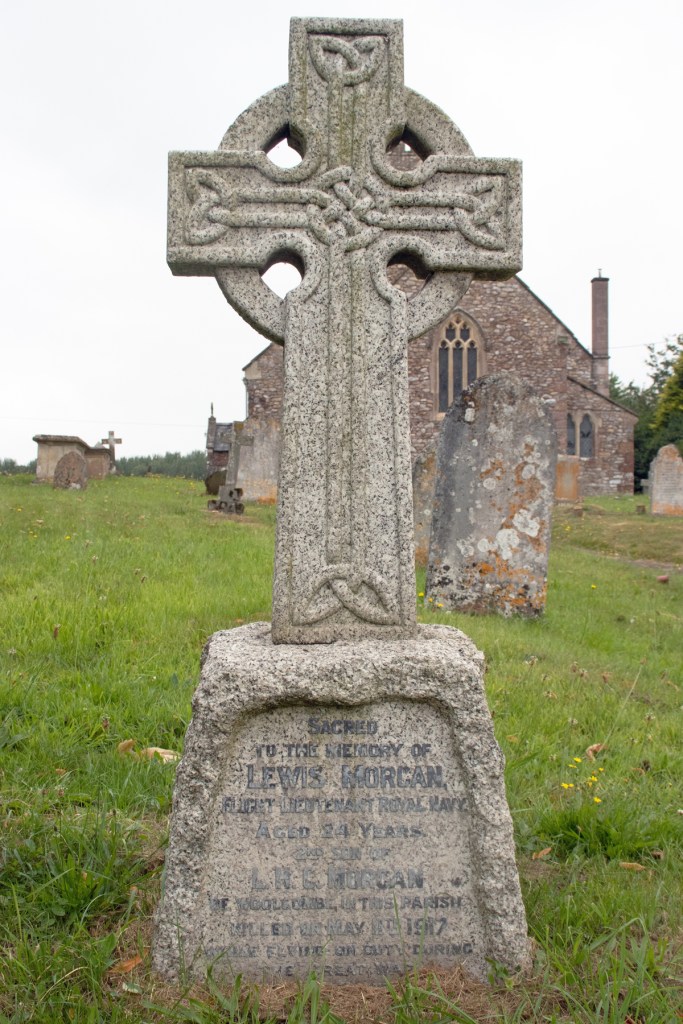
Lewis Morgan was just 24 years old, and days away from his 25th birthday. His body was brought back to Somerset, and laid to rest in the graveyard of Holy Cross Church in Sampford Arundel. By this point, his parents were living in the nearby Woolcombe House, so their son was, in a way, brought home.
The newspaper article went on to report that Flight Lieutenant Morgan was the third and last son to Lewis and Mary.
Francis Morgan – five years Lewis’ senior – enlisted in the Royal Field Artillery when war broke out. He rose to the rank of Captain, and was mentioned in Despatches for his actions. He was killed in the Dardanelles – potentially at Gallipoli – on 2nd May 1915, at the age of 28 years old.
Walter Morgan was a year younger than Lewis. He also played his part in the First World War, joining the South Lancashire Regiment, and rising to the rank of Second Lieutenant. Walter was also sent to fight in Gallipoli, and this is where he also lost his life. He was killed just three months after Francis, on 9th August 1915. He was just 22 years of age.
The loss of three sons in two years was to take a further toll on the Morgan family. Mary had suffered from poor health for a while, and the deaths of Francis, Walter and Lewis was to prove too much. She passed away at home on 15th July 1917, aged just 56 years old.
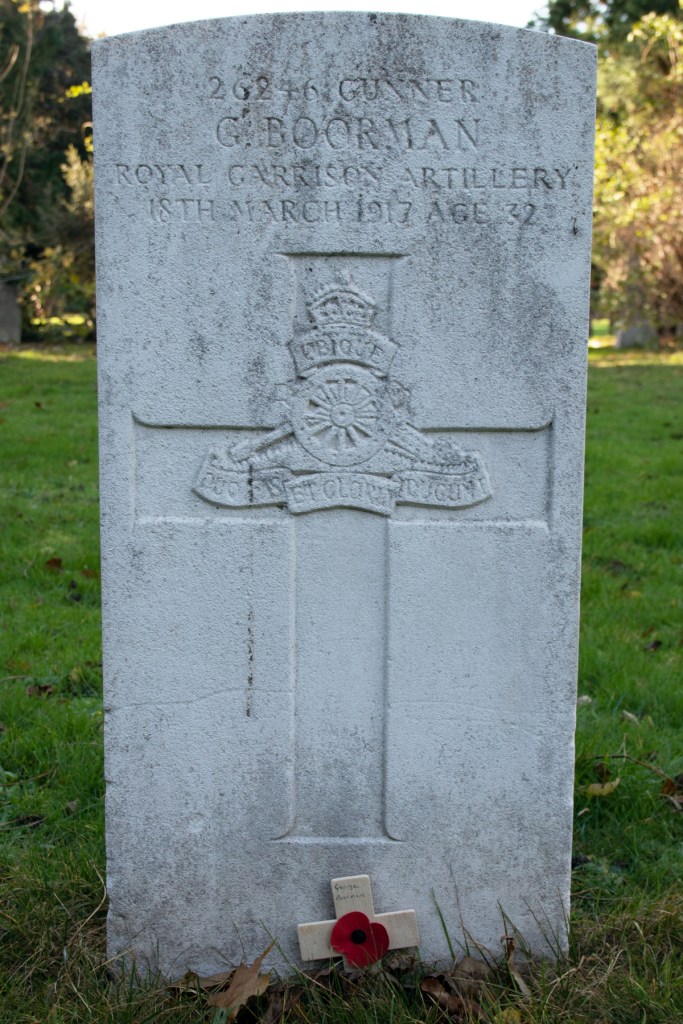
George Boorman was born in Lenham, Kent, in the spring of 1886, one of thirteen children to farm labourer George Boorman and his wife, Sarah. There is little further information about his early life, other than that he went into labouring when he finished school.
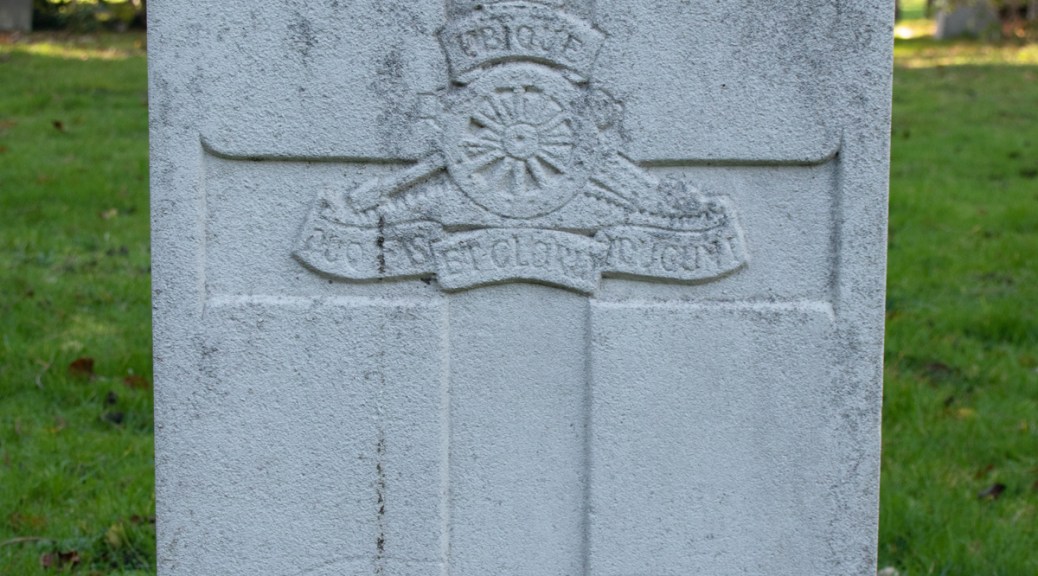
And agricultural life was not enough for George, however, and, on 15th January 1907, he enlisted in the Royal Garrison Artillery. His records show that he was 5ft 9.5ins (1.77m) tall and weighed 134lbs (60.8kg). George had hazel eyes, brown hair and a fresh complexion.
Full details of Gunner Boorman’s military service are not available, but the 1911 census records him as being attached to the 64th Company, based in Aden.
Further information about George’s life is difficult to piece together. His father died in 1913, and the next evidence of Gunner Boorman is that of his passing, on 18th March 1917. The cause of his death is lost to time, but he was 31 years of age.
George Boorman was laid to rest in the Borough Cemetery in Faversham, Kent.
Tragedy struck Sarah Boorman on more than one occasion. Four of George’s brothers died before they turned eighteen, while only six of her thirteen children outlived their mother.
Albert Cluett was born on 2nd August 1896, one of three children to fisherman Richard Cluett and his wife, Johanna. The couple were third generation immigrants to North America, and had made their home on the remote Fogo Island, to the north of Newfoundland.
There is little concrete information about Albert’s life; given his father’s occupation, it seems likely that he would have had a good working knowledge of seafaring, and this led him to enrol in the Newfoundland Royal Naval Reserve when war broke out.
Details of Seaman Cluett’s military life are scant. All that we know is that, by the summer of 1917, he was based at HMS Pembroke, the Royal Naval Dockyard in Chatham, Kent. He was billeted in the Drill Hall, which had been set up with temporary accommodation because the barracks themselves had become overcrowded.
On the night of the 3rd September 1917, the German Air Force carried out an air raids on Chatham. The town was heavily bombed and the Drill Hall received a direct hit. Seaman Cluett was badly injured and died of his wounds in hospital the following day. He had just celebrated his 21st birthday.
Albert Cluett was laid to rest, along with the other victims of the Chatham Air Raid, in the Woodlands Cemetery, Gillingham.
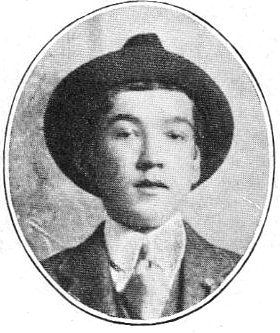
Seaman Albert Cluett (from ancestry.co.uk)
Another young man from Fogo, Seaman Thomas Ginn, also died during the bombing raid; given the remoteness of the Newfoundland town, it seems very unlikely that he and Albert did not know each other.
William John Nolan was born in County Kildare, Ireland, on the 8th October 1892, one of ten children to agricultural labourer Thomas Nolan and his wife, Anna.
There is little documentation connected to his early life, but when he left school, William found work as a porter, and is was this that he was doing up until war broke out in 1914.
William was conscripted on 1st March 1915, joining the Royal Navy as an Ordinary Seaman. His service records show that he stood 5ft 5.5ins (1.66m) tall, had brown hair, brown eyes and a fresh complexion. He was also noted as having tattoos on his forearms, and a scar on his right one.
Ordinary Seaman Nolan was sent to HMS Pembroke, the Naval Dockyard in Chatham, Kent, for training. Within a month, he was given his first posting, on board the armoured cruiser HMS Lancaster. He spent fifteen weeks aboard and, over the next two years, he served on four more ships, returning to his base in Chatham after each voyage.
William came back to HMS Pembroke in July 1917: the base was particularly busy and cramped that summer, so much so that additional temporary accommodation was set up in the barracks’ Drill Hall. This is where Ordinary Seaman Nolan was billeted.
On the night of the 3rd September 1917, Chatham was bombarded by a German air raid, and the Drill Hall received a direct hit. Tragically, Ordinary Seamen Nolan was amongst those killed. He was just 24 years old.
William John Nolan’s body was laid to rest in the Woodlands Cemetery in Gillingham, alongside the other victims of the Chatham Air Raid.
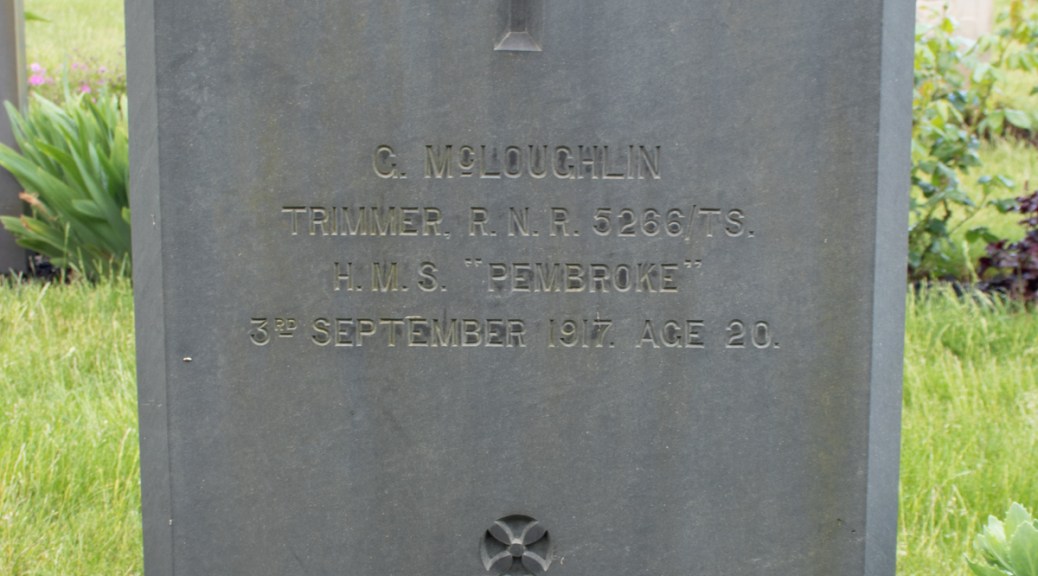
Gilbert McLoughlin was born in Grimsby, Lincolnshire, on 19th August 1896, one of eight children to Charles and Isabella McLoughlin. Being a fishing port, it is likely that Charles was involved in the industry, and it is no surprise that Gilbert and his siblings followed suit.
When war came to Europe, his skills at sea led to him being brought into the Royal Naval Reserve, and indeed Gilbert joined up on 20th March 1916. His service records show that he stood 5ft 2.5ins (1.59m) tall, had brown eyes and a sallow complexion, and had tattoos on his left arm.
Trimmer McLoughlin was based at HMS Pekin, a shore establishment in Grimsby, from which he would have served on ships patrolling the Lincolnshire coast. He remained posted in his home town until the end of 1916, at which point he moved down the coast to HMS Ganges, the naval base in Ipswich.
Gilbert made a further move in July 1917, when he was posted to HMS Pembroke, the Royal Naval Dockyard in Chatham, Kent. The base was particularly crowded that summer, and he was billeted in temporary accommodation set up in the barracks’ Drill Hall.
On the night of 3rd September, Chatham came under attack from a German air raid, and the Drill Hall received a direct hit. Trimmer McLoughlin was among those to be killed that night. He was just 20 years of age.
Gilbert McLoughlin was laid to rest in the Woodlands Cemetery in Gillingham, Kent, alongside the other victims of the Chatham Air Raid.
Gilbert’s older brother Joseph McLoughlin was also a victim of the First World War. As the conflict began, he continued his work as a trawlerman, although the role of his ship – the Kilmarnock – now also included elements of mine location.
On the afternoon of the 22nd September 1914, the Kilmarnock left Grimsby on a routine trip. She was around thirty miles offshore when the captain spotted floating mines ahead.
The skipper put out a buoy to mark the position, and intended returning to port to report the matter to the Admiralty authorities, but seeing some naval vessels in the distance he made towards them instead with the object of reporting.
Whilst doing so an explosion occurred amidships, and the vessel was blown into two parts, which sank immediately.
The skipper was blown to pieces on the bridge and the chief engineer badly injured.
The naval vessels, attracted by the explosion, hurried to the spot, picked up the wounded engineer, mate, and one member of the crew.
Boston Guardian: Saturday 26th September 1914
Joseph was one of the six crewmen to be killed in the incident. He was just 19 years of age.
Michael Brown was born on 25th October 1891 in Kirkdale, Lancashire, one of four children to James and Julia Brown. James was a sailor who died when Michael was just a boy. While Julia tried to make ends meet by taking in washing, it must have worried her when her son then fell into a sea-going life when he left school.
Michael enlisted in the Royal Navy on 19th February 1910, by which time he was already a seaman in the merchant fleet. His service records show that he was 5ft 4.5ins (1.64m) tall, had bark brown hair, brown eyes and a dark complexion. He also had a number of tattoos on his forearms, including a shamrock and a cross.
Recruited as a Stoker 2nd Class, Michael served on a number of vessels in the lead up to the outbreak of war, including the scout ship HMS Patrol, which served from Harwich Harbour, Essex. It was here that he gained promotion to Stoker 1st Class in February 1911.
When not at sea, Stoker Brown was based at HMS Pembroke, the Royal Naval Dockyard in Chatham, Kent. When war broke out in 1914, however, he was in the middle of a three-year stint on board HMS St George, a cruiser that went on to guard the Humber Estuary on the east coast of Yorkshire and Lincolnshire.
By the spring of 1916, he was back in Chatham and from this point on, remained firmly on dry land, with assignments in Kent and at HMS Victory, the Royal Naval Dockyard in Portsmouth, Hampshire. By the summer of 1917, though, Stoker Brown returned to HMS Pembroke once again.
The naval base was particularly busy and cramped at that point in the war, and temporary overflow accommodation was set up in the barracks’ Drill Hall. This is where Michael came to be billeted.
On the night of the 3rd September, the German Air Force conducted the first night time raid on England. Chatham came in the firing line, and the Drill Hall received a direct hit. Stoker 1st Class Brown was among those to be killed. He was just 24 years of age.
Michael Brown was laid to rest in the Woodlands Cemetery in nearby Gillingham, along with the other victims of the Chatham Air Raid.
James Anderson was born on 9th April 1892 in Galway, Ireland. He was one of eleven children to labourer Thomas Anderson and his wife, Mary. Thomas was a labourer and fisherman, and it was into the sea-faring life that James entered into when he finished school. The 1901 census notes that the family were Roman Catholic, and that, while not all of them were able to read and/or write, those that could – James included – could do so in both English and Irish.
James was set on using his knowledge of boats to build a career for himself and, on 9th December 1911, he enrolled in the Royal Naval Reserve. His service records show that he was 5ft 3.5ins (1.61m) tall, had a fresh complexion and blue eyes.
Over the next few years, Seaman Anderson served on a number of different vessels, plying the seas around Ireland, to and from Liverpool. He was on board the Cressy when war was declared, and within a couple of weeks, he had been stationed at HMS Pembroke, the Royal Naval Dockyard in Chatham, Kent.
There is little information about James’ life during the war, although, as he appears to have been permanently based at HMS Pembroke, it is likely that his skills were being put to training new recruits, rather than serving at sea.
As the war progressed, Chatham Dockyard became busier. In the summer of 1917, the base became so overcrowded that temporary accommodation was set up in the barracks’ Drill Hall: this is where Seaman Anderson found himself billeted.
On the 3rd September 1917, the first night air raid carried out by the German Air Force bombarded the town, and scored a direct hit on the Drill Hall; Seaman Anderson was among those killed that night. He was just 25 years of age.
James Anderson was laid to rest, along with the other victims of the Chatham Air Raid, in the Woodlands Cemetery, Gillingham.
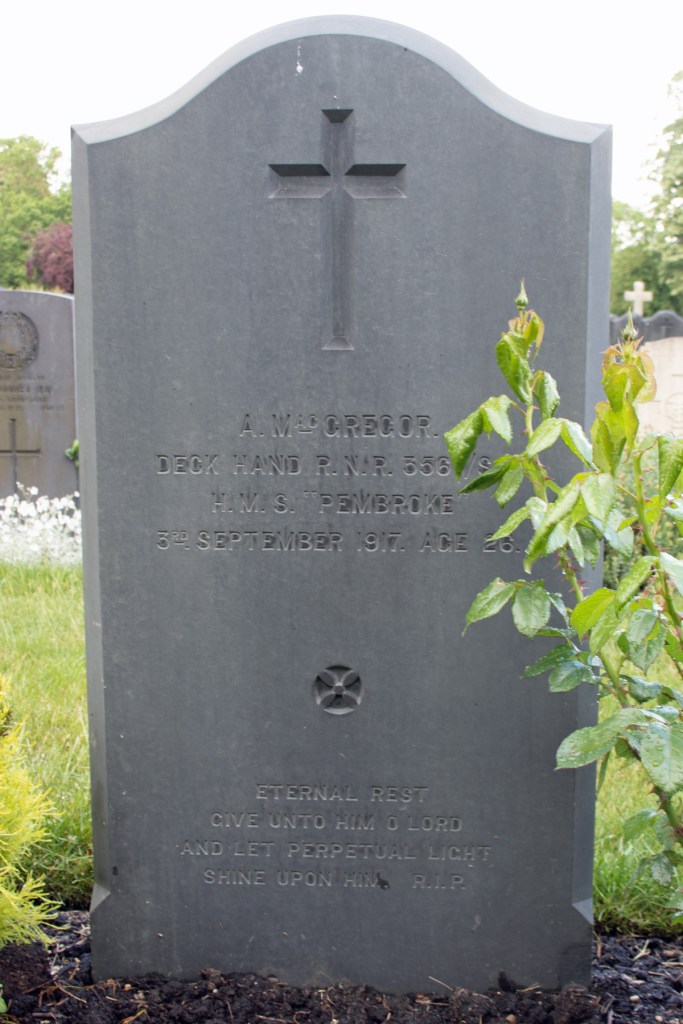
Alexander MacGregor was born on 1st January 1890 in the Scottish village of Acharacle. The oldest of eleven children, his parents were Dugald and Mary MacGregor.
There is little concrete information about Alexander’s early life, but, by the outbreak of war, he had moved to London. He married a woman called Bridget in around 1916: the couple settled in Battersea, and went on to have a son, Peter, who was born in December 1916.
Alexander had, by this point, signed up to play his part in the European conflict. He joined the Royal Naval Reserve as a Deck Hand on 1st December 1915. His service records confirm that he was 5ft 7.5ins (1.71m) tall, had grey eyes and a medium complexion. The section of the Royal Navy that he joined suggests that he had had previous sea-faring experience (given the proximity of his home village to the Argyll coast, this is not surprising).
Deck Hand MacGregor’s was assigned to HMS Pembroke, the Royal Naval Dockyard in Chatham, Kent. Details of his military service are unclear, but he spent just under two years at the dockyard. By the summer of 1917, the base was a busy and cramped place, and Alexander found himself billeted in temporary accommodation set up in the barracks’ Drill Hall.
On the night of the 3rd September, the German Air Force conducted the first night time raid on England. Chatham came in the firing line, and the Drill Hall received a direct hit. Deck Hand MacGregor was among those to be killed. He was just 27 years of age.
Alexander MacGregor was laid to rest in the Woodlands Cemetery in nearby Gillingham, along with the other victims of the Chatham Air Raid.
Edmund Walsh was born on 11th September 1884 and was one of eleven children – eleven sons – to James and Christiana Walsh. James was a builder and plasterer from Chelsea, London, while his wife was from nearby Marylebone. The family lived in Treverton Street, North Kensington: by the time of the 1911 census, James and Christina were living in two rooms with seven of their children – the oldest of whom were in their twenties.
Edmund, however, had moved on. The same census found him living in two rooms in Rackham Street, not far from his parents. He was sharing the house with his wife, Lilian Walsh, who he had married five years before, and his brother-in-law, Thomas Culverhouse. All three were bringing in some money – Edmund and his brother-in-law were working as labourers, while Lilian was employed as a shirt machinist.
War was coming to Europe and, in March 1915, Edmund was called upon to play his part. He enlisted in the Royal Navy as a Stoker 2nd Class, and was sent to HMS Pembroke, the Royal Naval Dockyard in Chatham, Kent, for training. Edmund’s service records show that he was 5ft 6ins (1.68m) tall, had auburn hair, grey eyes, a fair complexion and a scar on his left eyebrow.
Stoker Walsh’s first posting was on board the gunboat HMS Halcyon. He served there until 5th September 1915, when he was recorded as “run”. Edmund was caught (or handed himself in, it is unclear) on 13th October, and was sentenced to three months’ detention back at HMS Pembroke.
On his release in January 1916, Stoker Walsh returned to duties at the dockyard, before being given a second posting on board the cruiser HMS Bonaventure. He spent just over a year on board, gaining a promotion to Stoker 1st Class in the process. At the end of his time on board, however, Edmund was again sentenced to detention for being absent from duty. The Bonaventure had returned to HMS Pembroke by this point, and this is where he served 28 days in the cells.
Stoker 1st Class Walsh was released back to duties on 17th June 1917, and remained at HMS Pembroke. The Dockyard was a busy and cramped place that particular summer, and he was billeted to temporary accommodation set up in Chatham Drill Hall.
On the night of 3rd September, the town came under attack from a German air raid, and the Drill Hall received a direct hit. Stoker Walsh was among those to be killed that night. He was a week short of his 32nd birthday.
Edmund Walsh was laid to rest in the Woodlands Cemetery in Gillingham, Kent, alongside the other victims of the Chatham Air Raid.
Stoker 1st Class Edmund Walsh (from ancestry.co.uk)










 Death and Service