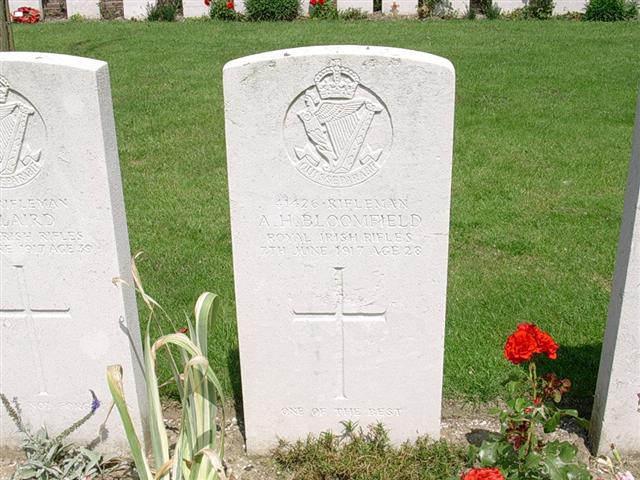
Arthur Henry Bloomfield was born on 19th December 1888, the youngest of six children. His parents, agricultural labourer and carter William and his wife Mary, raised the family in the small Norfolk village of East Harling, which was about halfway between the larger towns of Thetford and Diss.
Arthur married Rose Howlett in November 1911; the couple had two children – Margaret and Frederick – who became siblings for Rose’s daughter, Violet.
While Arthur’s military records are scarce, it is evident that he enlisted in the 9th Battalion of the Royal Irish Rifles. Private Bloomfield’s troop fought at a number of the key skirmishes on the Western Front, including the devastating (for the battalion) Battle of Albert in 1916.
A year later, the 8th and 9th Battalions were caught up in the Battle of Messines and it was here that Private Bloomfield met his fate. His pension records show that he was killed in action on 7th June 1917. He was 28 years old.
Arthur Henry Bloomfield lies at rest in the Lone Tree Military Cemetery in Mesen, West Flanders, Belgium.
Interestingly, Arthur’s pension records only cite his beneficiaries as Rose, Margaret and Frederick. This may go further in confirming that Violet was not his daughter.
Arthur Henry Bloomfield was my great great uncle.
Photo courtesy of Commonwealth War Graves Commission.
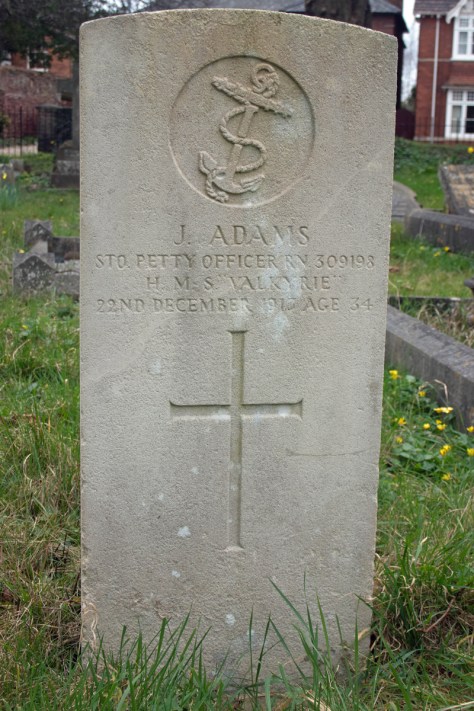
James Adams was born in June 1883, son of Robert and Eliza Adams from Bridgwater in Somerset. Robert was an agricultural labourer; James was one of seven children.
James was keen to get out and see the world. In November 1905 – aged just 12 years old – he enlisted in the Royal Navy as a stoker. After training in Devonport, Plymouth, Stoker Adams served on a number of different vessels, including HMS Victorious, Ramillies, Amphitrite, Monmouth, Andromeda and Halcyon.
By the time war broke out, James has been promoted to Leading Stoker, and was assigned to HMS Cornwall. This was an armoured cruiser that was involved in the Battle of the Falklands in December 1914.
Promoted to Stoker Petty Officer in October 1915, James continued to serve on HMS Cornwall until he was transferred to the brand new ship, HMS Valkyrie. The vessel was involved in offensive sweeps and convoy escorts based out of Harwich.
On 22nd December 1917, the Valkyrie was part of the escort for a convoy travelling to the Netherlands, when she struck a mine. In total, nineteen men were killed, twelve instantly; this included Stoker Petty Officer Adams. He was 34 years old.
James Adams lies at rest in the Wembdon Road Cemetery in his home town of Bridgwater.
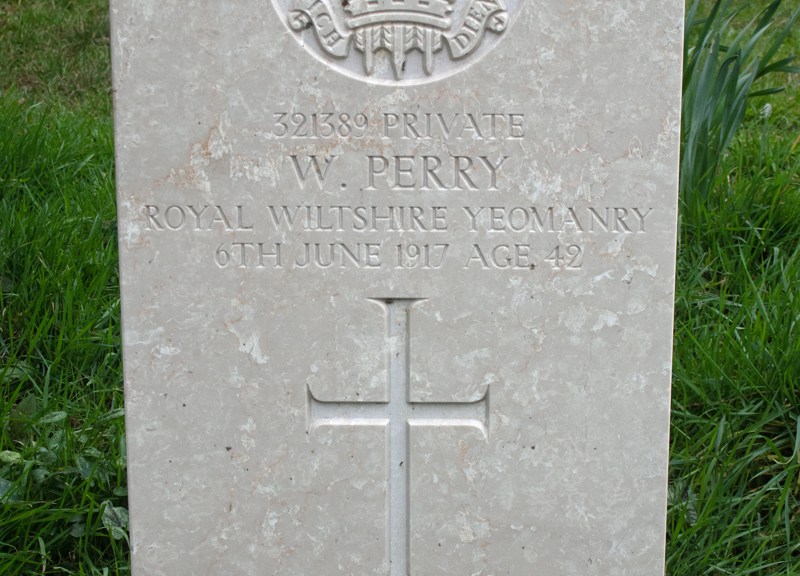
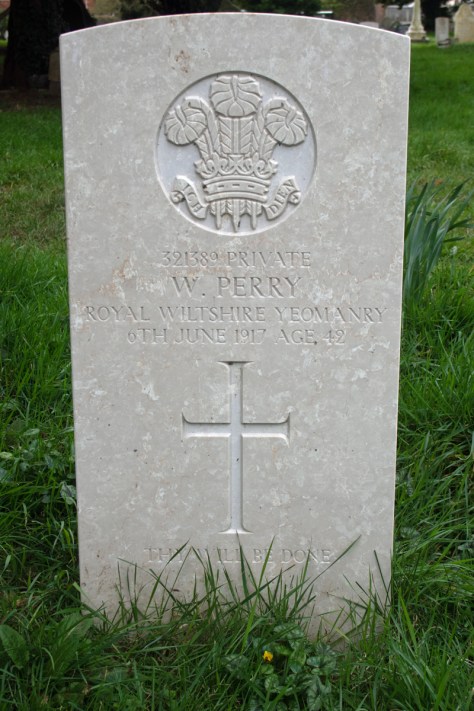
Walter Perry was born in Bridgwater, Somerset, in 1874. He was one of ten children to James Perry, a general dealer, and his wife Hannah. After he had left school, Walter became a labourer; his older siblings had all become labourers or factory workers in the area.
In November 1899, Walter married Rebecca Cavill; their first child, Hilda, was born at the end of March the following year. By this time, Walter was working for a brewery, while his new wife was working at a shirt collar factory. The young couple went on to have two further children – Walter and Beatrice – before Rebecca tragically passed away in June 1906.
Walter married again in November 1908, this time to a Mary Ann Reed also from Somerset. The couple went on to have two children, Joseph and Edna, and the family lived together in the centre of Bridgwater.
The Great War was on the horizon. While details of Walter’s military service are not readily available, it is unlikely that he was called up as soon as hostilities broke out – he turned 40 in 1914, and so was too old to qualify immediately.
Walter enlisted in the 2/1st Royal Wiltshire Yeomanry; he was based primarily in England, where his battalion acted as a training/reserve for the 1st Battalion, who were serving on the Western Front. It was while Private Perry was based in Essex, that he contracted appendicitis; he was admitted to the General Military Hospital in Colchester, but passed away on 6th June 1917. He was 43 years old.
Walter Perry lies at peace in the Wembdon Road Cemetery in his home town of Bridgwater.
Joseph Richard Steadman was born in Ellesmere Port, Cheshire, in 1892. One of seven children to William and Mary Ann Steadman, his father worked as a slab maker for the local council.
Sadly, Joseph’s mother died in 1899, at the age of just 40. William had moved the family to Birmingham by this point, and, on leaving school, Joseph found work at a jeweller’s as a scratch brusher.
Moving to London, Joseph met Ethel May Tambling, who was originally from Somerset, and the couple married at the beginning of 1914. Ethel already had a child – Frederick – and the young couple also had a son, Alfred, who was born in July 1914.
War was on the horizon, and Joseph was quick to enlist. He joined the Coldstream Guards, embarking for France a month after Alfred was born. An elite force, the Coldstream Guards were involved in some of the heaviest fighting of the war, including the Battles of Mons, Ypres, Loos, Somme, Passchendale and Cambrai. It is likely that Guardsman Steadman was caught up in many of these engagements.
His luck was to run out, however, and Joseph was injured towards the end of October 1917. Shipped back to England for treatment, he was admitted to the King George Hospital in London. Sadly, Guardsman Steadman did not recover from his wounds; he died on 1st November 1917, aged just 25 years old.
Joseph Richard Steadman lies at rest in the Wembdon Road Cemetery in Bridgwater, Somerset.
Joseph and Ethel Steadman (from Ancestry.com)
As a sad aside to this story, two of Joseph’s brothers also died in the war. William Steadman was 29 when he was killed at Ypres in April 1915, while Charles Steadman was just 19 when he died at Armentieres.
Albert Francis Pow was born in the autumn of 1886, one of five children to Albert and Annie Pow from Somerset. Albert Sr. was a farm labourer, but by the time he left school, Albert Jr. started work as a porter in the Singer sewing machine factory in Bridgwater.
Albert’s father passed away in 1905, at the age of 51, and his son – who was by this time repairing the sewing machines – became head of the household.
He was obviously good at what he did, because, by the time he married in 1913, he was able to support his wife Leonora as branch manager for the Singer store in the town. The young couple soon moved on, as, when war broke out, he was manager of the shop in Barnstaple.
War came calling, and while the date of his enlistment is absent from his records, Private Pow joined the 1st Battalion of the Somerset Light Infantry. Sent to the front, he quickly became ill, suffering from dysentery and trench foot, which led to him being hospitalised for nearly two months.
Returning to his troops, Private Pow’s health remained unsteady, and he soon contracted trench fever. He was evacuated back to England for treatment, and was admitted to the Canadian Red Cross Memorial Hospital in Taplow, Buckinghamshire.
Sadly, Albert was not to recover this time; he died at the hospital on 11th May 1917 as a result of empyema (pleuritis) and an abscess of the axilla (armpit). He was just 30 years old when he died.
Albert Francis Pow lies at rest in the Wembdon Road Cemetery in Bridgwater.
Albert left behind his widow, Leonora and their child Vanessa. Leonora was to be reunited with her late husband; she died in August 1986, and is buried with her beloved.
Sidney Victor Hoskins was born in February 1892, one of eleven children to Sidney and Elizabeth Hoskins from Shepton Mallet in Somerset. Sidney Sr worked as a quarryman and labourer in local factories.
Sidney was keen to make a life for himself, enlisting in the army in 1909. He served two years as a driver for the Royal Engineers, before being put on the reserve list. By the time of the 1911 census, he was listed as a packer on the railway. In November of that year, Sidney married Ada Lambert, also of Shepton Mallet.
While working on the line in April 1913, Sidney had an accident, suffering a fractured skull. He wasn’t able to carry out any hard labour form that point.
War broke out and Sidney was remobilised; just a month after Ada gave birth to their one and only child, a daughter they named Ada.
New baby notwithstanding, Driver Hoskins was shipped to France as part of the British Expeditionary Force. After two months he was sent down the line after suffering a fit, and was subsequently treated for pleurisy in Nantes. In November 1914, he returned to England and was ultimately discharged on medical grounds in February 1915.
During his time in France, he had also developed tuberculosis, and eventually spent three months in a sanitorium in Taunton, Somerset, to recover.
The condition continued to haunt Sidney, however, and he succumbed to the illness on 5th November 1917. He was 25 years of age.
Sidney Victor Hoskins lies at rest in the cemetery of his home town of Shepton Mallet.
Sidney’s younger brother, William Napier Hoskins, was also involved in the Great War. He had enlisted in the Somerset Light Infantry, and was based in India. Injured in fighting in the Persian Gulf, he was invalided back to India to recover. He was well enough to return to the fray, and was shipped to Mesopotamia, where he was injured again. He died of his wounds in Kut-al Amarah, Iraq, in 1915, aged just 20 years old.
The boys’ older brother Charles had also died in 1895, aged just six years old. While Sidney Sr and Elizabeth had had a family of eight girls, they were to outlive all three of their sons.
Eustace Lionel Bourne was born in 1897, one of six children to Robert and Eve, from Westonzoyland, Somerset. Robert was a wheelwright and carpenter and, after leaving school, Eustace followed in a similar vein, becoming an apprentice to an ironmonger.
When war broke out, Eustace’s interest in engineering led him to join the Royal Flying Corps, where he was appointed as an Air Mechanic. His enlistment papers – dated November 1915 – give his trade or calling as “motor cyclist”, so it is obviously a passion that he had.
Air Mechanic Bourne was assigned to Milton Airfield near Abingdon, Oxfordshire and it was there that he served for nearly eighteen months. He seems to have enjoyed his time off as much as his time working, and boating on the Thames nearby was a hobby. Sadly, it was also to be his undoing.
On 2nd May 1917, he was out on the river at Culham Reach; the local newspaper account picked up the story.
Accidentally drowned was the verdict returned at the inquest last Saturday on Eustace Lionel Bourne, 21 [sic], attached to the mechanical department of the RFC, stationed at Milton.
It appeared that while sculling with a colleague in Culham Reach on May 2nd, he lost a scull. His companion, who had dropped a rudder-line, was turning round at the time. Deceased, in leaning over to pick up the scull, fell into the river and disappeared. It was twilight at the time, and a search was unavailing.
The other man, who could neither swim nor scull, was left in the boat, which was half filled with water.
The body was discovered on Friday morning near Sutton Weirs.
Reading Mercury: Saturday 19th May 1917
Eustace Lionel Bourne was just 20 years old when he drowned. He lies at rest in the cemetery of Westonzoyland, his home village.
Lilian Ella Chinn was born in 1893, one of six children to Walter and Kate Chinn. Walter was the butcher in the Somerset village of Middlezoy, and this is where the family had made their home.
There is little recorded of Lilian, and the information is confusing – another Lilian Chinn was born around the same time a few miles away, so it’s a challenge to identify the correct details.
What is known, is that, with the war raging, Lilian felt that she needed to do what she could – and enlisted in the Voluntary Aid Detachment in 1916. Serving as a nurse, she was based at the military hospital in Devonport, Plymouth.
Sadly, it is evident that nursing staff were not immune to the ailments and illnesses of the soldiers they were treating. Lilian contracted meningitis and peritonitis, passing away on 24th June 1917, aged just 23 years old.
Lilian Ella Chinn lies at rest in the peaceful graveyard of Holy Cross Church in Middlezoy, Somerset.
It is worth noting that Lilian’s brother Hedley also served – and perished – as a result of the Great War. Click here to learn more.
When I was researching Lilian’s life, I ran through the contemporary newspapers to trace her name. Nothing evident came up, although her father Walter’s name did appear.
In 1910, he declared himself bankrupt after being unable to pay for meat for his shop, that he had bought at auction. It appears that he had run up debts of over £300 (approximately £23,500 in today’s money) over a number of years; he put these debts down to a number of factors – “illness of my children, bad debts, having to maintain my mother for 14 years; and loss on sale of Middlezoy House, Middlezoy, three years ago, which realised £200 less than the amount I gave for it, and the amount expended on improvements”.
The 1921 census found Walter and Kate still running the butcher in Middezoy, their home empty but for each other. Walter’s debts were finally cleared in 1928 and the bankruptcy annulled.
The gravestone in Holy Cross Churchyard is a haunting memorial to the tragic lives of the Chinn family.
Walter and Kate had six children, and would outlive every one of them. The stone confirms that each of their children lies in the grave:
The grave’s epitaph – God moves in a mysterious way, his wonders to perform – sounds cruelly hollow to 21st century ears. The only comfort to take, I guess, is that the whole family was destined to be together again: both Kate (who died in 1927) and Walter (who died in 1933) are also buried in the family grave.
Ronald Victor Knight was born in March 1894, the youngest of two children – both sons – to John Knight, an Ironmonger from London, and his Swiss wife, Marie.
Ronald was well educated – being taught at Wells and Bedford Grammar Schools in the UK and Neuchatel in Switzerland, not far from where his mother was born. After studying at Bristol University, he went to work at Guys Hospital in London, training as a dental student.
When war broke out, he volunteered at once, being enlisted in the 8th Battalion London Regiment. Lieutenant Knight went with his regiment to France, and was involved in the Battle of Festubert and the fighting at Loos.
Returning home towards the end of 1915, Ronald married Gwendoline Dawkes, in a ceremony overseen by the Bishop of Bath & Wells.
Rather than returning to the front line, Lieutenant Knight accepted a commission to lead a section of the London Cyclist Corps, a position he held for a year or do. While in this service, Ronald and Gwendoline had their one and only child, a little girl they called Beryl.
In 1916, Ronald accepted a further move to the Royal Naval Air Service, becoming involved in flying as a Flight Lieutenant. It was while he was based at RNAS Cranwell that he was involved in the accident that led to his death.
An inquest was held into the incident, and evidence was taken.
Air Mechanic Charles Deboo [said] that the machine had been recently inspected, and that it was alright. He did not see the deceased flying, but saw the machine come down, nose first, in corkscrew fashion. He saw it at a height of 400ft. He went to the machine after it had fallen and found the officer was dead. The machine struck the ground and smashed up, but he could not say how the accident happened.
Charles Barrett, air mechanic, said he saw the accident. The deceased seemed as if he was going to turn towards the wind to land, and, as he turned, he banked, but he never righted himself. He nose-dived and spun round to the earth. He thought he lost control as he was turning, or the wind might have caught him. The machine was smashed, except for the tail.
The jury returned a verdict that deceased accidentally met his death while flying.
Retford and Workshop Herald and North Notts Advertiser: Tuesday 20th March 1917.
Flight Lieutenant Knight died in an aeroplane crash on 12th March 1917. He was 22 years old.
Ronald Victor Knight lies at rest in Wells Cemetery, Somerset.
Sadly, Ronald’s daughter, Beryl, died in the spring of 1923, when she was only 7 years old. She is buried with her father.
Gwendoline went on to marry Henri Booth in months after the death of her daughter. The couple went on to have two children, Elizabeth and William. She requested that her late husband’s war medals be given to his father, John.
Victor Charles Edelsten Bracey was born in October 1897, the only child of William and Florence Bracey. William was a physician and surgeon, practicing in Lancashire when Victor was born. The young family soon moved south, however, and by the time of the 1901 census, they were living in Wedmore, Somerset, where William had taken up as the village’s general practitioner.
Military records for Victor are not available, but his life can readily be pieced together from newspaper reports of his death and the de Ruvigny’s Roll of Honour, published after the war.
TWO PILOTS KILLED IN THE NEW FOREST
Two air fatalities have occurred within twenty-four hours of each other in the New Forest. On Saturday [22nd September 1917] Second Lieutenant Ernest Hargrave’s machine nose-dived from the height of 200ft, and crashed to earth.
Second Lieutenant Victor Bracey was flying on Sunday morning at a height of 300ft, when his machine turned and came down in a spinning nose-dive.
At the inquests verdicts of “Death by misadventure” were returned.
Western Gazette: Friday 28th September 1917
BRACEY, VICTOR CHARLES EDELSTEN, 2nd Lieut., RFC, only child of William Edelsten Bracey, LRCP [Licentiate of the Royal College of Physicians], Lieut. (Hon.) RAMC (retired), by his wife, Florence Marion, dau. of the late James Canning Gould.
[Victor was] educated St Peter’s School, Weston-super-Mare, and Blundell’s School, Tiverton, where he was a member of the OTC [Officers’ Training Corps]; passed into the Royal Military Academy in April 1915; joined the Inns of Court OTC in December 1916; was gazetted 2nd Lieut. RFC [Royal Flying Corps] 27 April 1917, obtaining his wings in July, and was killed in an aerial accident at the Beaulieu Aerodrome, Hampshire, 23 September, while testing a new machine.
A brother officer wrote that he was a gallant gentleman and a most skilful pilot.” He was a keen cricketer and footballer, and while at Blundell’s played in the First Cricket XI and the Second Football XV, and was also captain of the First Hockey XI; later played for the Royal Military Academy, Woolwich, and the RFC Rugby Football XV at Oxford.
de Ruvigny’s Roll of Honour, 1914-1919
A note on Second Lieutenant Bracey’s Roll of Honour states that he was ineligible for medals as he saw no overseas service; this seems to have been challenged by Victor’s father in 1921, but nothing confirms whether this anything was subsequently awarded.
Victor Charles Edelsten Bracey lies at rest in the churchyard of St Mary’s in Wedmore, where his father continued to practice. He died, aged just 19 years of age.
William’s prominence in the village played a big part in Victor’s legacy. A Memorial Fund was set up; this helped fund “necessitous cases for medical requirements and for conveying patients to hospitals“. The Victor Bracey Cup was also awarded into the 1940s for sporting achievement in the schools he had attended.