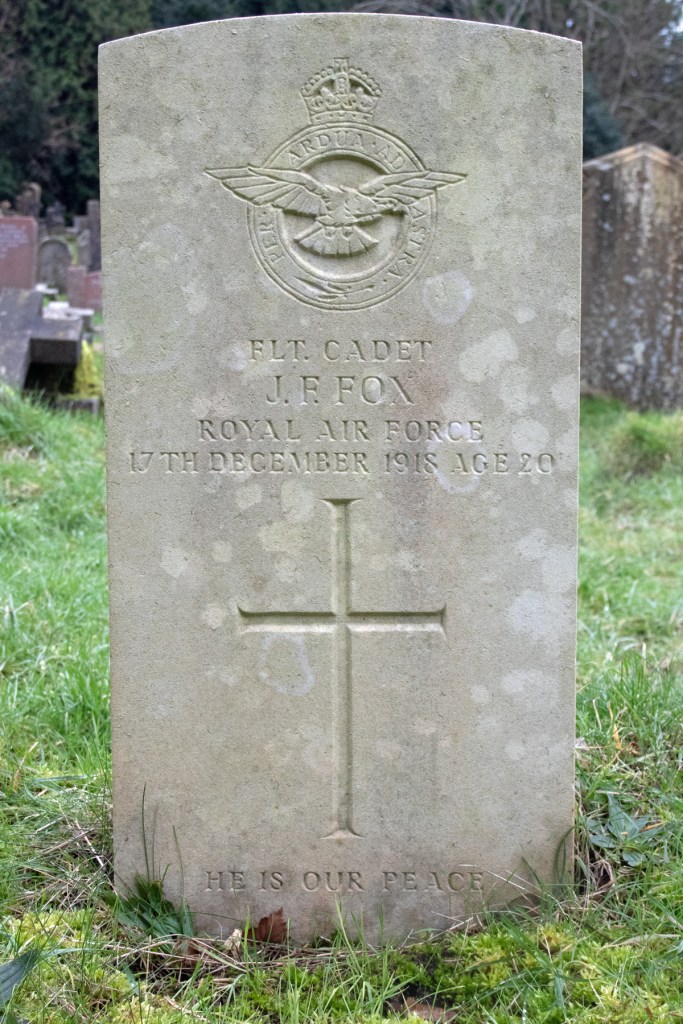
John Francis Fox was born early in 1898 in the village of Alkerton, Oxfordshire. One of eight children, he was the only son to miller-turned-butcher George Fox, and his wife, Ann. The family remained in Oxfordshire until at least the outbreak of war, when George and Ann appeared to have moved to Somerset.
When John left school, he took up an apprenticeship at Stothert & Pitt’s engineering works in Bath and in May 1918, with the First World War entering its last few bloody months, he was finally old enough to enlist. He joined the Royal Air Force as a Flight Cadet and was based at the 13th Training Depot Station near Market Drayton, Shropshire.
On 21st December 1918, Flight Cadet Fox was undertaking his first solo flight, on board an Avro 504K. His aircraft collided with another, which was piloted by a Captain Edgar Beamer. Both were killed in the accident: John was just 20 years of age.
An inquest into the crash, which also involved a third man, Captain Harrison, who was a passenger in Beamer’s plane, returned verdicts of accidental death.
John Francis Fox’s body was brought back to Somerset for burial. He was laid to rest in the graveyard of St Mary the Virgin’s Church, Bath.
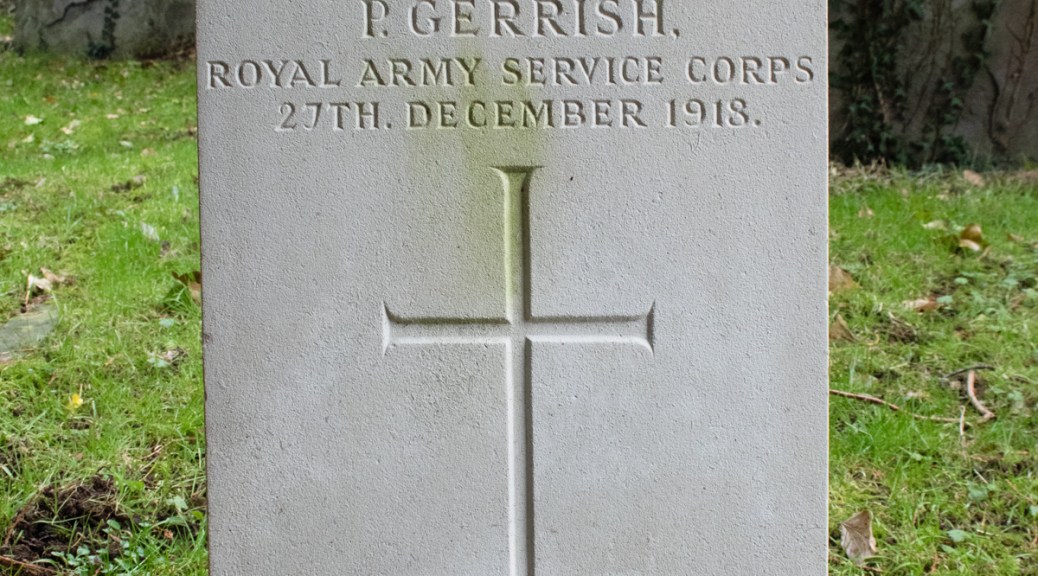
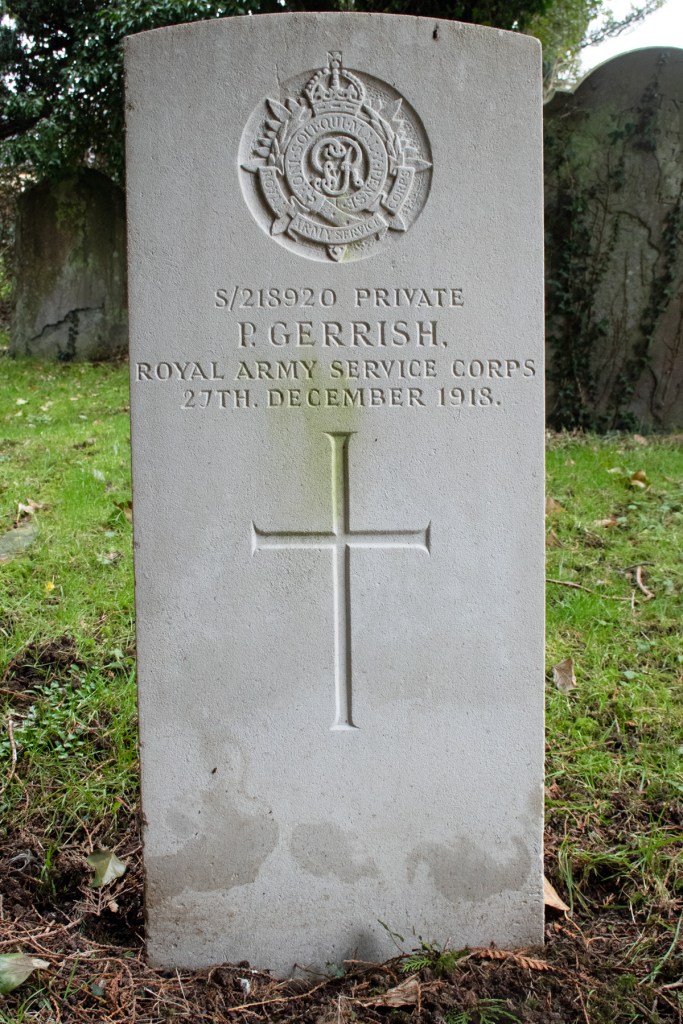
Percy Gerrish was born on 22nd August 1890 in Bath, Somerset. The youngest of three children – all boys – his parents were Alfred and Charlotte Gerrish. Alfred was painter and decorator by trade but, by the time of the 1911 census, the family had moved to Batheaston, and he was employed as a school attendance officer.
Alfred and Charlotte had raised their children well: the same census recorded their oldest son, also called Alfred, was employed as a clerk; their middle son, Reginald, was a printer; Percy, then 20 years old, was working as a draughtsman for an engineering company,
War came to Britain’s shores in 1914, and while he did not join up at once, when the Military Service Act of 1916 came in, Percy found himself conscripted. He enlisted on 24th November 1916 and, while he noted a preference for the Royal Field Artillery or Royal Garrison Artillery, his previous employment made him ideal for work as a clerk in the Army Service Corps.
Private Gerrish’s time in the army was spent on home soil. Full details are not available, but he certainly served in camps around Codford, Wiltshire. This may have been how he met a young woman called Ada Cox, who lived in Bemerton, on the outskirts of Salisbury. On 21st July 1917, the couple married in the new Mrs Gerrish’s local church.
Percy’s army career went well, although during 1918 illness was to dog him. He spent a week in a hospital in Fovant, near Salisbury in June, suffering from influenza, before being readmitted for a month just a week later, having contracted pharyngitis – an inflammation of the pharynx.
By the late summer of 1918, Private Gerrish had been moved to Newport Pagnell, Buckinghamshire. His ongoing health conditions were still an issue, however, and on 23rd October he was admitted to the Tickford Abbey Auxiliary Hospital. He had contracted laryngitis by this point, but, as the weeks in hospital progressed, he was soon also bogged down by tuberculosis.
Sadly, this was to prove Percy’s undoing. He passed away on 27th December 1918, aged just 28 years old.
Percy Gerrish’s body was brought back to Somerset for burial. He was laid to rest in the graveyard of St John the Baptist Church, in a plot next to his father, Alfred, who had died seven months before.
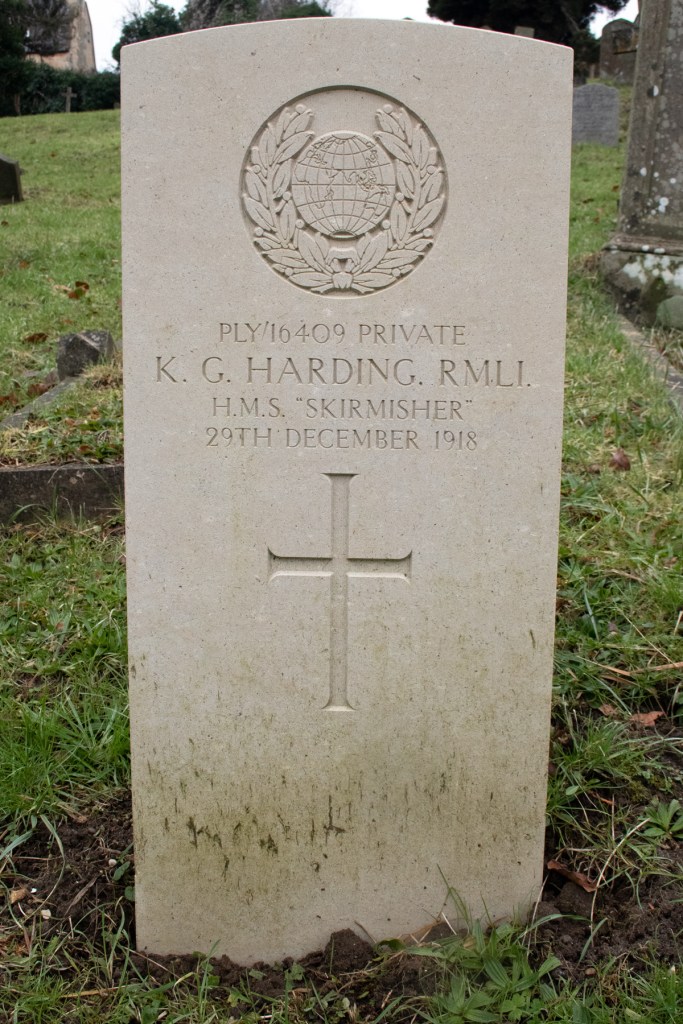
Kenneth Gordon Harding was born in the autumn of 1896, in the Somerset village of Batheaston. The oldest of nine children, his parents were Lawrence and Fanny Harding. Lawrence was a market gardener when Kenneth was born, but by the time of the 1911 census – and with a growing family to support – he found other employment as a roadman.
When he left school, Kenneth found work as a gardener, but he had his sight set on distant shores. On 25th September 1913 he enlisted in the Royal Marine Light Infantry, determined to see the world. His service records show that he was 5ft 3ins (1.6m) tall, with light hair, blue eyes and a light complexion.
For the duration of his naval career, Private Harding was based out of Plymouth Dockyard, returning there in between each of his voyages. Over the next four years, he served on three different vessels – HMS Heroic, HMS Duke of Edinburgh and HMS Skirmisher. His service records shows that he maintained a satisfactory level of conduct, and that his general character was very good.
By January 1917, Kenneth had fallen ill, and was medically discharged from the army, having contracted tuberculosis. He returned home, but his illness continued to dog him.
On 22nd May 1918, Kenneth’s younger brother, Leonard Harding, who was serving with the Royal Inniskilling Fusiliers, was killed while fighting in France. Private Leonard Harding was just 19 years old. He was laid to rest in the Duhallow ADS Cemetery at Ypres.
With Kenneth’s own health not looking good, his parents must have feared the worst. The worst was to some, sadly, when he breathed his last at home on 29th December 1918. He was just 22 years of age.
Kenneth Gordon Harding was laid to rest in the graveyard of St John the Baptist Church in his home village, Batheaston.
Iva Victor Brewer was born on 2nd May 1886, the fourth of four children to James and Annie Brewer. James was a farm labourer from Weston-super-Mare, but the family were living in Bathampton by the time of Iva’s birth. James died in 1887, and Annie remarried three years later. Her new husband, Thomas Dolman, was the manager of the George Inn in Bathampton, and the couple went on to have four children of their own, half-siblings to Iva.
Tragedy struck again when Annie passed away in February 1897, at the age of just 37 years old. By the time of the next census in 1901, Iva was boarding with his stepfather’s parents; the following year, however, Thomas also passed away, and the children were left to build their own lives.
Iva – who was now going by his middle name, Victor – found an escape in the army and, according to the 1911 census was an Acting Bombardier in No. 69 Company of the Royal Garrison Artillery, based in Colaba, at the tip of the Mumbai peninsula.
By the time war was declared, Victor had cemented his military career. Full details of his service are no longer available, but the summer of 1916 he had left India for Aden, and was then mentioned in dispatches that October for his bravery in the field at the Somme.
In November 1917, the now Battery Quartermaster Sergeant Brewer was injured in fighting at Passchendaele, and was medically evacuated to Britain for treatment. It seems that he was treated in South Wales, and it seems a whirlwind romance set in when he was living in Pontardawe, near Swansea. On 2nd January 1918, Victor married Laura Seddon, a railway inspector’s daughter from the village of Ystalyfera, just up the valley from Victor.
The couple moved to Bathampton before Victor returned to the fighting. He was badly wounded and, having been evacuated back to Britain in May 1918, he was admitted to the Northern Central Hospital in London where his shattered leg was amputated. Sadly, bronchial pneumonia set in while he was recovering, and he passed away from the subsequent sepsis. Quartermaster Sergeant Brewer passed away on 7th May 1918, days after his 32nd birthday.
Iva Victor Brewer was brought back to Bathampton for burial. He was laid to rest in the quiet graveyard of St Nicholas’ Church in the village.
Tragedy was to strike again, sadly. After his funeral, Laura returned to Wales and found employment at a draper’s store.
…the loss of her husband played on her mind.
On Monday she set off for Bathampton, and on her way posted two letters to her late husband’s relatives.
One ran: “I cannot live without my husband. If you don’t hear from me, search Bathampton, as I shall be there somewhere.” Another letter asked her relatives to let her mother in the Swansea Valley know.
She reached Bath, and it is thought she there took a taxi to Bathampton. She then paid a visit to the cemetery, and placed her hat and handbag on her husband’s grave. At the canal-side nearby she laid her fur coat on the bank, and, it is supposed about midnight, plunged into the water
Western Gazette: Friday 9th April 1920
Laura was just 27 years old when she died: she was buried with Victor, husband and wife reunited again.
Ernest Stanley Bailey was born in the autumn of 1900 in the quiet Somerset village of Barton St David. The oldest of three children, his parents were stonemason William Bailey and his wife, Fanny.
Ernest was only 14 years old when war broke out, but his time to serve his King and Country came in the summer of 1918. He enlisted in the Devonshire Regiment and was assigned to the 53rd (Young Soldier) Battalion.
Private Bailey was sent to the Rollestone Camp, near Shrewton in Wiltshire for training. With the war in its closing months, army barracks were still places rife with disease, and Ernest was not to be immune from this. He contracted influenza, which then became pneumonia, and was admitted to the camp hospital. Sadly, the conditions were to prove too much for his young body to bear, and he passed away on 6th November 1918. He was just 18 years of age.
Ernest Stanley Bailey was brought back to Somerset for burial. He was laid to rest in the peaceful graveyard of St David’s Church in his home village, Barton St David.
Louis Blake Stevens was born in the spring of 1870 in Pilton, now a suburb of Barnstaple, Devon. One of nine children, his parents were Devon-born sawyer John Stevens and his wife Mary, who was from Swansea.
When he left school, Louis found work in the leather industry, working as a parer and grinder. In the autumn of 1890, he married an Edith Turner, the couple went on to have two children – Edith and Albert – although they seem to have parted company soon after.
On 4th April 1896, Louis married again, this time to a Mary Webber. The couple set up home in Stoke-under-Hamdon (now Stoke-sub-Hamdon), Somerset, and went on to have seven children of their own. By the time of the 1911 census, the family had moved to South Petherton, Somerset, where Louis and Albert were working as a glovers.
Storm clouds were brewing over Europe and, despite his age, Louis was keen to step up and play his part and, on 7th August 1915, he enlisted in the Army Veterinary Corps. His service records confirm he was 42 years old, 5ft 4ins (1.63m) tall, with a dark complexion, dark brown hair and brown eyes.
After some initial training at the Army Veterinary Corps depot, Private Stevens was sent to France. Arriving there on 25th October 1915, he spent the next nine months overseas. During this time, he had issues with his teeth, breaking several on the hard biscuits the army were provided with.
Private Stevens was sent to a camp hospital in Boulogne, where his teeth were extracted, and he was then sent back to Britain to recover. The operation identified epithelioma (a malignant tumour) on his tongue and face, caused by the state of his teeth. He was initially sent to a hospital in Epsom, before being transferred to the Horton City of London War Hospital in Woolwich.
Treatment was ongoing, and, in the end, Private Stevens was finally discharged from the army on medical grounds on 2nd July 1917. The report noted permanent total incapacity, and that treatment was required.
At this point, Louis’ trail goes cold. He returned home to Somerset, and, died there on 23rd January 1918, aged 47 years old. Louis Blake Stevens was laid to rest in South Petherton Cemetery, within walking distance of his widow and family’s home.
Joseph Henry Sibley was born on 23rd September 1897 in the hamlet of Elm, near Frome in Somerset. He was one of seven children to Joseph and Ellen Sibley. Joseph Sr worked as an iron moulder and, by the time of the 1911 census, the family had moved to South Petherton.
When he left school, Joseph Jr found work as a baker. But when he turned 18, and with war ravaging Europe, he enlisted to serve his King and his Country. On 8th December 1915, he joined the Somerset Light Infantry, and was assigned to the 6th Battalion.
Private Sibley’s service records confirm that he was 5ft 5ins (1.65m) tall and 116lbs (52.6kg) in weight. He was declared fit for the army, and was formally mobilised in June 1916.
Joseph was sent to France and by January 1917, he found himself on the Front Line. On 19th May, he was injured, receiving a gun shot wound to his hand and face. Medically evacuated to Britain for treatment and admitted to hospital.
He was for some time in Norwich Infirmary for treatment and ultimately received his discharge from the Army. He had been home only a short time and his health being very unsatisfactory, he was taken to Bristol Royal Infirmary, where an operation was performed, which, unfortunately, terminated fatally.
Western Chronicle: Friday 22nd March 1918
Private Sibley died on 16th March 1918, he was just 19 years of age.
Joseph Henry Sibley’s body was brought back to South Petherton for burial. He was laid to rest in the town’s cemetery.
William John Lydston Poulett was born on 11th September 1883, in Belsize Park, London. The oldest child to William Poulett, 6th Earl Poulett, and his third wife, Rosa, William Jr was known by the title Viscount Hinton.
When William’s father died in January 1899, a battle ensued for the title of the 7th Earl Poulett. The 6th Earl had married his first wife, Elizabeth, in 1849, separating from her within a couple of months, when he learnt that she was pregnant. The alleged father was Captain William Turnour Granville, and when the 6th Earl died, Elizabeth’s son, another William Poulett, claimed the right to take the title. In July 1903, the judge decreed that William and Rosa’s son held the valid claim, and William John Lydston Poulett succeeded him, becoming the 7th Earl. At this point, he was living in Ayston, Rutland, expanding his education and boarding with a Clerk in Holy Orders.
In 1908, William married Sylvia Storey. She was the daughter of actor and dancer Fred Storey, and was herself an actress and Gaiety girl. Given Earl Poulett’s status, it seems this might not have been the most appropriate of matches, as a contemporary newspaper reported:
Another marriage alliance of the stage with the aristocracy, and one of the most remarkable of them all, was brought about yesterday by a quiet ceremony at St James’ Church, Piccadilly, uniting Earl Poulett and Miss Sylvia Lilian Storey, the well-known comedienne.
Besides contracting parties, there were only one or two persons present, including the family solicitor and Lady Violet Wingfield, sister of the bridegroom [who was also a Gaiety girl]. There were no bridesmaids.
Before the ceremony, some consternation was caused by an untoward event. The wedding ring was dropped, and there were some perturbing moments while a scrambling hunt was made for it on the floor. Finally it was discovered and pounced upon by the verger.
The time and place of the ceremony had been kept quite a secret, and the bride and bridegroom were on their way from London before the news of their marriage became known. The sudden announcement which was then made greatly enhanced the romance of the affair.
The Earl is just twenty-five years of age, and the new Countess is eighteen…
Shields Daily News: Thursday 3rd September 1908
The secret nuptials couple went on to have two children – George and Bridget – and, by the time of the 1911 census, the family were living in some luxury at Hinton House in Hinton St George, Somerset.
William had also had a distinguished military career by this point. In 1903 he received a commission as Second Lieutenant in the 4th Battalion of the Royal Welch Fusiliers, before being transferred to the 4th Highland Light Infantry.
On 26th February 1913, he was recommissioned, as a Second Lieutenant in the Warwickshire Royal Horse Artillery and, when war broke out, he was sent to France. By November 1915, he had been promoted to Captain, but after three years on the Western Front, his health was beginning to suffer.
Captain Poulett was transferred back to Britain, and assigned to the Royal Warwickshire Regiment. By 1918, he was serving as part of the Anti-Aircraft Corps in Middlesbrough, when he contracted pneumonia. This was to take his life, and he breathed his last on 11th July 1918, at the age of just 34 years old.
William John Lydston Poulett, 7th Earl Poulett, was brought back to Somerset for burial. He was laid to rest in the graveyard of St George’s Church in Hinton St George.
Captain William Poulett (from ancestry.co.uk)
William’s death meant that his nine-year-old son, George, inherited his title and his £187,200 estate (worth £8.2m today). The 8th Earl served during the Second World War, working as an engineer at Woolwich Arsenal and becoming an Associate of the Institute of Railway Signal Engineers and the Institute of British Engineers.
George married three times: he divorced his first wife, Oriel, in 1941; outlived his second wife, Olga, who died in 1961; and was survived by his third wife, Margaret, when he passed away in 1973. When he died, with no children, all of his titles became extinct.
Alan James Howland was born in the spring of 1897 in Plymouth, Devon. One of nine children, his parents were pianist and musician Harman Howland and his Irish wife, Ellen.
The Howland family moved around as, presumably, Harman followed where his work was needed. The 1901 census records them living in Devonport: ten years later they had moved to Barnstaple. Alan, by this time, had left school and was working as an errand boy.
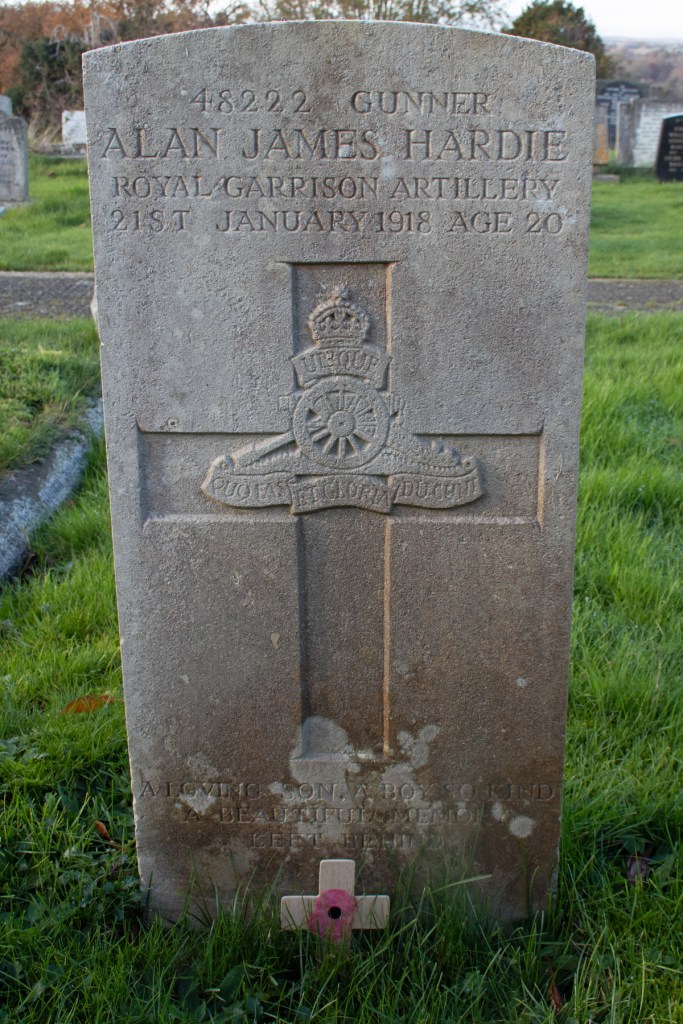
War came to Europe in 1914, and, at some point, Alan stepped up to play his part. Full details of his military service are no longer available, but from what remains it is clear that he enlisted in the Royal Garrison Artillery at some point before the summer of 1917.
Alan enlisted using his mother’s maiden name of Hardie, and was assigned to the 274th Siege Battery. His troop saw action at the Somme and Arras, and a later newspaper report confirmed that Gunner Hardie saw action overseas:
[He] had been previously wounded but was gassed and entered Leicester Hospital on November 2nd 1917.
Taunton Courier and Western Advertiser: Wednesday 30th January 1918
Gunner Hardie had been admitted to the 5th Northern General Hospital following his injury. He seemed to be improving, but developed pneumonia and the lung condition was to take his life. He passed away on 21st January 1918, at the age of just 20 years old.
Alan James Hardie/Howland was brought back to Somerset for burial. He was laid to rest in the cemetery of the town where his family now lived, Ilminster, Somerset.
Alan’s older brother, William Harman Howland, also fought in the First World War. He enlisted in the 1st Battalion of the Hertfordshire Regiment, also using his mother’s maiden name. Again, details of his service are sparse, and Private Hardie seems to have transferred to the Royal Army Service Corps at some point during his military career.
William passed away on 18th August 1918, while in Germany. The cause of his death is not clear, but he was 28 years old. He was laid to rest in the Ohlsdorfer Cemetery in Hamburg.
William Locke was born in the spring of 1885, the sixth of ten children. His parents were George and Sarah Locke, both of whom were from Chard, Somerset, and it was here that William and his siblings were raised.
George worked in the local lace factory, and the 1891 census provides a snapshot of where the Lockes lived. The document notes that the family’s neighbours were a sawyer, launderess and a chimney sweep.
William did not follow in his father’s – or siblings’ – trade when he left school. Instead, he first found work as an ironmonger’s porter, then as a plumber.
On 5th April 1915, William married Mabel Male, a gardener’s daughter from Barrington, Somerset. War had come to Europe, and it seems that William was aware that he would shortly receive notice for him to play his part. The couple were by now living in Parkstone, Dorset, and William had changed career again: his service records confirm that he was a line telegraphist at the time he enlisted.
William enlisted in the Royal Engineers in Bournemouth on 29th July 1915: his records note that he was 5ft 3ins (1.6m) tall, 122lbs (55.3kg) in weight and had blue eyes, brown hair and a fresh complexion.
Sapper Locke spent a year at the regiment’s Stratford Depot, learning the skills he would need for the front line. He had leave before he was then dispatched to the Front Line and arrived in France on 29th May 1916.
In September, Mabel gave birth to a son the couple called Roy. She had, by this time, returned to Somerset, moving to Chard, to be near William’s family.
Sapper Locke remained in France until the autumn of 1918. He came home in November, but was unwell. A doctor attended, and noted influenza that has developed into pneumonia. Sadly, the conditions were to take William’s life. He passed away at home on 7th November 1918, his death, according to the doctor, directly attributable to his army service. He was aged just 34 years old.
Mabel returned to her family home in Barrington, and William Locke was laid to rest in the graveyard of the village’s St Mary’s Church. His burial was on 11th November, the day the armistice was signed.







 Death and Service