Albert Aven was born on 18th December 1896 in the Somerset hamlet of Rodden. One of eleven children, his parents were Alfred and Elizabeth Aven. Alfred was a farm labourer, and farming was certainly something that his sons went into when they finished school.
When war came to Europe’s shores, however, Albert was keen to play his part. On 29th November 1915, he enlisted in the Royal Navy as a Stoker 2nd Class. His service records show that he was 5ft 5.5ins (1.66m) tall, with brown hair, blue eyes and a fresh complexion.
The record also suggests that he lied about his age, giving his year of birth as 1895. It is likely that Albert would have done this because there was a minimum age requirement, although, as he was already over that minimum age, it wouldn’t have made that much difference anyway.
Stoker 2nd Class Aven’s first posting was to HMS Pembroke, the Royal Naval Dockyard in Chatham, Kent, where he spent a couple of months undergoing training. At the end of January 1916, he was moved to HMS Gibraltar, an old cruiser, which patrolled the waters around the Shetland Isles.
After six months on board, and following a further month in Chatham Dockyard, Stoker Aven was assigned to HMS Test. She was a destroyer that patrolled the waters of the Humber Estuary, and Albert spent the next sixteen month with her. During this time, he was promoted to Stoker 1st Class, but the Test was also to be the last ship he served on.
On 8th November 1918, Stoker 1st Class Aven was ashore at the naval base in Hull, when he fell into a dry dock, dying instantly. Little additional information is available – and indeed contemporary newspapers are silent on the matter – but his service records report “Death caused by accidental fall into dry dock at Hull. Verdict of accidental death returned at inquest.” He was just 21 years of age.
Albert Aven’s body was brought home to Somerset for burial. He was laid to rest in the tranquil graveyard of All Saints’ Church in Rodden.
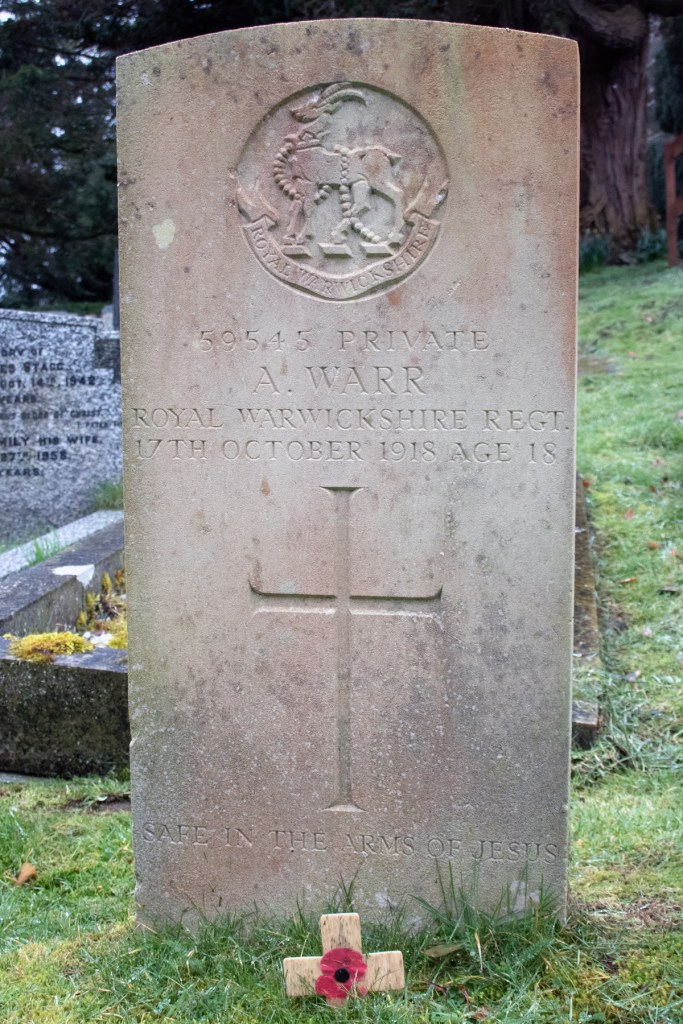
Albert Warr was born in Chaffcombe, near Chard, Somerset, in the spring of 1900. He was the middle of three children to William and Edith. Edith, who was also known as Sophie or Sophia, was nine years older than her husband, and had been married previously. When her first husband passed away, she was left with three children under ten years old – half-siblings to Albert – and so married William to provide them and her a home.
William was an agricultural labourer, but by the time of the 1911 census, the family had moved east to Crewkerne, where both he and Edith took up work in a laundry. The household was complemented by the two older of Edith’s children – Edith, who helped with the laundry work, and Samuel, who was a fishmonger.
Little information is available for Albert’s military service, so his time in the army is a challenge to piece together. He enlisted no earlier than April 1918, and was assigned to the 5th Battalion of the Royal Warwickshire Regiment. Private Warr’s troop fought in France and Italy, although it is unlikely that he saw any action overseas.
All that can be confirmed is that he was admitted to the 1st Northern General Hospital in Newcastle-upon-Tyne, although his condition is unknown. Private Warr passed away on 17th October 1918, aged just 18 years old.
The body of Albert Warr was brought back to Somerset for burial. He was laid to rest in the Townsend Cemetery, within walking distance of the family home in Crewkerne.
Private Warr’s pension ledger notes that Edith had passed away, and that the beneficiary was to be William instead. As this document is not dated, it is not possible to determine when Albert’s mother died, but it is likely to have been between 1917 and 1919.
Charles James Anderson Newbery was born in Misterton, a stone’s throw from Crewkerne, Somerset, in the spring of 1895. The oldest of eight children, his parents were Benjamin and Edith Newbery. Benjamin was a farmer, who passed away in 1908, when his son was just 13 years of age.
Charles seems not to have spent a great deal of time in the family home, however: the 1901 census found him living with his paternal grandmother, while the 1911 census, taken three years after his father’s death, recorded him as living with his paternal aunt, and working on their farm.
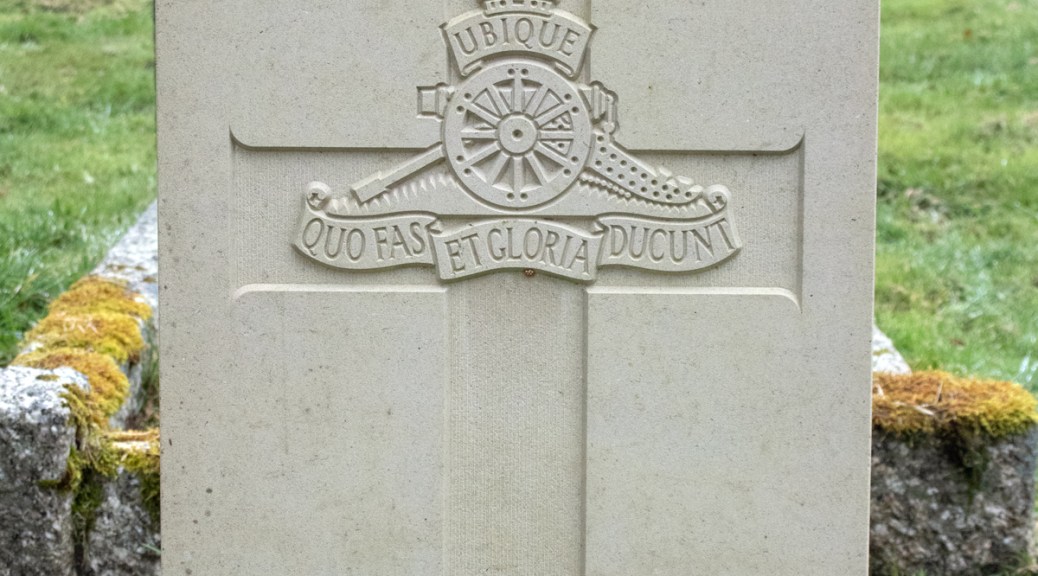
The farming life seemed to suit Charles: indeed he emigrated to Australia to pursue the life. When war broke out in Europe, however, he returned to England’s shores to better serve King and Country. He enlisted in the Royal Garrison Artillery on 18th October 1915, and was given the rank of Gunner.
Charles’ service records confirm that he was 5ft 5ins (1.65m) tall and weighed 140lbs (63.5kg). He was noted as having a mole on his left shoulder and an upper denture.
Private Newbery was sent to France in April 1916 and, a little over a year later, was promoted to Bombardier. He was attached to the 137th Heavy Battery and all seemed to be going reasonably well for him. He had ten days’ in England in July 1917, and a further two weeks’ in March 1918.
On 13th August 1918, possible during the Battle of Amiens, Charles was injured by a gun shot wound to his right leg. He was initially treated at the 47th General Hospital at Le Treport on the French coast, but was medically evacuated to Britain for further treatment.
Charles was moved to the 4th Northern General Hospital in Lincoln. To complicate matters, he had contracted bronchitis and, while his injury was being managed, it was a combination of the lung condition and cardiac failure to which he succumbed. Private Newbery passed away on 2nd September 1918, his mother and sisters by his side. He was just 23 years of age.
Charles James Anderson Newbery was taken back to Somerset for burial. He was laid to rest in Crewkerne’s Townsend Cemetery, not far from the family home.
Bombardier Charles Newbery (from ancestry.co.uk)
Edith had to write to the regimental office three times to get her late son’s belongings back, and in the end it took more than six months to do so. She received the items he had on him in Lincoln in April 1919: they included and “upper row [of] teeth, cigarette case, wallet containing letters, hair brush [and] comb, disc, letter, wristlet watch, note paper and envelopes.”
Albert Lowman was born in Crewkerne, Somerset, in the autumn of 1876. He was the younger of two children to Charles and Sarah Lowman. The 1881 census recorded the family – Charles, Sarah and their boys Charles Jr and Albert – living in Back Lane. Charles Sr was noted as being a labourer, although in the column highlighting any medical conditions (‘deaf-and-dumb’, ‘blind’, ‘imbecile or idiot’, ‘lunatic’), is one word: “afflicted”.
Charles Sr passed away in 1886, when Albert was just 9 years old. The next census, in 1891, found Sarah working as a charwoman, while her youngest, who had left school by this point, was employed as a labourer. Mother and son also had a lodger, Alice, who was a dressmaker. Charles Jr, by this point, had left home, and was living in Penarth, Glamorganshire, where he was apprenticed to his paternal uncle, who was a tailor.
On 28th November 1896, Albert married Sarah Ann Dodge, a weaver’s daughter who was also from Crewkerne. Albert recorded his job as a drayman, although this seems to have been piecemeal employment.
The next census found more permanent work, as he was cited as being a shirt factory packer, while Sarah was employed by the factory as a machinist. Making up the household was young Charles Lowman, the couple’s first son, who was just a month old although sadly, he survived only a couple of months more before dying.
Further tragedy is highlighted by the 1911 census, as it highlights that the couple had had a further child, who had also died when just a babe-in-arms. The Lowmans were now living on Hermitage Street near the centre of the town. Albert was still a shirt packer, and, even though their cottage was small, they had two boarders and a visitor staying. The lodgers brought the couple a little rent, which meant that Sarah no longer had to work.
War was closing in on Europe and, while his full military records are lost to time, it is clear that Albert had stepped up to play his part. He had enlisted by January 1918, and was attached to the Devonshire Regiment, through which he served with the 380 Company of the Labour Corps.
Private Lowman was barracked on Salisbury Plain, Wiltshire, and in July he was admitted to the military hospital in Salisbury itself, suffering from appendicitis. He was operated on, but died following complications. He passed away on 10th July 1918, at the age of 41 years old.
Albert Lowman was brought back to Somerset for burial. He was laid to rest in the cemetery of his home town, Crewkerne.
Private Lowman’s pension ledger record shows the beneficiaries of his army service. The document identified Sarah as his widow, but also Phillis Annie Matilda Denning, the couple’s adopted daughter, who had been born in August 1904.
Sarah was not to outlive her late husband for long, however.
The death occurred with tragic suddenness on Sunday afternoon, January 7th, at her residence in Hermitage-street, of Mrs Sarah Ann Lowman… The deceased, who was of middle age, was about as usual attending to her ordinary household duties in the morning. Just before dinner hour, however, she complained of not feeling well and went upstairs to lie down. Her niece took her up a cup of how water, and she then apparently went to sleep. She awoke about 3:40pm, and then had to get out of bed owing to sickness. Upon going back into bed again she expired almost immediately. Dr Wolfenstein was called, but he could only pronounce life extinct.
Langport & Somerton Herald: Saturday 20th January 1923
Sarah was 47 years of age when she passed away. It is likely that she was laid to rest near her husband, although records to confirm this have been lost.
Albert’s brother, Charles, survived his sibling by less than six months. He had left tailoring behind him in South Wales, and instead embarked on a military career. He joined the Royal Field Artillery in 1895 and, over the course of his twelve years’ service, served in the Caribbean and the Mediterranean.
Charles married Florence Dodge in 1908, and the couple went on to have two children – Cecil and Freda. When war broke out in 1914, he stepped up once more. Having already risen through the ranks from Gunner to Bombardier and Corporal, he re-entered service as a Sergeant in the Royal Garrison Artillery.
Based in Le Harve, Northern France, Sergeant Lowman was admitted to a hospital in Harfleur, having contracted bronchial pneumonia. Sadly, he passed away while admitted, on 8th November 1918, just three days before the end of the conflict. He was 43 years of age.
Charles Lowman was laid to rest in the Sainte Marie Cemetery, near the centre of Le Harve.
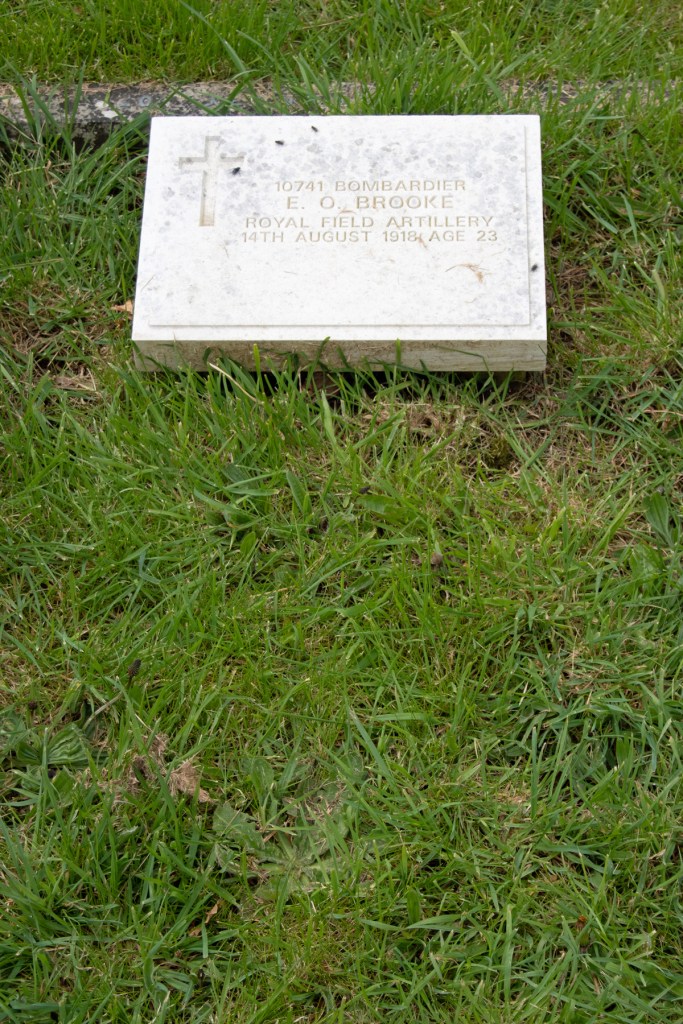
Ernest Oliver Brooke was born in 1895 in Bath, Somerset. The oldest of four children, his parents were tailor Oliver Brooke and his wife, Kate. Ernest did not follow in his father’s footsteps, however, and, by the time of the 1911 census, when the family were living in a Georgian town house in the Lyncombe area of the city, he was noted as being employed as an engine fitter.
Storm clouds were brewing over Europe by this point and, when war was declared, Ernest was one of the first to step up to play his part. He enlisted in 1st September 1914, and was assigned to the Royal Field Artillery.
Gunner Brooke’s service records show that he was 5ft 10ins (1.78m) tall and weighed 138lbs (62.6kg). He had brown hair, grey eyes and a fresh complexion.
Ernest spent ten months on the Home Front, learning and honing his skills. In July 1915 he was sent to the Mediterranean, and found himself in Gallipoli. After nearly a year in Eastern Europe, he was sent to serve on the Western Front in France.
His service records show that the now Bombardier Brooke was wounded on 10th November 1916. Little additional information about this is available, and he was certainly fit enough not to be sent back to Britain for treatment or recuperation.
Things had changed for Ernest, however, and by December 1916, he was transferred back to the UK, to serve on the Home Front once more. While serving in Gallipoli, he had contracted tuberculosis. Over the ensuing months, he had gradually lost weight and developed a distressing cough, which occasionally resulted in haemoptysis, or coughing up blood.
By the summer of 1918, Bombardier Brooke was admitted to a sanitorium. His health led to him being medically discharged from the army on 20th June, and his condition slowly deteriorating. On 14th August 1918 he finally succumbed, aged just 23 years old.
Ernest Oliver Brooke was laid to rest in the family plot in St James’ Cemetery, Bath.
William Henry Dyer was born on 26th March 1895, in Bath, Somerset. He was the only child of William and Elizabeth Dyer. Elizabeth had had a son prior to her marriage to William Sr, and so William Jr had a half-brother, Sidney.
Elizabeth tragically passed away in December when her youngest was only a toddler. William Sr went on to marry again, to a Sarah Chivers. The couple went on to have a family of their own, giving William Jr and Sidney a further five half-siblings.
William Sr was a carman and, when his son left school, he also found carting work, the 1911 census recording him as being a milk carrier. He wanted bigger and better things, however, and, on 8th April 1913, a fortnight after his eighteenth birthday, he joined the Royal Navy.
William’s service records show that he was working as a van guard on the railway at the time of his enlistment. He was 5ft 7ins (1.7m) tall, with light hair, grey eyes and a fresh complexion. He joined as a Stoker 2nd Class, and was initially assigned to HMS Vivid, the Royal Naval Dockyard in Devonport.
After six months’ training, William was assigned to the dreadnought battleship HMS Ajax. She became his home for the next four years, patrolling the North Sea during the conflict and, in June 1916, was involved in the Battle of Jutland. During his time on board, William rose through the ranks, becoming Stoker 1st Class in August 1914, Leading Stoker in August 1916 and Petty Officer Stoker in October 1917.
In January 1918, William returned to HMS Vivid for a few weeks He was then given a new posting, on board HMS Sandhurst, based at Scapa Flow in the Orkneys. Petty Officer Stoker Dyer was to spend the next ten months here, albeit with a short break that autumn.
It was during this period of leave that William married Lily Sarah Bethia Durbin. She was the daughter of a miner, and the couple married in Clutton, Somerset. Their time together was to be brief, however, as William soon returned to Scotland.
It was while Petty Officer Stoker Dyer was back at HMS Sandhurst that he developed pneumonia. Sadly, the condition was to get the better of him. He passed away on board on 27th November 1918, at the age of just 23 years old.
William Henry Dyer’s body was brought back to Somerset for burial. He was laid to rest in St James’ Cemetery in Bath.
Lily had been a wife for just a matter of weeks, and was now left a widow. In 1926 she remarried, to baker and confectioner Albert Farmer. The couple lived a long and happy life, celebrating their 59th wedding anniversary before Albert died in 1985. Lily lived on, passing away in January 1997, at the ripe of age of 98 years old.
Algernon Carlyle Graham Spurge was born on 27th August 1891 in Bath, Somerset. The middle of five children, his parents were Algernon and Ida Spurge.
Algernon Sr was a portrait photographer, based in the Twerton area of the city, and this was very much a family business. The 1901 census recorded the Spurges as living in Victoria Road, Bath, with Ida’s brother, Tom Leaman, who was working as a photographic reloader.
Later that year, however, things were to take a turn for the worst. Algernon Sr seems to have been having some business worries and, on the morning of 16th December, he set off for work as usual. His and Ida’s daughter, also called Ida, arrived at the studio to find her father in some distress, a bottle of potassium cyanide – used as part of the photographic process at the time – next to him. He asked Ida to fetch him some water and salt, but when she returned, he declared it was too late, and lost consciousness. A doctor was called, but Algernon passed away shortly after he arrived.
A note was found, which read “My dearest wife, I really cannot stand the worry and anxiety of another day, to say nothing of weeks and perhaps months. Ask Mr Ashman and Mr Withy to be kind enough to help you straighten out matters a little. My best love to you and all my dear ones. AS” [Somerset Guardian and Radstock Observer – Saturday 21 December 1901] Ashman and Withy were family friends, who were also in the photography business.
An inquest was held and a verdict of suicide while temporarily insane was recorded.
The family rallied round, and Algernon’s widow and children moved in with Ida’s widowed mother in Bristol. Algernon’s daughter Ida continued working in photography, and Algernon Jr also took up the business. The 1911 census found him boarding with, and working for, his uncle Tom in Bath.
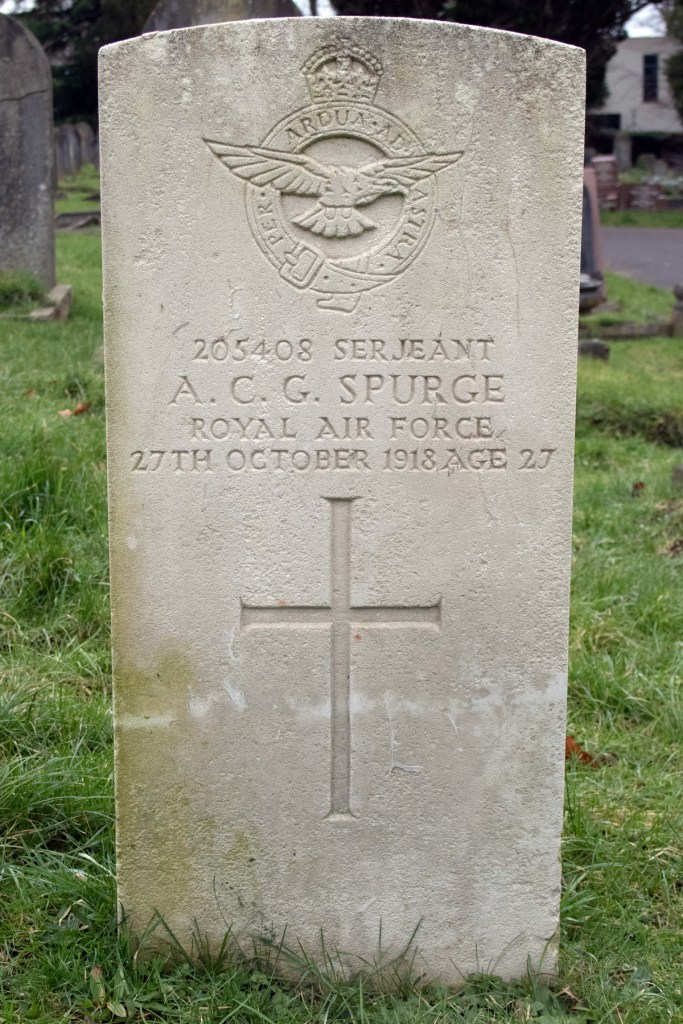
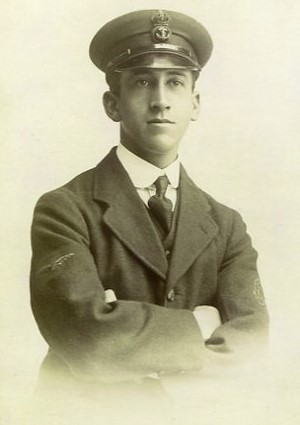
War was closing in on Europe by this point and, when it was declared, Algernon stepped up to play his part. He enlisted in the Royal Naval Air Service on 4th June 1915 as a Leading Mechanic (Photography). His service records show that he was 5ft 5ins (1.66m) tall, with dark brown hair, brown eyes and a dark complexion.
Algernon was initially assigned to the shore establishment HMS President in London for three years, rising to the rank of Petty Officer Mechanic (Photography). In April 1918, when the Royal Air Force was created he transferred across to HMS Daedalus in Lee-on-Solent, Hampshire, and rising to the rank of Sergeant Mechanic.
That autumn, with the end of the war in sight, Algernon fell ill. He contracted influenza, and this developed into pneumonia. He was admitted to the Military Hospital in York, but the conditions were to prove too much for his body to take. He died on 27th October 1918, aged just 27 years old.
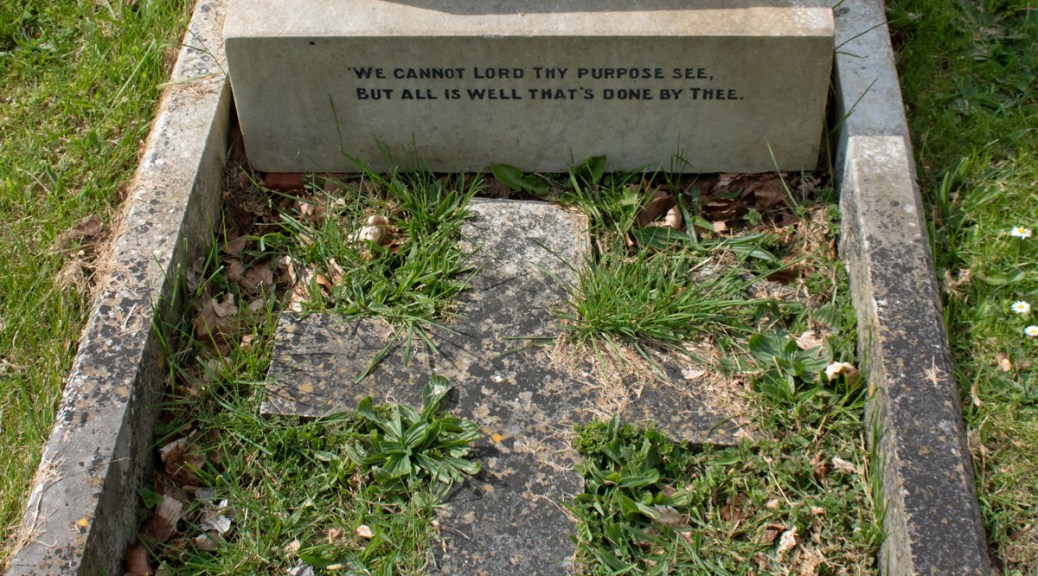
The body of Algernon Carlyle Graham Spurge was brought back to Somerset for burial. He was laid to rest in St James Cemetery, Bath, not far from his father. When Ida passed away in 1926, she was buried in the same cemetery, father, mother and son reunited once more
Charles Thomas Claude Jefferys was born on 23rd August 1880 in the small Carmarthenshire town of Laugharne. One of five children, his parents were naturalist Charles Jefferys and his wife Adeline.
Charles’ Jr’s life was to be one of education, and his father’s standing allowed for the best. He studied at Ellesmere College, Shropshire, then attended Durham University and Durham Theological College. By the 1901 census he was passing that education on to others: he was listed as a schoolmaster at Stow Wood College in Hampshire.
By 1908 Charles had returned to Wales, and was living in Monmouth. On 2nd January he married Eva Pride, an estate agent’s daughter from Tetbury, Gloucestershire. The marriage certificate confirms that, by this point, Charles was a clerk in holy orders, on his way to his true calling.
The 1911 census showed what a transient life the church could lead to: Charles and Eva were listed as living in a house in Oswaldkirk, North Yorshire. Their two young children, George and Charles, born in 1909 and 1910 respectively, were living with Eva’s sister, back in Tetbury.
When war came to Europe, Reverend Jefferys must have felt compelled to play his part. He joined the Army Chaplains’ Department, and by May 1916, he found himself in France. His role – providing pastoral care to the troops – would have led him to some of the darkest places of the Front Line. He remained there for the next couple of years, only returning to the family home – now in Chelsea, London – towards the end of the conflict.
Reverend Jefferys had contracted pneumonia, and he had returned from the continent to recuperate. Sadly, the condition was to prove too much, and he succumbed to it on 20th November 1918, at the age of 38.
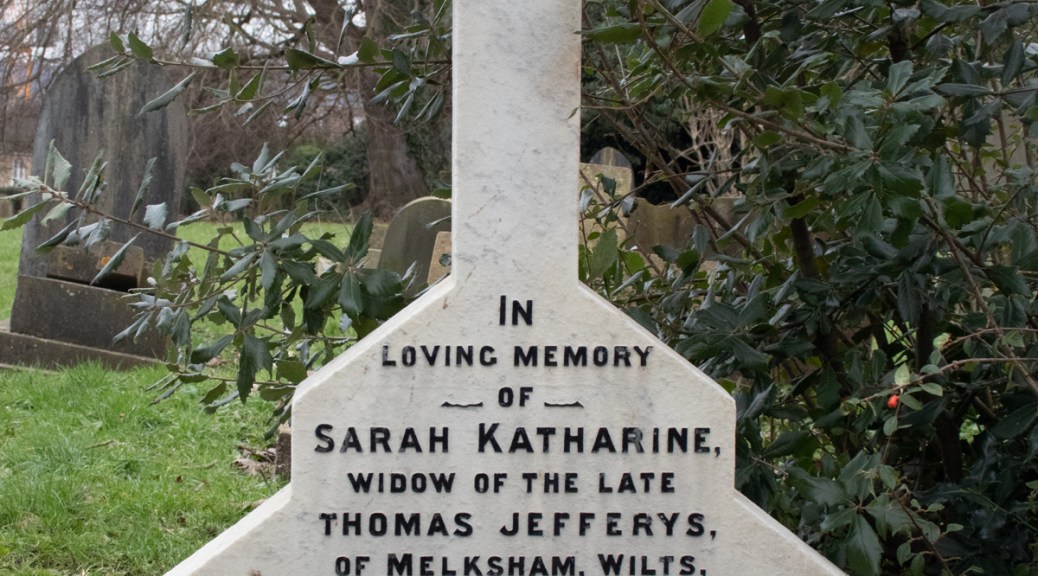
Charles Thomas Claude Jefferys was taken to Somerset for burial – there were close family connections in the Bath area. He was laid to rest in the family plot, alongside his paternal grandmother in the city’s St James’ Cemetery.
Further tragedy was to strike in June 1925 when Eva also passed away. Details of her death are unclear, but this left George and Charles as orphans in their early teens.
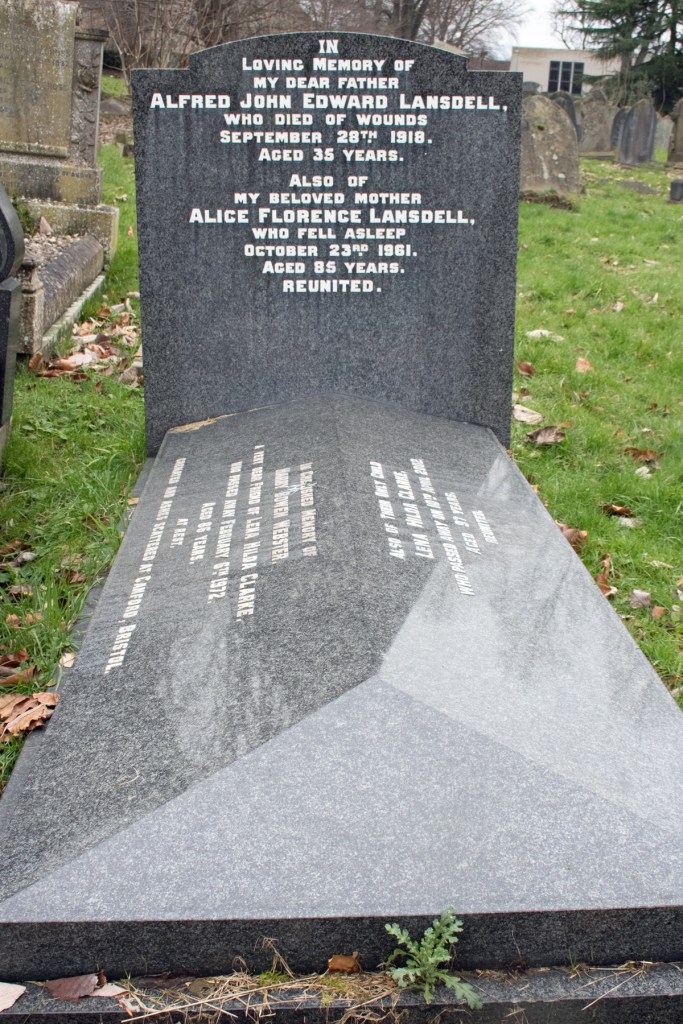
Alfred John Edward Lansdell was born on 25th October 1882 in Fulham, London. The fourth of six children, his parents were James and Matilda Lansdell.
James was a trunk maker, working in his father’s business. By the time of the 1901 census, he was recorded as living by his own means, while Alfred had taken up employment as a hotel porter in Chelsea.
By 1902, Alfred had moved to Somerset and set up home in Bath. He married local woman Alice Stevenson, and the couple went on to have a daughter, Lena, who was born in November 1904.
The 1911 census found the family living in central Bath, Alfred continuing his portering work, with one of his colleagues, lift operator Thomas Ward, boarding with them.
War came to Europe and on 9th December 1915, Alfred stepped up to play his part. He enlisted in the Worcestershire Regiment, and was formally mobilised the following June. Alfred’s service records confirm that he was, at the time of his review, he was 35 years old and 5ft 6ins (1.67m) tall.
Private Lansdell was assigned to the 1st/7th Battalion and by October 1916, he was shipped to France. He was very much on the Front Line, and was wounded on 19th August 1917, while at Ypres. His casualty record notes that “while waiting in a shell hole for a further move on he was wounded… in the back”. He has been shot, and the bullet penetrated his kidney.
Initially treated in a hospital in France, Private Lansdell was transferred to England on 25th October. He was admitted to the Norfolk War Hospital and remained there for some time.
Alfred’s injuries were too severe for him to continue in the army, and he was formally discharged on 20th March 1918. He eventually returned home to Bath, but in the end his poor health was to get the better of him. He passed away at home on 28th September 1918, at the age of 35.
Alfred John Edward Lansdell was laid to rest in St James’ Cemetery, Bath. Alice lived on until 1961, when she was buried with her late husband, a couple reunited after more than four decades.
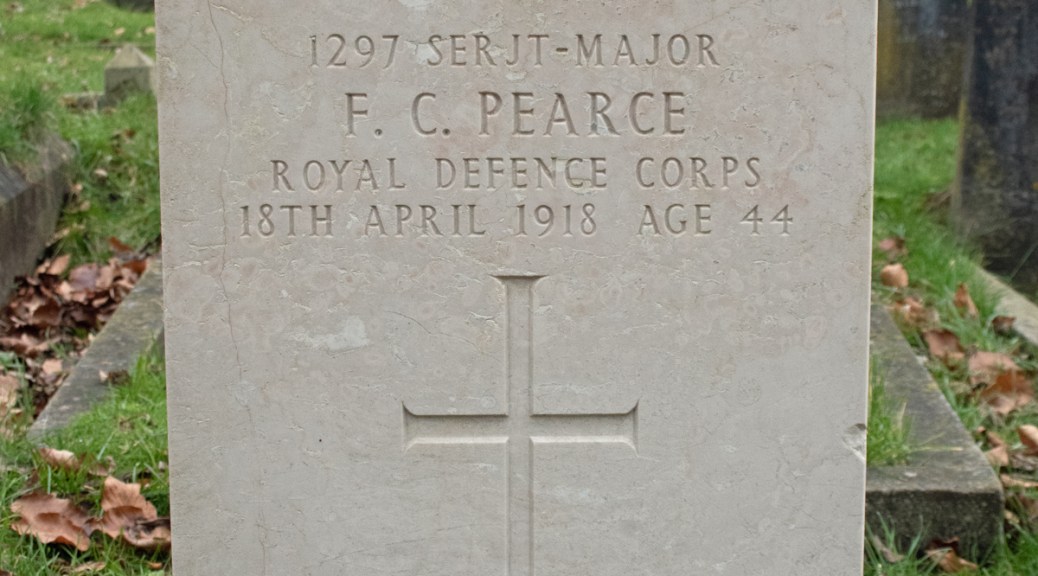
Frederick Charles Pearce was born in the spring of 1873 in the Gloucestershire town of Thornbury. The youngest of six children, his parents were Thomas and Elizabeth Pearce. Thomas was an agricultural labourer and, when he finished school, Frederick found work as a ‘rural messenger’.
This was only a step towards the career that Frederick sought, however, and on 12th July 1892, he enlisted in the Gloucestershire Regiment a a Private. His service records show that he was 5ft 5ins (1.65m) tall and weighed 128lbs (58kg). He was noted as having a fresh complexion, blue eyes and brown hair.
Private Pearce spent twelve years in the army, serving in Malta, Egypt, India and Ceylon (Sri Lanka). He had two stints in South Africa, including the 1899-1900 campaign, during which he was wounded in his chest in the battle at Farquhar’s Farm.
By the time he was discharged on 11th July 1904, he had risen through the ranks to Sergeant, his service records noting that his conduct had been “very good” (in capitals and underlined).
Thomas had died in 1896, and Frederick’s widowed brother William moved back in with his mother to help support her. Frederick also returned to Gloucestershire and, on 30th March 1905, he married Mary Rugman in the parish church in Olveston. The couple may have been childhood sweethearts, as the Pearces and Rugmans were Thornbury neighbours.
The marriage certificate noted Frederick as a groom, and it is likely that he was able to turn his hand to any role after his army career. The couple had a son Leslie, who was born in 1909, and, with the new responsibility of fatherhood, Frederick sought a more permanent career.
The 1911 census found the family living in Somerset, where Frederick was employed as a gardener at the Kingswood Reformatory School. This was a boarding school on an estate to the north of Bath, set in 57 acres of grounds, and again it seems likely that his military career stood him in good stead for such a prestigious role.
When war came to Europe, Frederick felt the pull of his military career once more. While his age did not compel it, on 20th November 1914, he re-enlisted in the Gloucester Regiment. He was enlisted with his previous rank, but within a year has been promoted to Acting Colour Sergeant.
In the spring of 1916, the Royal Defence Corps was formed, and, given his experience and age, Frederick was transferred across to the new regiment. Colour Sergeant Pearce was based in London and, over the next eighteen months served in four troops: 109, 149 and 150 Protection Companies and the 10th City of London Volunteers’ Regiment.
Frederick’s age and the demands of his role were beginning to take their toll by this point, and by the end of 1917, he had developed nephritis, or inflamed kidneys. The condition was severe enough to warrant his discharge from service, and the now Sergeant Major Pearce’s military career came to an end on 17th January 1918.
Frederick returned home to Bath, to the bosom of his family. He and Mary three children by this point, Violet and Freddie being two younger siblings to Leslie. Tragically for the Pearces, however, the family life was not to to last for long: Frederick’s condition was to get the better of him just three months later. He passed away on 18th April 1918, at the age of 44 years old.
Frederick Charles Pearce was laid to rest in St James’ Cemetery in Bath; a man of duty resting at last.
Tragedy was to strike again for poor Mary, when just six months later her youngest child, Freddie, also passed away. Details of his death are vague, but he was buried with his father, the two Fredericks reunited too soon.